
Low Vision Optics Will Smith OD Resident Lecture

- Slides: 74
Low Vision Optics Will Smith, OD Resident Lecture Series
Low Vision Optics Magnification ¢ Calculation of Magnification ¢ Telescopes ¢ Magnifiers ¢ Assistive Technology ¢
Magnification Overview ¢ Retinal Image Magnification ¢ Relative Distance Magnification ¢ Relative Size Magnification ¢ Lens Vertex Magnification ¢ Projection Magnification ¢
Magnification Helpful/often essential for patients with reduced visual acuity ¢ Comparison between 2 image sizes: The original object viewed and the magnified image. ¢ This comparison is known as Retinal Image Magnification (RIM) ¢
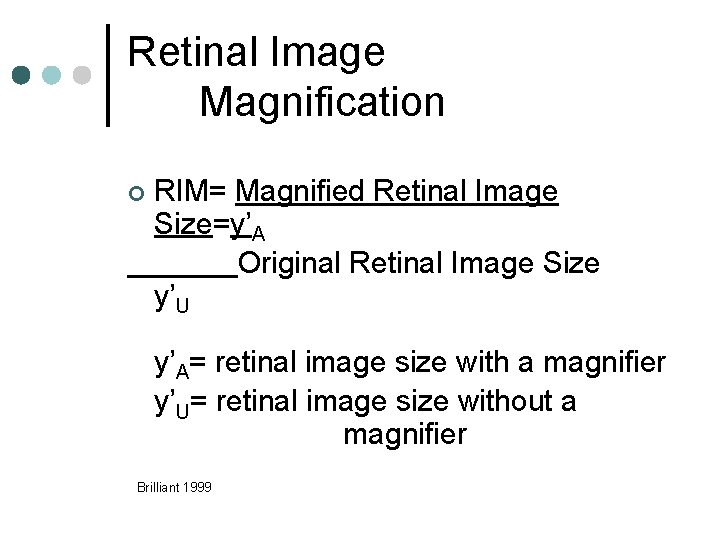
Retinal Image Magnification ¢ RIM= Magnified Retinal Image Size=y’A Original Retinal Image Size y’U y’A= retinal image size with a magnifier y’U= retinal image size without a magnifier Brilliant 1999
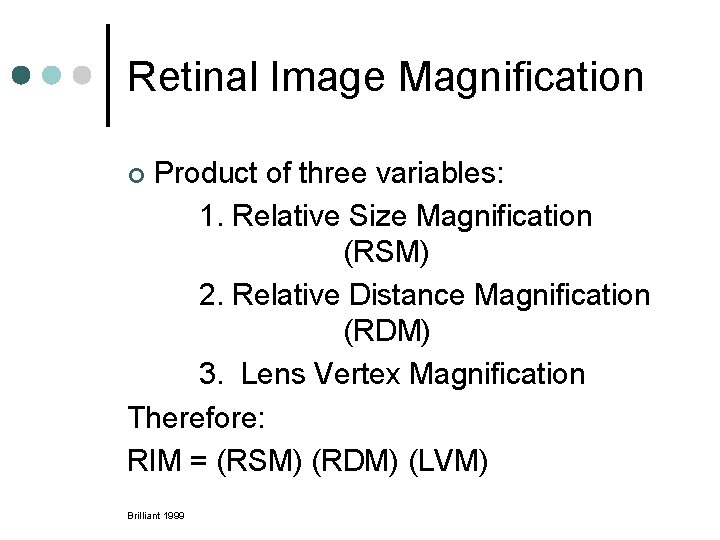
Retinal Image Magnification Product of three variables: 1. Relative Size Magnification (RSM) 2. Relative Distance Magnification (RDM) 3. Lens Vertex Magnification Therefore: RIM = (RSM) (RDM) (LVM) ¢ Brilliant 1999
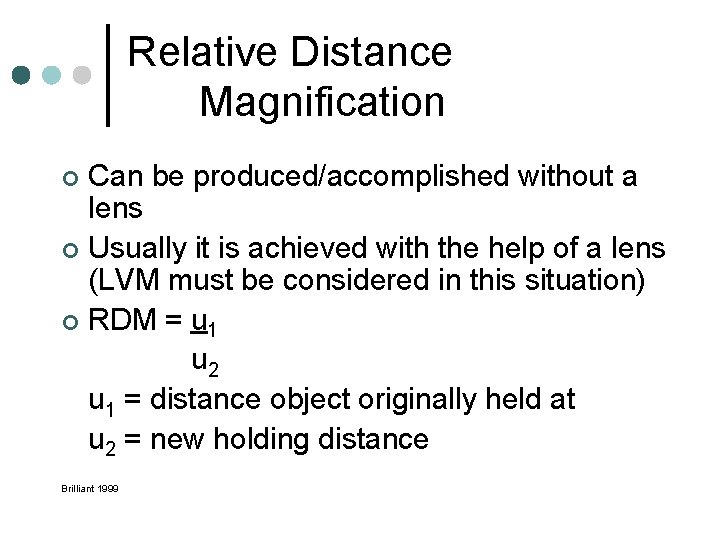
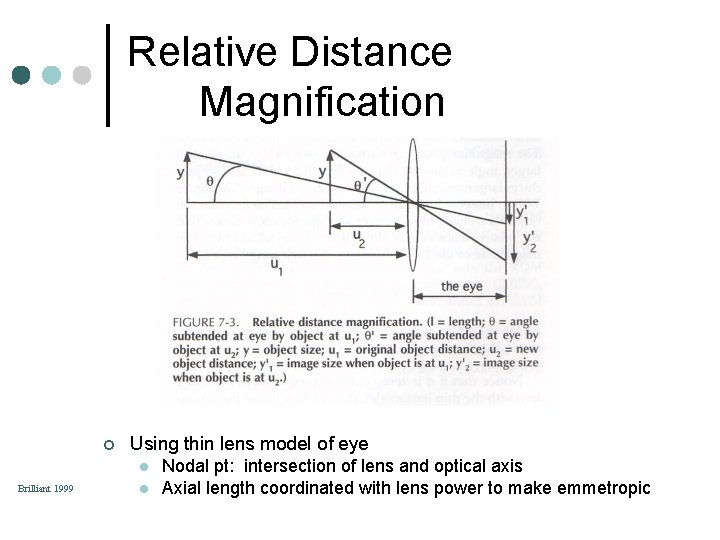
Relative Distance Magnification Can be produced/accomplished without a lens ¢ Usually it is achieved with the help of a lens (LVM must be considered in this situation) ¢ RDM = u 1 u 2 u 1 = distance object originally held at u 2 = new holding distance ¢ Brilliant 1999
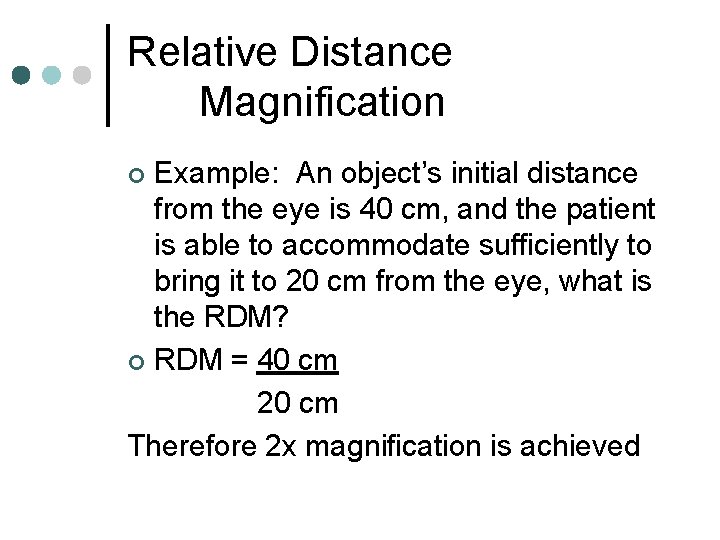
Relative Distance Magnification Example: An object’s initial distance from the eye is 40 cm, and the patient is able to accommodate sufficiently to bring it to 20 cm from the eye, what is the RDM? ¢ RDM = 40 cm 20 cm Therefore 2 x magnification is achieved ¢
Relative Distance Magnification ¢ Using thin lens model of eye l Brilliant 1999 l Nodal pt: intersection of lens and optical axis Axial length coordinated with lens power to make emmetropic
Relative Distance Magnification ¢ Bottom Line: The closer you bring and item toward your eyes, the bigger it becomes !
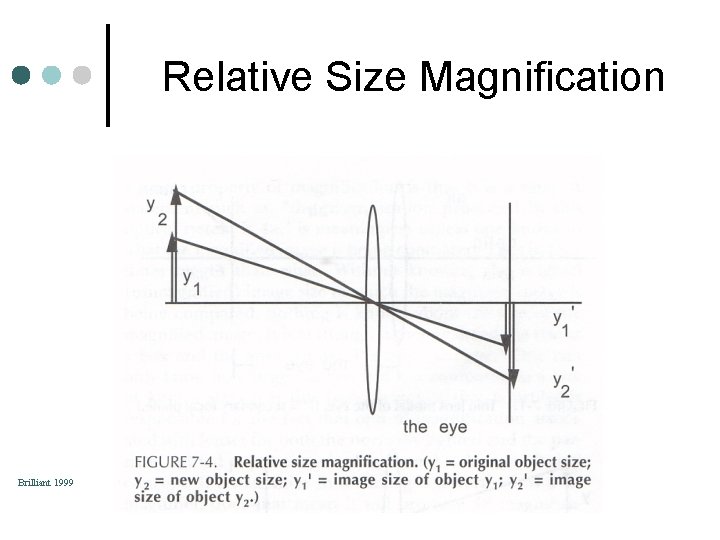
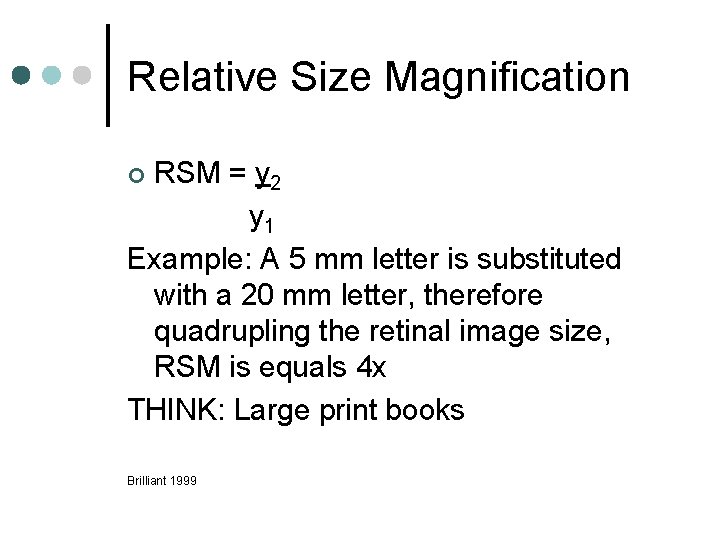
Relative Size Magnification Achieved by changing the size of the object while it’s distance remains constant. ¢ No lenses are involved ¢ Magnification in this case is the ratio of the magnified size of the object to the original ¢
Relative Size Magnification Brilliant 1999
Relative Size Magnification RSM = y 2 y 1 Example: A 5 mm letter is substituted with a 20 mm letter, therefore quadrupling the retinal image size, RSM is equals 4 x THINK: Large print books ¢ Brilliant 1999
Lens Vertex Magnification ¢ ¢ Lens vertex magnification alone is defined as magnification provided by a magnifying lens and the object is not moved Example: Px looks at a newspaper and is unable to see it. Reaches for a hand held magnifier. If the newspaper is stationary, and the magnifier must be held no further than one focal length from the object…LVM occurs
Lens Vertex Magnification ¢ The magnifier must be held no further than one focal length from the object because if it is held further than one focal length the retinal image will be blurred and inverted.
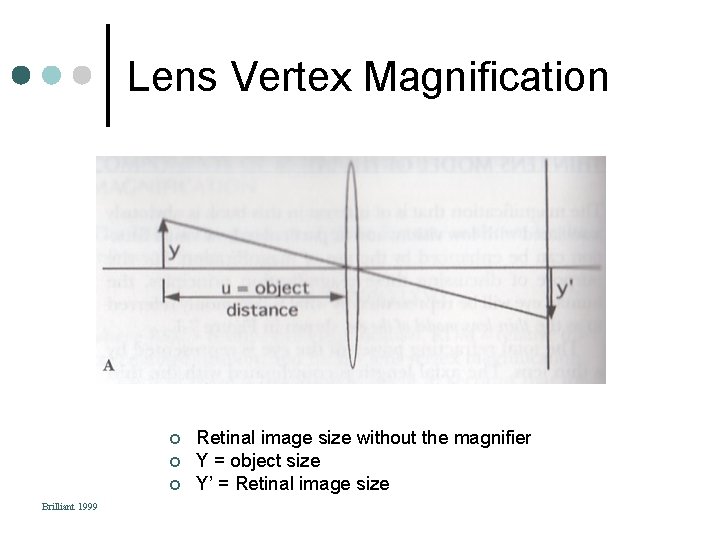
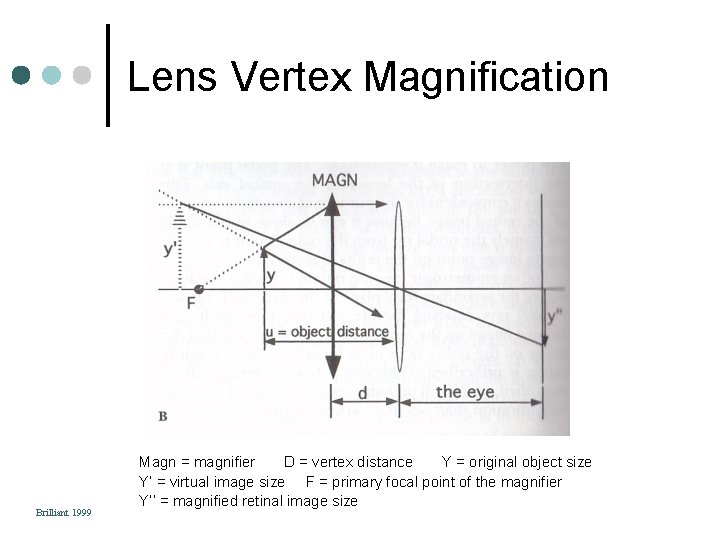
Lens Vertex Magnification ¢ ¢ ¢ Brilliant 1999 Retinal image size without the magnifier Y = object size Y’ = Retinal image size
Lens Vertex Magnification Brilliant 1999 Magn = magnifier D = vertex distance Y = original object size Y’ = virtual image size F = primary focal point of the magnifier Y’’ = magnified retinal image size
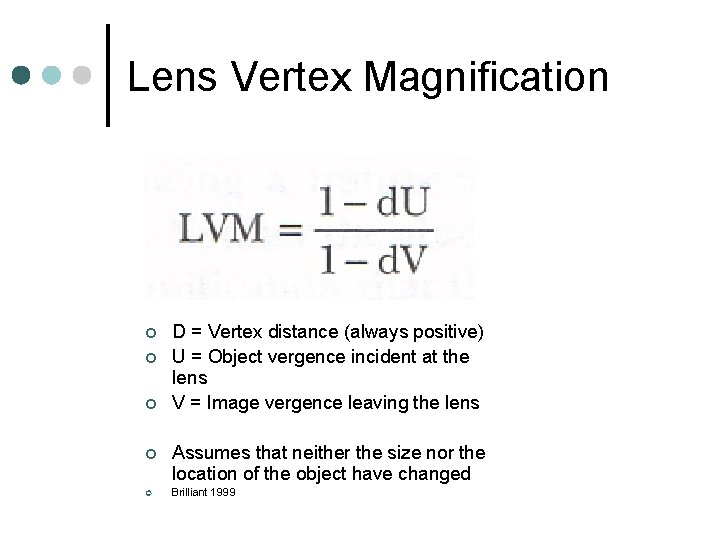
Lens Vertex Magnification ¢ ¢ ¢ D = Vertex distance (always positive) U = Object vergence incident at the lens V = Image vergence leaving the lens Assumes that neither the size nor the location of the object have changed Brilliant 1999
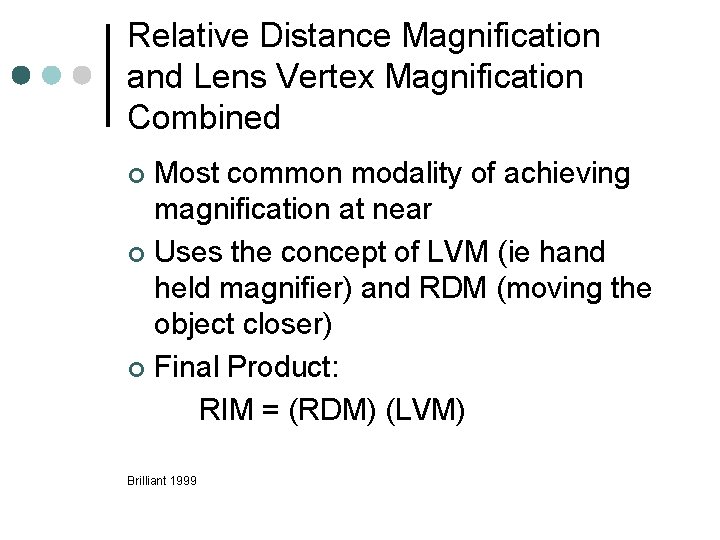
Relative Distance Magnification and Lens Vertex Magnification Combined Most common modality of achieving magnification at near ¢ Uses the concept of LVM (ie hand held magnifier) and RDM (moving the object closer) ¢ Final Product: RIM = (RDM) (LVM) ¢ Brilliant 1999
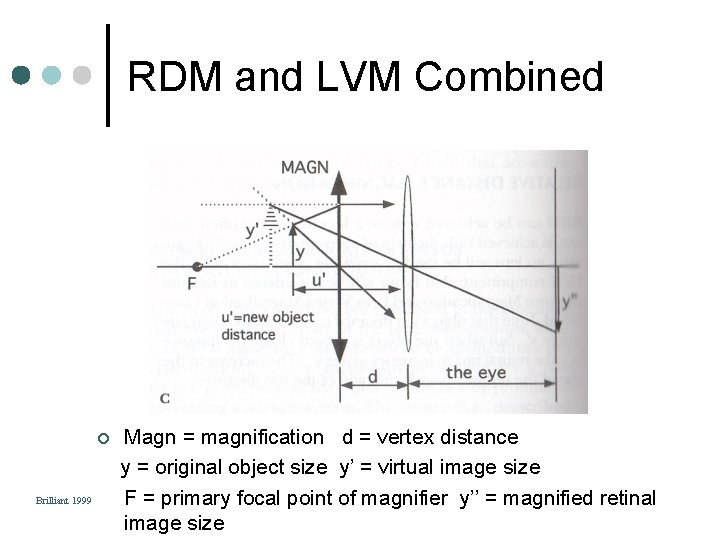
RDM and LVM Combined ¢ Brilliant 1999 Magn = magnification d = vertex distance y = original object size y’ = virtual image size F = primary focal point of magnifier y’’ = magnified retinal image size
Projection Magnification provided by an electronic system ¢ Examples: Closed circuit TV, Overhead projector, etc. ¢
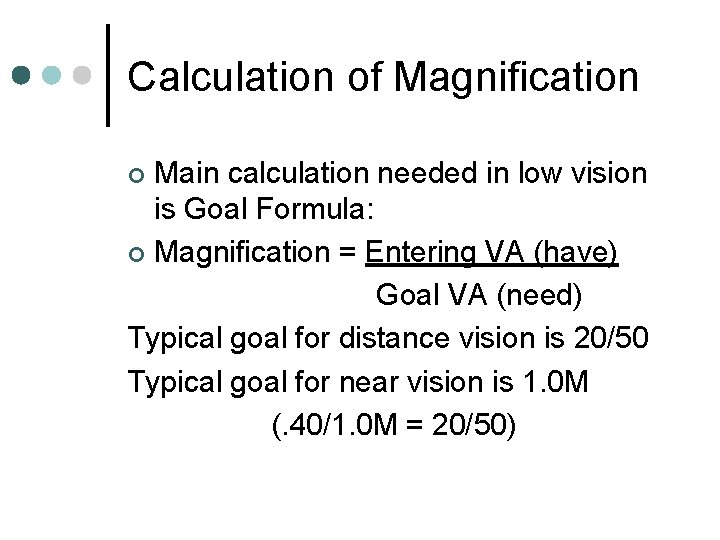
Calculation of Magnification Main calculation needed in low vision is Goal Formula: ¢ Magnification = Entering VA (have) Goal VA (need) Typical goal for distance vision is 20/50 Typical goal for near vision is 1. 0 M (. 40/1. 0 M = 20/50) ¢
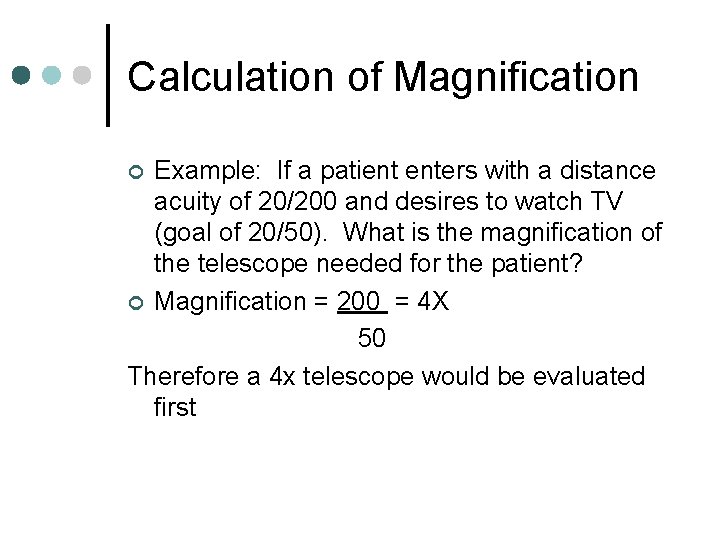
Calculation of Magnification Example: If a patient enters with a distance acuity of 20/200 and desires to watch TV (goal of 20/50). What is the magnification of the telescope needed for the patient? ¢ Magnification = 200 = 4 X 50 Therefore a 4 x telescope would be evaluated first ¢
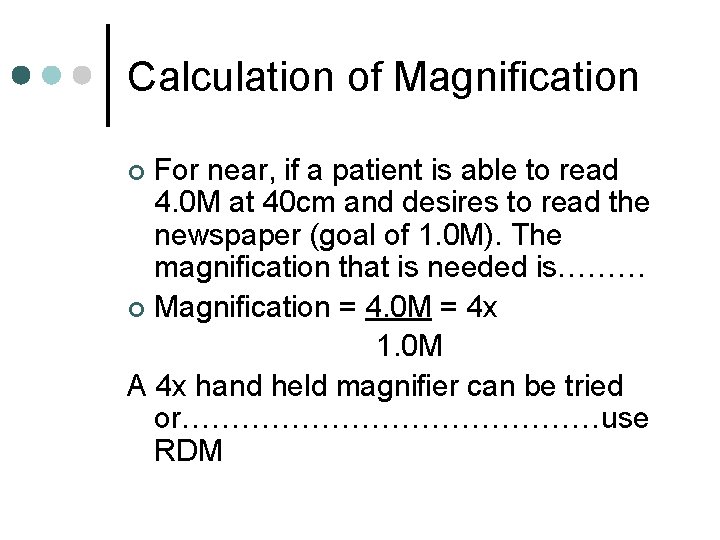
Calculation of Magnification For near, if a patient is able to read 4. 0 M at 40 cm and desires to read the newspaper (goal of 1. 0 M). The magnification that is needed is……… ¢ Magnification = 4. 0 M = 4 x 1. 0 M A 4 x hand held magnifier can be tried or…………………use RDM ¢
Calculation of Magnification ¢ ¢ We can bring the printed material 4 times closer than 40 cm. Therefore the patients new working distance is 10 cm. To calculate the dioptric power of the patients reading glasses (assuming that the patient is an absolute presbyope) at their new working distance…. . take the inverse of the working distance…. therefore the patient must wear a +10. 00 sphere to maintain a clear image.
Calculation of Magnification ¢ ¢ Remember…. . the magnification is provided by the closer working distance (RDM)…. . NOT the reading glasses…. . the reading glasses are just clearing the optical image for that specific working distance. Remember also to incorporate the patient’s distance refractive error into the reading glasses….
Calculation of Magnification ¢ Example: If the patient is a 5 diopter myope…. the reading Rx would be +5. 00 not +10. 00 (if using NVO) ¢ Note that once a patient is prescribed +4. 00 sphere or greater that base in prism must be added to the Rx if the patient is binocular.
Calculation of Magnification The reason for the base in prism is to alleviate the convergence demand on the patient. ¢ To calculate the amount of base in prism needed…. . take the dioptric power and add 2…therefore if the patient is given +4. 00 spheres…the amount of base in prism given would be 6 prism diopters in each eye. ¢
Calculation of Magnification Another key formula that is extremely useful in low vision is: ¢ Magnification = Diopters 4 The reason this becomes beneficial is that if a company offers a 12 diopter magnifier one can calculate the magnification provided by the device. The magnifier would provide…… 3 x magnification ¢
Calculation of Magnification ¢ Another use for this formula would be if you needed to calculate the diopters of a certain magnifier to reproduce the effect in a pair of spectacles…. . therefore if a patient is using a 5 x magnifier and desires a pair of reading spectacles…. . the power needed would be a +20. 00 diopters
Calculation of Magnification ¢ Remember that if this patient is going to use these +20. 00 reading glasses…. . their working distance is going to be calculated by taking the inverse of the dioptric power……. therefore the patient must hold their reading material at 5 cm.
Calculation of Magnification ¢ Kestenbaum’s Formula: l l Used to predict the lens power needed @ near for achieving a given reading level……. based on the patient’s distance acuity The reciprocal of the best corrected distance acuity would equal the dioptric value of the add needed to read normal/average sized text at near
Calculation of Magnification Example: A patient has a best corrected distance acuity of 20/100 should be able to read 1 M print (standard size reading material) with a add power of (100/20 = 5) +5. 00 sphere. l Test circumstances such as illumination, contrast, and target type must be kept precisely the same……………. . this is most of the time unable to be performed l
Telescopes Used to achieve magnification @ distance ¢ During a low vision examination…. we use two types of telescopes often ¢ Keplerian (astronomical) Galilean (terrestrial)
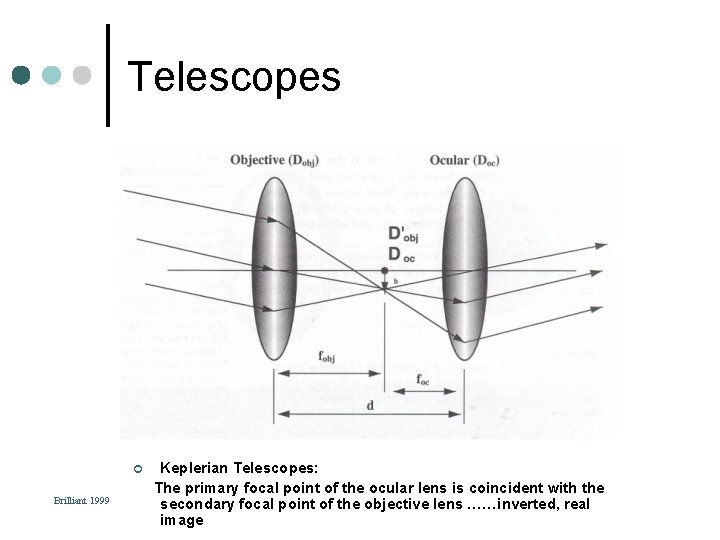
Telescopes ¢ ¢ ¢ Both telescopic designs are considered afocal because parallel light enters and exits the telescopes…produces angular magnification In the Galilean system, the rays do not cross, but they do in the Keplerian This means that the image is erect and virtual in the Galilean system and inverted and real in the Keplerian system. Brilliant 1999
Telescopes Keplerian telescopes, therefore, require a reinverting prism, which is placed between the ocular and the objective, so that the images do not appear upside down and backward through the telescope.
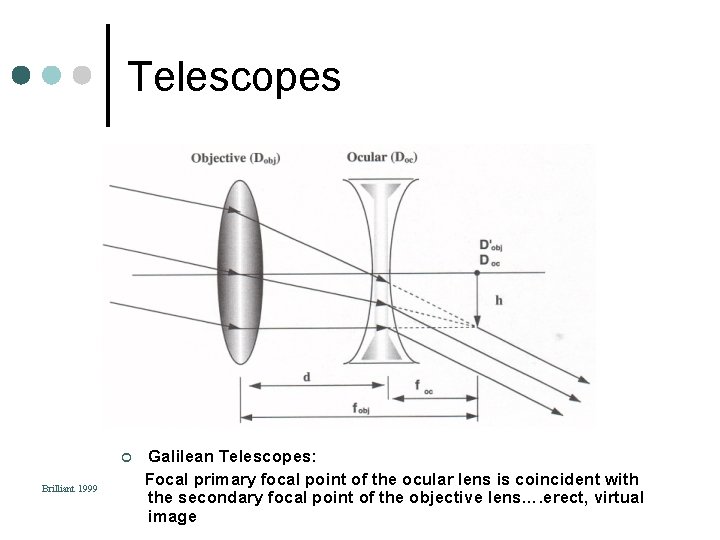
Telescopes ¢ Brilliant 1999 Galilean Telescopes: Focal primary focal point of the ocular lens is coincident with the secondary focal point of the objective lens…. erect, virtual image
Telescopes ¢ Brilliant 1999 Keplerian Telescopes: The primary focal point of the ocular lens is coincident with the secondary focal point of the objective lens ……inverted, real image
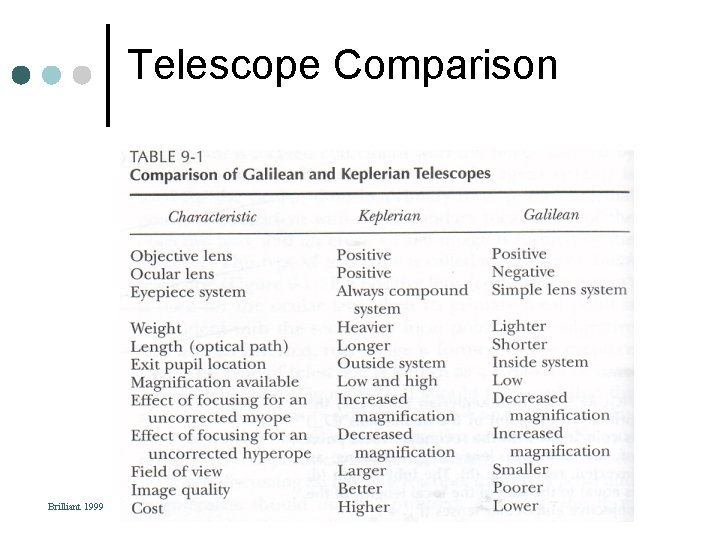
Telescopes ¢ ¢ The inverting prism in the Keplerian telescope increases the weight of the telescope compared to its Galilean counterpart The optical quality of the Keplerian telescope is far superior to that of the Galilean telescope…therefore in clinical practice we use Keplerian telescopes if the magnification needed is 4 x or greater
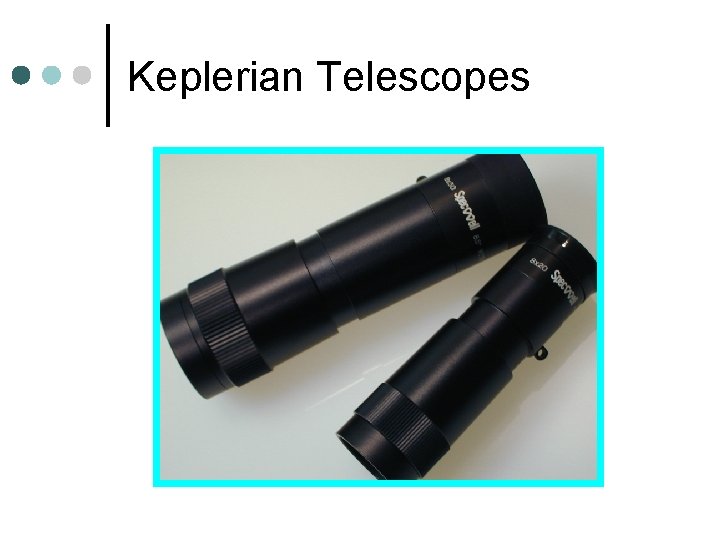
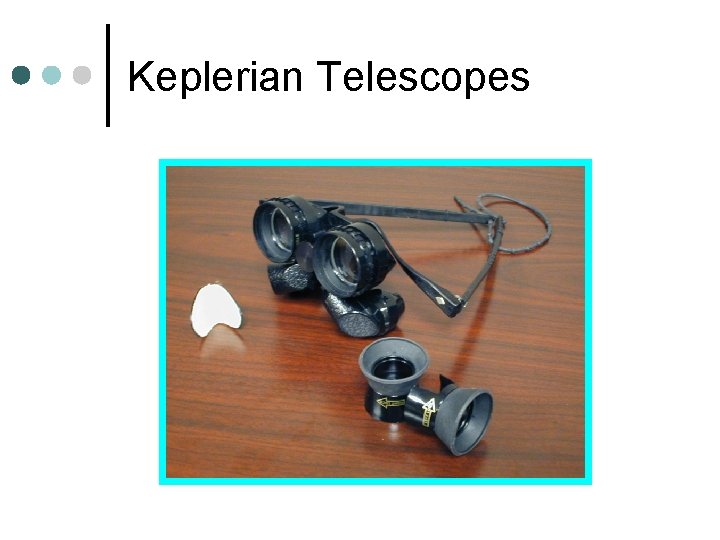
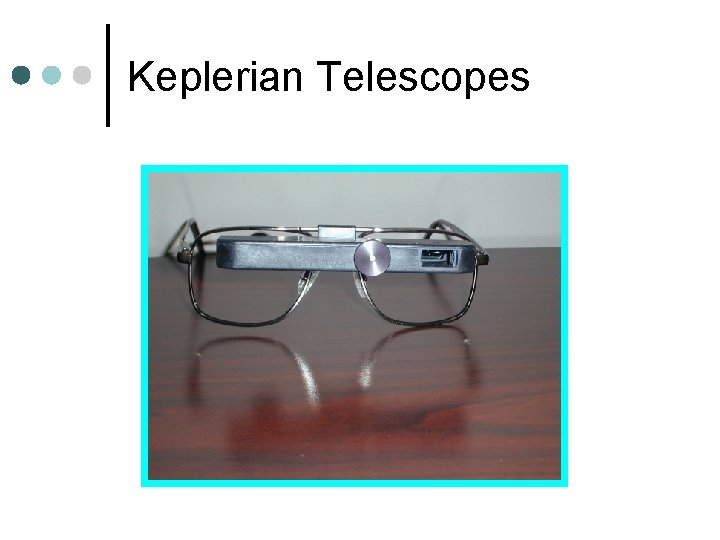
Keplerian Telescopes Consist of a (+) power ocular lens and a (+) power objective lens ¢ Larger field of view at a given level of magnification ¢ Tube length is longer ¢ More expensive ¢ Available up to 10 x ¢
Keplerian Telescopes
Keplerian Telescopes
Keplerian Telescopes
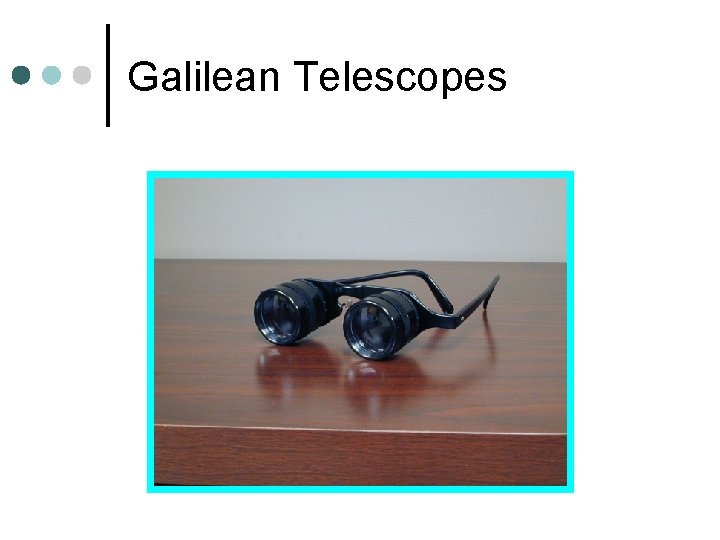
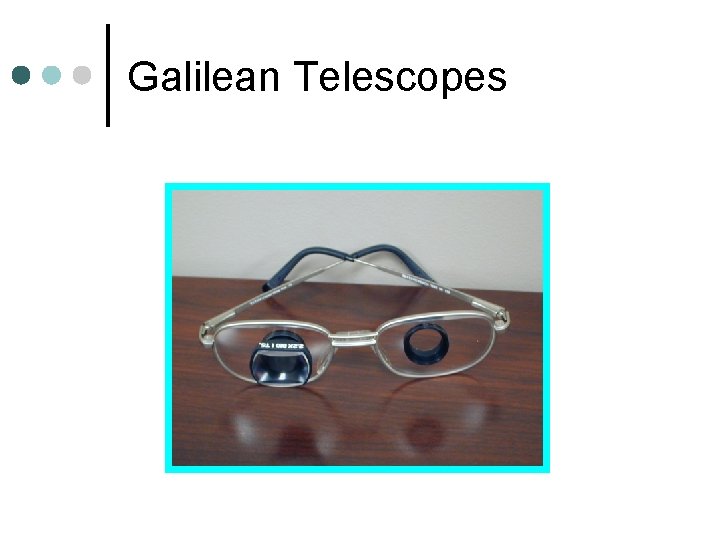
Galilean Telescopes Consist of a (-) ocular lens and a (+) objective lens ¢ Smaller field of view at a given level of magnification ¢ Smaller and lighter ¢ Less expensive ¢ Available up to 4 x ¢
Galilean Telescopes
Galilean Telescopes
Telescope Comparison Brilliant 1999
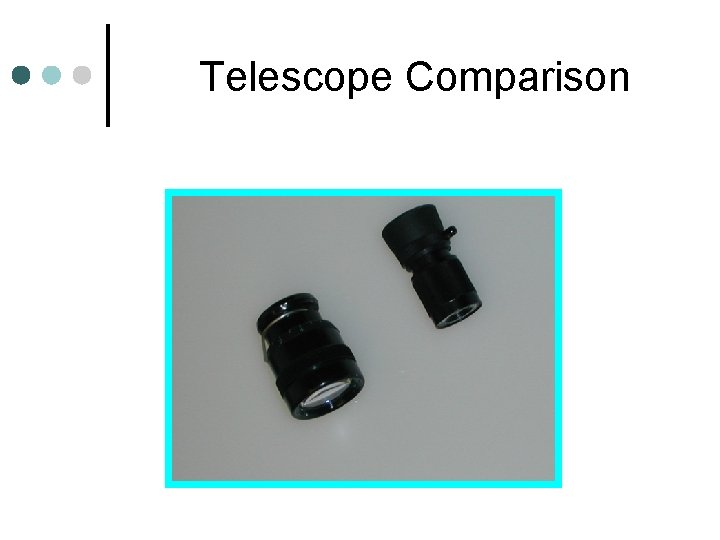
Telescope Comparison
Telescope Comparison ¢ ¢ When possible, it is best to correct a patient’s refractive error by incorporating the correction directly into the ocular lens or as a lens cap at the eyepiece of the telescope. When using this method, the total magnification of the system remains the same and no adjustment of the tube length of an afocal telescope has to be made to view an object at infinity Brilliant 1999
Telescope Comparison When altering the tube length for the correction of myopia, the tube length must be made shorter for both types of telescopes. ¢ Myopic patients (when altering the tube length) less magnification with Galilean and greater magnification with Keplerian telescope ¢
Telescope Comparison The opposite effect occurs with hyperopes. The tube length must be made longer for both telescopes. ¢ The hyperope obtains more magnification with a Galilean telescope and achieves less magnification when focusing a Keplerian telescope ¢
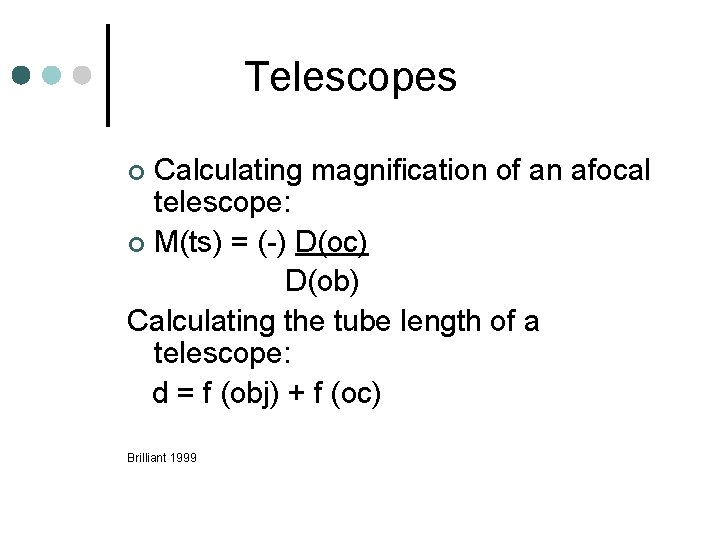
Telescopes Calculating magnification of an afocal telescope: ¢ M(ts) = (-) D(oc) D(ob) Calculating the tube length of a telescope: d = f (obj) + f (oc) ¢ Brilliant 1999
Telescopes In reviewing the calculation of magnification for telescopes, one can see that the magnification for Galilean telescopes is positive…. producing an erect image. ¢ The magnification for Keplerian telescopes, by the same formula, is negative therefore producing an inverted image ¢
Telescopes Field of View……. . limited by the size (diameter) of the objective lens, the magnification of the system, and the separation of the objective and eyepiece, and the exit pupil size. ¢ Exit pupil size is critical……. . often the larger the exit pupil, the larger the field of view ¢
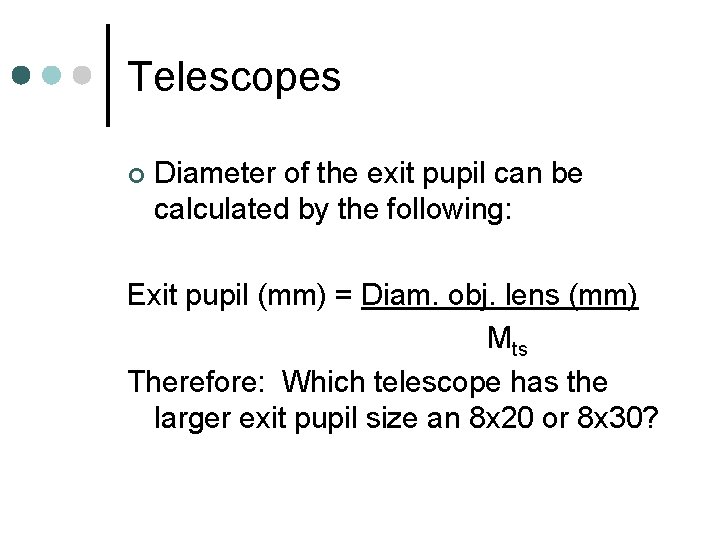
Telescopes ¢ Diameter of the exit pupil can be calculated by the following: Exit pupil (mm) = Diam. obj. lens (mm) Mts Therefore: Which telescope has the larger exit pupil size an 8 x 20 or 8 x 30?
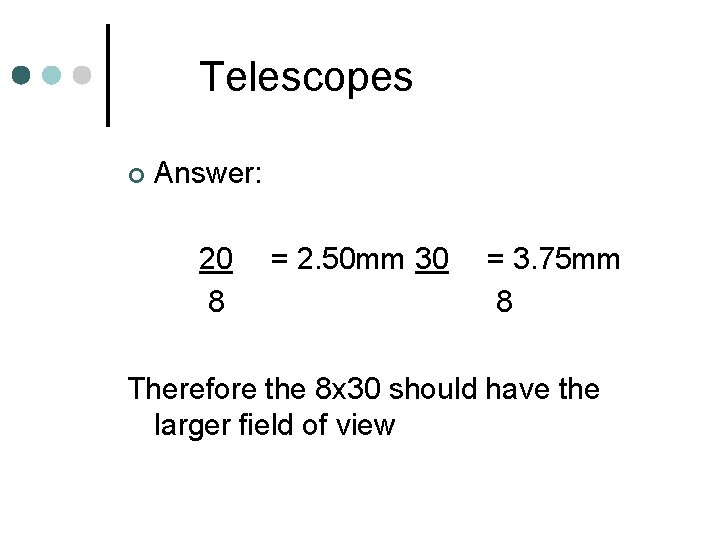
Telescopes ¢ Answer: 20 8 = 2. 50 mm 30 = 3. 75 mm 8 Therefore the 8 x 30 should have the larger field of view
Magnifiers ¢ Types of magnifiers commonly used in a low vision practice: Hand Held (illuminated vs non) Stand (illuminated vs non)
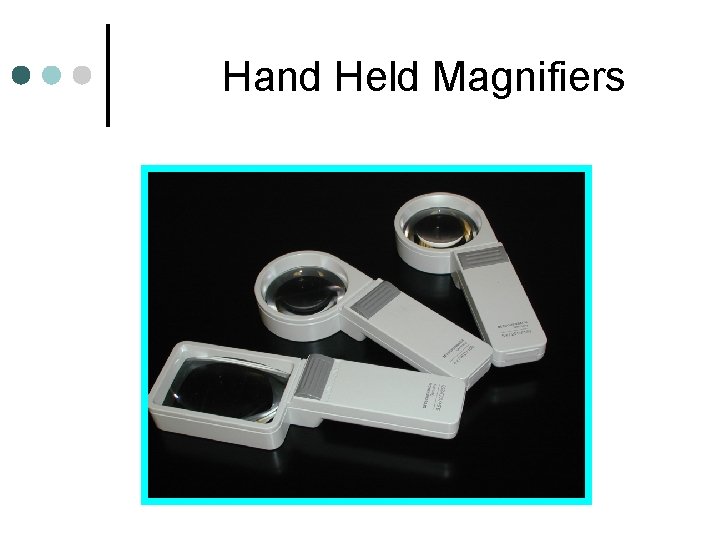
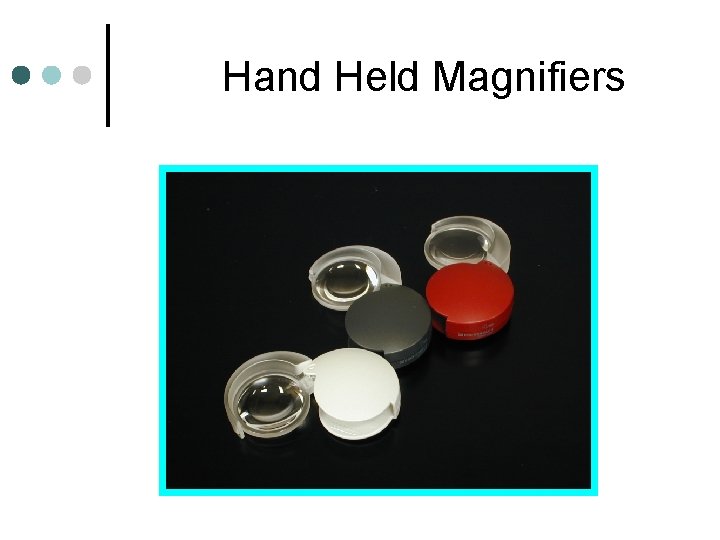
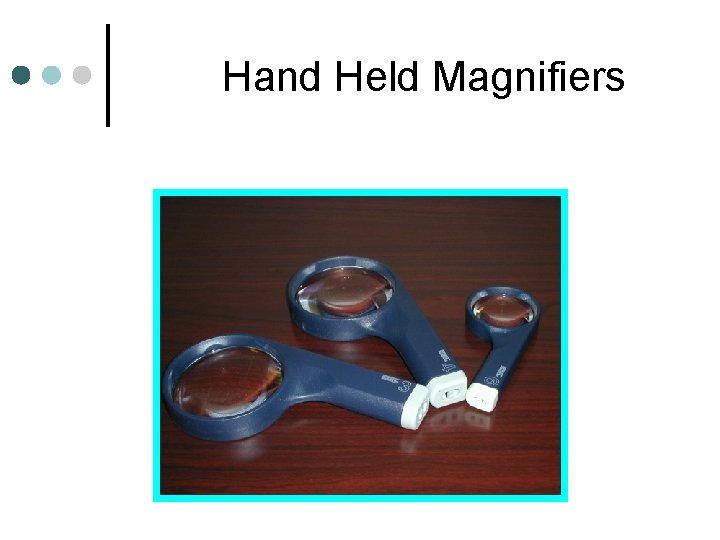
Hand Held Magnifiers ¢ ¢ ¢ Convex Lens that is utilized by means of a handle at a various distance from the eye/glasses. The near object should ideally be placed at the focal plane of the magnifying glass (inverse of the dioptric power) Thus: the convex lens will neutralize the divergent rays from the near object and allow parallel rays to exit the magnifier and enter the eye Brilliant 1999
Hand Held Magnifiers ¢ In this situation the vergence is zero…the patient does not need to accommodate or have a near correction in place…their refractive error must be fully corrected though.
Hand Held Magnifiers ¢ ¢ If the near material is held within the magnifiers focal length, divergent rays will exit the lens…. . therefore the patient must provide accommodation or have a near Rx (will correct for myopia) Conversely, if the magnifier is being held too far from the page, farther than one focal length, convergent rays will exit the magnifier…. . the image will appear upside down and inverted (will correct for hyperopia)
Hand Held Magnifiers
Hand Held Magnifiers
Hand Held Magnifiers
Magnifiers ¢ Types of magnifiers commonly used in a low vision practice: Hand Held (illuminated vs non) Stand (illuminated vs non)
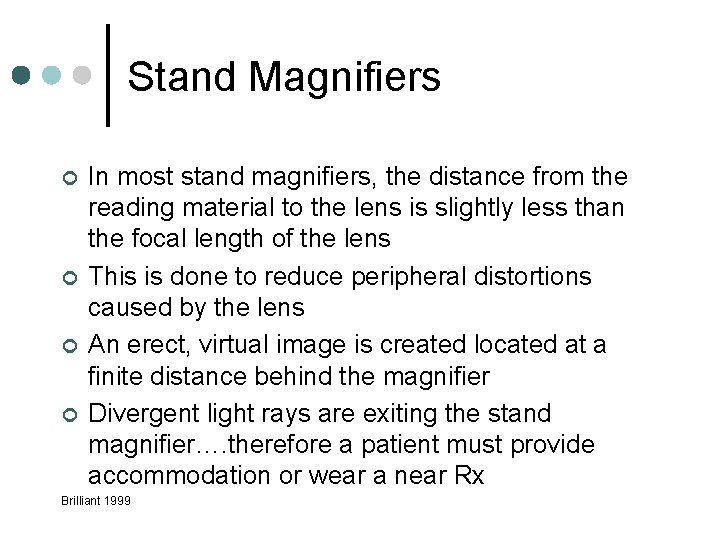
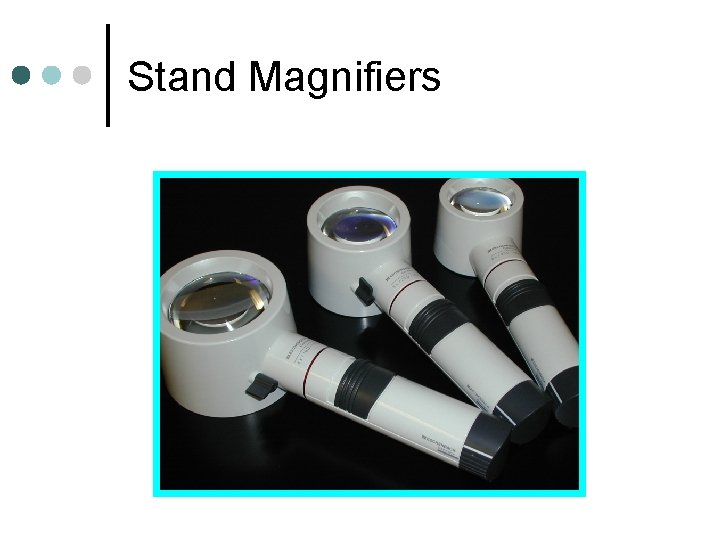
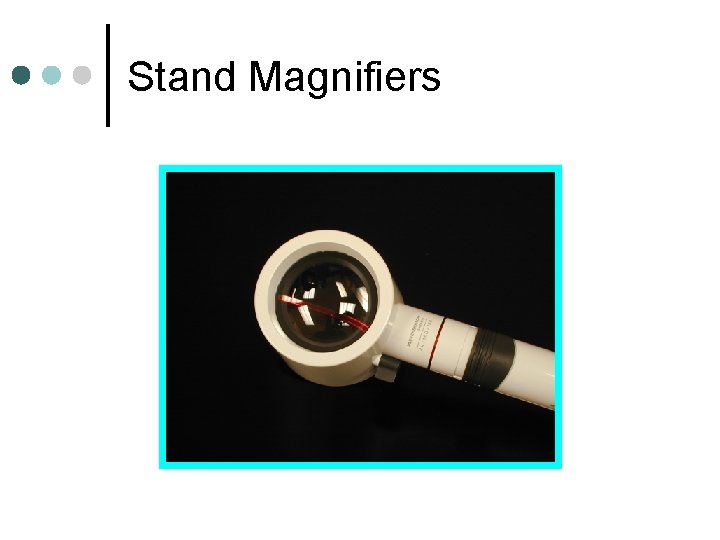
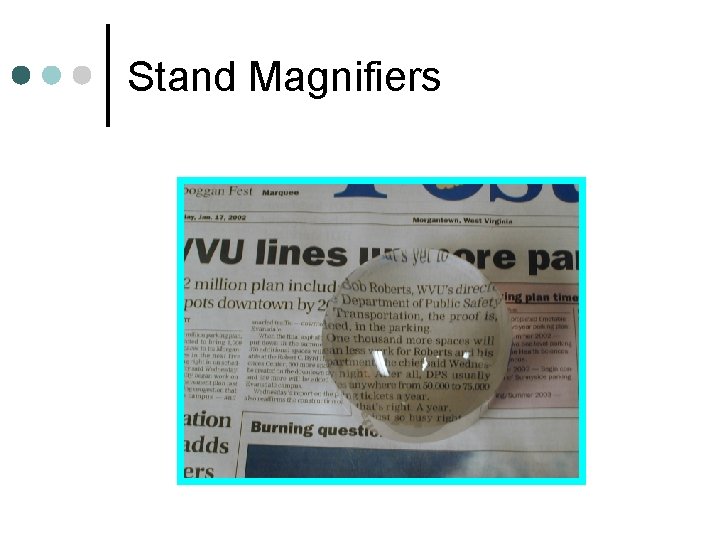
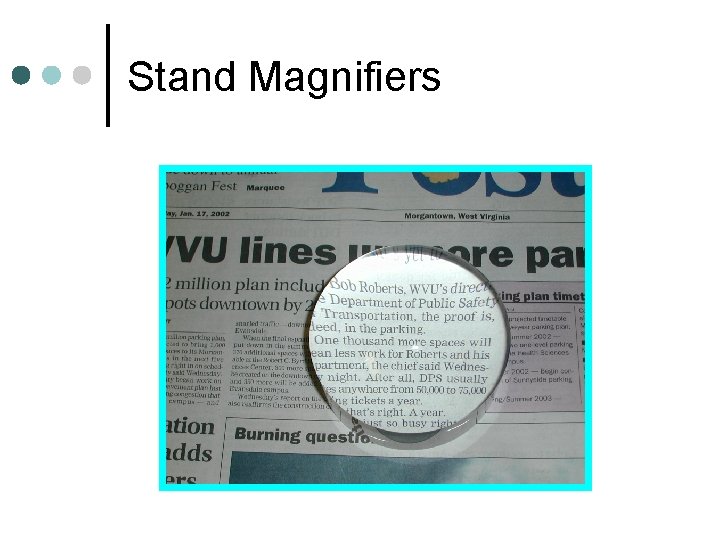
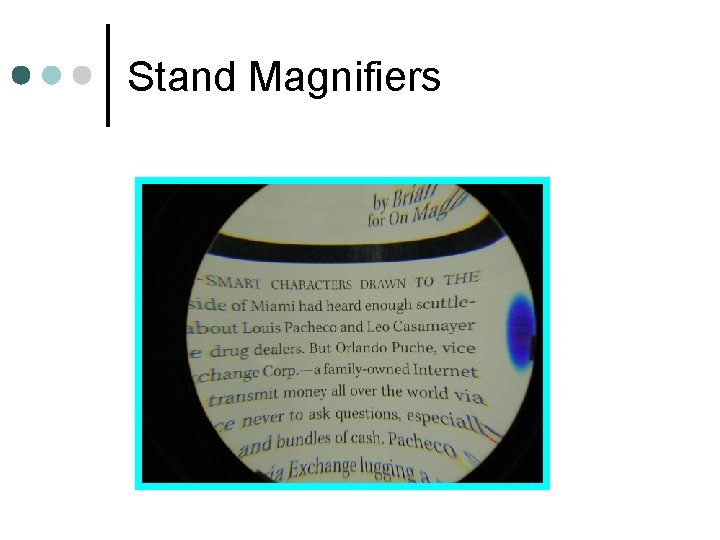
Stand Magnifiers Convex lens mounted at a fixed distance from the desired reading material ¢ Can have variable focus or fixed focus ¢ Brilliant 1999
Stand Magnifiers ¢ ¢ In most stand magnifiers, the distance from the reading material to the lens is slightly less than the focal length of the lens This is done to reduce peripheral distortions caused by the lens An erect, virtual image is created located at a finite distance behind the magnifier Divergent light rays are exiting the stand magnifier…. therefore a patient must provide accommodation or wear a near Rx Brilliant 1999
Stand Magnifiers
Stand Magnifiers
Stand Magnifiers
Stand Magnifiers
Stand Magnifiers
Assistive Technology Closed-Circuit Televisions (CCTV’s) are the most common device used in the area ¢ A CCTV system incorporates both projection magnification and relative distance magnification ¢ Offers a wide variety of magnification, contrast, and distance ¢
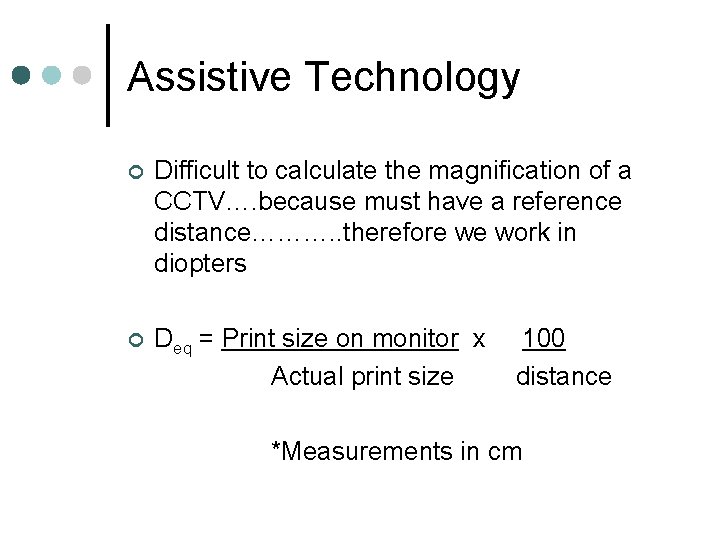
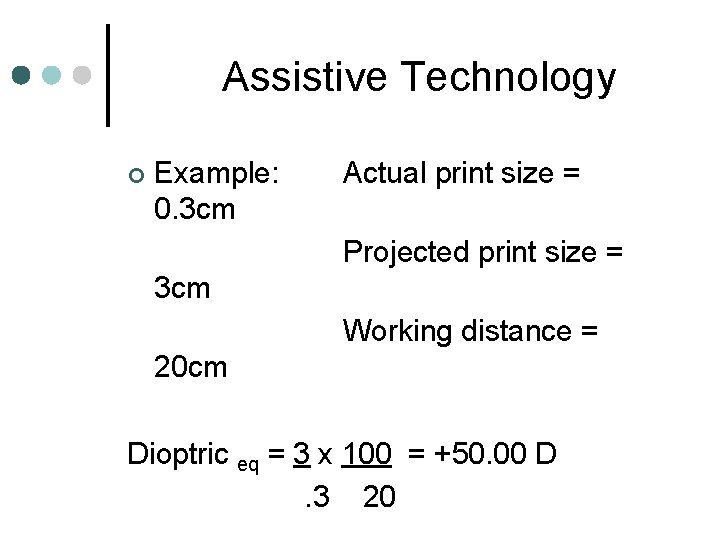
Assistive Technology ¢ Difficult to calculate the magnification of a CCTV…. because must have a reference distance………. . therefore we work in diopters ¢ Deq = Print size on monitor x Actual print size 100 distance *Measurements in cm
Assistive Technology ¢ Example: 0. 3 cm Actual print size = Projected print size = 3 cm Working distance = 20 cm Dioptric eq = 3 x 100 = +50. 00 D. 3 20