
Low Temperature Heat Pulse Thermal Relaxation Calorimeter Principle
- Slides: 1
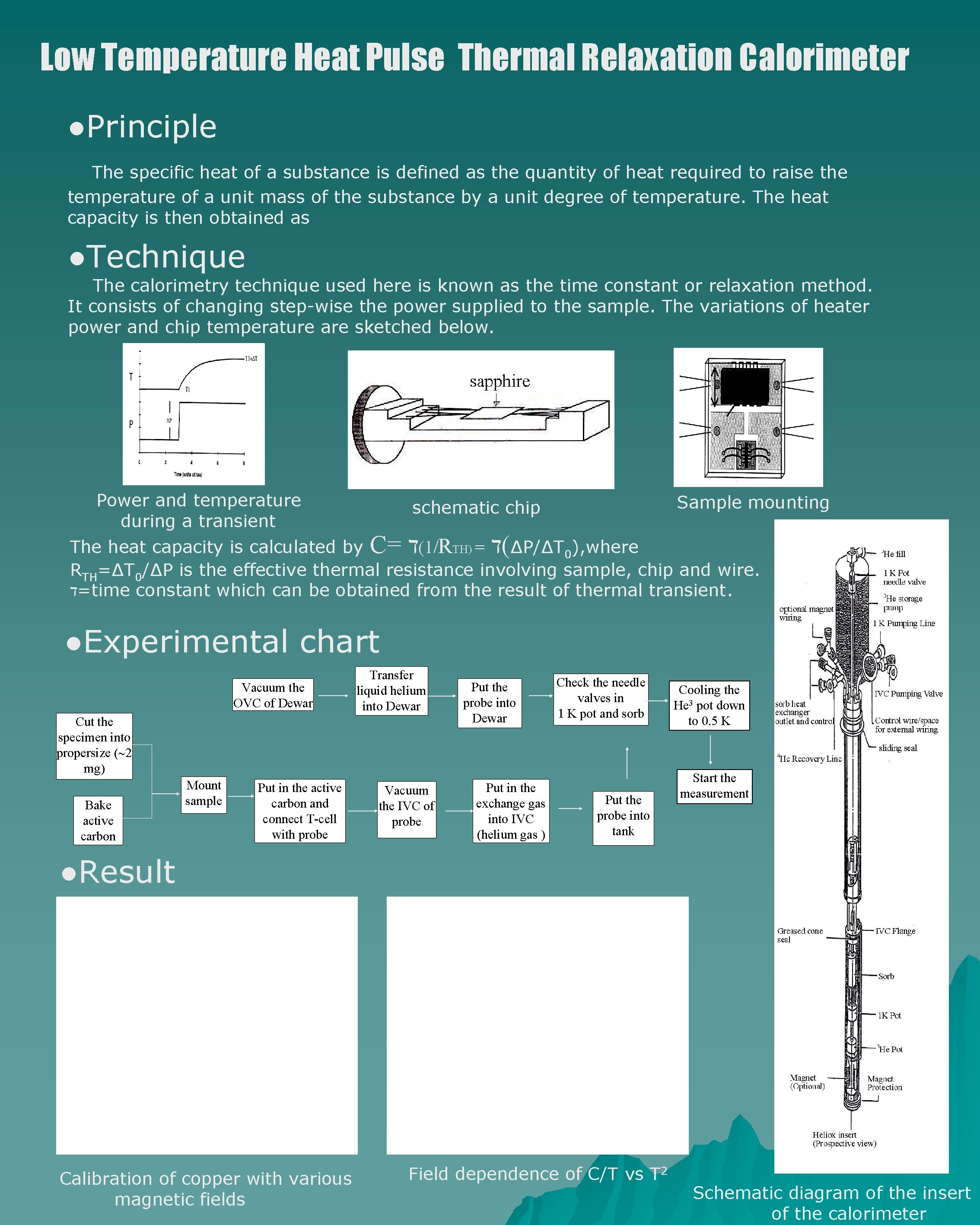
Low Temperature Heat Pulse Thermal Relaxation Calorimeter ●Principle The specific heat of a substance is defined as the quantity of heat required to raise the temperature of a unit mass of the substance by a unit degree of temperature. The heat capacity is then obtained as ●Technique The calorimetry technique used here is known as the time constant or relaxation method. It consists of changing step-wise the power supplied to the sample. The variations of heater power and chip temperature are sketched below. Power and temperature during a transient Sample mounting schematic chip The heat capacity is calculated by C= (ד 1/RTH) = ∆(ד P/∆T 0), where RTH=∆T 0/∆P is the effective thermal resistance involving sample, chip and wire. =ד time constant which can be obtained from the result of thermal transient. ●Experimental chart Vacuum the OVC of Dewar Transfer liquid helium into Dewar Cut the specimen into propersize ( 2 mg) Bake active carbon Mount sample Put in the active carbon and connect T-cell with probe Vacuum the IVC of probe Put the probe into Dewar Put in the exchange gas into IVC (helium gas ) Check the needle valves in 1 K pot and sorb Put the probe into tank Cooling the He 3 pot down to 0. 5 K Start the measurement ●Result Calibration of copper with various magnetic fields Field dependence of C/T vs T 2 Schematic diagram of the insert of the calorimeter