
Low Temperature Cure of PBO Films on Wafers
Low Temperature Cure of PBO Films on Wafers Custom Polymer Design Bob Hubbard, Keith Hicks Lambda Technologies, Inc. Masayuki Ohe, Tomoko Kawamura HD Micro. Systems Hubbard 2006
Designing a Low-Temp Polymer q Increasing interest in low temperatures § § Moving to lower temperature sensitive devices (<200 C) Need lower thermal budget for wafers & packages Need the same film properties (high Tg, elongation, etc. ) Low stress and tailored mechanical properties q Recent progress § 150 -200ºC polyimides (10 th Symposium on Polymers) § Lowered stress epoxies and silicones 2005 q Polybenzoxazoles (PBO) wafer films § Water processed § Mechanical properties similar to polyimides Hubbard 2006
Limits to Convection Curing q Lower temperature curing compromises film properties PI-2525 q Polyimide convection limit appears to be around 250ºC q PBO convection limit appears to be 250 -330ºC q Variable Frequency Microwave curing even lower Hubbard 2006
Characteristics of VFM q Multiple frequencies excite a large number of modes resulting in a uniform energy distribution q Rapid frequency sweeping eliminates conditions that can cause arcing on metal components q Agile control and feedback for fast response q Benign process to semiconductors q 90 nm SRAM, DRAM, microprocessors, analog q No change to device parameters or dopants Hubbard 2006

Variable Frequency Microwaves q Multiple scanned frequencies § 4096 frequencies, each 260 Hz wide, for only 25 s each C-band: 5. 85 -7. 0 GHz X-band: 7. 9 -8. 7 GHz q Dielectric relaxation causes dipole rotation § Dipoles in uncured polymers cause whole chains to rotate § Rotation of dipoles causes very efficient heating in bulk Hubbard 2006
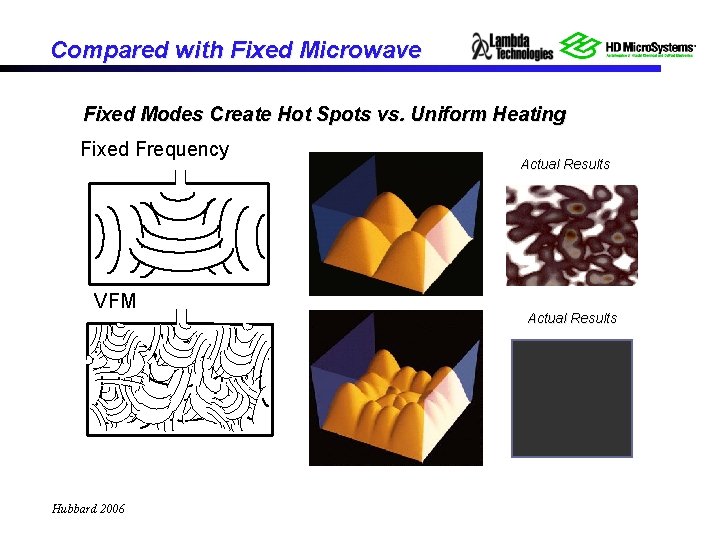
Compared with Fixed Microwave Fixed Modes Create Hot Spots vs. Uniform Heating Fixed Frequency VFM Hubbard 2006 Actual Results
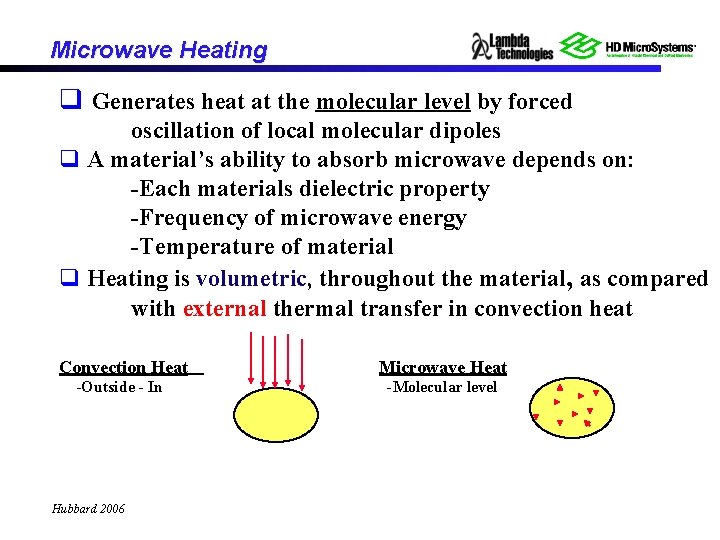
Microwave Heating q Generates heat at the molecular level by forced oscillation of local molecular dipoles q A material’s ability to absorb microwave depends on: -Each materials dielectric property -Frequency of microwave energy -Temperature of material q Heating is volumetric, throughout the material, as compared with external thermal transfer in convection heat Convection Heat -Outside - In Hubbard 2006 Microwave Heat -Molecular level
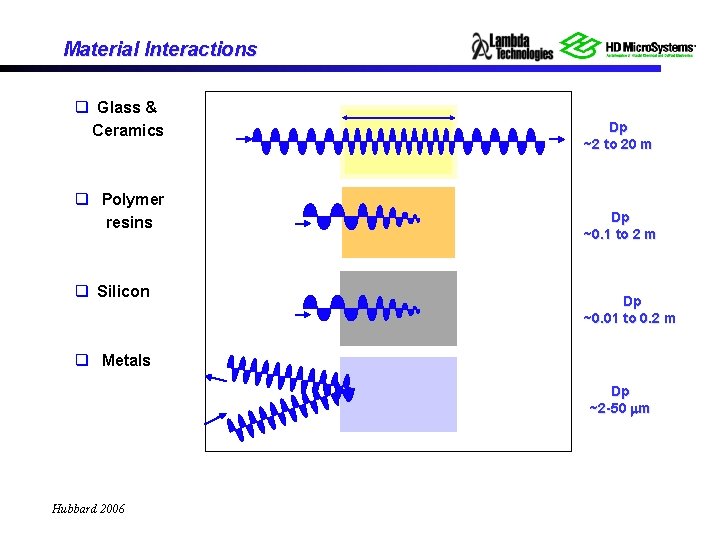
Material Interactions q Glass & Ceramics q Polymer resins q Silicon Dp ~2 to 20 m Dp ~0. 1 to 2 m Dp ~0. 01 to 0. 2 m q Metals Dp ~2 -50 m Hubbard 2006

Dipoles in Polymer Resins PI Epoxies Hubbard 2006 PBO BCB
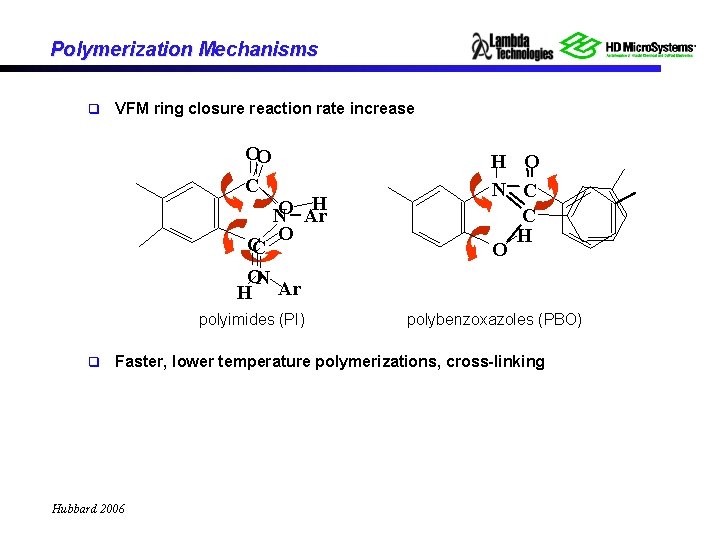
Polymerization Mechanisms q VFM ring closure reaction rate increase OO C H NO Ar O CC ON H Ar polyimides (PI) q H O N C C H O polybenzoxazoles (PBO) Faster, lower temperature polymerizations, cross-linking Hubbard 2006
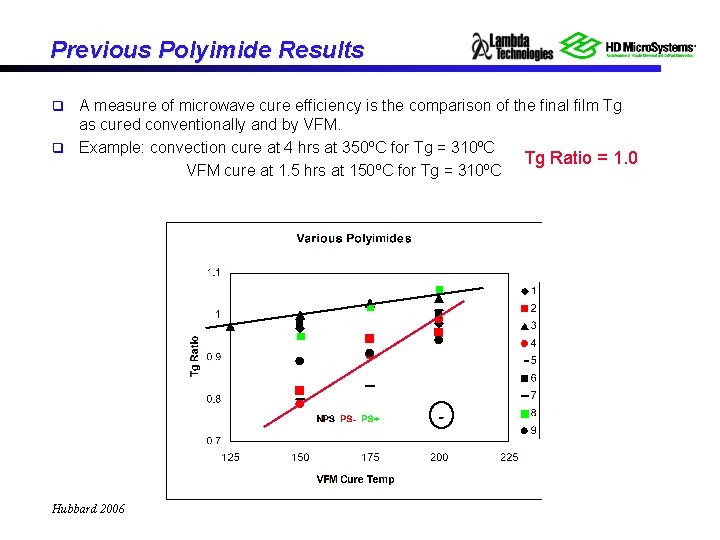
Previous Polyimide Results A measure of microwave cure efficiency is the comparison of the final film Tg as cured conventionally and by VFM. q Example: convection cure at 4 hrs at 350ºC for Tg = 310ºC Tg Ratio = 1. 0 VFM cure at 1. 5 hrs at 150ºC for Tg = 310ºC q Hubbard 2006
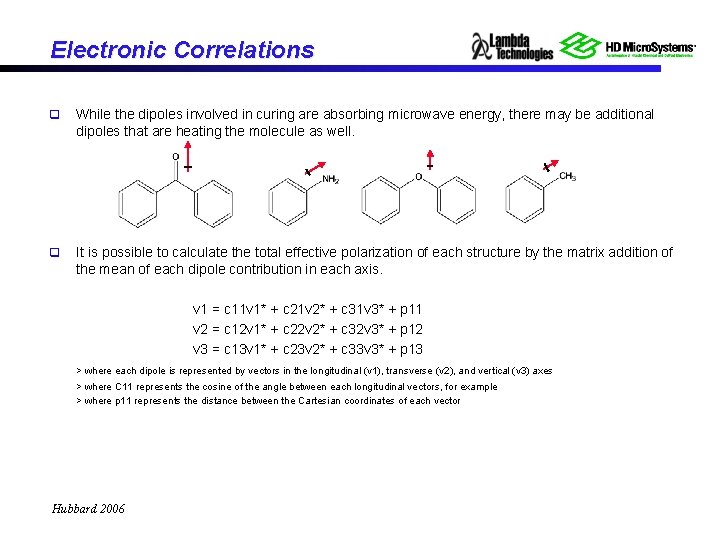
Electronic Correlations q While the dipoles involved in curing are absorbing microwave energy, there may be additional dipoles that are heating the molecule as well. q It is possible to calculate the total effective polarization of each structure by the matrix addition of the mean of each dipole contribution in each axis. v 1 = c 11 v 1* + c 21 v 2* + c 31 v 3* + p 11 v 2 = c 12 v 1* + c 22 v 2* + c 32 v 3* + p 12 v 3 = c 13 v 1* + c 23 v 2* + c 33 v 3* + p 13 > where each dipole is represented by vectors in the longitudinal (v 1), transverse (v 2), and vertical (v 3) axes > where C 11 represents the cosine of the angle between each longitudinal vectors, for example > where p 11 represents the distance between the Cartesian coordinates of each vector Hubbard 2006
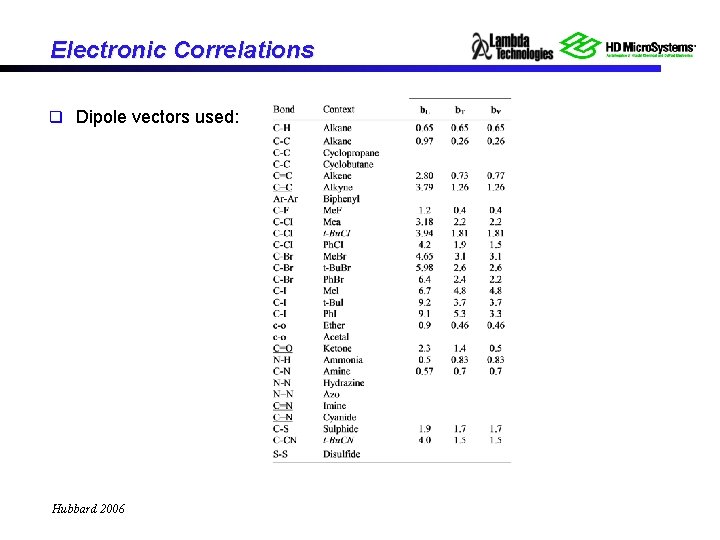
Electronic Correlations q Dipole vectors used: Hubbard 2006
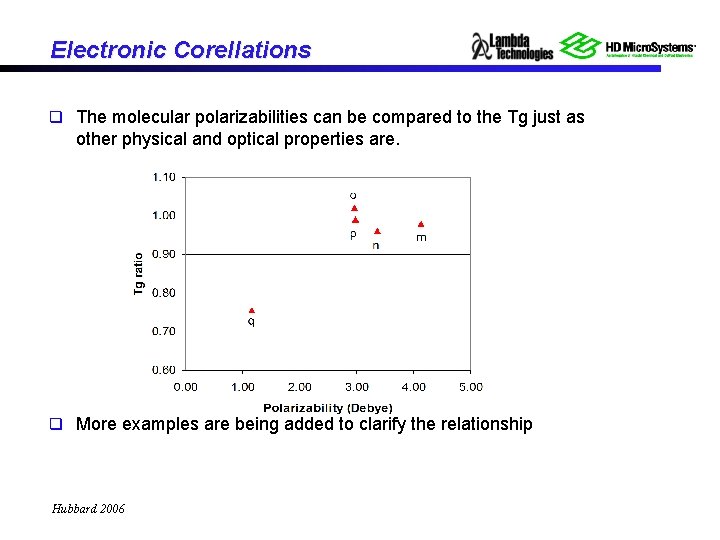
Electronic Corellations q The molecular polarizabilities can be compared to the Tg just as other physical and optical properties are. q More examples are being added to clarify the relationship Hubbard 2006
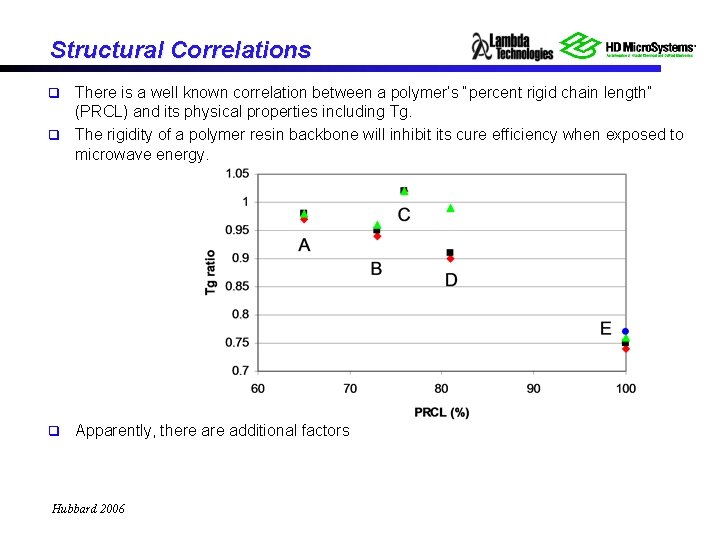
Structural Correlations There is a well known correlation between a polymer’s “percent rigid chain length” (PRCL) and its physical properties including Tg. q The rigidity of a polymer resin backbone will inhibit its cure efficiency when exposed to microwave energy. q q Apparently, there additional factors Hubbard 2006
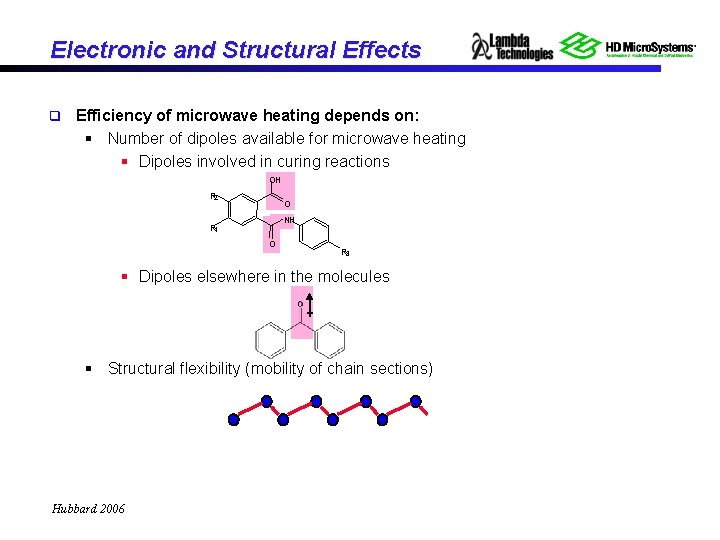
Electronic and Structural Effects q Efficiency of microwave heating depends on: § Number of dipoles available for microwave heating § Dipoles involved in curing reactions OH R 2 O NH R 1 O R 3 § Dipoles elsewhere in the molecules § Structural flexibility (mobility of chain sections) Hubbard 2006
Custom Design of PBOs q Crosslinking more complex than linear PI q Design options: § Backbone: aromatic or alicyclic § Chain endcap: dipole strength § Cyclization promoter: yes or no § Crosslinker: dipole strength § Crosslinker: amount q Process options: § Temperature of soak: 170 -200ºC § Time of soak: 1 -2 hrs. § Ramp rate up to soak: 0. 2 -1. 0 deg/s § Solvent: NMP or GBL q Design Matrix (DOE) § Newly synthesized molecules § Eight variables; 16 trials (28 -5) with four center points § Dipole strengths are not exact center points q Confirmation experiments and photolithography Hubbard 2006
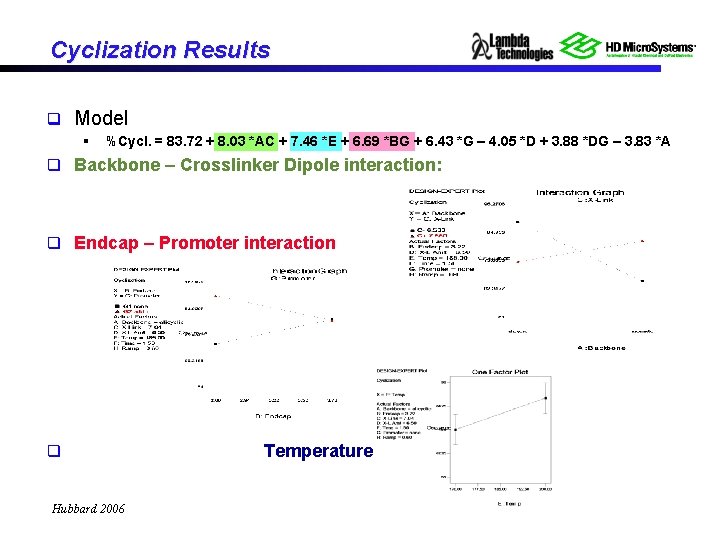
Cyclization Results q Model § %Cycl. = 83. 72 + 8. 03 *AC + 7. 46 *E + 6. 69 *BG + 6. 43 *G – 4. 05 *D + 3. 88 *DG – 3. 83 *A q Backbone – Crosslinker Dipole interaction: q Endcap – Promoter interaction q Hubbard 2006 Temperature
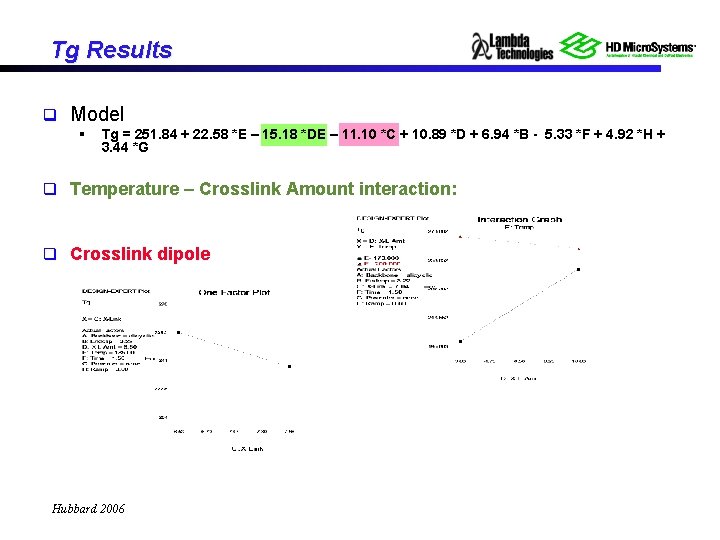
Tg Results q Model § Tg = 251. 84 + 22. 58 *E – 15. 18 *DE – 11. 10 *C + 10. 89 *D + 6. 94 *B - 5. 33 *F + 4. 92 *H + 3. 44 *G q Temperature – Crosslink Amount interaction: q Crosslink dipole Hubbard 2006
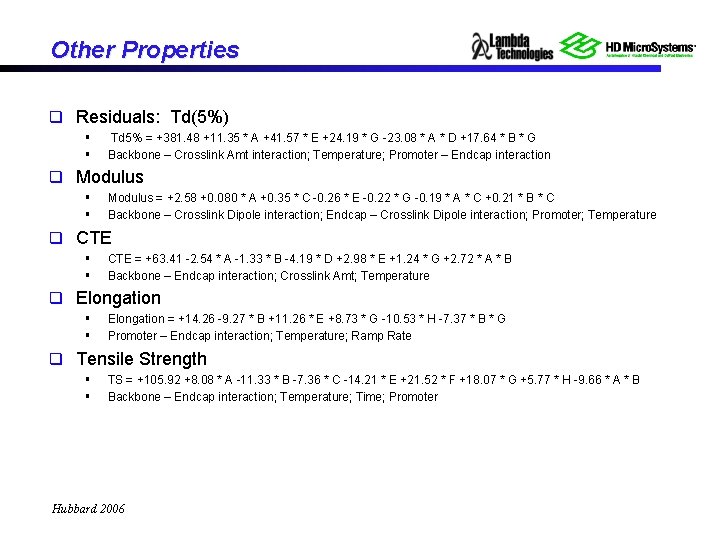
Other Properties q Residuals: Td(5%) § § Td 5% = +381. 48 +11. 35 * A +41. 57 * E +24. 19 * G -23. 08 * A * D +17. 64 * B * G Backbone – Crosslink Amt interaction; Temperature; Promoter – Endcap interaction q Modulus § § Modulus = +2. 58 +0. 080 * A +0. 35 * C -0. 26 * E -0. 22 * G -0. 19 * A * C +0. 21 * B * C Backbone – Crosslink Dipole interaction; Endcap – Crosslink Dipole interaction; Promoter; Temperature q CTE § § CTE = +63. 41 -2. 54 * A -1. 33 * B -4. 19 * D +2. 98 * E +1. 24 * G +2. 72 * A * B Backbone – Endcap interaction; Crosslink Amt; Temperature q Elongation § § Elongation = +14. 26 -9. 27 * B +11. 26 * E +8. 73 * G -10. 53 * H -7. 37 * B * G Promoter – Endcap interaction; Temperature; Ramp Rate q Tensile Strength § § TS = +105. 92 +8. 08 * A -11. 33 * B -7. 36 * C -14. 21 * E +21. 52 * F +18. 07 * G +5. 77 * H -9. 66 * A * B Backbone – Endcap interaction; Temperature; Time; Promoter Hubbard 2006
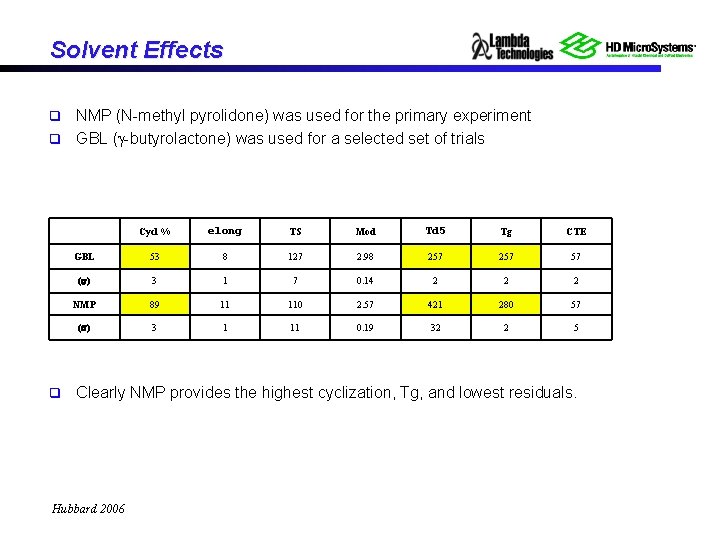
Solvent Effects NMP (N-methyl pyrolidone) was used for the primary experiment q GBL (g-butyrolactone) was used for a selected set of trials q q Cycl % elong TS Mod Td 5 Tg CTE GBL 53 8 127 2. 98 257 57 (s) 3 1 7 0. 14 2 2 2 NMP 89 11 110 2. 57 421 280 57 (s) 3 1 11 0. 19 32 2 5 Clearly NMP provides the highest cyclization, Tg, and lowest residuals. Hubbard 2006
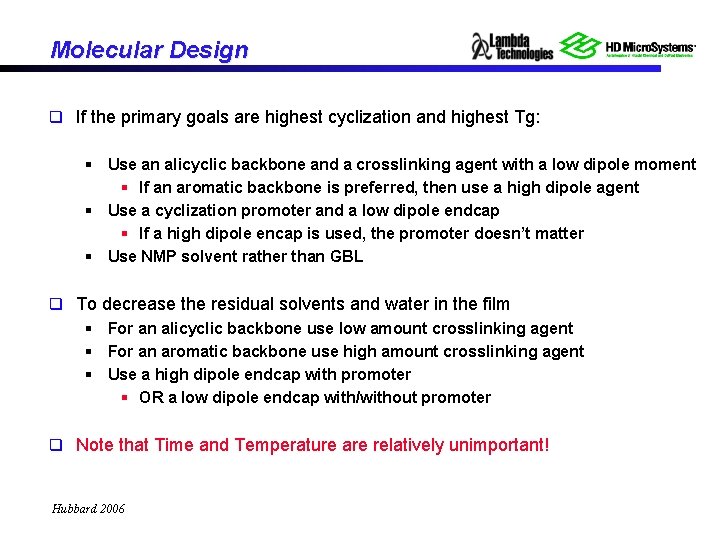
Molecular Design q If the primary goals are highest cyclization and highest Tg: § Use an alicyclic backbone and a crosslinking agent with a low dipole moment § If an aromatic backbone is preferred, then use a high dipole agent § Use a cyclization promoter and a low dipole endcap § If a high dipole encap is used, the promoter doesn’t matter § Use NMP solvent rather than GBL q To decrease the residual solvents and water in the film § For an alicyclic backbone use low amount crosslinking agent § For an aromatic backbone use high amount crosslinking agent § Use a high dipole endcap with promoter § OR a low dipole endcap with/without promoter q Note that Time and Temperature are relatively unimportant! Hubbard 2006
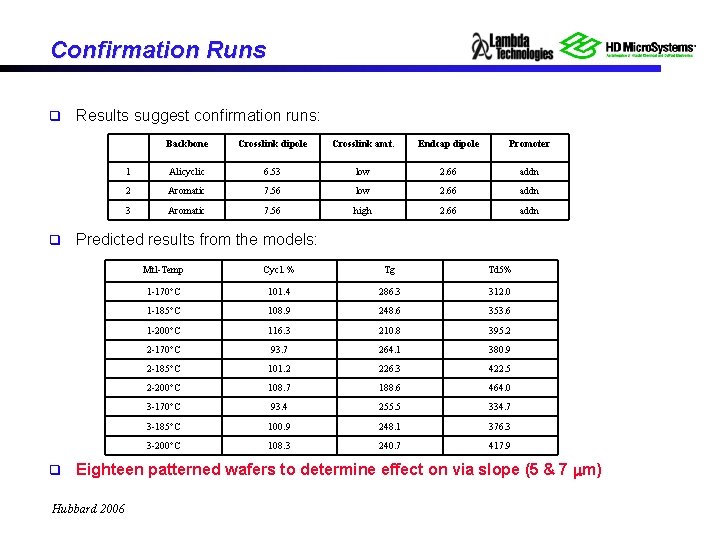
Confirmation Runs q q q Results suggest confirmation runs: Backbone Crosslink dipole Crosslink amt. Endcap dipole Promoter 1 Alicyclic 6. 53 low 2. 66 addn 2 Aromatic 7. 56 low 2. 66 addn 3 Aromatic 7. 56 high 2. 66 addn Predicted results from the models: Mtl-Temp Cycl. % Tg Td 5% 1 -170 C 101. 4 286. 3 312. 0 1 -185 C 108. 9 248. 6 353. 6 1 -200 C 116. 3 210. 8 395. 2 2 -170 C 93. 7 264. 1 380. 9 2 -185 C 101. 2 226. 3 422. 5 2 -200 C 108. 7 188. 6 464. 0 3 -170 C 93. 4 255. 5 334. 7 3 -185 C 100. 9 248. 1 376. 3 3 -200 C 108. 3 240. 7 417. 9 Eighteen patterned wafers to determine effect on via slope (5 & 7 m) Hubbard 2006
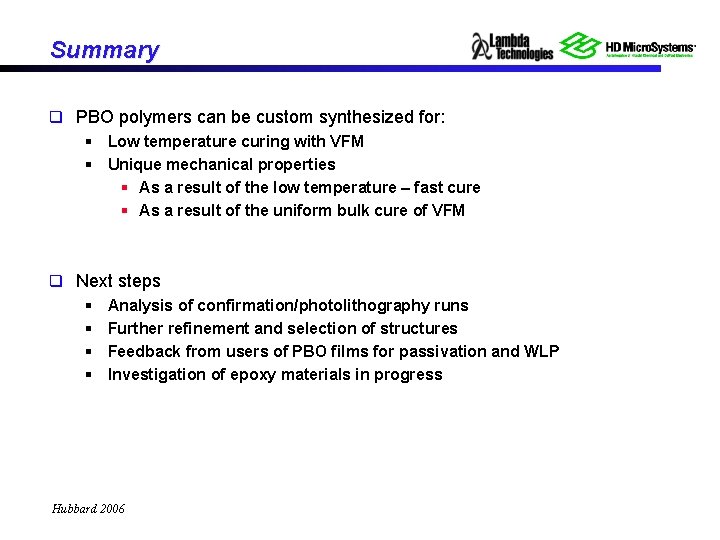
Summary q PBO polymers can be custom synthesized for: § Low temperature curing with VFM § Unique mechanical properties § As a result of the low temperature – fast cure § As a result of the uniform bulk cure of VFM q Next steps § § Analysis of confirmation/photolithography runs Further refinement and selection of structures Feedback from users of PBO films for passivation and WLP Investigation of epoxy materials in progress Hubbard 2006
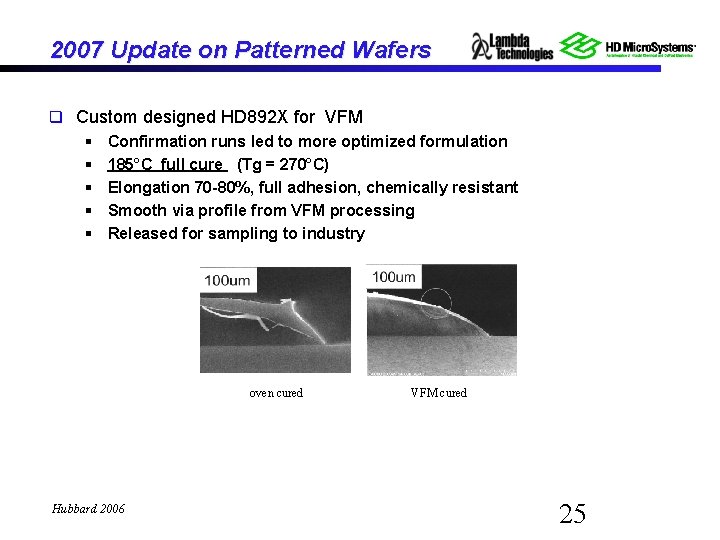
2007 Update on Patterned Wafers q Custom designed HD 892 X for VFM § § § Confirmation runs led to more optimized formulation 185°C full cure (Tg = 270°C) Elongation 70 -80%, full adhesion, chemically resistant Smooth via profile from VFM processing Released for sampling to industry oven cured Hubbard 2006 VFM cured 25
- Slides: 25