
Low radioactivity issues in EDELWEISSII Low Radioactivity Techniques
- Slides: 25
Low radioactivity issues in EDELWEISS-II Low Radioactivity Techniques, LRT 2010 Sudbury, 27 -30 August 2010 Pia Loaiza, Laboratoire Souterrain de Modane, France 1
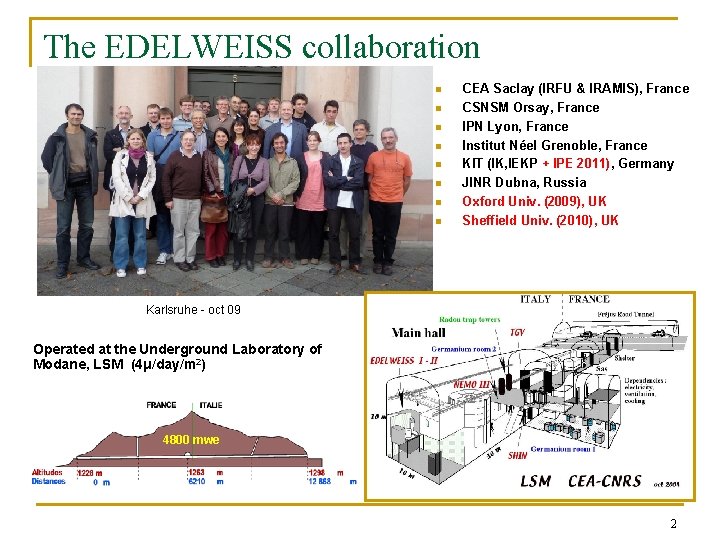
The EDELWEISS collaboration n n n n CEA Saclay (IRFU & IRAMIS), France CSNSM Orsay, France IPN Lyon, France Institut Néel Grenoble, France KIT (IK, IEKP + IPE 2011), Germany JINR Dubna, Russia Oxford Univ. (2009), UK Sheffield Univ. (2010), UK Karlsruhe - oct 09 Operated at the Underground Laboratory of Modane, LSM (4μ/day/m 2) 4800 mwe 2
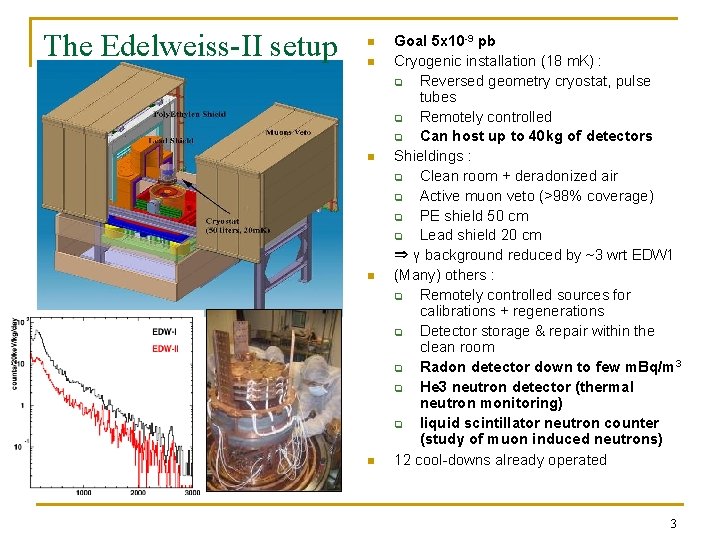
The Edelweiss-II setup n n n Goal 5 x 10 -9 pb Cryogenic installation (18 m. K) : q Reversed geometry cryostat, pulse tubes q Remotely controlled q Can host up to 40 kg of detectors Shieldings : q Clean room + deradonized air q Active muon veto (>98% coverage) q PE shield 50 cm q Lead shield 20 cm ⇒ γ background reduced by ~3 wrt EDW 1 (Many) others : q Remotely controlled sources for calibrations + regenerations q Detector storage & repair within the clean room q Radon detector down to few m. Bq/m 3 q He 3 neutron detector (thermal neutron monitoring) q liquid scintillator neutron counter (study of muon induced neutrons) 12 cool-downs already operated 3
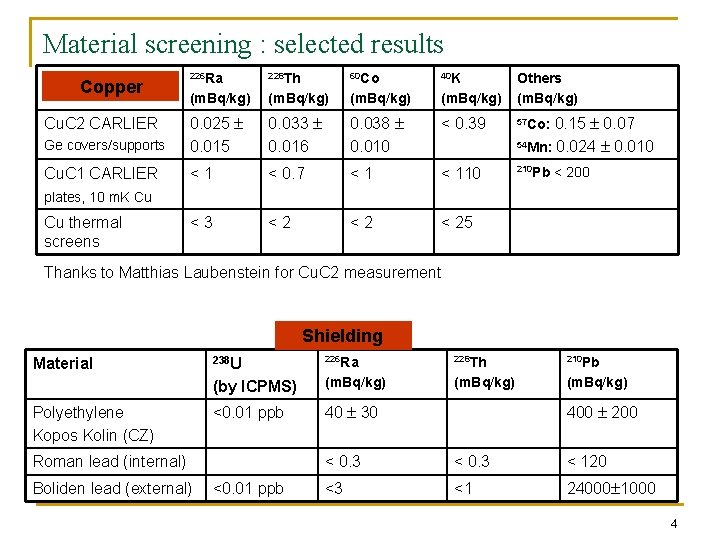
Material screening : selected results Material 226 Ra 228 Th 60 Co 40 K (m. Bq/kg) Others (m. Bq/kg) 0. 025 0. 015 0. 033 0. 016 0. 038 0. 010 < 0. 39 57 Co: Cu. C 1 CARLIER plates, 10 m. K Cu < 1 < 0. 7 < 110 210 Pb Cu thermal screens < 3 < 2 < 25 Copper Cu. C 2 CARLIER Ge covers/supports 0. 15 0. 07 54 Mn: 0. 024 0. 010 < 200 Thanks to Matthias Laubenstein for Cu. C 2 measurement Shielding Material Polyethylene Kopos Kolin (CZ) 238 U 226 Ra 228 Th 210 Pb (by ICPMS) (m. Bq/kg) <0. 01 ppb 40 30 Roman lead (internal) Boliden lead (external) <0. 01 ppb 400 200 < 0. 3 < 120 <3 <1 24000 1000 4
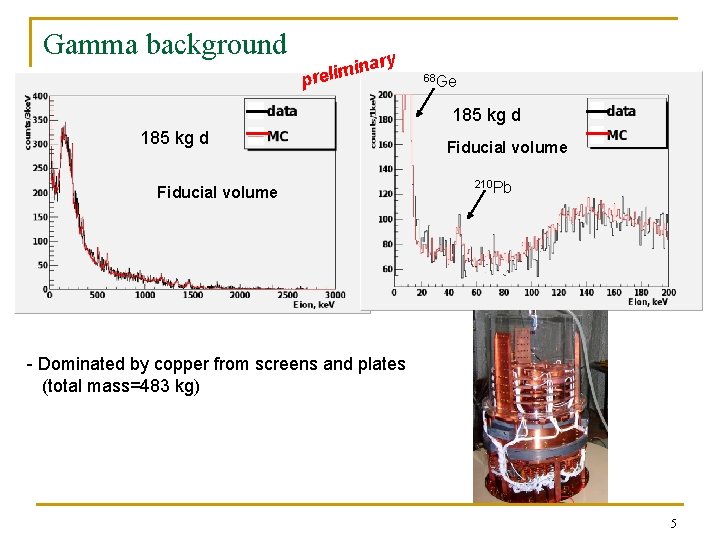
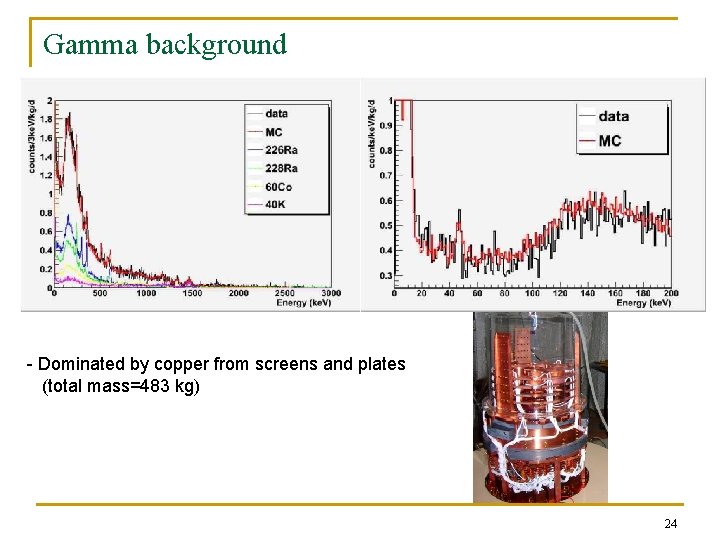
Gamma background ry ina m i l e pr 68 Ge 185 kg d Fiducial volume 210 Pb - Dominated by copper from screens and plates (total mass=483 kg) 5
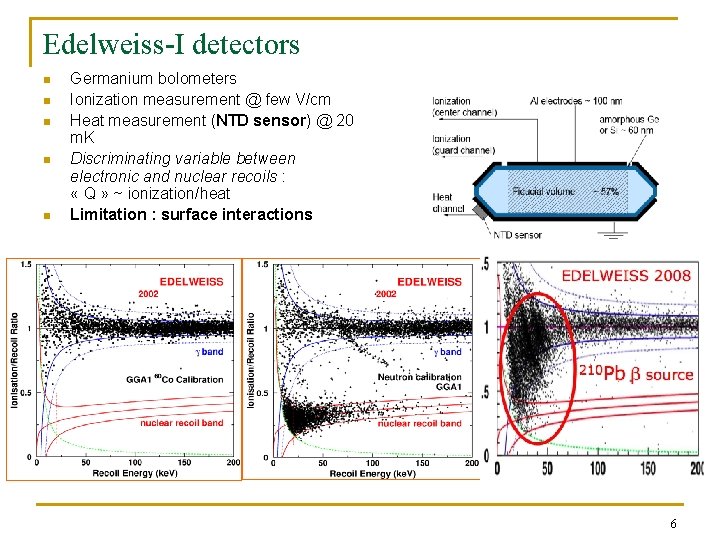
Edelweiss-I detectors n n n Germanium bolometers Ionization measurement @ few V/cm Heat measurement (NTD sensor) @ 20 m. K Discriminating variable between electronic and nuclear recoils : « Q » ~ ionization/heat Limitation : surface interactions 6
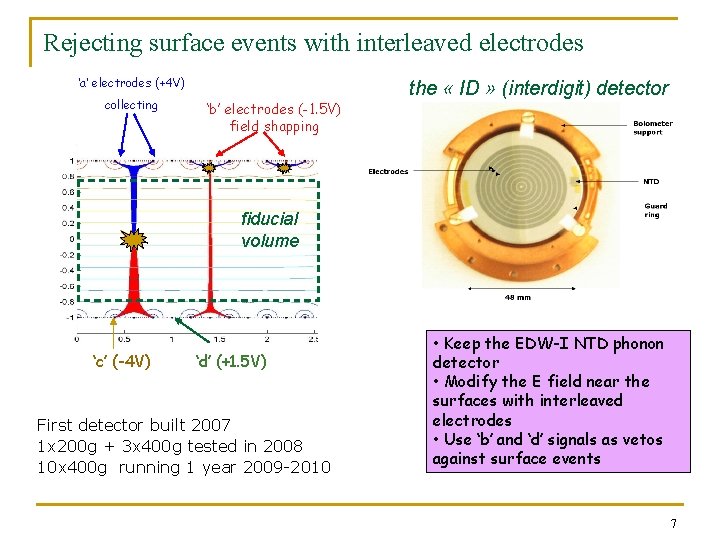
Rejecting surface events with interleaved electrodes ‘a’ electrodes (+4 V) collecting ‘b’ electrodes (-1. 5 V) field shapping the « ID » (interdigit) detector fiducial volume ‘c’ (-4 V) ‘d’ (+1. 5 V) First detector built 2007 1 x 200 g + 3 x 400 g tested in 2008 10 x 400 g running 1 year 2009 -2010 • Keep the EDW-I NTD phonon detector • Modify the E field near the surfaces with interleaved electrodes • Use ‘b’ and ‘d’ signals as vetos against surface events 7
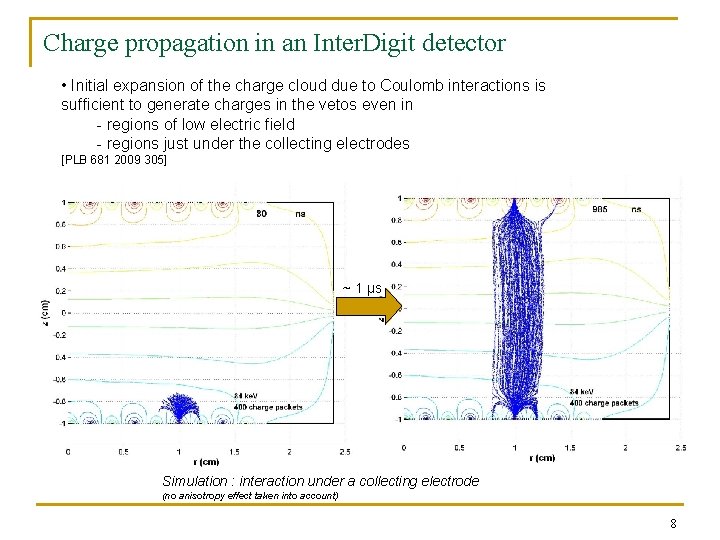
Charge propagation in an Inter. Digit detector • Initial expansion of the charge cloud due to Coulomb interactions is sufficient to generate charges in the vetos even in - regions of low electric field - regions just under the collecting electrodes [PLB 681 2009 305] ~ 1 μs Simulation : interaction under a collecting electrode (no anisotropy effect taken into account) 8
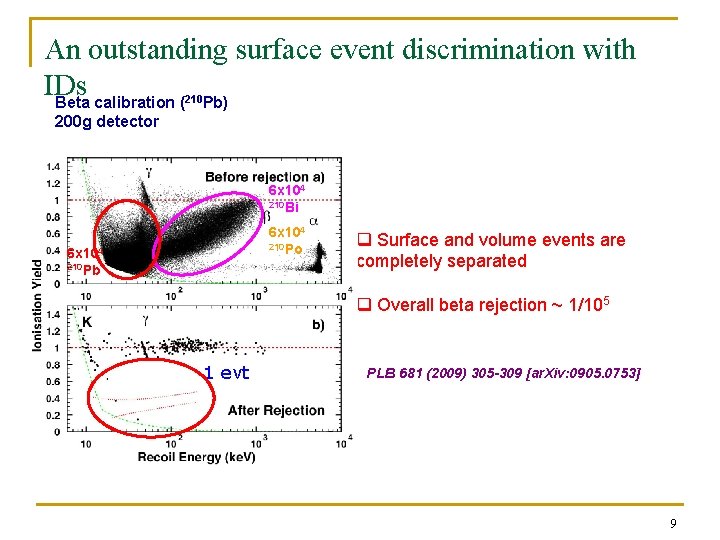
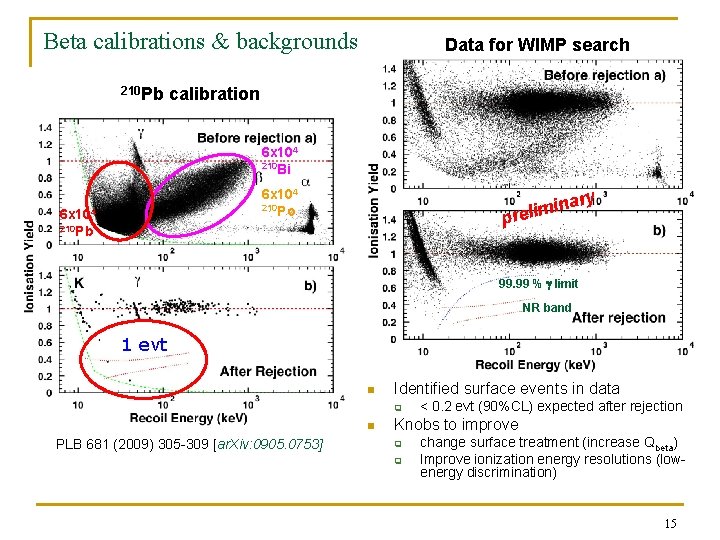
An outstanding surface event discrimination with IDs Beta calibration ( Pb) 210 200 g detector 6 x 10⁴ 210 Bi 6 x 10⁴ 210 Po 6 x 10⁴ 210 Pb 1 evt q Surface and volume events are completely separated q Overall beta rejection ~ 1/105 PLB 681 (2009) 305 -309 [ar. Xiv: 0905. 0753] 9
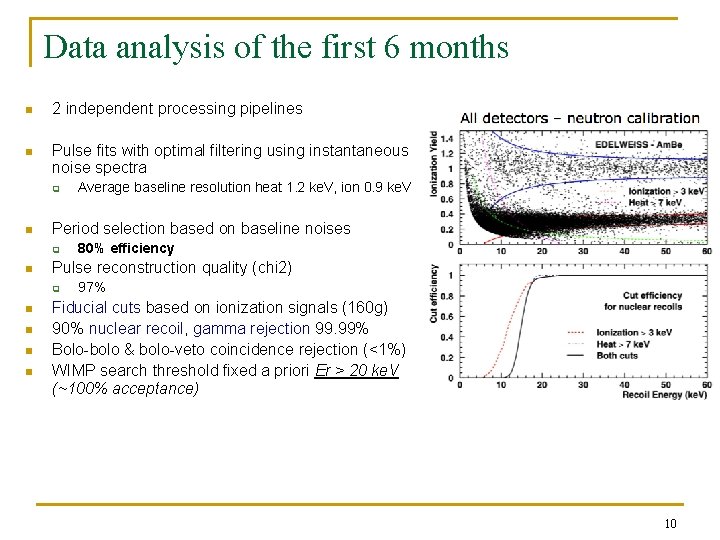
Data analysis of the first 6 months n 2 independent processing pipelines n Pulse fits with optimal filtering using instantaneous noise spectra q n Period selection based on baseline noises q n n 80% efficiency Pulse reconstruction quality (chi 2) q n Average baseline resolution heat 1. 2 ke. V, ion 0. 9 ke. V 97% Fiducial cuts based on ionization signals (160 g) 90% nuclear recoil, gamma rejection 99. 99% Bolo-bolo & bolo-veto coincidence rejection (<1%) WIMP search threshold fixed a priori Er > 20 ke. V (~100% acceptance) 10
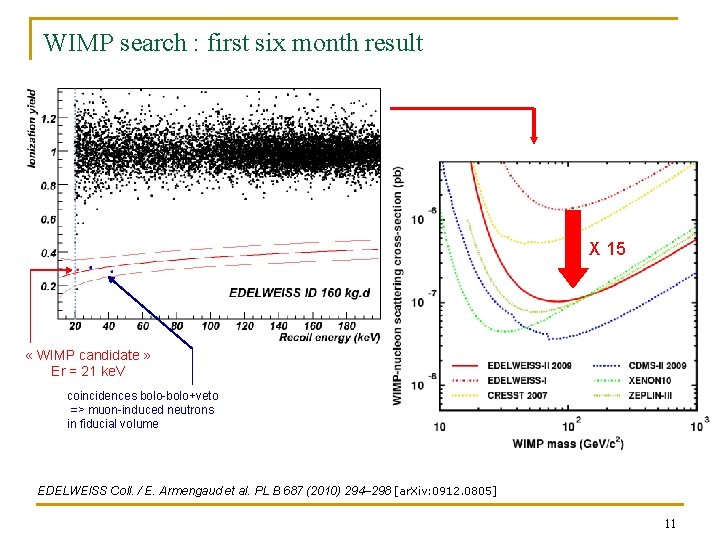
WIMP search : first six month result X 15 « WIMP candidate » Er = 21 ke. V coincidences bolo-bolo+veto => muon-induced neutrons in fiducial volume EDELWEISS Coll. / E. Armengaud et al. PL B 687 (2010) 294– 298 [ar. Xiv: 0912. 0805] 11
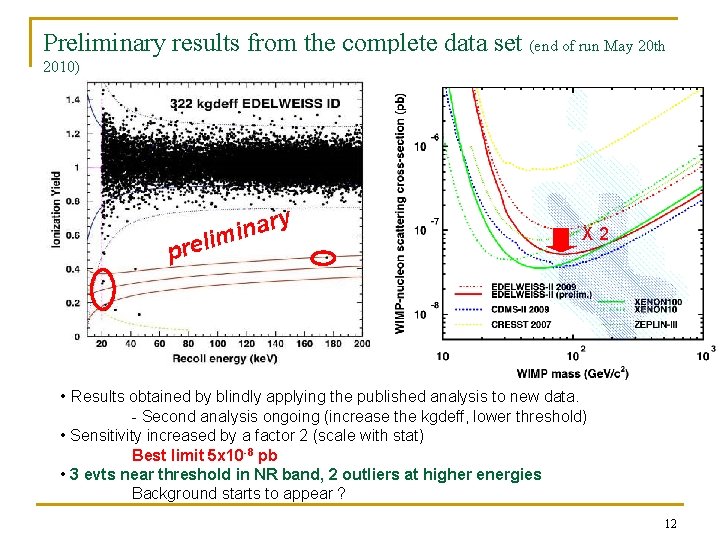
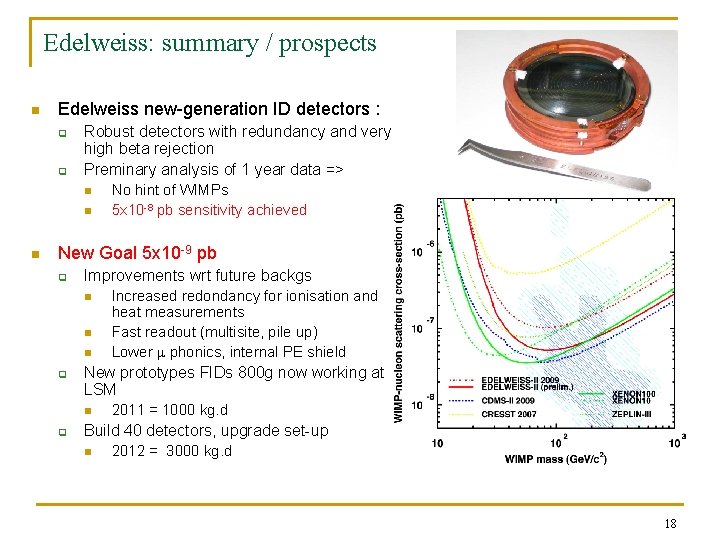
Preliminary results from the complete data set (end of run May 20 th 2010) ary n i relim p X 2 • Results obtained by blindly applying the published analysis to new data. - Second analysis ongoing (increase the kgdeff, lower threshold) • Sensitivity increased by a factor 2 (scale with stat) Best limit 5 x 10 -8 pb • 3 evts near threshold in NR band, 2 outliers at higher energies Background starts to appear ? 12
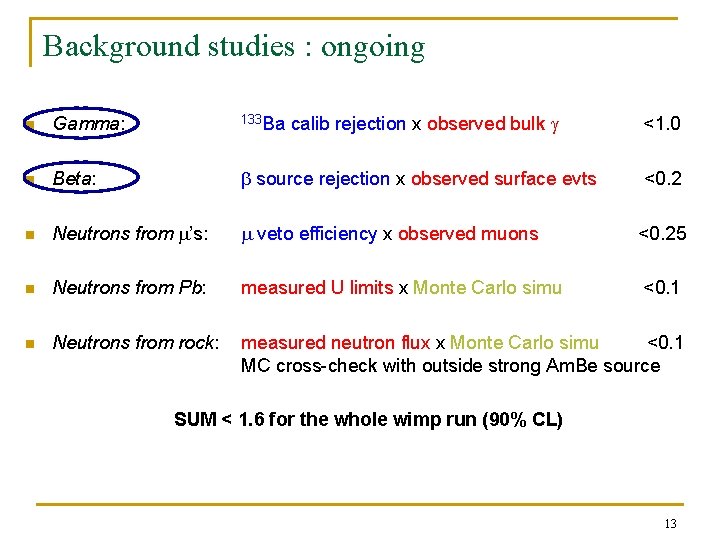
Background studies : ongoing n Gamma: 133 Ba calib rejection x observed bulk <1. 0 n Beta: source rejection x observed surface evts <0. 2 n Neutrons from ’s: veto efficiency x observed muons <0. 25 n Neutrons from Pb: measured U limits x Monte Carlo simu <0. 1 n Neutrons from rock: measured neutron flux x Monte Carlo simu <0. 1 MC cross-check with outside strong Am. Be source SUM < 1. 6 for the whole wimp run (90% CL) 13
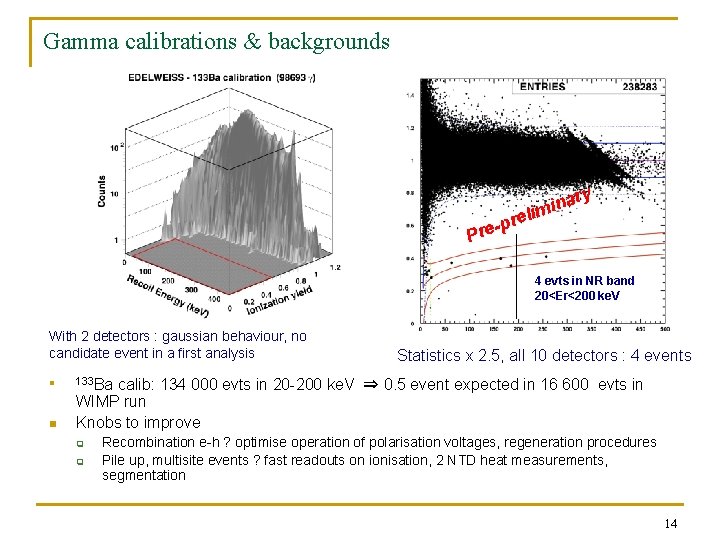
Gamma calibrations & backgrounds y Pre ar n i m reli -p 4 evts in NR band 20<Er<200 ke. V With 2 detectors : gaussian behaviour, no candidate event in a first analysis n n Statistics x 2. 5, all 10 detectors : 4 events 133 Ba calib: 134 000 evts in 20 -200 ke. V ⇒ 0. 5 event expected in 16 600 evts in WIMP run Knobs to improve q q Recombination e-h ? optimise operation of polarisation voltages, regeneration procedures Pile up, multisite events ? fast readouts on ionisation, 2 NTD heat measurements, segmentation 14
Beta calibrations & backgrounds 210 Pb Data for WIMP search calibration 6 x 10⁴ 210 Bi 6 x 10⁴ 210 Po 6 x 10⁴ ry a n i m reli p 210 Pb 99. 99 % limit NR band 1 evt n Identified surface events in data q n PLB 681 (2009) 305 -309 [ar. Xiv: 0905. 0753] < 0. 2 evt (90%CL) expected after rejection Knobs to improve q q change surface treatment (increase Qbeta) Improve ionization energy resolutions (lowenergy discrimination) 15
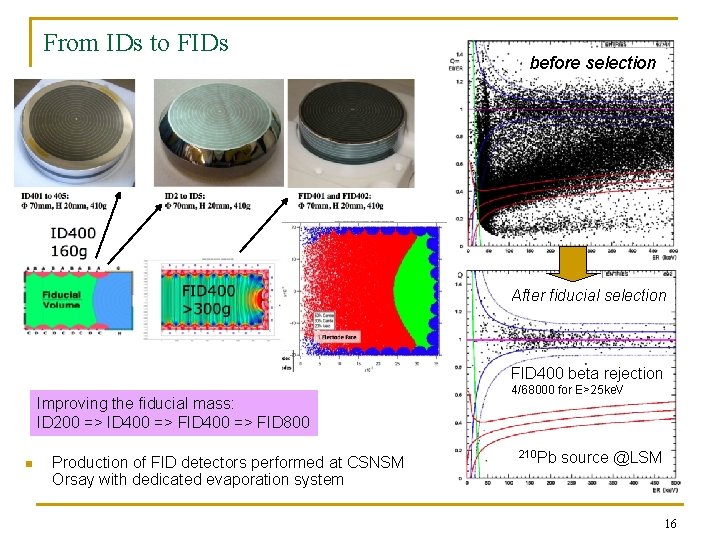
From IDs to FIDs before selection After fiducial selection FID 400 beta rejection Improving the fiducial mass: ID 200 => ID 400 => FID 800 n Production of FID detectors performed at CSNSM Orsay with dedicated evaporation system 4/68000 for E>25 ke. V 210 Pb source @LSM 16
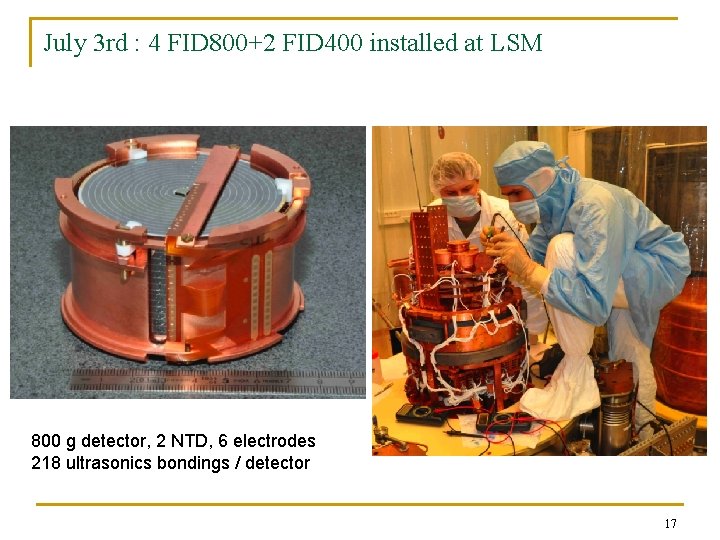
July 3 rd : 4 FID 800+2 FID 400 installed at LSM 800 g detector, 2 NTD, 6 electrodes 218 ultrasonics bondings / detector 17
Edelweiss: summary / prospects n Edelweiss new-generation ID detectors : q q Robust detectors with redundancy and very high beta rejection Preminary analysis of 1 year data => n n n No hint of WIMPs 5 x 10 -8 pb sensitivity achieved New Goal 5 x 10 -9 pb q Improvements wrt future backgs n n n q New prototypes FIDs 800 g now working at LSM n q Increased redondancy for ionisation and heat measurements Fast readout (multisite, pile up) Lower phonics, internal PE shield 2011 = 1000 kg. d Build 40 detectors, upgrade set-up n 2012 = 3000 kg. d 18
Spares 19
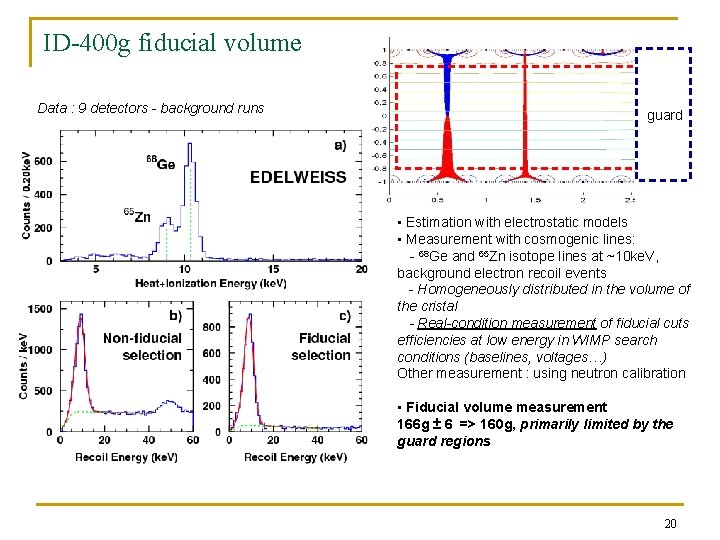
ID-400 g fiducial volume Data : 9 detectors - background runs guard • Estimation with electrostatic models • Measurement with cosmogenic lines: - 68 Ge and 65 Zn isotope lines at ~10 ke. V, background electron recoil events - Homogeneously distributed in the volume of the cristal - Real-condition measurement of fiducial cuts efficiencies at low energy in WIMP search conditions (baselines, voltages…) Other measurement : using neutron calibration • Fiducial volume measurement 166 g ± 6 => 160 g, primarily limited by the guard regions 20
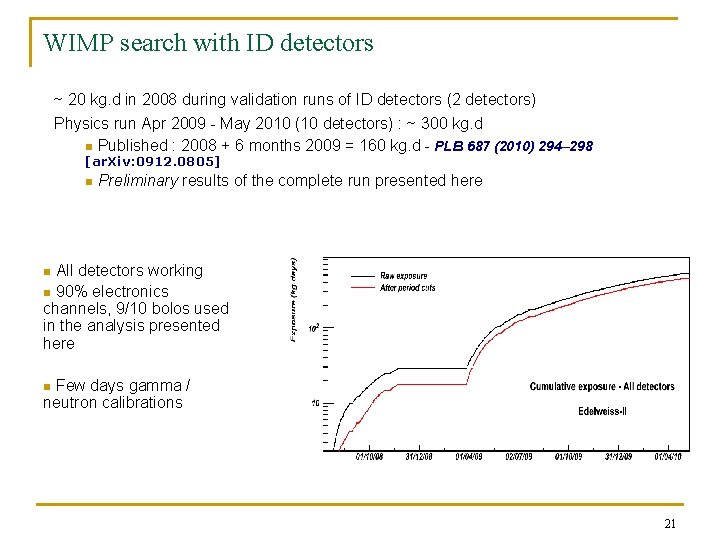
WIMP search with ID detectors ~ 20 kg. d in 2008 during validation runs of ID detectors (2 detectors) Physics run Apr 2009 - May 2010 (10 detectors) : ~ 300 kg. d n Published : 2008 + 6 months 2009 = 160 kg. d - PLB 687 (2010) 294– 298 [ar. Xiv: 0912. 0805] n Preliminary results of the complete run presented here n All detectors working n 90% electronics channels, 9/10 bolos used in the analysis presented here n Few days gamma / neutron calibrations 21
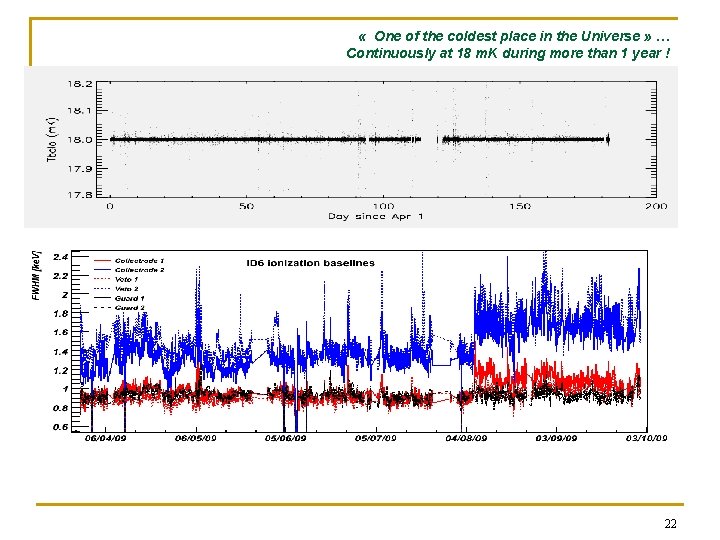
« One of the coldest place in the Universe » … Continuously at 18 m. K during more than 1 year ! 22
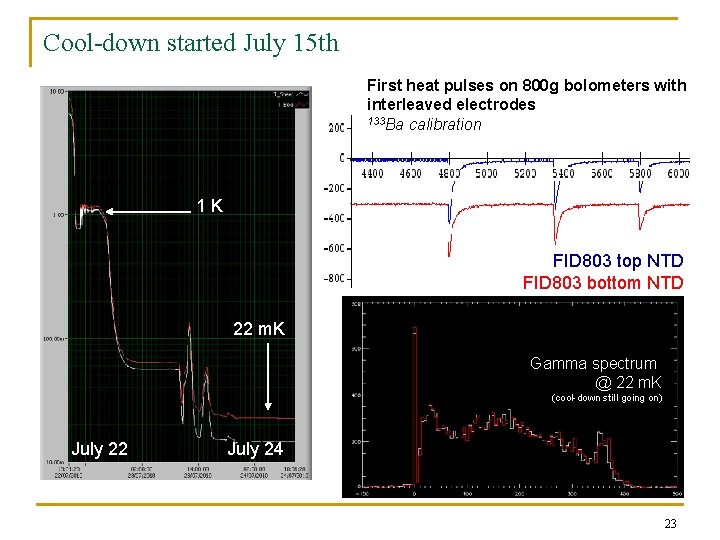
Cool-down started July 15 th First heat pulses on 800 g bolometers with interleaved electrodes 133 Ba calibration 1 K FID 803 top NTD FID 803 bottom NTD 22 m. K Gamma spectrum @ 22 m. K (cool-down still going on) July 22 July 24 23
Gamma background - Dominated by copper from screens and plates (total mass=483 kg) 24
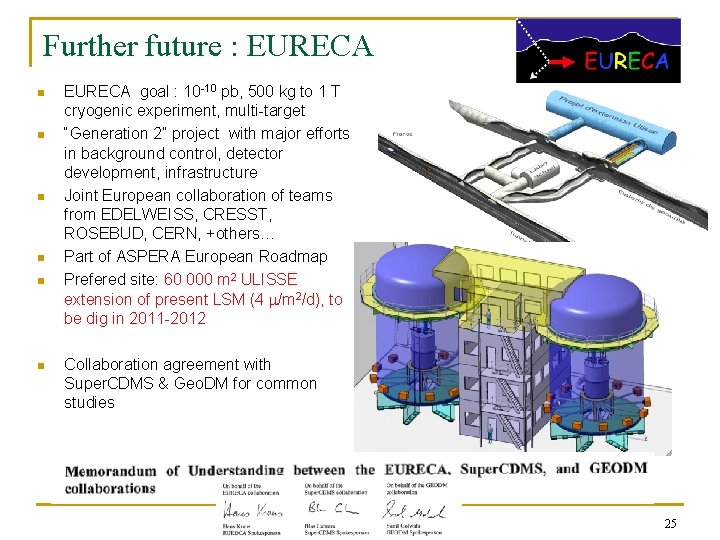
Further future : EURECA n n n EURECA goal : 10 -10 pb, 500 kg to 1 T cryogenic experiment, multi-target “Generation 2” project with major efforts in background control, detector development, infrastructure Joint European collaboration of teams from EDELWEISS, CRESST, ROSEBUD, CERN, +others… Part of ASPERA European Roadmap Prefered site: 60 000 m 2 ULISSE extension of present LSM (4 /m 2/d), to be dig in 2011 -2012 Collaboration agreement with Super. CDMS & Geo. DM for common studies 25