
Low Power LDPC Decoder with Efficient Stopping Scheme


- Slides: 20
Low Power LDPC Decoder with Efficient Stopping Scheme for Undecodable Blocks Tinoosh Mohsenin 2, Houshmand Shirani-mehr 1, Bevan Baas 1 1 University of California, Davis 2 University of Maryland Baltimore County 1
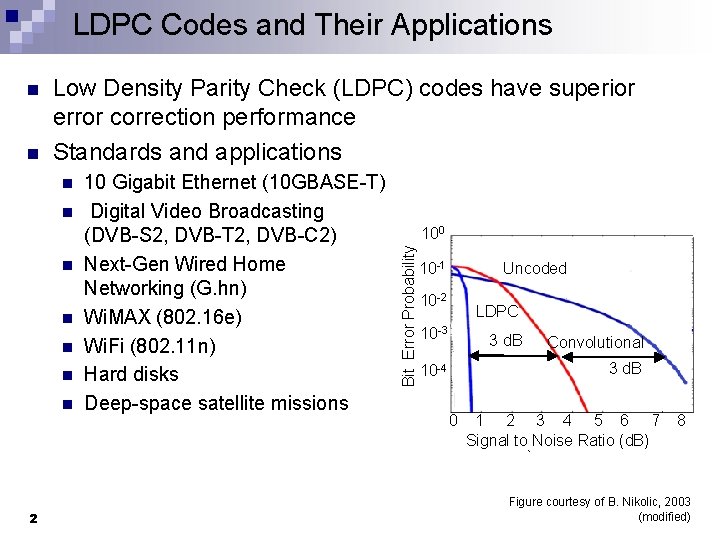
LDPC Codes and Their Applications n Low Density Parity Check (LDPC) codes have superior error correction performance Standards and applications n n n n 2 10 Gigabit Ethernet (10 GBASE-T) Digital Video Broadcasting (DVB-S 2, DVB-T 2, DVB-C 2) Next-Gen Wired Home Networking (G. hn) Wi. MAX (802. 16 e) Wi. Fi (802. 11 n) Hard disks Deep-space satellite missions 100 Bit Error Probability n Uncoded 10 -1 10 -2 LDPC 10 -3 3 d. B Convolutional 3 d. B 10 -4 0 1 2 3 4 5 6 7 Signal to Noise Ratio (d. B) 8 Figure courtesy of B. Nikolic, 2003 (modified)
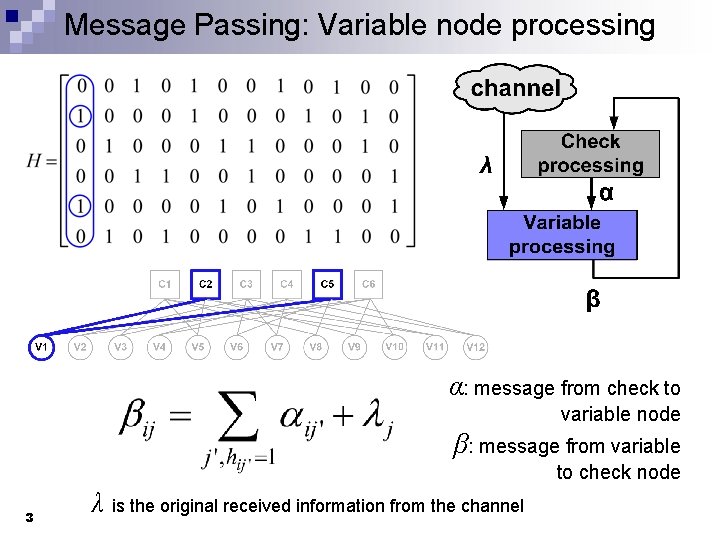
Message Passing: Variable node processing α: message from check to variable node β: message from variable to check node 3 λ is the original received information from the channel
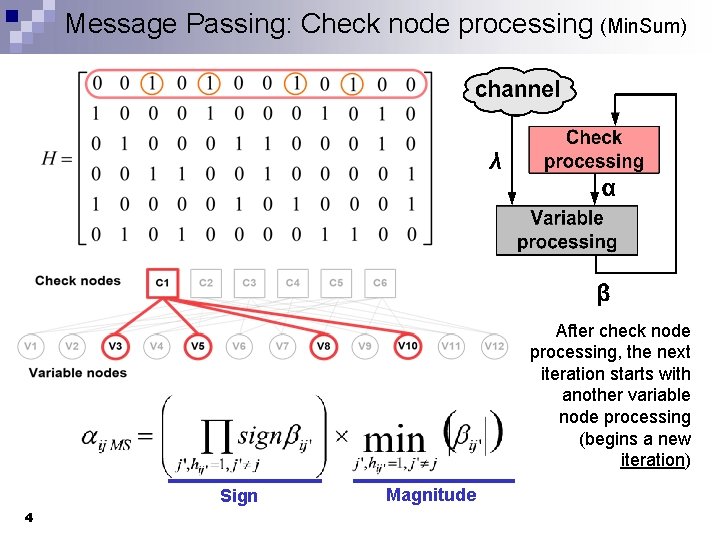
Message Passing: Check node processing (Min. Sum) After check node processing, the next iteration starts with another variable node processing (begins a new iteration) Sign 4 Magnitude
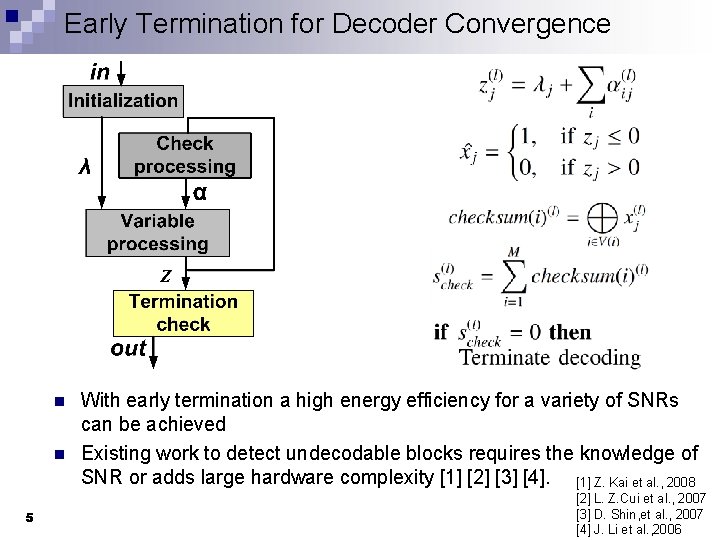
Early Termination for Decoder Convergence n n 5 With early termination a high energy efficiency for a variety of SNRs can be achieved Existing work to detect undecodable blocks requires the knowledge of SNR or adds large hardware complexity [1] [2] [3] [4]. [1] Z. Kai et al. , 2008 [2] L. Z. Cui et al. , 2007 [3] D. Shin, et al. , 2007 [4] J. Li et al. , 2006
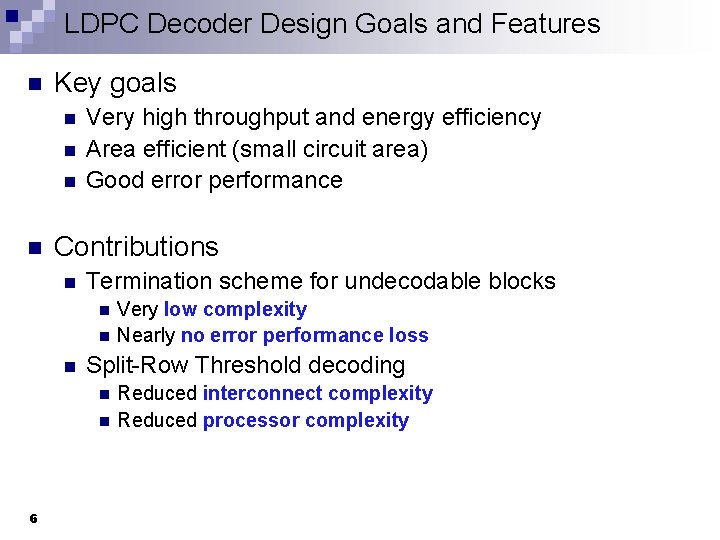
LDPC Decoder Design Goals and Features n Key goals n n Very high throughput and energy efficiency Area efficient (small circuit area) Good error performance Contributions n Termination scheme for undecodable blocks n n n Split-Row Threshold decoding n n 6 Very low complexity Nearly no error performance loss Reduced interconnect complexity Reduced processor complexity
Outline n Iterative LDPC Decoding Termination Scheme for Undecodable Blocks Split-Row Threshold Decoding n Decoder Implementations and Results n Conclusion n n
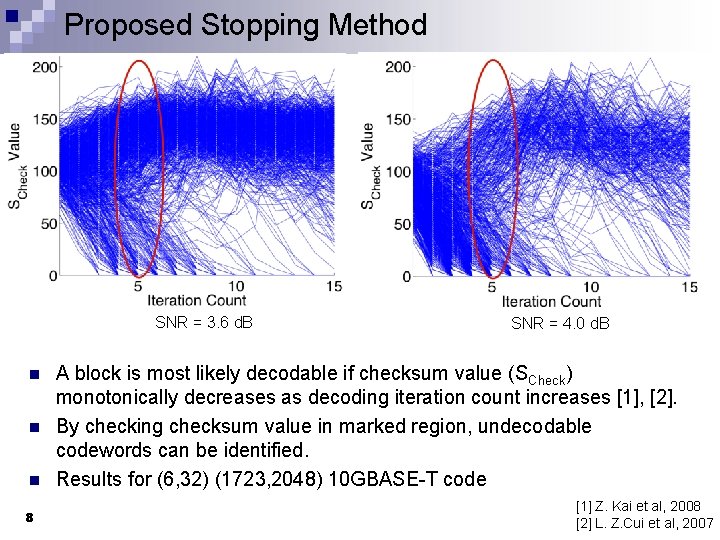
Proposed Stopping Method SNR = 3. 6 d. B n n n 8 SNR = 4. 0 d. B A block is most likely decodable if checksum value (SCheck) monotonically decreases as decoding iteration count increases [1], [2]. By checking checksum value in marked region, undecodable codewords can be identified. Results for (6, 32) (1723, 2048) 10 GBASE-T code [1] Z. Kai et al, 2008 [2] L. Z. Cui et al, 2007
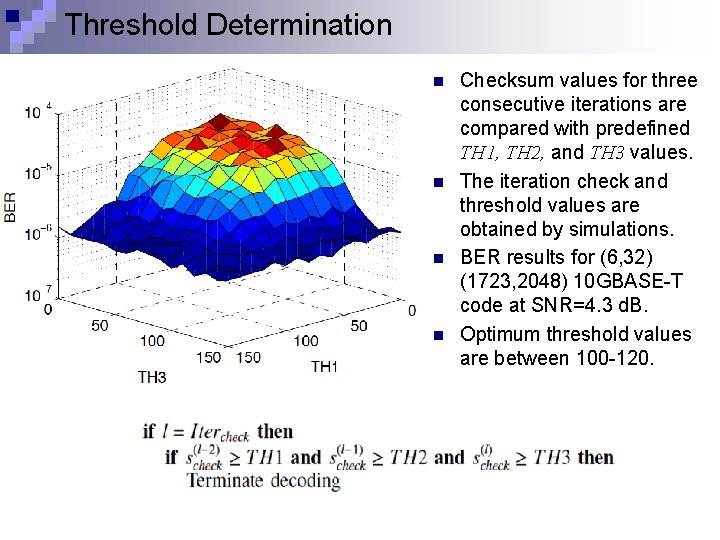
Threshold Determination n n Checksum values for three consecutive iterations are compared with predefined TH 1, TH 2, and TH 3 values. The iteration check and threshold values are obtained by simulations. BER results for (6, 32) (1723, 2048) 10 GBASE-T code at SNR=4. 3 d. B. Optimum threshold values are between 100 -120.
Outline n Iterative LDPC Decoding Termination Scheme for Undecodable Blocks Split-Row Threshold Decoding n Decoder Implementations and Results n Conclusion n n
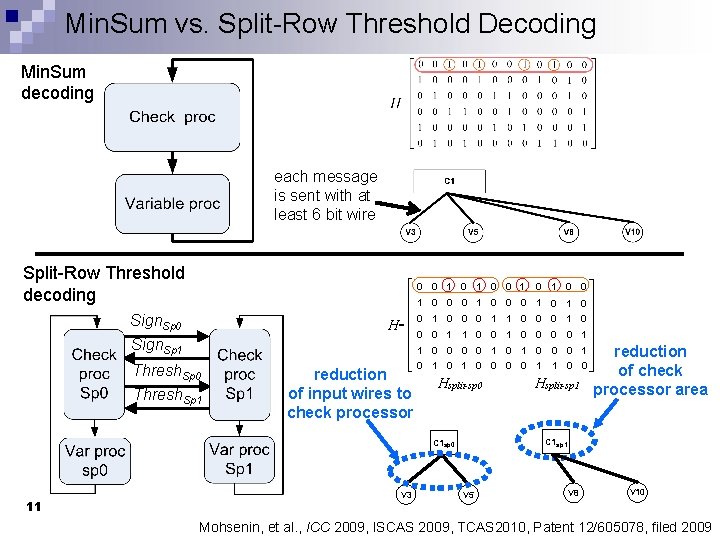
Min. Sum vs. Split-Row Threshold Decoding Min. Sum decoding each message is sent with at least 6 bit wire Split-Row Threshold decoding 0 0 1 1 0 0 0 1 0 Sign. Sp 1 H= Thresh. Sp 0 Thresh. Sp 1 reduction of input wires to check processor 0 1 0 0 0 1 1 0 0 0 V 3 0 1 1 0 0 0 1 0 1 0 0 1 1 0 0 Hsplit-sp 1 reduction of check processor area C 1 sp 1 C 1 sp 0 11 0 0 V 5 V 8 V 10 Mohsenin, et al. , ICC 2009, ISCAS 2009, TCAS 2010, Patent 12/605078, filed 2009
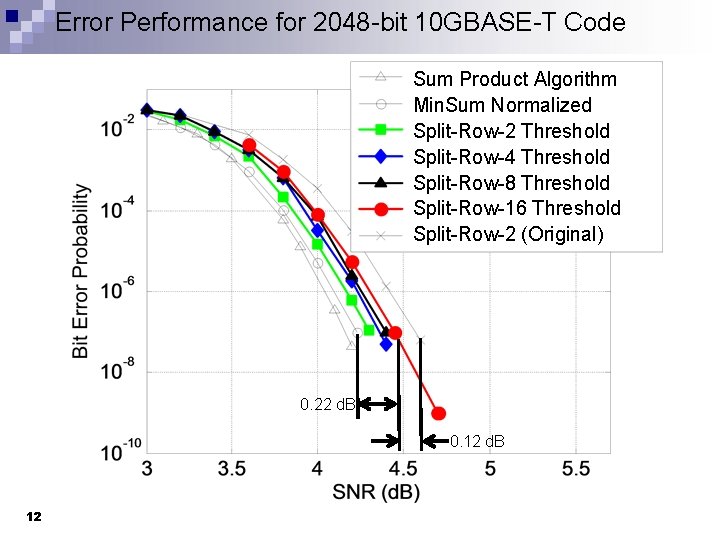
Error Performance for 2048 -bit 10 GBASE-T Code Sum Product Algorithm Min. Sum Normalized Split-Row-2 Threshold Split-Row-4 Threshold Split-Row-8 Threshold Split-Row-16 Threshold Split-Row-2 (Original) 0. 22 d. B 0. 12 d. B 12
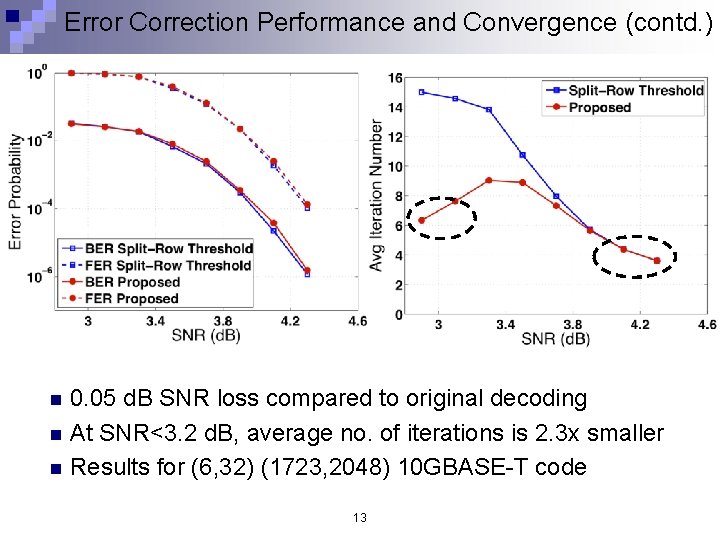
Error Correction Performance and Convergence (contd. ) 0. 05 d. B SNR loss compared to original decoding n At SNR<3. 2 d. B, average no. of iterations is 2. 3 x smaller n Results for (6, 32) (1723, 2048) 10 GBASE-T code n 13
Outline n Iterative LDPC Decoding Termination Scheme for Undecodable Blocks Split-Row Threshold Decoding n Decoder Implementations and Results n Conclusion n n
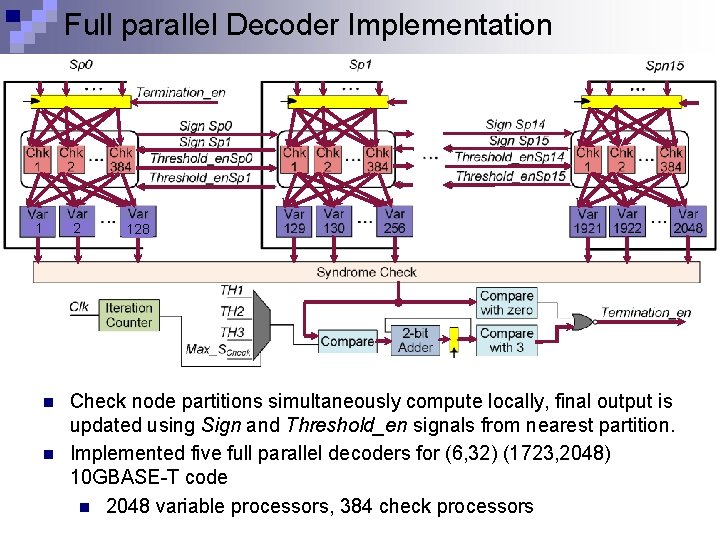
Full parallel Decoder Implementation 1 n n 2 128 Check node partitions simultaneously compute locally, final output is updated using Sign and Threshold_en signals from nearest partition. Implemented five full parallel decoders for (6, 32) (1723, 2048) 10 GBASE-T code n 2048 variable processors, 384 check processors
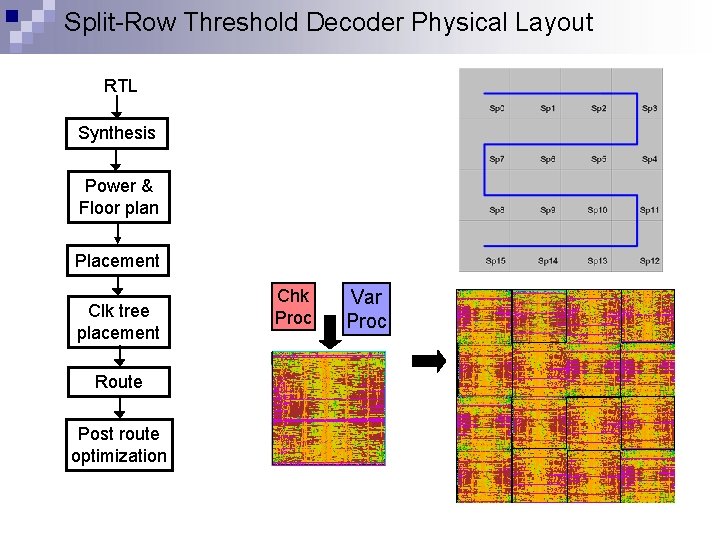
Split-Row Threshold Decoder Physical Layout RTL Synthesis Power & Floor plan Placement Clk tree placement Route Post route optimization Chk Proc Var Proc
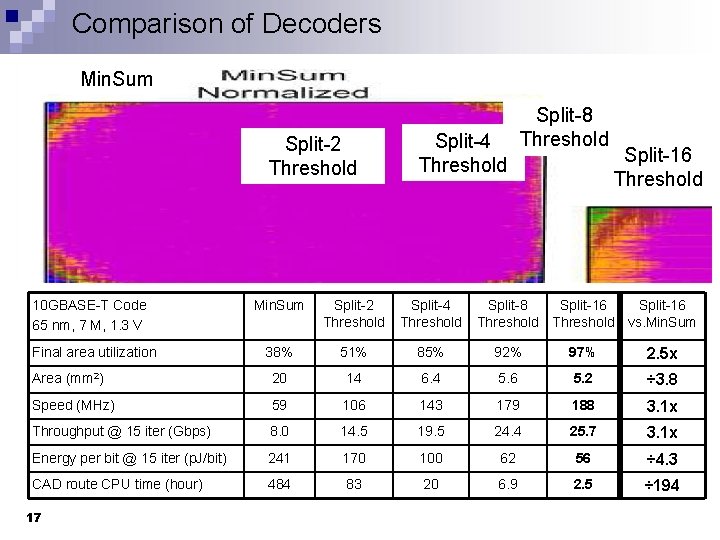
Comparison of Decoders Min. Sum Split-2 Threshold 10 GBASE-T Code 65 nm, 7 M, 1. 3 V Split-4 Threshold Split-8 Threshold Split-16 Threshold Min. Sum Split-2 Threshold Split-4 Threshold 38% 51% 85% 92% 97% 2. 5 x Area (mm 2) 20 14 6. 4 5. 6 5. 2 ÷ 3. 8 Speed (MHz) 59 106 143 179 188 3. 1 x Throughput @ 15 iter (Gbps) 8. 0 14. 5 19. 5 24. 4 25. 7 3. 1 x Energy per bit @ 15 iter (p. J/bit) 241 170 100 62 56 ÷ 4. 3 CAD route CPU time (hour) 484 83 20 6. 9 2. 5 ÷ 194 Final area utilization 17 Split-8 Split-16 Threshold vs. Min. Sum
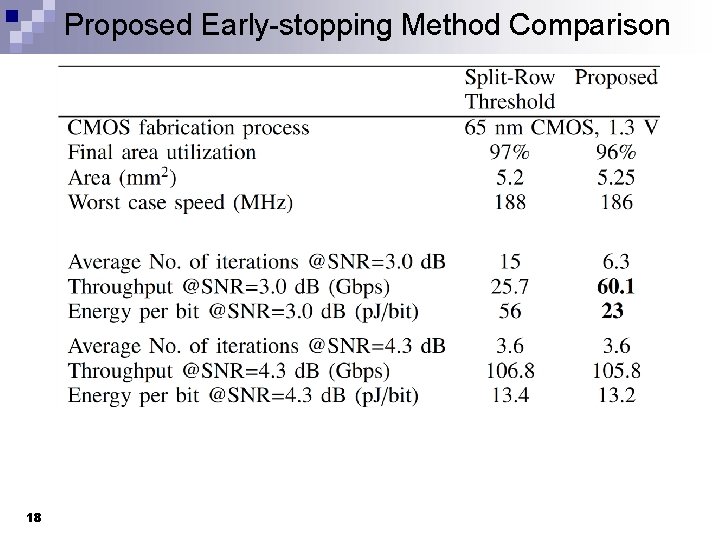
Proposed Early-stopping Method Comparison 18
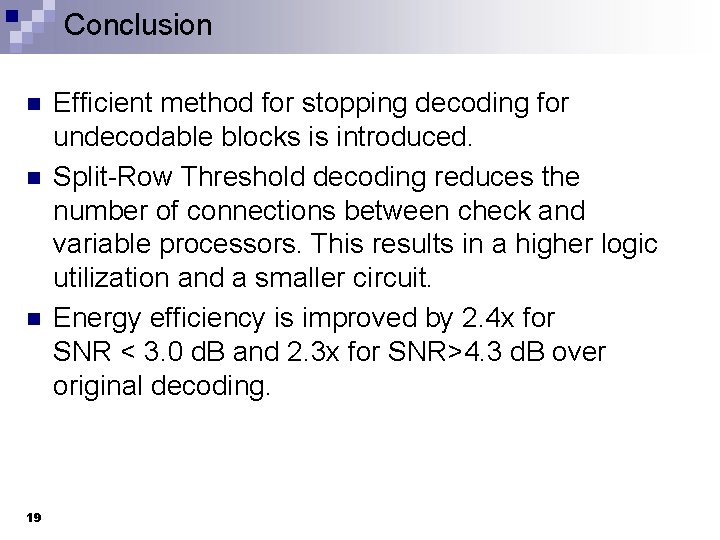
Conclusion n 19 Efficient method for stopping decoding for undecodable blocks is introduced. Split-Row Threshold decoding reduces the number of connections between check and variable processors. This results in a higher logic utilization and a smaller circuit. Energy efficiency is improved by 2. 4 x for SNR < 3. 0 d. B and 2. 3 x for SNR>4. 3 d. B over original decoding.
Acknowledgements n Support n n n n ST Microelectronics NSF Grant 430090 and CAREER award 546907 Intel SRC Grant 1598 and CSR Grant 1659 Intellasys UC Micro SEM