
Low Mass Stars 8 MSun Outline Mommy Molecular
- Slides: 25
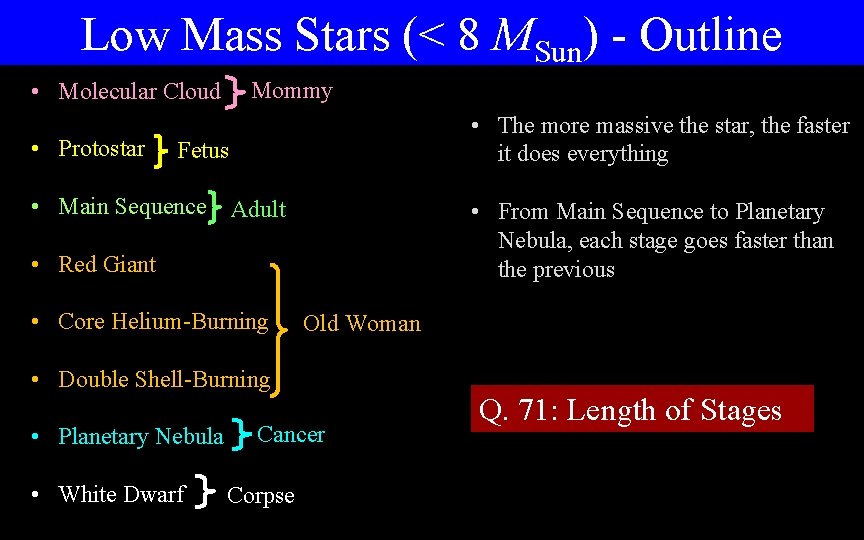
Low Mass Stars (< 8 MSun) - Outline Mommy • Molecular Cloud • Protostar • The more massive the star, the faster it does everything Fetus • Main Sequence Adult • From Main Sequence to Planetary Nebula, each stage goes faster than the previous • Red Giant • Core Helium-Burning Old Woman • Double Shell-Burning • Planetary Nebula • White Dwarf Cancer Corpse Q. 71: Length of Stages
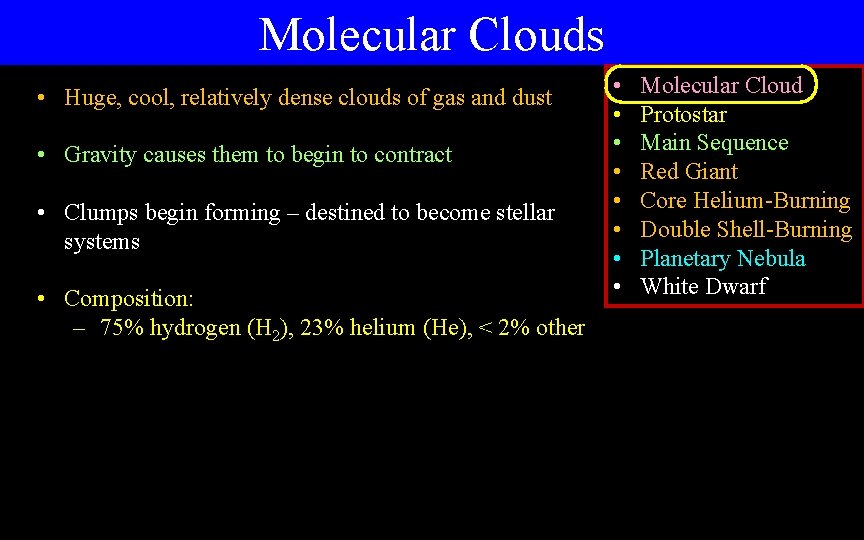
Molecular Clouds • Huge, cool, relatively dense clouds of gas and dust • Gravity causes them to begin to contract • Clumps begin forming – destined to become stellar systems • Composition: – 75% hydrogen (H 2), 23% helium (He), < 2% other • • Molecular Cloud Protostar Main Sequence Red Giant Core Helium-Burning Double Shell-Burning Planetary Nebula White Dwarf
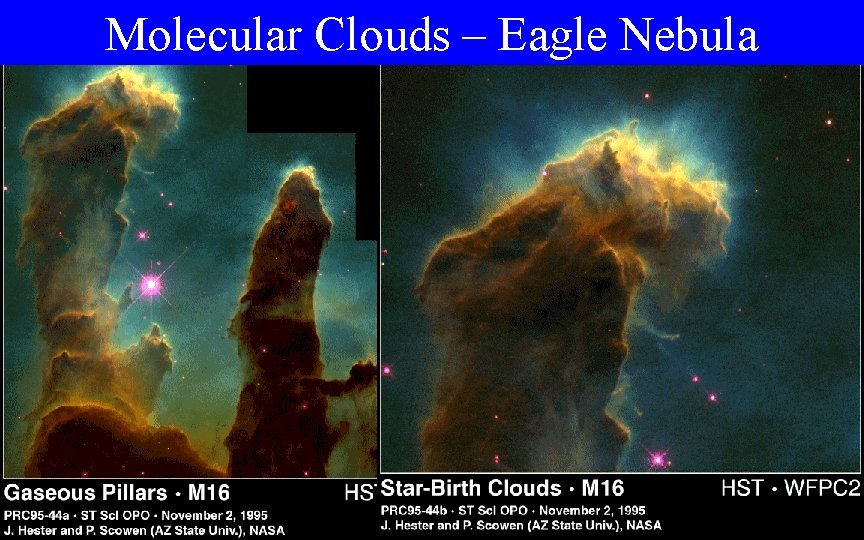
Molecular Clouds – Eagle Nebula
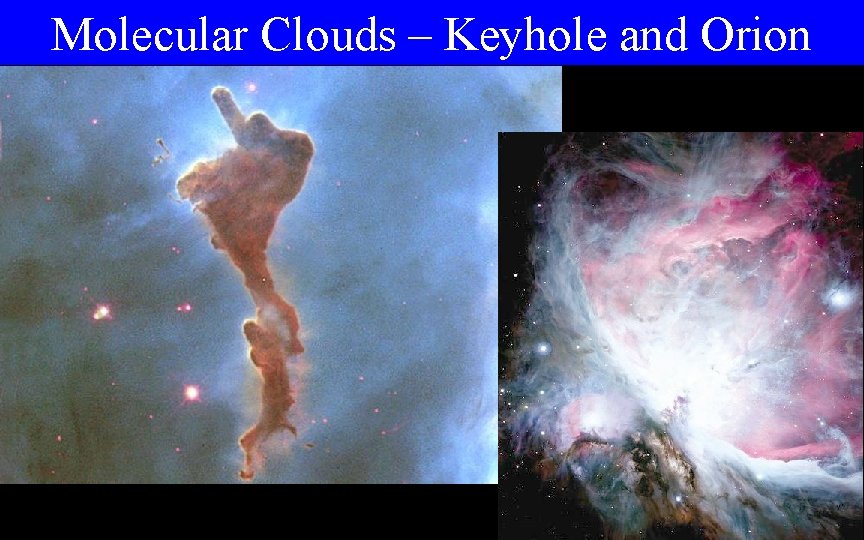
Molecular Clouds – Keyhole and Orion
Formation of Protostars • Cloud fragments to form multiple stars – Stars usually form in clusters – Often, two or more stars remain in orbit • The stars are a balance of pressure vs. gravity • Heat leaks out – they cool off • Reduced pressure – gravity wins – it contracts • • Molecular Cloud Protostar Main Sequence Red Giant Core Helium-Burning Double Shell-Burning Planetary Nebula White Dwarf
Negative Heat Capacity What happen as heat leaks out • They cool off – By P = kn. T, they have less pressure • Gravity defeats pressure – They contract • Energy is converted – Gravitational Energy Kinetic energy – Kinetic energy Heat • Net effect: When you remove heat, a star gets: – Smaller – Hotter (!)
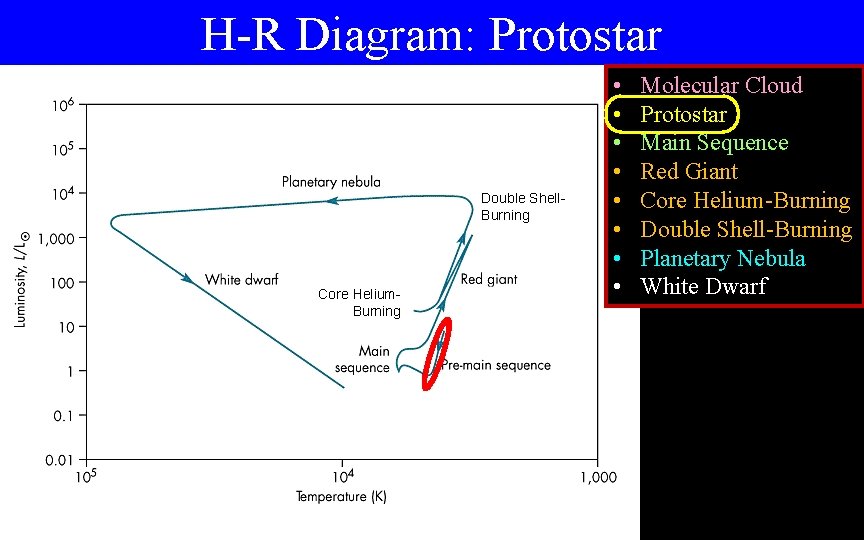
H-R Diagram: Protostar Double Shell. Burning Core Helium. Burning • • Molecular Cloud Protostar Main Sequence Red Giant Core Helium-Burning Double Shell-Burning Planetary Nebula White Dwarf
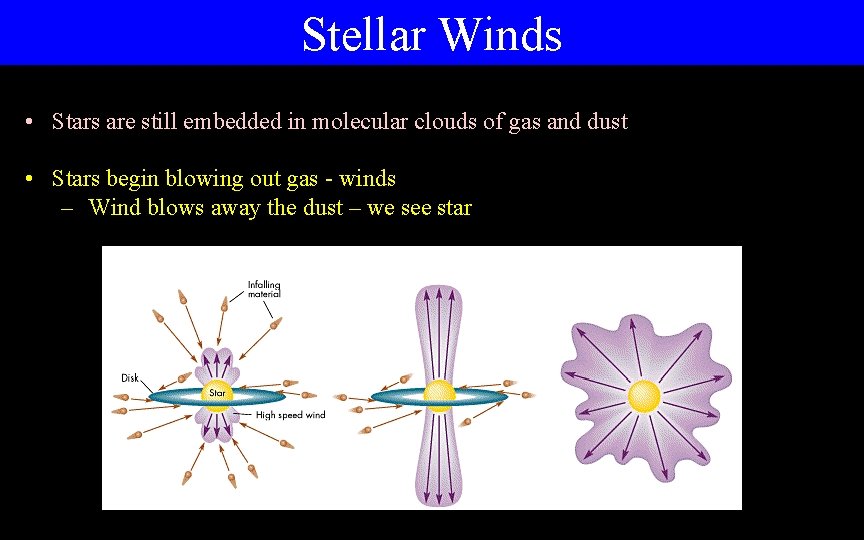
Stellar Winds • Stars are still embedded in molecular clouds of gas and dust • Stars begin blowing out gas - winds – Wind blows away the dust – we see star
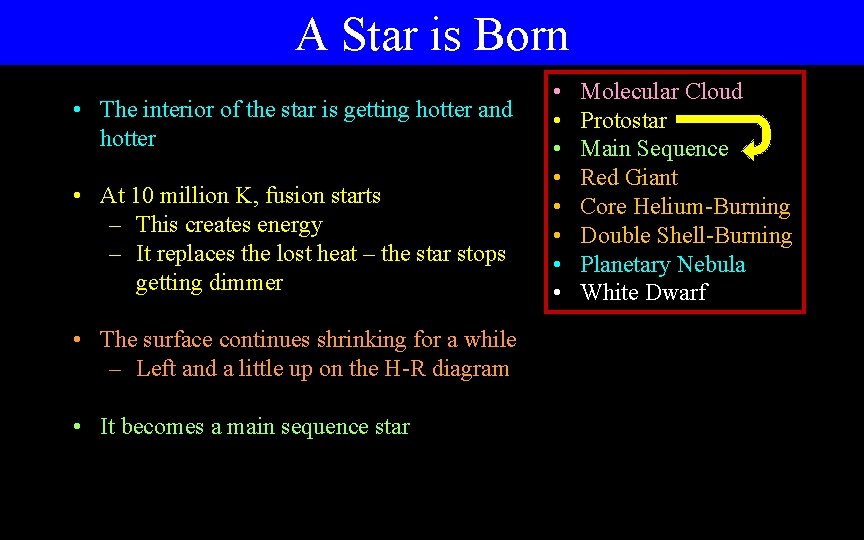
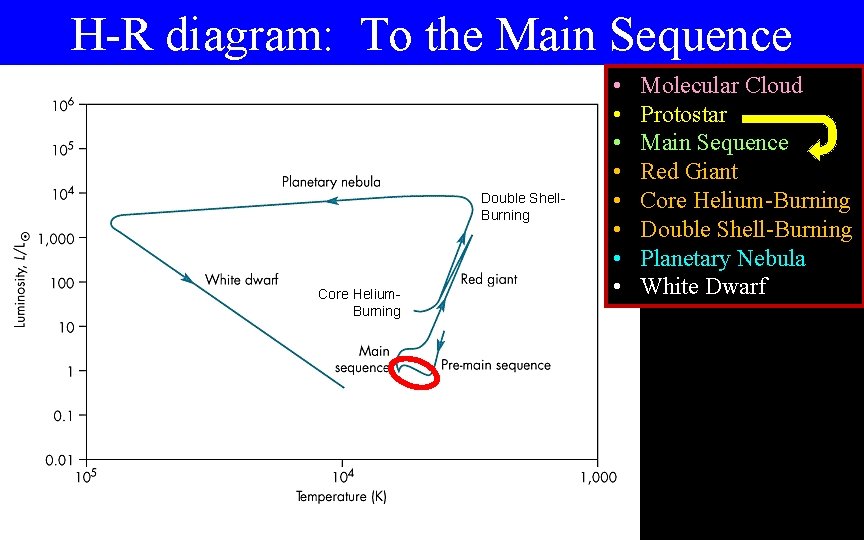
A Star is Born • The interior of the star is getting hotter and hotter • At 10 million K, fusion starts – This creates energy – It replaces the lost heat – the star stops getting dimmer • The surface continues shrinking for a while – Left and a little up on the H-R diagram • It becomes a main sequence star • • Molecular Cloud Protostar Main Sequence Red Giant Core Helium-Burning Double Shell-Burning Planetary Nebula White Dwarf
H-R diagram: To the Main Sequence Double Shell. Burning Core Helium. Burning • • Molecular Cloud Protostar Main Sequence Red Giant Core Helium-Burning Double Shell-Burning Planetary Nebula White Dwarf
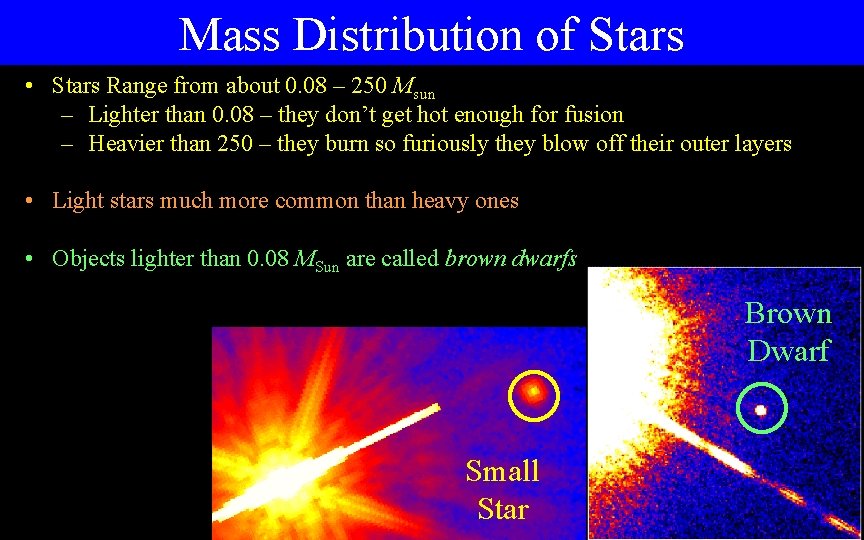
Mass Distribution of Stars • Stars Range from about 0. 08 – 250 Msun – Lighter than 0. 08 – they don’t get hot enough for fusion – Heavier than 250 – they burn so furiously they blow off their outer layers • Light stars much more common than heavy ones • Objects lighter than 0. 08 MSun are called brown dwarfs Brown Dwarf Small Star
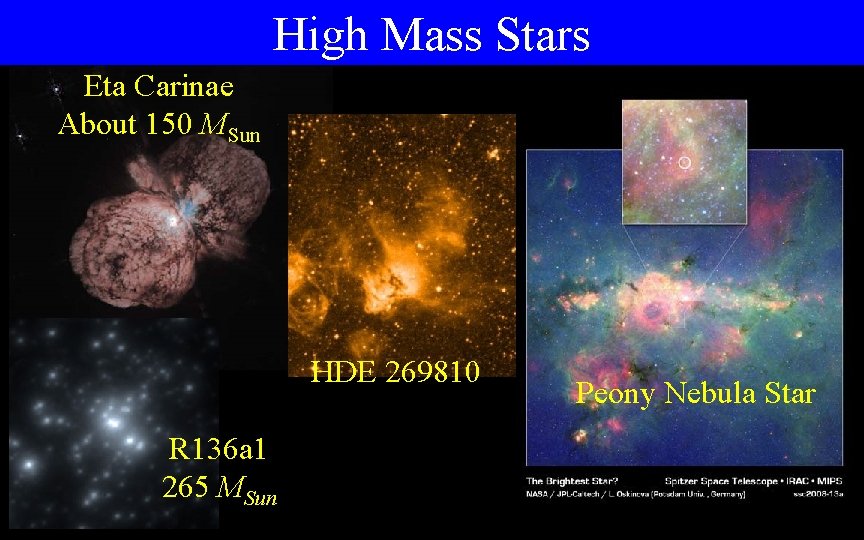
High Mass Stars Eta Carinae About 150 MSun HDE 269810 R 136 a 1 265 MSun Peony Nebula Star
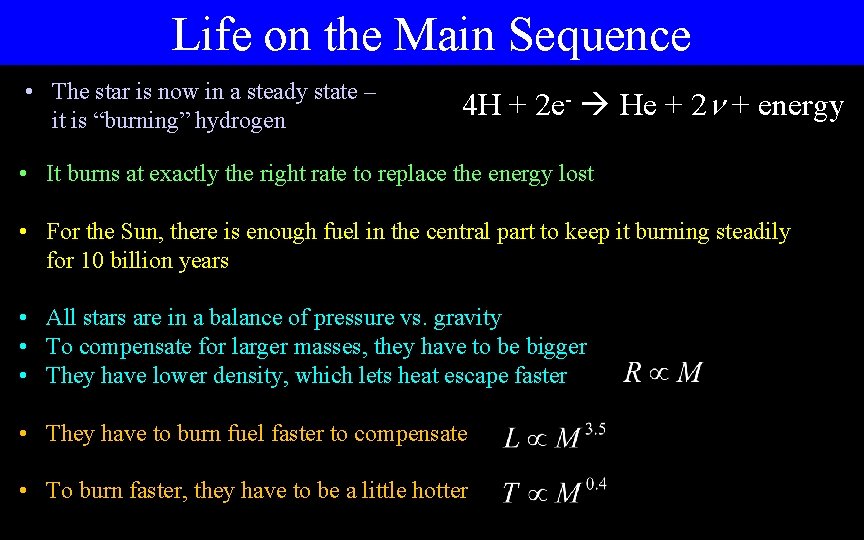
Life on the Main Sequence • The star is now in a steady state – it is “burning” hydrogen 4 H + 2 e- He + 2 + energy • It burns at exactly the right rate to replace the energy lost • For the Sun, there is enough fuel in the central part to keep it burning steadily for 10 billion years • All stars are in a balance of pressure vs. gravity • To compensate for larger masses, they have to be bigger • They have lower density, which lets heat escape faster • They have to burn fuel faster to compensate • To burn faster, they have to be a little hotter
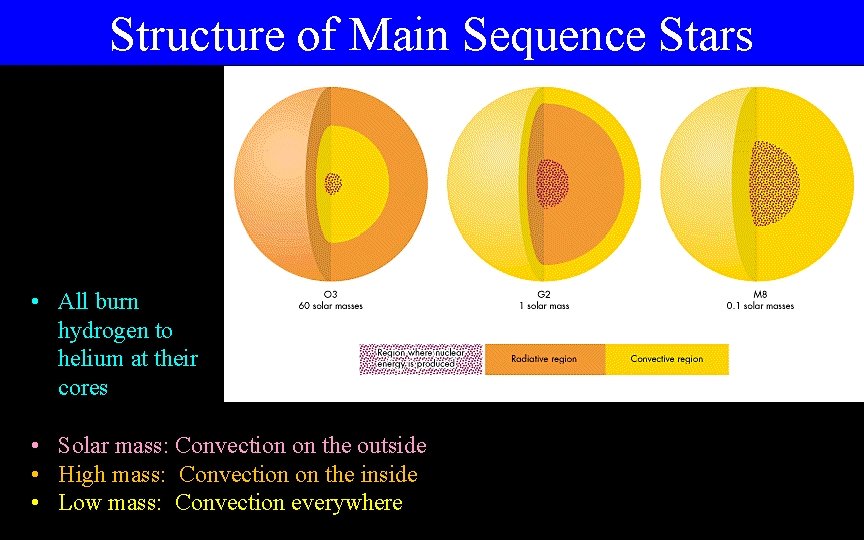
Structure of Main Sequence Stars • All burn hydrogen to helium at their cores • Solar mass: Convection on the outside • High mass: Convection on the inside • Low mass: Convection everywhere
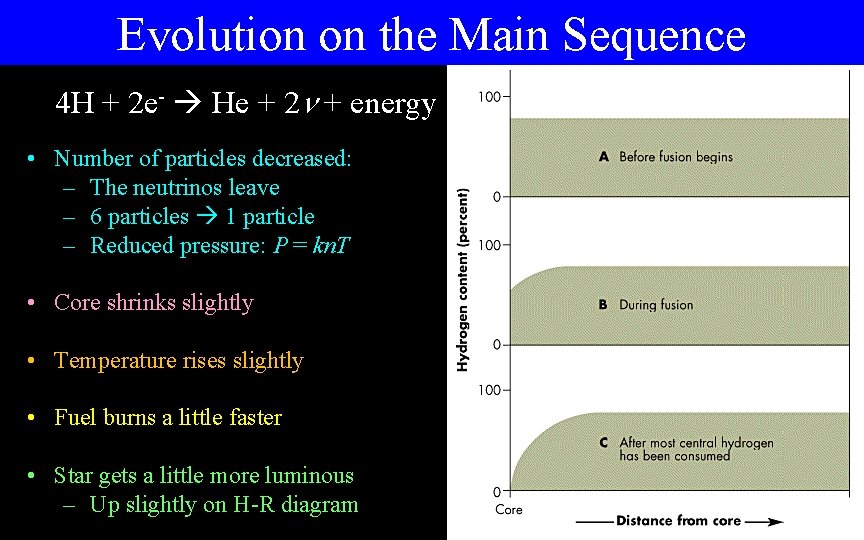
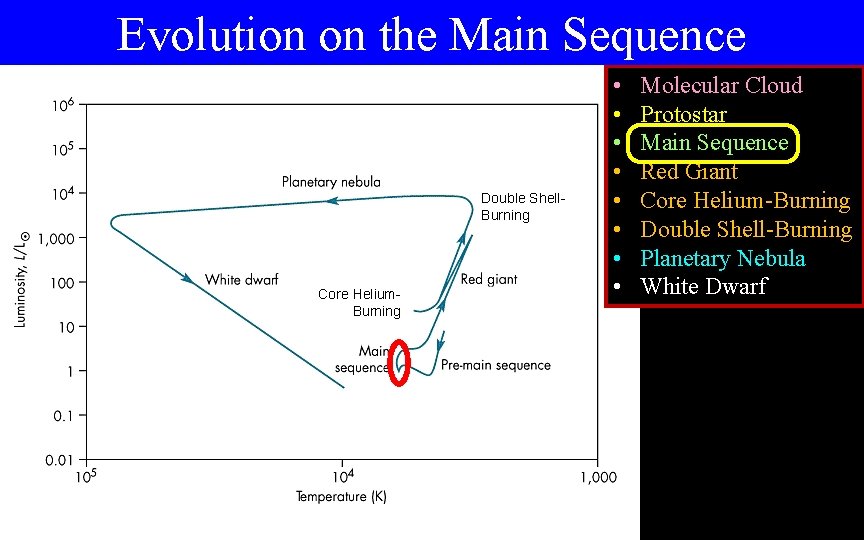
Evolution on the Main Sequence 4 H + 2 e- He + 2 + energy • Number of particles decreased: – The neutrinos leave – 6 particles 1 particle – Reduced pressure: P = kn. T • Core shrinks slightly • Temperature rises slightly • Fuel burns a little faster • Star gets a little more luminous – Up slightly on H-R diagram
Evolution on the Main Sequence Double Shell. Burning Core Helium. Burning • • Molecular Cloud Protostar Main Sequence Red Giant Core Helium-Burning Double Shell-Burning Planetary Nebula White Dwarf
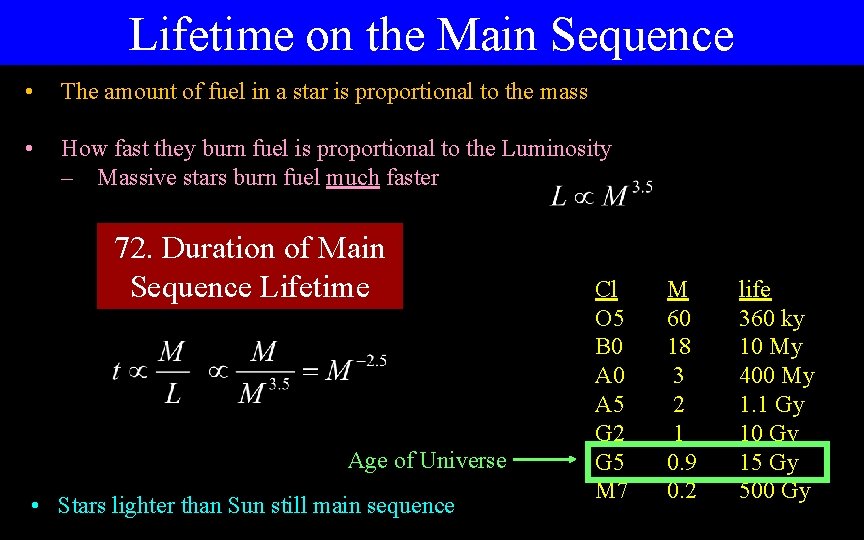
Lifetime on the Main Sequence • The amount of fuel in a star is proportional to the mass • How fast they burn fuel is proportional to the Luminosity – Massive stars burn fuel much faster 72. Duration of Main Sequence Lifetime Age of Universe • Stars lighter than Sun still main sequence Cl O 5 B 0 A 5 G 2 G 5 M 7 M 60 18 3 2 1 0. 9 0. 2 life 360 ky 10 My 400 My 1. 1 Gy 10 Gy 15 Gy 500 Gy
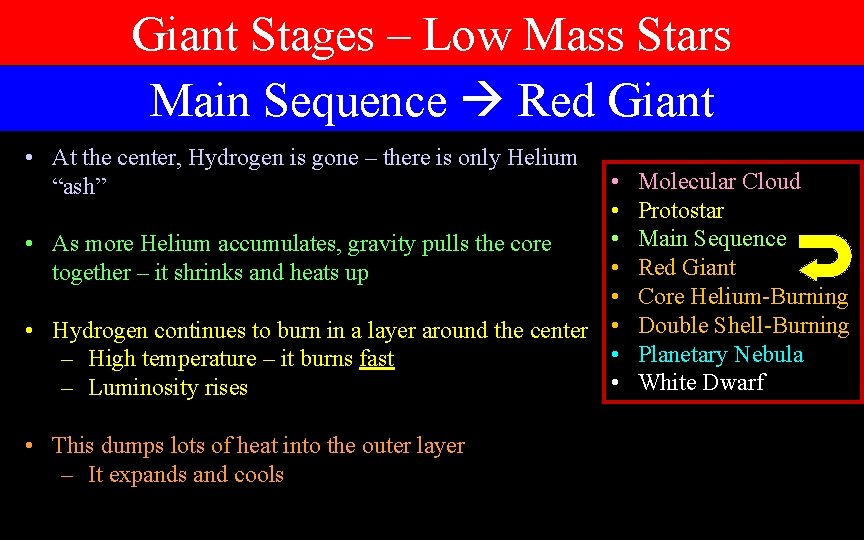
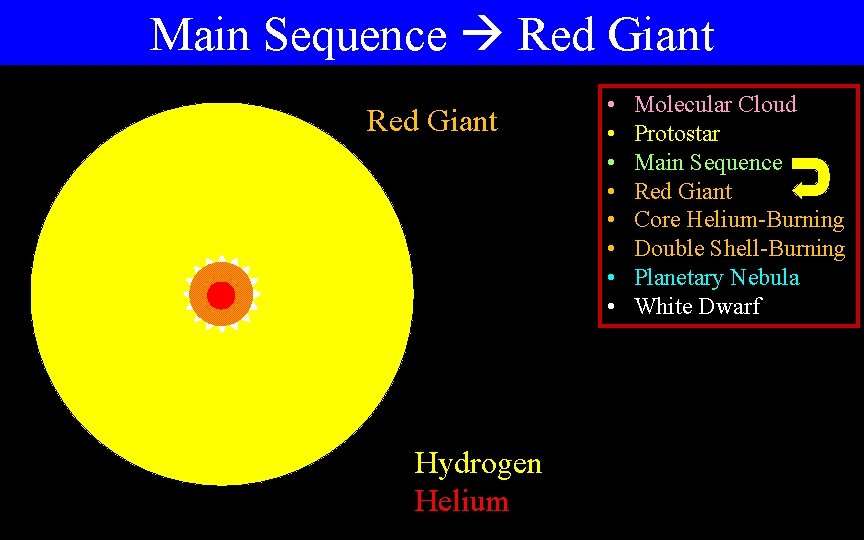
Giant Stages – Low Mass Stars Main Sequence Red Giant • At the center, Hydrogen is gone – there is only Helium “ash” • • As more Helium accumulates, gravity pulls the core • together – it shrinks and heats up • • Hydrogen continues to burn in a layer around the center • • – High temperature – it burns fast • – Luminosity rises • This dumps lots of heat into the outer layer – It expands and cools Molecular Cloud Protostar Main Sequence Red Giant Core Helium-Burning Double Shell-Burning Planetary Nebula White Dwarf
Main Sequence Red Giant Main Red Giant Sequence Hydrogen Helium • • Molecular Cloud Protostar Main Sequence Red Giant Core Helium-Burning Double Shell-Burning Planetary Nebula White Dwarf
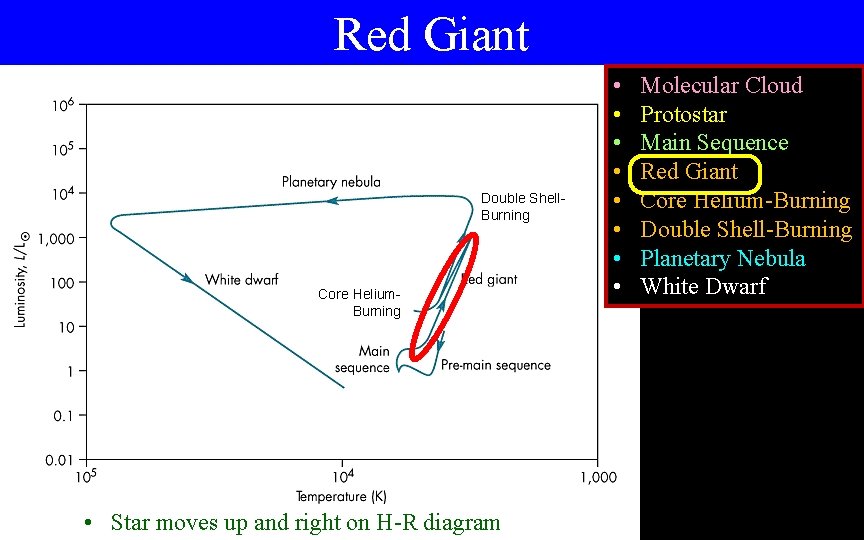
Red Giant Double Shell. Burning Core Helium. Burning • Star moves up and right on H-R diagram • • Molecular Cloud Protostar Main Sequence Red Giant Core Helium-Burning Double Shell-Burning Planetary Nebula White Dwarf
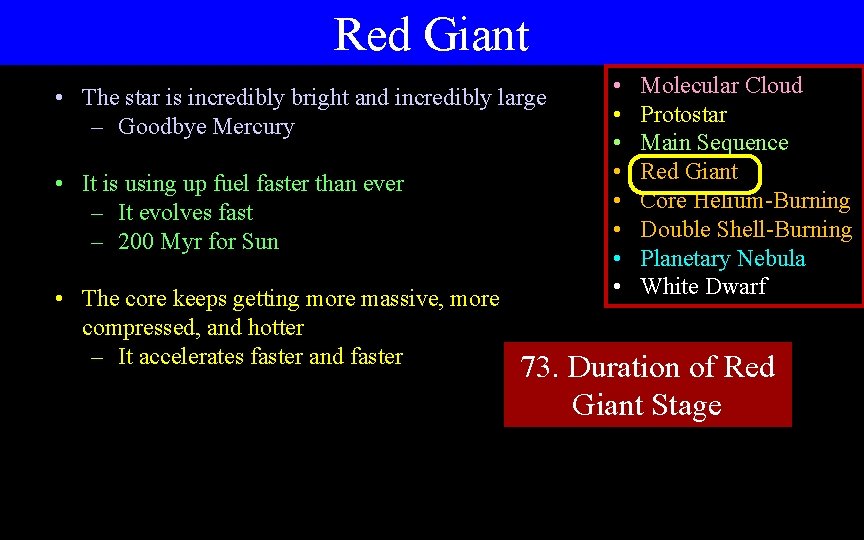
Red Giant • The star is incredibly bright and incredibly large – Goodbye Mercury • It is using up fuel faster than ever – It evolves fast – 200 Myr for Sun • The core keeps getting more massive, more compressed, and hotter – It accelerates faster and faster • • Molecular Cloud Protostar Main Sequence Red Giant Core Helium-Burning Double Shell-Burning Planetary Nebula White Dwarf 73. Duration of Red Giant Stage
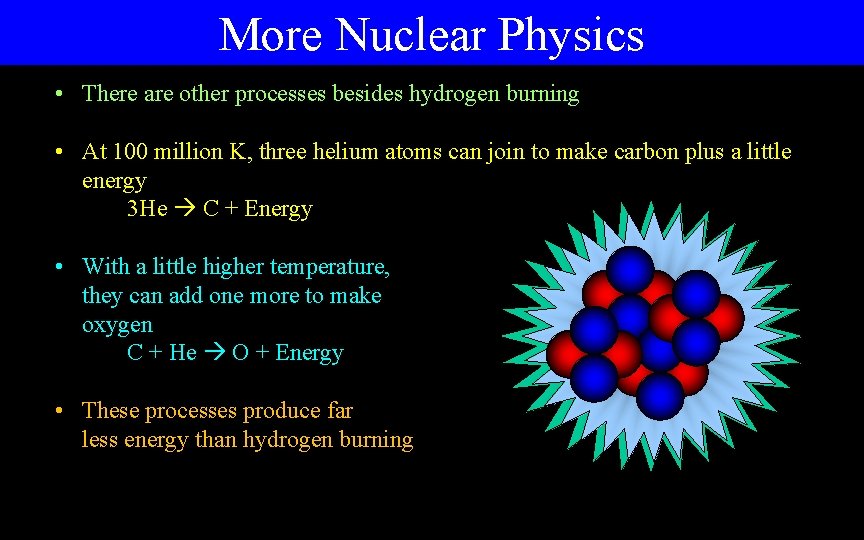
More Nuclear Physics • There are other processes besides hydrogen burning • At 100 million K, three helium atoms can join to make carbon plus a little energy 3 He C + Energy • With a little higher temperature, they can add one more to make oxygen C + He O + Energy • These processes produce far less energy than hydrogen burning
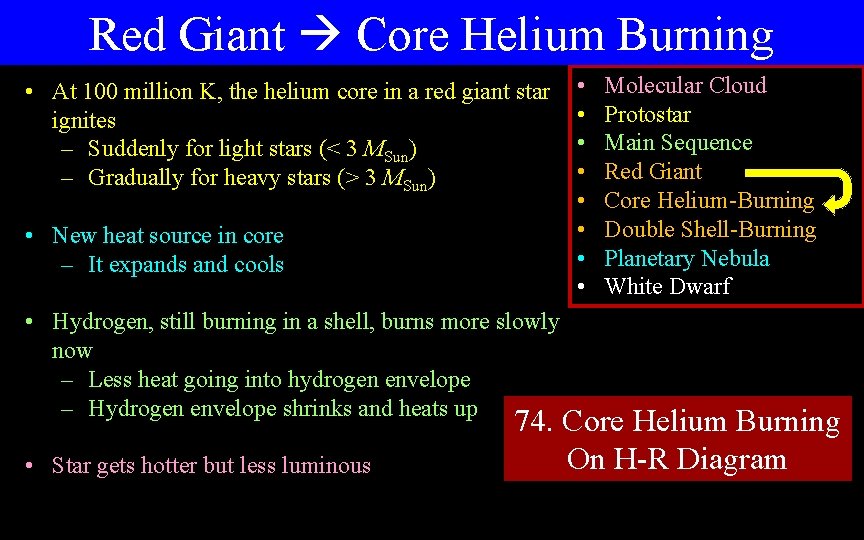
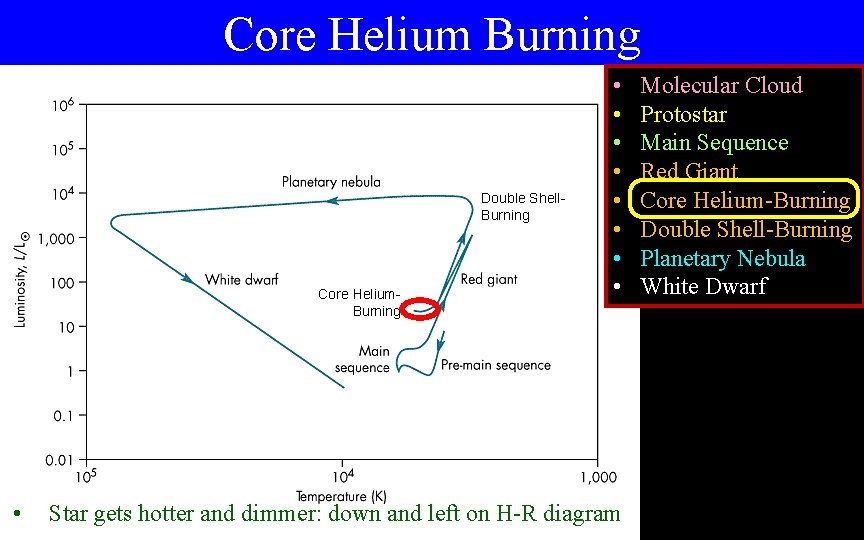
Red Giant Core Helium Burning • At 100 million K, the helium core in a red giant star ignites – Suddenly for light stars (< 3 MSun) – Gradually for heavy stars (> 3 MSun) • New heat source in core – It expands and cools • Hydrogen, still burning in a shell, burns more slowly now – Less heat going into hydrogen envelope – Hydrogen envelope shrinks and heats up • Star gets hotter but less luminous • • Molecular Cloud Protostar Main Sequence Red Giant Core Helium-Burning Double Shell-Burning Planetary Nebula White Dwarf 74. Core Helium Burning On H-R Diagram
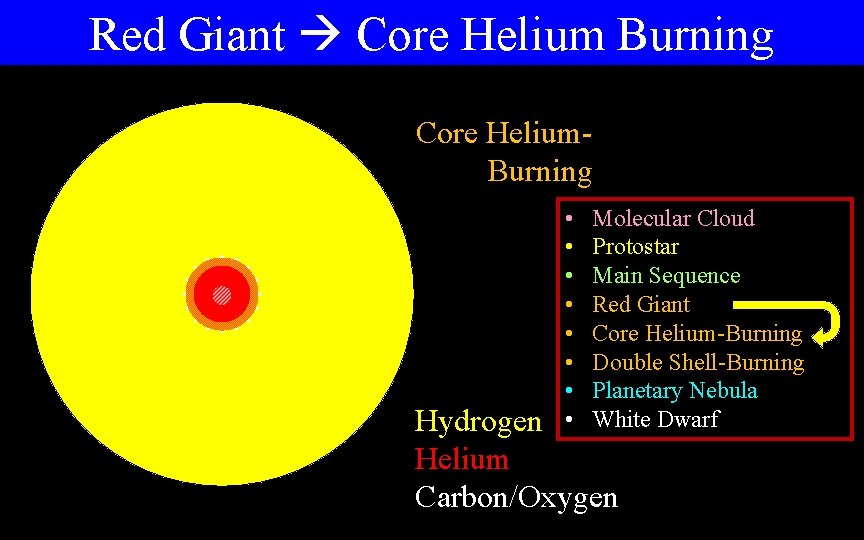
Red Giant Core Helium Burning Red Core. Giant Helium. Burning • • Molecular Cloud Protostar Main Sequence Red Giant Core Helium-Burning Double Shell-Burning Planetary Nebula White Dwarf Hydrogen Helium Carbon/Oxygen
Core Helium Burning Double Shell. Burning Core Helium. Burning • • • Star gets hotter and dimmer: down and left on H-R diagram Molecular Cloud Protostar Main Sequence Red Giant Core Helium-Burning Double Shell-Burning Planetary Nebula White Dwarf