
Low Level Laser Therapy for Oral Mucositis Ashlee


- Slides: 18
Low Level Laser Therapy for Oral Mucositis Ashlee Handeland Katie Thigpen Lamar Institute of Technology Dental Hygiene Program
Introduction to Oral Mucositis � Head and neck cancer is the 6 th leading cancer world wide. � Oral Mucositis is one of the most frequent complications seen in the treatment of head and neck cancer. � Oral mucositis develops in approximately 6085% of patients undergoing radiation therapy and chemotherapy.
� http: //www. youtube. com/watch? v=1 YXe. GXtu je. E&sns=em
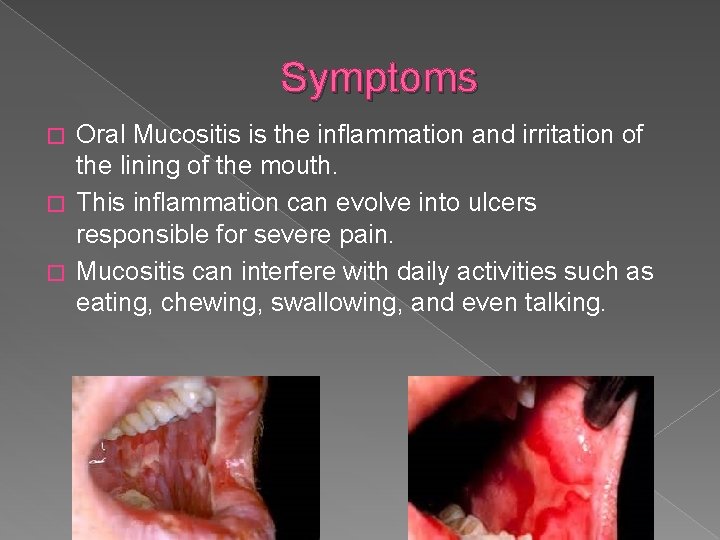
Symptoms Oral Mucositis is the inflammation and irritation of the lining of the mouth. � This inflammation can evolve into ulcers responsible for severe pain. � Mucositis can interfere with daily activities such as eating, chewing, swallowing, and even talking. �
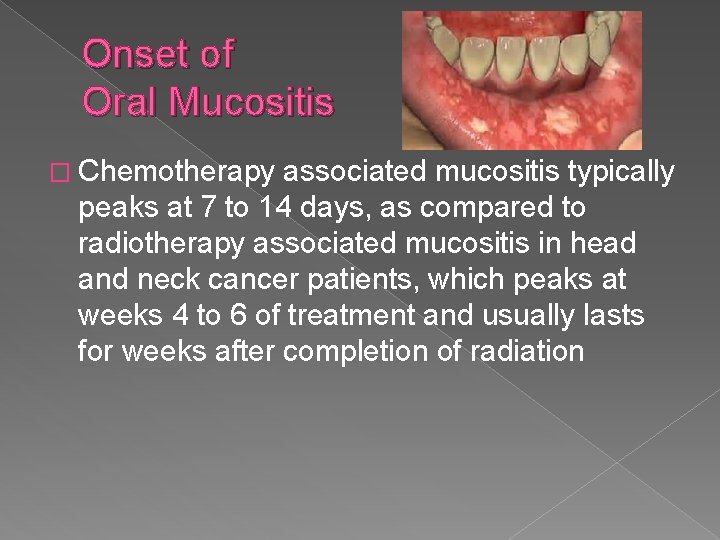
Onset of Oral Mucositis � Chemotherapy associated mucositis typically peaks at 7 to 14 days, as compared to radiotherapy associated mucositis in head and neck cancer patients, which peaks at weeks 4 to 6 of treatment and usually lasts for weeks after completion of radiation
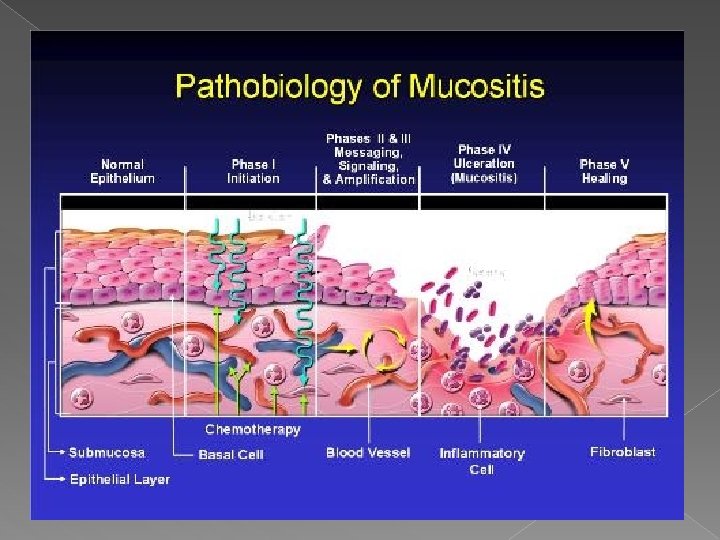
5 Phases of Oral Mucositis � Phase one is the initiation stage in which radiation and chemotherapy directly injures DNA and causes death of basil epithelial cells. � Phase two is when free radicals activate messengers that send signals to the inside of the cells which leads to tissue injury and cell death.
5 Phases Continued � Phase three is the chain reaction of amplifying and prolonging tissue injury because the damaging events are focuses on the sub mucosal and basil epithelium, the clinical appearance of the mucosal surface remains normal � Phase four is the ulceration stage which is the loss of mucosal integrity and produces extremely painful lesions.
5 Phases Continued � Phase five is the healing process in which proliferation of epithelium occurs as well as cellular and tissue differentiation, restoring the integrity of the epithelium.
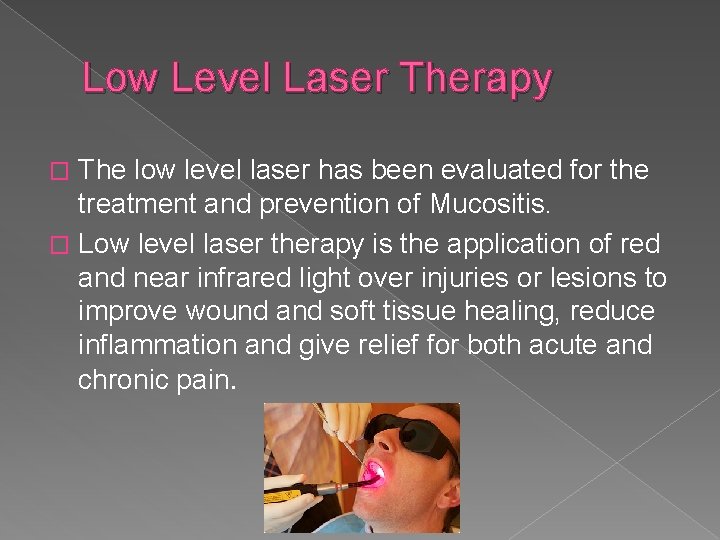
Low Level Laser Therapy The low level laser has been evaluated for the treatment and prevention of Mucositis. � Low level laser therapy is the application of red and near infrared light over injuries or lesions to improve wound and soft tissue healing, reduce inflammation and give relief for both acute and chronic pain. �
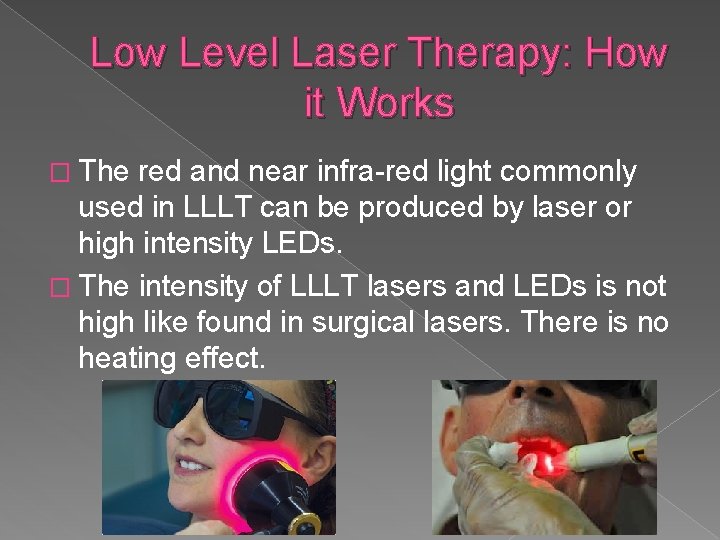
Low Level Laser Therapy: How it Works � The red and near infra-red light commonly used in LLLT can be produced by laser or high intensity LEDs. � The intensity of LLLT lasers and LEDs is not high like found in surgical lasers. There is no heating effect.
Low Level Laser Therapy: How it Works The low level laser is directed at affected areas of the mouth and is thought to stimulate healing therefore it helps to reduce pain symptoms, helps improvement of swallowing, and the quality of life of the patients. � After beaming the oral mucosa, pain relief was noticed. Depending on the severity of oral mucositis, on average, 2. 5 treatments per lesion in a period of one week were sufficient to heal a mucositis lesion �
� http: //www. youtube. com/watch? v=9 Mfrrga 40 yw&sns=em
Adverse effects? There are normally no adverse effects from Low level laser therapy; however, patients occasionally experience mild discomfort/ache after treatment. � This is due to a restimulation of the inflammatory phase and should settle down after 24 -48 hours. � All people present in the treatment area should wear appropriate laser safety eye wear, because the laser beam is harmful to the eyes. �
Why is this important? � The dental hygienist plays an important role in meeting the unique and often challenging oral health care needs of patients who are impacted by cancer. � Because cancer greatly affects the oral tissues, the dental hygienist needs to know about the potential side effects of radiation and chemotherapy and how to treat it.
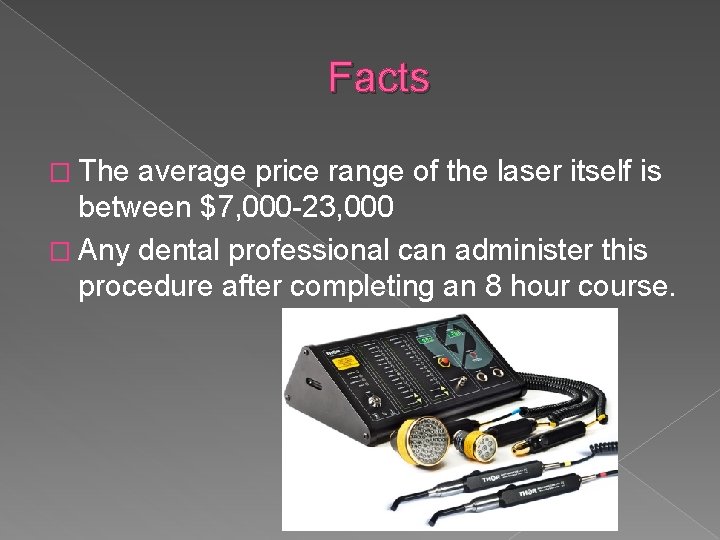
Facts � The average price range of the laser itself is between $7, 000 -23, 000 � Any dental professional can administer this procedure after completing an 8 hour course.
In conclusion. . � The low level laser has been proven to significantly reduce and prevent the side effects of oral mucositis caused by chemotherapy and radiation. � By using this laser we can improve the patients quality of life by reducing inflammation, ulceration, and pain in the patients oral cavity.
References � � � Antunes H, Herchenhorn C, & Aragugo E. (2011). Low Level Laser Therapy Reduces Oral Mucositis in Head and Neck Cancer. N. P. http: //cancer. unm. edu/2011/08/18/lasertherapy-reduces-oral-mucositis-in-head-and-neck-cancer/ Arbabi-Kalati, F. , & Moridi, T. (2013). Evaluation of the Effect of Low Level Laser on Prevention of Chemotherapy-Induced Mucositis. Acta Medica Iranica, 51(3), 157 -162. Drs Rita G. E. C. Cauwels, & L. C. Martens. (2011). Low level laser therapy in oral mucositis: a pilot study. European Archives. Vol. 12. n. p. Retrieved from http: //link. springer. com/article/10. 1007/BF 03262791. Doi: 10. 1007/BF 03262791 � Merigo, E. , Fontana, M. , Fornaini, C. , Clini, F. , Cella, L. , Vescovi, P. , & Oppici, A. (2012). Preliminary study on radio-chemo-induced oral mucositis and low level laser therapy. AIP Conference Proceedings, 1486(1), 137 -141. doi: 10. 1063/1. 4757833 � http: //www. thorlaser. com/