
Low Latency Photon Mapping with Block Hashing Vincent
Low Latency Photon Mapping with Block Hashing Vincent C. H. Ma Michael D. Mc. Cool Computer Graphics Lab University of Waterloo Block Hashing
Menu du Jour Appetizer: First course: Entrée: Dessert: Motivation and Background Locality Sensitive Hashing Block Hashing Results, Future Work, Conclusion Block Hashing 2
![Motivation • Trend: Rendering algorithms migrating towards hardware(-assisted) implementations – [Purcell et al. 2002]](http://slidetodoc.com/presentation_image_h2/899ecf7217c863d60a44acbf2ab891f3/image-3.jpg "Motivation • Trend: Rendering algorithms migrating towards hardware(-assisted) implementations – [Purcell et al. 2002]")
Motivation • Trend: Rendering algorithms migrating towards hardware(-assisted) implementations – [Purcell et al. 2002] – [Schmittler et al. 2002] Ø We wanted to investigate hardware(-assisted) implementation of Photon Mapping [Jensen 95] Block Hashing 3
k. NN Problem • Need to solve for k-Nearest Neighbours (k. NN) • Used for density estimation in photon mapping • Want to eventually integrate with GPU-based rendering Ø Migrate k. NN onto hardware-assisted platform – Adapting algorithms and data structures – Parallelization – Approximate k. NN? Block Hashing 4
Applications of k. NN • k. NN has many other applications, such as: – Procedural texture generation [Worley 96] – Direct ray tracing of point-based objects [Zwicker et al. 2001] – Surface reconstruction – Sparse data interpolation – Collision detection Block Hashing 5
Hashing-Based Ak. NN • Why hashing? – Hash function can be evaluated in constant time – Eliminates multi-level, serially-dependent memory accesses Ø Amenable to fine-scale parallelism and pipelined memory Block Hashing 6
Hashing-Based Ak. NN • Want hash functions that preserve spatial neighbourhoods – Points close to each other in domain space will be close together in hash space – Points in the same hash bucket as query point are close to query point in domain space – Good candidates for k-nearest neighbour search Block Hashing 7

Locality Sensitive Hashing • Gionis, Indyk, and Motwani, Similarity Search in High Dimensions via Hashing, Proc. VLDB’ 99 – Hash function partitions domain space – Assigns one hash value per partition Ø All points falling into the same partition will receive the same hash value Block Hashing 8
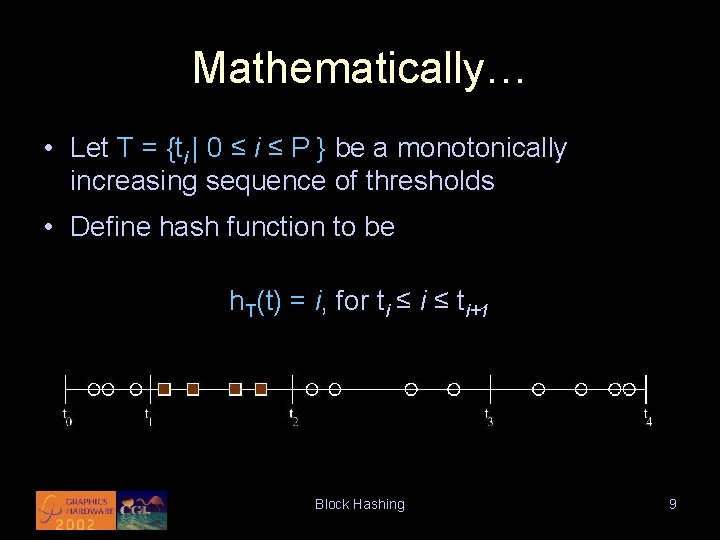
Mathematically… • Let T = {ti | 0 ≤ i ≤ P } be a monotonically increasing sequence of thresholds • Define hash function to be h. T(t) = i, for ti ≤ ti+1 Block Hashing 9
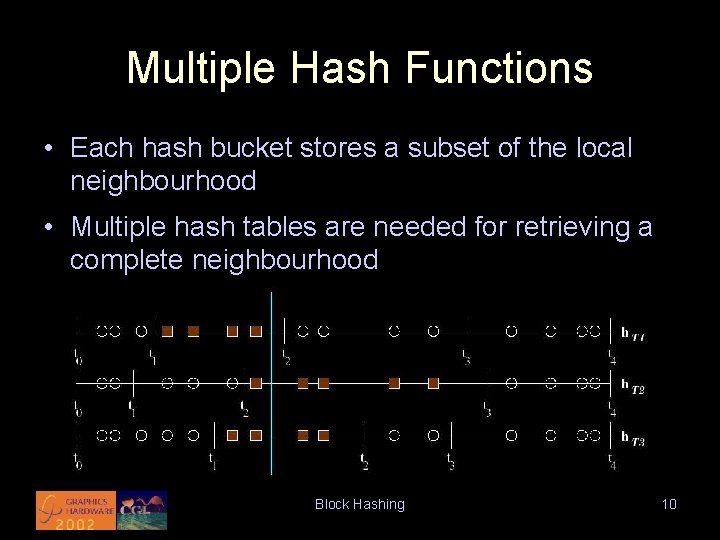
Multiple Hash Functions • Each hash bucket stores a subset of the local neighbourhood • Multiple hash tables are needed for retrieving a complete neighbourhood Block Hashing 10
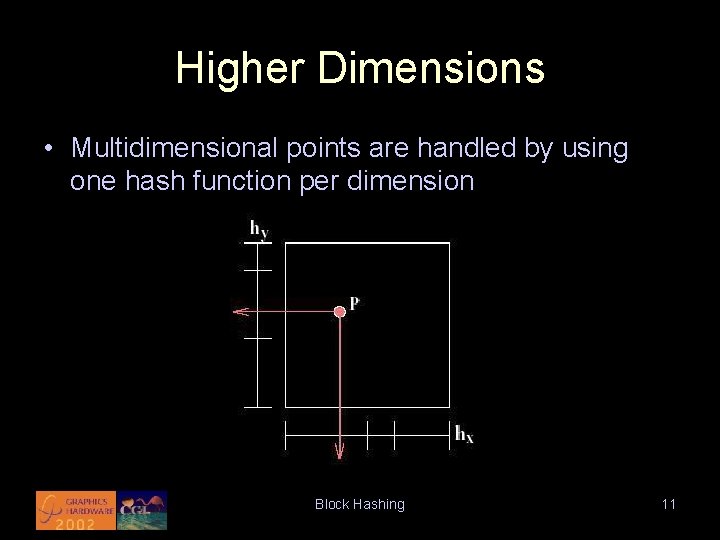
Higher Dimensions • Multidimensional points are handled by using one hash function per dimension Block Hashing 11
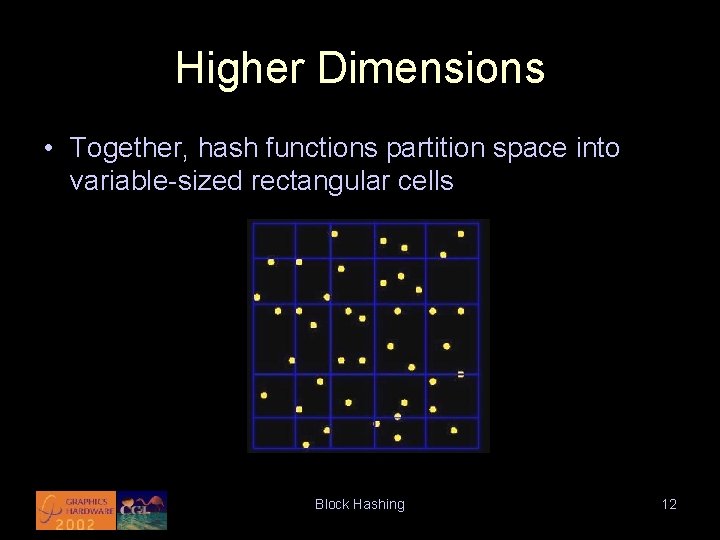
Higher Dimensions • Together, hash functions partition space into variable-sized rectangular cells Block Hashing 12
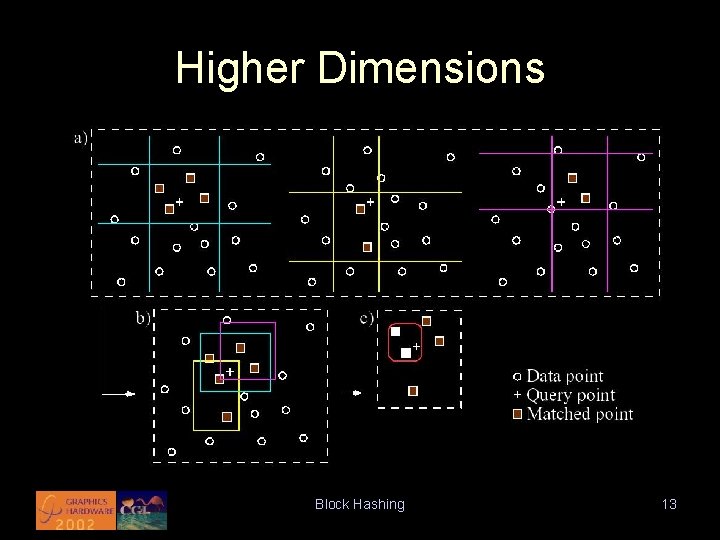
Higher Dimensions Block Hashing 13
Block Hashing Essentials • Photons are grouped into spatially-coherent memory blocks • Entire blocks are inserted into the hash tables Block Hashing 14
Why Blocks of Photons? • More desirable to insert blocks of photons into the hash table (instead of individual photons) – Fewer references needed per hash table bucket – Fewer items to compare when merging results from multiple hash tables during query – Photon records are accessed once per query – Memory block-oriented anyways Block Hashing 15

Block-Oriented Memory Model • Memory access is via burst transfer – Reading any part of a fixed-sized memory block implies the access to the rest of this block is virtually zero-cost • 256 -byte chosen as size of photon blocks – Photons are 24 -bytes – X = 10 photons fit in each block Block Hashing 16
Block Hashing • Preprocessing: before rendering – Organize photons into blocks – Create hash tables – Insert blocks into hash tables • Query phase: during rendering Block Hashing 17
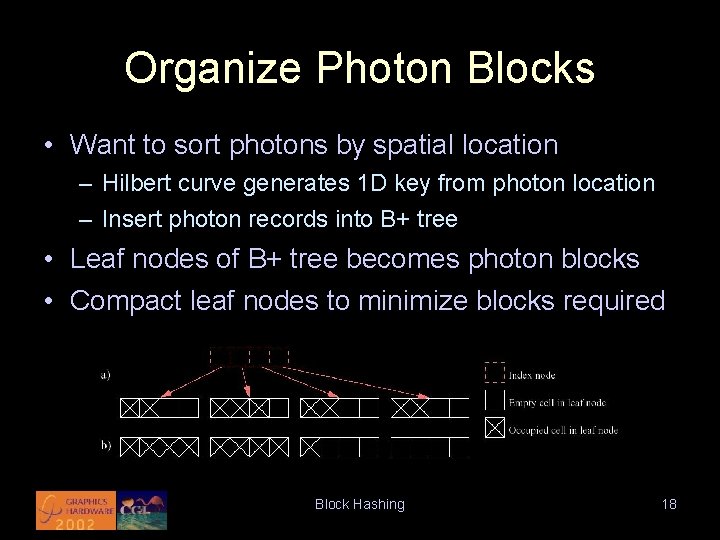
Organize Photon Blocks • Want to sort photons by spatial location – Hilbert curve generates 1 D key from photon location – Insert photon records into B+ tree • Leaf nodes of B+ tree becomes photon blocks • Compact leaf nodes to minimize blocks required Block Hashing 18
Create Hash Tables • Based on LSH: – L hash tables – Each hash table has three hash functions – Each function has P thresholds Block Hashing 19
Create Hash Tables • Generate thresholds adaptively – Create one photon-position histogram per dimension – Integrate → cumulative distribution function (cdf) – Invert cdf, take stochastic samples to get thresholds Block Hashing 20
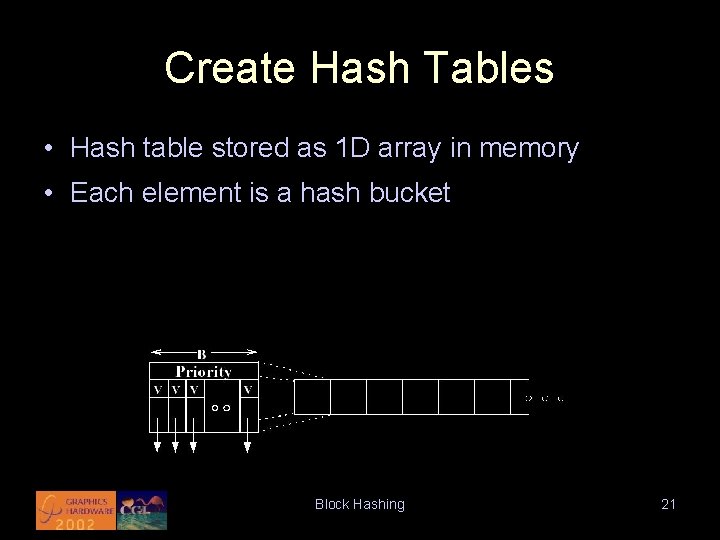
Create Hash Tables • Hash table stored as 1 D array in memory • Each element is a hash bucket Block Hashing 21
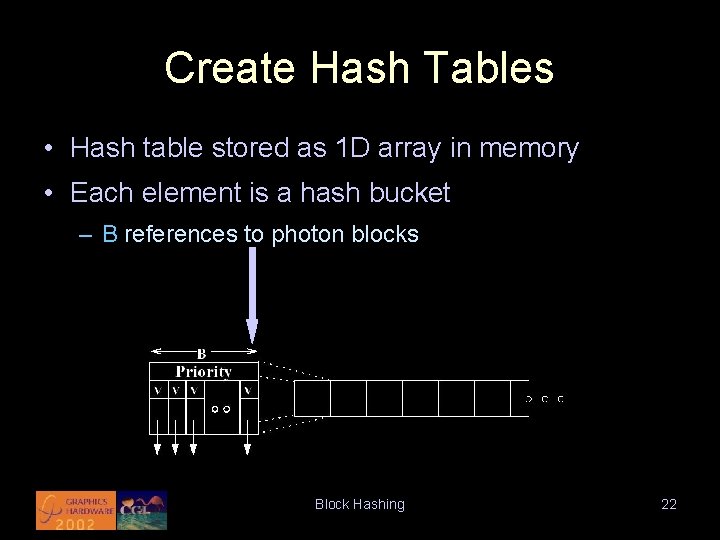
Create Hash Tables • Hash table stored as 1 D array in memory • Each element is a hash bucket – B references to photon blocks Block Hashing 22
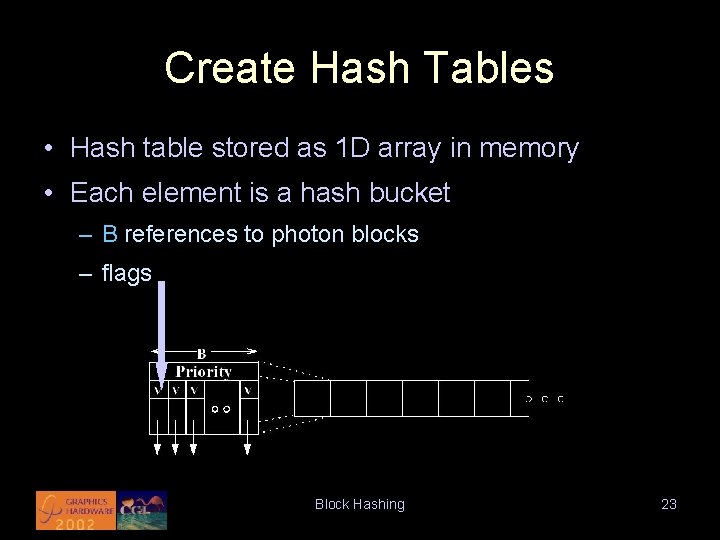
Create Hash Tables • Hash table stored as 1 D array in memory • Each element is a hash bucket – B references to photon blocks – flags Block Hashing 23

Create Hash Tables • Hash table stored as 1 D array in memory • Each element is a hash bucket – B references to photon blocks – flags – a priority value Block Hashing 24
Insert Photon Blocks • For each photon and each hash table: – Create hash key using 3 D position of photon – Insert entire photon block into hash table using key • Strategies to deal with bucket overflow Block Hashing 25
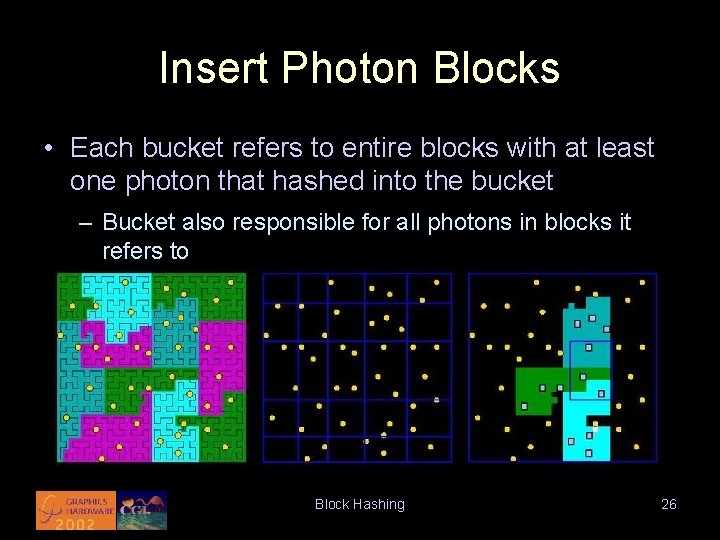
Insert Photon Blocks • Each bucket refers to entire blocks with at least one photon that hashed into the bucket – Bucket also responsible for all photons in blocks it refers to Block Hashing 26
Block Hashing • Preprocessing: before rendering – Organizing photons into blocks – Creating the hash tables – Inserting blocks into hash tables • Query phase: during rendering Block Hashing 27
Querying • Query is delegated to each hash table in parallel • Each hash table returns all blocks contained in bucket that matched the query • Set of unique blocks contain candidate set of photons – Each block contains a disjoint set of photons Block Hashing 28
Querying • Each query yields L buckets, each bucket gives B photon blocks • Each query retrieves at most BL blocks • Can trade accuracy for speed: – User defined variable A, determines # blocks eventually included in candidate search – Examines at most Ak photons → Ak/X blocks Block Hashing 29
Querying • Which photon blocks to examine first? • Assign “quality measure” Q to every bucket in each hash table – Q = B - #blocks_inserted - #overflows • Sort buckets by their “priority” |Q| Block Hashing 30
Parameter Values • Need to express L, P, and B in terms of N, k and A • Experiments showed ln. N is a good choice for both L and P • B is determined by k and A, given by: • Memory overhead: Block Hashing 31
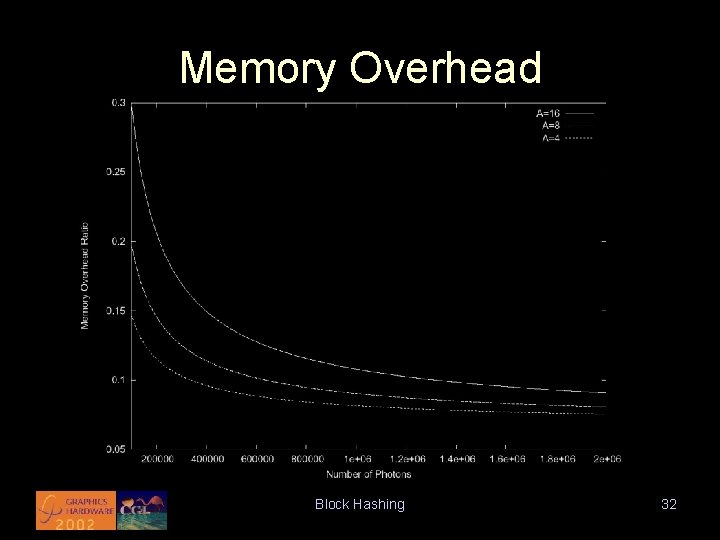
Memory Overhead Block Hashing 32
Results • Visual quality • Algorithmic accuracy – False negatives – Maximum distance dilation – Average distance dilation Block Hashing 33
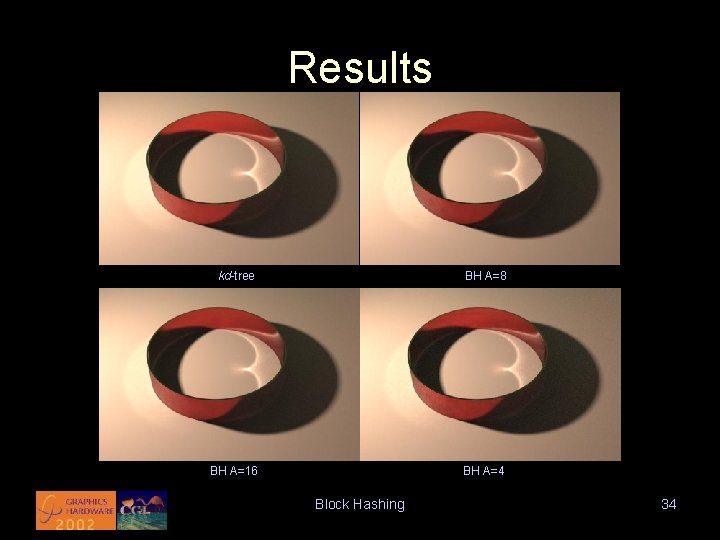
Results kd-tree BH A=8 BH A=16 BH A=4 Block Hashing 34
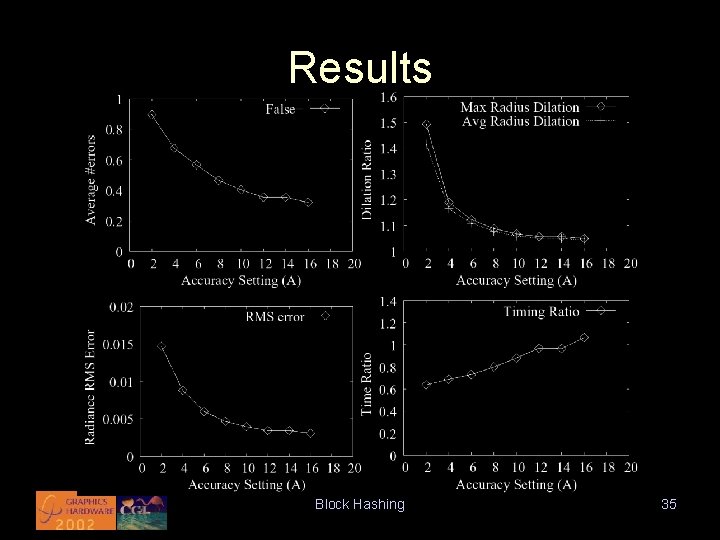
Results Block Hashing 35
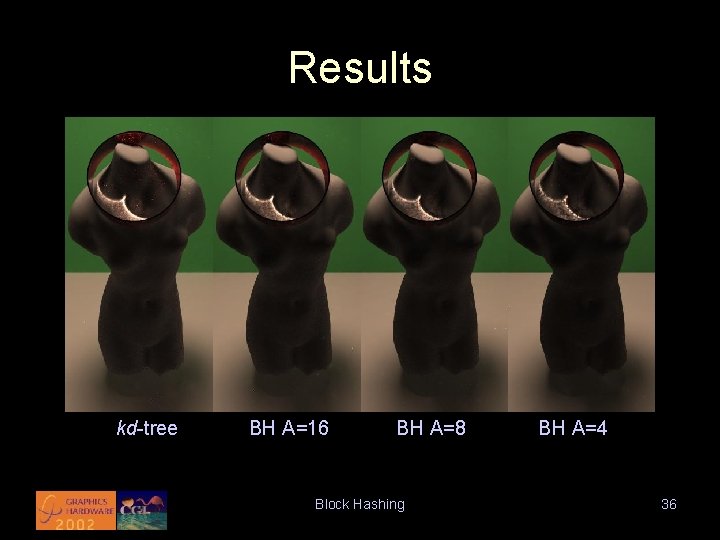
Results kd-tree BH A=16 BH A=8 Block Hashing BH A=4 36
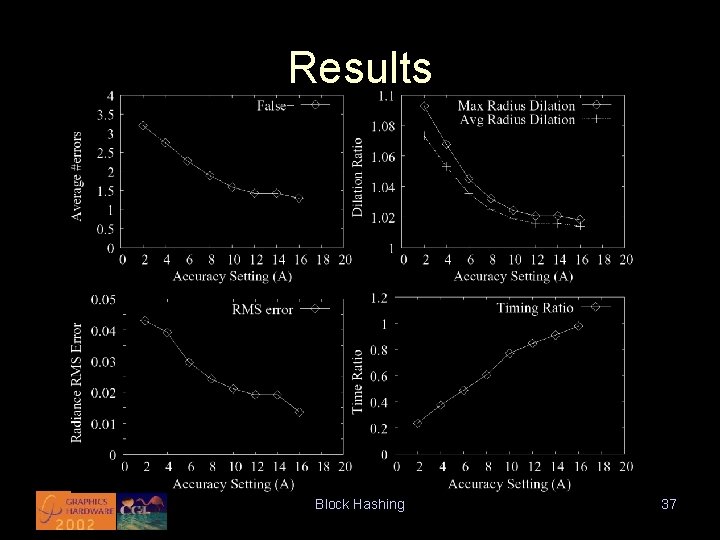
Results Block Hashing 37
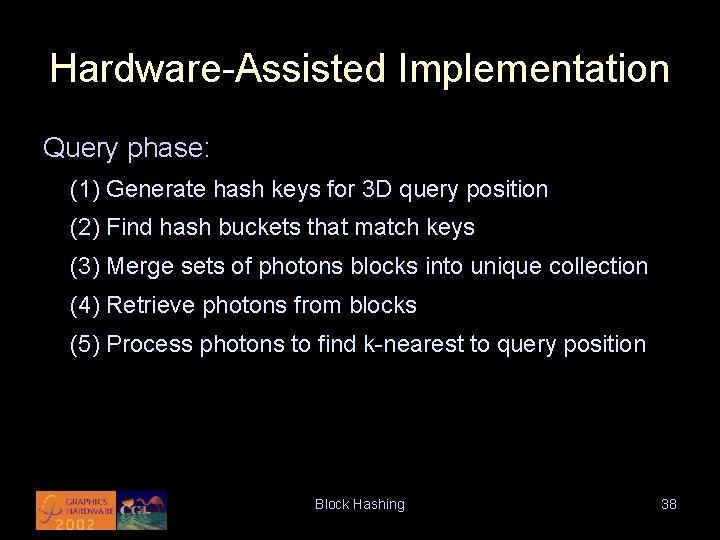
Hardware-Assisted Implementation Query phase: (1) Generate hash keys for 3 D query position (2) Find hash buckets that match keys (3) Merge sets of photons blocks into unique collection (4) Retrieve photons from blocks (5) Process photons to find k-nearest to query position Block Hashing 38
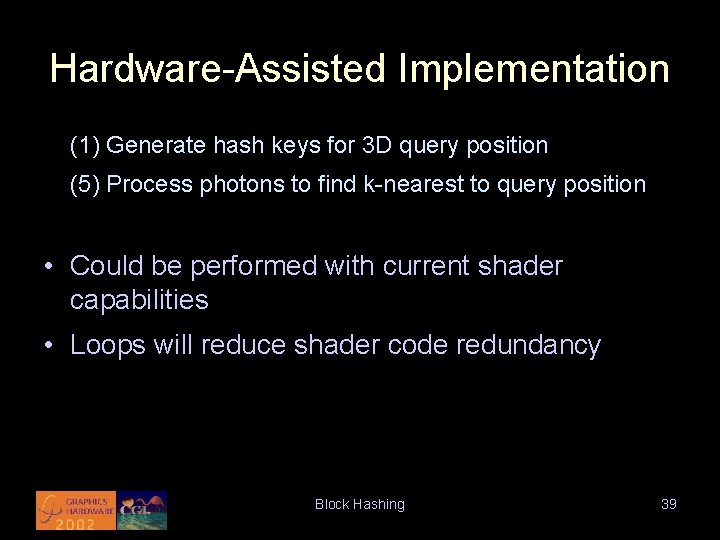
Hardware-Assisted Implementation (1) Generate hash keys for 3 D query position (5) Process photons to find k-nearest to query position • Could be performed with current shader capabilities • Loops will reduce shader code redundancy Block Hashing 39
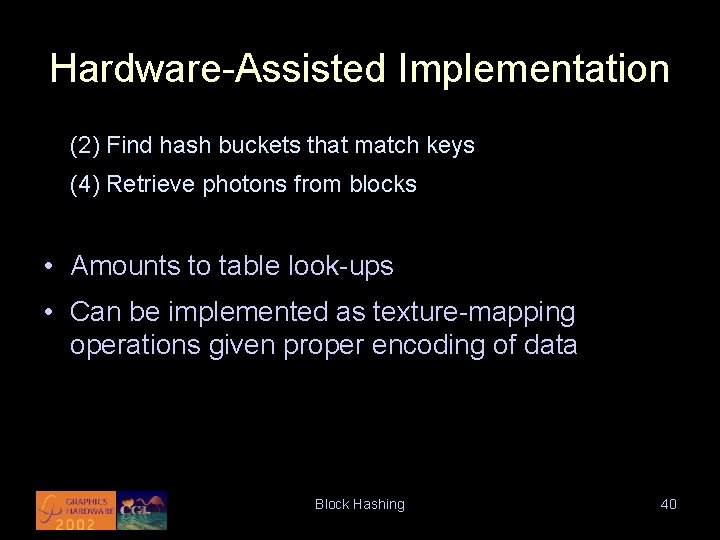
Hardware-Assisted Implementation (2) Find hash buckets that match keys (4) Retrieve photons from blocks • Amounts to table look-ups • Can be implemented as texture-mapping operations given proper encoding of data Block Hashing 40
Hardware-Assisted Implementation (3) Merge sets of photons blocks into unique collection • Difficult to do efficiently without conditionals • Generating unique collection may reduce size of candidate set • Alternative: Perform calculations on duplicated photons anyhow, but ignore their contribution by multiplying them by zero Block Hashing 41
Future Work • Approximation dilates radius of bounding sphere/disc of nearest neighbours • Experiment with other density estimators that may be less sensitive to such dilation – Average radius – Variance of radii Block Hashing 42
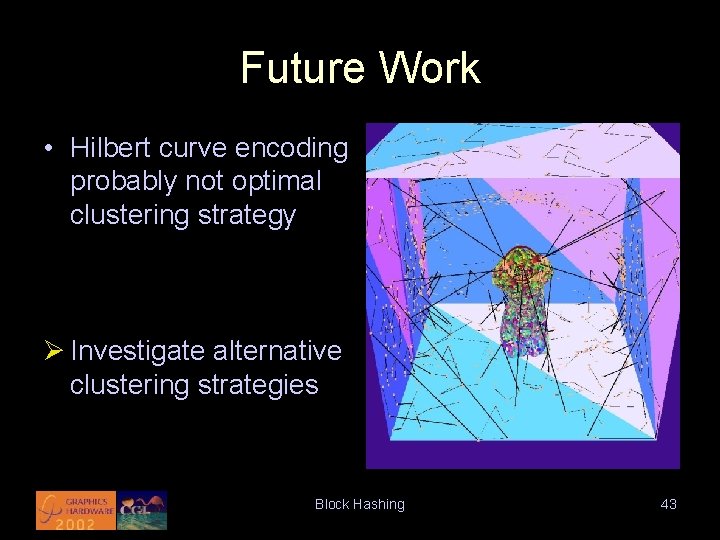
Future Work • Hilbert curve encoding probably not optimal clustering strategy Ø Investigate alternative clustering strategies Block Hashing 43
Conclusion • Block Hashing is an efficient, coherent and highly parallelizable approximate k-nearest neighbour scheme • Suitable for hardware-assisted implementation of Photon Mapping Block Hashing 44
Thank you http: //www. cgl. uwaterloo. ca/Projects/rendering/ vma@cgl. uwaterloo. ca mmccool@cgl. uwaterloo. ca Block Hashing 45
- Slides: 45