
Low Humidity By Refrigeration Two Energy Saving Techniques

Low Humidity By Refrigeration Two Energy Saving Techniques By Surendra H. Shah
Impact On Environment n n n n A one ton air conditioner uses, every hour: 1 kilowatt of electricity, but power station must generate. 2 KVA of power, due to distribution & PF losses, burning. 1 kg/hr of coal, which would release, in the air, 2 kg/hr of CO 2, adding to global warming and. 8 kg/hr of NOx & Sulphates, plus particulates. 10 liters of water/hr. Would evaporate via the cooling tower. Add to this the cost of mining the coal/ import of fuel oil, its transportation and ash disposal. The social/ environmental cost of power is enormous. . The country also loses foreign exchange. n Air conditioning must be used frugally.

Abstract n A commonly used process for maintaining low humidity involves chilling the air by refrigeration, followed by heating it with an external energy source, usually electricity. Both the steps waste energy. Two techniques described here reduce cooling load and increase efficiency. The resulting energy saving is 70% and the refrigeration plant size is cut by 50%.
Introduction § § § Low relative humidity by refrigeration is achieved by a two step process : 1. Cool the air to a low dew point 2. Re-heat that air to the required temperature. Each step carries an energy penalty. Low dew point operation lowers capacity and EER. Steam/ hot water re-heating adds to the cooling load This means a larger cooling plant and more energy.

Single Stage D/X System
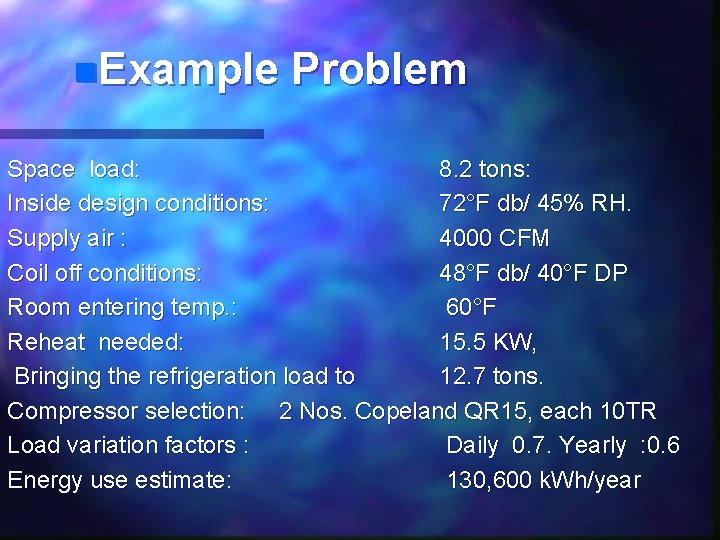
n. Example Problem Space load: 8. 2 tons: Inside design conditions: 72°F db/ 45% RH. Supply air : 4000 CFM Coil off conditions: 48°F db/ 40°F DP Room entering temp. : 60°F Reheat needed: 15. 5 KW, Bringing the refrigeration load to 12. 7 tons. Compressor selection: 2 Nos. Copeland QR 15, each 10 TR Load variation factors : Daily 0. 7. Yearly : 0. 6 Energy use estimate: 130, 600 k. Wh/year
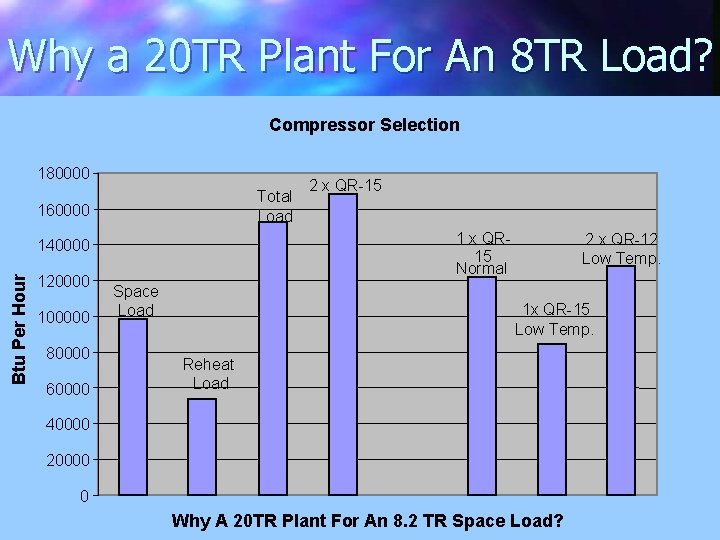
Why a 20 TR Plant For An 8 TR Load? Compressor Selection n. 180000 Total Load 160000 1 x QR 15 Normal Btu Per Hour 140000 120000 100000 80000 60000 2 x QR-15 Space Load 2 x QR-12 Low Temp. 1 x QR-15 Low Temp. Reheat Load 40000 20000 0 Why A 20 TR Plant For An 8. 2 TR Space Load?
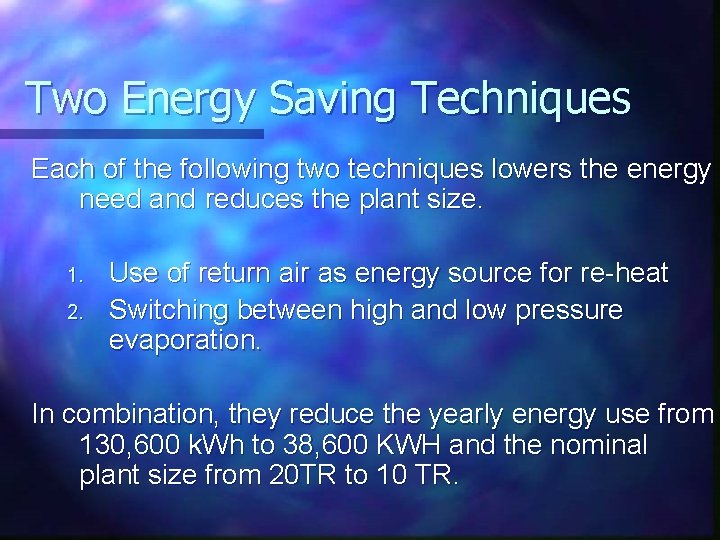
Two Energy Saving Techniques Each of the following two techniques lowers the energy need and reduces the plant size. 1. 2. Use of return air as energy source for re-heat Switching between high and low pressure evaporation. In combination, they reduce the yearly energy use from 130, 600 k. Wh to 38, 600 KWH and the nominal plant size from 20 TR to 10 TR.
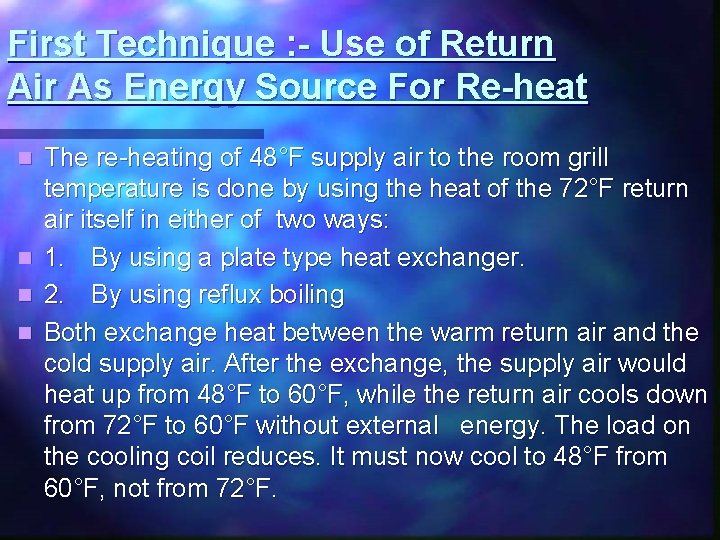
First Technique : - Use of Return Air As Energy Source For Re-heat The re-heating of 48°F supply air to the room grill temperature is done by using the heat of the 72°F return air itself in either of two ways: n 1. By using a plate type heat exchanger. n 2. By using reflux boiling n Both exchange heat between the warm return air and the cold supply air. After the exchange, the supply air would heat up from 48°F to 60°F, while the return air cools down from 72°F to 60°F without external energy. The load on the cooling coil reduces. It must now cool to 48°F from 60°F, not from 72°F. n
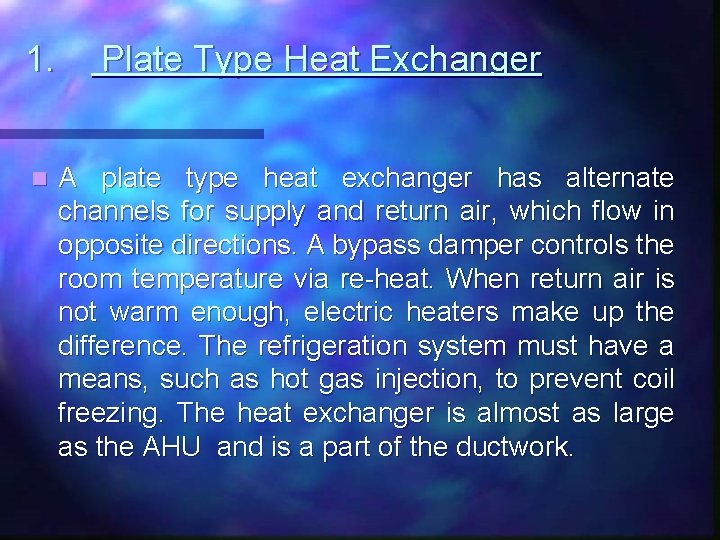
1. n Plate Type Heat Exchanger A plate type heat exchanger has alternate channels for supply and return air, which flow in opposite directions. A bypass damper controls the room temperature via re-heat. When return air is not warm enough, electric heaters make up the difference. The refrigeration system must have a means, such as hot gas injection, to prevent coil freezing. The heat exchanger is almost as large as the AHU and is a part of the ductwork.

Heat Exchange Process 1. Room conditions 2. Coil Entering 3. Coil Leaving 4. Room Entering
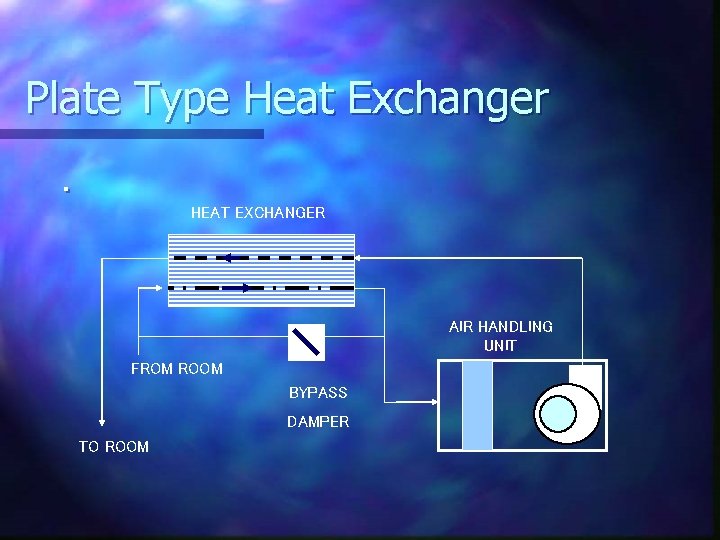
Plate Type Heat Exchanger. HEAT EXCHANGER AIR HANDLING UNIT FROM ROOM BYPASS DAMPER TO ROOM

2. Heat Recovery By Reflux Boiling Finned pipe partially filled with liquid and vapour 4 1 3 1. 2. 3. 4. Warm return air Cooled by evaporating liquid Cold air from main coil Re-heated by condensing vapour 2 Here heat recovered from return air both provides free re-heat and also reduces load on the main coil This saves energy and reduces plant capacity
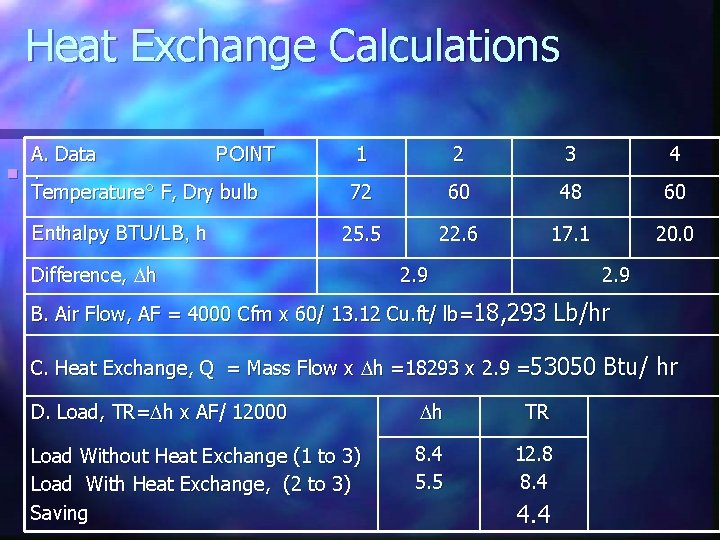
Heat Exchange Calculations A. Data POINT n. Temperature° F, Dry bulb Enthalpy BTU/LB, h 1 2 3 4 72 60 48 60 25. 5 22. 6 17. 1 20. 0 Difference, h 2. 9 B. Air Flow, AF = 4000 Cfm x 60/ 13. 12 Cu. ft/ lb=18, 293 Lb/hr C. Heat Exchange, Q = Mass Flow x h =18293 x 2. 9 =53050 D. Load, TR= h x AF/ 12000 h TR Load Without Heat Exchange (1 to 3) Load With Heat Exchange, (2 to 3) Saving 8. 4 5. 5 12. 8 8. 4 4. 4 Btu/ hr
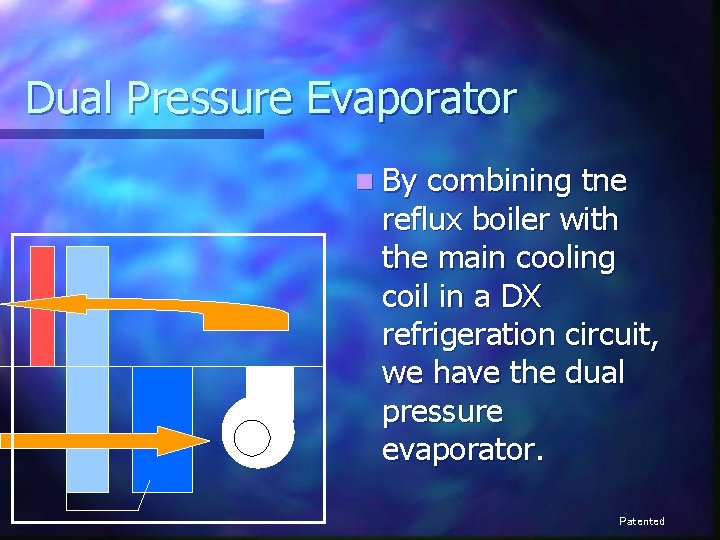
Dual Pressure Evaporator n By combining tne reflux boiler with the main cooling coil in a DX refrigeration circuit, we have the dual pressure evaporator. Patented
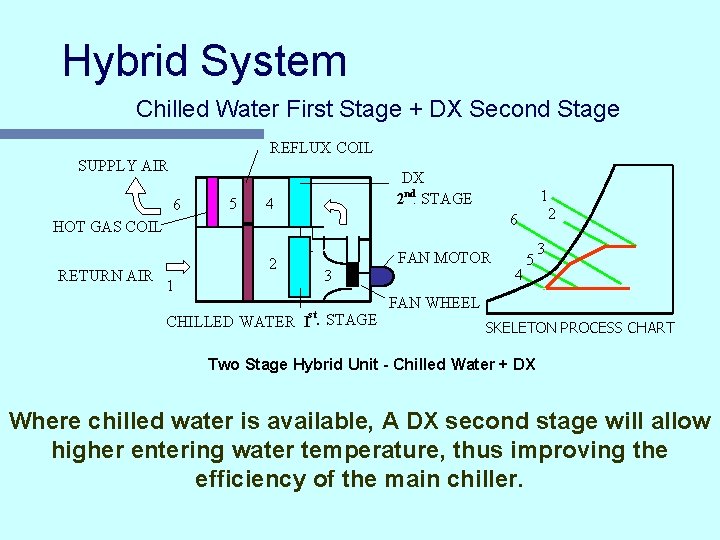
Hybrid System Chilled Water First Stage + DX Second Stage REFLUX COIL SUPPLY AIR 6 5 4 DX 2 nd. STAGE 2 FAN MOTOR 1 RETURN AIR 2 6 HOT GAS COIL 3 1 st CHILLED WATER 1. STAGE 4 5 3 FAN WHEEL SKELETON PROCESS CHART Two Stage Hybrid Unit - Chilled Water + DX. Where chilled water is available, A DX second stage will allow higher entering water temperature, thus improving the efficiency of the main chiller.
The Advantages Of The Dual Pressure Evaporator Over A Heat Pipe n n n It can be assembled from standard components and uses the same refrigerant, being a part of the circuit. While the reflux coil absorbs and recycles the room sensible heat, the hot gas added to it and to the internal condenser is mostly the room latent heat absorbed by the main cooling coil. Thus both the sensible and the latent heats of the room are recycled for reheat as needed. Even the liquid heat is used, thus improving performance by sub cooling. Electric reheat is occasionally needed by plate type exchangers; never by the dual pressure evaporator. Refrigeration load is now reduced to 8. 4 tons since reheat energy is eliminated, but the second technique is needed for reducing the nominal plant size.
Second Technique : Switching Between High and Low Evaporator Pressures Energy And Size Penalty For Low Temperature Evaporation n To cool the air to 40°F dew point, the evaporator coil has to work at 30°F. The Compressor Energy Efficiency Ratio reduces by more than 20% at this evaporating temperature as compared to the standard rating at 45°F. Its cooling capacity also reduces by 34% from the rated value. n

Back To The Problem Refer to the example problem. After availing the saving from the heat exchanger, the refrigeration load is 100, 600 BTU/Hr or about 8. 4 tons. n A Copeland model QR 15 M 1 (10 TR nominal) compressor will absorb 122, 000 BTU/Hr at 45°F/130°F, using 12. 9 k. W, but only 84, 000 BTU/Hr at 30°F/130°F, needing 11 KW. n Now two units of model QR 12 M 1 (7. 5 TR nominal) are needed, using a total of 15. 6 k. W at 30°F/130°F. Their total nominal capacity at 45°F/130°F would be 15 TR. n However, the single QR 15 M 1 compressor can be retained by switching between high and low evaporator pressures. n

n. Energy Cost Reduces From 130, 600 k. Wh To Just 38, 600 k. Wh Per Year Savings = 11, 000 k. Wh Per Ton Per Year
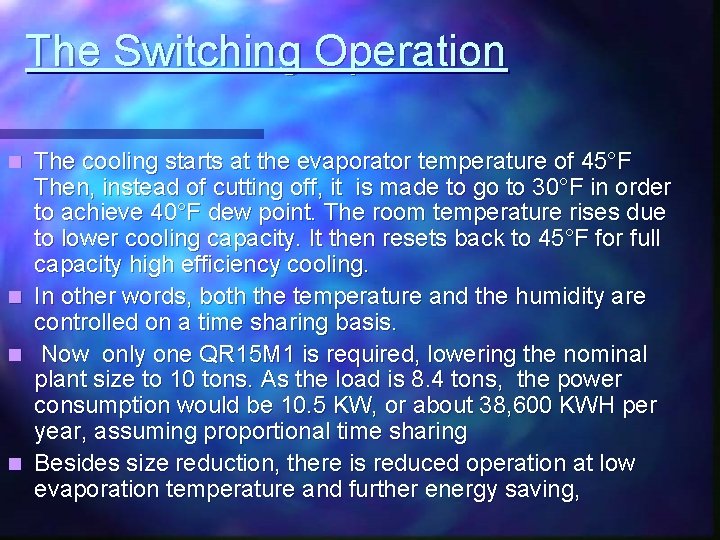
The Switching Operation n n The cooling starts at the evaporator temperature of 45°F Then, instead of cutting off, it is made to go to 30°F in order to achieve 40°F dew point. The room temperature rises due to lower cooling capacity. It then resets back to 45°F for full capacity high efficiency cooling. In other words, both the temperature and the humidity are controlled on a time sharing basis. Now only one QR 15 M 1 is required, lowering the nominal plant size to 10 tons. As the load is 8. 4 tons, the power consumption would be 10. 5 KW, or about 38, 600 KWH per year, assuming proportional time sharing Besides size reduction, there is reduced operation at low evaporation temperature and further energy saving,
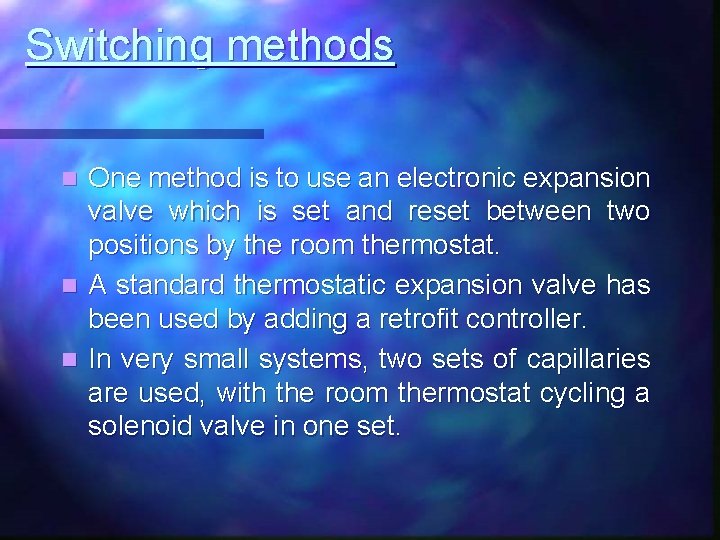
Switching methods One method is to use an electronic expansion valve which is set and reset between two positions by the room thermostat. n A standard thermostatic expansion valve has been used by adding a retrofit controller. n In very small systems, two sets of capillaries are used, with the room thermostat cycling a solenoid valve in one set. n
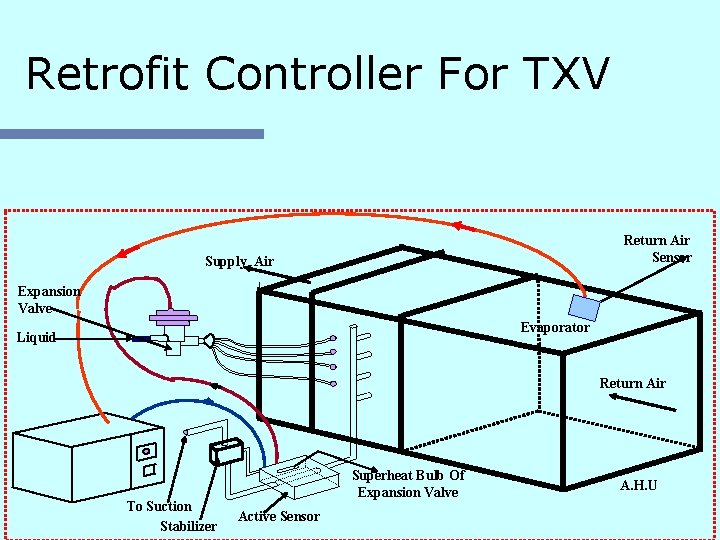
Retrofit Controller For TXV Return Air Sensor Supply Air Expansion Valve Evaporator Liquid Return Air To Suction Stabilizer Superheat Bulb Of Expansion Valve Active Sensor A. H. U
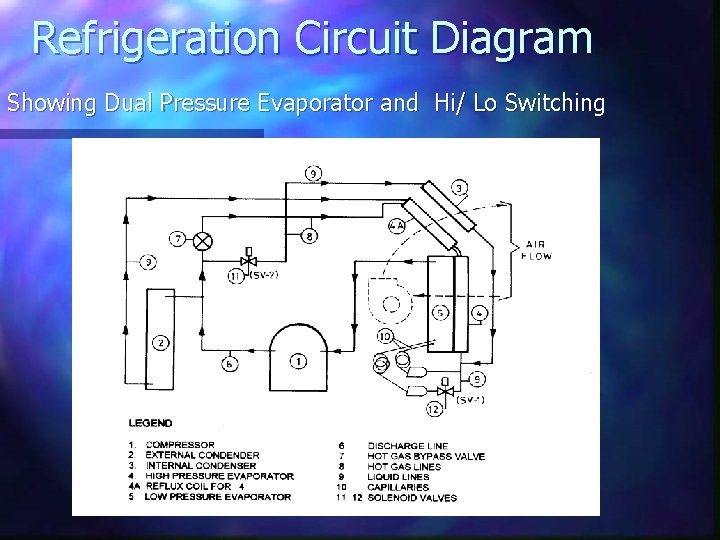
Refrigeration Circuit Diagram Showing Dual Pressure Evaporator and Hi/ Lo Switching

Combined Effect Of The Two Techniques The nominal refrigeration plant size reduces from 20 TR to 10 TR, and the energy consumption reduces from 130, 600 KWH/Year to just 38, 600 KWH/Year. . n The total calculated savings are of 92, 000 KWH per year (70%) for an 8. 4 ton load, or 11, 000 KWH per year per ton of space load. Reduction in the size of the plant is 50%, subject to the assumptions. n The pay back period is less than one year in India, due to high energy cost and tax rebates on energy saving devices. These figures will vary from job to job and from analyst to analyst. n Several new and retrofit installations are already working in India for many years. n

Some Applications: 1. 2. 3. 4. 5. 6. Coating pans for sugar candy. Fluid bed dryers Dried and reheated make up air for pressurising the clean room passages and tablet coating pans. Air-handling units for the operation theaters of hospitals. They require 25% to 100% outside air. Chilled water-cooled plastic moulds need a blanket of dry but cool air to prevent dewing inside. Fresh air supply into hotel guest rooms. In monsoon, Dry, cold air would keep the rooms dry and mold free, thus avoiding that dank smell.
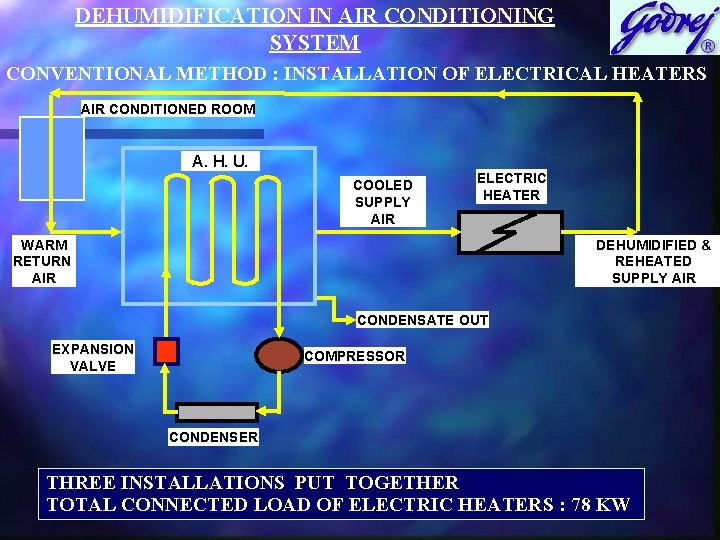
DEHUMIDIFICATION IN AIR CONDITIONING SYSTEM CONVENTIONAL METHOD : INSTALLATION OF ELECTRICAL HEATERS AIR CONDITIONED ROOM A. H. U. COOLED SUPPLY AIR ELECTRIC HEATER WARM RETURN AIR DEHUMIDIFIED & REHEATED SUPPLY AIR CONDENSATE OUT EXPANSION VALVE COMPRESSOR CONDENSER THREE INSTALLATIONS PUT TOGETHER TOTAL CONNECTED LOAD OF ELECTRIC HEATERS : 78 KW
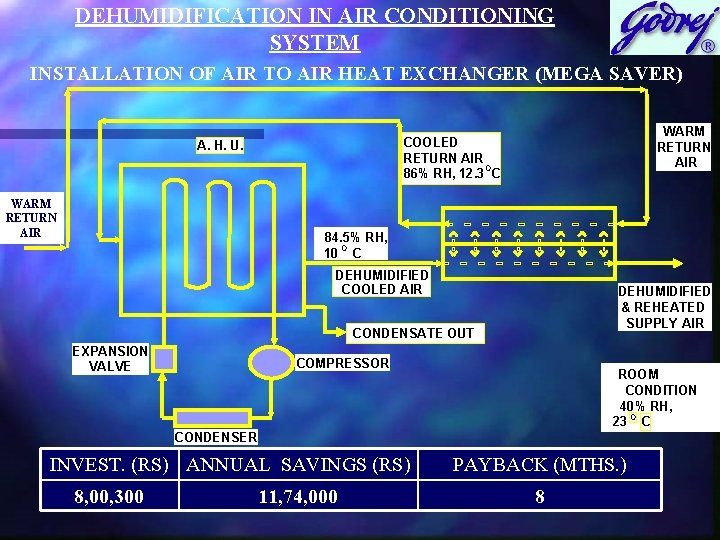
DEHUMIDIFICATION IN AIR CONDITIONING SYSTEM INSTALLATION OF AIR TO AIR HEAT EXCHANGER (MEGA SAVER) WARM RETURN AIR COOLED RETURN AIR O 86% RH, 12. 3 C A. H. U. 84. 5% RH, O 10 C DEHUMIDIFIED COOLED AIR DEHUMIDIFIED & REHEATED SUPPLY AIR CONDENSATE OUT EXPANSION VALVE COMPRESSOR ROOM CONDITION 40% RH, O 23 C CONDENSER INVEST. (RS) ANNUAL SAVINGS (RS) 8, 00, 300 11, 74, 000 PAYBACK (MTHS. ) 8
Conclusion Energy efficiency is paramount for remaining competitive in a liberalized market. n It is established that the system described above shall substantially reduce the running cost of units supplying reheated air at a low dew point n Reheat systems are in disrepute as energy wasters, and many designers avoid their use. Perhaps the above two techniques would encourage the designers to revisit them as economical energy savers while choosing low humidity systems. n

Namaste ! ¬None can stop an idea whose time has come. ¬This idea could be your key. ¬ – Or your competitor’s. ¬Thank you.
- Slides: 30