
Low frequency extension of the Backus averaging Alexey
Low frequency extension of the Backus averaging Alexey Stovas, NTNU ROSE meeting, May 02 -03, Trondheim, Norway
Upscaling z l
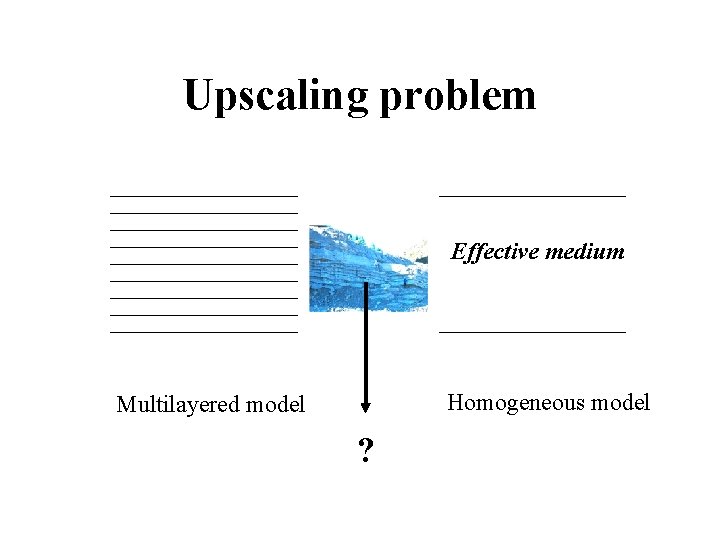
Upscaling problem Effective medium Homogeneous model Multilayered model ?
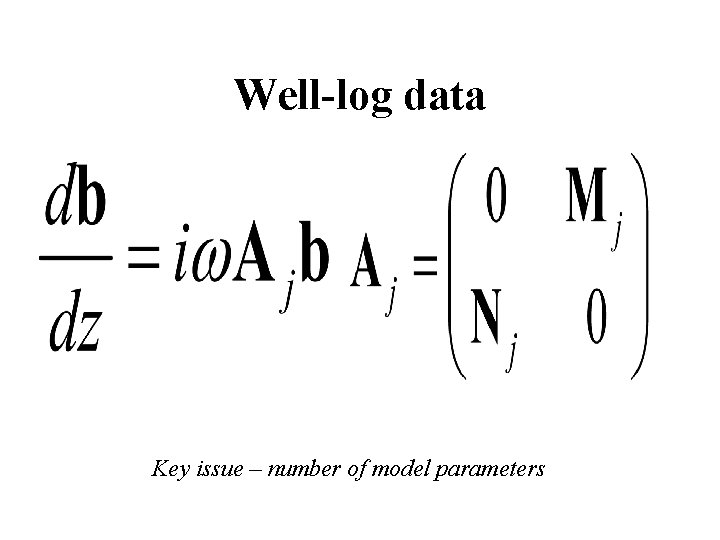
Well-log data Key issue – number of model parameters
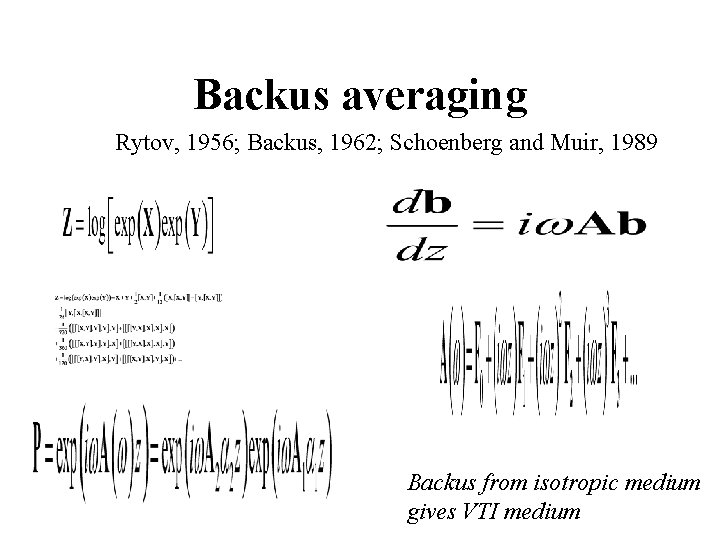
Backus averaging Rytov, 1956; Backus, 1962; Schoenberg and Muir, 1989 Backus from isotropic medium gives VTI medium
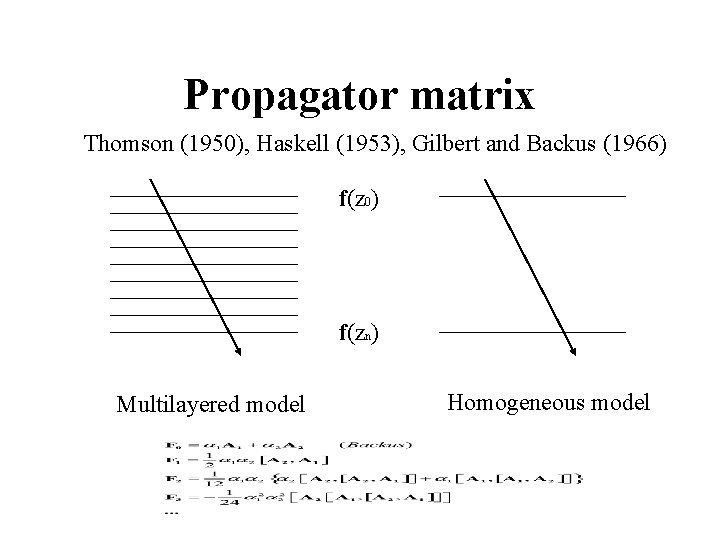
Propagator matrix Thomson (1950), Haskell (1953), Gilbert and Backus (1966) f(z 0) f(zn) Multilayered model Homogeneous model
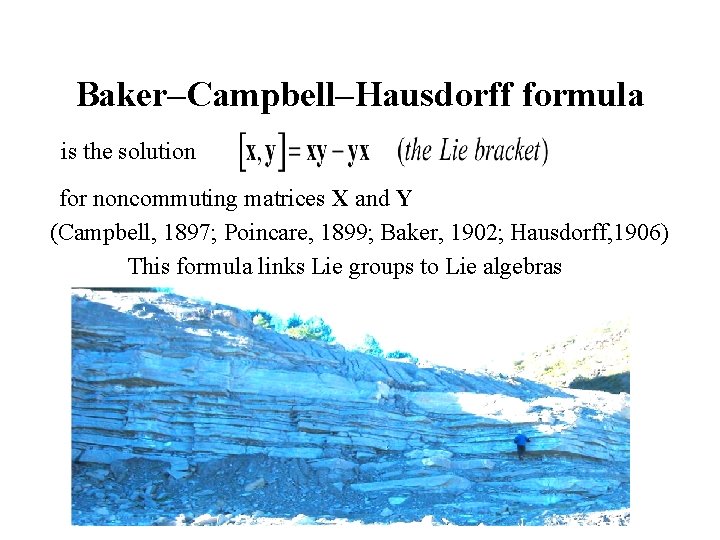
Baker–Campbell–Hausdorff formula is the solution for noncommuting matrices X and Y (Campbell, 1897; Poincare, 1899; Baker, 1902; Hausdorff, 1906) This formula links Lie groups to Lie algebras
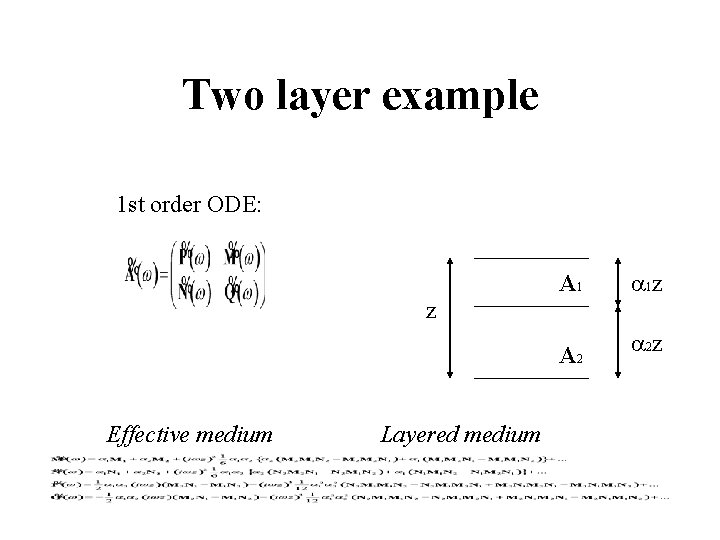
Two layer example 1 st order ODE: A 1 a 1 z A 2 a 2 z z Effective medium Layered medium
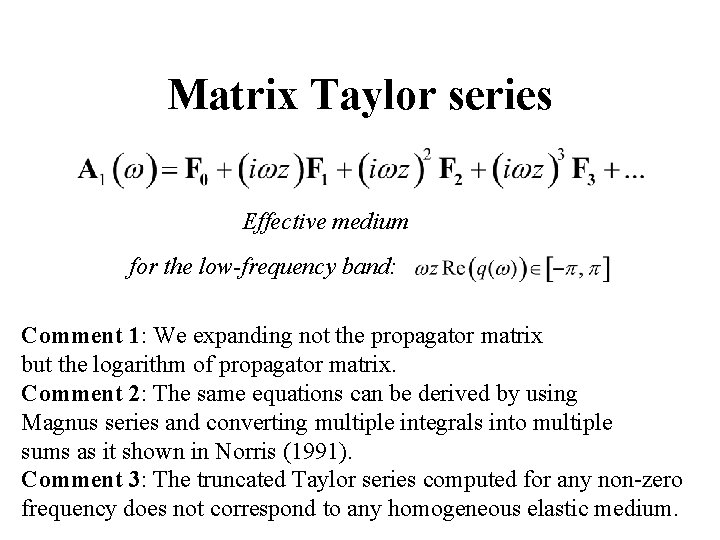
Matrix Taylor series Effective medium for the low-frequency band: Comment 1: We expanding not the propagator matrix but the logarithm of propagator matrix. Comment 2: The same equations can be derived by using Magnus series and converting multiple integrals into multiple sums as it shown in Norris (1991). Comment 3: The truncated Taylor series computed for any non-zero frequency does not correspond to any homogeneous elastic medium.
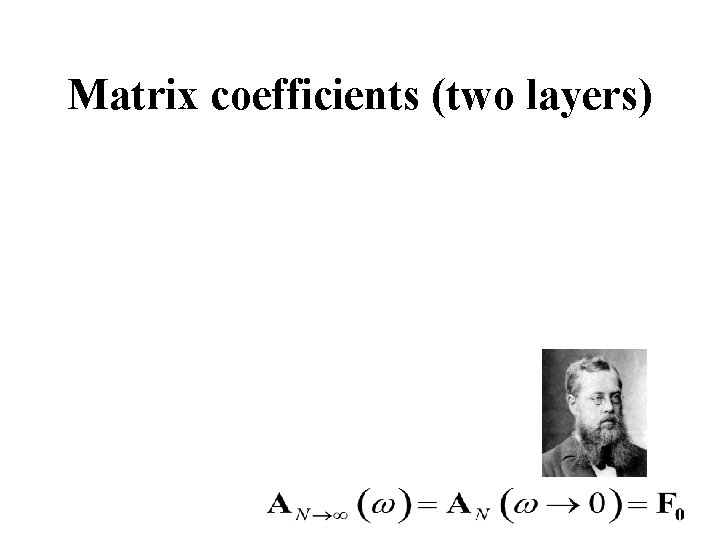
Matrix coefficients (two layers)
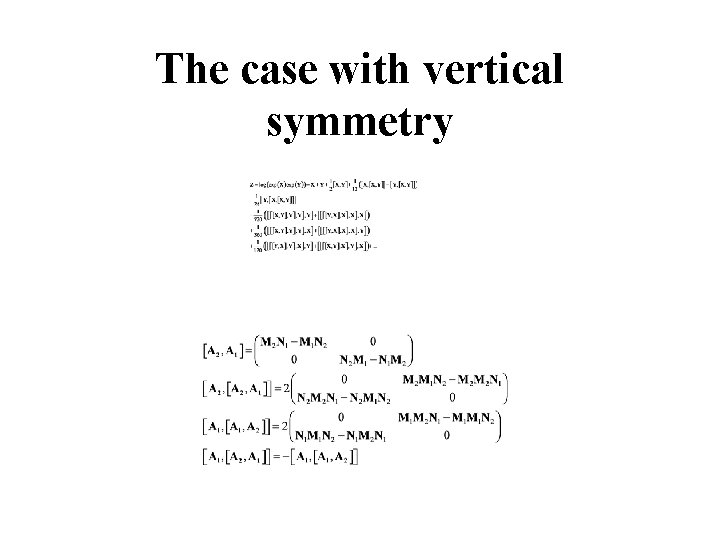
The case with vertical symmetry
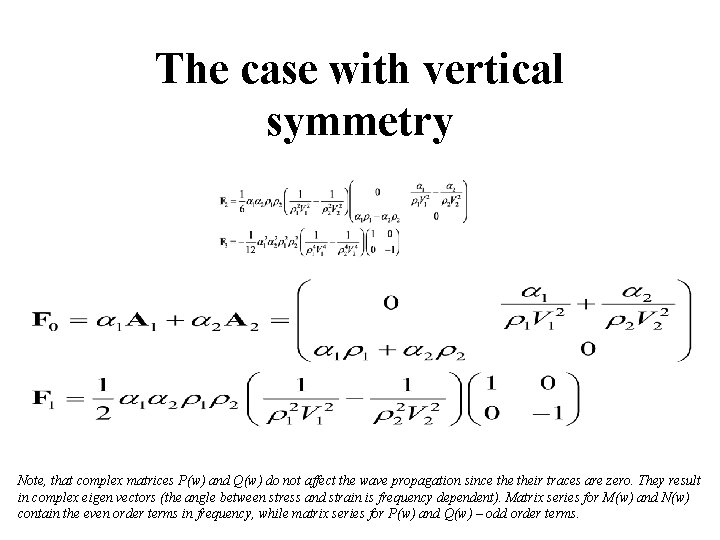
The case with vertical symmetry Note, that complex matrices P(w) and Q(w) do not affect the wave propagation since their traces are zero. They result in complex eigen vectors (the angle between stress and strain is frequency dependent). Matrix series for M(w) and N(w) contain the even order terms in frequency, while matrix series for P(w) and Q(w) – odd order terms.
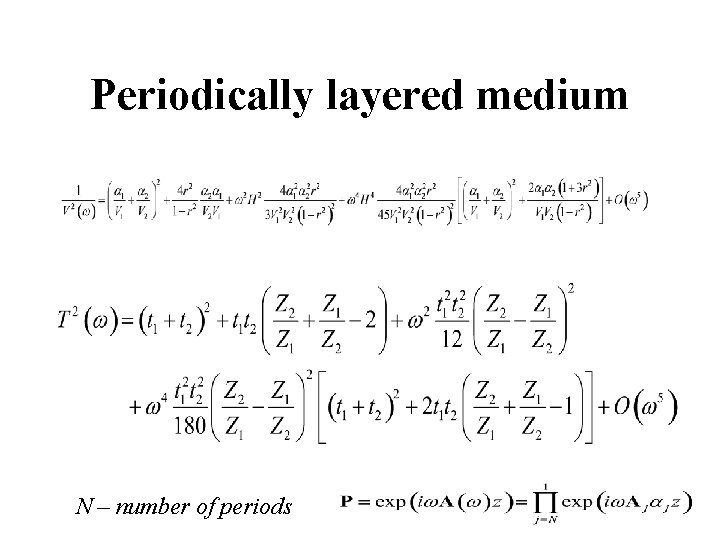
Periodically layered medium N – number of periods
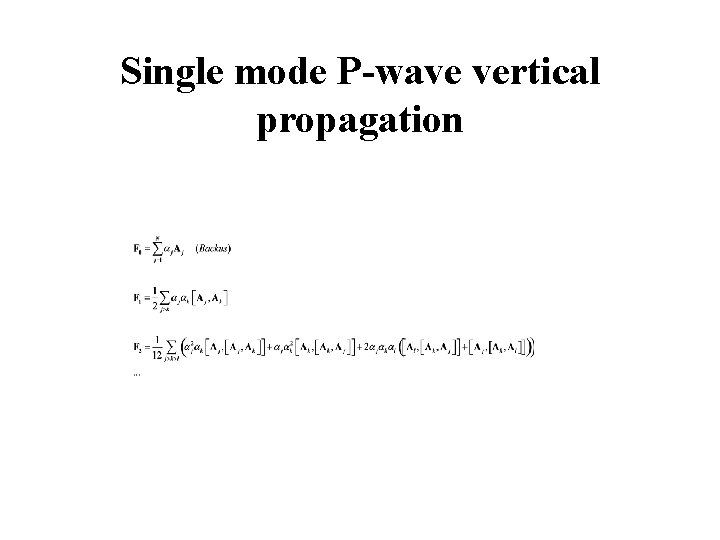
Single mode P-wave vertical propagation
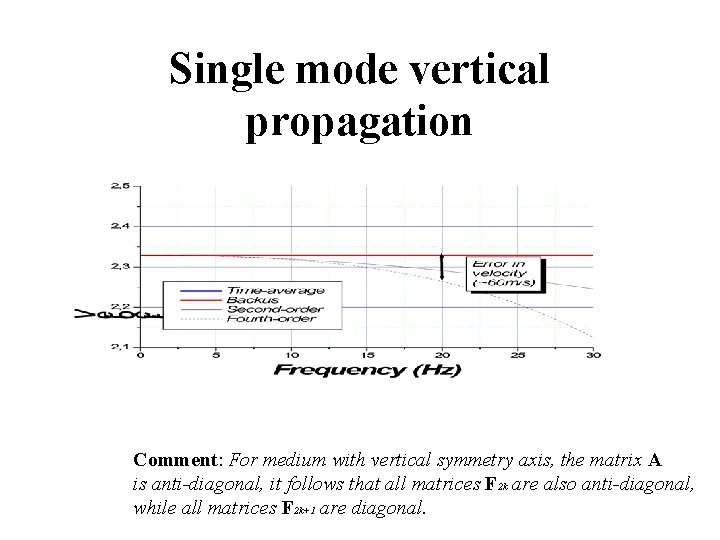
Single mode vertical propagation Comment: For medium with vertical symmetry axis, the matrix A is anti-diagonal, it follows that all matrices F 2 k are also anti-diagonal, while all matrices F 2 k+1 are diagonal.
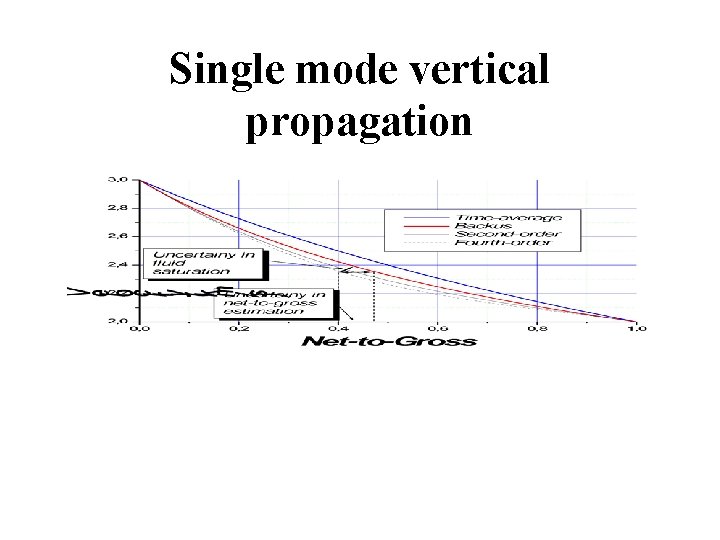
Single mode vertical propagation
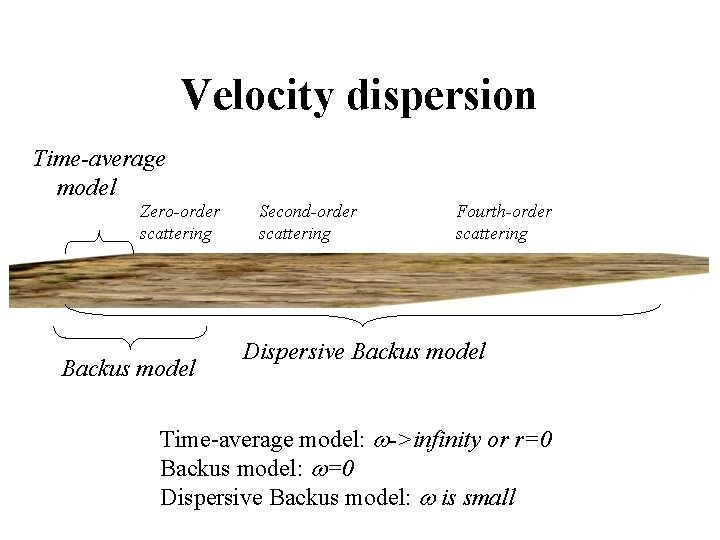
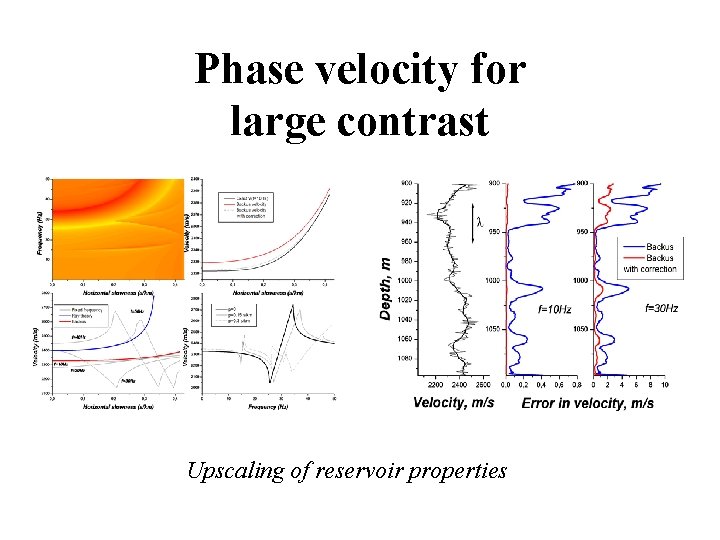
Velocity dispersion Time-average model Zero-order scattering Backus model Second-order scattering Fourth-order scattering Dispersive Backus model Time-average model: w->infinity or r=0 Backus model: w=0 Dispersive Backus model: w is small
Velocity dispersion (traveltime vs impedance) tj are the traveltimes within each layer and Zj are the impedances
Two layers isotropic medium
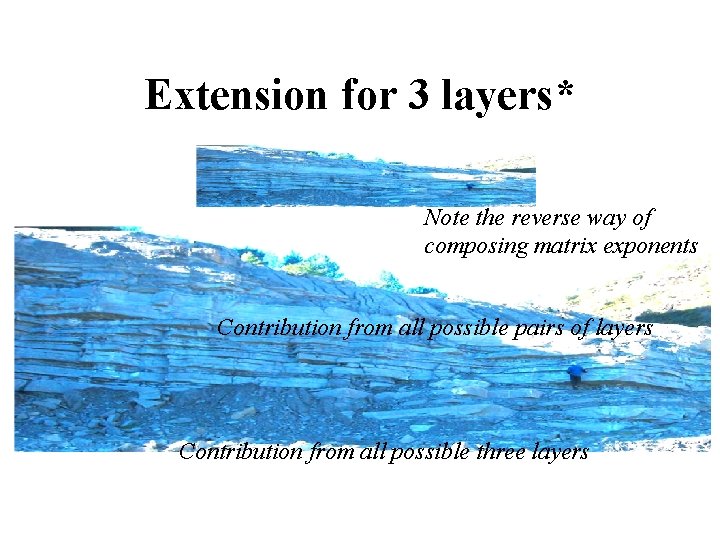
Extension for 3 layers* Note the reverse way of composing matrix exponents Contribution from all possible pairs of layers Contribution from all possible three layers
Smoothing of log data
Phase velocity for large contrast Upscaling of reservoir properties
Conclusion&Discussion • Velocity dispersion is very important issue for contrast velocity models. In this case the Backus averaging could not be accurate enough. • The method is an extension of the standard Backus averaging for low-frequency case (correction term) • Method is based on expansion of the logarithm of propagator matrix in frequency • The frequency-dependent term can be computed as a sum of contributions from all the layers composed by combinations of three layers
Acknowledgement • I would like to acknowledge NFR via the ROSE project
- Slides: 24