
Low Frequencies for Inversion of Reflections Lasse Amundsen
- Slides: 15
Low Frequencies for Inversion of Reflections Lasse Amundsen, Ørjan Pedersen and Rune Mittet
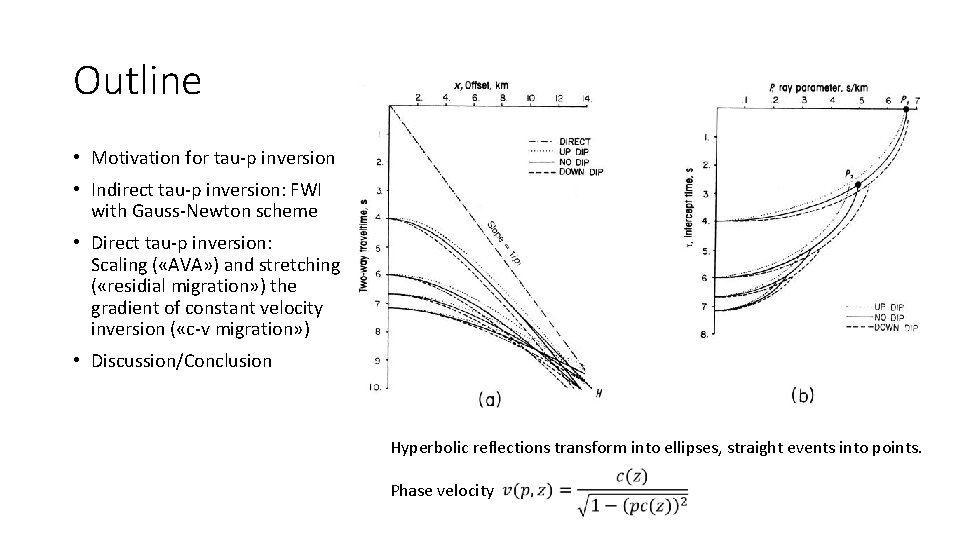
Outline • Motivation for tau-p inversion • Indirect tau-p inversion: FWI with Gauss-Newton scheme • Direct tau-p inversion: Scaling ( «AVA» ) and stretching ( «residial migration» ) the gradient of constant velocity inversion ( «c-v migration» ) • Discussion/Conclusion Hyperbolic reflections transform into ellipses, straight events into points. Phase velocity
Motivation for tau-p reflection inversion • Fast, elastic Newton-type inversions for VP, VS, density, attenuation … • Used where geology is «flattish» 1. 2. 3. 4. • Unconventionals: «sweet spot» mapping Gas hydrates Temperature changes of water column Starting model for general FWI Understand the potential, pitfalls, and limitations of FWI 1. What can the gradient (of the misfit function) offer you “today”? 2. Effect of missing low frequencies • Assumtions in this presentation 1. Acoustic wave equation; constant density 2. Known wavelet Amundsen and Ursin 1991 F-K inversion of acoustic data: Geophysics 56 1027 -1039 Zhao, Ursin and Amundsen 1994 F-K elastic inversion: Geophysics 59 1868 -1881 Amundsen, Reitan and Arntsen 2005 Geometric analysis of data-driven inversion/depth imaging: JSE 14 51 -62 Amundsen, Reitan, Helgesen and Arntsen 2005 Data-driven inversion/depth imaging: Inverse Problems 21 1823 -50 Amundsen, Reitan, Arntsen and Ursin 2006 Acoustic AVA inversion/depth imaging: Inverse Problems 22 1921 -45 Amundsen, Reitan, Arntsen and Ursin 2008 Elastic AVA inversion/depth imaging: Inverse Problems 22 1921 -45
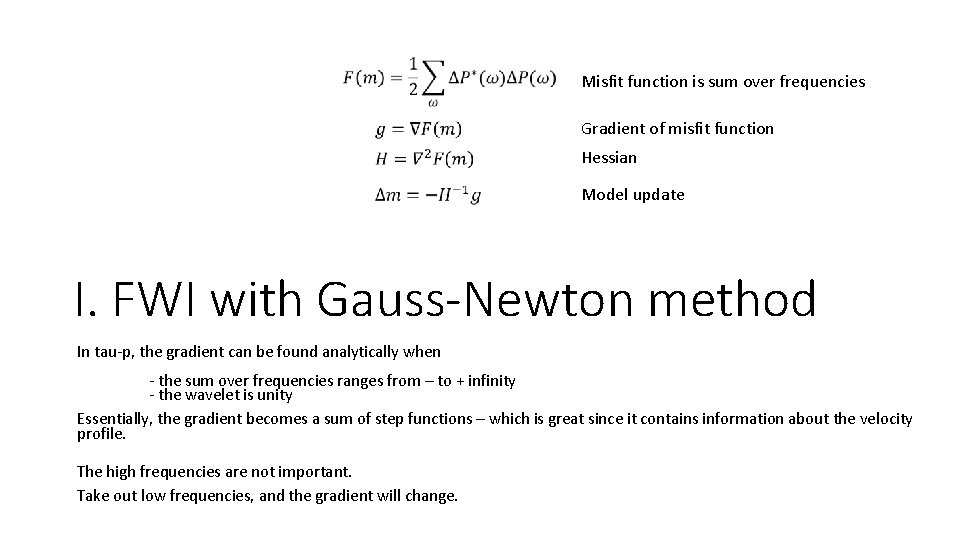
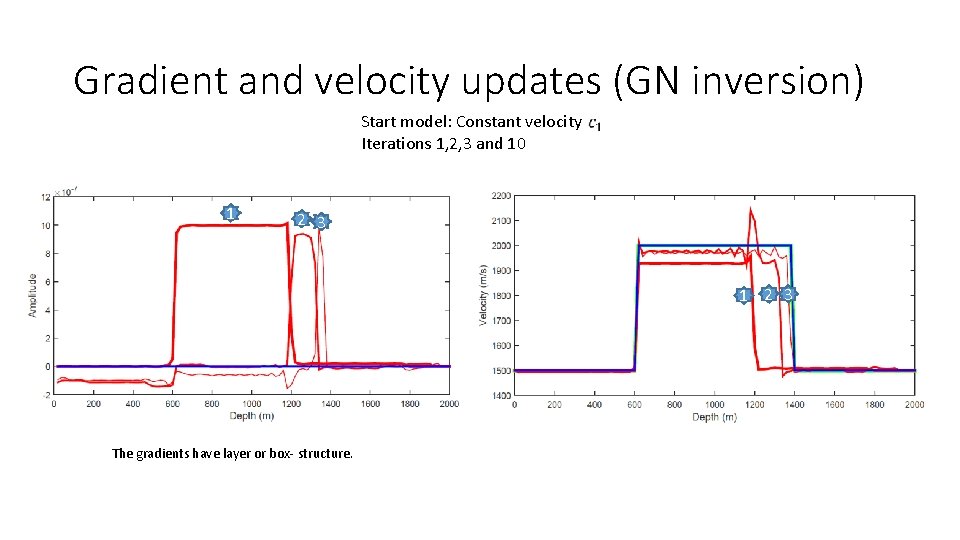
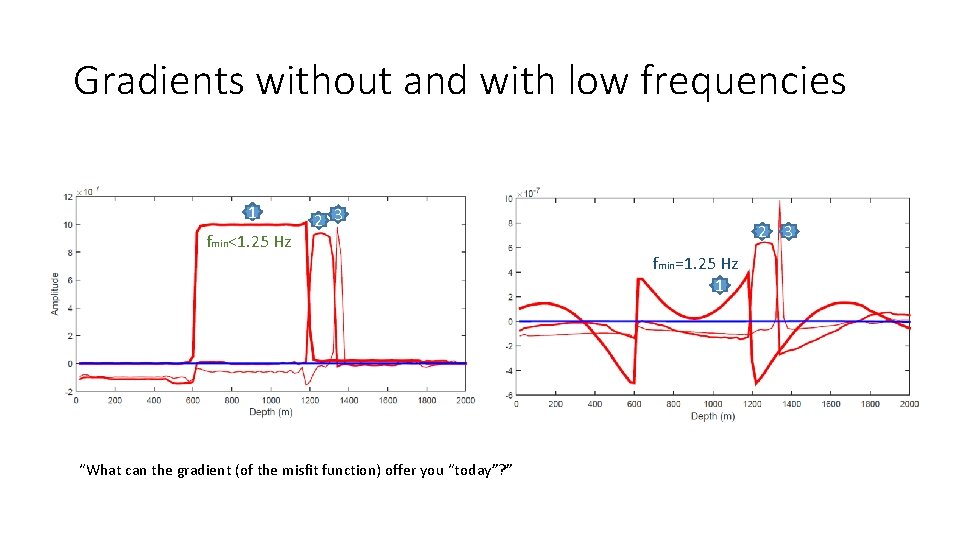
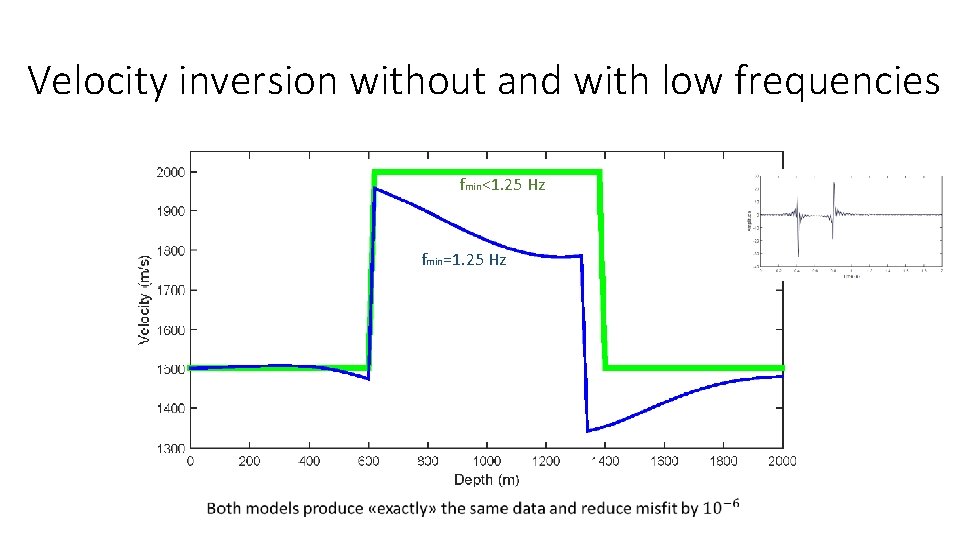
Misfit function is sum over frequencies Gradient of misfit function Hessian Model update I. FWI with Gauss-Newton method In tau-p, the gradient can be found analytically when - the sum over frequencies ranges from – to + infinity - the wavelet is unity Essentially, the gradient becomes a sum of step functions – which is great since it contains information about the velocity profile. The high frequencies are not important. Take out low frequencies, and the gradient will change.
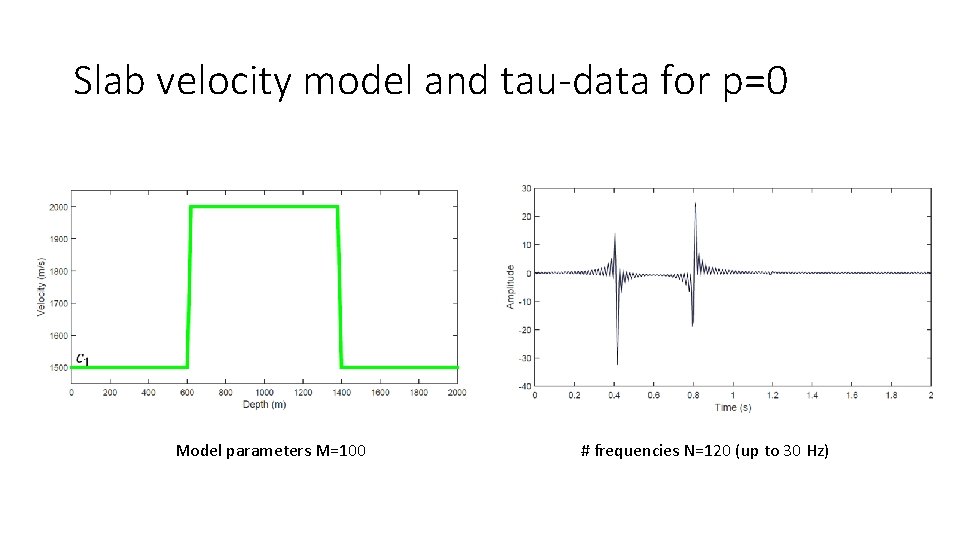
Slab velocity model and tau-data for p=0 Model parameters M=100 # frequencies N=120 (up to 30 Hz)
Gradient and velocity updates (GN inversion) Start model: Constant velocity Iterations 1, 2, 3 and 10 1 2 3 The gradients have layer or box- structure.
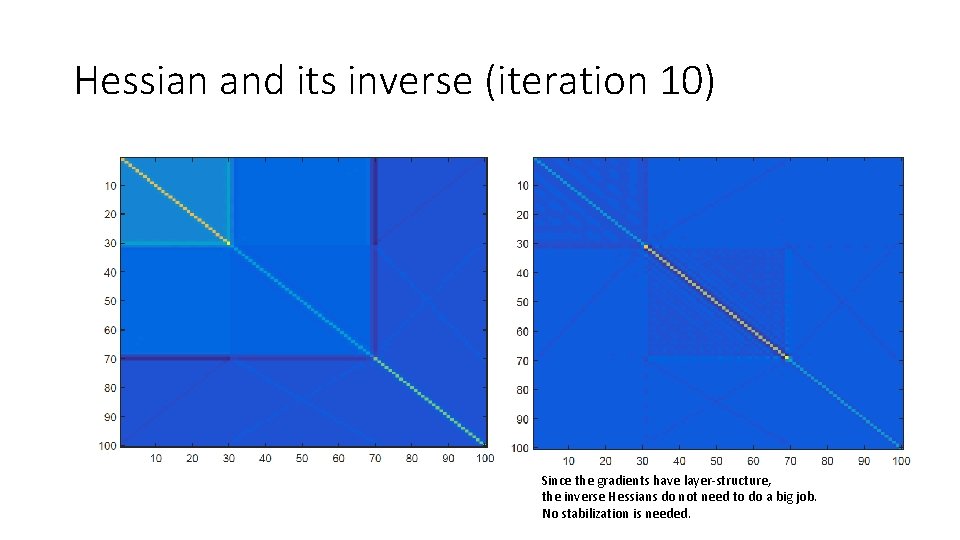
Hessian and its inverse (iteration 10) Since the gradients have layer-structure, the inverse Hessians do not need to do a big job. No stabilization is needed.
Gradients without and with low frequencies 1 fmin<1. 25 Hz 2 3 fmin=1. 25 Hz 1 “What can the gradient (of the misfit function) offer you “today”? ”
Velocity inversion without and with low frequencies fmin<1. 25 Hz fmin=1. 25 Hz
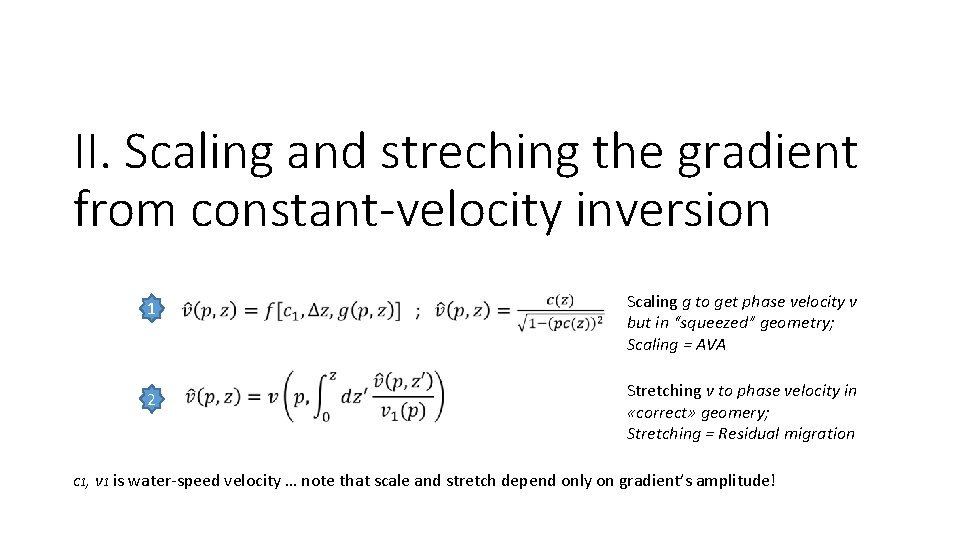
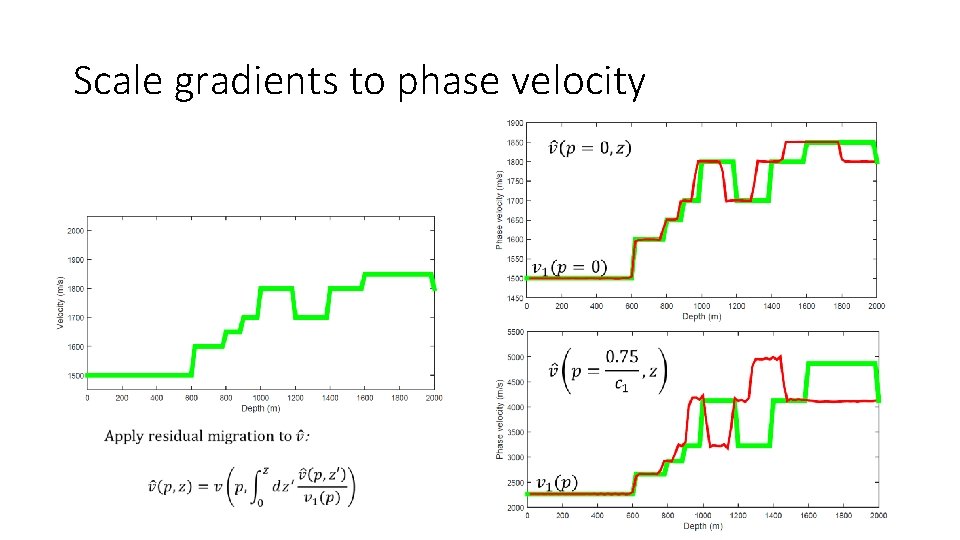
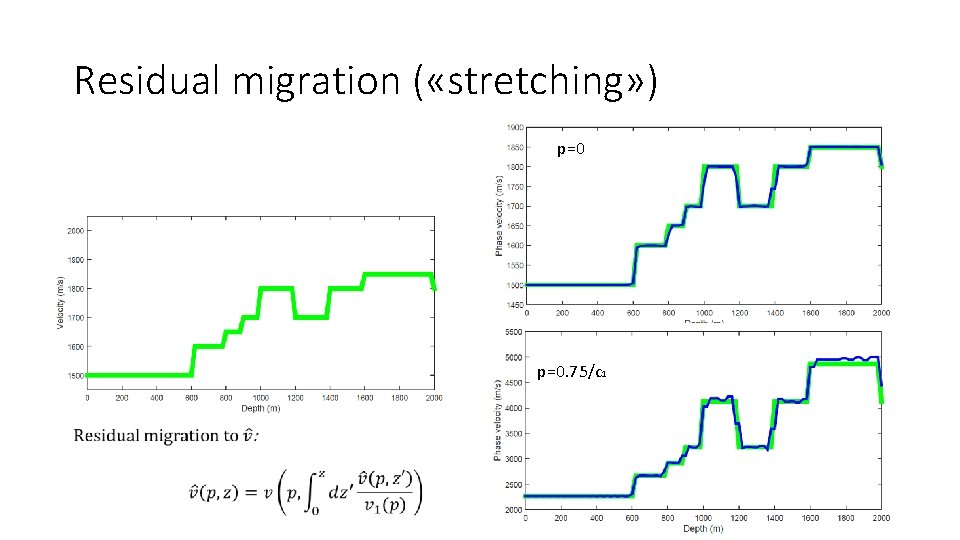
II. Scaling and streching the gradient from constant-velocity inversion 1 Scaling g to get phase velocity v but in “squeezed” geometry; Scaling = AVA 2 Stretching v to phase velocity in «correct» geomery; Stretching = Residual migration c 1, v 1 is water-speed velocity … note that scale and stretch depend only on gradient’s amplitude!
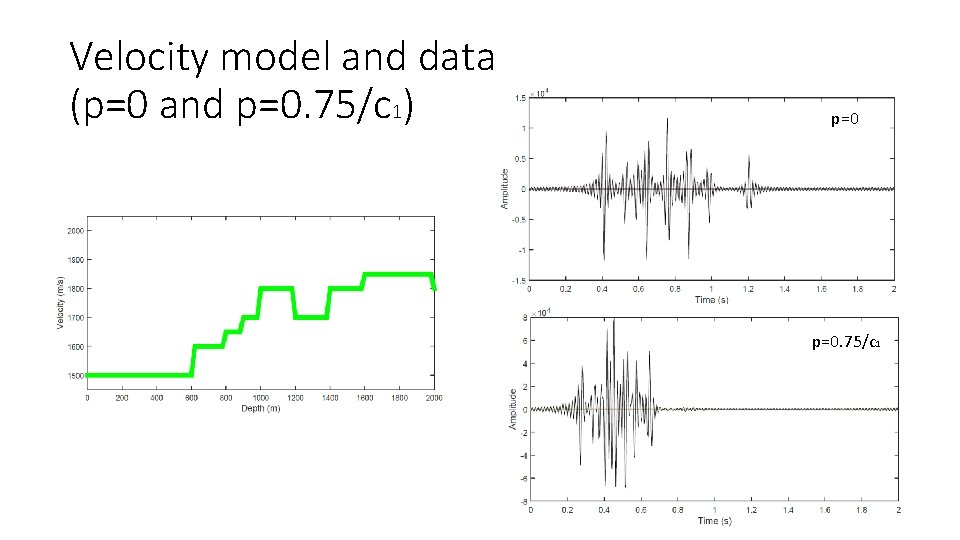
Velocity model and data (p=0 and p=0. 75/c 1) p=0. 75/c 1
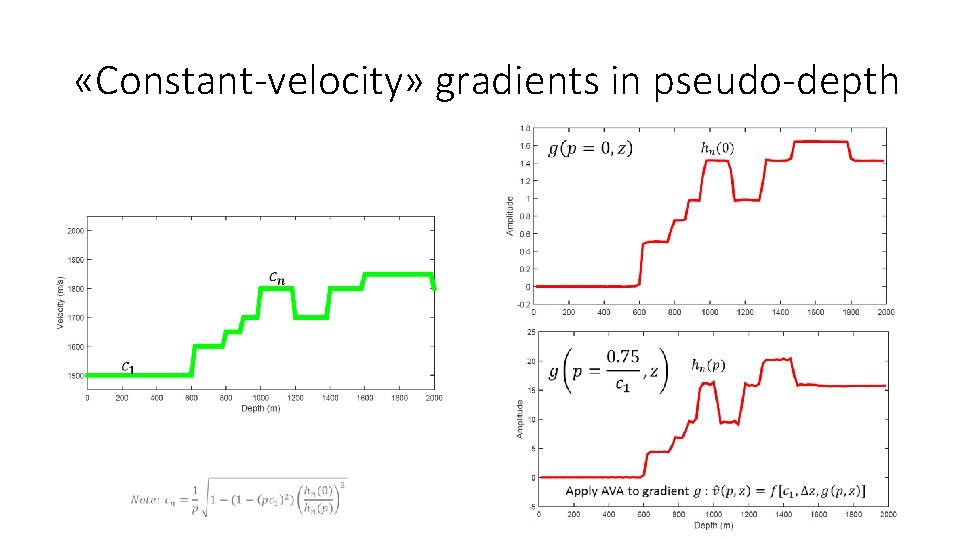
«Constant-velocity» gradients in pseudo-depth
Scale gradients to phase velocity
Residual migration ( «stretching» ) p=0. 75/c 1
Discussion/Conclusion • Need low frequencies to calculate a gradient that carries information of layer velocities • The Hessian can partly correct the gradient for missing low frequencies • Scaling and stretching the gradient shown for plane-layer tau-p inversion – need generalization to laterally varying medium … tougher problem to handle