
Low Flow Water is taken out of the
- Slides: 14
“Low Flow” “Water is taken out of the stream for a variety of uses, such as irrigated agriculture, municipal and industrial. Low flow means that amount of water that must be left in the stream for the fish. With anything less than the low flow, the fish will die. ” Only differentiated between two relative events: 1. Disastrously low 2. Everything else Used Instream Flow Incremental Methodology to negotiate acceptable flow levels from multiple possibilities
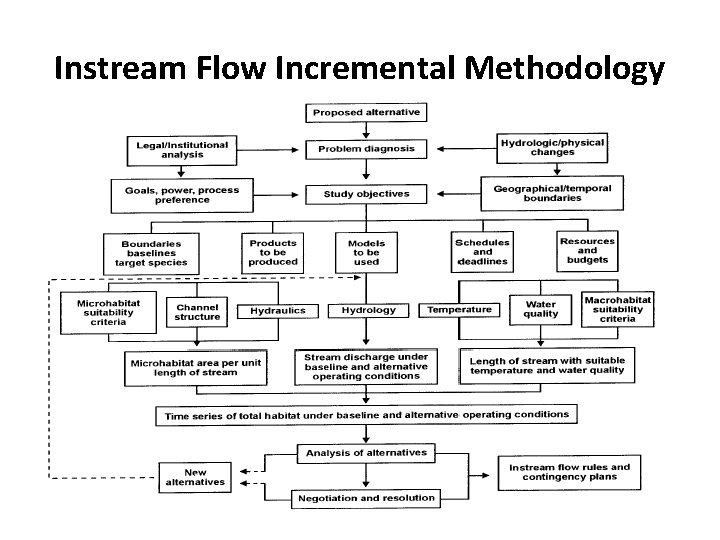
Instream Flow Incremental Methodology • Interdisciplinary Problem Solving Tool – Determine benefits or consequences of management – Solves water resource allocation problems including riverine habitat • Modular Decision Support System – Library of linked analytical procedures – Three macrohabitat-level stratifications • Drainage basins, networks, segments
Instream Flow Incremental Methodology • Interdisciplinary Problem Solving Tool – Determine benefits or consequences of management – Solves water resource allocation problems including riverine habitat • Modular Decision Support System – Library of linked analytical procedures – Three macrohabitat-level stratifications • Drainage basins, networks, segments
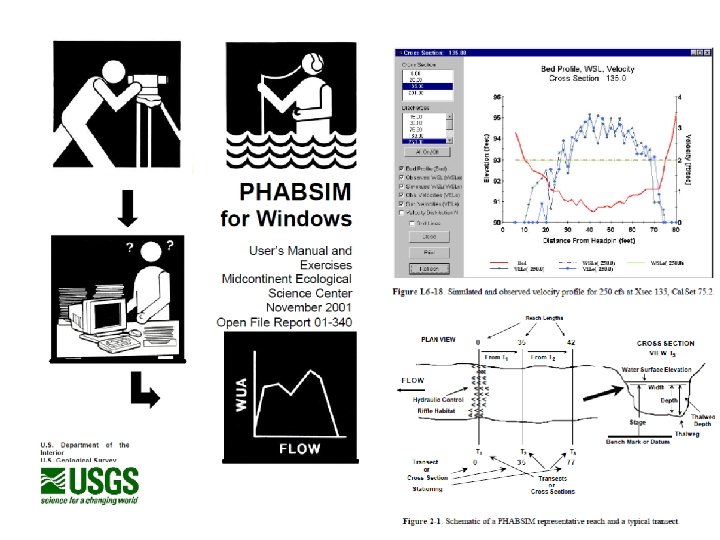
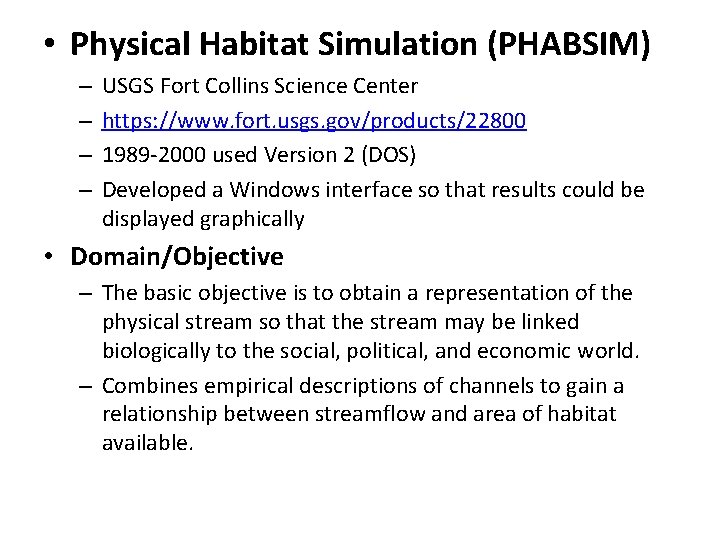
• Physical Habitat Simulation (PHABSIM) – – USGS Fort Collins Science Center https: //www. fort. usgs. gov/products/22800 1989 -2000 used Version 2 (DOS) Developed a Windows interface so that results could be displayed graphically • Domain/Objective – The basic objective is to obtain a representation of the physical stream so that the stream may be linked biologically to the social, political, and economic world. – Combines empirical descriptions of channels to gain a relationship between streamflow and area of habitat available.
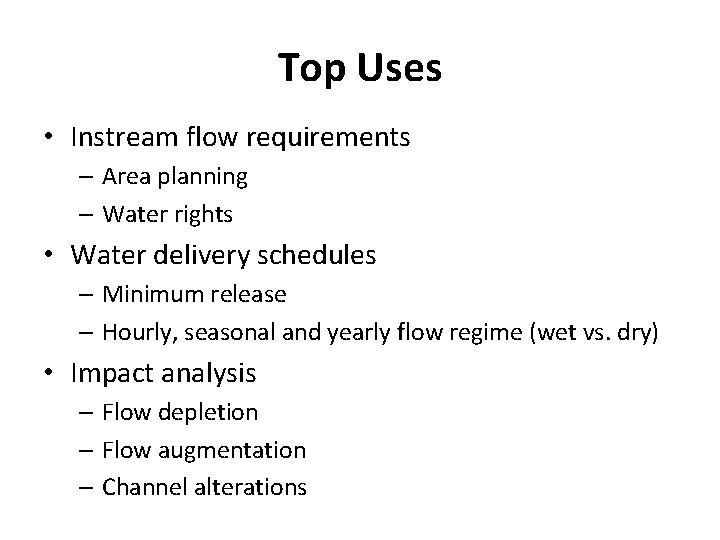
Top Uses • Instream flow requirements – Area planning – Water rights • Water delivery schedules – Minimum release – Hourly, seasonal and yearly flow regime (wet vs. dry) • Impact analysis – Flow depletion – Flow augmentation – Channel alterations
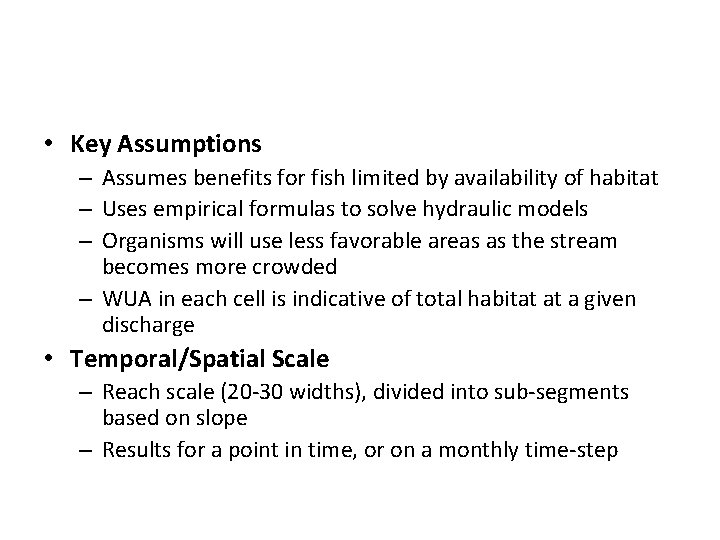
• Key Assumptions – Assumes benefits for fish limited by availability of habitat – Uses empirical formulas to solve hydraulic models – Organisms will use less favorable areas as the stream becomes more crowded – WUA in each cell is indicative of total habitat at a given discharge • Temporal/Spatial Scale – Reach scale (20 -30 widths), divided into sub-segments based on slope – Results for a point in time, or on a monthly time-step
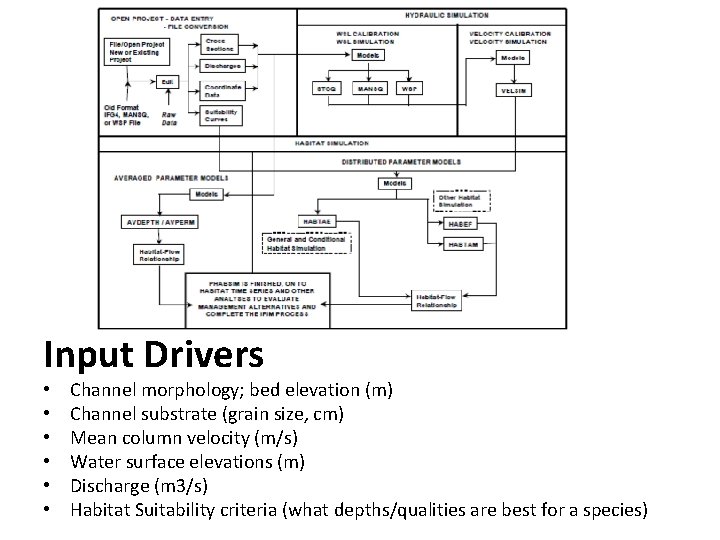
Input Drivers • • • Channel morphology; bed elevation (m) Channel substrate (grain size, cm) Mean column velocity (m/s) Water surface elevations (m) Discharge (m 3/s) Habitat Suitability criteria (what depths/qualities are best for a species)
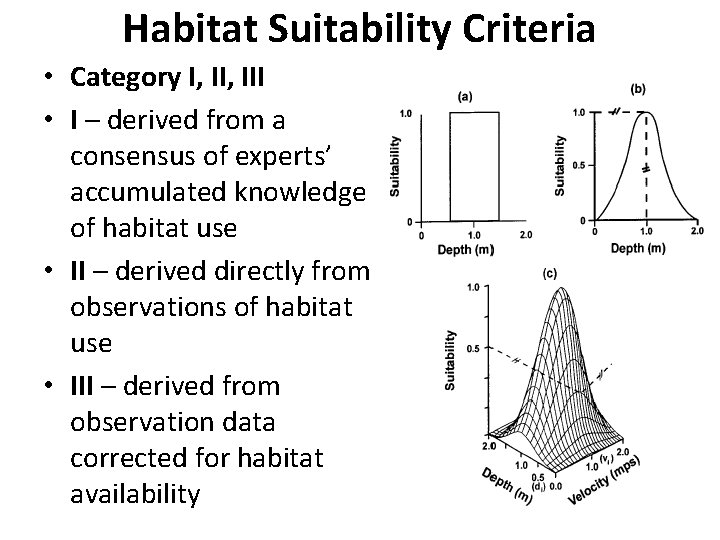
Habitat Suitability Criteria • Category I, III • I – derived from a consensus of experts’ accumulated knowledge of habitat use • II – derived directly from observations of habitat use • III – derived from observation data corrected for habitat availability
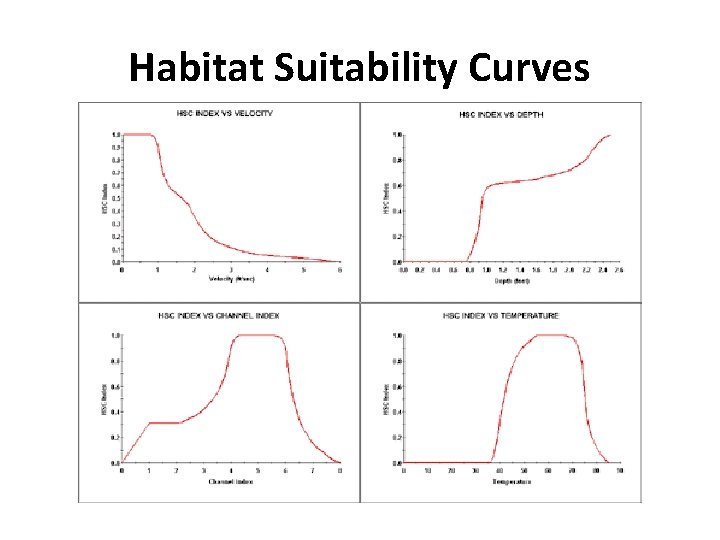
Habitat Suitability Curves
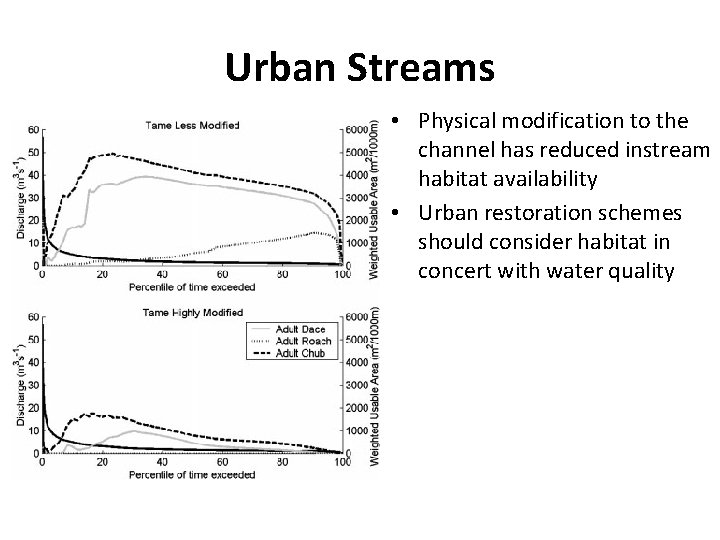
Key Outputs • Weighted Usable Area (WUA) – measure of microhabitat quantity and quality (habitat area/stream distance) • Competition analysis between species
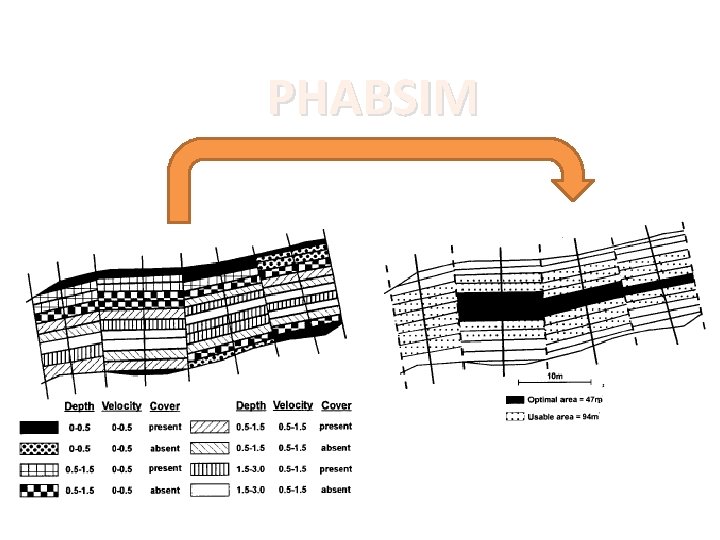
PHABSIM
Urban Streams • Physical modification to the channel has reduced instream habitat availability • Urban restoration schemes should consider habitat in concert with water quality
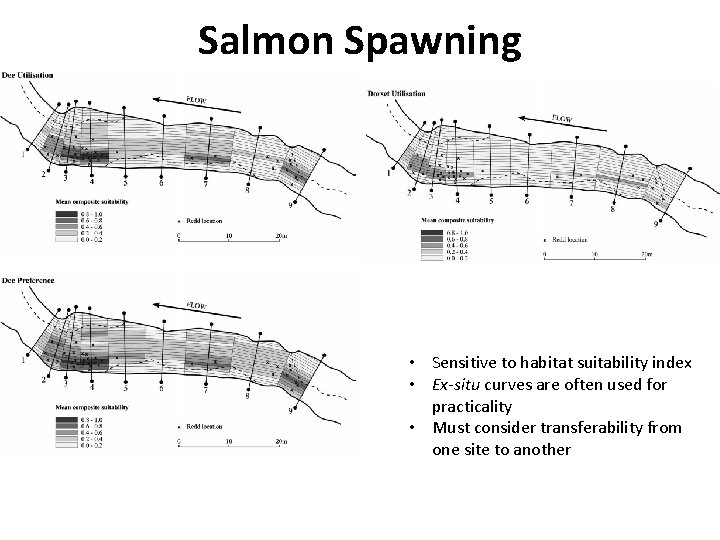
Salmon Spawning • Sensitive to habitat suitability index • Ex-situ curves are often used for practicality • Must consider transferability from one site to another