
LOW EXTERNAL INPUT FOR SUSTAINABLE AGRICULTURE LEISA SYSTEMS
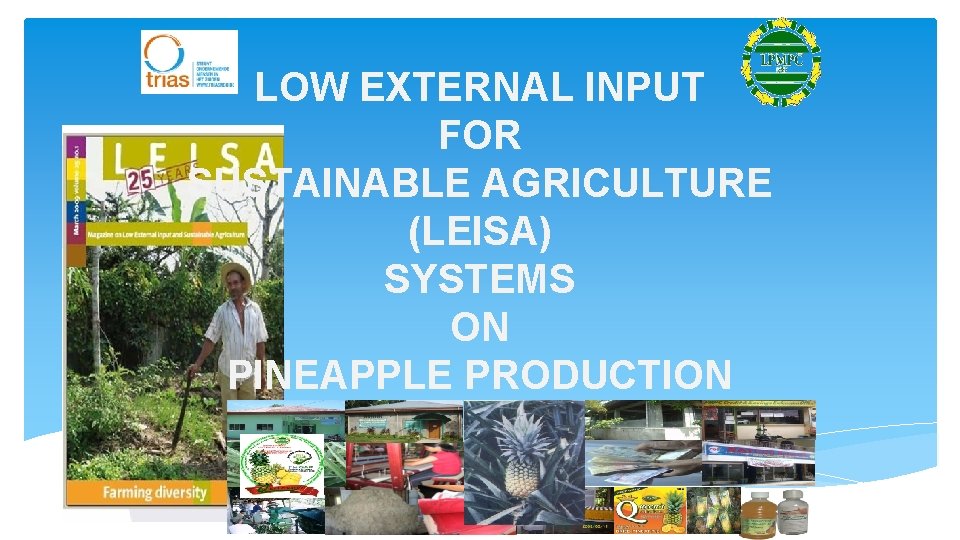
LOW EXTERNAL INPUT FOR SUSTAINABLE AGRICULTURE (LEISA) SYSTEMS ON PINEAPPLE PRODUCTION

WHAT IS LEISA? Is a series of practices which serve as to reinforce ecological principles that are in line with local ecosystem, practices that involves recycling plant nutrients, minimizing crop losses due to insect and pest, and securing favorable soil conditions for plant growth are just the tip of the hat. An integral component of LEISA is in ensuring that this environmental awareness remains connected to the daily lives, needs and concerns of farmers who rely on these ecosystems for their livelihoods. It is also a steps towards Organic Farming Technology.

WHY LEISA? 1. Maximizing the use of locally available plants and tree species. 2. Reducing the use of non-renewable fuels and energy sources. 3. Acknowledging the right of local communities to control, manage and benefit from natural resources. 4. Ensuring that agricultural practices help to shape positive landscapes and sustained ‘life support systems’ for small-scale who rely on favourable environmental conditions for their survival. 5. Minimize the cost of production, by generating farm inputs, LOCALLY. 6. Safe to environment, a response for sustainable agriculture.
HOW DO WE APPLY LEISA? Our task is to apply on Pineapple Production. On-Farm natural Resource Conservation. Empowering farmers group through participatory Processes.

Purpose of LEISA Produce a progressive and efficient farming system Conserve and develop natural resources Reducing production cost by generating farm inputs Reversing impact on environment – SOIL, WATER, BIODIVERSITY It helps the farmers solve related problems

Importance of LEISA systems are that they are based on a preventive approach whereby the problem is tackled at its roots, as opposed to the more symptom-curing nature of modern agriculture. Ecological and biological principles are the basis of the farm system. Nature works for the farmer, the farmer does not have to work against it. They are often based on local knowledge and production systems adapted to modern requirements and much less on external expertise. They are generally more labor-intensive compared to the mechanization-and petrochemicalintensive character of the agriculture envisioned by the Green Revolution and what it has become.
Benefits of LEISA Low cost of external input on production Product produce are healthy Product produce are more competitive in the market
LEISA AIMS To produce with the use of low cost on inputs To have a sustainable supply of pineapple To utilize the land , more efficiently To maximize the profit of the pineapple growers

Target of LEISA application on pineapple production pineapple farmers may lessen their production cost corresponds to resources conservation and sustainable production Increase the status of life of pineapple farmers And empowering farmers groups through participatory processes
Criteria for LEISA Ecological Criteria Balanced use of nutrients and organic matter Efficient use of water resources Diversity of genetic resources Efficient use of energy sources Minimal negative environmental effects Minimal use of external inputs
Economic Criteria Sustained farmer livelihood systems Competitiveness Efficient use of production factors Low relative value of external inputs
Social Criteria Wide-spread and equitable adoption potential, especially among small farmers Reduced dependency on external institutions Enhanced food security at the family and national level Respecting and building on indigenous knowledge, beliefs and value systems Contribution to employment generation
Monitoring and Evaluation Information repackaged is monitored and evaluated to ensure timely corrective measures. interactive discussion with implementers and the recipient group, sample farmers survey, and Participatory Rural Appraisal(PRA) with especial focus on participatory monitoring and evaluation approach. Feed back mechanism used includes: - Adapt systems to the context - Develop assessment criteria with farmers - Generate quantitative data through surveys - Reporting comparative data -Discussing findings together to identify improvements - Repeating the process

Application of LEISA in pineapple production Conduct an orientation about LEISA implementation on pineapple farmers Make a survey about the prospected pineapple farmers Evaluate the pineapple farmers that are willing to participate in implementing LEISA Implement the LEISA on the selected pineapple growers

Conclusion The presence of LEISA on agricultural land is important for maintaining and sustaining the health and productivity of farmlands. Farmers should be aware on the proper implementation of LEISA system to conserve the natural resources. Information dissemination can go a long way in providing information that can lead to sustainable use of our farmlands hence increase food security.
- Slides: 15