
Low energy section design of a linear accelerator


- Slides: 34
Low energy section design of a linear accelerator for carbon ions therapy V. Bencini 6/14/2021 Vittorio Bencini - Ph. D status report 1
Outline • Introduction - Hadrontherapy - Accelerators for hadrontherapy - The linac solution • Twin. EBIS source - Working principles - Output parameters • LEBT - General layout - Matching - Error study • The 750 MHz RFQ - Input parameters - Final design - End to end tracking • Conclusions and next steps 6/14/2021 Vittorio Bencini - Ph. D status report 2
Introduction 6/14/2021 Vittorio Bencini - Ph. D status report 3
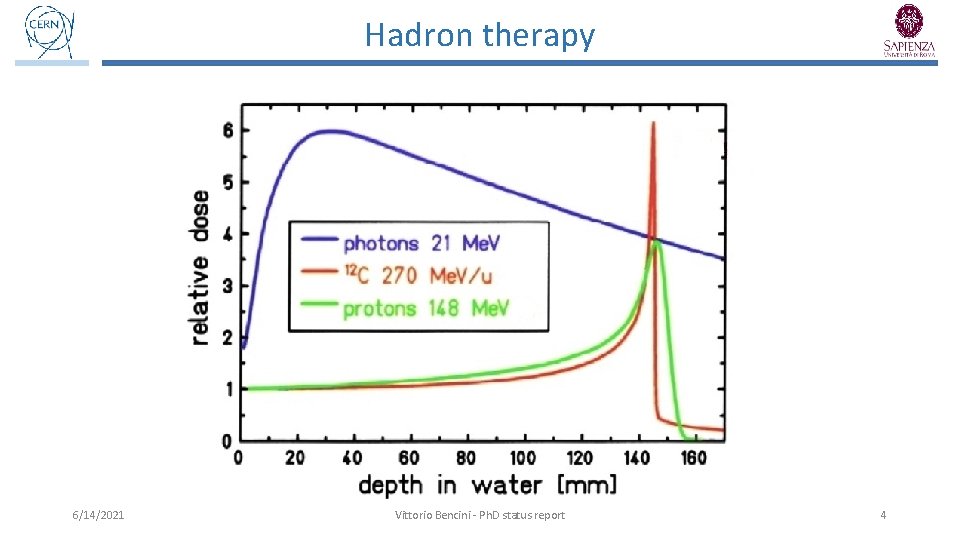
Hadron therapy 6/14/2021 Vittorio Bencini - Ph. D status report 4
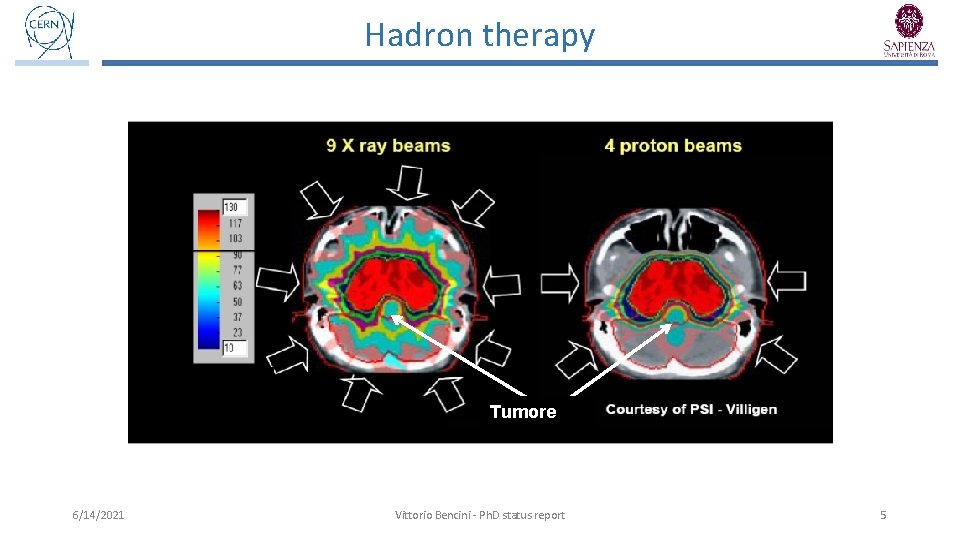
Hadron therapy Tumore 6/14/2021 Vittorio Bencini - Ph. D status report 5
Accelerators for hadron therapy Features • Small footprint • • Drawbacks Passive energy modulation Beam emittance Slow energy modulation Only for protons 6/14/2021 Vittorio Bencini - Ph. D status report 6
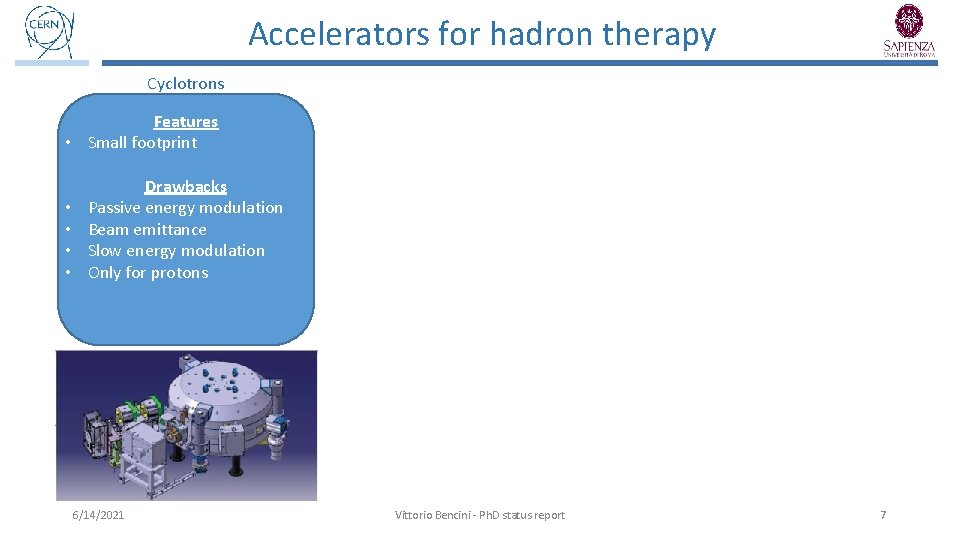
Accelerators for hadron therapy Cyclotrons Features • Small footprint • • Drawbacks Passive energy modulation Beam emittance Slow energy modulation Only for protons 6/14/2021 Vittorio Bencini - Ph. D status report 7
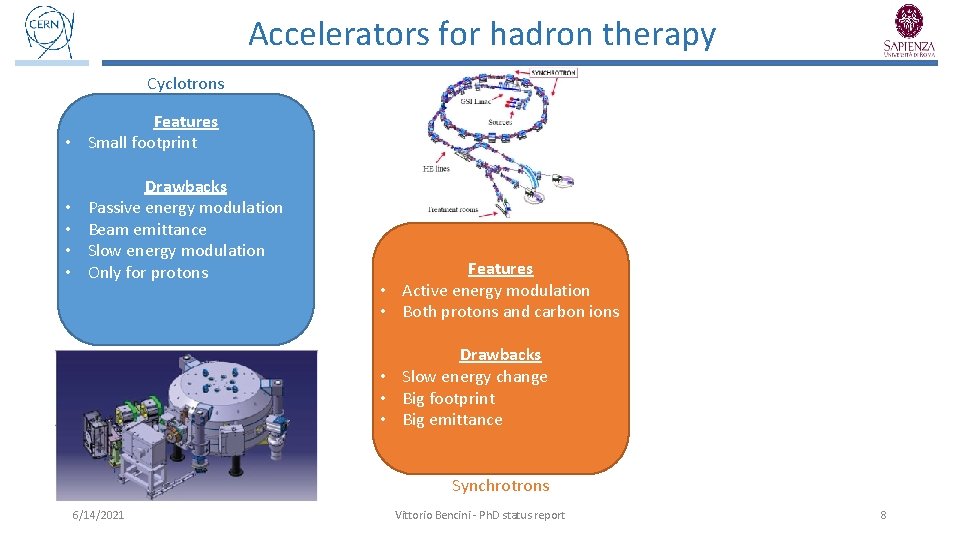
Accelerators for hadron therapy Cyclotrons Features • Small footprint • • Drawbacks Passive energy modulation Beam emittance Slow energy modulation Only for protons Features • Active energy modulation • Both protons and carbon ions Drawbacks • Slow energy change • Big footprint • Big emittance Synchrotrons 6/14/2021 Vittorio Bencini - Ph. D status report 8
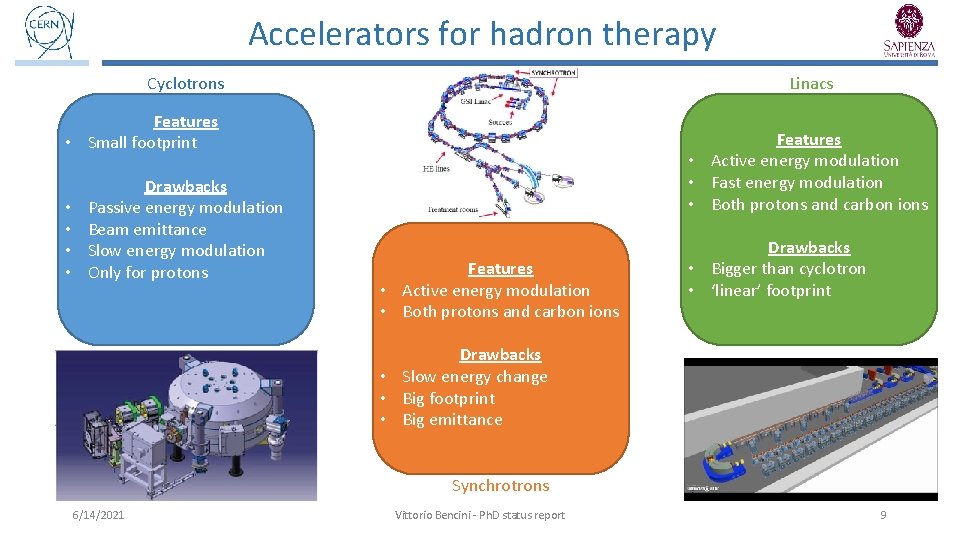
Accelerators for hadron therapy Cyclotrons Linacs Features • Small footprint • • Drawbacks Passive energy modulation Beam emittance Slow energy modulation Only for protons Features • Active energy modulation • Fast energy modulation • Both protons and carbon ions Features • Active energy modulation • Both protons and carbon ions Drawbacks • Bigger than cyclotron • ‘linear’ footprint Drawbacks • Slow energy change • Big footprint • Big emittance Synchrotrons 6/14/2021 Vittorio Bencini - Ph. D status report 9
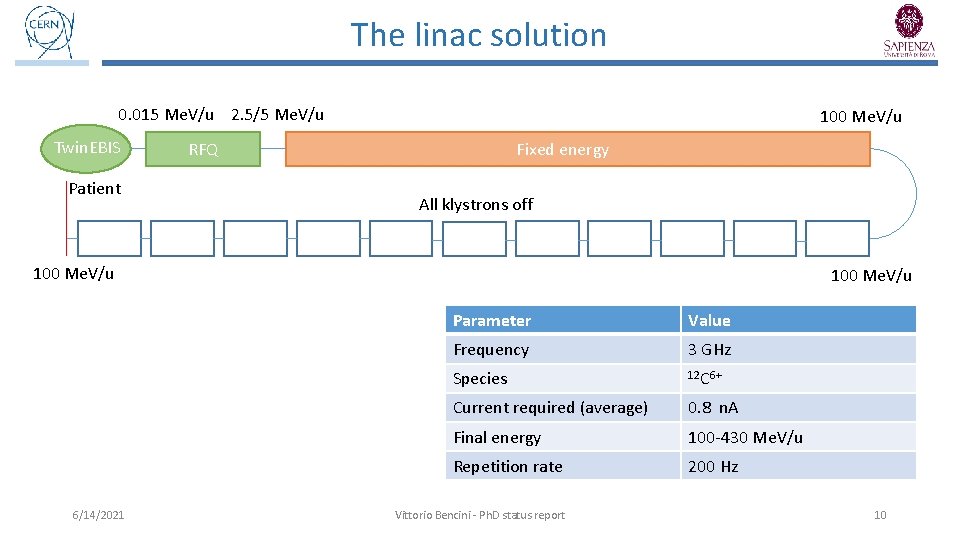
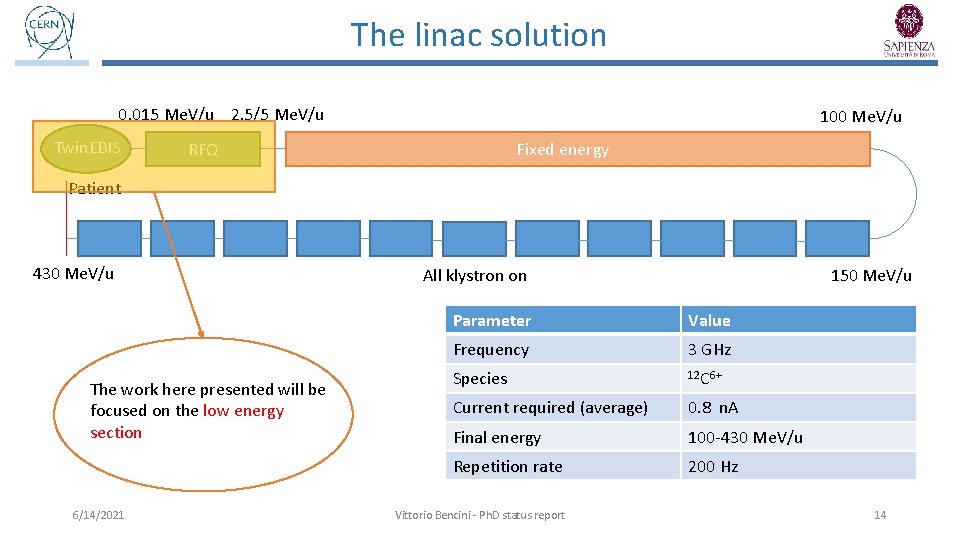
The linac solution 0. 015 Me. V/u 2. 5/5 Me. V/u Twin. EBIS Patient 100 Me. V/u 6/14/2021 100 Me. V/u RFQ Fixed energy All klystrons off 100 Me. V/u Energy modulation Parameter Value Frequency 3 GHz Species 12 C 6+ Current required (average) 0. 8 n. A Final energy 100 -430 Me. V/u Repetition rate 200 Hz Vittorio Bencini - Ph. D status report 10
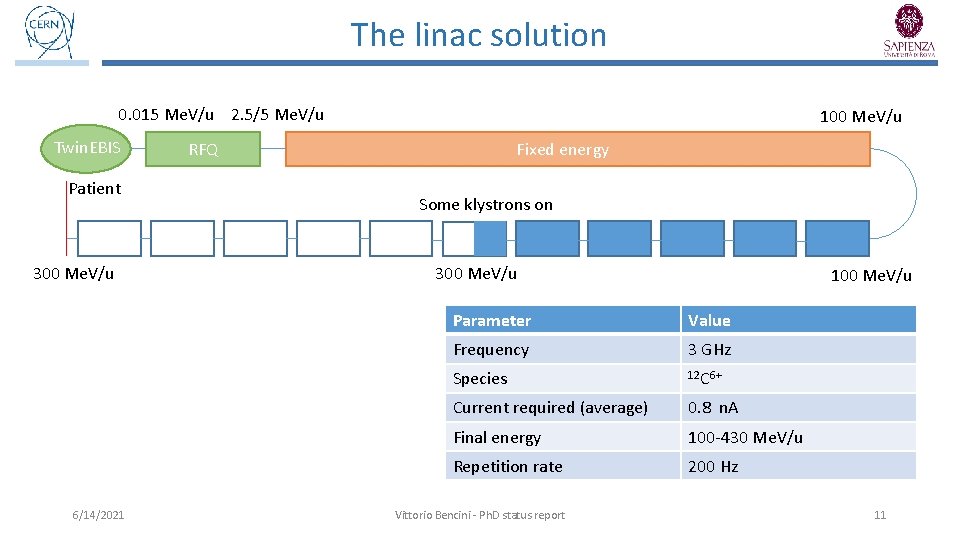
The linac solution 0. 015 Me. V/u 2. 5/5 Me. V/u Twin. EBIS Patient 300 Me. V/u 6/14/2021 100 Me. V/u RFQ Fixed energy Some klystrons on 300 Me. V/u 100 Me. V/u Parameter Value Frequency 3 GHz Species 12 C 6+ Current required (average) 0. 8 n. A Final energy 100 -430 Me. V/u Repetition rate 200 Hz Vittorio Bencini - Ph. D status report 11
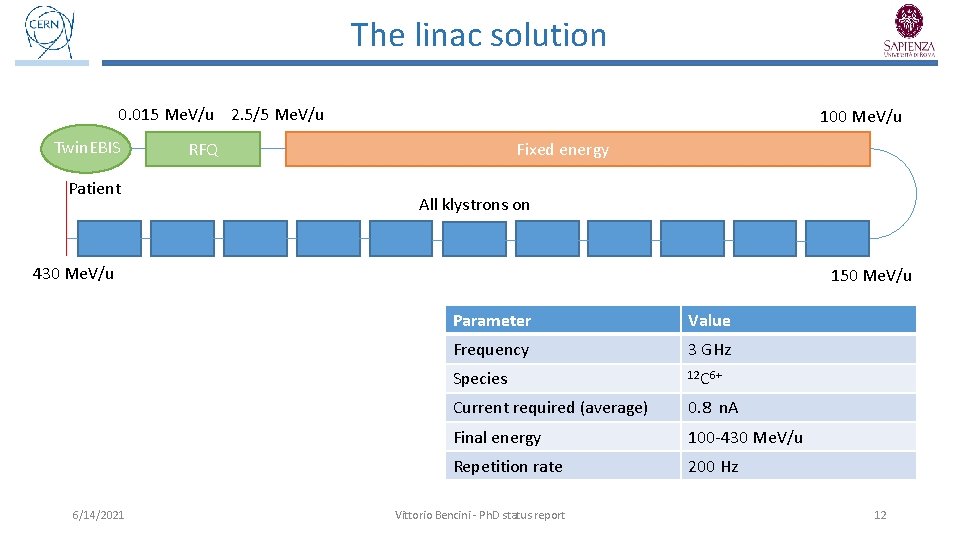
The linac solution 0. 015 Me. V/u 2. 5/5 Me. V/u Twin. EBIS Patient 430 Me. V/u 6/14/2021 100 Me. V/u RFQ Fixed energy All klystrons on 150 Me. V/u Energy modulation Parameter Value Frequency 3 GHz Species 12 C 6+ Current required (average) 0. 8 n. A Final energy 100 -430 Me. V/u Repetition rate 200 Hz Vittorio Bencini - Ph. D status report 12
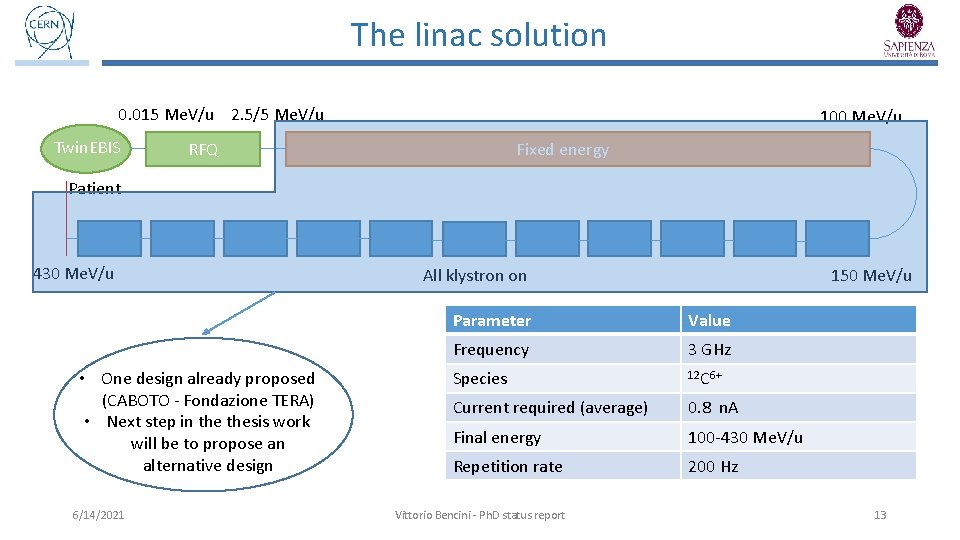
The linac solution 0. 015 Me. V/u 2. 5/5 Me. V/u Twin. EBIS 100 Me. V/u RFQ Fixed energy Patient 430 Me. V/u • One design already proposed (CABOTO - Fondazione TERA) • Next step in thesis work will be to propose an alternative design 6/14/2021 All klystron on Energy modulation 150 Me. V/u Parameter Value Frequency 3 GHz Species 12 C 6+ Current required (average) 0. 8 n. A Final energy 100 -430 Me. V/u Repetition rate 200 Hz Vittorio Bencini - Ph. D status report 13
The linac solution 0. 015 Me. V/u 2. 5/5 Me. V/u Twin. EBIS 100 Me. V/u RFQ Fixed energy Patient 430 Me. V/u The work here presented will be focused on the low energy section 6/14/2021 All klystron on Energy modulation 150 Me. V/u Parameter Value Frequency 3 GHz Species 12 C 6+ Current required (average) 0. 8 n. A Final energy 100 -430 Me. V/u Repetition rate 200 Hz Vittorio Bencini - Ph. D status report 14
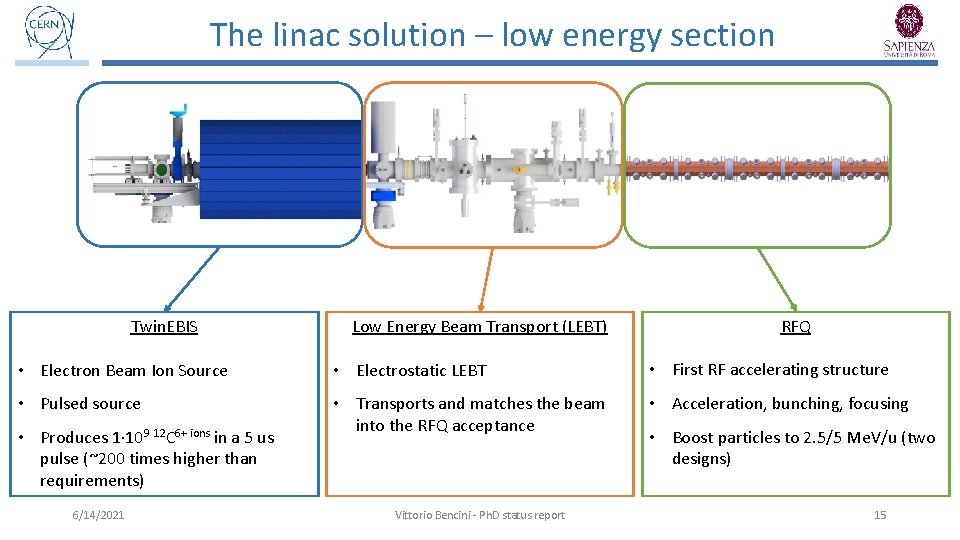
The linac solution – low energy section Twin. EBIS Low Energy Beam Transport (LEBT) RFQ • Electron Beam Ion Source • Electrostatic LEBT • First RF accelerating structure • Pulsed source • Transports and matches the beam into the RFQ acceptance • Acceleration, bunching, focusing • Produces 1· 109 12 C 6+ ions in a 5 us pulse (~200 times higher than requirements) 6/14/2021 Vittorio Bencini - Ph. D status report • Boost particles to 2. 5/5 Me. V/u (two designs) 15
The Twin. EBIS source 6/14/2021 Vittorio Bencini - Ph. D status report 16
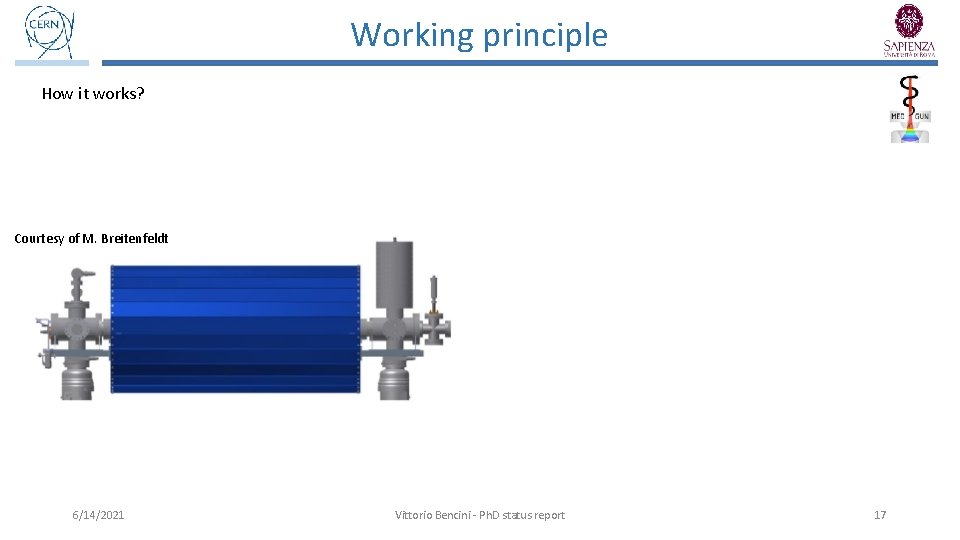
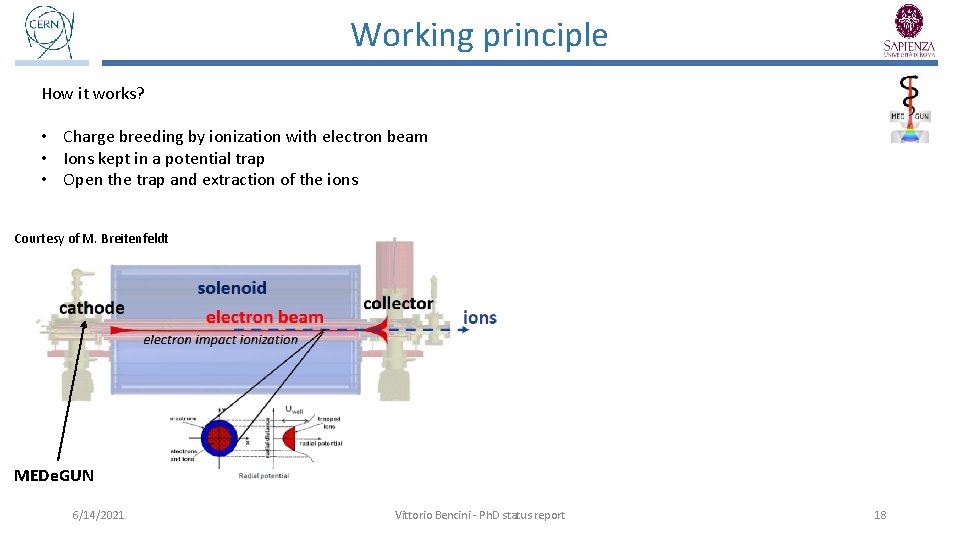
Working principle How it works? Courtesy of M. Breitenfeldt 6/14/2021 Vittorio Bencini - Ph. D status report 17
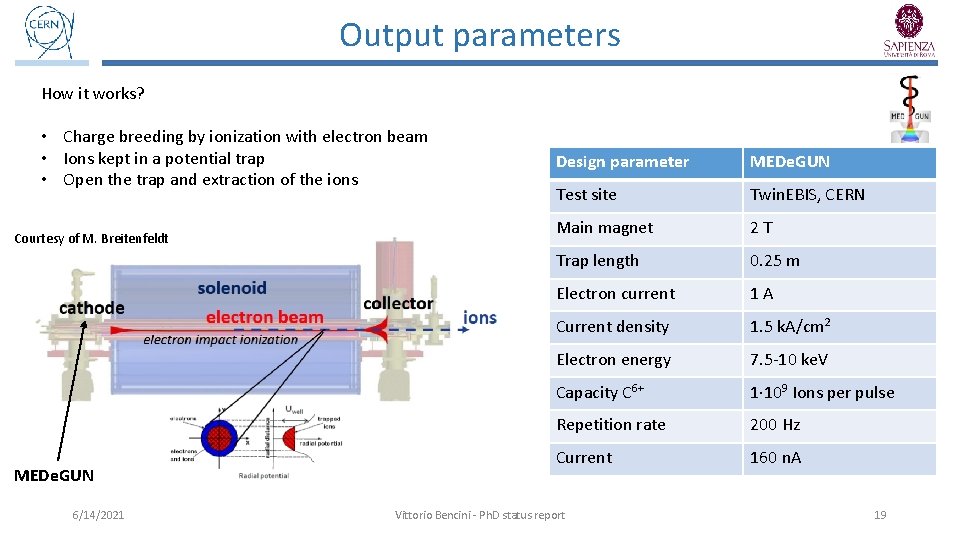
Working principle How it works? • Charge breeding by ionization with electron beam • Ions kept in a potential trap • Open the trap and extraction of the ions Courtesy of M. Breitenfeldt MEDe. GUN 6/14/2021 Vittorio Bencini - Ph. D status report 18
Output parameters How it works? • Charge breeding by ionization with electron beam • Ions kept in a potential trap • Open the trap and extraction of the ions Courtesy of M. Breitenfeldt MEDe. GUN 6/14/2021 Design parameter MEDe. GUN Test site Twin. EBIS, CERN Main magnet 2 T Trap length 0. 25 m Electron current 1 A Current density 1. 5 k. A/cm 2 Electron energy 7. 5 -10 ke. V Capacity C 6+ 1· 109 Ions per pulse Repetition rate 200 Hz Current 160 n. A Vittorio Bencini - Ph. D status report 19
The LEBT 6/14/2021 Vittorio Bencini - Ph. D status report 20
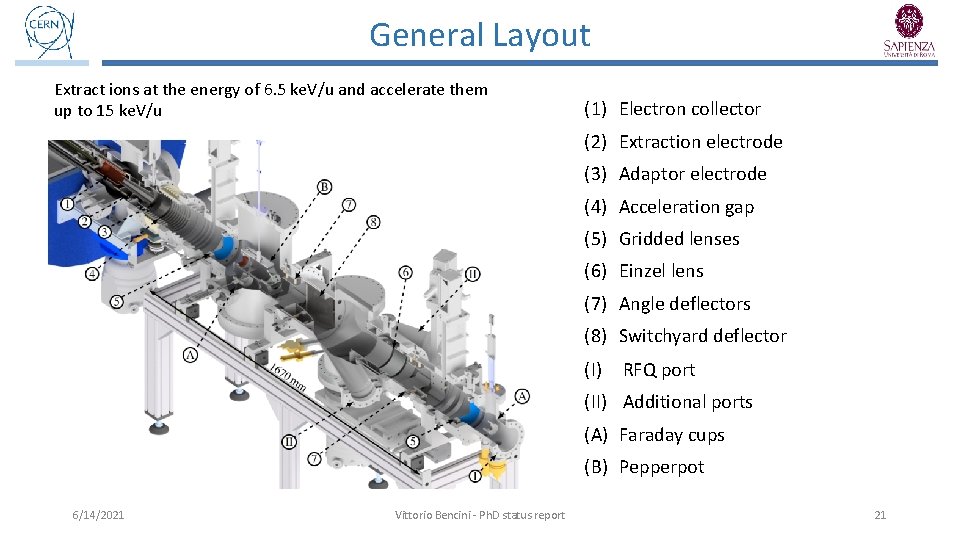
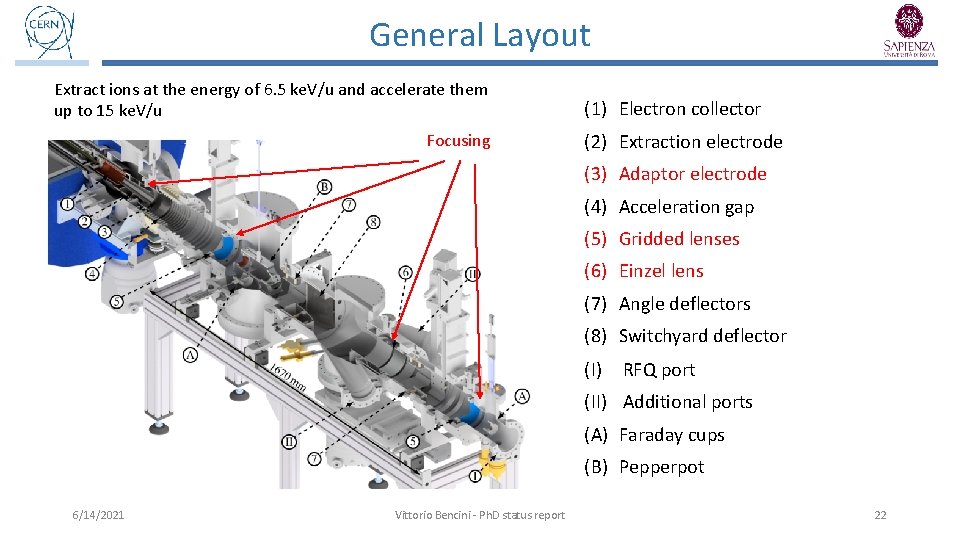
General Layout Extract ions at the energy of 6. 5 ke. V/u and accelerate them up to 15 ke. V/u (1) Electron collector (2) Extraction electrode (3) Adaptor electrode (4) Acceleration gap (5) Gridded lenses (6) Einzel lens (7) Angle deflectors (8) Switchyard deflector (I) RFQ port (II) Additional ports (A) Faraday cups (B) Pepperpot 6/14/2021 Vittorio Bencini - Ph. D status report 21
General Layout Extract ions at the energy of 6. 5 ke. V/u and accelerate them up to 15 ke. V/u Focusing (1) Electron collector (2) Extraction electrode (3) Adaptor electrode (4) Acceleration gap (5) Gridded lenses (6) Einzel lens (7) Angle deflectors (8) Switchyard deflector (I) RFQ port (II) Additional ports (A) Faraday cups (B) Pepperpot 6/14/2021 Vittorio Bencini - Ph. D status report 22
Matching methodology Step 1 – Telescopic matching • Select voltage on adaptor that gives alpha=0 • Select voltage on gridded lens 1 that gives alpha=0 • Select voltage on Einzel lens that gives alpha=0 • Scan gridded lens to to find best match to accptance Step 2 – Optimised matching • • 6/14/2021 Use Telescopic matching set-up as starting point Scan many possible combination of voltages Obtain transmission maps Fine scan on gridded lens 2 Vittorio Bencini - Ph. D status report 23
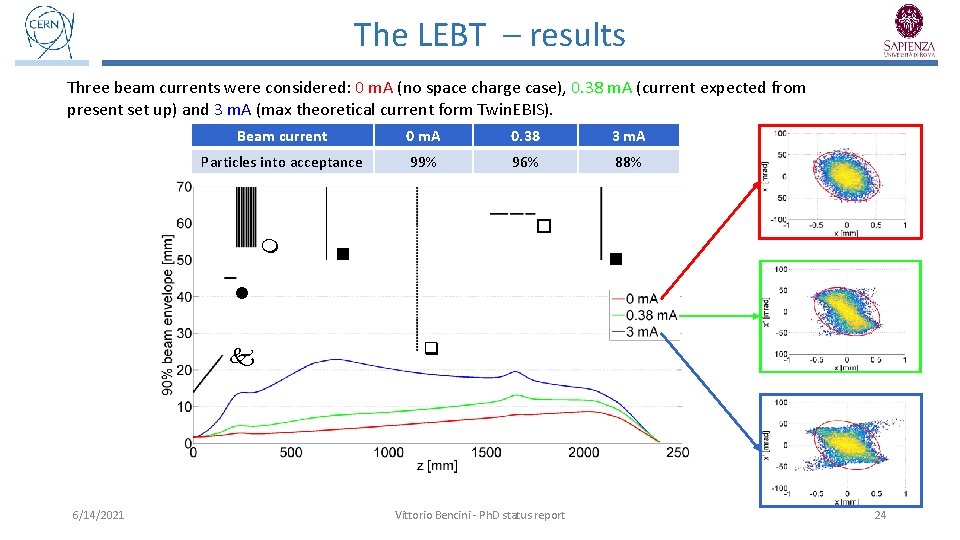
The LEBT – results Three beam currents were considered: 0 m. A (no space charge case), 0. 38 m. A (current expected from present set up) and 3 m. A (max theoretical current form Twin. EBIS). Beam current 0 m. A 0. 38 3 m. A Particles into acceptance 99% 96% 88% m o n n l k 6/14/2021 q Vittorio Bencini - Ph. D status report 24
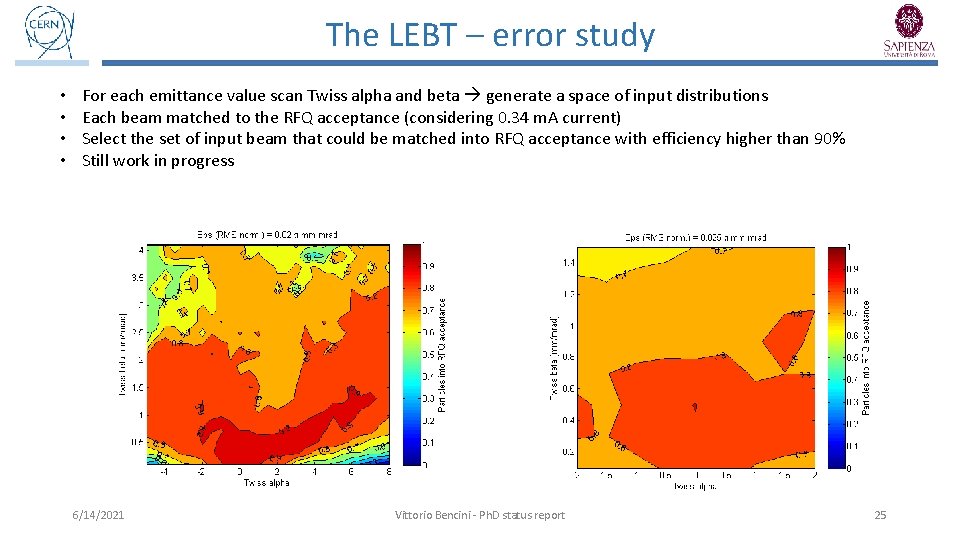
The LEBT – error study • • For each emittance value scan Twiss alpha and beta generate a space of input distributions Each beam matched to the RFQ acceptance (considering 0. 34 m. A current) Select the set of input beam that could be matched into RFQ acceptance with efficiency higher than 90% Still work in progress 6/14/2021 Vittorio Bencini - Ph. D status report 25
Radio Frequency Quadrupole 6/14/2021 Vittorio Bencini - Ph. D status report 26
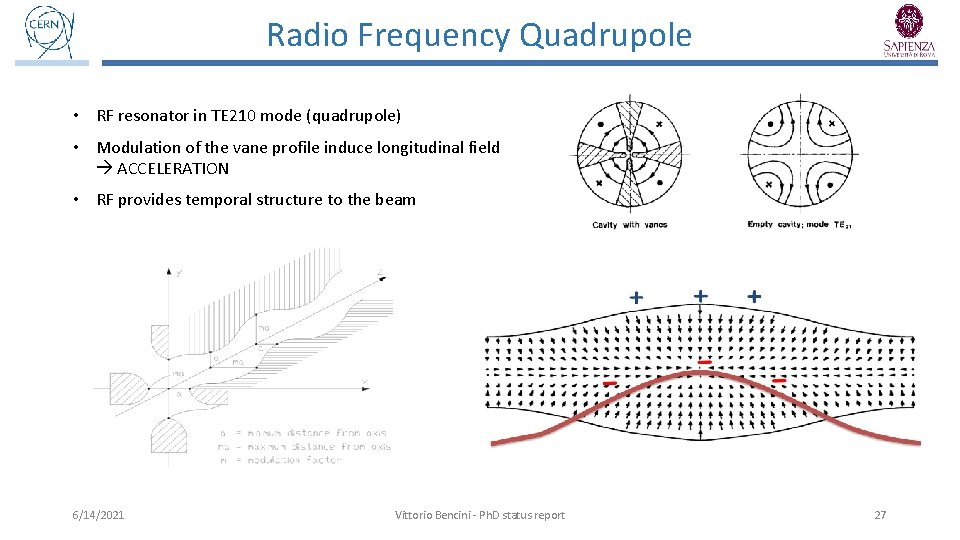
Radio Frequency Quadrupole • RF resonator in TE 210 mode (quadrupole) • Modulation of the vane profile induce longitudinal field ACCELERATION • RF provides temporal structure to the beam 6/14/2021 Vittorio Bencini - Ph. D status report 27
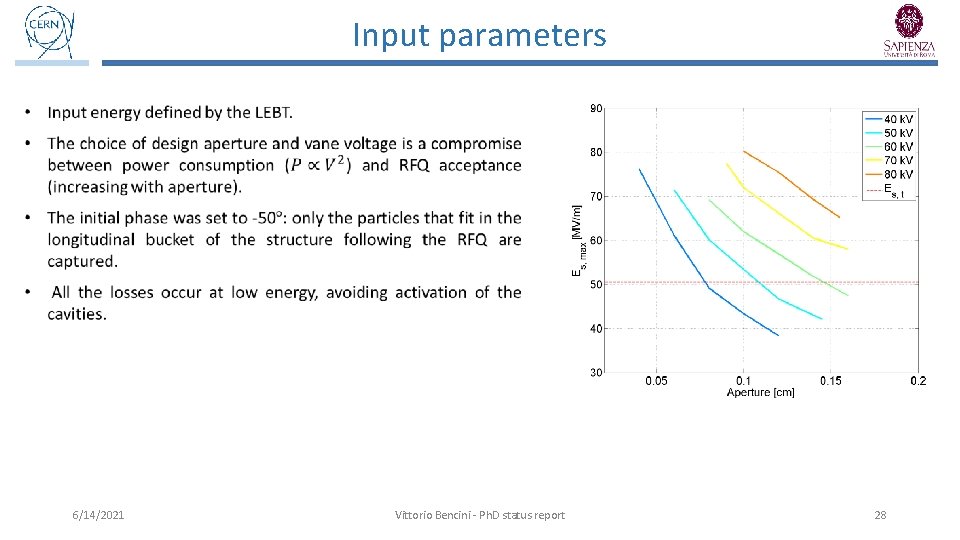
Input parameters 6/14/2021 Vittorio Bencini - Ph. D status report 28
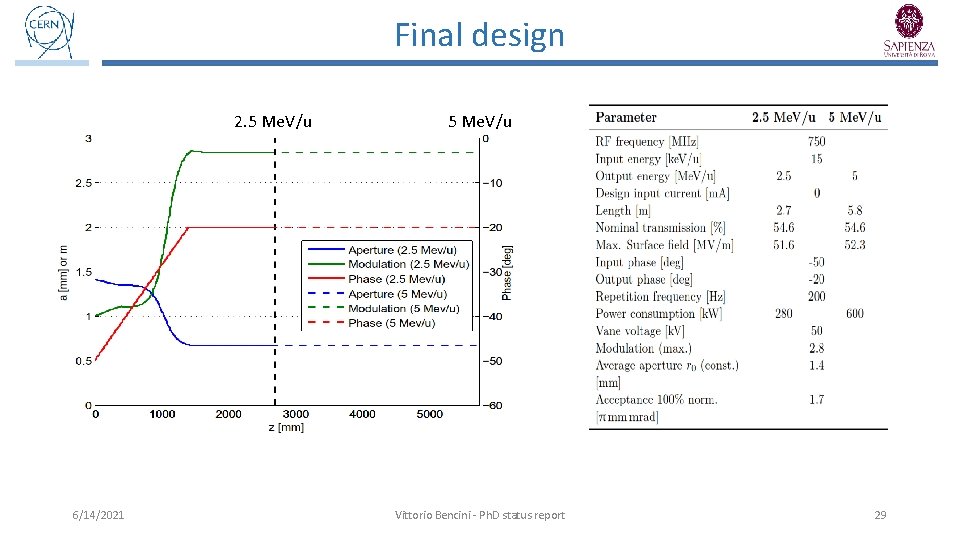
Final design 2. 5 Me. V/u 6/14/2021 5 Me. V/u Vittorio Bencini - Ph. D status report 29
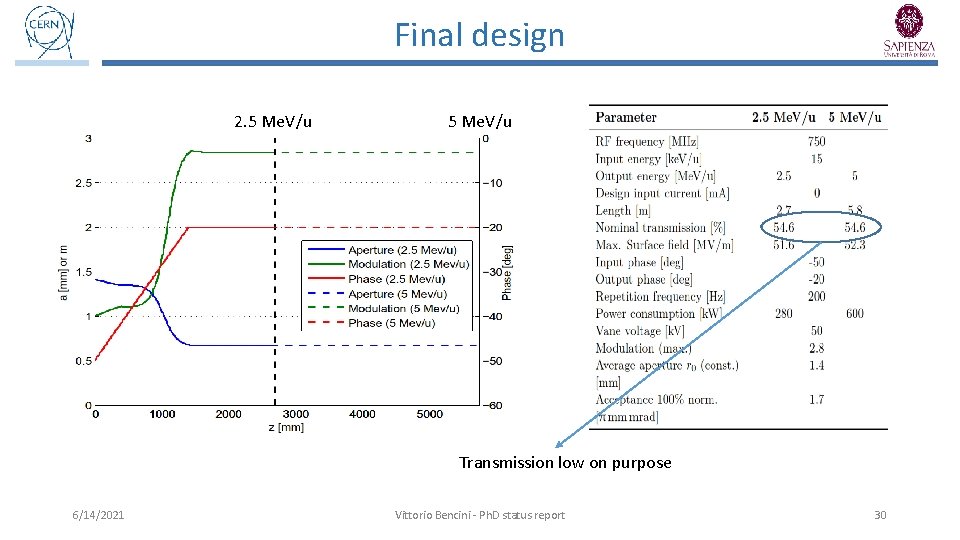
Final design 2. 5 Me. V/u Transmission low on purpose 6/14/2021 Vittorio Bencini - Ph. D status report 30
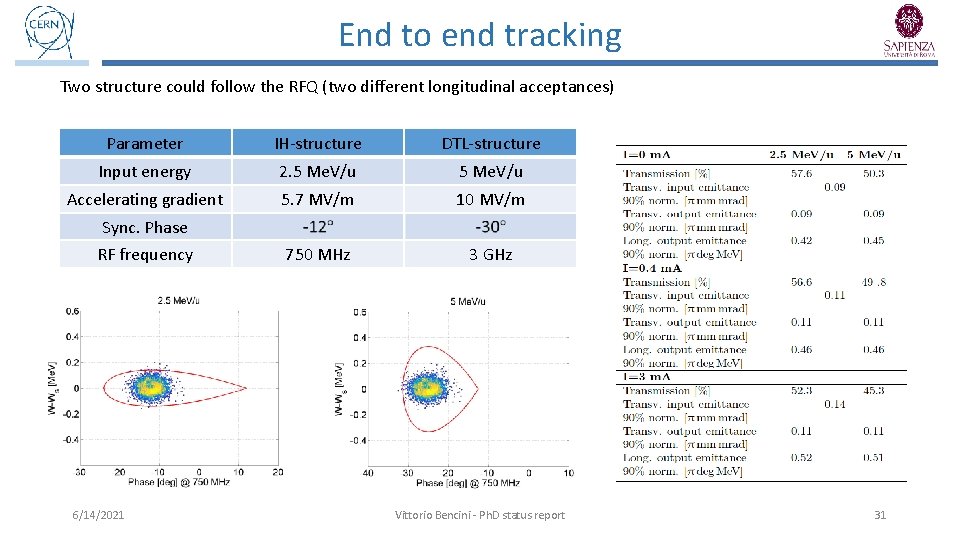
End to end tracking Two structure could follow the RFQ (two different longitudinal acceptances) Parameter IH-structure DTL-structure Input energy 2. 5 Me. V/u Accelerating gradient 5. 7 MV/m 10 MV/m 750 MHz 3 GHz Sync. Phase RF frequency 6/14/2021 Vittorio Bencini - Ph. D status report 31
Conclusions and next steps 6/14/2021 Vittorio Bencini - Ph. D status report 32
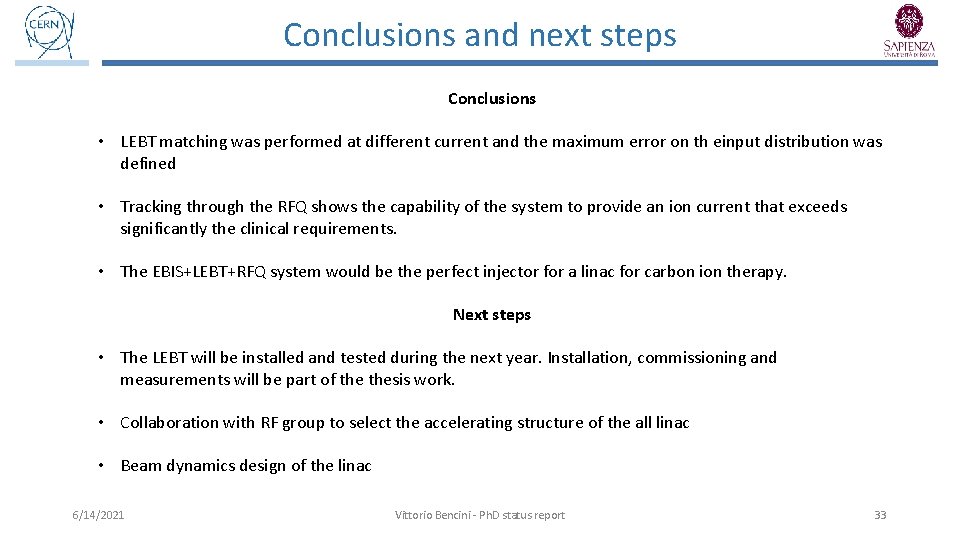
Conclusions and next steps Conclusions • LEBT matching was performed at different current and the maximum error on th einput distribution was defined • Tracking through the RFQ shows the capability of the system to provide an ion current that exceeds significantly the clinical requirements. • The EBIS+LEBT+RFQ system would be the perfect injector for a linac for carbon ion therapy. Next steps • The LEBT will be installed and tested during the next year. Installation, commissioning and measurements will be part of thesis work. • Collaboration with RF group to select the accelerating structure of the all linac • Beam dynamics design of the linac 6/14/2021 Vittorio Bencini - Ph. D status report 33
Thank you for your attention! 6/14/2021 Vittorio Bencini - Ph. D status report 34