
Low energy approach for the SUN Kondo model


- Slides: 33
Low energy approach for the SU(N) Kondo model Christophe Mora, Xavier Leyronas, Nicolas Regnault Laboratoire Pierre Aigrain, ENS, Paris Many thanks to Takis Kontos ENS mesoscopic group Aashish A Clerk, P. Vitushinsky Karyn Le Hur
Outline of the talk I. Reminder: SU(2) Kondo model II. Transport and Local Fermi liquid theory III. SU(4) and SU(N)
SU(2) Kondo model
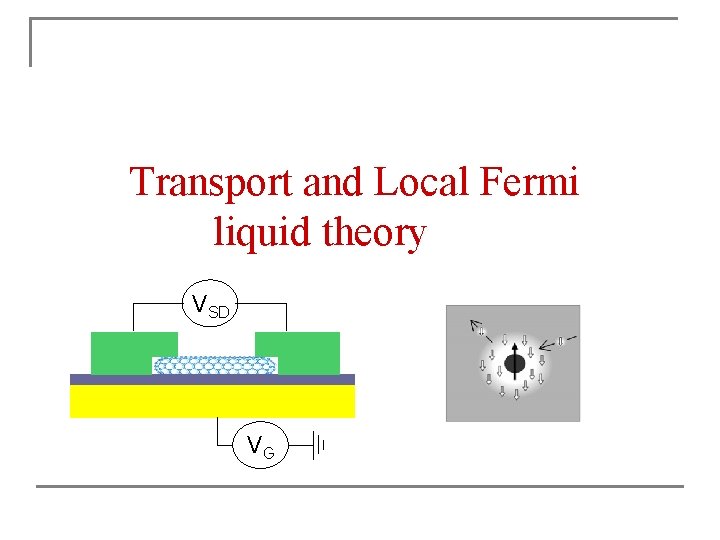
Coulomb blockade U (or EC) VSD L R VG Current flows for Low energy sector Charge excitation quenched: quantum dot acts as an impurity ½-spin.
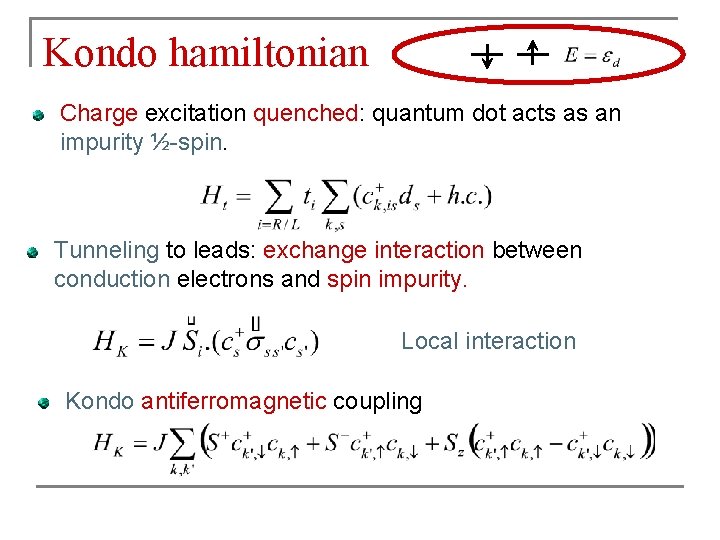
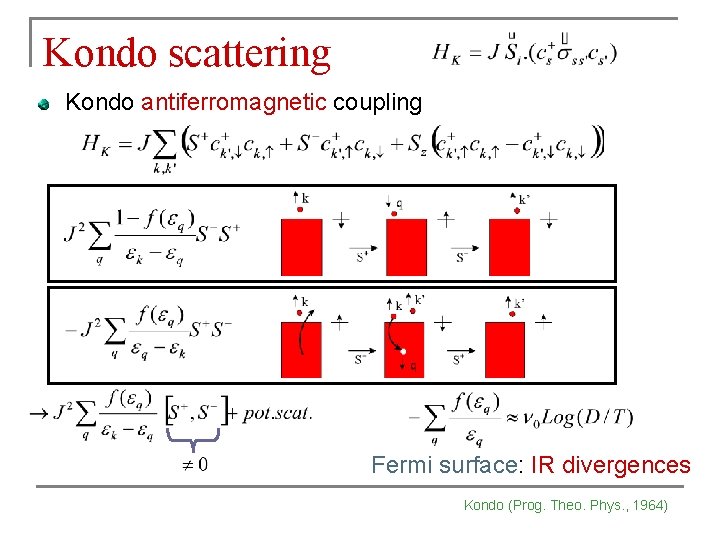
Kondo hamiltonian Charge excitation quenched: quantum dot acts as an impurity ½-spin. Tunneling to leads: exchange interaction between conduction electrons and spin impurity. Local interaction Kondo antiferromagnetic coupling
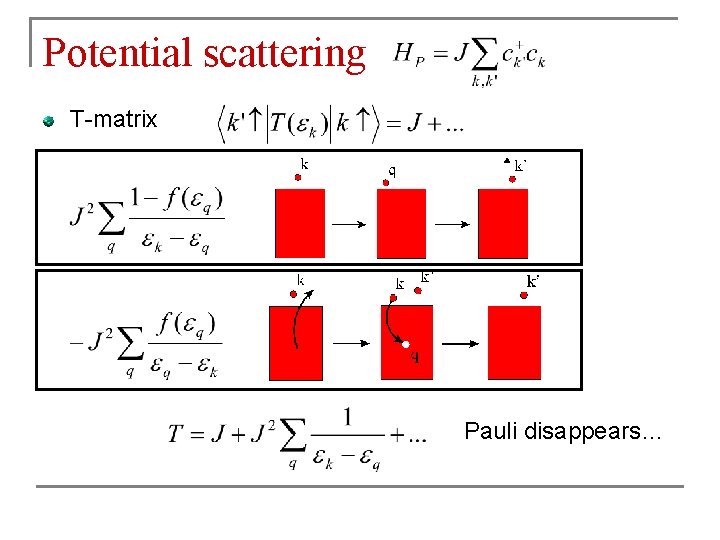
Potential scattering T-matrix Pauli disappears…
Kondo scattering Kondo antiferromagnetic coupling Fermi surface: IR divergences Kondo (Prog. Theo. Phys. , 1964)
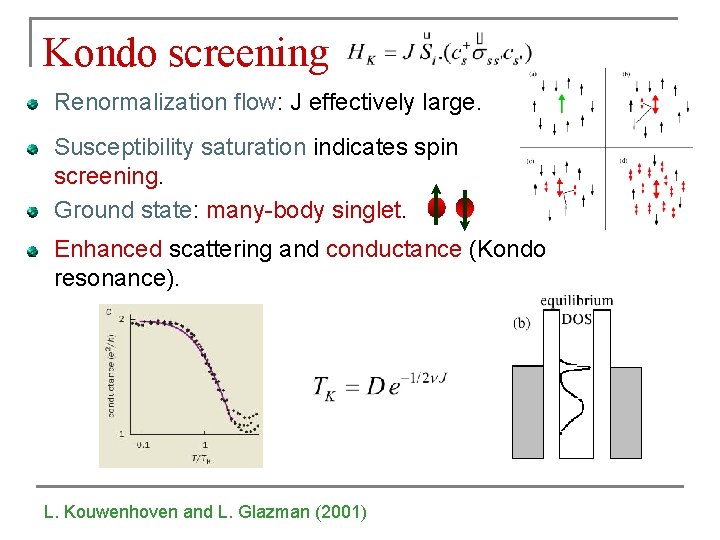
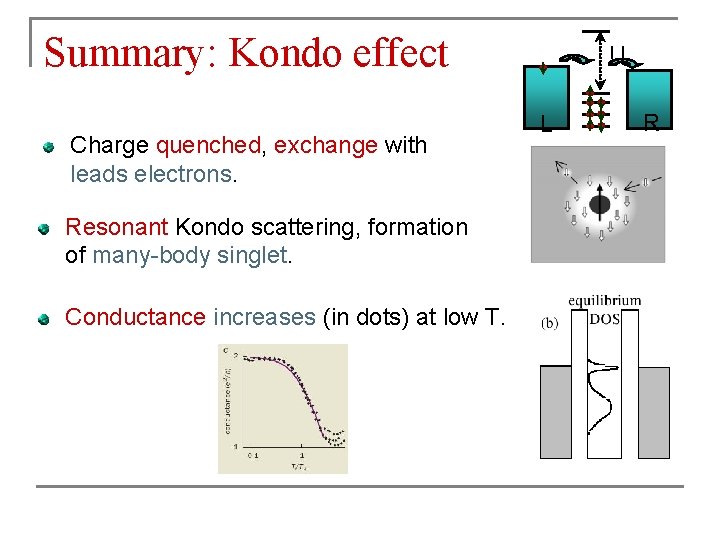
Kondo screening Renormalization flow: J effectively large. Susceptibility saturation indicates spin screening. Ground state: many-body singlet. Enhanced scattering and conductance (Kondo resonance). L. Kouwenhoven and L. Glazman (2001)
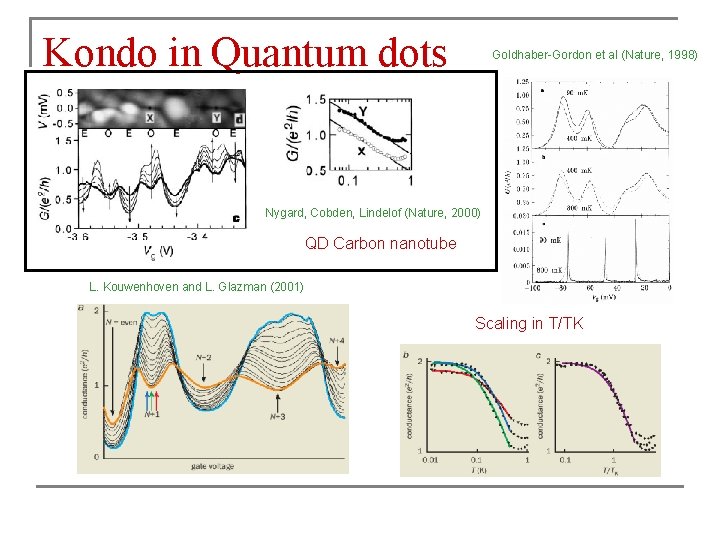
Kondo in Quantum dots Goldhaber-Gordon et al (Nature, 1998) Nygard, Cobden, Lindelof (Nature, 2000) QD Carbon nanotube L. Kouwenhoven and L. Glazman (2001) Scaling in T/TK
Summary: Kondo effect Charge quenched, exchange with leads electrons. Resonant Kondo scattering, formation of many-body singlet. Conductance increases (in dots) at low T. U L R
Transport and Local Fermi liquid theory VSD VG
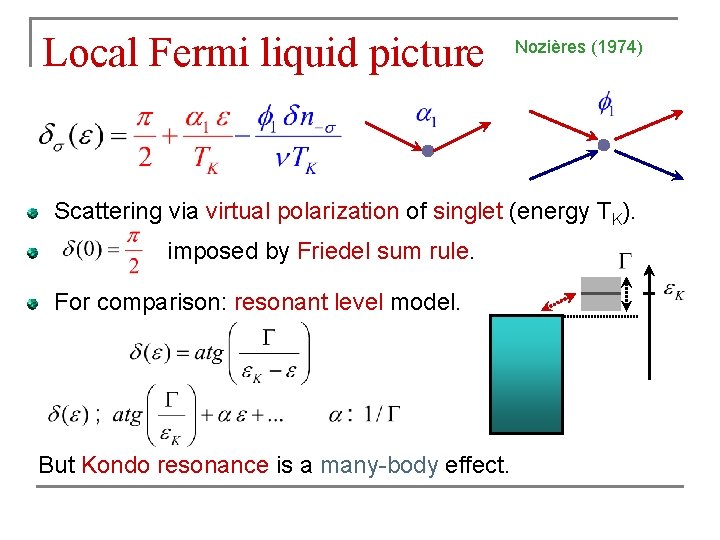
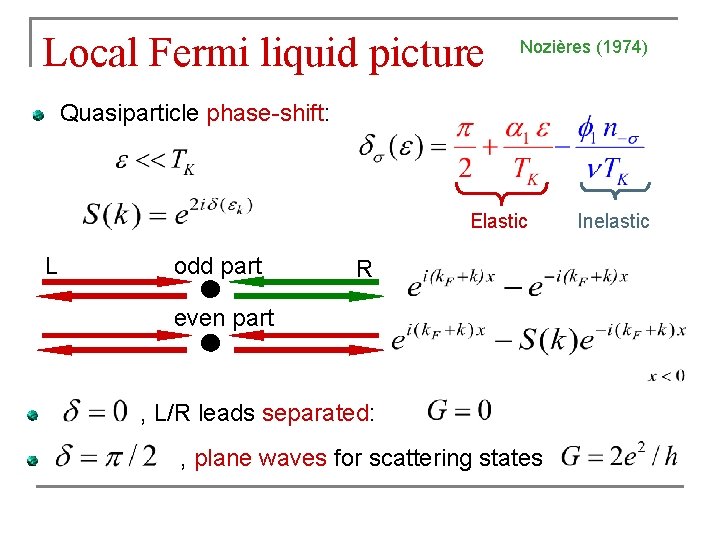
Local Fermi liquid picture Nozières (1974) Scattering via virtual polarization of singlet (energy TK). imposed by Friedel sum rule. For comparison: resonant level model. But Kondo resonance is a many-body effect.
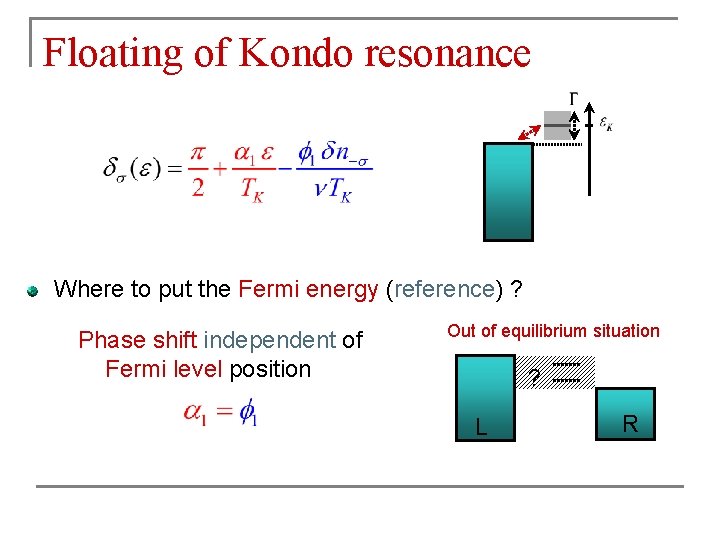
Floating of Kondo resonance Where to put the Fermi energy (reference) ? Phase shift independent of Fermi level position Out of equilibrium situation ? L R
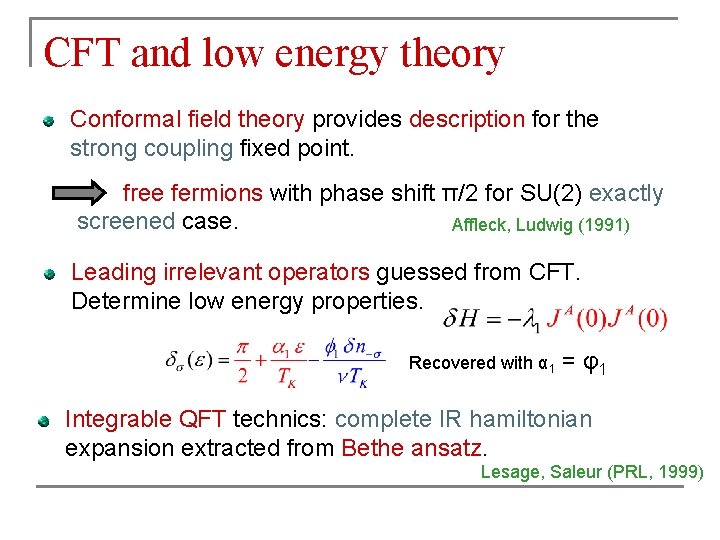
CFT and low energy theory Conformal field theory provides description for the strong coupling fixed point. free fermions with phase shift π/2 for SU(2) exactly screened case. Affleck, Ludwig (1991) Leading irrelevant operators guessed from CFT. Determine low energy properties. Recovered with α 1 = φ1 Integrable QFT technics: complete IR hamiltonian expansion extracted from Bethe ansatz. Lesage, Saleur (PRL, 1999)
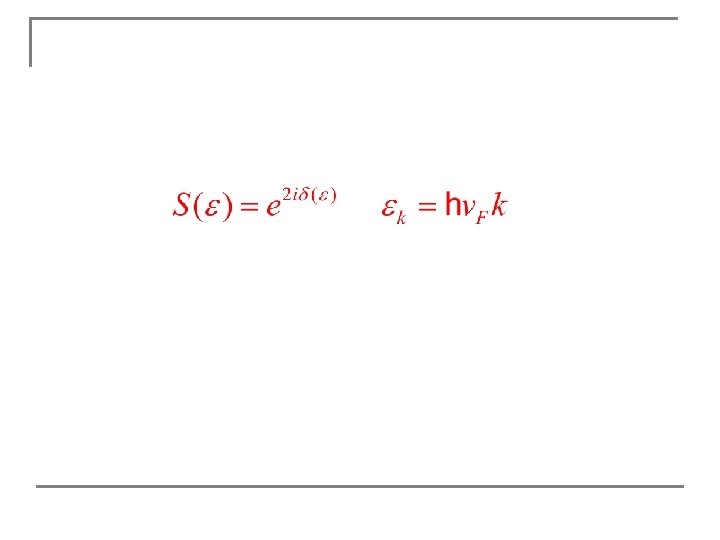
Local Fermi liquid picture Nozières (1974) Quasiparticle phase-shift: Elastic L odd part R even part , L/R leads separated: , plane waves for scattering states Inelastic
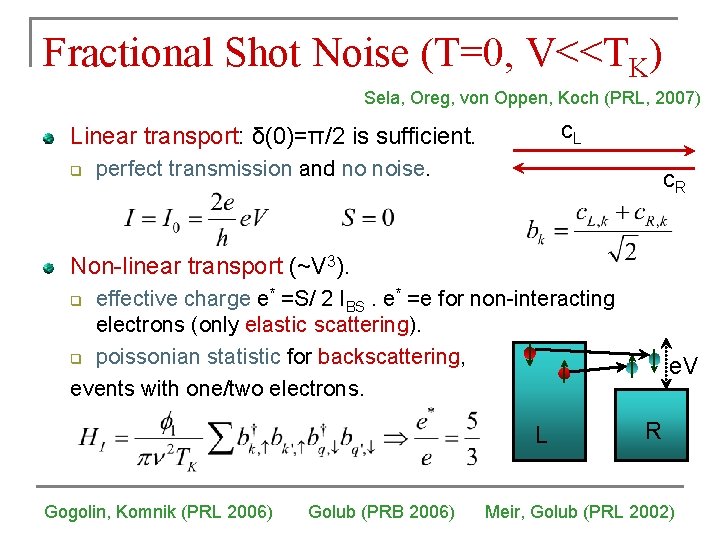
Fractional Shot Noise (T=0, V<<TK) Sela, Oreg, von Oppen, Koch (PRL, 2007) c. L Linear transport: δ(0)=π/2 is sufficient. q perfect transmission and no noise. c. R Non-linear transport (~V 3). effective charge e* =S/ 2 IBS. e* =e for non-interacting electrons (only elastic scattering). q poissonian statistic for backscattering, events with one/two electrons. q L Gogolin, Komnik (PRL 2006) Golub (PRB 2006) e. V R Meir, Golub (PRL 2002)
Current operator L R Straightforward approach: Kaminski, Nazarov, Glazman (PRB 2000) n does not apply for T≠ 0 Noise (Nyquist Noise not recovered) Back to Büttiker but with even/odd channels. all elastic scattering encoded in b
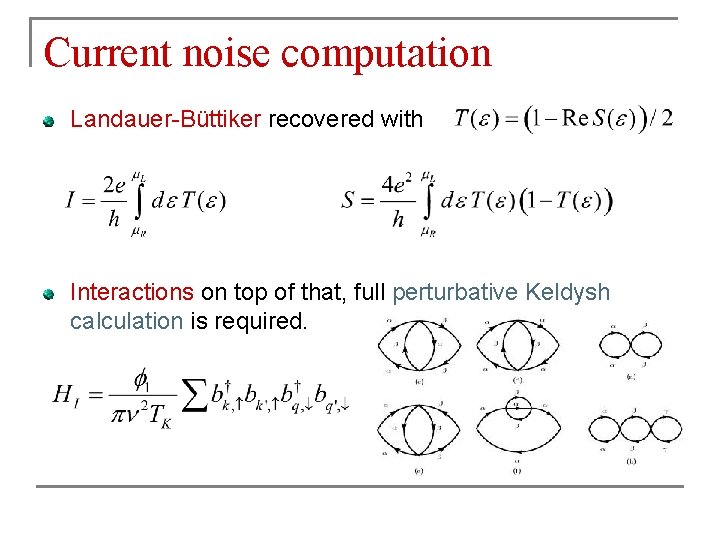
Current noise computation Landauer-Büttiker recovered with Interactions on top of that, full perturbative Keldysh calculation is required.
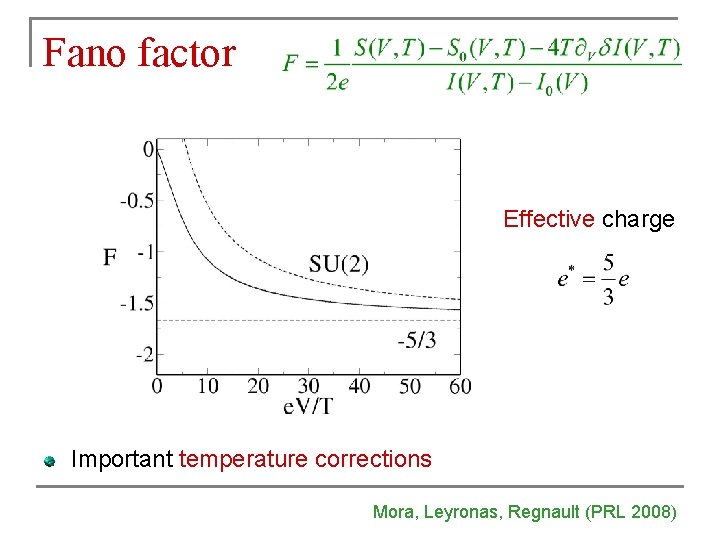
Fano factor Effective charge Important temperature corrections Mora, Leyronas, Regnault (PRL 2008)
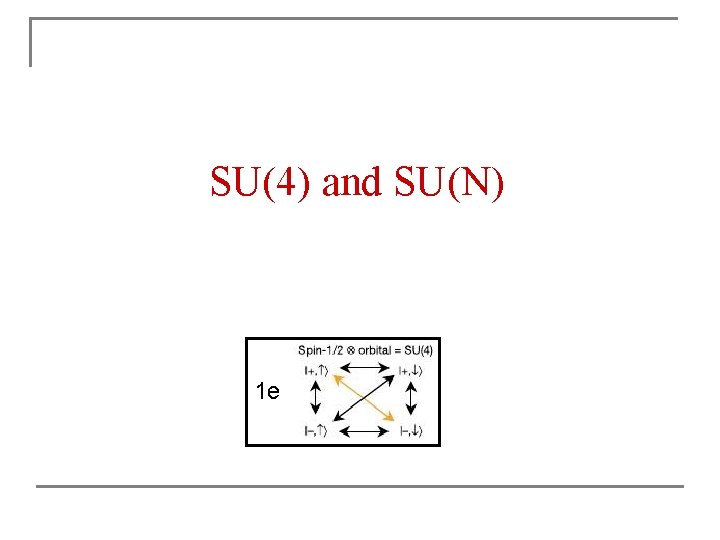
SU(4) and SU(N) 1 e
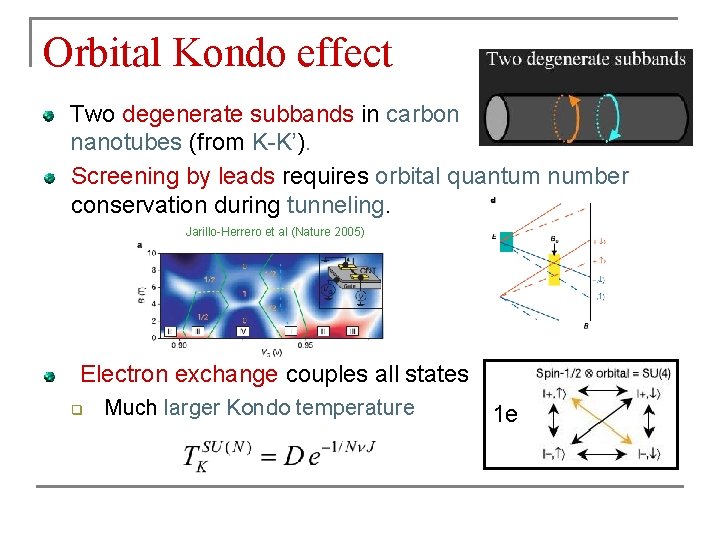
Orbital Kondo effect Two degenerate subbands in carbon nanotubes (from K-K’). Screening by leads requires orbital quantum number conservation during tunneling. Jarillo-Herrero et al (Nature 2005) Electron exchange couples all states q Much larger Kondo temperature 1 e
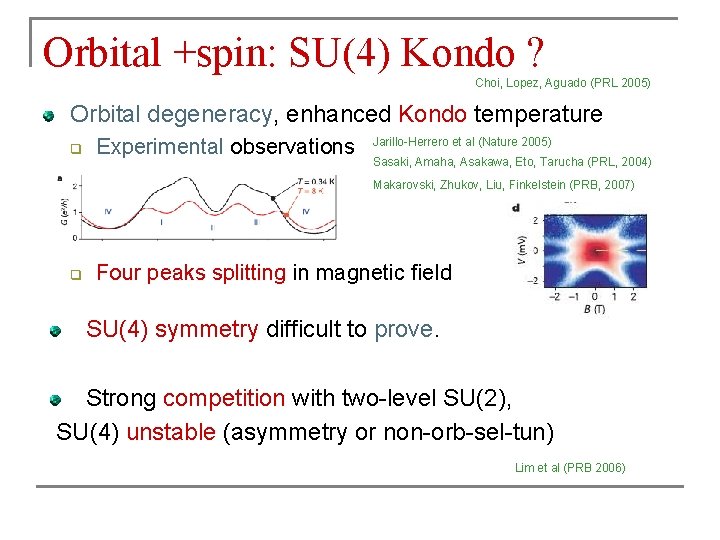
Orbital +spin: SU(4) Kondo ? Choi, Lopez, Aguado (PRL 2005) Orbital degeneracy, enhanced Kondo temperature q Experimental observations Jarillo-Herrero et al (Nature 2005) Sasaki, Amaha, Asakawa, Eto, Tarucha (PRL, 2004) Makarovski, Zhukov, Liu, Finkelstein (PRB, 2007) q Four peaks splitting in magnetic field SU(4) symmetry difficult to prove. Strong competition with two-level SU(2), SU(4) unstable (asymmetry or non-orb-sel-tun) Lim et al (PRB 2006)
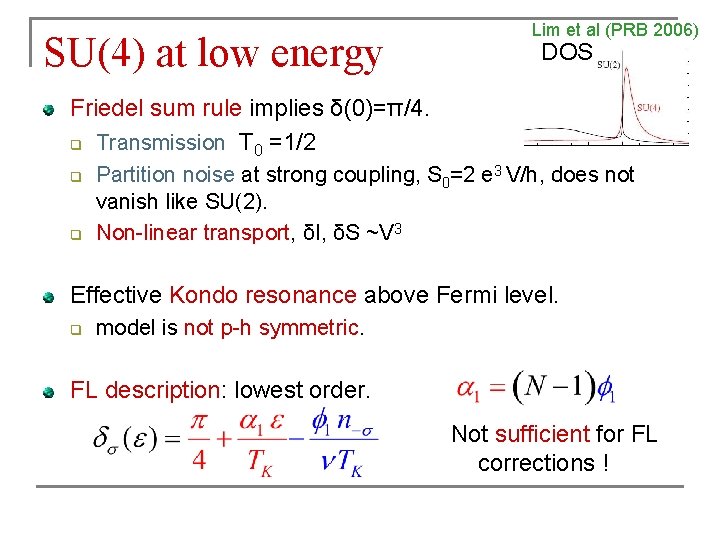
SU(4) at low energy Lim et al (PRB 2006) DOS Friedel sum rule implies δ(0)=π/4. q Transmission T 0 =1/2 q q Partition noise at strong coupling, S 0=2 e 3 V/h, does not vanish like SU(2). Non-linear transport, δI, δS ~V 3 Effective Kondo resonance above Fermi level. q model is not p-h symmetric. FL description: lowest order. Not sufficient for FL corrections !
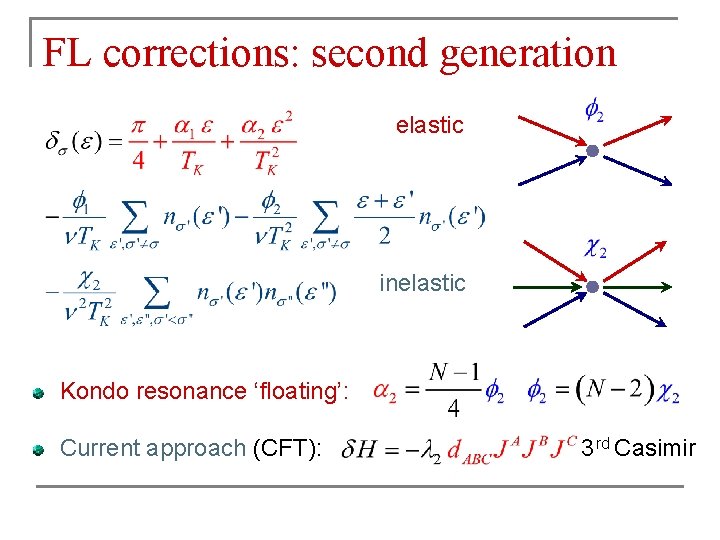
FL corrections: second generation elastic inelastic Kondo resonance ‘floating’: Current approach (CFT): 3 rd Casimir
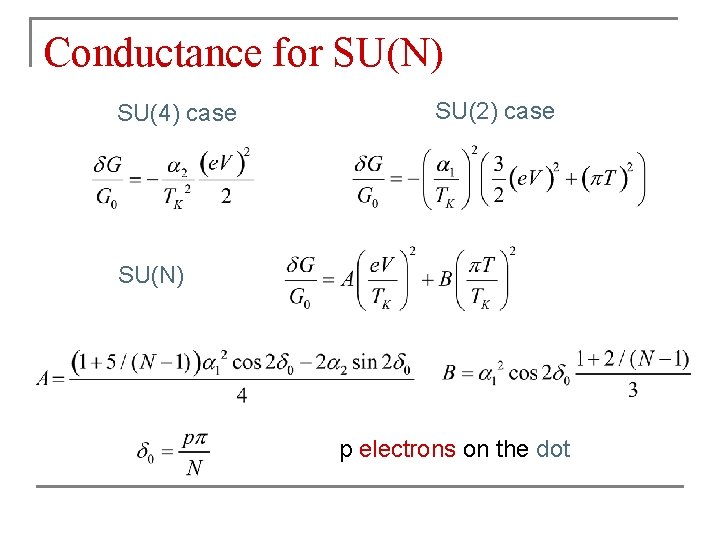
Conductance for SU(N) SU(4) case SU(2) case SU(N) p electrons on the dot
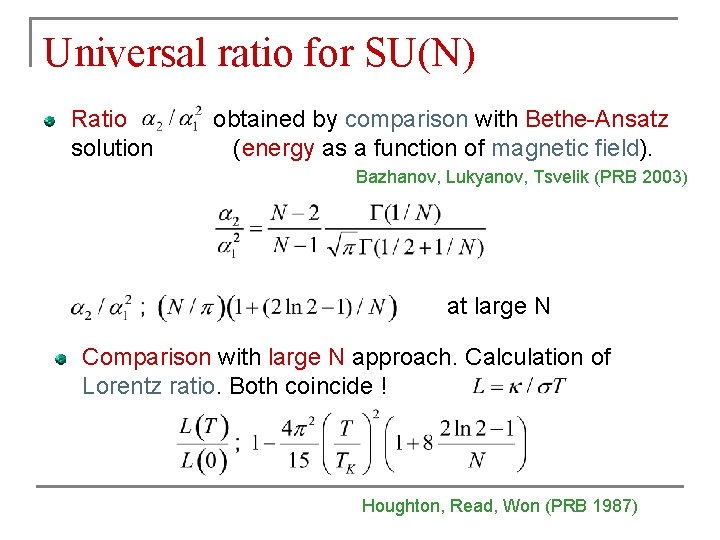
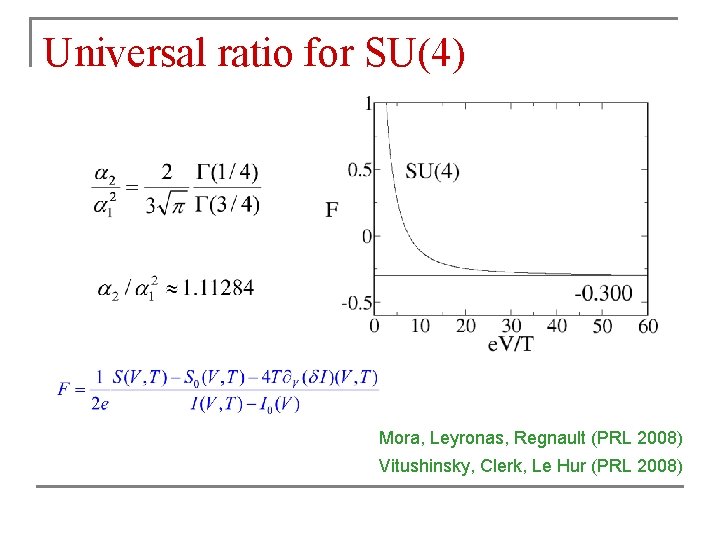
Universal ratio for SU(N) Ratio solution obtained by comparison with Bethe-Ansatz (energy as a function of magnetic field). Bazhanov, Lukyanov, Tsvelik (PRB 2003) at large N Comparison with large N approach. Calculation of Lorentz ratio. Both coincide ! Houghton, Read, Won (PRB 1987)
Universal ratio for SU(4) Mora, Leyronas, Regnault (PRL 2008) Vitushinsky, Clerk, Le Hur (PRL 2008)
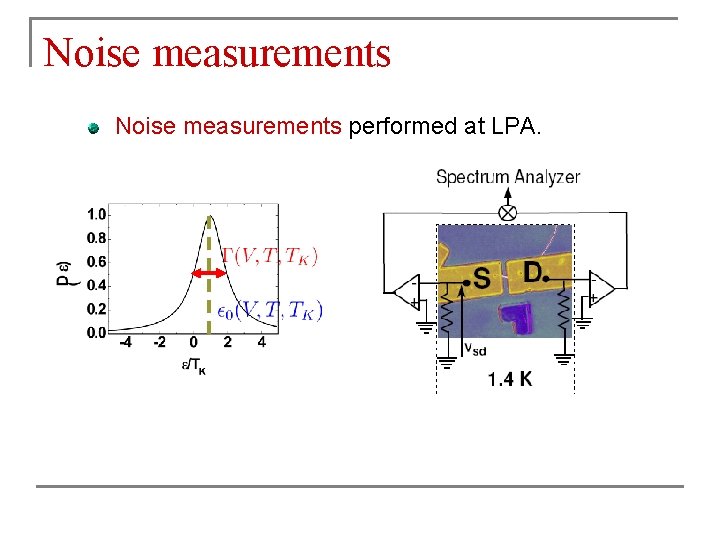
Noise measurements performed at LPA.
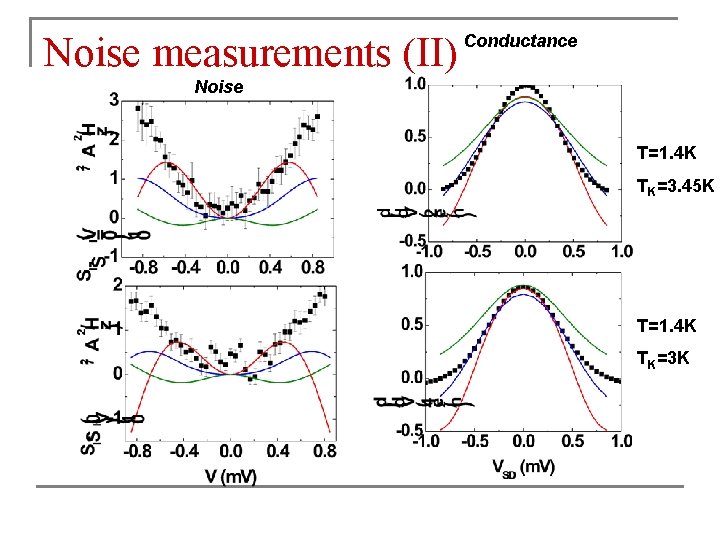
Noise measurements (II) Conductance Noise T=1. 4 K TK=3. 45 K T=1. 4 K TK=3 K
Conclusion General framework for low energy properties of SU(N) screening. Effective Fano factor characterizes non-linear transport, effective charges can be extracted. Important temperature corrections to shot noise. Vitushinsky, Clerk, Le Hur (PRL 2008) Mora, Leyronas, Regnault (PRL 2008)
L. Kouwenhoven and L. Glazman (2001) Felsch (Z. Phys. , 1978) Winzer (Z. Phys. , 1973) D. Goldhaber-Gordon et al (Nature, 1998) Nygard, Cobden, Lindelof (Nature, 2000) Sasaki, Amaha, Asakawa, Eto, Tarucha (PRL, 2004) Zarchin, Zaffalon, Heiblum, Mahalu, Umansky (PRB, 2008) Makarovski, Zhukov, Liu, Finkelstein (PRB, 2007)
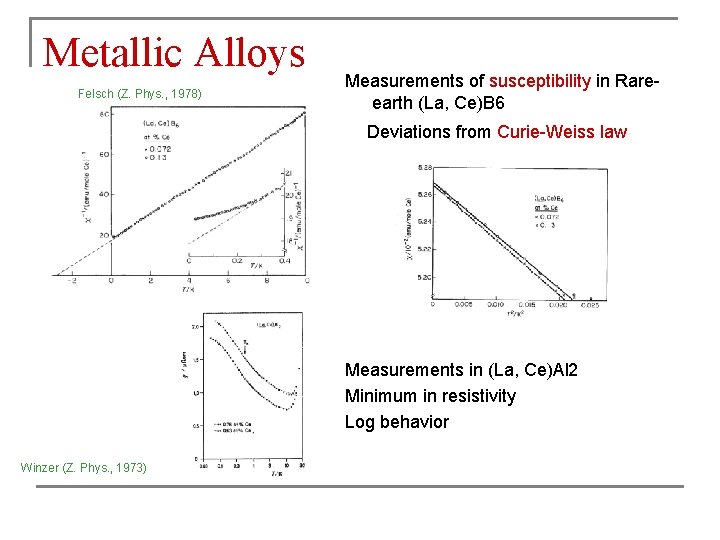
Metallic Alloys Felsch (Z. Phys. , 1978) Measurements of susceptibility in Rareearth (La, Ce)B 6 Deviations from Curie-Weiss law Measurements in (La, Ce)Al 2 Minimum in resistivity Log behavior Winzer (Z. Phys. , 1973)