
Low Cost Deployable Geo Shelters For Humanitarian Disaster
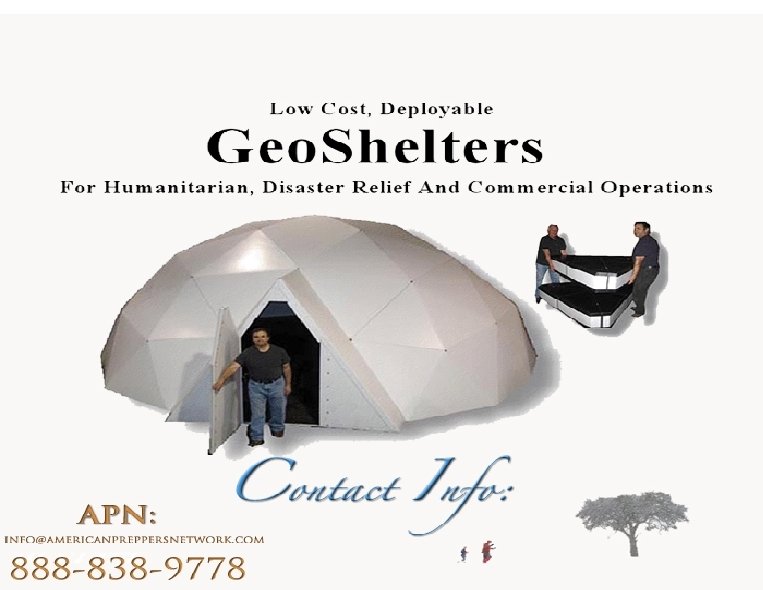
Low Cost, Deployable Geo. Shelters For Humanitarian, Disaster Relief And Commercial Operations Triangular Integrated Structures, LLC 7450 W 52 nd Ave, #M Suite 232 Arvada, Colorado 80003 Contact: Chuck. Vollmer@Deployable. Geo. Shelters. com 703 -319 -2090 (2091 fax) www. Deployable. Geo. Shelters. com 23 Aug 07 TIS Washington Office, 1645 White Pine Drive Vienna, VA 22182
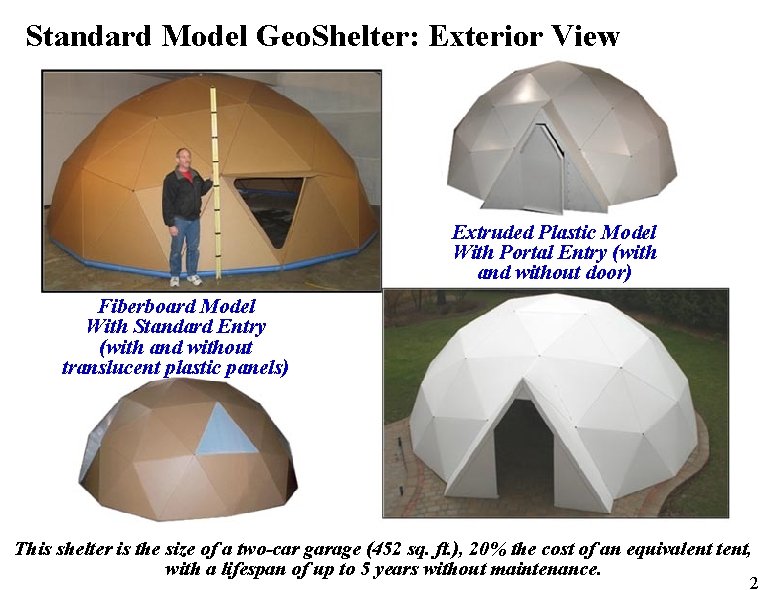
Standard Model Geo. Shelter: Exterior View Extruded Plastic Model With Portal Entry (with and without door) Fiberboard Model With Standard Entry (with and without translucent plastic panels) This shelter is the size of a two-car garage (452 sq. ft. ), 20% the cost of an equivalent tent, with a lifespan of up to 5 years without maintenance. 2
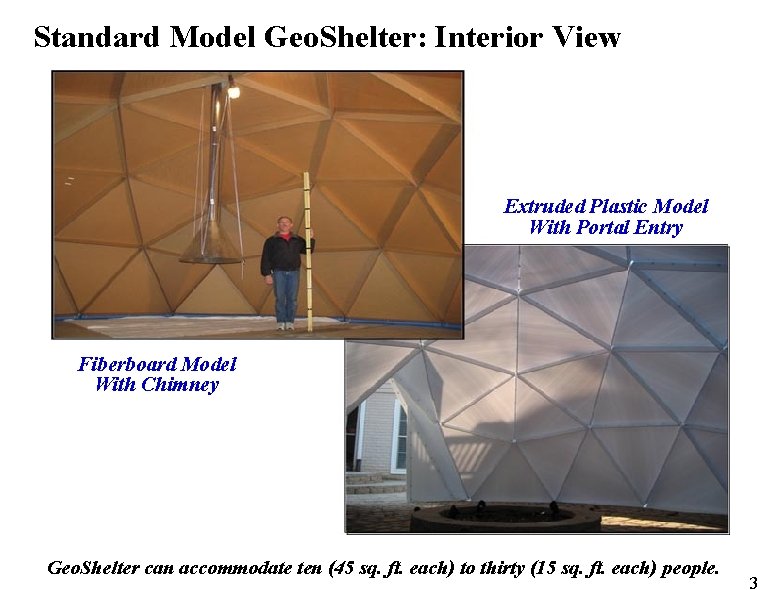
Standard Model Geo. Shelter: Interior View Extruded Plastic Model With Portal Entry Fiberboard Model With Chimney Geo. Shelter can accommodate ten (45 sq. ft. each) to thirty (15 sq. ft. each) people. 3
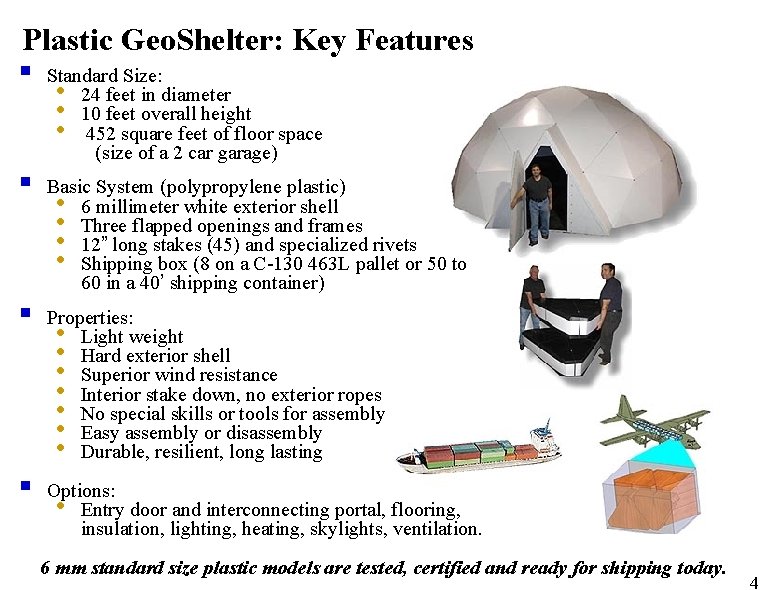
Plastic Geo. Shelter: Key Features § Standard Size: • 24 feet in diameter • 10 feet overall height • 452 square feet of floor space (size of a 2 car garage) § Basic System (polypropylene plastic) • 6 millimeter white exterior shell • Three flapped openings and frames • 12” long stakes (45) and specialized rivets • Shipping box (8 on a C-130 463 L pallet or 50 to 60 in a 40’ shipping container) § Properties: • Light weight • Hard exterior shell • Superior wind resistance • Interior stake down, no exterior ropes • No special skills or tools for assembly • Easy assembly or disassembly • Durable, resilient, long lasting § Options: • Entry door and interconnecting portal, flooring, insulation, lighting, heating, skylights, ventilation. 6 mm standard size plastic models are tested, certified and ready for shipping today. 4
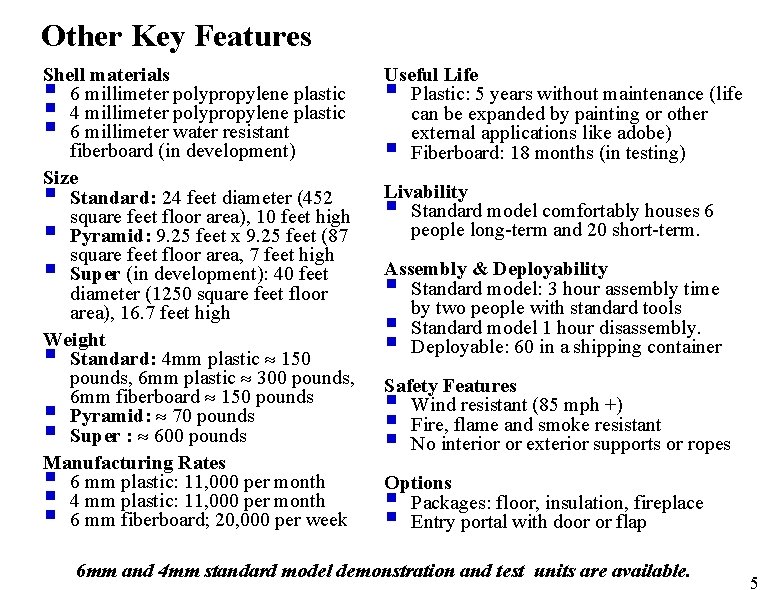
Other Key Features Shell materials § 6 millimeter polypropylene plastic § 4 millimeter polypropylene plastic § 6 millimeter water resistant fiberboard (in development) Size § Standard: 24 feet diameter (452 square feet floor area), 10 feet high § Pyramid: 9. 25 feet x 9. 25 feet (87 square feet floor area, 7 feet high § Super (in development): 40 feet diameter (1250 square feet floor area), 16. 7 feet high Weight § Standard: 4 mm plastic 150 pounds, 6 mm plastic 300 pounds, 6 mm fiberboard 150 pounds § Pyramid: 70 pounds § Super : 600 pounds Manufacturing Rates § 6 mm plastic: 11, 000 per month § 4 mm plastic: 11, 000 per month § 6 mm fiberboard; 20, 000 per week Useful Life § Plastic: 5 years without maintenance (life can be expanded by painting or other external applications like adobe) § Fiberboard: 18 months (in testing) Livability § Standard model comfortably houses 6 people long-term and 20 short-term. Assembly & Deployability § Standard model: 3 hour assembly time by two people with standard tools § Standard model 1 hour disassembly. § Deployable: 60 in a shipping container Safety Features § Wind resistant (85 mph +) § Fire, flame and smoke resistant § No interior or exterior supports or ropes Options § Packages: floor, insulation, fireplace § Entry portal with door or flap 6 mm and 4 mm standard model demonstration and test units are available. 5
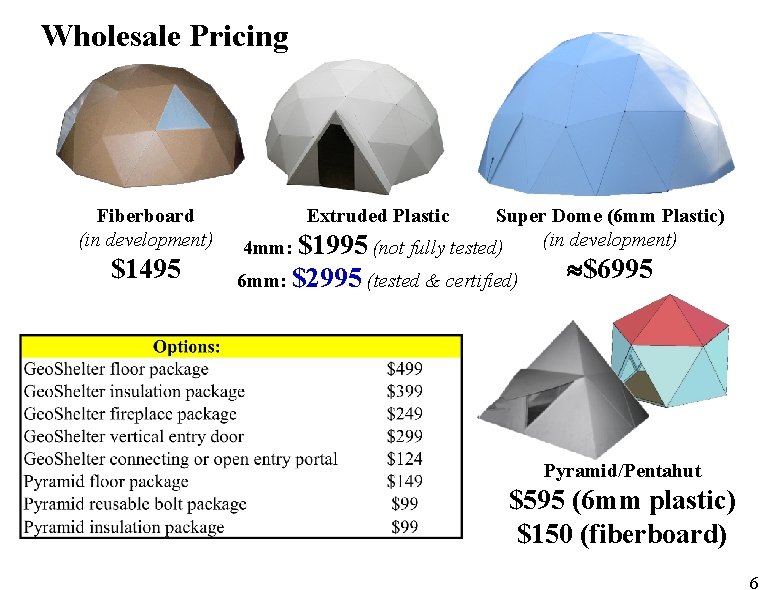
Wholesale Pricing Fiberboard (in development) $1495 Extruded Plastic Super Dome (6 mm Plastic) (in development) 4 mm: $1995 (not fully tested) 6 mm: $2995 (tested & certified) $6995 Pyramid/Pentahut $595 (6 mm plastic) $150 (fiberboard) 6
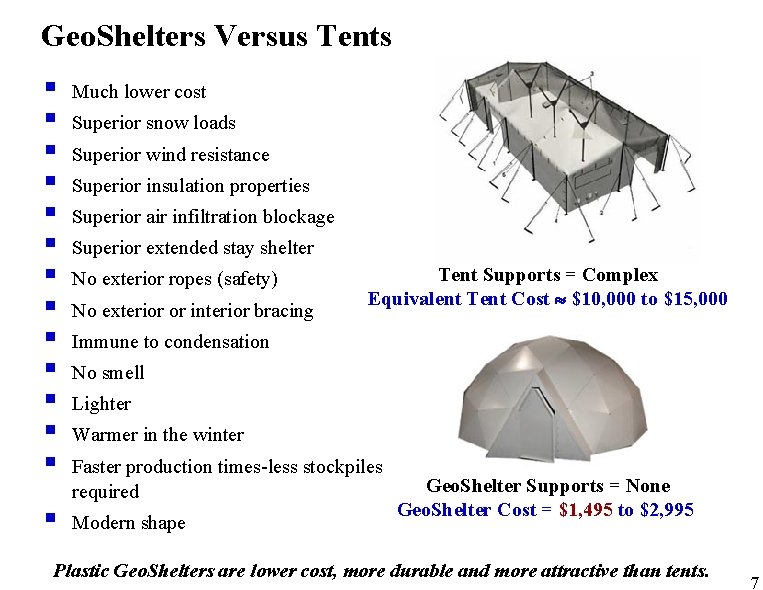
Geo. Shelters Versus Tents § § § § Much lower cost § Modern shape Superior snow loads Superior wind resistance Superior insulation properties Superior air infiltration blockage Superior extended stay shelter No exterior ropes (safety) No exterior or interior bracing Tent Supports = Complex Equivalent Tent Cost $10, 000 to $15, 000 Immune to condensation No smell Lighter Warmer in the winter Faster production times-less stockpiles required Geo. Shelter Supports = None Geo. Shelter Cost = $1, 495 to $2, 995 Plastic Geo. Shelters are lower cost, more durable and more attractive than tents. 7
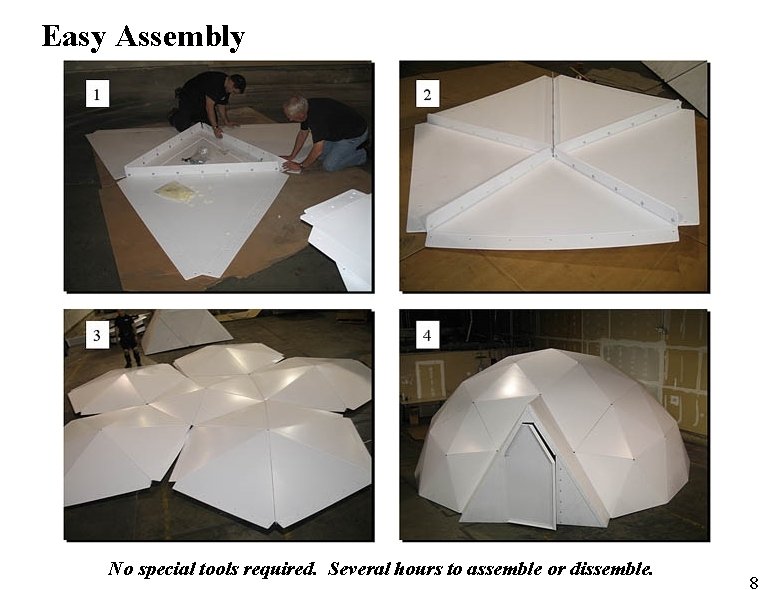
Easy Assembly No special tools required. Several hours to assemble or dissemble. 8
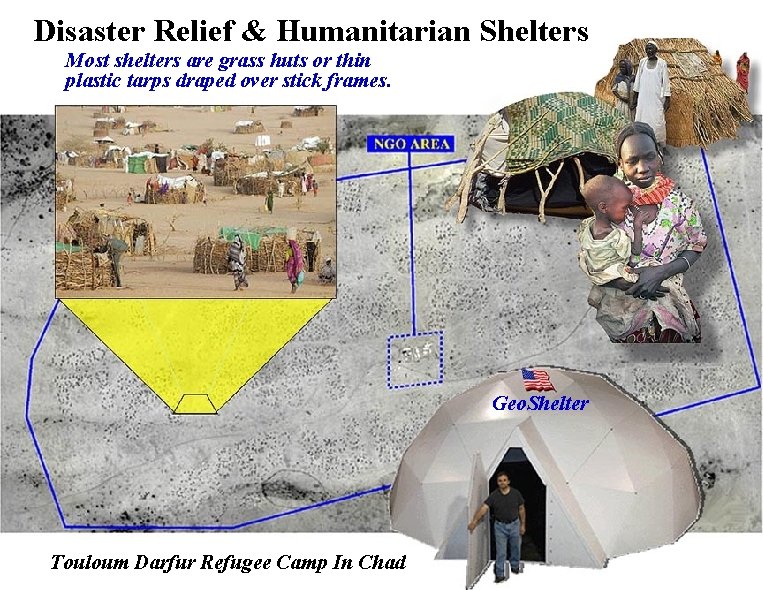
Disaster Relief & Humanitarian Shelters Most shelters are grass huts or thin plastic tarps draped over stick frames. Geo. Shelter Touloum Darfur Refugee Camp In Chad 9
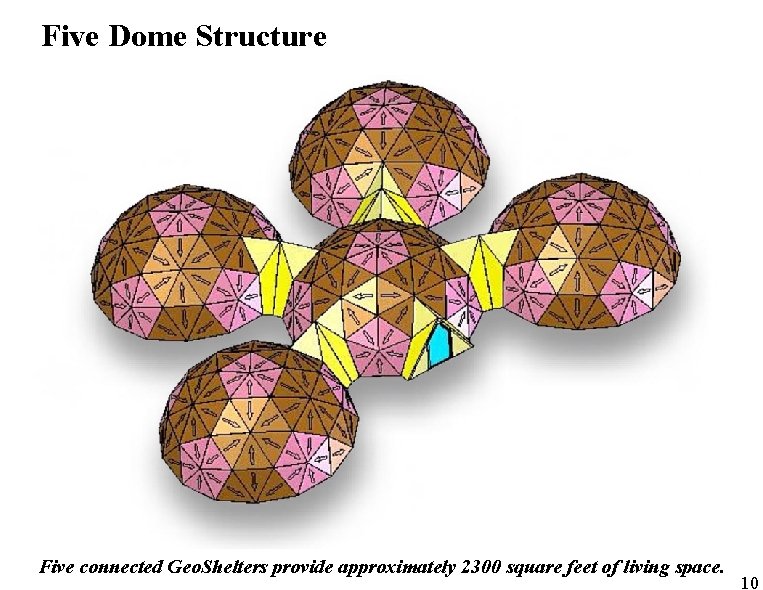
Five Dome Structure Five connected Geo. Shelters provide approximately 2300 square feet of living space. 10
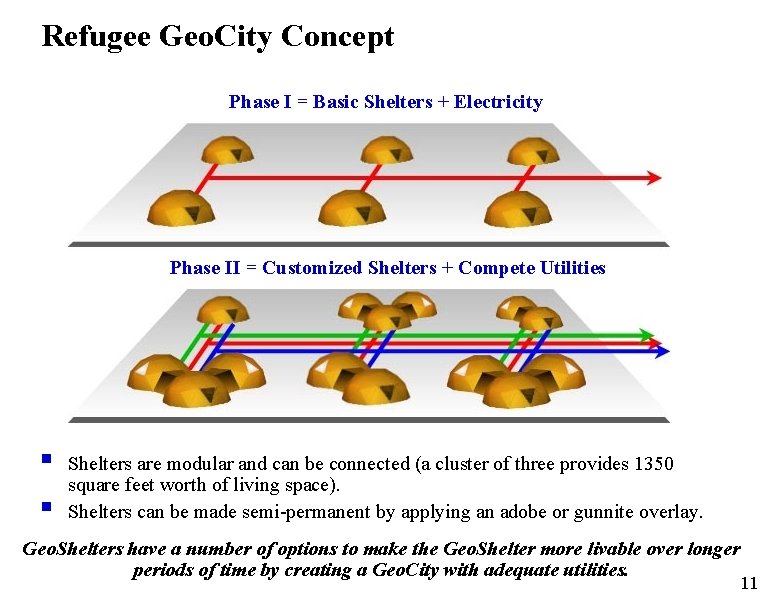
Refugee Geo. City Concept Phase I = Basic Shelters + Electricity Phase II = Customized Shelters + Compete Utilities § § Shelters are modular and can be connected (a cluster of three provides 1350 square feet worth of living space). Shelters can be made semi-permanent by applying an adobe or gunnite overlay. Geo. Shelters have a number of options to make the Geo. Shelter more livable over longer periods of time by creating a Geo. City with adequate utilities. 11
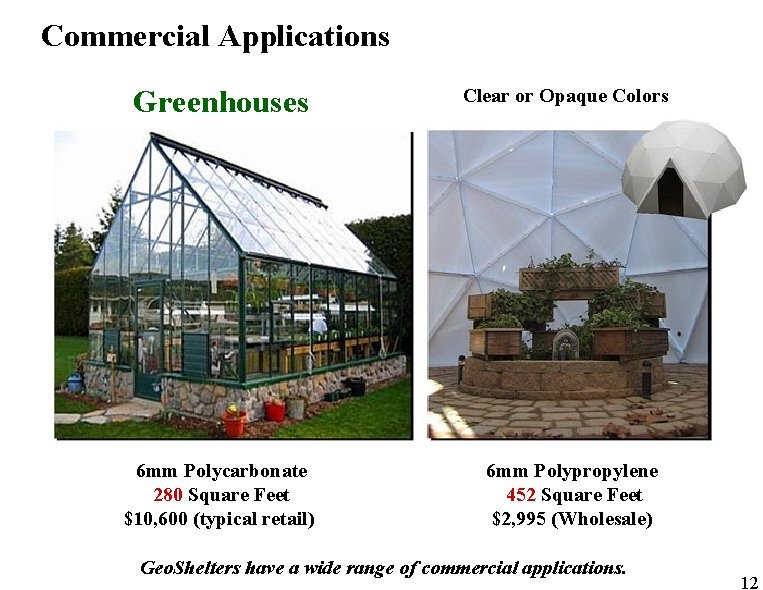
Commercial Applications Greenhouses 6 mm Polycarbonate 280 Square Feet $10, 600 (typical retail) Clear or Opaque Colors 6 mm Polypropylene 452 Square Feet $2, 995 (Wholesale) Geo. Shelters have a wide range of commercial applications. 12
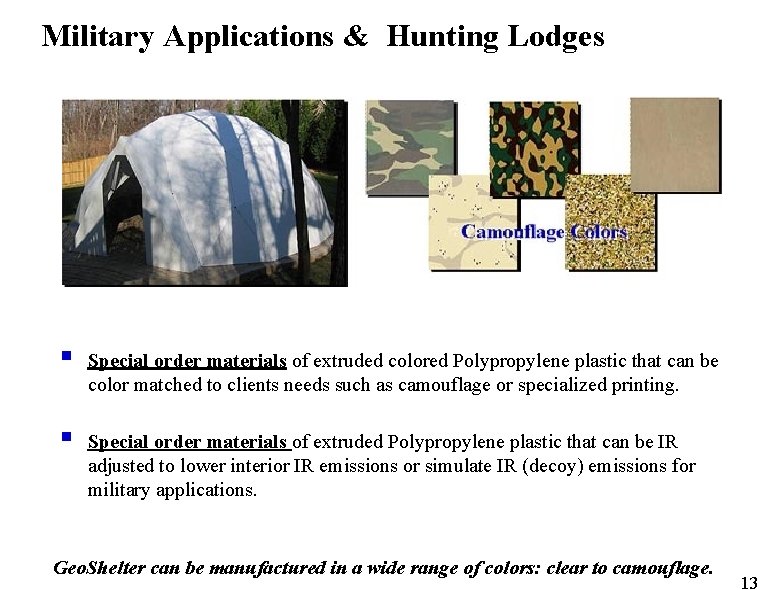
Military Applications & Hunting Lodges § Special order materials of extruded colored Polypropylene plastic that can be color matched to clients needs such as camouflage or specialized printing. § Special order materials of extruded Polypropylene plastic that can be IR adjusted to lower interior IR emissions or simulate IR (decoy) emissions for military applications. Geo. Shelter can be manufactured in a wide range of colors: clear to camouflage. 13
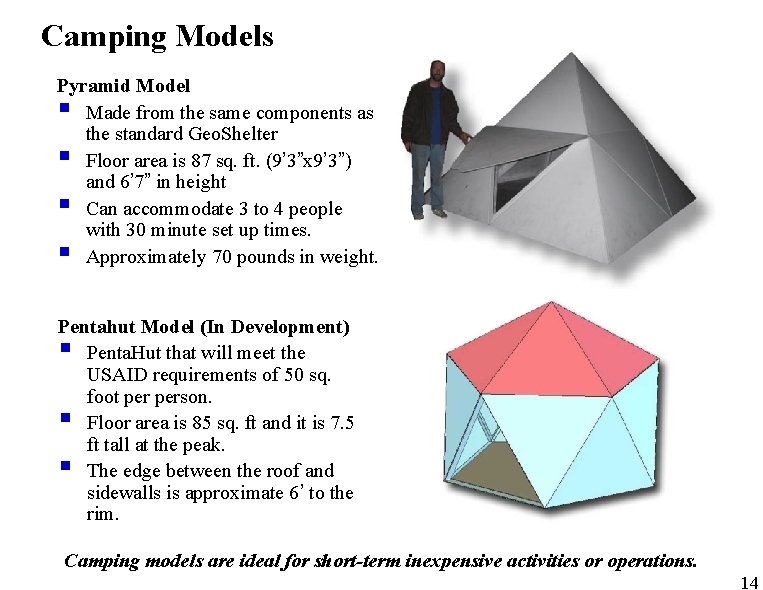
Camping Models Pyramid Model § Made from the same components as the standard Geo. Shelter § Floor area is 87 sq. ft. (9’ 3”x 9’ 3”) and 6’ 7” in height § Can accommodate 3 to 4 people with 30 minute set up times. § Approximately 70 pounds in weight. Pentahut Model (In Development) § Penta. Hut that will meet the USAID requirements of 50 sq. foot person. § Floor area is 85 sq. ft and it is 7. 5 ft tall at the peak. § The edge between the roof and sidewalls is approximate 6’ to the rim. Camping models are ideal for short-term inexpensive activities or operations. 14
6 mm Plastic Geo. Shelter Specifications & Certifications 15
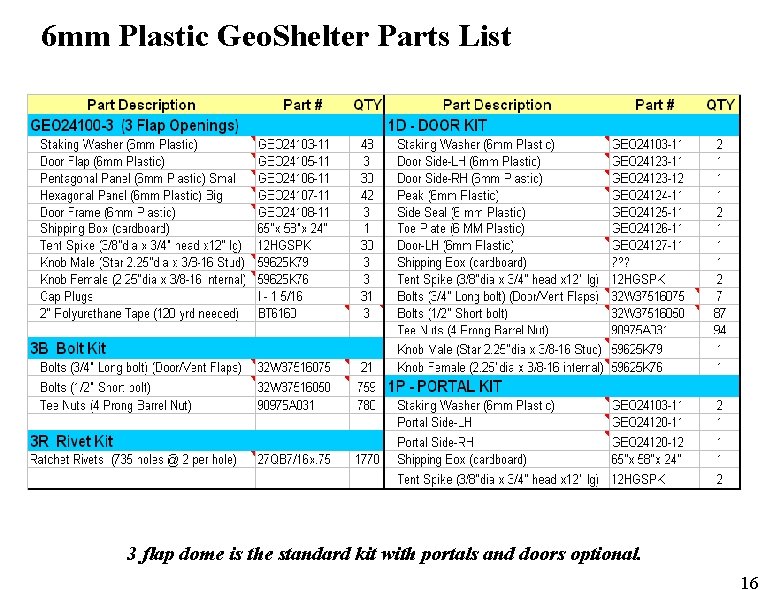
6 mm Plastic Geo. Shelter Parts List 3 flap dome is the standard kit with portals and doors optional. 16
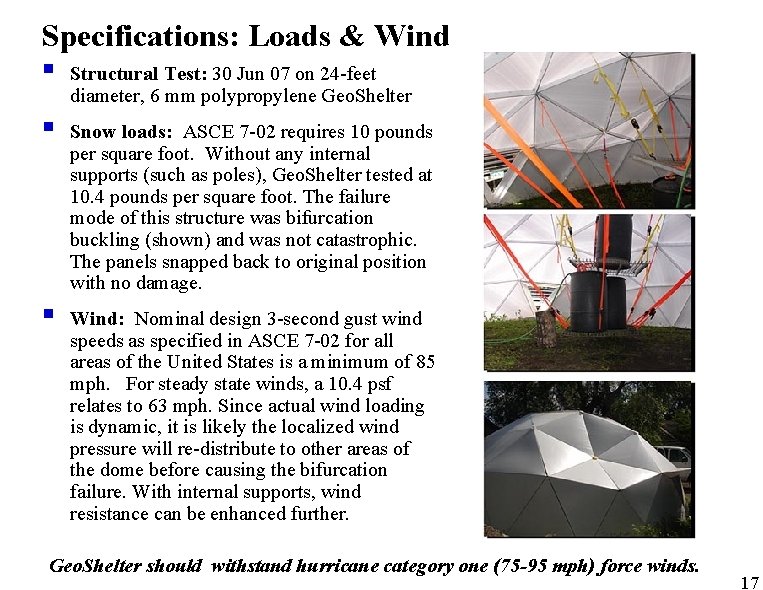
Specifications: Loads & Wind § Structural Test: 30 Jun 07 on 24 -feet diameter, 6 mm polypropylene Geo. Shelter § Snow loads: ASCE 7 -02 requires 10 pounds per square foot. Without any internal supports (such as poles), Geo. Shelter tested at 10. 4 pounds per square foot. The failure mode of this structure was bifurcation buckling (shown) and was not catastrophic. The panels snapped back to original position with no damage. § Wind: Nominal design 3 -second gust wind speeds as specified in ASCE 7 -02 for all areas of the United States is a minimum of 85 mph. For steady state winds, a 10. 4 psf relates to 63 mph. Since actual wind loading is dynamic, it is likely the localized wind pressure will re-distribute to other areas of the dome before causing the bifurcation failure. With internal supports, wind resistance can be enhanced further. Geo. Shelter should withstand hurricane category one (75 -95 mph) force winds. 17
Specifications: Flame & Smoke Propagation § § Flame Spread And Retardancy: Standard materials of extruded Polypropylene plastic with additives that will meet Class B flame spread and retardancy requirements of NFPA 701 and ASTM-E 662. Special order materials of extruded Polypropylene plastic with additives that will meet Class A flame spread and retardancy requirements of NFPA 701 and ASTM-E 662. • NFPA 701 is a vertical burn test designed to measure flame spread up a vertically-mounted sample. • ASTM-E 662 is a test to measure the amount of smoke given off by a burning material. Flame Retardant: 3 and 4 mm flame retardant sheet was tested according to ASTM E-84 to have a flame spread of < 25 and smoke developed index of < 450. Therefore, flame retardant sheet is classified as class A Interior Wall & Ceiling Finish according to National Fire Association Life Safety Code 101, Section 6 -5. 3. • ASTM E-84 tests applies to products designed for use as building materials, and measures the surface flame spread on the substrate to be tested. Class B certified Geo. Shelters are safer than many other shelters made of wood and similar materials. Geo. Shelters can be manufactured to Class A standards. 18
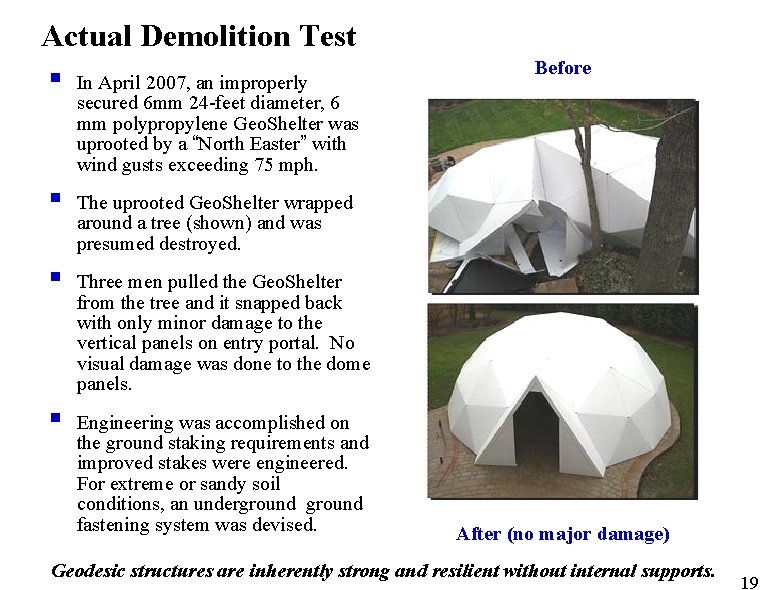
Actual Demolition Test § In April 2007, an improperly Before secured 6 mm 24 -feet diameter, 6 mm polypropylene Geo. Shelter was uprooted by a “North Easter” with wind gusts exceeding 75 mph. § The uprooted Geo. Shelter wrapped around a tree (shown) and was presumed destroyed. § Three men pulled the Geo. Shelter from the tree and it snapped back with only minor damage to the vertical panels on entry portal. No visual damage was done to the dome panels. § Engineering was accomplished on the ground staking requirements and improved stakes were engineered. For extreme or sandy soil conditions, an underground fastening system was devised. After (no major damage) Geodesic structures are inherently strong and resilient without internal supports. 19
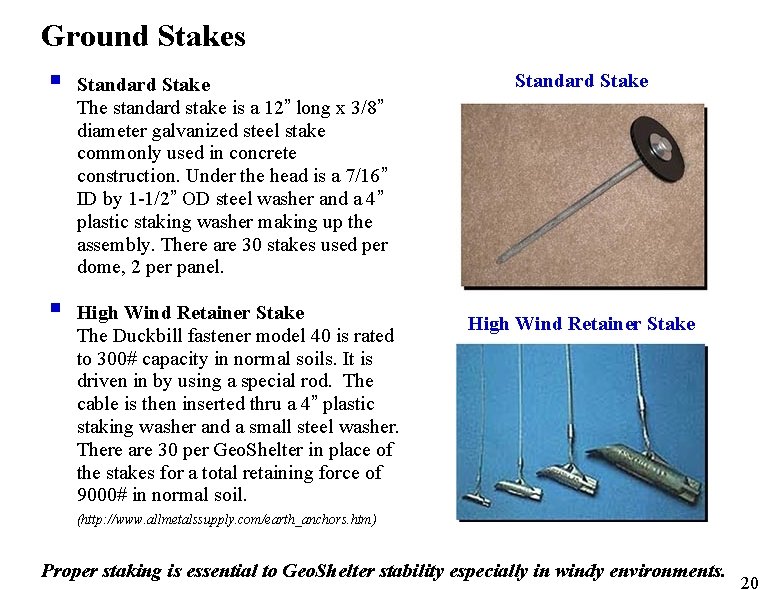
Ground Stakes § Standard Stake The standard stake is a 12” long x 3/8” diameter galvanized steel stake commonly used in concrete construction. Under the head is a 7/16” ID by 1 -1/2” OD steel washer and a 4” plastic staking washer making up the assembly. There are 30 stakes used per dome, 2 per panel. § High Wind Retainer Stake The Duckbill fastener model 40 is rated to 300# capacity in normal soils. It is driven in by using a special rod. The cable is then inserted thru a 4” plastic staking washer and a small steel washer. There are 30 per Geo. Shelter in place of the stakes for a total retaining force of 9000# in normal soil. High Wind Retainer Stake (http: //www. allmetalssupply. com/earth_anchors. htm) Proper staking is essential to Geo. Shelter stability especially in windy environments. 20
- Slides: 20