
Low Complexity User Selection Algorithms for Multiuser MIMO

- Slides: 12
Low Complexity User Selection Algorithms for Multiuser MIMO Systems with Block Diagonalization Zukang Shen, Runhua Chen, Jeff Andrews, Robert Heath, and Brian Evans The University of Texas at Austin Nov. 1, 2005
Multi-Antenna Systems v Exploit the spatial dimension with multiple antennas v Improve transmission reliability – diversity Ø Combat channel fading [Jakes, 1974] Ø Combat co-channel interference [Winters, 1984] v Increase spectral efficiency – multiplexing Ø Multiple parallel spatial channels created with multiple antennas at the transmitter and receiver [Winters, 1987] [Foschini et al. , 1998] Ø Theoretical results on point-to-point MIMO channel capacity [Telatar, 1999] v Tradeoff between diversity and multiplexing Ø A theoretical treatment [zheng et al. , 2003] Ø Switching between diversity and multiplexing [Heath et al. 2005] 2
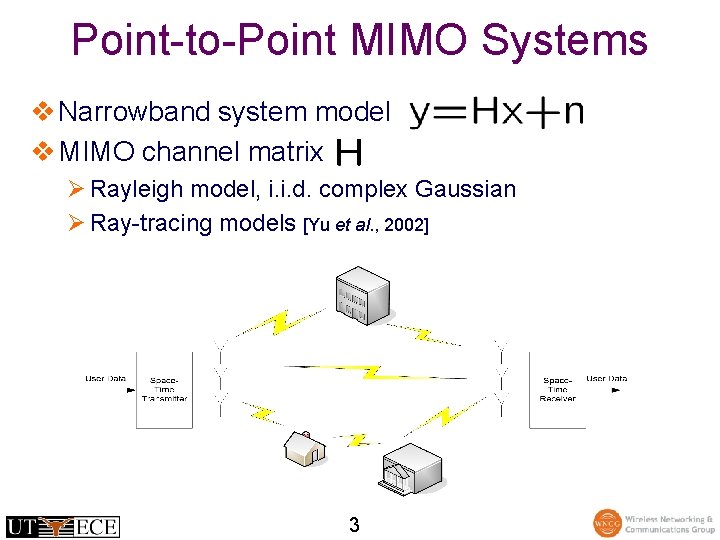
Point-to-Point MIMO Systems v Narrowband system model v MIMO channel matrix Ø Rayleigh model, i. i. d. complex Gaussian Ø Ray-tracing models [Yu et al. , 2002] 3
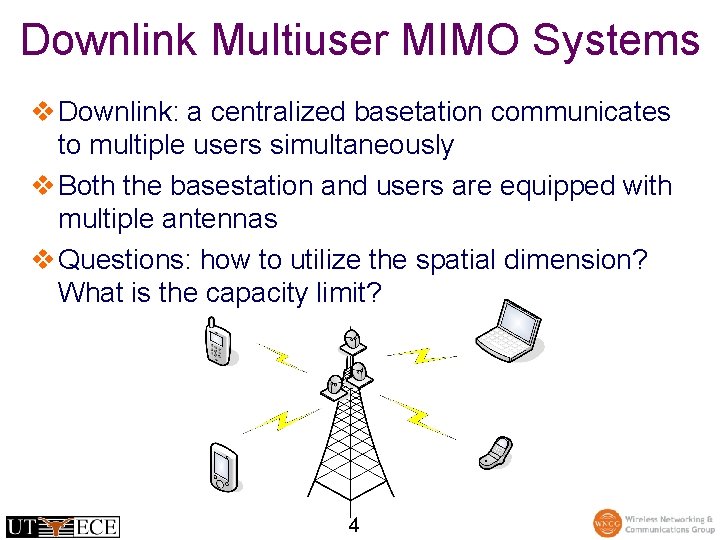
Downlink Multiuser MIMO Systems v Downlink: a centralized basetation communicates to multiple users simultaneously v Both the basestation and users are equipped with multiple antennas v Questions: how to utilize the spatial dimension? What is the capacity limit? 4
Capacity of MIMO Gaussian Broadcast Channels v Duality between MIMO Gaussian broadcast and multiple access channels [Vishwanath et al. , 2003] [Viswanath et al. , 2003] Ø Dirty paper coding [Costa 1983] Ø Sum capacity achieved with DPC [Vishwanath et al. , 2003] Ø Iterative water-filling [Yu et al. , 2004] [Jindal et al. , 2005] v Capacity region of MIMO Gaussian broadcast channels [Weingarten et al. , 2004] v Practical coding schemes approaching the DPC sum capacity [Zamir et al. , 2002] [Airy et al. , 2004] [Stojnic et al. , 2004] Ø Too complicated for cost-effective implementations 5
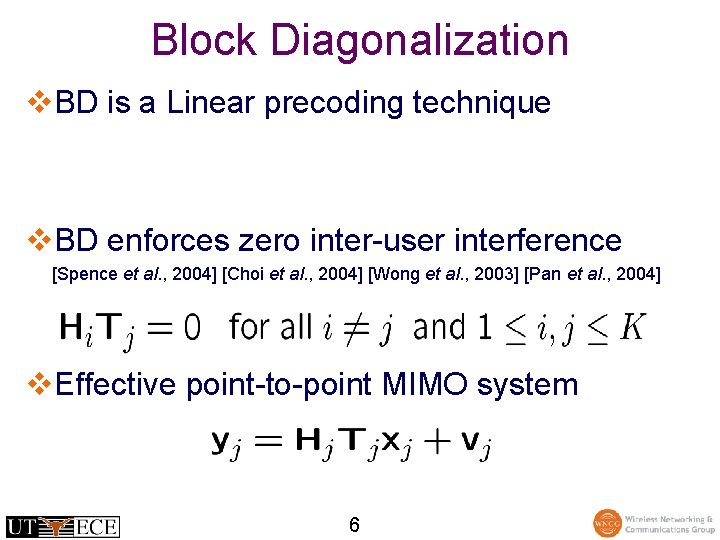
Block Diagonalization v. BD is a Linear precoding technique v. BD enforces zero inter-user interference [Spence et al. , 2004] [Choi et al. , 2004] [Wong et al. , 2003] [Pan et al. , 2004] v. Effective point-to-point MIMO system 6
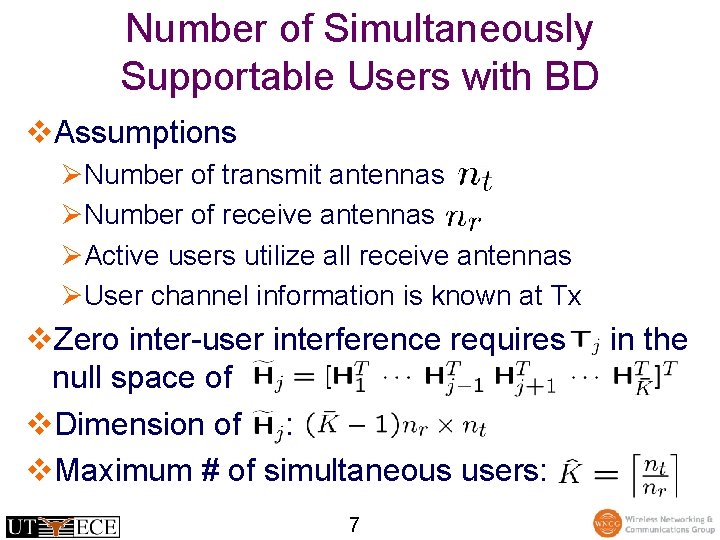
Number of Simultaneously Supportable Users with BD v. Assumptions ØNumber of transmit antennas ØNumber of receive antennas ØActive users utilize all receive antennas ØUser channel information is known at Tx v. Zero inter-user interference requires null space of v. Dimension of : v. Maximum # of simultaneous users: 7 in the
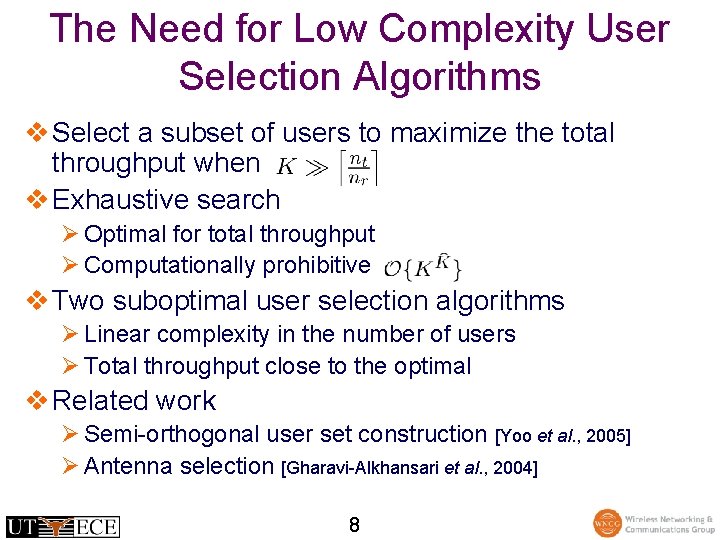
The Need for Low Complexity User Selection Algorithms v Select a subset of users to maximize the total throughput when v Exhaustive search Ø Optimal for total throughput Ø Computationally prohibitive v Two suboptimal user selection algorithms Ø Linear complexity in the number of users Ø Total throughput close to the optimal v Related work Ø Semi-orthogonal user set construction [Yoo et al. , 2005] Ø Antenna selection [Gharavi-Alkhansari et al. , 2004] 8
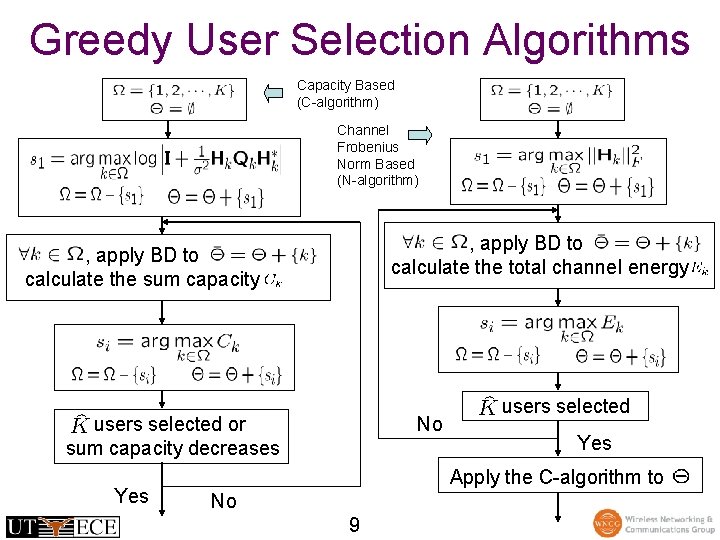
Greedy User Selection Algorithms Capacity Based (C-algorithm) Channel Frobenius Norm Based (N-algorithm) , apply BD to calculate the total channel energy , apply BD to calculate the sum capacity No users selected or sum capacity decreases Yes users selected Yes Apply the C-algorithm to No 9
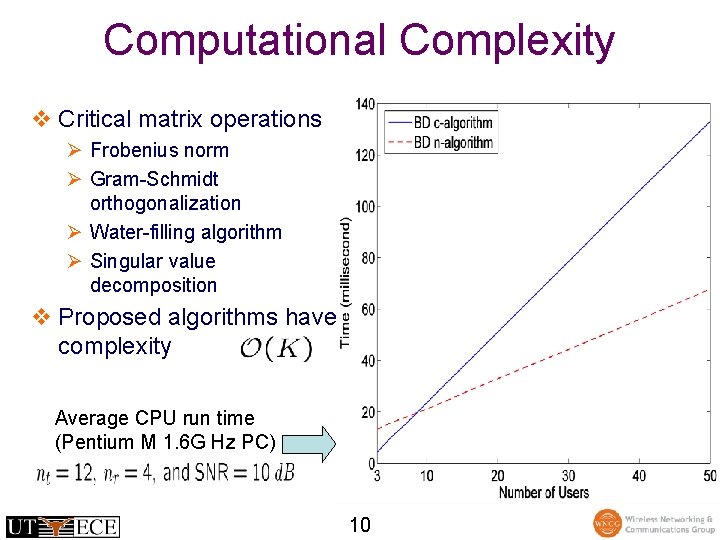
Computational Complexity v Critical matrix operations Ø Frobenius norm Ø Gram-Schmidt orthogonalization Ø Water-filling algorithm Ø Singular value decomposition v Proposed algorithms have complexity Average CPU run time (Pentium M 1. 6 G Hz PC) 10
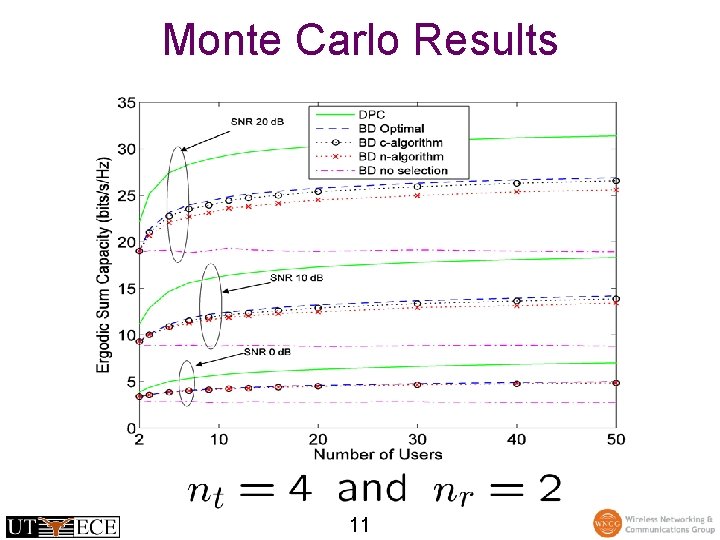
Monte Carlo Results 11
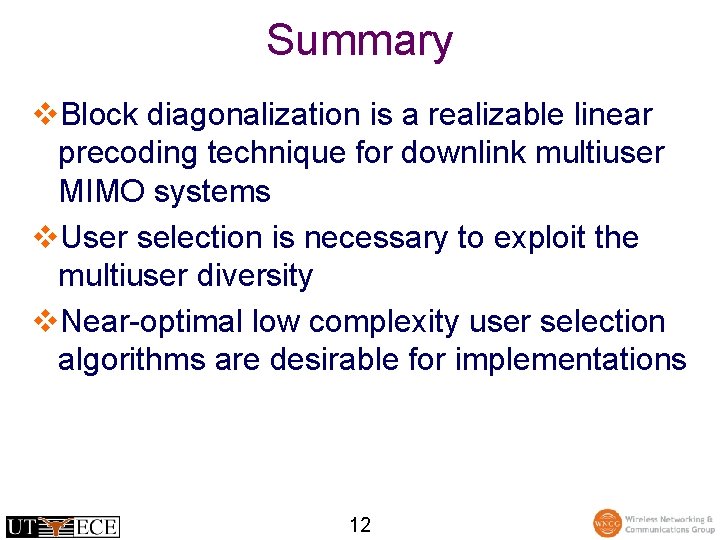
Summary v. Block diagonalization is a realizable linear precoding technique for downlink multiuser MIMO systems v. User selection is necessary to exploit the multiuser diversity v. Near-optimal low complexity user selection algorithms are desirable for implementations 12