
Low Bit Rate H 263 Video Coding Efficiency
Low Bit Rate H. 263 + Video Coding: Efficiency, Scalability and Error Resilience Faouzi Kossentini Signal Processing and Multimedia Group Department of Electrical and Computer Engineering University of British Columbia http: //spmg. ece. ubc. ca/
Outline Ø Introduction: Low bit rate video coding Ø The H. 263/H. 263+ standards and their optional modes Ø Efficiency: Performance and complexity of individual modes and combinations of modes Ø Efficiency: Real-time software-only encoding Ø Efficiency: Rate-distortion optimized video coding Ø Scalability: Description & Characteristics Ø Scalability: Rate-distortion optimized framework Ø Error resilience: Synchronization & error concealment Ø Error resilience: Multiple description video coding Ø Conclusions: H. 263/H. 263+, MPEG-4 and research directions Low Bit Rate H. 263 + Video Coding: Efficiency, Scalability and Error Resilience Copyright (C) 1998 Faouzi Kossentini 2
Low Bit Rate Video coding Why? : Increasing demand for video conferencing and telephony applications, limited bandwidth in PSTN and wireless networks Video coding algorithms: Ø Waveform based coding: MC+DCT/wavelets, 3 D subband, etc. Ø Object- and model-based coding : shape coding, wireframes, etc. Video coding standards: Ø ITU-T H. 261(1990), H. 262 (1994), H. 263 (1995), H. 263+ (1998) Ø ISO/IEC MPEG 1 (1992), MPEG 2 (1994), MPEG 4 (1999) H. 263 version 2 (H. 263+): Higher coding efficiency, more flexibility, scalability support, error resilience support Low Bit Rate H. 263 + Video Coding: Efficiency, Scalability and Error Resilience Copyright (C) 1998 Faouzi Kossentini 3
The H. 263 Standard Low Bit Rate H. 263 + Video Coding: Efficiency, Scalability and Error Resilience Copyright (C) 1998 Faouzi Kossentini 4
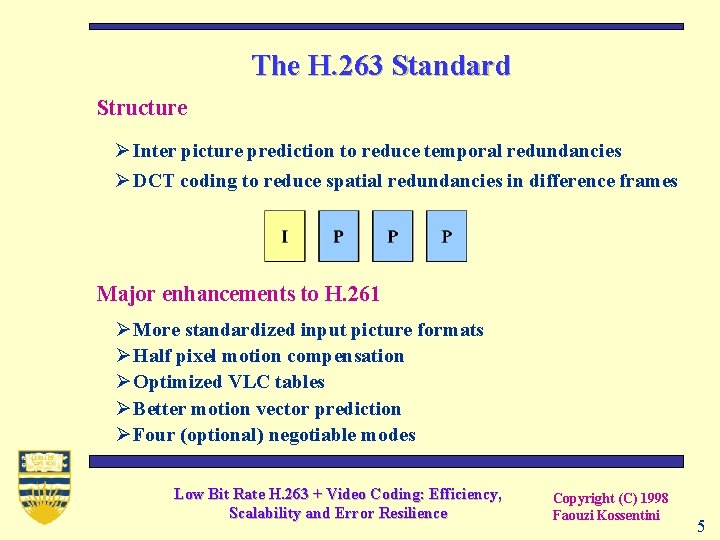
The H. 263 Standard Structure Ø Inter picture prediction to reduce temporal redundancies Ø DCT coding to reduce spatial redundancies in difference frames Major enhancements to H. 261 Ø More standardized input picture formats Ø Half pixel motion compensation Ø Optimized VLC tables Ø Better motion vector prediction Ø Four (optional) negotiable modes Low Bit Rate H. 263 + Video Coding: Efficiency, Scalability and Error Resilience Copyright (C) 1998 Faouzi Kossentini 5
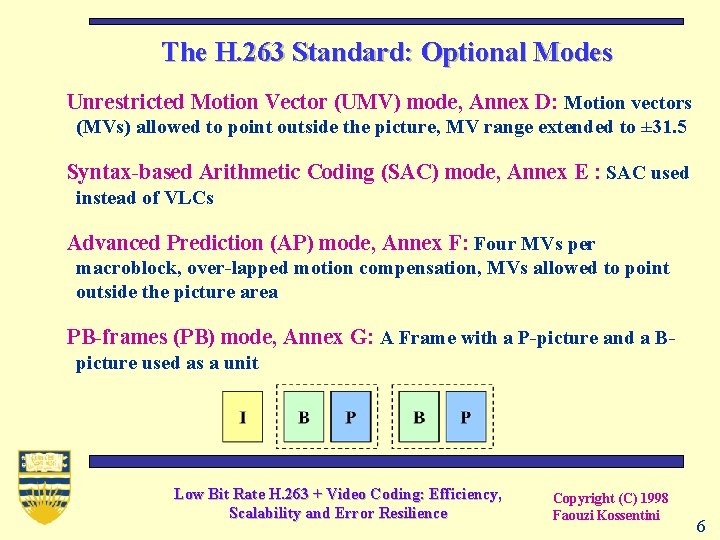
The H. 263 Standard: Optional Modes Unrestricted Motion Vector (UMV) mode, Annex D: Motion vectors (MVs) allowed to point outside the picture, MV range extended to ± 31. 5 Syntax-based Arithmetic Coding (SAC) mode, Annex E : SAC used instead of VLCs Advanced Prediction (AP) mode, Annex F: Four MVs per macroblock, over-lapped motion compensation, MVs allowed to point outside the picture area PB-frames (PB) mode, Annex G: A Frame with a P-picture and a Bpicture used as a unit Low Bit Rate H. 263 + Video Coding: Efficiency, Scalability and Error Resilience Copyright (C) 1998 Faouzi Kossentini 6

The H. 263+ Standard: Optional Modes Unrestricted Motion Vector (UMV) mode, Annex D: MV range extended to ± 256 depending on the picture size, reversible VLCs used for MVs Advanced Intra Coding (AIC) mode, Annex I: Inter block prediction from neighboring intra coded blocks, modified quantization, optimized VLCs Deblocking Filter (DF) mode, Annex J: Deblocking filter inside the coding loop, four motion vectors per macroblock, MVs outside picture boundaries Slice Structured (SS) mode, Annex K: Slices used instead of GOBs Supplemental Enhancement Information (SEI) mode, Annex L: Supplemental information included in the stream to offer display capabilities Low Bit Rate H. 263 + Video Coding: Efficiency, Scalability and Error Resilience Copyright (C) 1998 Faouzi Kossentini 7
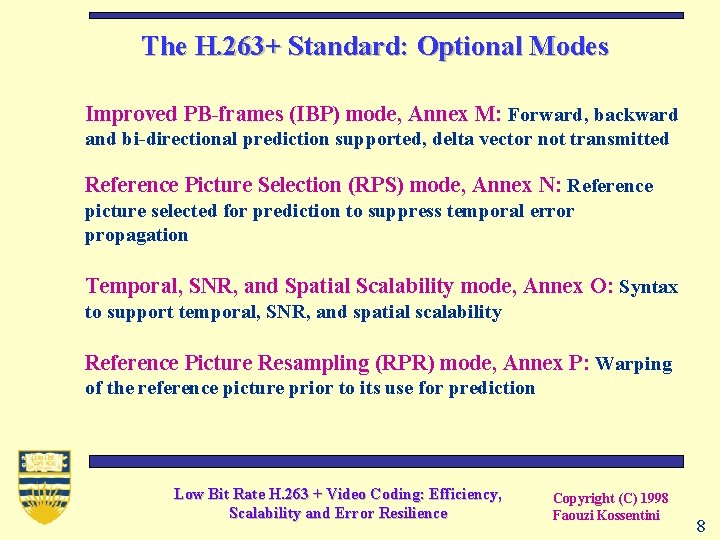
The H. 263+ Standard: Optional Modes Improved PB-frames (IBP) mode, Annex M: Forward, backward and bi-directional prediction supported, delta vector not transmitted Reference Picture Selection (RPS) mode, Annex N: Reference picture selected for prediction to suppress temporal error propagation Temporal, SNR, and Spatial Scalability mode, Annex O: Syntax to support temporal, SNR, and spatial scalability Reference Picture Resampling (RPR) mode, Annex P: Warping of the reference picture prior to its use for prediction Low Bit Rate H. 263 + Video Coding: Efficiency, Scalability and Error Resilience Copyright (C) 1998 Faouzi Kossentini 8
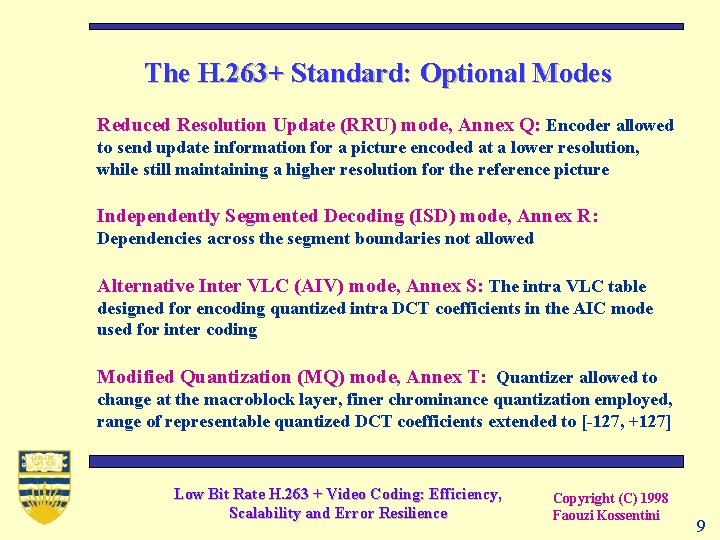
The H. 263+ Standard: Optional Modes Reduced Resolution Update (RRU) mode, Annex Q: Encoder allowed to send update information for a picture encoded at a lower resolution, while still maintaining a higher resolution for the reference picture Independently Segmented Decoding (ISD) mode, Annex R: Dependencies across the segment boundaries not allowed Alternative Inter VLC (AIV) mode, Annex S: The intra VLC table designed for encoding quantized intra DCT coefficients in the AIC mode used for inter coding Modified Quantization (MQ) mode, Annex T: Quantizer allowed to change at the macroblock layer, finer chrominance quantization employed, range of representable quantized DCT coefficients extended to [-127, +127] Low Bit Rate H. 263 + Video Coding: Efficiency, Scalability and Error Resilience Copyright (C) 1998 Faouzi Kossentini 9
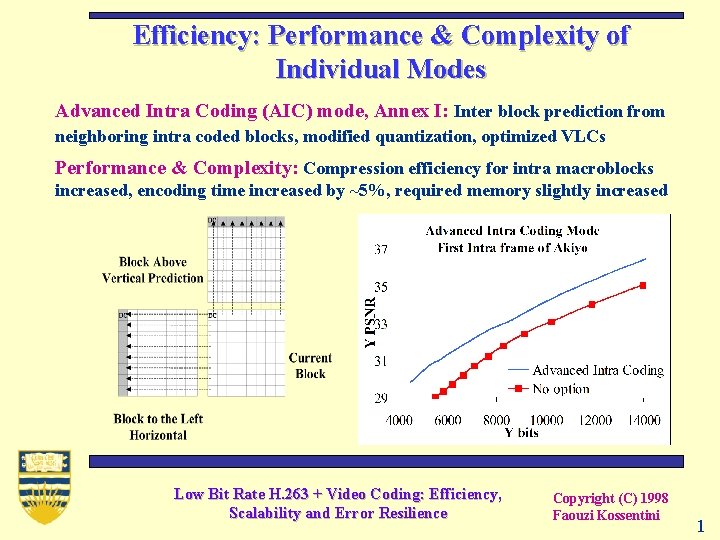
Efficiency: Performance & Complexity of Individual Modes Advanced Intra Coding (AIC) mode, Annex I: Inter block prediction from neighboring intra coded blocks, modified quantization, optimized VLCs Performance & Complexity: Compression efficiency for intra macroblocks increased, encoding time increased by ~5%, required memory slightly increased Low Bit Rate H. 263 + Video Coding: Efficiency, Scalability and Error Resilience Copyright (C) 1998 Faouzi Kossentini 1
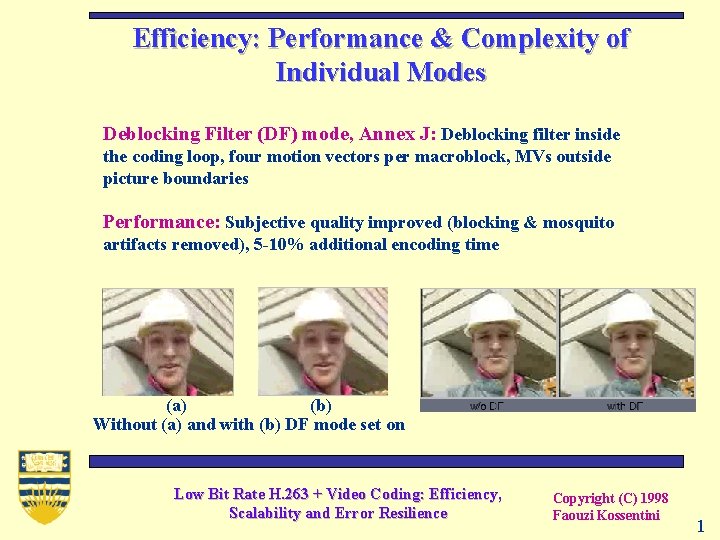
Efficiency: Performance & Complexity of Individual Modes Deblocking Filter (DF) mode, Annex J: Deblocking filter inside the coding loop, four motion vectors per macroblock, MVs outside picture boundaries Performance: Subjective quality improved (blocking & mosquito artifacts removed), 5 -10% additional encoding time (a) (b) Without (a) and with (b) DF mode set on Low Bit Rate H. 263 + Video Coding: Efficiency, Scalability and Error Resilience Copyright (C) 1998 Faouzi Kossentini 1
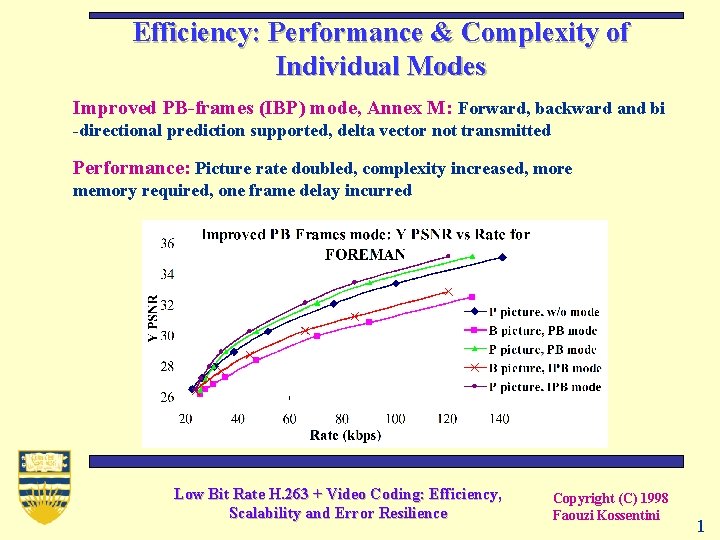
Efficiency: Performance & Complexity of Individual Modes Improved PB-frames (IBP) mode, Annex M: Forward, backward and bi -directional prediction supported, delta vector not transmitted Performance: Picture rate doubled, complexity increased, more memory required, one frame delay incurred Low Bit Rate H. 263 + Video Coding: Efficiency, Scalability and Error Resilience Copyright (C) 1998 Faouzi Kossentini 1
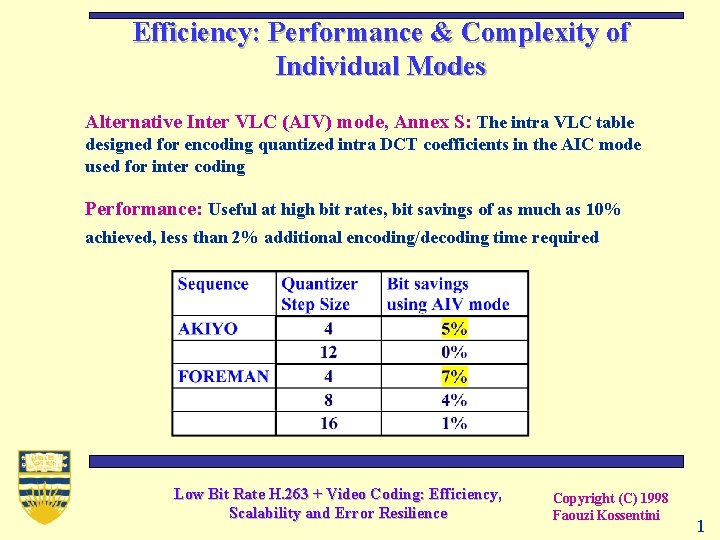
Efficiency: Performance & Complexity of Individual Modes Alternative Inter VLC (AIV) mode, Annex S: The intra VLC table designed for encoding quantized intra DCT coefficients in the AIC mode used for inter coding Performance: Useful at high bit rates, bit savings of as much as 10% achieved, less than 2% additional encoding/decoding time required Low Bit Rate H. 263 + Video Coding: Efficiency, Scalability and Error Resilience Copyright (C) 1998 Faouzi Kossentini 1
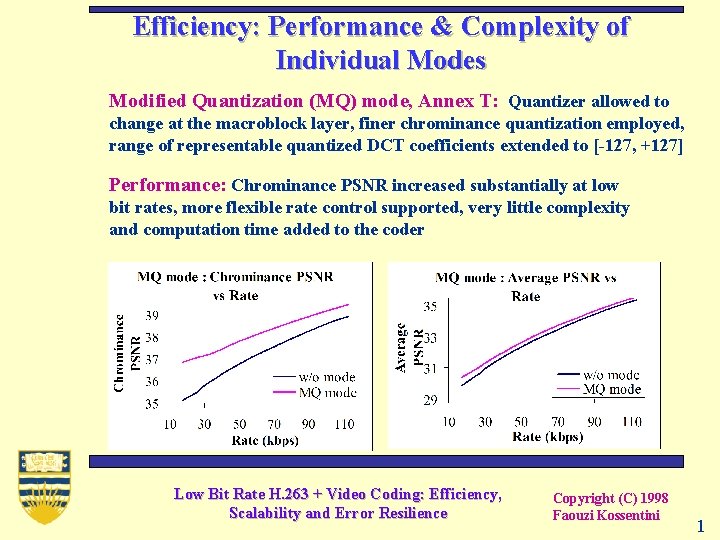
Efficiency: Performance & Complexity of Individual Modes Modified Quantization (MQ) mode, Annex T: Quantizer allowed to change at the macroblock layer, finer chrominance quantization employed, range of representable quantized DCT coefficients extended to [-127, +127] Performance: Chrominance PSNR increased substantially at low bit rates, more flexible rate control supported, very little complexity and computation time added to the coder Low Bit Rate H. 263 + Video Coding: Efficiency, Scalability and Error Resilience Copyright (C) 1998 Faouzi Kossentini 1
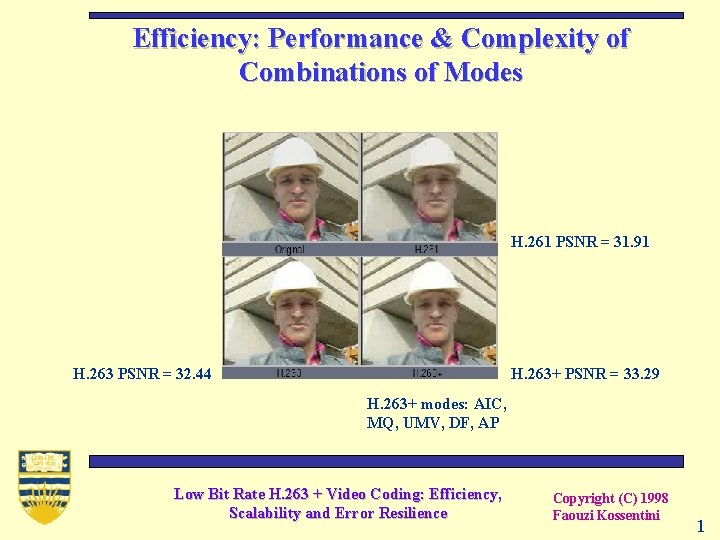
Efficiency: Performance & Complexity of Combinations of Modes H. 261 PSNR = 31. 91 H. 263 PSNR = 32. 44 H. 263+ PSNR = 33. 29 H. 263+ modes: AIC, MQ, UMV, DF, AP Low Bit Rate H. 263 + Video Coding: Efficiency, Scalability and Error Resilience Copyright (C) 1998 Faouzi Kossentini 1
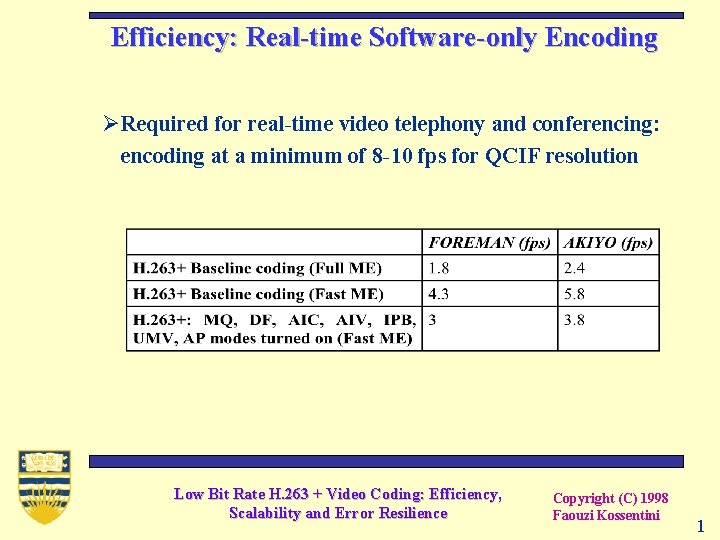
Efficiency: Real-time Software-only Encoding ØRequired for real-time video telephony and conferencing: encoding at a minimum of 8 -10 fps for QCIF resolution Low Bit Rate H. 263 + Video Coding: Efficiency, Scalability and Error Resilience Copyright (C) 1998 Faouzi Kossentini 1
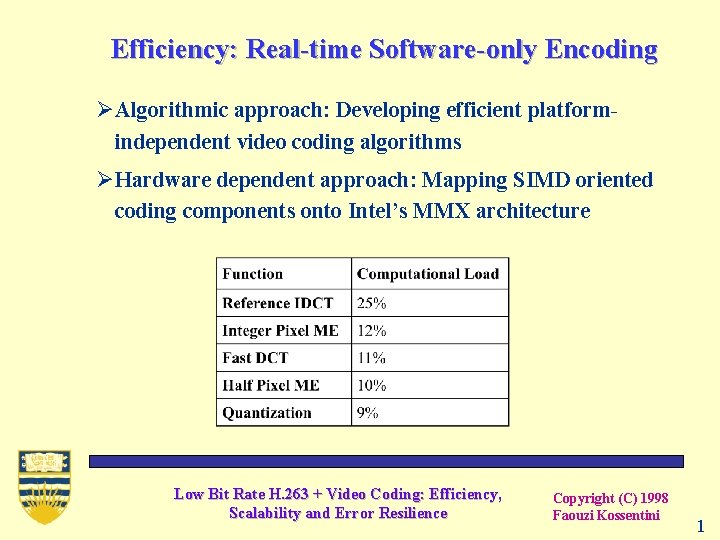
Efficiency: Real-time Software-only Encoding ØAlgorithmic approach: Developing efficient platformindependent video coding algorithms ØHardware dependent approach: Mapping SIMD oriented coding components onto Intel’s MMX architecture Low Bit Rate H. 263 + Video Coding: Efficiency, Scalability and Error Resilience Copyright (C) 1998 Faouzi Kossentini 1
Efficiency: Real-time Software-only Encoding Efficient Video Coding Algorithms: ØIDCT for blocks with all or most of the coefficients equal to zero avoided or efficiently computed (respectively) ØSAD for most macroblocks computed efficiently via prediction ØDCT & Quantization for most blocks avoided via prediction ØLinear approximation methods used for half-pixel ME ØQuantization: look-up tables employed Some Image and Video Processing Research Projects @ the UBC Signal Processing and Multimedia Laboratory Copyright (C) 1998 Faouzi Kossentini 1
Efficiency: Real-time Software-only Encoding Intel’s MMX Architecture: ØFeatures : Ø SIMD structure Ø Four new data types Ø 57 new instructions Ø Saturation arithmetic Low Bit Rate H. 263 + Video Coding: Efficiency, Scalability and Error Resilience Copyright (C) 1998 Faouzi Kossentini 1
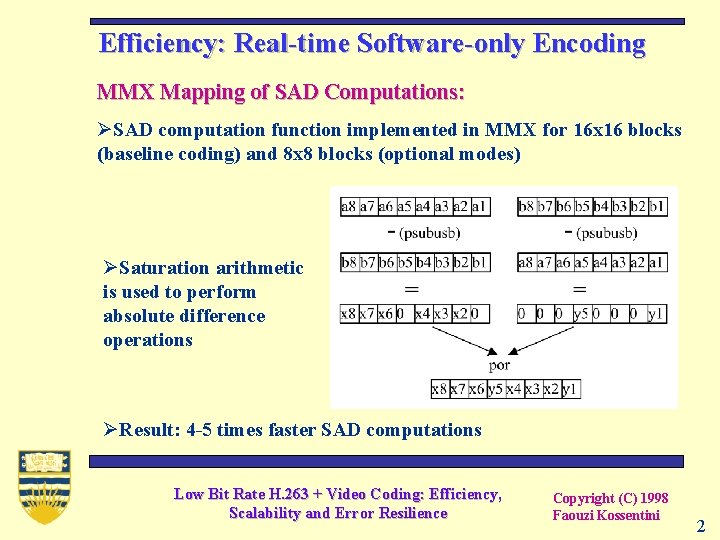
Efficiency: Real-time Software-only Encoding MMX Mapping of SAD Computations: ØSAD computation function implemented in MMX for 16 x 16 blocks (baseline coding) and 8 x 8 blocks (optional modes) ØSaturation arithmetic is used to perform absolute difference operations ØResult: 4 -5 times faster SAD computations Low Bit Rate H. 263 + Video Coding: Efficiency, Scalability and Error Resilience Copyright (C) 1998 Faouzi Kossentini 2
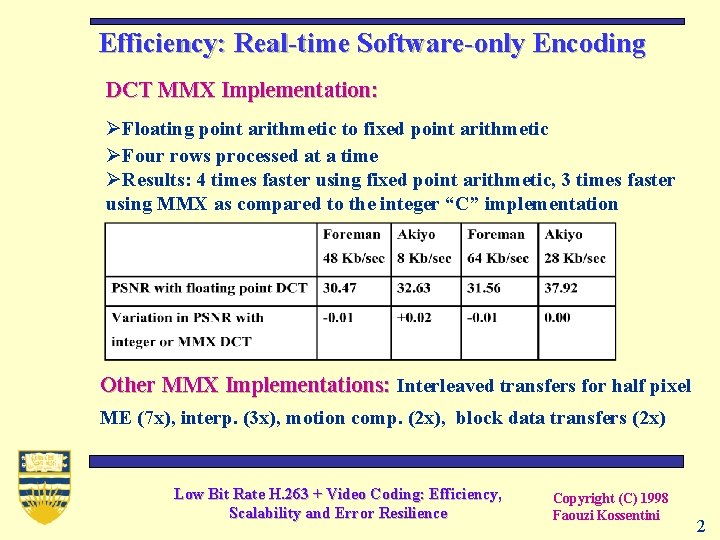
Efficiency: Real-time Software-only Encoding DCT MMX Implementation: ØFloating point arithmetic to fixed point arithmetic ØFour rows processed at a time ØResults: 4 times faster using fixed point arithmetic, 3 times faster using MMX as compared to the integer “C” implementation Other MMX Implementations: Interleaved transfers for half pixel ME (7 x), interp. (3 x), motion comp. (2 x), block data transfers (2 x) Low Bit Rate H. 263 + Video Coding: Efficiency, Scalability and Error Resilience Copyright (C) 1998 Faouzi Kossentini 2
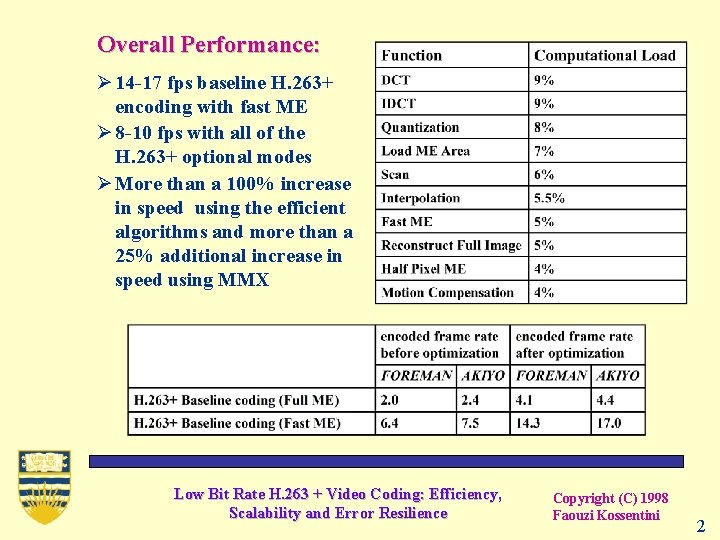
Overall Performance: Ø 14 -17 fps baseline H. 263+ encoding with fast ME Ø 8 -10 fps with all of the H. 263+ optional modes Ø More than a 100% increase in speed using the efficient algorithms and more than a 25% additional increase in speed using MMX Low Bit Rate H. 263 + Video Coding: Efficiency, Scalability and Error Resilience Copyright (C) 1998 Faouzi Kossentini 2
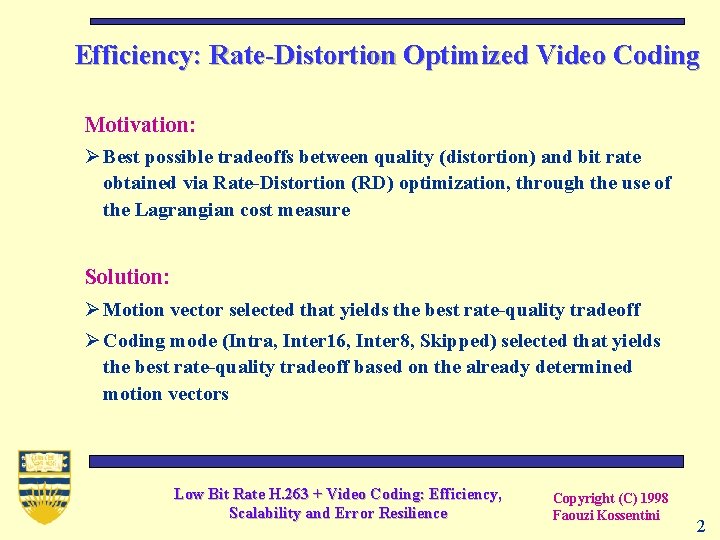
Efficiency: Rate-Distortion Optimized Video Coding Motivation: Ø Best possible tradeoffs between quality (distortion) and bit rate obtained via Rate-Distortion (RD) optimization, through the use of the Lagrangian cost measure Solution: Ø Motion vector selected that yields the best rate-quality tradeoff Ø Coding mode (Intra, Inter 16, Inter 8, Skipped) selected that yields the best rate-quality tradeoff based on the already determined motion vectors Low Bit Rate H. 263 + Video Coding: Efficiency, Scalability and Error Resilience Copyright (C) 1998 Faouzi Kossentini 2
Efficiency: Rate-Distortion Optimized Video Coding Result: Ø 10 - 30% savings in bit rate obtained using the RD optimized coder for most sequences over our reference software Low Bit Rate H. 263 + Video Coding: Efficiency, Scalability and Error Resilience Copyright (C) 1998 Faouzi Kossentini 2
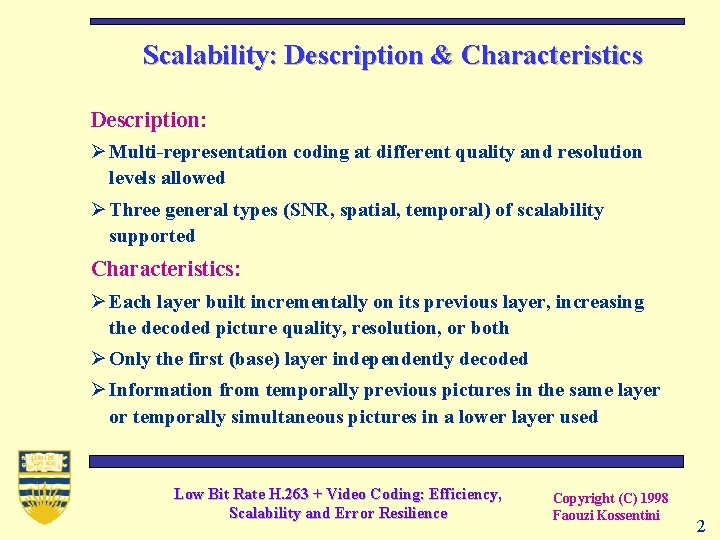
Scalability: Description & Characteristics Description: Ø Multi-representation coding at different quality and resolution levels allowed Ø Three general types (SNR, spatial, temporal) of scalability supported Characteristics: Ø Each layer built incrementally on its previous layer, increasing the decoded picture quality, resolution, or both Ø Only the first (base) layer independently decoded Ø Information from temporally previous pictures in the same layer or temporally simultaneous pictures in a lower layer used Low Bit Rate H. 263 + Video Coding: Efficiency, Scalability and Error Resilience Copyright (C) 1998 Faouzi Kossentini 2
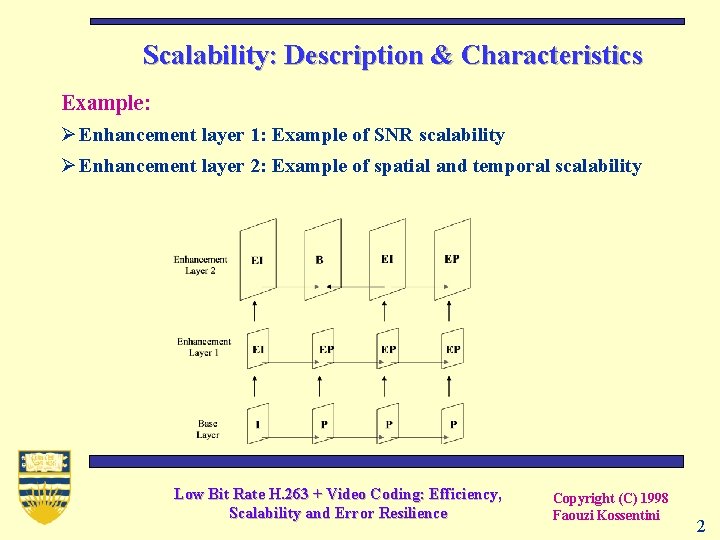
Scalability: Description & Characteristics Example: Ø Enhancement layer 1: Example of SNR scalability Ø Enhancement layer 2: Example of spatial and temporal scalability Low Bit Rate H. 263 + Video Coding: Efficiency, Scalability and Error Resilience Copyright (C) 1998 Faouzi Kossentini 2
Scalability: RD Optimized Framework Motivation: Ø Compression efficiency of a higher layer dependent on that of all preceding (lower) layers Ø Higher compression efficiency and more flexible joint rate-distortion control achieved via an RD optimized framework Current research direction: Ø Employ (1) multiple rate constraints (explicit for each layer) OR (2) a single rate constraint with explicit distortion constraints for each layer. Ø Apply RD optimization to temporal, spatial and SNR scalable coding algorithms Low Bit Rate H. 263 + Video Coding: Efficiency, Scalability and Error Resilience Copyright (C) 1998 Faouzi Kossentini 2
Error Resilience: Synchronization & Error Concealment Use of Synchronization Markers: ØDifferent synchronization markers (between GOBs, slices, etc. ) used for higher error resilience Error concealment: ØMissing motion vectors for a macroblock received in error recovered from neighboring macroblocks (via spatial methods) ØTexture information from the previous frame is compensated using the recovered motion vectors Low Bit Rate H. 263 + Video Coding: Efficiency, Scalability and Error Resilience Copyright (C) 1998 Faouzi Kossentini 2
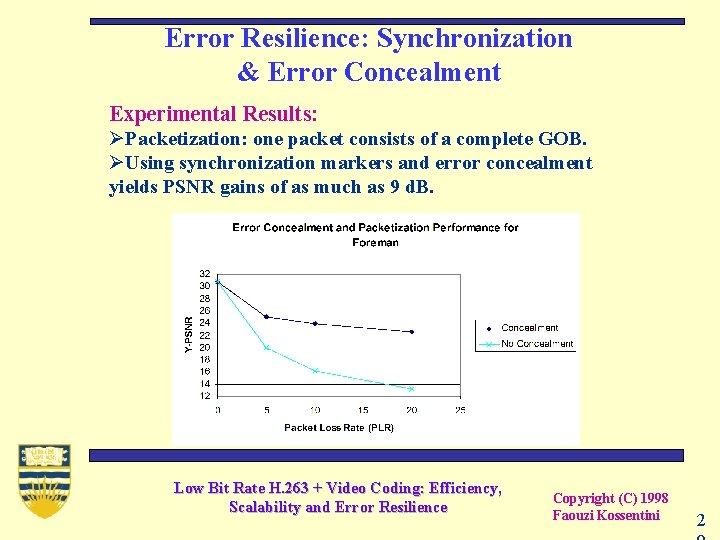
Error Resilience: Synchronization & Error Concealment Experimental Results: ØPacketization: one packet consists of a complete GOB. ØUsing synchronization markers and error concealment yields PSNR gains of as much as 9 d. B. Low Bit Rate H. 263 + Video Coding: Efficiency, Scalability and Error Resilience Copyright (C) 1998 Faouzi Kossentini 2
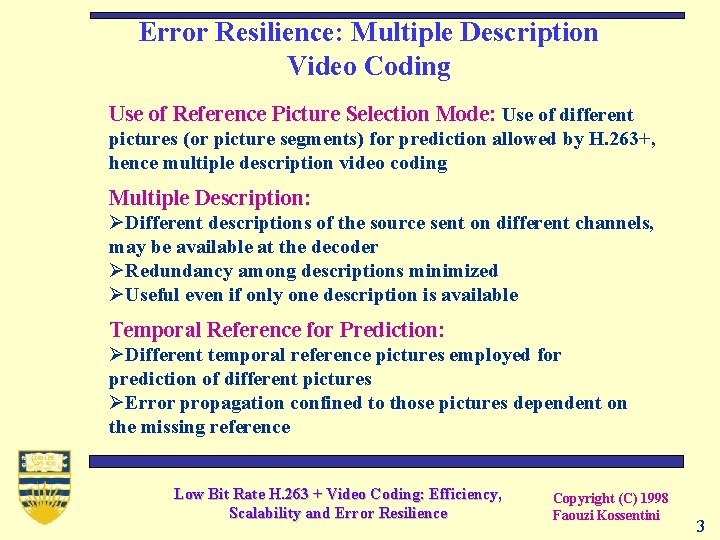
Error Resilience: Multiple Description Video Coding Use of Reference Picture Selection Mode: Use of different pictures (or picture segments) for prediction allowed by H. 263+, hence multiple description video coding Multiple Description: ØDifferent descriptions of the source sent on different channels, may be available at the decoder ØRedundancy among descriptions minimized ØUseful even if only one description is available Temporal Reference for Prediction: ØDifferent temporal reference pictures employed for prediction of different pictures ØError propagation confined to those pictures dependent on the missing reference Low Bit Rate H. 263 + Video Coding: Efficiency, Scalability and Error Resilience Copyright (C) 1998 Faouzi Kossentini 3
Conclusions H. 263+ versus H. 263: Ø H. 263+ backward compatible with the H. 263 (same baseline) Ø Efficient ways provided by H. 263+ of trading additional complexity for more compression efficiency, scalability, resilience and flexibility H. 263/H. 263+ versus MPEG-4: Ø H. 263 output decodable by MPEG-4, H. 263+/MPEG-4 sharing tools Ø Although somewhat available via chroma keying in H. 263+, objectbased functionality better provided by MPEG-4 Ø H. 263/H. 263+ public-domain implementation: http: //spmg. ece. ubc. ca/ Future directions: Ø Still higher coding efficiency and better scalability/resilience possible Ø More object-based tools and capabilities, better (efficient) shape coding Low Bit Rate H. 263 + Video Coding: Efficiency, Scalability and Error Resilience Copyright (C) 1998 Faouzi Kossentini 3
- Slides: 31