
Low Band Receiving Loops Design optimization and applications
Low Band Receiving Loops Design optimization and applications, including SO 2 R on the same band Rick Karlquist N 6 RK
Topics • Small, square so-called “shielded” receiving loops for 160 m and 80 m. • Theory • Design and optimization • Applications • NOT: Transmit loops, delta loops, “skywire” loops, ferrite loopsticks, nonham freq. , mechanical construction
Why this presentation is necessary • Available literature on loop antennas is unsatisfactory for various reasons • Misleading/confusing • Incomplete • Not applicable to ham radio • Folklore • Just plain wrong (even Terman is wrong) • Even stuff published in Connecticut
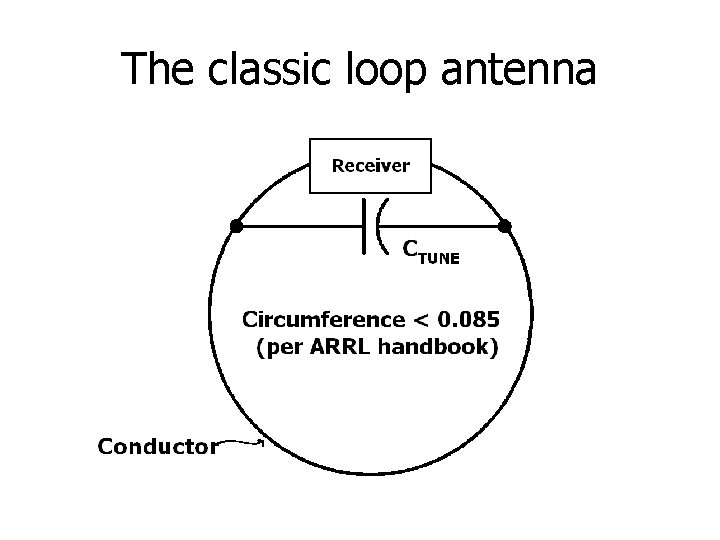
The classic loop antenna
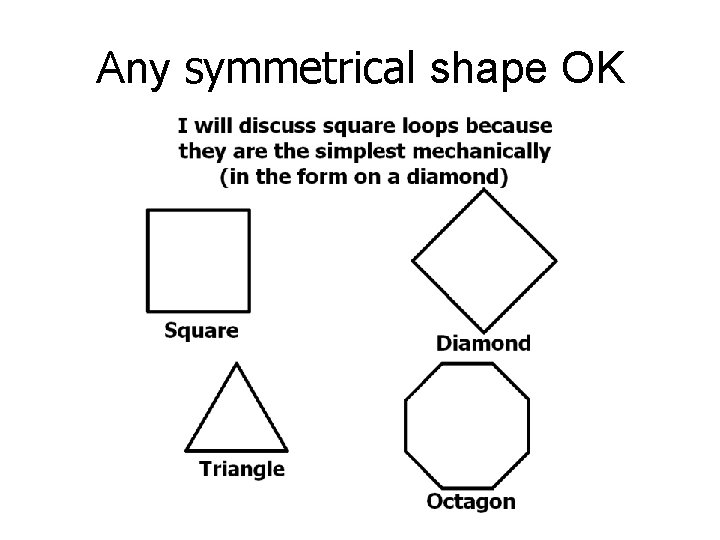
Any symmetrical shape OK
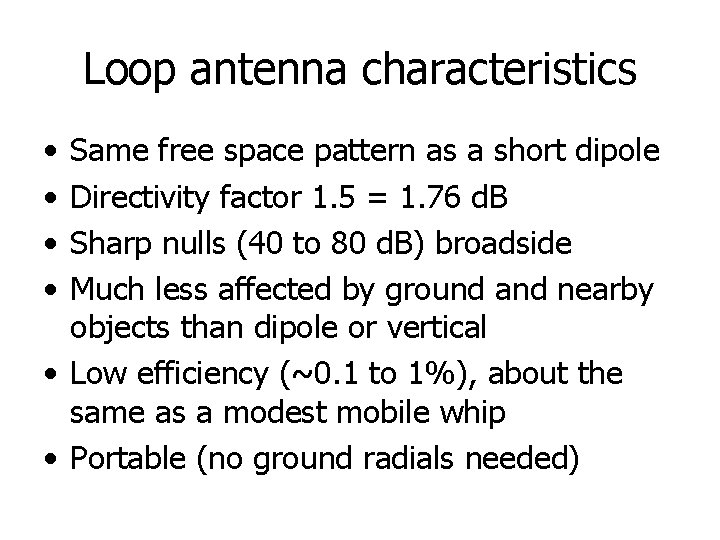
Loop antenna characteristics • • Same free space pattern as a short dipole Directivity factor 1. 5 = 1. 76 d. B Sharp nulls (40 to 80 d. B) broadside Much less affected by ground and nearby objects than dipole or vertical • Low efficiency (~0. 1 to 1%), about the same as a modest mobile whip • Portable (no ground radials needed)
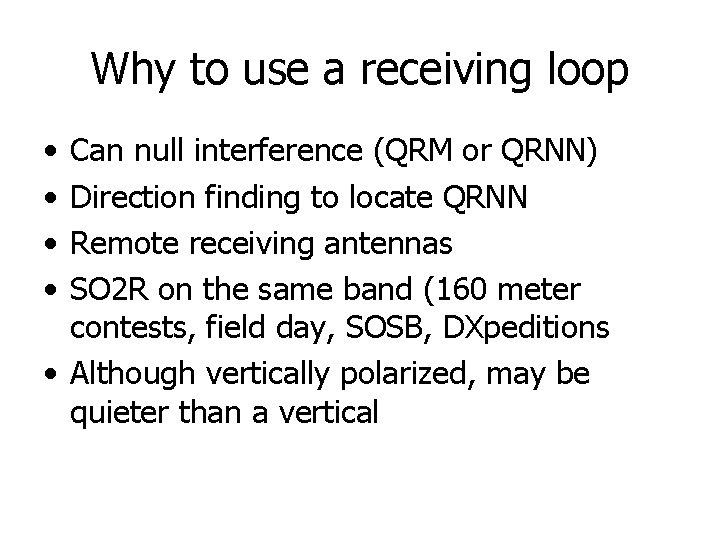
Why to use a receiving loop • • Can null interference (QRM or QRNN) Direction finding to locate QRNN Remote receiving antennas SO 2 R on the same band (160 meter contests, field day, SOSB, DXpeditions • Although vertically polarized, may be quieter than a vertical
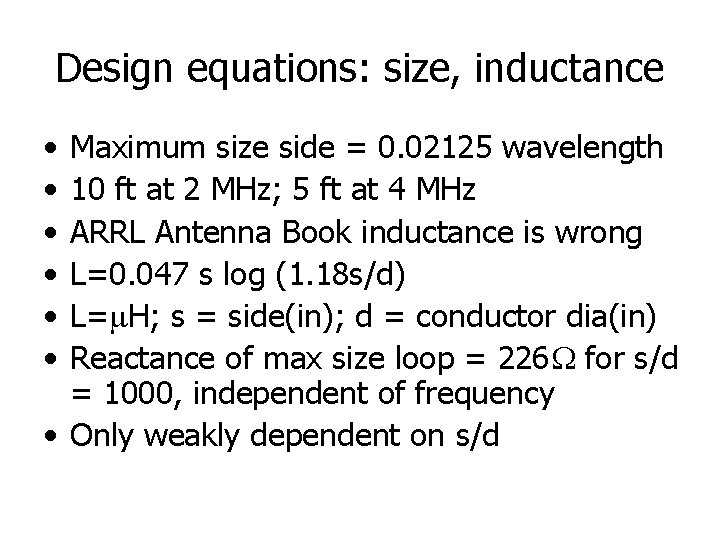
Design equations: size, inductance • • • Maximum size side = 0. 02125 wavelength 10 ft at 2 MHz; 5 ft at 4 MHz ARRL Antenna Book inductance is wrong L=0. 047 s log (1. 18 s/d) L=m. H; s = side(in); d = conductor dia(in) Reactance of max size loop = 226 W for s/d = 1000, independent of frequency • Only weakly dependent on s/d
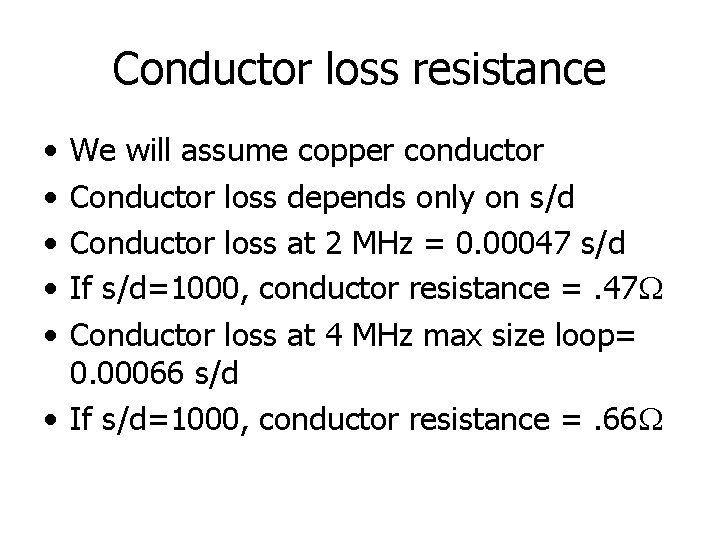
Conductor loss resistance • • • We will assume copper conductor Conductor loss depends only on s/d Conductor loss at 2 MHz = 0. 00047 s/d If s/d=1000, conductor resistance =. 47 W Conductor loss at 4 MHz max size loop= 0. 00066 s/d • If s/d=1000, conductor resistance =. 66 W
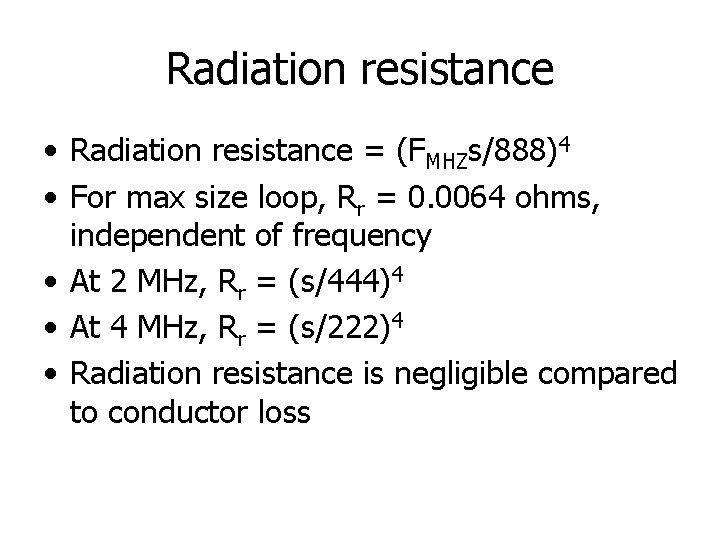
Radiation resistance • Radiation resistance = (FMHZs/888)4 • For max size loop, Rr = 0. 0064 ohms, independent of frequency • At 2 MHz, Rr = (s/444)4 • At 4 MHz, Rr = (s/222)4 • Radiation resistance is negligible compared to conductor loss
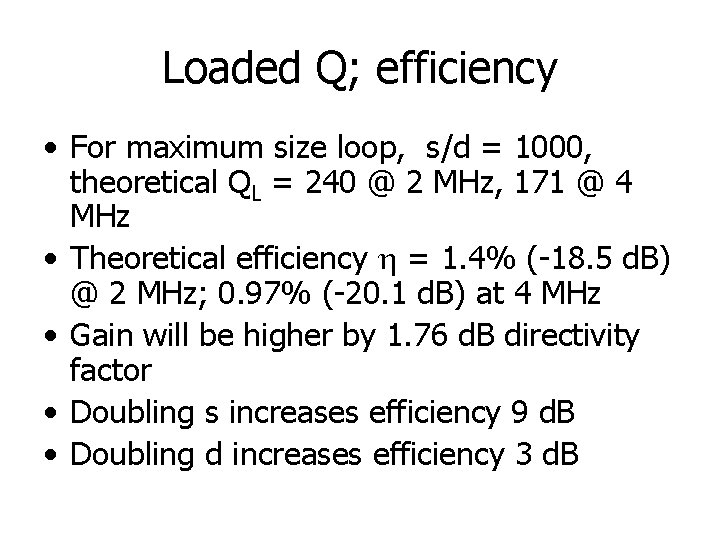
Loaded Q; efficiency • For maximum size loop, s/d = 1000, theoretical QL = 240 @ 2 MHz, 171 @ 4 MHz • Theoretical efficiency h = 1. 4% (-18. 5 d. B) @ 2 MHz; 0. 97% (-20. 1 d. B) at 4 MHz • Gain will be higher by 1. 76 d. B directivity factor • Doubling s increases efficiency 9 d. B • Doubling d increases efficiency 3 d. B
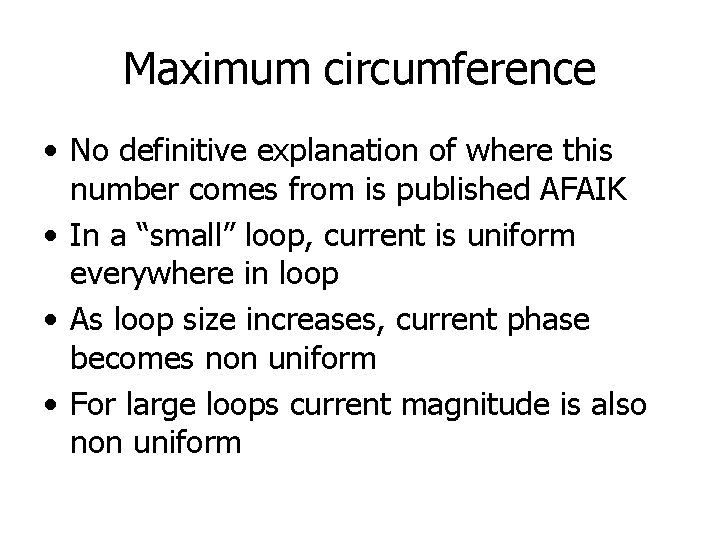
Maximum circumference • No definitive explanation of where this number comes from is published AFAIK • In a “small” loop, current is uniform everywhere in loop • As loop size increases, current phase becomes non uniform • For large loops current magnitude is also non uniform
Effects of “large” loop • Supposedly, a too-large loop will have poor nulls, but is this really true? • For vertically polarized waves, there is a broadside null for any size, even a 1 wavelength “quad” driven element • For horizontally polarized waves, there is an end fire null for any size • Topic for further study • I will use ARRL limit of 0. 085 wavelengths
Multiturn loops • Maximum perimeter rule applies to total length of wire, not circumference of bundle • To the extent that max perimeter rule applies, multiturn configuration greatly limits loop size • Multiple turns are a circuit design convenience, they do not increase loop sensitivity • Multiple turns in parallel make more sense • We will assume single turn from now on
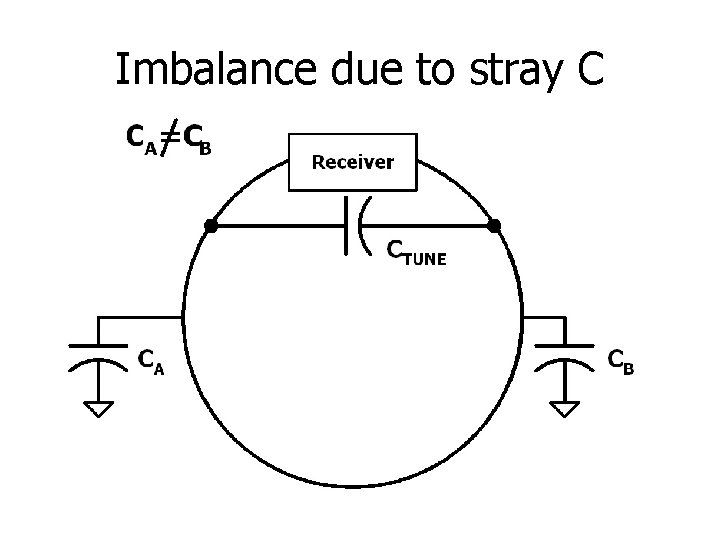
Imbalance due to stray C
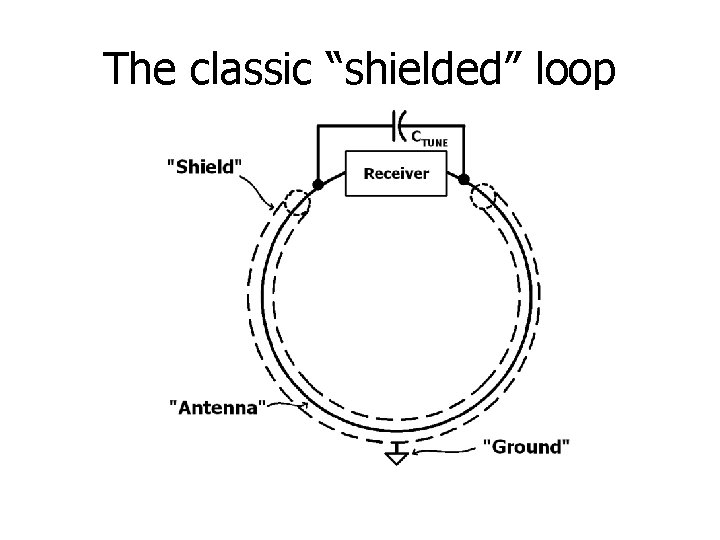
The classic “shielded” loop
So-called “shielded loop” • First described (incorrectly) in 1924 as “electrostatic shield” and repeated by Terman • If the loop were really an electrostatic shield, we could enclose the entire loop in a shield box and it would still work; we know that is false • Theory of shielded loop as published overlooks skin effect • Shielded loop actually works and is useful, but not for the reasons given in handbooks
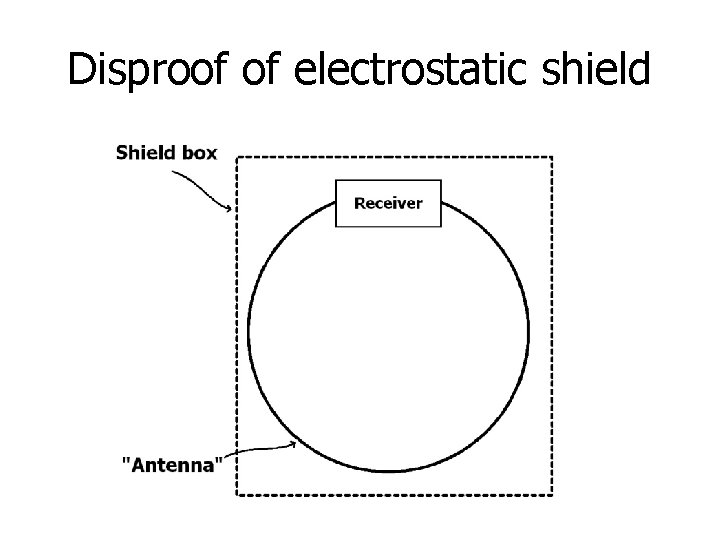
Disproof of electrostatic shield
Development of classic loop into “shielded” loop
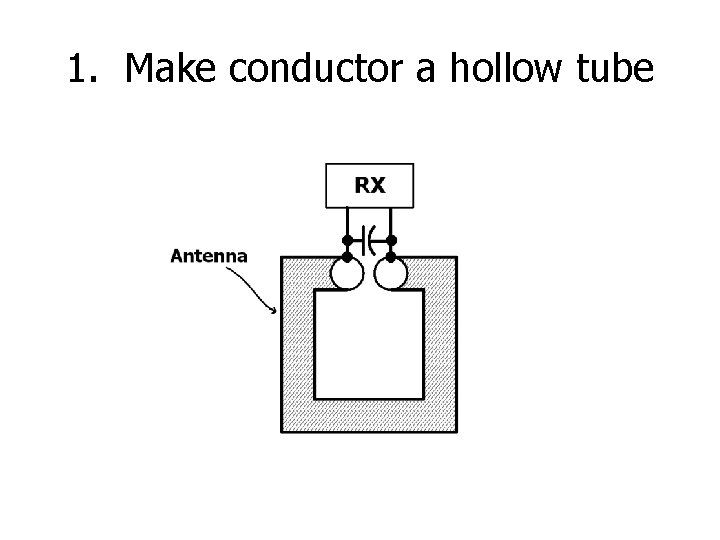
1. Make conductor a hollow tube
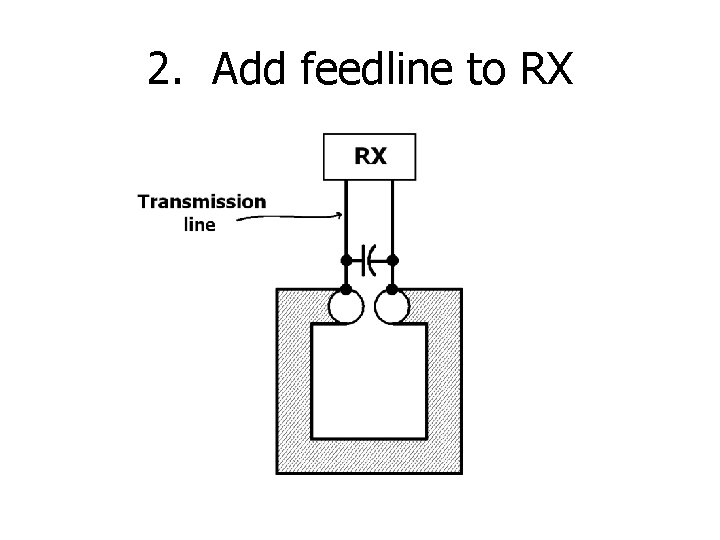
2. Add feedline to RX
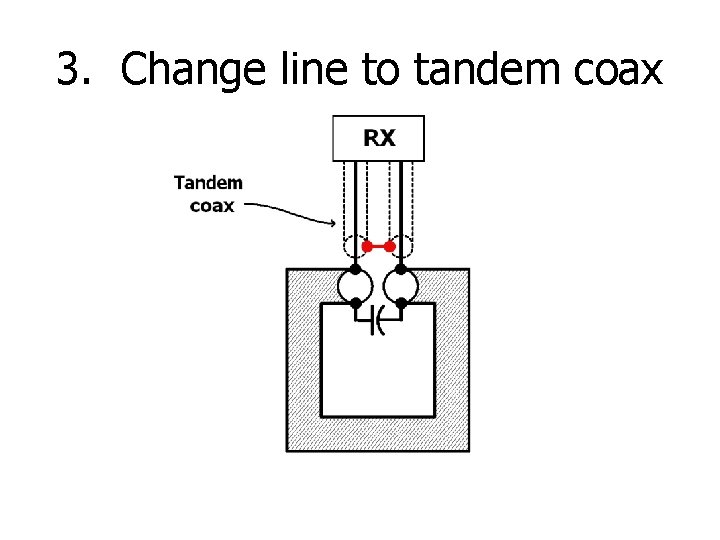
3. Change line to tandem coax
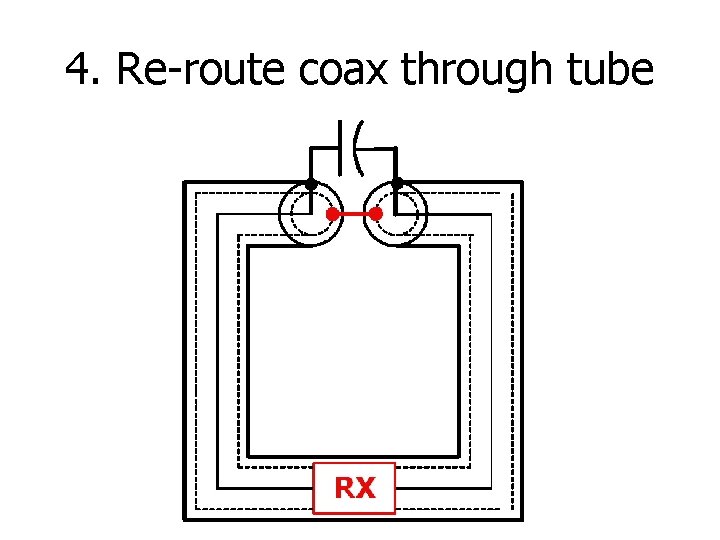
4. Re-route coax through tube
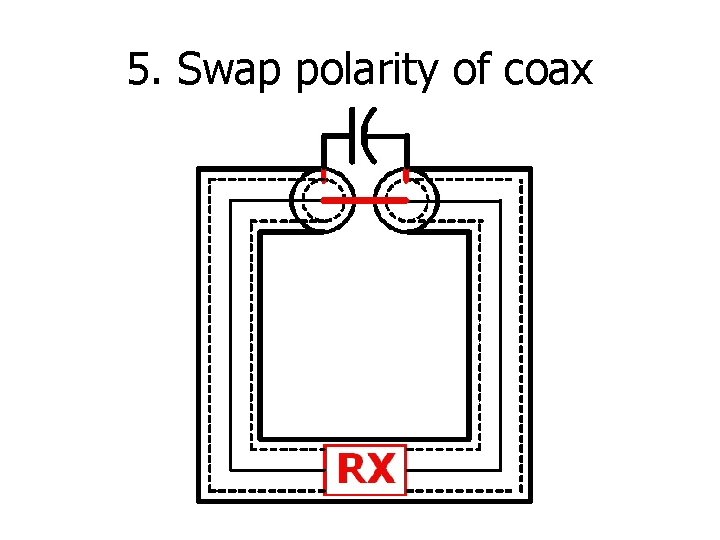
5. Swap polarity of coax
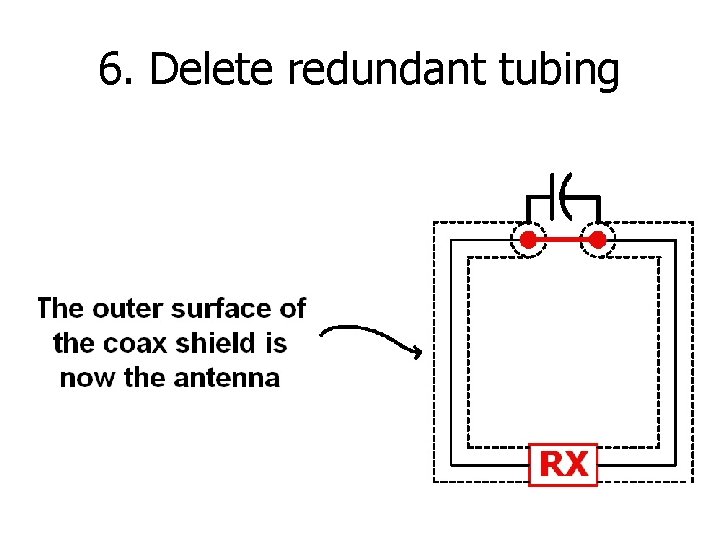
6. Delete redundant tubing
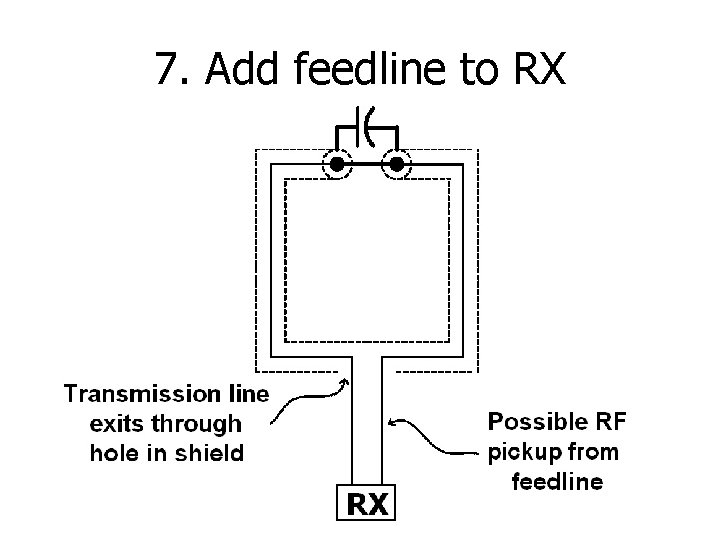
7. Add feedline to RX
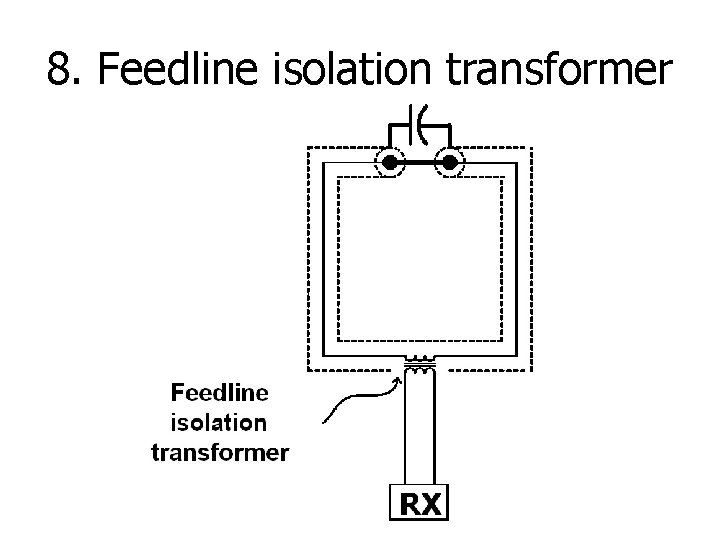
8. Feedline isolation transformer
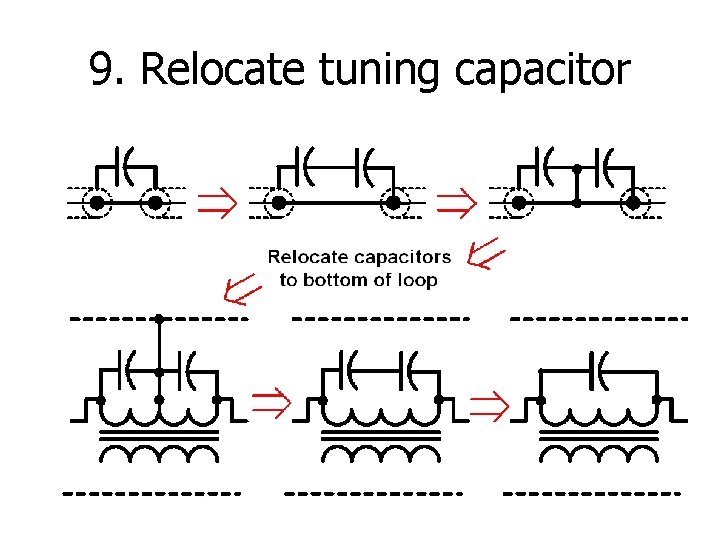
9. Relocate tuning capacitor
Coax capacitance • Capacitance of coax is in parallel with tuning capacitor • The two coax branches are effectively in series so the capacitance is halved • Use foam dielectric 75 ohm coax to minimize loss of tuning range • Still possible to reach maximum frequency where perimeter = 0. 085 wavelengths
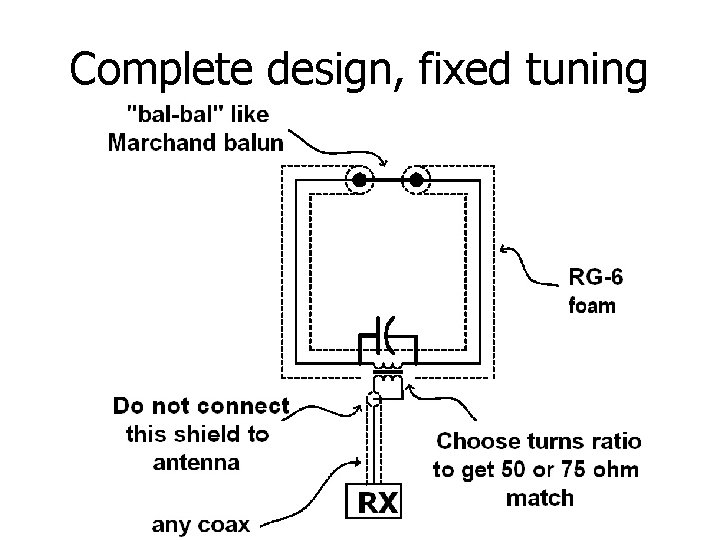
Complete design, fixed tuning
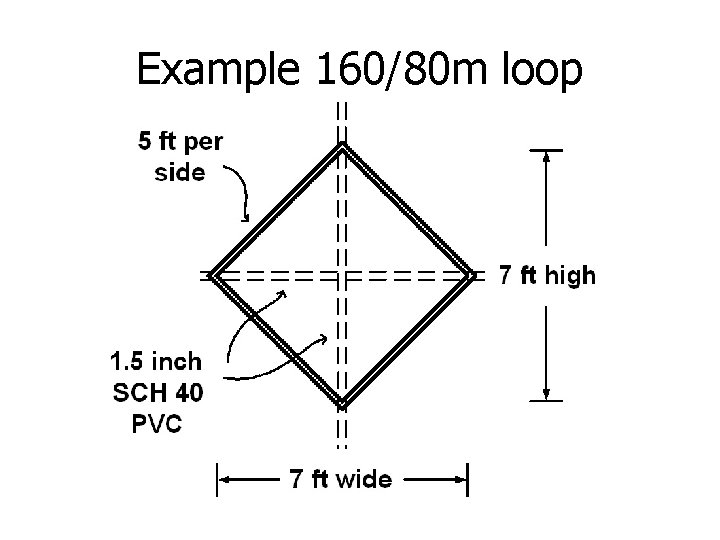
Example 160/80 m loop
Example, max size 160/80 loop • • Total length of coax, 20 ft Perimeter is 0. 085 wavelength at 4 MHz Bandwidth ~25 to 50 k. Hz Gain 20 to 30 d. B below transmit vertical Tuning capacitance 200 -800 p. F Loop impedance ~ 5000 ohms Transformer turns ratio ~50: 5
Matching transformer • Use a transformer, not a balun, this is not for transmit. • Use low permeability core (m=125), Fair-Rite 61 material, 3/8” to ½” diameter • Use enough turns to get 100 m. H on the loop side, typically 50 T on 3/8” high core • Wind feedline side to match to 50 or 75 ohm feedline, approx. 5 turns • This core has negligible signal loss • Do NOT use high perm matl (73, 33, etc)
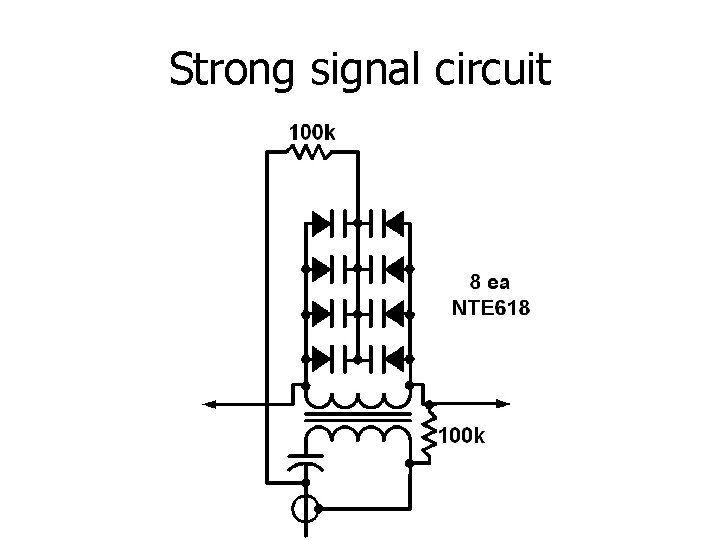
Remote varactor tuning • Use AM BCB tuning diodes • Only source of new diodes to hams is NTE 618 (available Mouser and others) • Continuous tuning from below 1. 8 MHz to above 4 MHz • Tuning voltage 0 to +10 V
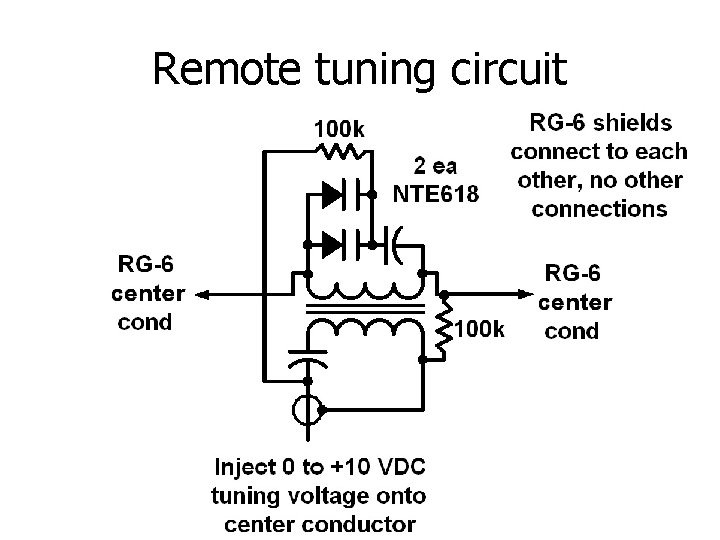
Remote tuning circuit
Strong signal issues • Typically no BCB overload problem • No problem 6 miles from 50 k. W station • Make sure birdies are in antenna, not your receiver • In case of a problem, use strong signal varactor circuit • For SO 2, may need to avoid varactors altogether
Strong signal circuit
Loop size issues • Bandwidth (counterintuitively) is independent of size • Tuning cap inversely proportional to loop width • Gain increases 9 d. B (theoretically) for doubling of loop width • I observed more than +9 d. B for full size loop on 160 meters (14 ft wide) vs 7 foot wide • Doubling conductor diameter increases gain 3 d. B, halves bandwidth • Nulling still good on large loops
Sensitivity issues • Noise from antenna must dominate receiver noise. • Example loop was quite adequate for FT 1000; even a half size loop was OK. • For 160 meter remote loop at long distance, consider 14 foot size. Easier than a preamp
Applications • Nulling power line noise, good for several S units • Very useful for DF’ing power line noise • Get bearing then walk to source using VHF gear to get actual pole • Remote loop away from noise if you have the land • Compare locations for noise using WWV(H) on 2. 5 MHz as a beacon • Null your own transmitter for SO 2 R
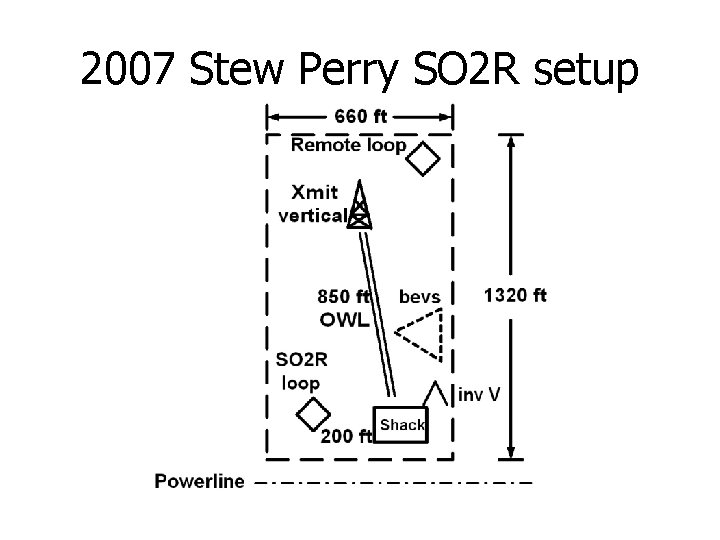
2007 Stew Perry SO 2 R setup
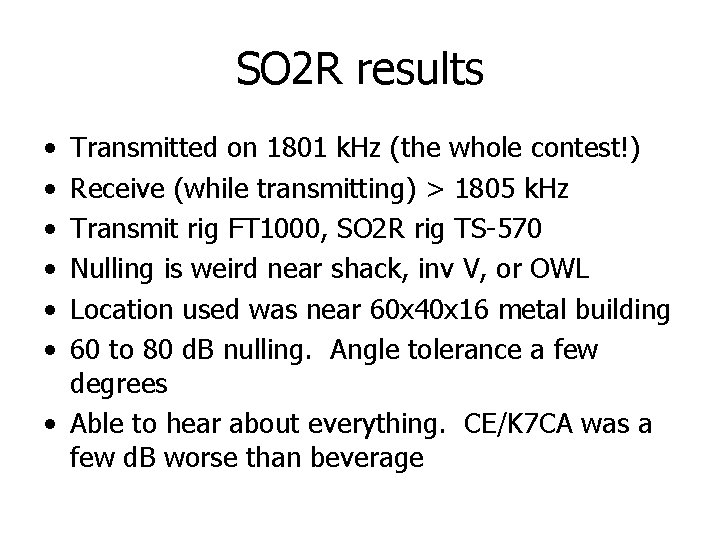
SO 2 R results • • • Transmitted on 1801 k. Hz (the whole contest!) Receive (while transmitting) > 1805 k. Hz Transmit rig FT 1000, SO 2 R rig TS-570 Nulling is weird near shack, inv V, or OWL Location used was near 60 x 40 x 16 metal building 60 to 80 d. B nulling. Angle tolerance a few degrees • Able to hear about everything. CE/K 7 CA was a few d. B worse than beverage
CU on the low bands 73, Rick N 6 RK
- Slides: 43