
Louisville Metro Department of Public Health and Wellness
Louisville Metro Department of Public Health and Wellness 6 -9 -17
THE ENVIRONMENTAL VIEW OF ZIKA VIRUS AND MOSQUITO CONTROL FROM BREEDING SITE TO CASE INVESTIGATION Matthew Vanderpool, R. S. , M. S. Louisville Metro Department of Public Health and Wellness
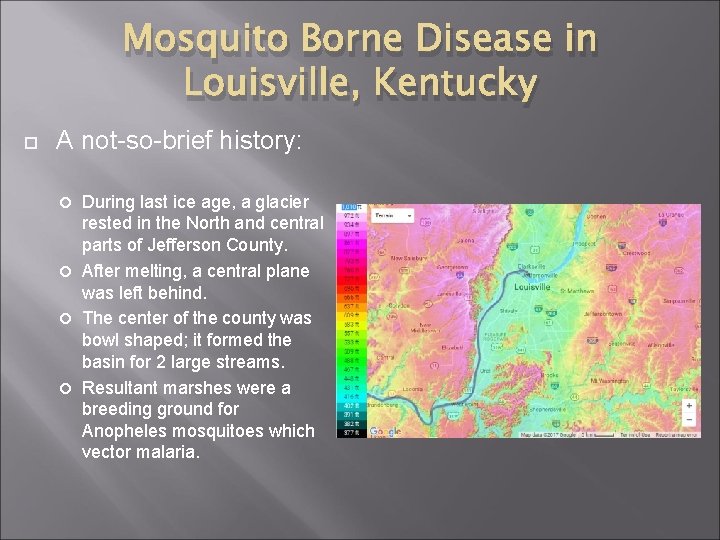
Mosquito Borne Disease in Louisville, Kentucky A not-so-brief history: During last ice age, a glacier rested in the North and central parts of Jefferson County. After melting, a central plane was left behind. The center of the county was bowl shaped; it formed the basin for 2 large streams. Resultant marshes were a breeding ground for Anopheles mosquitoes which vector malaria.
Mosquito Borne Disease in Louisville, Kentucky 1822 Malaria outbreak 25% morbidity, mortality rates vary greatly 1878 Yellow Fever outbreak 1956 & 1975 St. Louis Encephalitis outbreak 2002 -2003, 2012 West Nile Virus outbreaks
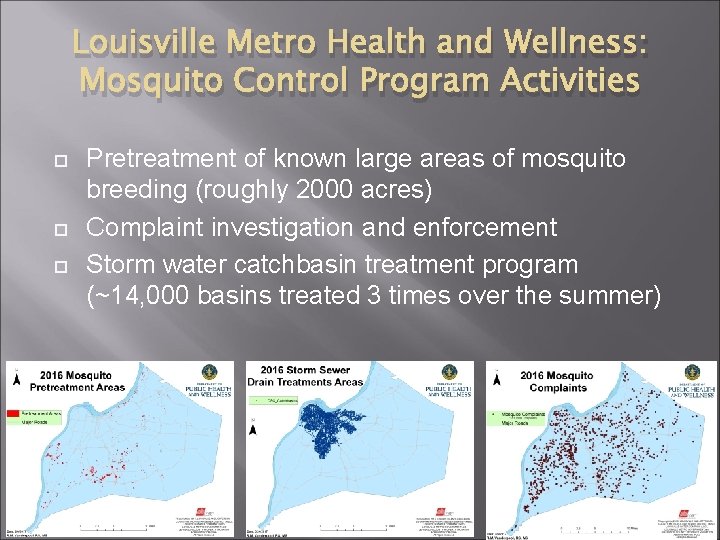
Louisville Metro Health and Wellness: Mosquito Control Program Activities Pretreatment of known large areas of mosquito breeding (roughly 2000 acres) Complaint investigation and enforcement Storm water catchbasin treatment program (~14, 000 basins treated 3 times over the summer)
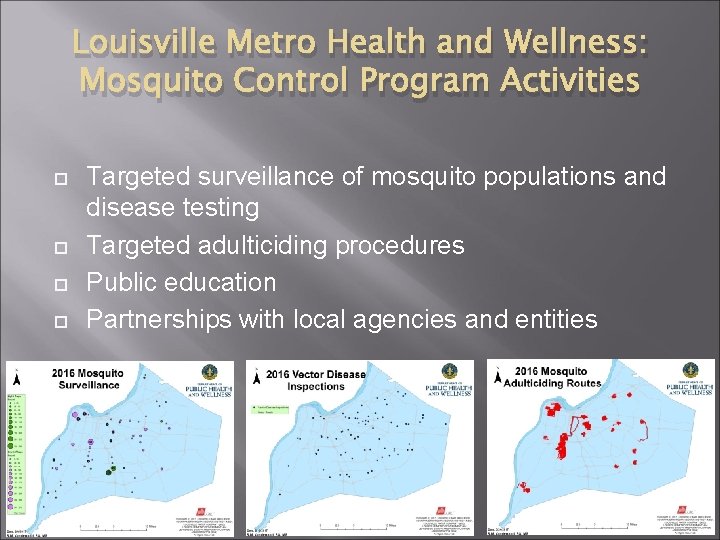
Louisville Metro Health and Wellness: Mosquito Control Program Activities Targeted surveillance of mosquito populations and disease testing Targeted adulticiding procedures Public education Partnerships with local agencies and entities
Basics of Mosquito Biology and Habits Mosquitoes MUST have standing water to breed. Mosquitoes can breed in less than a quarter inch of water. On hot summer days, mosquitoes only require about 5 days to complete their life cycle. Not all mosquito species bite people or suck blood. Only female mosquitoes drink blood. Mosquitoes are not obligate parasites, blood is used to produce eggs. Mosquitoes rest in vegetation and sheltered areas when they are not feeding.
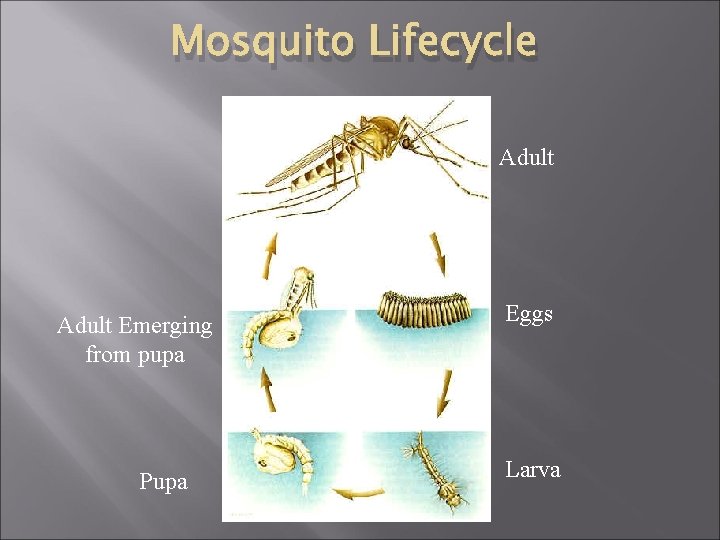
Mosquito Lifecycle Adult Emerging from pupa Pupa Eggs Larva
How does an investigation begin? A patient comes to a provider’s office; they appear to meet testing criteria (as established by the CDC) and a blood test is ordered. Mosquito borne diseases are reportable: Malaria, Yellow fever, West Nile virus, Zika, etc. If a positive result for the presence of a mosquito borne disease is found: The confirmatory lab notifies the local health department, communicable disease program. The treating physician/provider notifies the local health department, communicable disease program.
How does an investigation begin? The Communicable Disease (CD) program Prior to the test being ordered, CD staff speaks with the patient and conducts an epidemiological interview—CD staff determine eligibility for testing. Collects, analyzes and submits epidemiological data to the state Communicable Disease program. Notifies the Environmental Health division to inspect the patient’s home, workplace and/or other relevant locations. Louisville Metro’s CD Program notifies Environmental Health Staff upon approving Zika testing through the state.
Disease Investigations Environmental investigation parameters depend on the disease in question. Different mosquitoes carry different diseases Different mosquitoes have different breeding habitats Different mosquitoes will travel different distances from their breeding habitats. Malaria vs. West Nile Virus vs. Zika
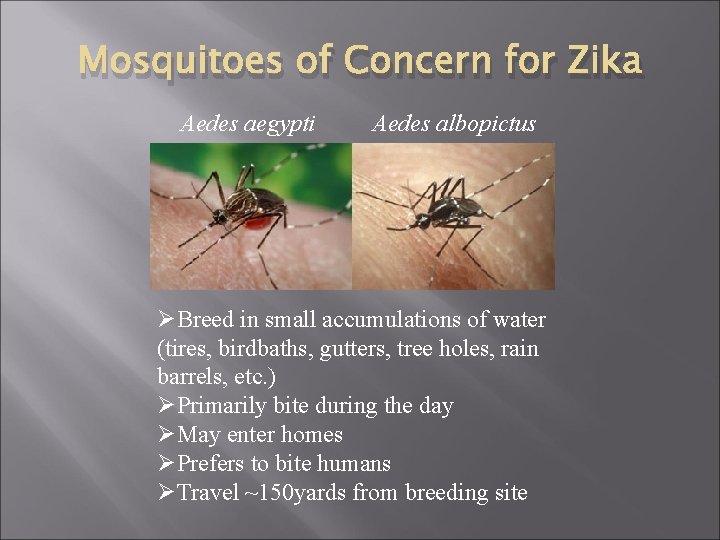
Mosquitoes of Concern for Zika Aedes aegypti Aedes albopictus ØBreed in small accumulations of water (tires, birdbaths, gutters, tree holes, rain barrels, etc. ) ØPrimarily bite during the day ØMay enter homes ØPrefers to bite humans ØTravel ~150 yards from breeding site
Zika Environmental Inspections Survey of the patient’s property. Look for small containers, kids toys, rubbish, or guttering that may be holding water. Empty or treat standing water. Take mosquito larval samples where possible. Identify harborage sites. Educate the patient on the environmental issues associated with Zika Virus: Use repellant, stay inside, wear long sleeves, and pants. What items should be removed or cleaned up.
Zika Environmental Inspections Place a mosquito surveillance trap in the patient’s yard Identify adult mosquitoes Test mosquitoes for the presence of the virus Place lethal ovitraps on property Treat harborage areas with a barrier treatment Perform surveys of the adjacent yards Empty water, treat water, take larval samples Conduct enforcement actions, if necessary Educate residents Barrier treat
Zika Virus Zika is a RNA virus Most RNA viruses have very high mutation rates Zika’s mutation rate is about 25 Substitutions per year Its genome is only about 10, 000 base pairs, this is mutation rate of rougly 2. 5 x 10 -3 * Mammal mutation rates are 10 -6 -10 -8 Slide adapted from seminar by Grayson Brown Ph. D, May 2017 http: //healthalerts. ky. gov/Pages/summit. aspx *Source: LOGAN IS. ZIKA-How fast does this virus mutate? Zoological Research. 2016; 37(2): 110 -115. doi: 10. 13918/j. issn. 2095 -8137. 2016. 2. 110.
Zika Virus A large number of people will have no symptoms or very mild symptoms Mild fever (56%) Rash (76%) Headache Joint pain (51%) Conjunctivitis (36%) Muscle pain Symptoms last several day to a week and rarely cause patients to seek medical attention Percentages based on data collected in Miami-Dade, information provided in seminar by Dr. Anna Likos, May 2017, n=1501 http: //healthalerts. ky. gov/Pages/summit. aspx
Zika Fetuses may become infected at any stage of pregnancy Zika virus in unborn children attacks central nervous tissue causing subcortical calcifications May lead to microcephaly, brain atrophy, brain asymmetry, etc. See: https: //www. cdc. gov/zika/hc-providers/infants-children/zika-syndrome-birthdefects. html May damage the back of the eye, causing macular scaring and focal pigment mottling. Congenital contractures (eg. Clubfoot or arthrogryposis). Hypertonia soon after birth.
Zika Of 267 infants delivered to mothers with Zika infection: 7 had congenital infections, and 6 had microcephaly or other neurological conditions. * Prior to Zika, microcephaly rates in US are 2 -12 live births per 10, 000. ** *Based on data collected in Miami-Dade, information provided in seminar by Dr. Anna Likos, May 2017 http: //healthalerts. ky. gov/Pages/summit. aspx **https: //www. cdc. gov/ncbddd/birthdefects/microcephaly. html
Zika Virus Confirmed to be vectored by Aedes aegypti and Aedes albopictus Confirmed to be passed to fetus from mother, during gestation or at the time of birth. No current reports of transmission via breast milk. Transmissible through sex. Transmissible before, during or after symptoms start. Asymptomatic individuals can still be infective. Zika virus is found in both vaginal fluids and semen but lasts longer in semen.
Zika Virus Transmissible via blood transfusion No reports in the US, but multiple reports in Brazil. Laboratory and Health Care exposure Prior to current outbreak, there were 4 reports of laboratory acquired infection, though route not clearly established. One case of laboratory-acquired Zika in U. S. To date, no confirmed cases of Zika transmission in healthcare settings: use universal precautions (PPE)
What does this mean for Physicians? Physicians may have to alter some of their intake questionnaires to help screen for at-risk patients. Are you pregnant or do you plan on becoming pregnant in the next year? Have you, your partner, or member of your household traveled outside of the US or to areas known to have local transmission of the Zika Virus (eg. Miami area)? If patients come in for travel vaccinations, discuss mosquito bite and Zika prevention information.
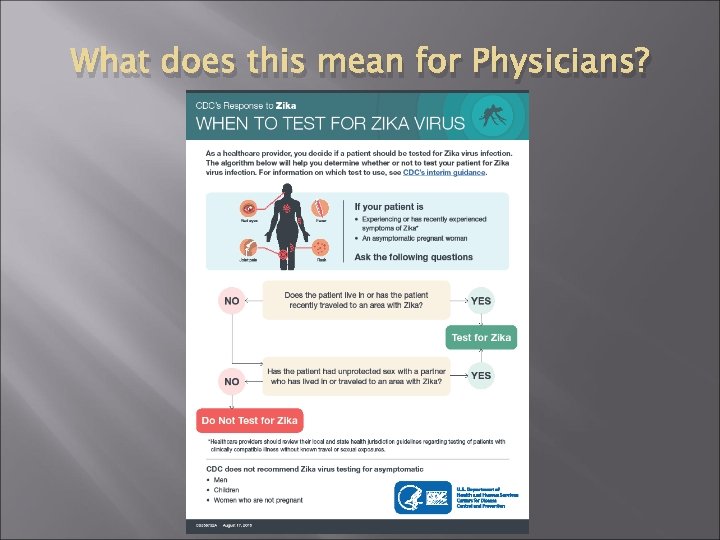
What does this mean for Physicians?
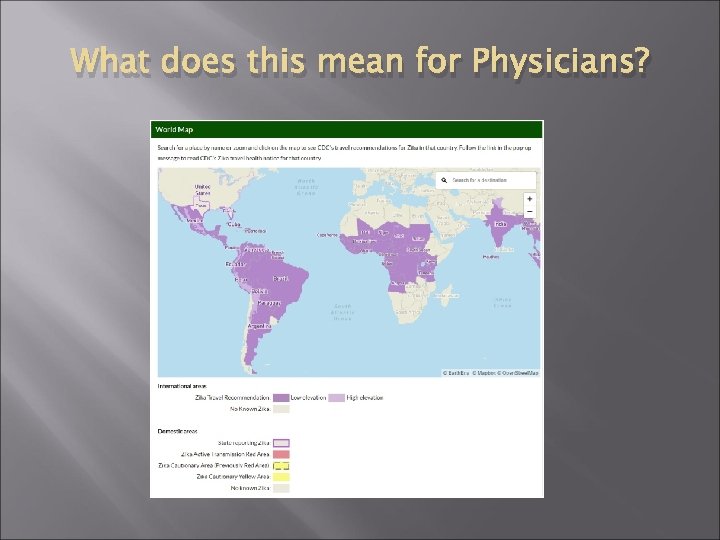
What does this mean for Physicians?
What does this mean for Physicians? Consider posting or handing out Zika information tailored for providers in your office. Review the CDC site regularly for changing protocols on when to recommend testing. https: //www. cdc. gov/zika/comm-resources/toolkits. html https: //www. cdc. gov/zika/hc-providers/testing-for-zikavirus. html Build a relationship with your local health department Communicable Disease program. Use universal precautions while treating patients.
“Dammit Jim, I’m a Doctor not a Environmentalist!” Begin the environmental message in your office Zika is primarily an environmentally acquired disease, but not in the strict sense: Aedes aegypti and Aedes albopictus are anthropophagic and anthropophilic, they vector the virus, but only fly 150 yards from their breeding site. People move the virus greater distances and serve as reservoir.
“Dammit Jim, I’m a Doctor not a Environmentalist!” Begin the environmental message in your office Zika is primarily an environmentally acquired disease, but not in the strict sense: If suspect and confirmed Zika patients begin removing the potential breeding sites in their yards, and use repellants so that mosquitoes are less likely to bite, they are protecting their neighbors and the public at large. Because there can be a significant lag between the test and the result, it is critical that patients avoid being bitten by mosquitoes prior to laboratory results.
“Dammit Jim, I’m a Doctor not a Environmentalist!” Control mosquitoes around the home: Plan for travel: https: //www. cdc. gov/zika/prevention/controlling-mosquitoes-at-home. html https: //www. cdc. gov/zika/prevention/plan-for-travel. html Protection during sex: https: //www. cdc. gov/zika/prevention/sexual-transmission-prevention. html
The Future of Mosquito Borne Disease Yellow fever is currently epidemic in Brazil. Vaccines stores are nearly depleted globally, and Senofi-Pasteur is no longer accepting orders. Mayaro Virus is currently circulating in the Caribbean and South America. Ae. aegypti and Ae. albopictus are potential vectors. Chikungunya Like symptoms https: //www. scientificamerican. com/article/the-next-zika/ Oropucha Virus—recent outbreaks in the South America affecting 500, 000 people, West Nile Virus-like symptoms.
Kentucky’s Preparedness for Zika Kentucky State Department of Health is building surveillance capacity, by: Acquiring surveillance materials, Assigning lead counties to perform mosquito surveillance for the counties in their region, Reviewing surveillance protocols, and modeling after CDC recommendations, Ensuring mosquito testing at state lab is ready, Barrier spraying of residences for confirmed Zika cases, as well as environmental surveys, and Extensively training environmental staff for surveillance and treatment.
Kentucky’s Preparedness for Zika Kentucky Department of Agriculture has mosquito fogging trucks to support KDH activities. Lexington-Fayette performs their own mosquito fogging and investigations. Louisville Metro performs their own: Surveillance, Investigations, home surveys, treatments, and Mosquito lab tests: Zika, WNV, SLE.
Questions? Matthew Vanderpool, RS, MS Louisville Metro Department of Public Health and Wellness Matthew. vanderpool@louisvilleky. gov 502 -574 -6650
- Slides: 31