
Louis Pasteur Germ Theory Beliefs about disease in
Louis Pasteur & Germ Theory
Beliefs about disease in 19 th Century • People knew there was a link between dirt and disease, but could not explain the link. • People explained disease as seeds bad seeds in the air known as miasma. • 1850 s &1860 s breakthrough in the cause of disease.
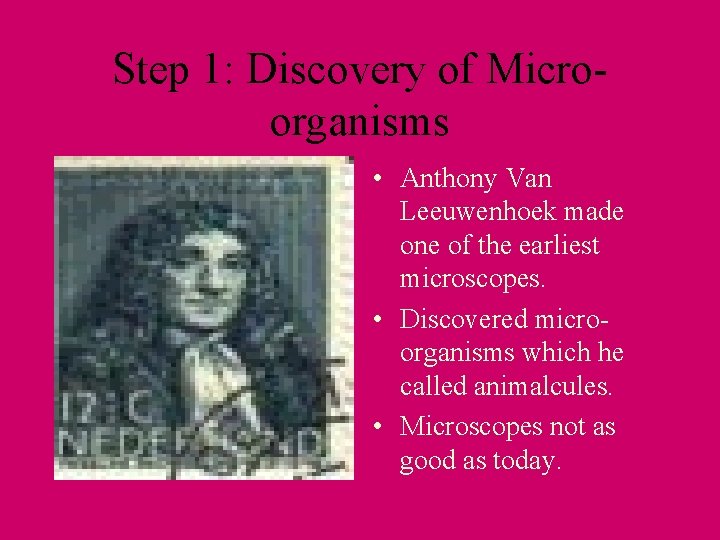
Step 1: Discovery of Microorganisms • Anthony Van Leeuwenhoek made one of the earliest microscopes. • Discovered microorganisms which he called animalcules. • Microscopes not as good as today.
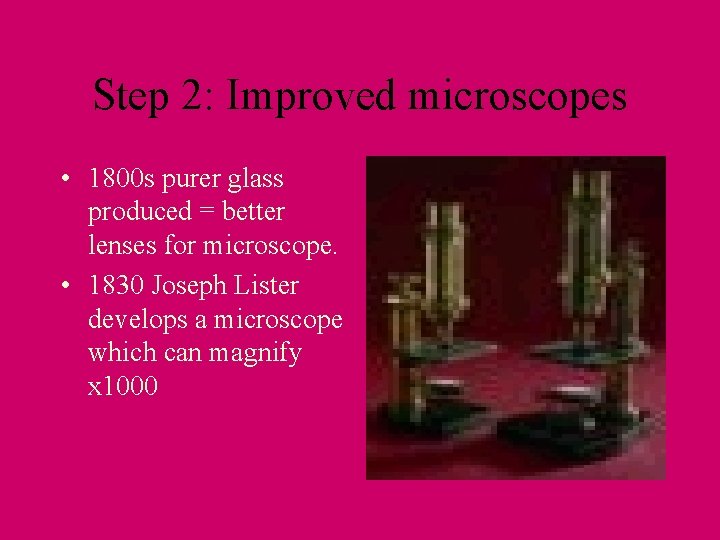
Step 2: Improved microscopes • 1800 s purer glass produced = better lenses for microscope. • 1830 Joseph Lister develops a microscope which can magnify x 1000
Step 3: Louis Pasteur’s germ theory • Old Theory: spontaneous generation – micro-organisms are the result of decaying matter. • New Theory: germ theory – micro-organisms cause decaying matter. – Pasteur showed you could kill the microorganisms by applying heat PASTEURISATION.
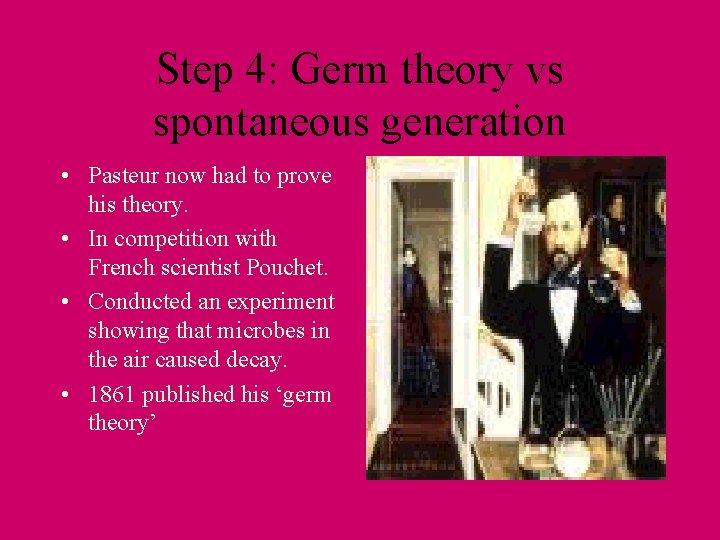
Step 4: Germ theory vs spontaneous generation • Pasteur now had to prove his theory. • In competition with French scientist Pouchet. • Conducted an experiment showing that microbes in the air caused decay. • 1861 published his ‘germ theory’
Step 5: Linking micro-organisms to disease • Pasteur showed micro-organisms made wine and beer go bad. • Could germs cause disease? • Another experiment! – Proved that a micro-organism was causing disease in silk worms.
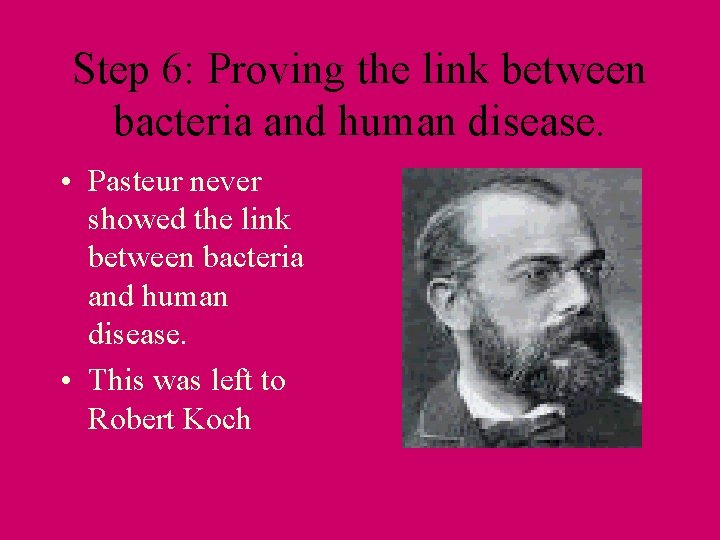
Step 6: Proving the link between bacteria and human disease. • Pasteur never showed the link between bacteria and human disease. • This was left to Robert Koch
Your Task You need to create a flow chart with the title 6 steps to discovering the causes of disease. Use the slides to help you. For each step you must explain how this helped to discover the cause of disease. You cannot use more then three sentences per step. Additional information can be found on p. 128 - 129 of the textbook.
This powerpoint was kindly donated to www. worldofteaching. com http: //www. worldofteaching. com is home to over a thousand powerpoints submitted by teachers. This is a completely free site and requires no registration. Please visit and I hope it will help in your teaching.
- Slides: 10