
Lossless Network Jun Liu johnliucisco com Lossy vs

- Slides: 15
Lossless Network Jun Liu (johnliu@cisco. com)
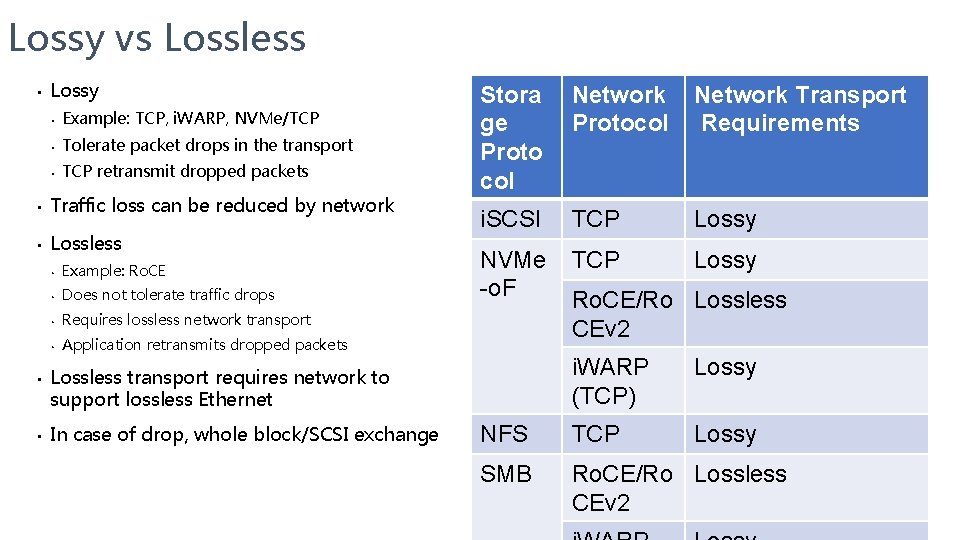
Lossy vs Lossless • Lossy • Example: TCP, i. WARP, NVMe/TCP • Tolerate packet drops in the transport • TCP retransmit dropped packets • Traffic loss can be reduced by network • Lossless • • • Example: Ro. CE • Does not tolerate traffic drops • Requires lossless network transport • Application retransmits dropped packets Stora ge Proto col Network Protocol Network Transport Requirements i. SCSI TCP Lossy NVMe -o. F TCP Lossy i. WARP (TCP) Lossy NFS TCP Lossy SMB Ro. CE/Ro Lossless CEv 2 Lossless transport requires network to support lossless Ethernet In case of drop, whole block/SCSI exchange Ro. CE/Ro Lossless CEv 2 2
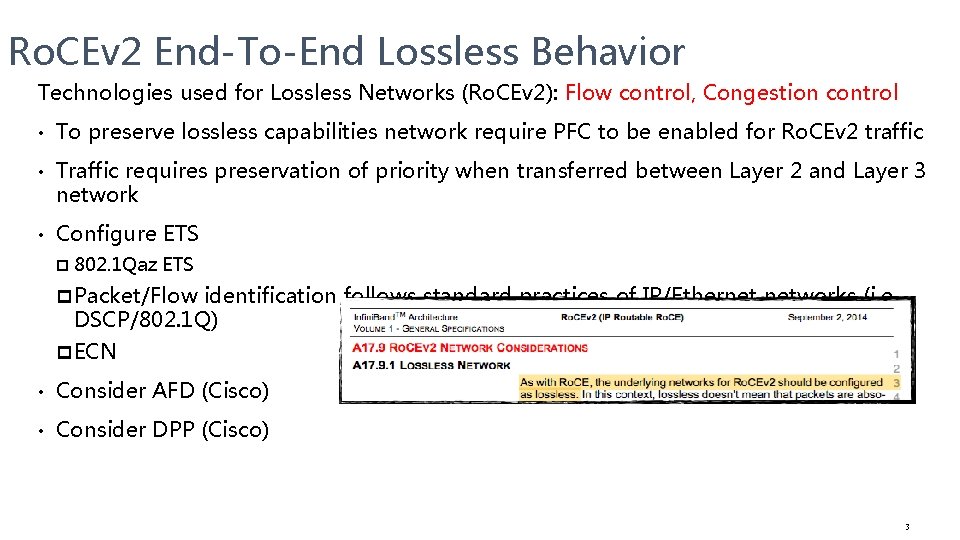
Ro. CEv 2 End-To-End Lossless Behavior Technologies used for Lossless Networks (Ro. CEv 2): Flow control, Congestion control • To preserve lossless capabilities network require PFC to be enabled for Ro. CEv 2 traffic • Traffic requires preservation of priority when transferred between Layer 2 and Layer 3 network • Configure ETS p 802. 1 Qaz ETS p Packet/Flow identification follows standard practices of IP/Ethernet networks (i. e. , DSCP/802. 1 Q) p ECN • Consider AFD (Cisco) • Consider DPP (Cisco) 3
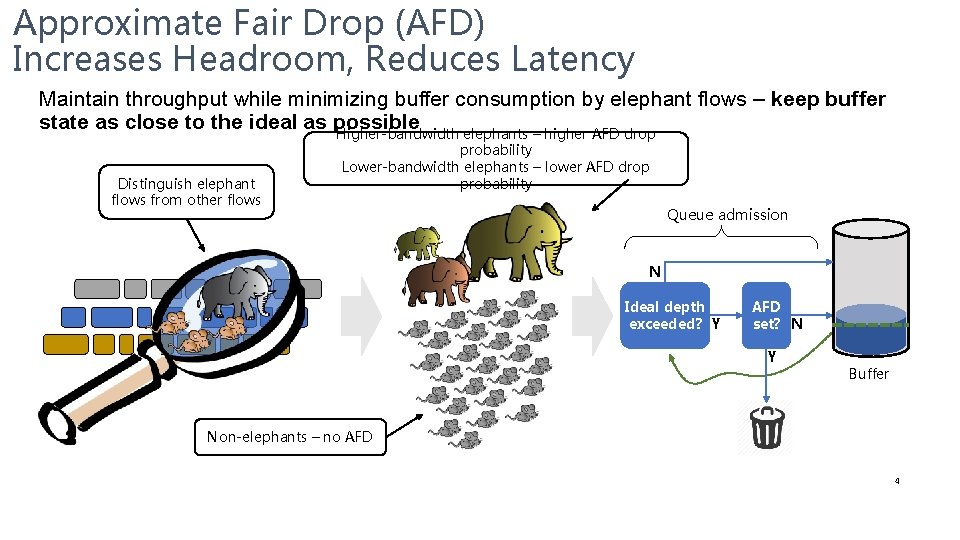
Approximate Fair Drop (AFD) Increases Headroom, Reduces Latency Maintain throughput while minimizing buffer consumption by elephant flows – keep buffer state as close to the ideal as possible Higher-bandwidth elephants – higher AFD drop Distinguish elephant flows from other flows probability Lower-bandwidth elephants – lower AFD drop probability Queue admission N Ideal depth exceeded? Y AFD set? N Y Buffer Non-elephants – no AFD 4
AFD Overview • AFD is an Active Queue Management (AQM) algorithm that acts on long lived large flows (elephant flows) in case of congestion and does not impact the short flows (mice flows). • As a result, improves flow based fairness, drops average queue occupancy and increases head-room for micro-bursts • Drop probability depends upon the arrival rate calculation of a flow at ingress. • In case of a congestion scenario, the AFD algorithm maintains the queue occupancy at the configured queue desired value by probabilistically dropping packets from the large elephant flows and not impacting small mice flows.
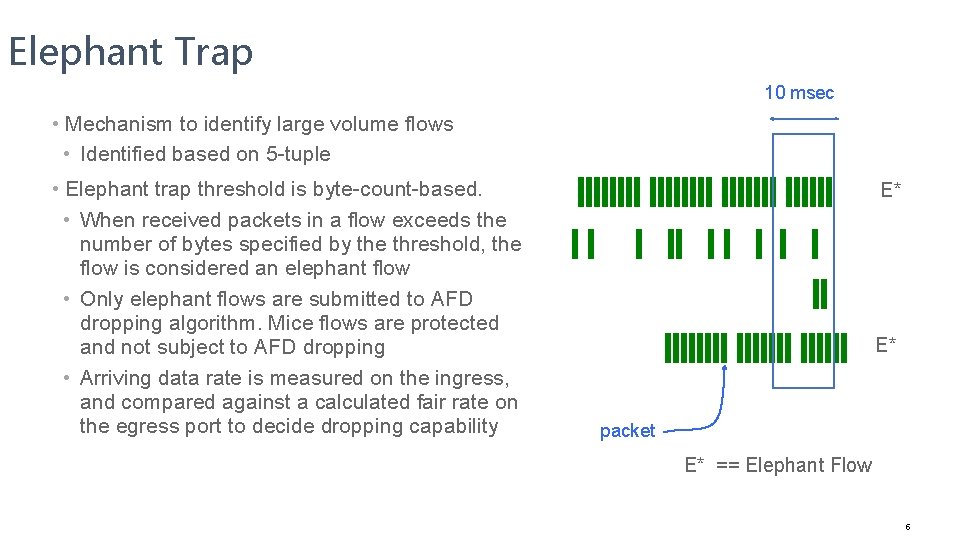
Elephant Trap 10 msec • Mechanism to identify large volume flows • Identified based on 5 -tuple • Elephant trap threshold is byte-count-based. • When received packets in a flow exceeds the number of bytes specified by the threshold, the flow is considered an elephant flow • Only elephant flows are submitted to AFD dropping algorithm. Mice flows are protected and not subject to AFD dropping • Arriving data rate is measured on the ingress, and compared against a calculated fair rate on the egress port to decide dropping capability E* E* packet E* == Elephant Flow 6
AFD Comparison to WRED • Both AFD and WRED are Active Queue Management algorithms. • In case of congestion, WRED computes a random drop probability and drops the packets indiscriminately across all the flows in a class of traffic. • AFD computes drop probability based on arrival rate of incoming flows, compares it with the computed fair rate and drops the packets from the elephant flows while not impacting the mice flows. • Recommended values for queue-desired for different port speeds: • 10 G: 150 kbytes • 40 G: 600 kbytes • 100 G: 1500 kbytes
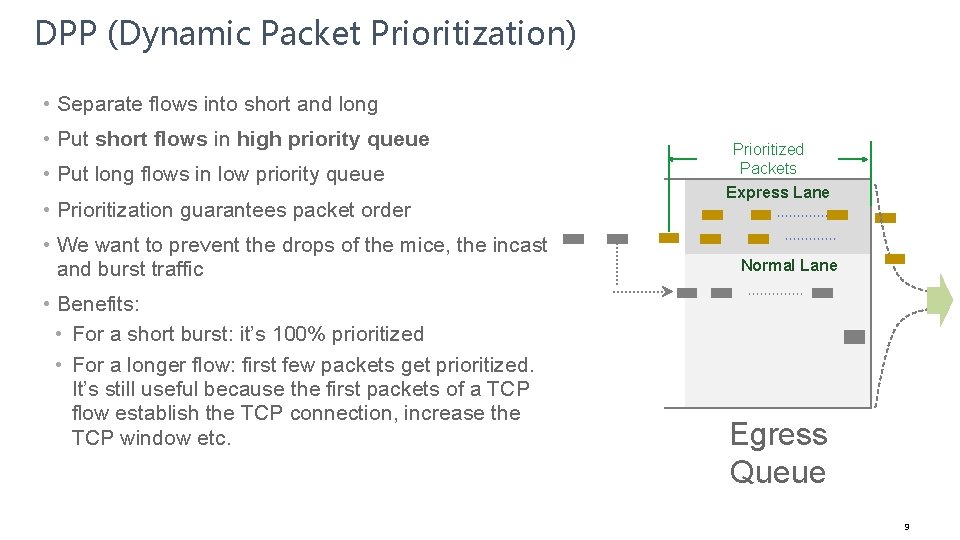
DPP Introduction • Thanks to AFD, mice flows (micro-bursts) can use the large buffer headroom. • But this is still within their original queue, which is typically not set a strict priority, since it holds all kinds of flows including elephant. • There’s also other queues that can have equal or higher priority to us. • DPP dynamically classifies the first packets of a mice flow into a strict priority queue.
DPP (Dynamic Packet Prioritization) • Separate flows into short and long • Put short flows in high priority queue • Put long flows in low priority queue • Prioritization guarantees packet order Prioritized Packets Express Lane • We want to prevent the drops of the mice, the incast and burst traffic Normal Lane • Benefits: • For a short burst: it’s 100% prioritized • For a longer flow: first few packets get prioritized. It’s still useful because the first packets of a TCP flow establish the TCP connection, increase the TCP window etc. Egress Queue 9
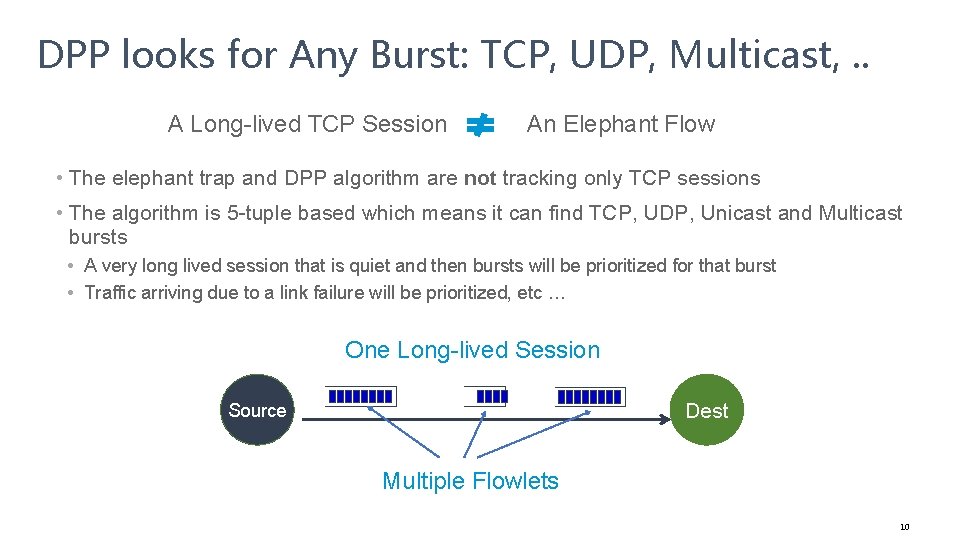
DPP looks for Any Burst: TCP, UDP, Multicast, . . A Long-lived TCP Session An Elephant Flow • The elephant trap and DPP algorithm are not tracking only TCP sessions • The algorithm is 5 -tuple based which means it can find TCP, UDP, Unicast and Multicast bursts • A very long lived session that is quiet and then bursts will be prioritized for that burst • Traffic arriving due to a link failure will be prioritized, etc … One Long-lived Session Dest Source Multiple Flowlets 10
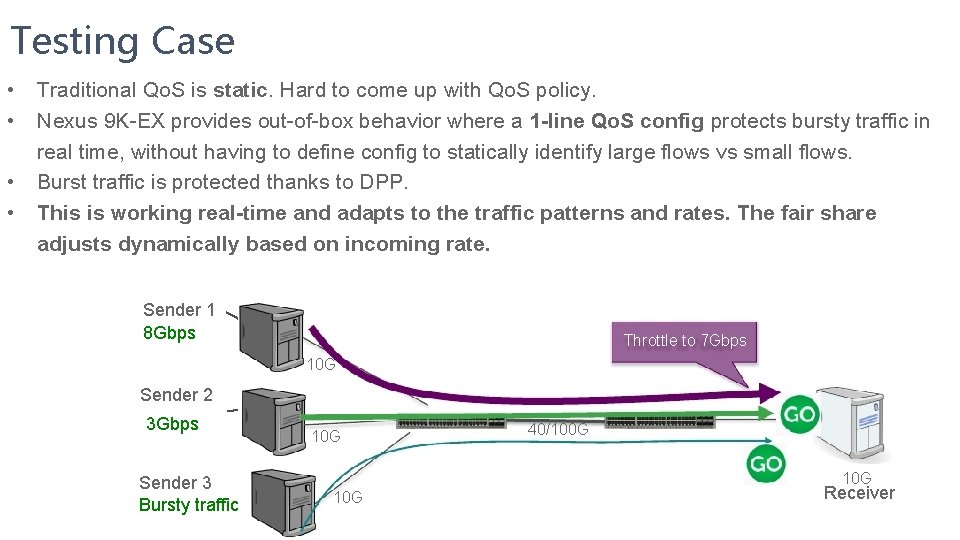
Testing Case • • Traditional Qo. S is static. Hard to come up with Qo. S policy. Nexus 9 K-EX provides out-of-box behavior where a 1 -line Qo. S config protects bursty traffic in real time, without having to define config to statically identify large flows vs small flows. Burst traffic is protected thanks to DPP. This is working real-time and adapts to the traffic patterns and rates. The fair share adjusts dynamically based on incoming rate. Sender 1 8 Gbps Throttle to 7 Gbps 10 G Sender 2 3 Gbps Sender 3 Bursty traffic 10 G 40/100 G 10 G Receiver
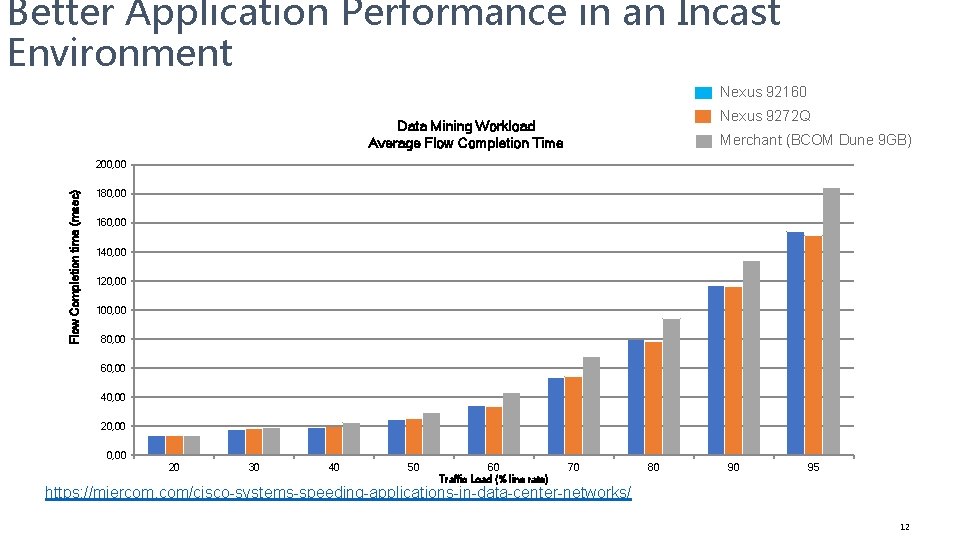
Better Application Performance in an Incast Environment Nexus 92160 Nexus 9272 Q Data Mining Workload Average Flow Completion Time Merchant (BCOM Dune 9 GB) Flow Completion time (msec) 200, 00 180, 00 160, 00 140, 00 120, 00 100, 00 80, 00 60, 00 40, 00 20, 00 20 30 40 50 60 Traffic Load (% line rate) 70 80 90 95 https: //miercom. com/cisco-systems-speeding-applications-in-data-center-networks/ 12
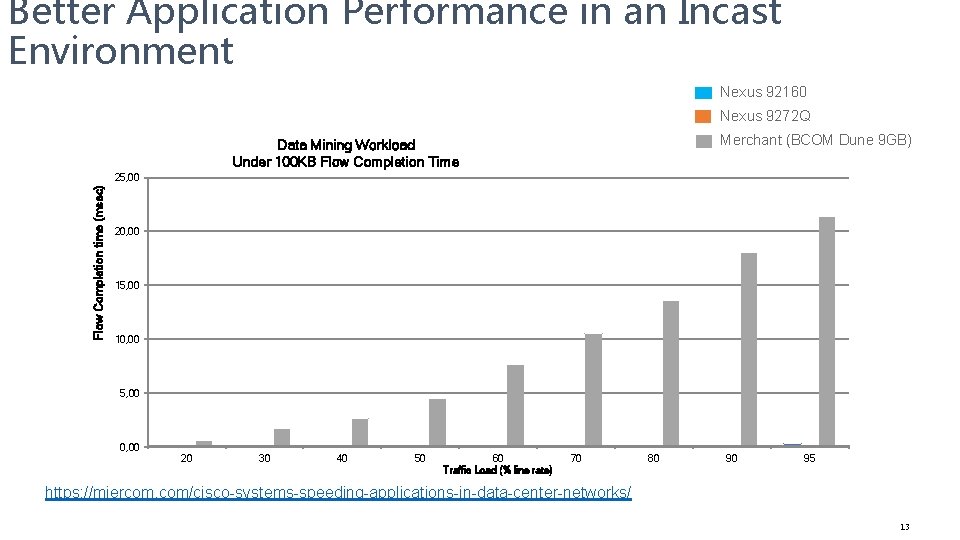
Better Application Performance in an Incast Environment Nexus 92160 Nexus 9272 Q Merchant (BCOM Dune 9 GB) Data Mining Workload Under 100 KB Flow Completion Time Flow Completion time (msec) 25, 00 20, 00 15, 00 10, 00 5, 00 0, 00 20 30 40 50 60 Traffic Load (% line rate) 70 80 90 95 https: //miercom. com/cisco-systems-speeding-applications-in-data-center-networks/ 13
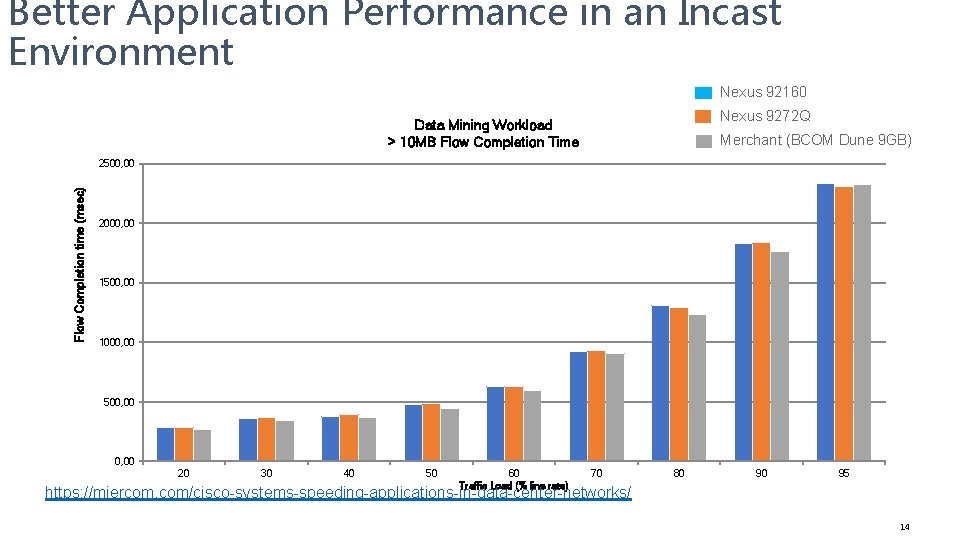
Better Application Performance in an Incast Environment Nexus 92160 Nexus 9272 Q Data Mining Workload > 10 MB Flow Completion Time Merchant (BCOM Dune 9 GB) Flow Completion time (msec) 2500, 00 2000, 00 1500, 00 1000, 00 500, 00 20 30 40 50 60 Traffic Load (% line rate) 70 80 90 95 https: //miercom. com/cisco-systems-speeding-applications-in-data-center-networks/ 14
Thank you!