
Loss Reserve Variability Using DFA Approaches Casualty Loss
Loss Reserve Variability Using DFA Approaches Casualty Loss Reserve Seminar September 19, 2000 Minneapolis
Loss Reserves in DFA Speakers – Chuck Emma, Paratus Consulting Limited Basic reserve modeling for unanticipated inflation – Susan Witcraft, Milliman & Robertson Modeling non-inflation variability – Nylesh Shah, Price. Waterhouse Coopers, LLP Reserve risk factor analysis
Basic Reserve Modeling Overview General Concepts Basic Illustration of Reserve Variability – Randomness in future loss payouts – Unanticipated inflation
Basic Reserve Modeling General Concepts Which reserve elements to model? – payment dollars – payout percentages Which risk factors to model? – economic inflation – social inflation – extra-normal shifts Best Estimates vs. Recorded Reserves
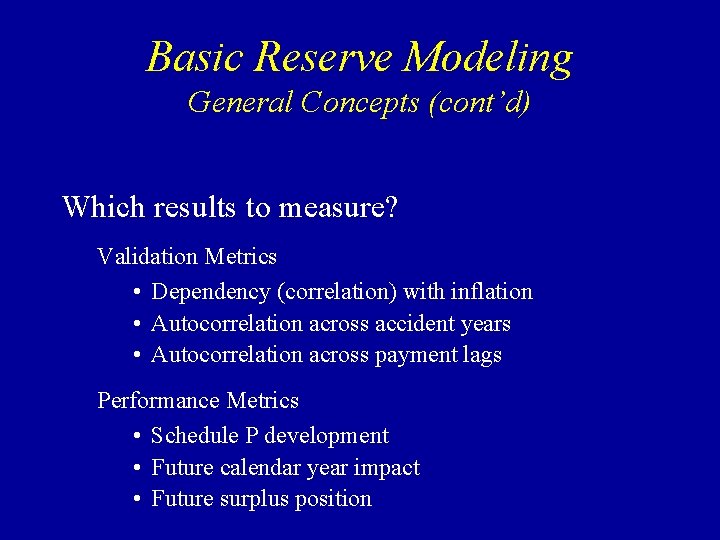
Basic Reserve Modeling General Concepts (cont’d) Which results to measure? Validation Metrics • Dependency (correlation) with inflation • Autocorrelation across accident years • Autocorrelation across payment lags Performance Metrics • Schedule P development • Future calendar year impact • Future surplus position

Basic Reserve Modeling Illustration Notion Future loss payments (reserves) vary, relative to a-priori expectations, due to two drivers: • Unexpected inflation • Pure randomness Loss Reserve Development = (A-Priori Loss Payments) – (Generated Loss Payments)
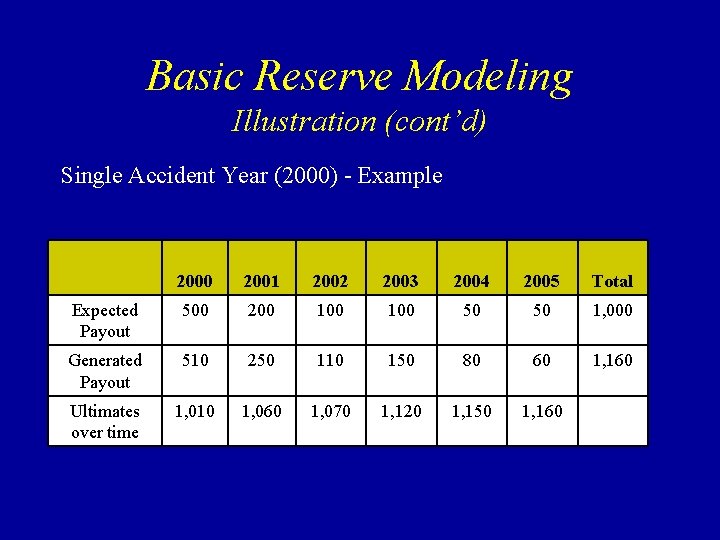
Basic Reserve Modeling Illustration (cont’d) Single Accident Year (2000) - Example 2000 2001 2002 2003 2004 2005 Total Expected Payout 500 200 100 50 50 1, 000 Generated Payout 510 250 110 150 80 60 1, 160 Ultimates over time 1, 010 1, 060 1, 070 1, 120 1, 150 1, 160
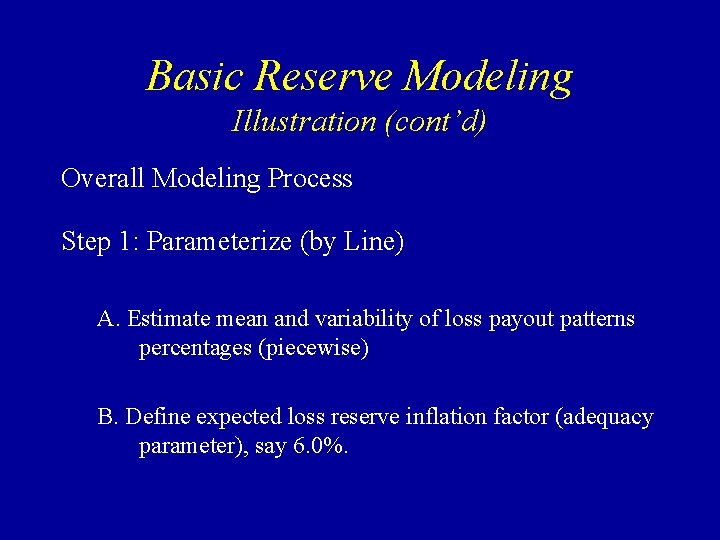
Basic Reserve Modeling Illustration (cont’d) Overall Modeling Process Step 1: Parameterize (by Line) A. Estimate mean and variability of loss payout patterns percentages (piecewise) B. Define expected loss reserve inflation factor (adequacy parameter), say 6. 0%.
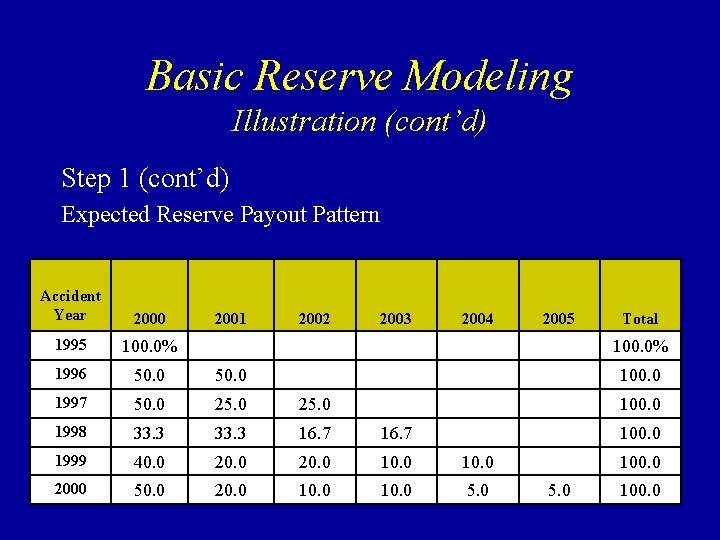
Basic Reserve Modeling Illustration (cont’d) Step 1 (cont’d) Expected Reserve Payout Pattern Accident Year 2000 1995 100. 0% 1996 50. 0 1997 50. 0 25. 0 1998 33. 3 16. 7 1999 40. 0 20. 0 10. 0 2000 50. 0 20. 0 10. 0 5. 0 2001 2002 2003 2004 2005 Total 100. 0% 100. 0 5. 0 100. 0
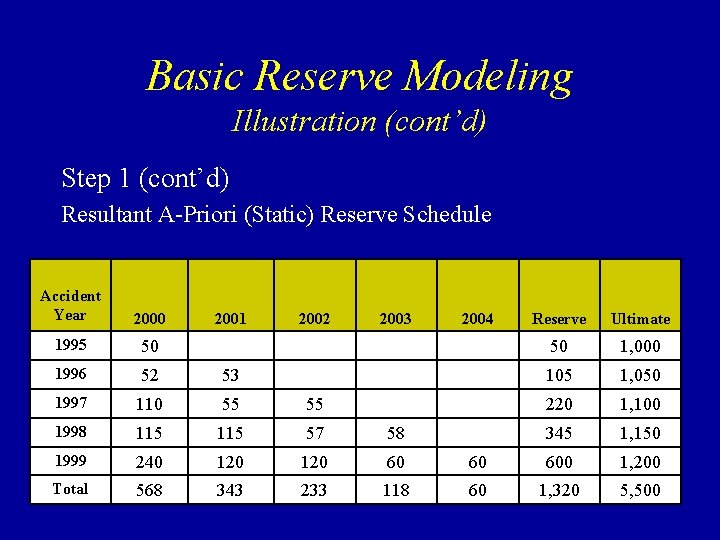
Basic Reserve Modeling Illustration (cont’d) Step 1 (cont’d) Resultant A-Priori (Static) Reserve Schedule Accident Year 2000 1995 50 1996 52 53 1997 110 55 55 1998 115 57 58 1999 240 120 60 Total 568 343 233 118 2001 2002 2003 2004 Reserve Ultimate 50 1, 000 105 1, 050 220 1, 100 345 1, 150 60 600 1, 200 60 1, 320 5, 500
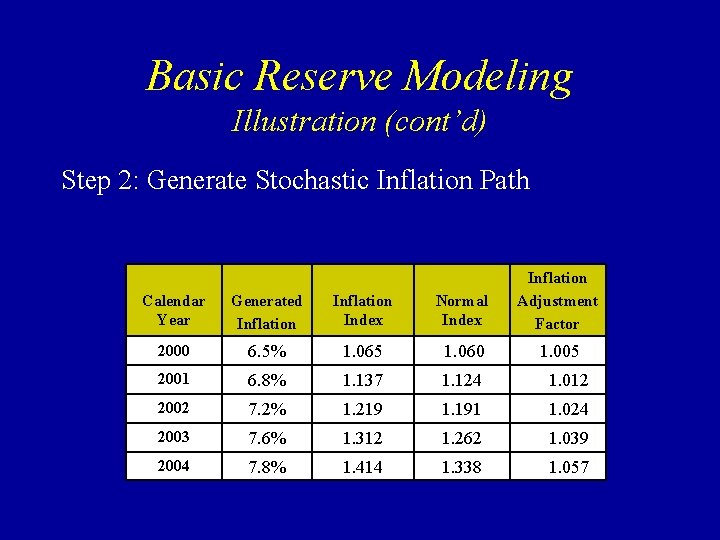
Basic Reserve Modeling Illustration (cont’d) Step 2: Generate Stochastic Inflation Path Calendar Year Generated Inflation Index Normal Index Inflation Adjustment Factor 2000 6. 5% 1. 065 1. 060 1. 005 2001 6. 8% 1. 137 1. 124 1. 012 2002 7. 2% 1. 219 1. 191 1. 024 2003 7. 6% 1. 312 1. 262 1. 039 2004 7. 8% 1. 414 1. 338 1. 057
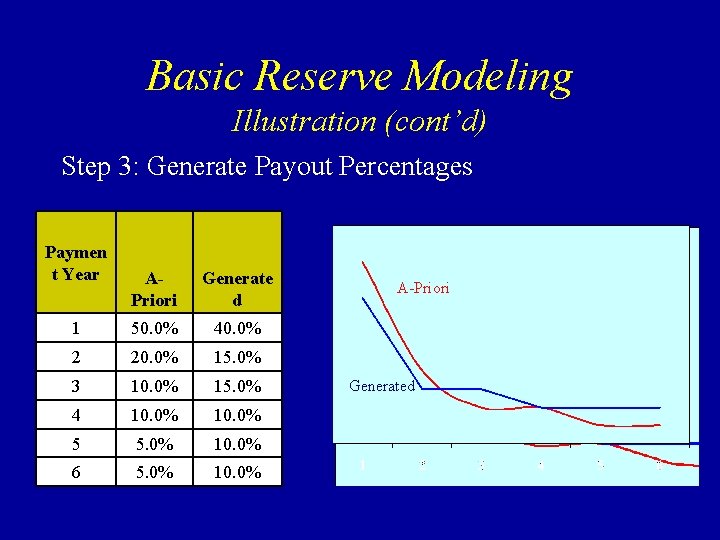
Basic Reserve Modeling Illustration (cont’d) Step 3: Generate Payout Percentages Paymen t Year APriori Generate d 1 50. 0% 40. 0% 2 20. 0% 15. 0% 3 10. 0% 15. 0% 4 10. 0% 5 5. 0% 10. 0% 6 5. 0% 10. 0% A-Priori Generated
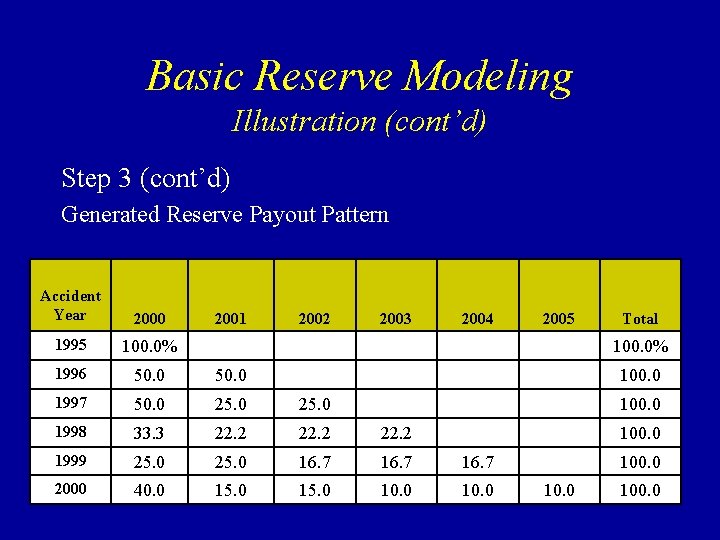
Basic Reserve Modeling Illustration (cont’d) Step 3 (cont’d) Generated Reserve Payout Pattern Accident Year 2000 1995 100. 0% 1996 50. 0 1997 50. 0 25. 0 1998 33. 3 22. 2 1999 25. 0 16. 7 2000 40. 0 15. 0 10. 0 2001 2002 2003 2004 2005 Total 100. 0% 100. 0 100. 0
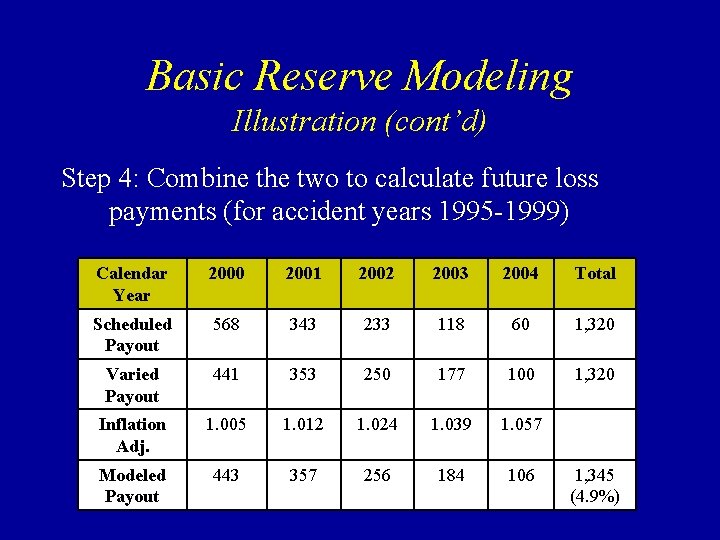
Basic Reserve Modeling Illustration (cont’d) Step 4: Combine the two to calculate future loss payments (for accident years 1995 -1999) Calendar Year 2000 2001 2002 2003 2004 Total Scheduled Payout 568 343 233 118 60 1, 320 Varied Payout 441 353 250 177 100 1, 320 Inflation Adj. 1. 005 1. 012 1. 024 1. 039 1. 057 Modeled Payout 443 357 256 184 106 1, 345 (4. 9%)
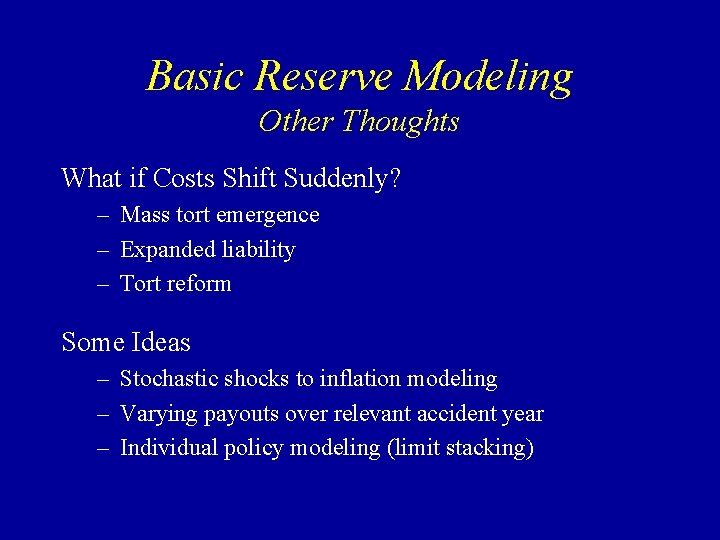
Basic Reserve Modeling Other Thoughts What if Costs Shift Suddenly? – Mass tort emergence – Expanded liability – Tort reform Some Ideas – Stochastic shocks to inflation modeling – Varying payouts over relevant accident year – Individual policy modeling (limit stacking)
- Slides: 15