
Los Tiempos de los Verbos ESPAOL 3 Seora
Los Tiempos de los Verbos ESPAÑOL 3 Señora Wagstaff
Directions • Go through the slides as a mini quiz. On a sheet of paper, write your answers • Each tense will ask “what does present tense mean to you? ” Use the verb phrase “lavarse las manos “ to create examples • Use the arrows on the keyboard to take the quiz at your own pace
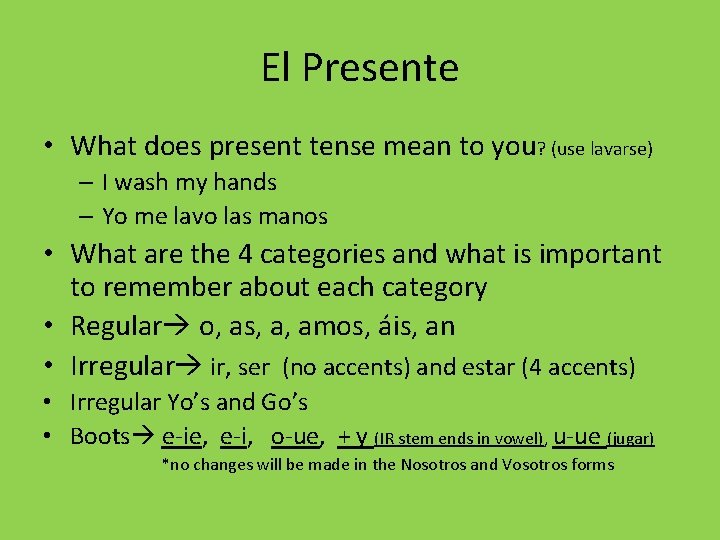
El Presente • What does present tense mean to you? (use lavarse) – I wash my hands – Yo me lavo las manos • What are the 4 categories and what is important to remember about each category • Regular o, as, a, amos, áis, an • Irregular ir, ser (no accents) and estar (4 accents) • Irregular Yo’s and Go’s • Boots e-ie, e-i, o-ue, + y (IR stem ends in vowel), u-ue (jugar) *no changes will be made in the Nosotros and Vosotros forms
El Futuro Simple • What does “simple future” mean to you – What your “going to do” – I am going to wash my hands – Yo voy a lavarme las manos • What is the formula for simple future? – Ir a + infintive
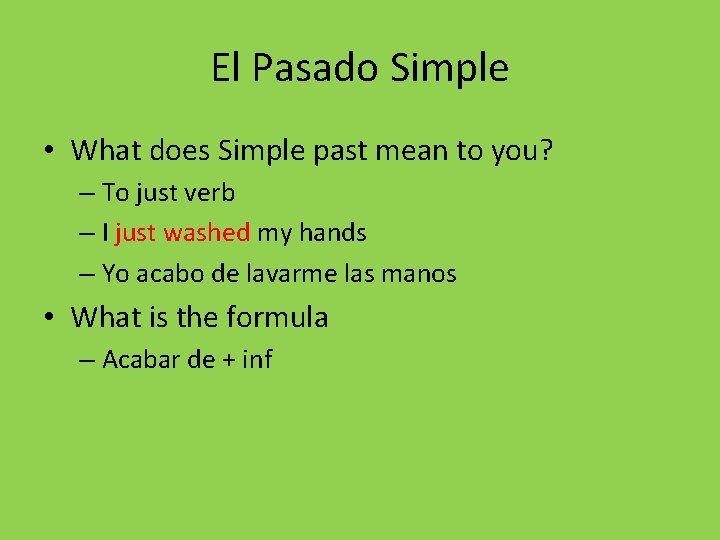
El Pasado Simple • What does Simple past mean to you? – To just verb – I just washed my hands – Yo acabo de lavarme las manos • What is the formula – Acabar de + inf
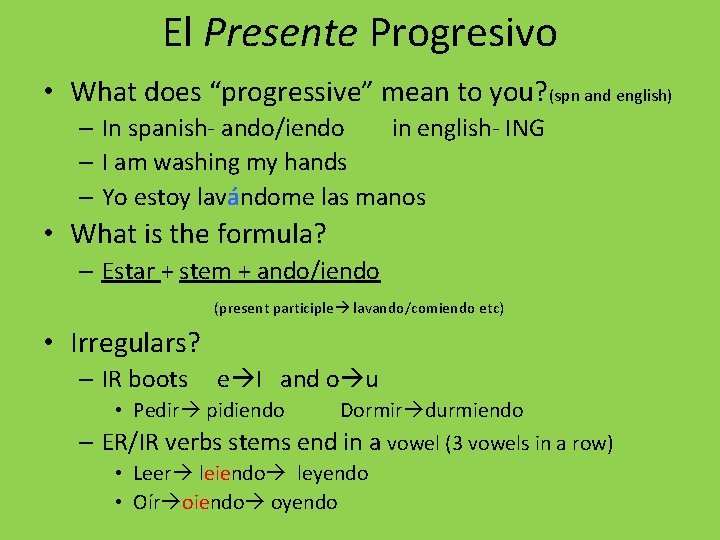
El Presente Progresivo • What does “progressive” mean to you? (spn and english) – In spanish- ando/iendo in english- ING – I am washing my hands – Yo estoy lavándome las manos • What is the formula? – Estar + stem + ando/iendo (present participle lavando/comiendo etc) • Irregulars? – IR boots e I and o u • Pedir pidiendo Dormir durmiendo – ER/IR verbs stems end in a vowel (3 vowels in a row) • Leer leiendo leyendo • Oír oiendo oyendo
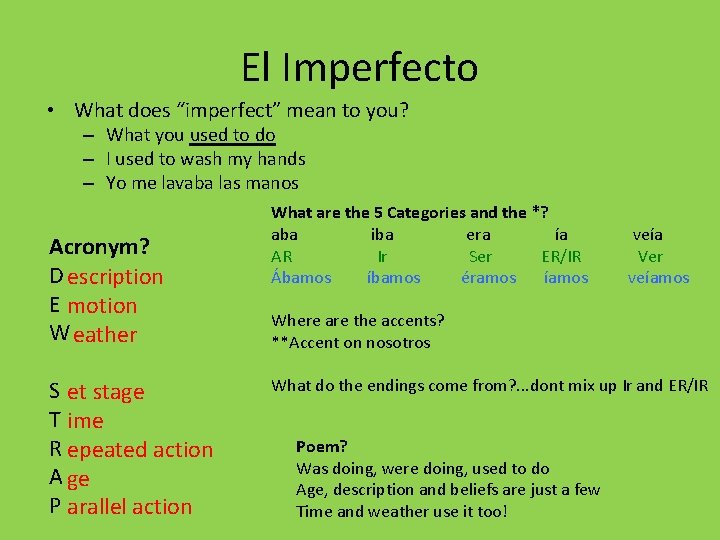
El Imperfecto • What does “imperfect” mean to you? – What you used to do – I used to wash my hands – Yo me lavaba las manos Acronym? D escription E motion W eather S et stage T ime R epeated action A ge P arallel action What are the 5 Categories and the *? aba iba era ía AR Ir Ser ER/IR Ábamos íbamos éramos íamos veía Ver veíamos Where are the accents? **Accent on nosotros What do the endings come from? . . . dont mix up Ir and ER/IR Poem? Was doing, were doing, used to do Age, description and beliefs are just a few Time and weather use it too!
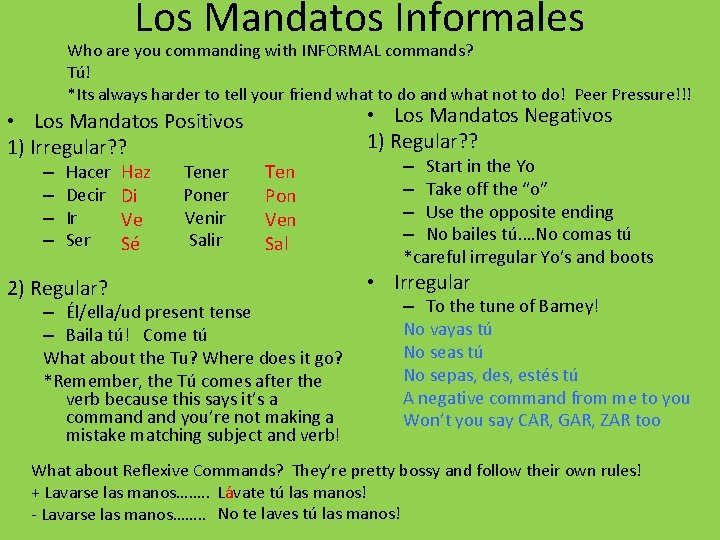
Los Mandatos Informales Who are you commanding with INFORMAL commands? Tú! *Its always harder to tell your friend what to do and what not to do! Peer Pressure!!! • Los Mandatos Positivos 1) Irregular? ? – – Hacer Decir Ir Ser 2) Regular? Haz Di Ve Sé Tener Poner Venir Salir • Los Mandatos Negativos 1) Regular? ? Ten Pon Ven Sal – Él/ella/ud present tense – Baila tú! Come tú What about the Tu? Where does it go? *Remember, the Tú comes after the verb because this says it’s a command you’re not making a mistake matching subject and verb! – Start in the Yo – Take off the “o” – Use the opposite ending – No bailes tú…. No comas tú *careful irregular Yo’s and boots • Irregular – To the tune of Barney! No vayas tú No sepas, des, estés tú A negative command from me to you Won’t you say CAR, GAR, ZAR too What about Reflexive Commands? They’re pretty bossy and follow their own rules! + Lavarse las manos……. . Lávate tú las manos! - Lavarse las manos……. . No te laves tú las manos!
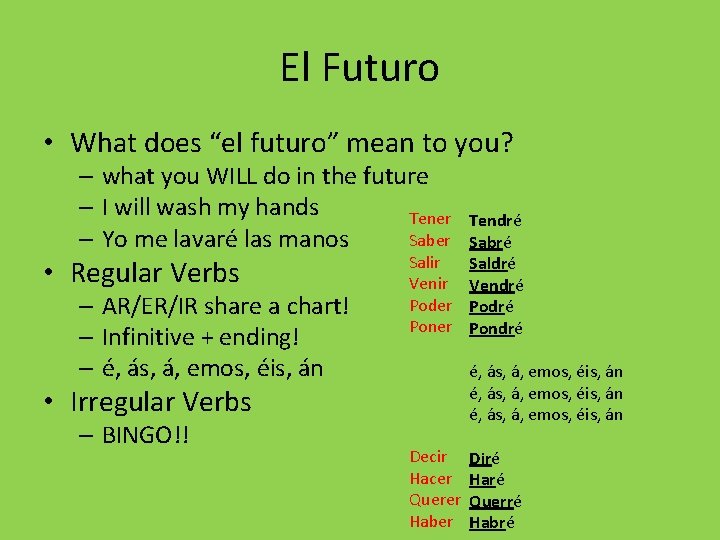
El Futuro • What does “el futuro” mean to you? – what you WILL do in the future – I will wash my hands Tener Saber – Yo me lavaré las manos • Regular Verbs – AR/ER/IR share a chart! – Infinitive + ending! – é, ás, á, emos, éis, án Tendré Sabré Salir Saldré Venir Vendré Poder Podré Poner Pondré é, ás, á, emos, éis, án • Irregular Verbs – BINGO!! Decir Hacer Querer Haber Diré Haré Querré Habré
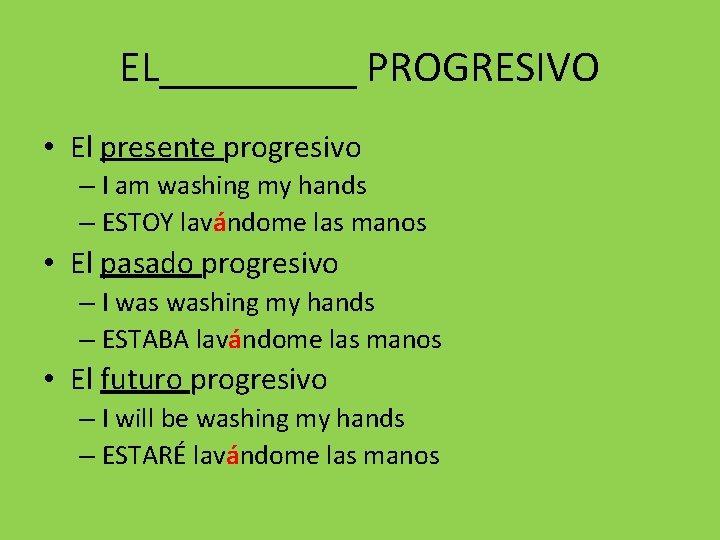
EL_____ PROGRESIVO • El presente progresivo – I am washing my hands – ESTOY lavándome las manos • El pasado progresivo – I washing my hands – ESTABA lavándome las manos • El futuro progresivo – I will be washing my hands – ESTARÉ lavándome las manos
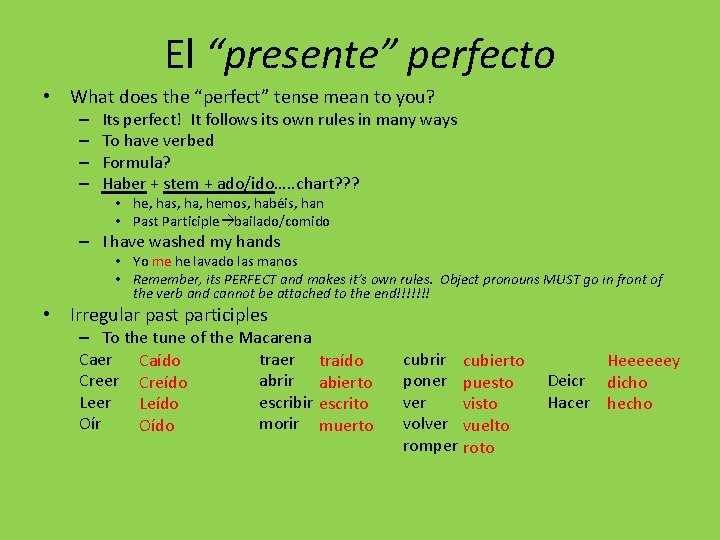
El “presente” perfecto • What does the “perfect” tense mean to you? – – Its perfect! It follows its own rules in many ways To have verbed Formula? Haber + stem + ado/ido…. . chart? ? ? • he, has, ha, hemos, habéis, han • Past Participle bailado/comido – I have washed my hands • Yo me he lavado las manos • Remember, its PERFECT and makes it’s own rules. Object pronouns MUST go in front of the verb and cannot be attached to the end!!!!!!! • Irregular past participles – To the tune of the Macarena Caer Caído traer Creído abrir Leer escribir Leído Oír morir Oído traído abierto escrito muerto cubrir cubierto poner puesto ver visto volver vuelto romper roto Heeeeeey Deicr dicho Hacer hecho
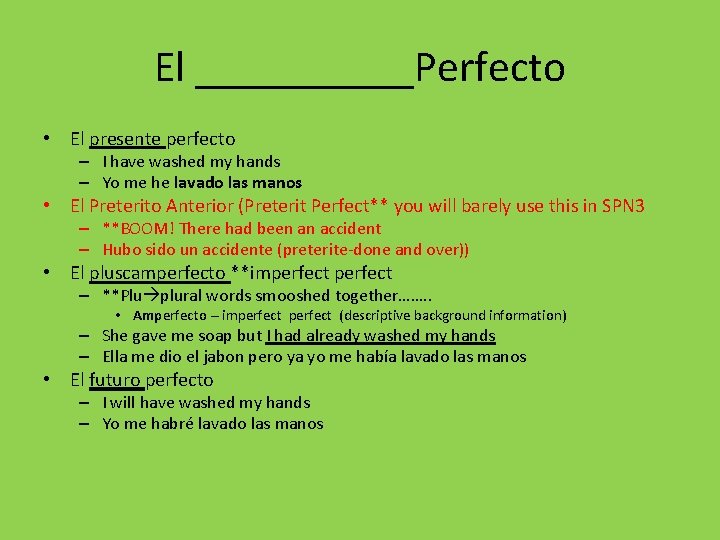
El _____Perfecto • El presente perfecto – I have washed my hands – Yo me he lavado las manos • El Preterito Anterior (Preterit Perfect** you will barely use this in SPN 3 – **BOOM! There had been an accident – Hubo sido un accidente (preterite-done and over)) • El pluscamperfecto **imperfect – **Plu plural words smooshed together……. . • Amperfecto -- imperfect (descriptive background information) – She gave me soap but I had already washed my hands – Ella me dio el jabon pero ya yo me había lavado las manos • El futuro perfecto – I will have washed my hands – Yo me habré lavado las manos
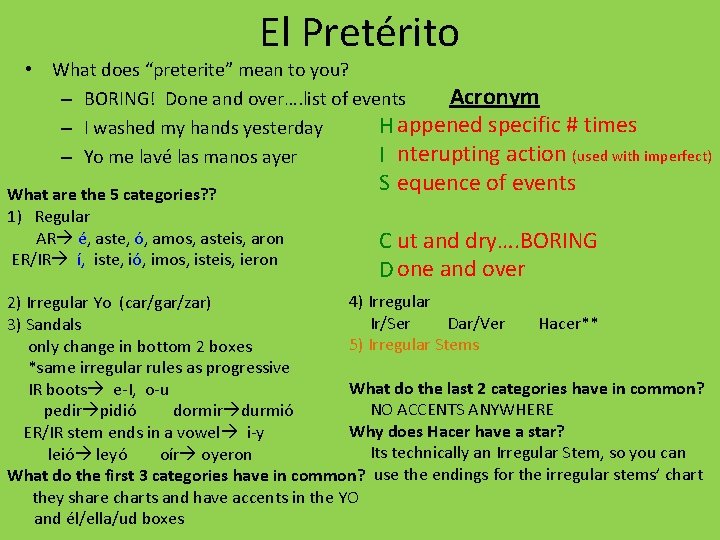
El Pretérito • What does “preterite” mean to you? Acronym – BORING! Done and over…. list of events H appened specific # times – I washed my hands yesterday I nterupting action (used with imperfect) – Yo me lavé las manos ayer What are the 5 categories? ? 1) Regular AR é, aste, ó, amos, asteis, aron ER/IR í, iste, ió, imos, isteis, ieron S equence of events C ut and dry…. BORING D one and over 4) Irregular 2) Irregular Yo (car/gar/zar) Ir/Ser Dar/Ver Hacer** 3) Sandals 5) Irregular Stems only change in bottom 2 boxes *same irregular rules as progressive What do the last 2 categories have in common? IR boots e-I, o-u NO ACCENTS ANYWHERE pedir pidió dormir durmió Why does Hacer have a star? ER/IR stem ends in a vowel i-y Its technically an Irregular Stem, so you can leió leyó oír oyeron What do the first 3 categories have in common? use the endings for the irregular stems’ chart they share charts and have accents in the YO and él/ella/ud boxes
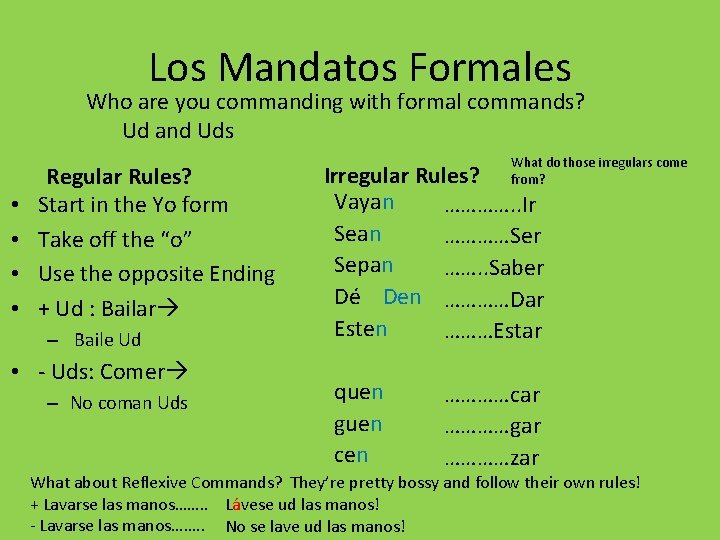
Los Mandatos Formales Who are you commanding with formal commands? Ud and Uds • • Regular Rules? Start in the Yo form Take off the “o” Use the opposite Ending + Ud : Bailar – Baile Ud • - Uds: Comer – No coman Uds What do those irregulars come from? Irregular Rules? Vayan …………. . Ir Sean …………Ser Sepan ……. . Saber Dé Den …………Dar Esten ………Estar quen guen cen …………car …………gar …………zar What about Reflexive Commands? They’re pretty bossy and follow their own rules! + Lavarse las manos……. . Lávese ud las manos! - Lavarse las manos……. . No se lave ud las manos!
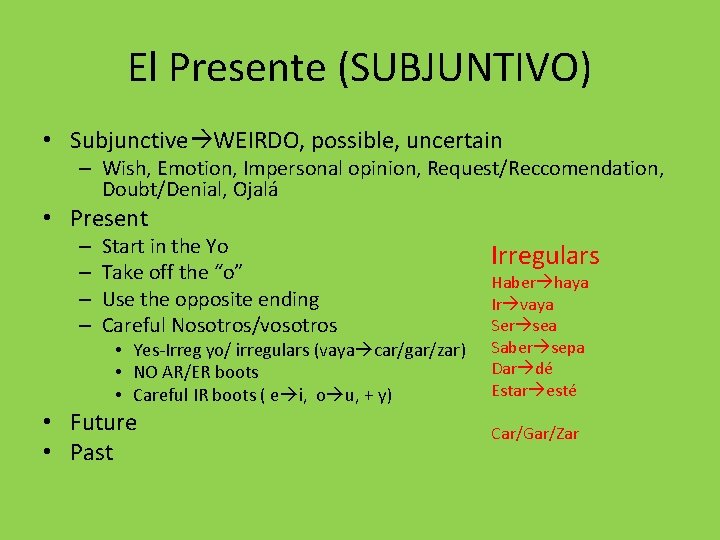
El Presente (SUBJUNTIVO) • Subjunctive WEIRDO, possible, uncertain – Wish, Emotion, Impersonal opinion, Request/Reccomendation, Doubt/Denial, Ojalá • Present – – Start in the Yo Take off the “o” Use the opposite ending Careful Nosotros/vosotros • Yes-Irreg yo/ irregulars (vaya car/gar/zar) • NO AR/ER boots • Careful IR boots ( e i, o u, + y) • Future • Past Irregulars Haber haya Ir vaya Ser sea Saber sepa Dar dé Estar esté Car/Gar/Zar
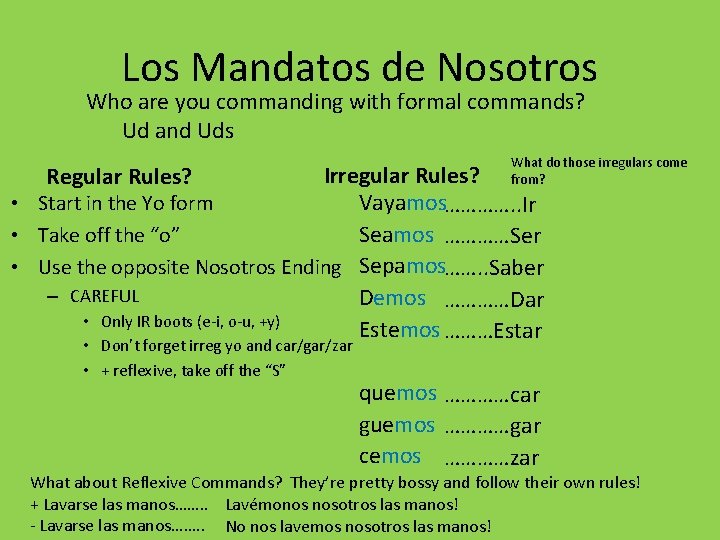
Los Mandatos de Nosotros Who are you commanding with formal commands? Ud and Uds What do those irregulars come from? Irregular Rules? Vayamos…………. . Ir • Start in the Yo form Seamos …………Ser • Take off the “o” • Use the opposite Nosotros Ending Sepamos……. . Saber – CAREFUL Demos …………Dar • Only IR boots (e-i, o-u, +y) Estemos ………Estar Regular Rules? • Don’t forget irreg yo and car/gar/zar • + reflexive, take off the “S” quemos …………car guemos …………gar cemos …………zar What about Reflexive Commands? They’re pretty bossy and follow their own rules! + Lavarse las manos……. . Lavémonos nosotros las manos! - Lavarse las manos……. . No nos lavemos nosotros las manos!
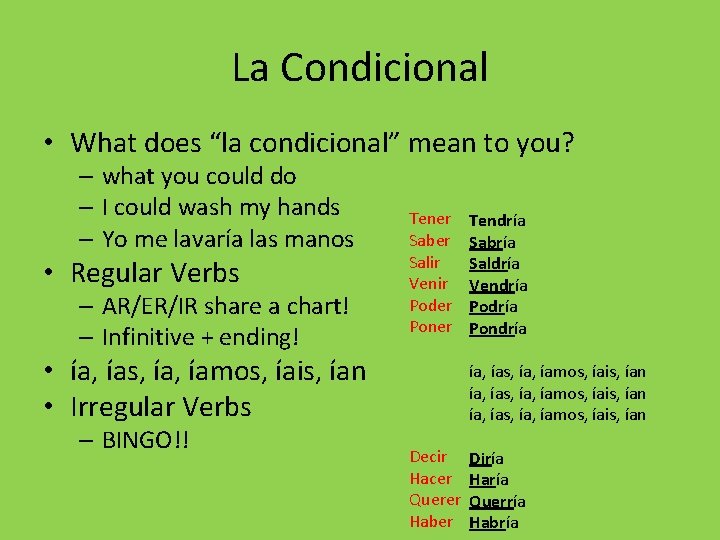
La Condicional • What does “la condicional” mean to you? – what you could do – I could wash my hands – Yo me lavaría las manos • Regular Verbs – AR/ER/IR share a chart! – Infinitive + ending! Tener Saber Salir Venir Poder Poner • ía, ías, íamos, íais, ían • Irregular Verbs – BINGO!! Tendría Sabría Saldría Vendría Pondría ía, ías, ía, íamos, íais, ían ía, ías, íamos, íais, ían Decir Hacer Querer Haber Diría Haría Querría Habría
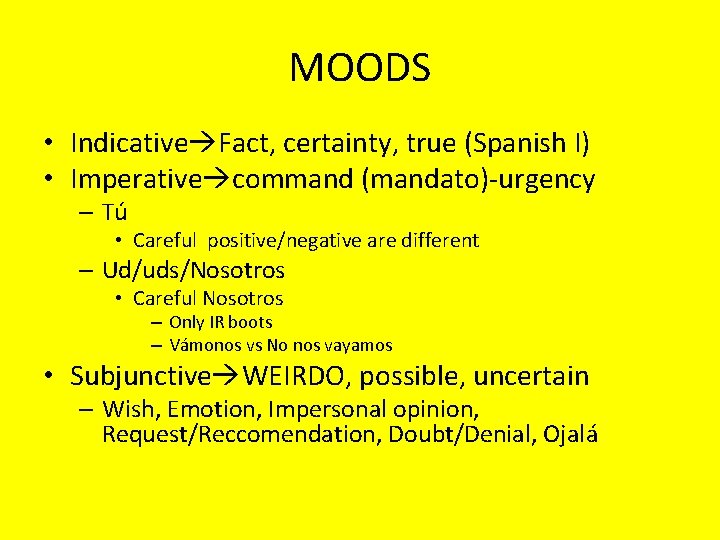
MOODS • Indicative Fact, certainty, true (Spanish I) • Imperative command (mandato)-urgency – Tú • Careful positive/negative are different – Ud/uds/Nosotros • Careful Nosotros – Only IR boots – Vámonos vs No nos vayamos • Subjunctive WEIRDO, possible, uncertain – Wish, Emotion, Impersonal opinion, Request/Reccomendation, Doubt/Denial, Ojalá
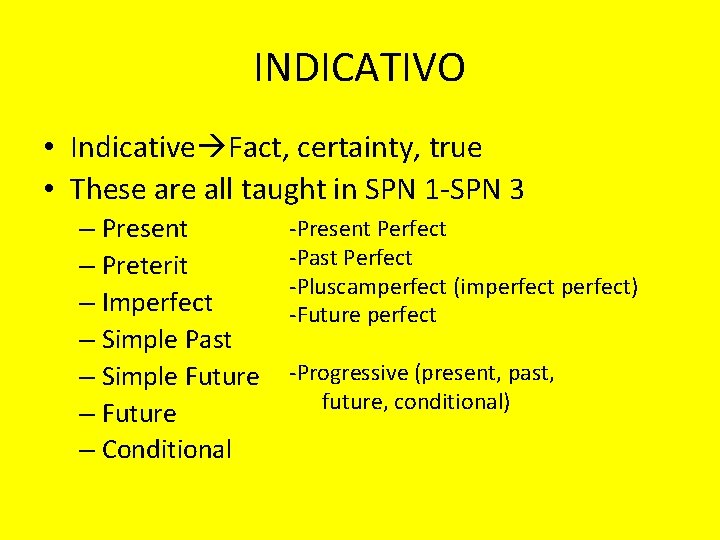
INDICATIVO • Indicative Fact, certainty, true • These are all taught in SPN 1 -SPN 3 – Present – Preterit – Imperfect – Simple Past – Simple Future – Conditional -Present Perfect -Past Perfect -Pluscamperfect (imperfect) -Future perfect -Progressive (present, past, future, conditional)
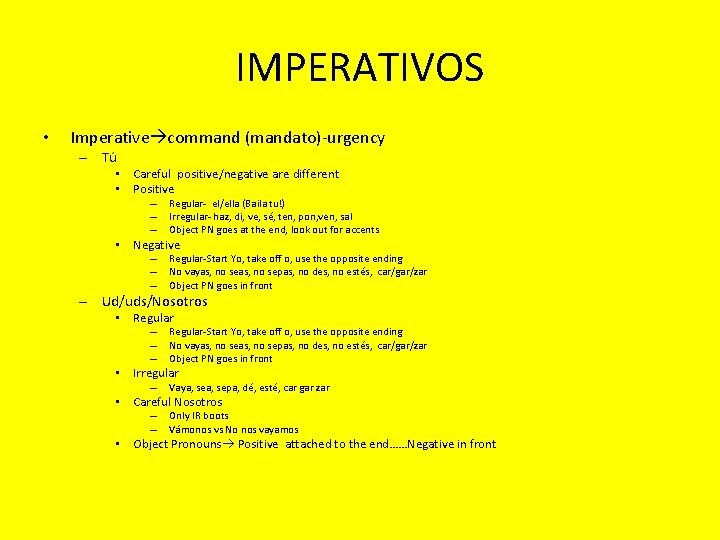
IMPERATIVOS • Imperative command (mandato)-urgency – Tú • Careful positive/negative are different • Positive – – – Regular- el/ella (Baila tu!) Irregular- haz, di, ve, sé, ten, pon, ven, sal Object PN goes at the end, look out for accents • Negative – – – Regular-Start Yo, take off o, use the opposite ending No vayas, no sepas, no des, no estés, car/gar/zar Object PN goes in front – Ud/uds/Nosotros • Regular – – – Regular-Start Yo, take off o, use the opposite ending No vayas, no sepas, no des, no estés, car/gar/zar Object PN goes in front • Irregular – Vaya, sepa, dé, esté, car gar zar • Careful Nosotros – – Only IR boots Vámonos vs No nos vayamos • Object Pronouns Positive attached to the end……Negative in front
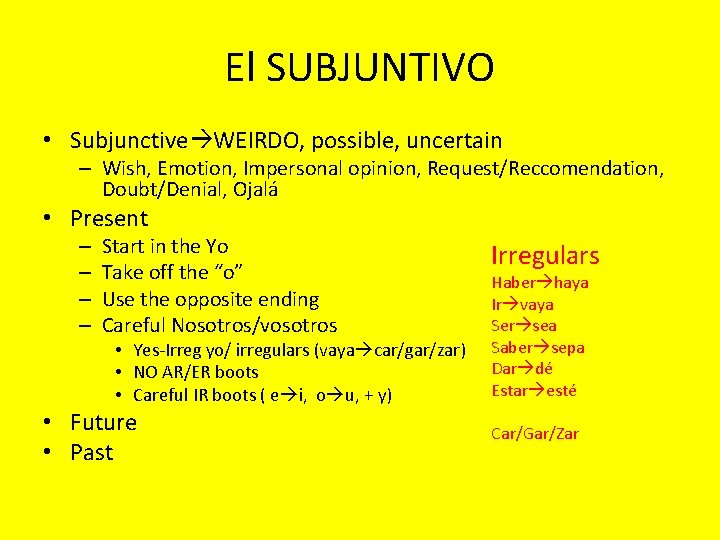
El SUBJUNTIVO • Subjunctive WEIRDO, possible, uncertain – Wish, Emotion, Impersonal opinion, Request/Reccomendation, Doubt/Denial, Ojalá • Present – – Start in the Yo Take off the “o” Use the opposite ending Careful Nosotros/vosotros • Yes-Irreg yo/ irregulars (vaya car/gar/zar) • NO AR/ER boots • Careful IR boots ( e i, o u, + y) • Future • Past Irregulars Haber haya Ir vaya Ser sea Saber sepa Dar dé Estar esté Car/Gar/Zar
- Slides: 21