
Lordoscoliosis and Large Intrathoracic Airway Obstruction Garrido E

Lordoscoliosis and Large Intrathoracic Airway Obstruction Garrido E†, Noordeen H†, Tucker SK†, Noordeen H†, Wallis C‡ From the †Department of Spinal Surgery † and Respiratory Medicine ‡ Great Ormond Street Hospital for Children, London, United Kingdom Study conducted at Great Ormond Street Hospital for Children, London.
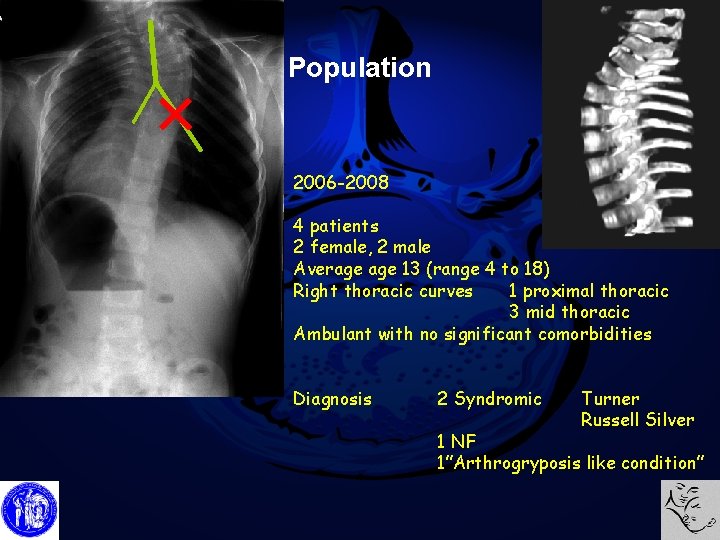
Population 2006 -2008 4 patients 2 female, 2 male Average 13 (range 4 to 18) Right thoracic curves 1 proximal thoracic 3 mid thoracic Ambulant with no significant comorbidities Diagnosis 2 Syndromic Turner Russell Silver 1 NF 1”Arthrogryposis like condition”
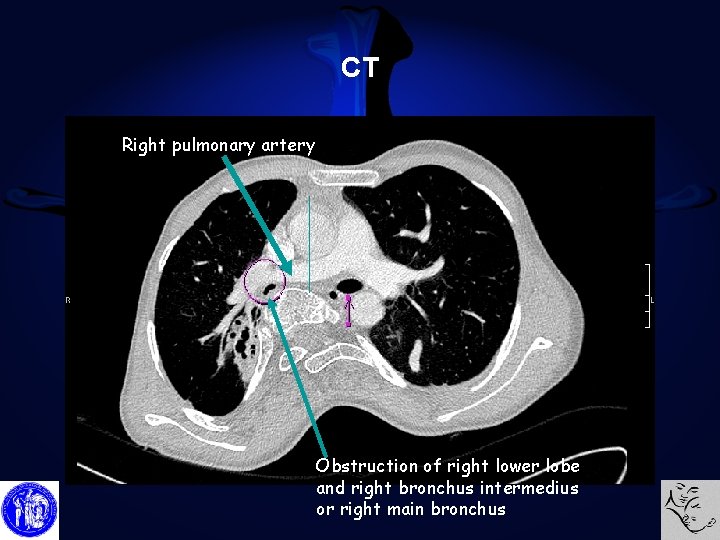
CT Right pulmonary artery Obstruction of right lower lobe and right bronchus intermedius or right main bronchus
Preoperative Symptoms 2 patients episode of respiratory arrest or respiratory distress 2 patients were diagnosed with asthma but were refractory to bronchodilators clinically and during spirometry testing 3 patients suffered from recurrent chest infections
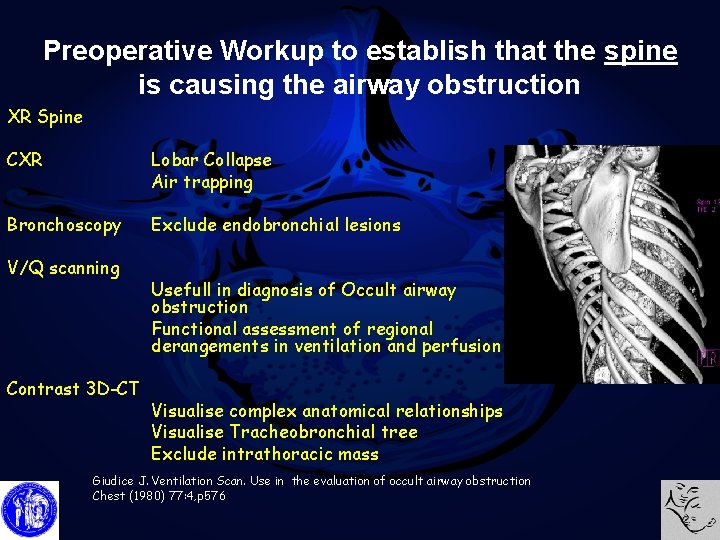
Preoperative Workup to establish that the spine is causing the airway obstruction XR Spine CXR Lobar Collapse Air trapping Bronchoscopy Exclude endobronchial lesions V/Q scanning Contrast 3 D-CT Usefull in diagnosis of Occult airway obstruction Functional assessment of regional derangements in ventilation and perfusion Visualise complex anatomical relationships Visualise Tracheobronchial tree Exclude intrathoracic mass Giudice J. Ventilation Scan. Use in the evaluation of occult airway obstruction Chest (1980) 77: 4, p 576
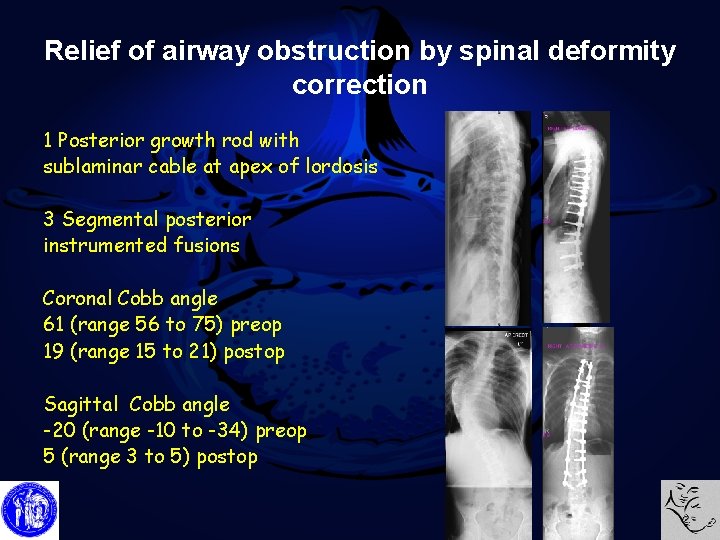
Relief of airway obstruction by spinal deformity correction 1 Posterior growth rod with sublaminar cable at apex of lordosis 3 Segmental posterior instrumented fusions Coronal Cobb angle 61 (range 56 to 75) preop 19 (range 15 to 21) postop Sagittal Cobb angle -20 (range -10 to -34) preop 5 (range 3 to 5) postop
Spirometry Results following spinal deformity correction % Pred FVC improved from average 49% preoperatively to 73% at 8 weeks postoperatively % Pred FEV 1 improved from average 42% preoperatively to 61% at 8 weeks postoperatively Symptomatic improvement was reported by all patients Resolution of obstruction was confirmed by V/Q scan 8 weeks postoperatively
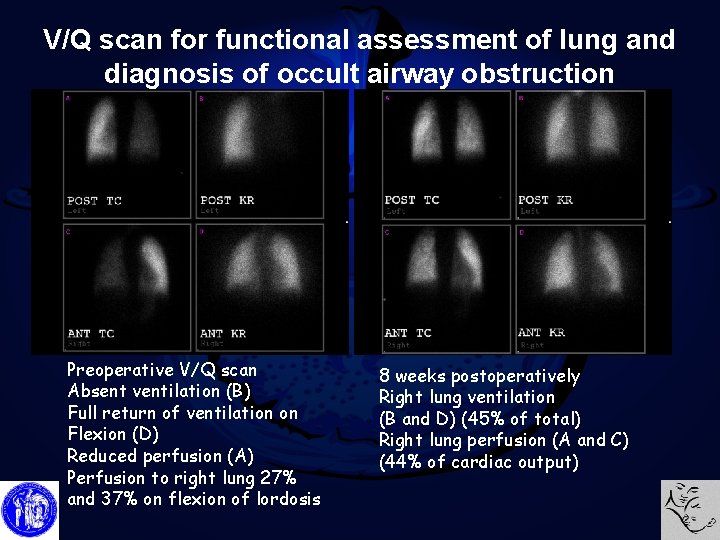
V/Q scan for functional assessment of lung and diagnosis of occult airway obstruction Preoperative V/Q scan Absent ventilation (B) Full return of ventilation on Flexion (D) Reduced perfusion (A) Perfusion to right lung 27% and 37% on flexion of lordosis 8 weeks postoperatively Right lung ventilation (B and D) (45% of total) Right lung perfusion (A and C) (44% of cardiac output)
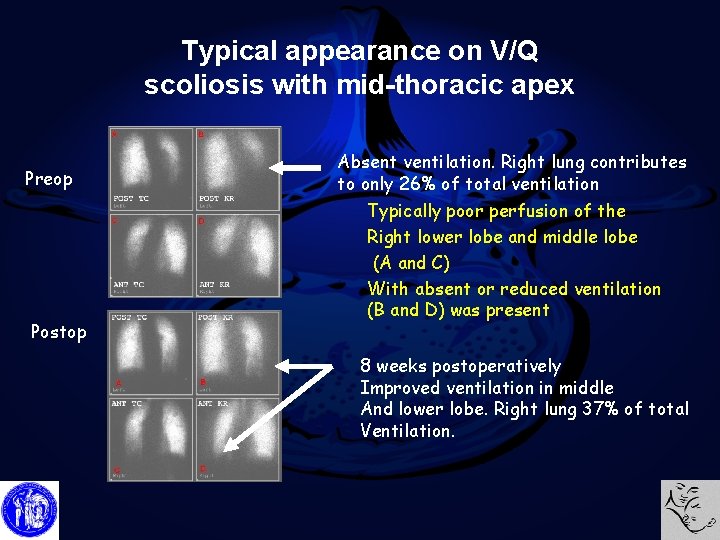
Typical appearance on V/Q scoliosis with mid-thoracic apex Preop Postop Absent ventilation. Right lung contributes to only 26% of total ventilation Typically poor perfusion of the Right lower lobe and middle lobe (A and C) With absent or reduced ventilation (B and D) was present 8 weeks postoperatively Improved ventilation in middle And lower lobe. Right lung 37% of total Ventilation.
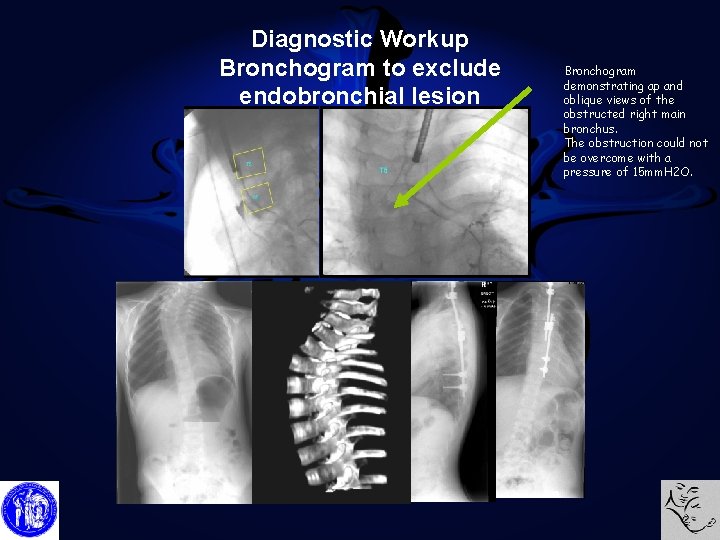
Diagnostic Workup Bronchogram to exclude endobronchial lesion Bronchogram demonstrating ap and oblique views of the obstructed right main bronchus. The obstruction could not be overcome with a pressure of 15 mm. H 2 O.
Concave vs Convex Lung Three dimensional CT volumetric analysis and scintigraphic studies in patients with AIS or early onset scoliosis have shown that the concave lung is comparatively more affected In large airway obstruction due to lordoscoliosis ventilation and perfusion impairment occurs in the convex lung Giordano A, Fuso L et al. Evaluation of pulmonary ventilation and diaphragmatic movement in I diopathic scoliosis using radioaerosol ventilation scintigraphy. Nucl Med Commun. 1997 Feb; 18(2): 105 Chun EM, Sub SW et al. The change in ratio of convex and concave lung volume in adolescent idiopathic scoliosis: a 3 D CT scan based cross sectional study of effect of severity of curve on convex and concave lung volumes in 99 cases. Eur Spine J. 2008 Feb; 17(2): 224 -9.
Need for relief of obstruction? Recurrent chest infection cause parenchymal damage In the developing lung, even temporary airway obstruction may cause irreversable change to lung function Davies H, Gordon I, Matthew DJ, et al. Long term follow up after inhalation of foreign bodies. Arch Dis Child. 1990 Jun; 65(6): 619 -21. Van Ooi. J, Van Belle A et al. The destroyed lung syndrome: report of a case after Harrington rod instrumentation and fusion for idiopathic scoliosis. Spine. 2002 Jul 15; 27(14): E 337 -41
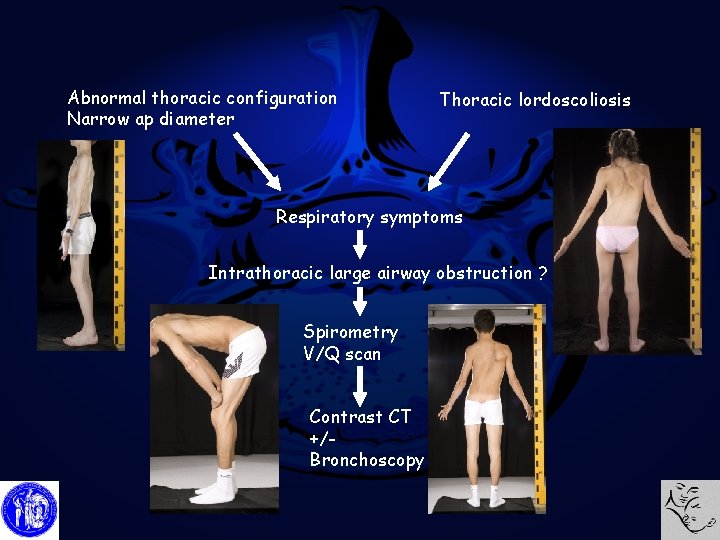
Abnormal thoracic configuration Narrow ap diameter Thoracic lordoscoliosis Respiratory symptoms Intrathoracic large airway obstruction ? Spirometry V/Q scan Contrast CT +/Bronchoscopy
Conclusion Lordoscoliosis can lead to direct bronchial obstruction Obstruction can be reliefed by spinal deformity correction Large airway obstruction due to thoracic lordoscoliosis is probably more common than generally appreciated Regular respiratory evaluation is mandatory Early intervention should be considered to prevent irreversible lung function loss
- Slides: 14