
Lord Palmerston By Mike Allen Henry John Temple
Lord Palmerston By Mike Allen
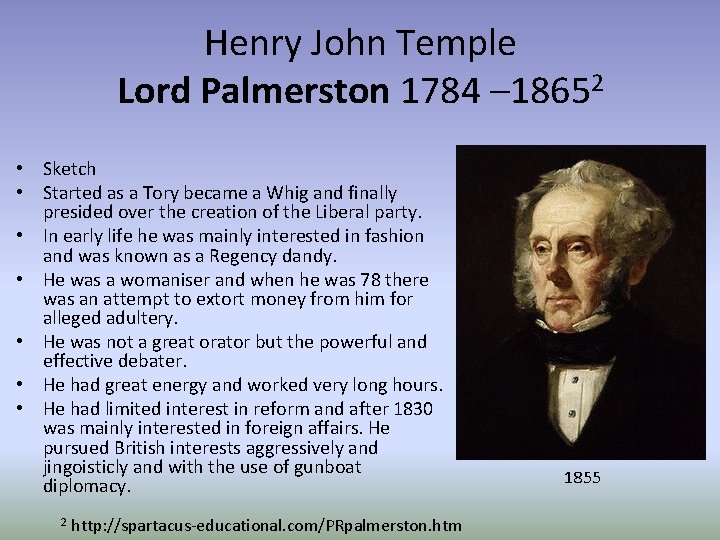
Henry John Temple Lord Palmerston 1784 – 18652 • Sketch • Started as a Tory became a Whig and finally presided over the creation of the Liberal party. • In early life he was mainly interested in fashion and was known as a Regency dandy. • He was a womaniser and when he was 78 there was an attempt to extort money from him for alleged adultery. • He was not a great orator but the powerful and effective debater. • He had great energy and worked very long hours. • He had limited interest in reform and after 1830 was mainly interested in foreign affairs. He pursued British interests aggressively and jingoisticly and with the use of gunboat diplomacy. 2 http: //spartacus-educational. com/PRpalmerston. htm 1855
Lord Palmerston 1 • “Among the surprising careers of British Prime Ministers, none has contained more surprises than that of Lord Palmerston. For twenty years junior minister in a Tory government, he became the most successful of Whig Foreign Secretaries; though always a Conservative, he ended his life by presiding over the transition from Whiggism to Liberalism. He was the exponent of British strength, yet was driven from office for truckling to a foreign despot; he preached the Balance of Power, yet helped to inaugurate the policy of isolation and of British withdrawal from Europe. ” • AJP Taylor History Today 1951
Lord Palmerston 2 • He succeeded to the Irish peerage on his father's death in 1802. • He went to Harrow school. Harrow has produced 7 PMs, Eton 19. • He attended Edinburgh university and afterwards Cambridge where he obtained first-class honours. • He became an MP in 1807. • He became Secretary of War in 1809 and held the post until 1828 when he resigned. • A dispute between Wellington and Huskisson over the issue of parliamentary representation for Manchester and Birmingham led to the resignation of Huskisson and his allies, including Palmerston.
Lord Palmerston 3 • Although he had always been a member of Tory administrations, Lord Palmerston accepted the offer to join Lord Grey and his Whig government in 1830. Palmerston became Foreign Secretary, and for the next two years was preoccupied with persuading France and Holland to accept the independence of Belgium. • One of the conditions of being a member of Lord Grey's government was to support the Whig policy of parliamentary reform. Although Palmerston had previously been opposed to parliamentary reform, he agreed to support Grey's proposed measures. The decision upset his electors at Cambridge University and he was forced to move to Bletchley and when this seat disappeared as a result of the 1832 Reform Act he became the MP for South Hampshire. • Between 1832 and 1852 Lord Palmerston served Whig governments under Lord Melbourne and Lord John Russell.
Lord Palmerston 4 • • • Although Palmerston had the support of most of Parliament, he was strongly disliked by Queen Victoria. Palmerston believed the main objective of the government's foreign policy should be to increase Britain's power in the world. This sometimes involved adopting policies that embarrassed and weakened foreign governments. Victoria and her husband, Prince Albert, on the other hand, believed that the British government should do what it could to help preserve European royal families against revolutionary groups advocating republicanism. Queen Victoria also objected to Palmerston's sexual behaviour. In 1839 he had attempted to seduce one of Victoria's ladies in waiting. Palmerston entered Lady Dacre's bedroom while staying as Victoria's guest at Windsor Castle. Only Lord Melbourne's intervention saved Palmerston from being removed from office. Lord Palmerstone's explanation was that he had gone to the wrong bedroom. It was well known that Palmerston had affairs with Lady Jersey and Princess Dorothy de Lieven before he began his affair with Lady Cowper in 1810; when her husband died in 1839, the pair finally married. Lady Cowper was the sister of Lord Melbourne, who said that his sister was a 'remarkable woman, a devoted mother, and excellent wife — but not chaste'. They had no children, and the title became extinct, the property descending to Lady Palmerston's second son by Earl Cowper, W. F. Cowper-Temple, afterwards Baron Mount Temple, and then to her grandson Evelyn Ashley (1836 -1907) son of her daughter, who married the 7 th earl of Shaftesbury, who was Lord Palmerston's private secretary from 1858 to 1865.
Lord Palmerston 5 • Palmerston was responsible for the whole of British foreign policy from the time of the French and Belgian Revolutions of 1830 until 1851. (1830 - 1834, 1835 - 1841, and 1846 – 1851). • His abrasive style earned him the nickname "Lord Pumice Stone", and his manner of dealing with foreign governments who crossed him was the original "gunboat diplomacy". • “Therefore I say that it is a narrow policy to suppose that this country or that is to be marked out as the eternal ally or the perpetual enemy of England. We have no eternal allies, and we have no perpetual enemies. Our interests are eternal and perpetual, and those interests it is our duty to follow. ” Remarks in the House of Commons defending his foreign policy, March 1, 1848. • Palmerston's overall policy was to safeguard British interests, maintain peace, keep the balance of power, and retain the status quo in Europe.

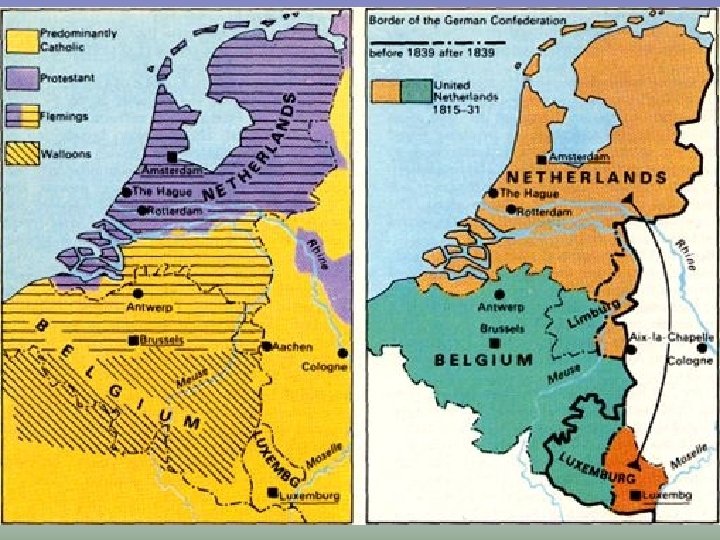
Lord Palmerston 6 Foreign Secretary 1830 -1841 • • • Belgium 1830 What was to become Belgium was given to the Netherlands in 1815. The southern part of the Netherlands revolted in 1830 against Dutch rule. William I of the Netherlands appealed to the great powers to maintain his rights; a conference assembled accordingly in London. The British solution involved the independence of Belgium, which Palmerston believed would greatly contribute to the security of Britain, but any solution was not straightforward. On the one hand, the northern powers were anxious to defend William I; on the other, many Belgian revolutionaries, supported the reunion of the Belgian provinces to France. The British policy was a close alliance with France, but one subject to the balance of power on the Continent, and in particular the preservation of Belgium. If the northern powers supported William I by force, they would encounter the resistance of France and Britain united in arms. If France sought to annex Belgium, it would forfeit the British alliance and find herself opposed by the whole of Europe. In the end the British policy prevailed. Although the continent had been close to war, peace was maintained on London's terms and Prince Leopold of Saxe-Coburg, the widower of a British princess, was placed upon the throne of Belgium.
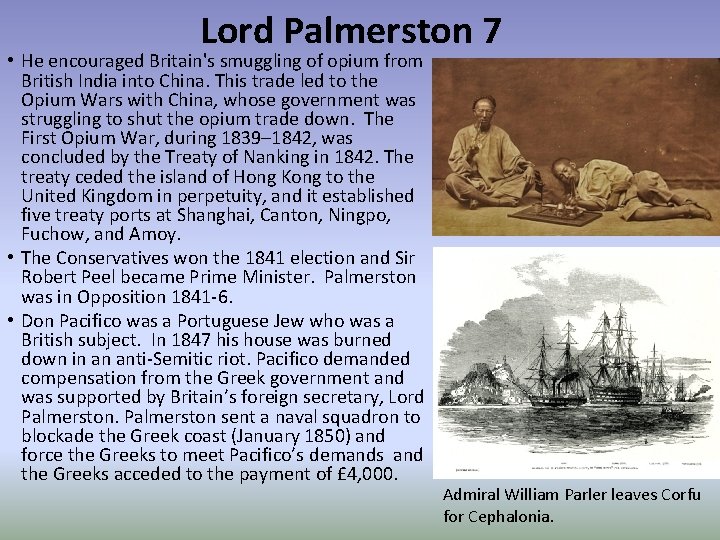
Lord Palmerston 7 • He encouraged Britain's smuggling of opium from British India into China. This trade led to the Opium Wars with China, whose government was struggling to shut the opium trade down. The First Opium War, during 1839– 1842, was concluded by the Treaty of Nanking in 1842. The treaty ceded the island of Hong Kong to the United Kingdom in perpetuity, and it established five treaty ports at Shanghai, Canton, Ningpo, Fuchow, and Amoy. • The Conservatives won the 1841 election and Sir Robert Peel became Prime Minister. Palmerston was in Opposition 1841 -6. • Don Pacifico was a Portuguese Jew who was a British subject. In 1847 his house was burned down in an anti-Semitic riot. Pacifico demanded compensation from the Greek government and was supported by Britain’s foreign secretary, Lord Palmerston sent a naval squadron to blockade the Greek coast (January 1850) and force the Greeks to meet Pacifico’s demands and the Greeks acceded to the payment of £ 4, 000. Admiral William Parler leaves Corfu for Cephalonia.
Lord Palmerston 8 • • • The incident had its greatest effect in British internal politics. Palmerston’s policy was censured by the House of Lords (June 18, 1850), but he won the support of the Commons on June 29. During his speech before the vote, he made his famous comparison between the British and Roman empires, saying that, just as a Roman could claim his rights anywhere in the world with the words “Civis Romanus sum” (“I am a Roman citizen”), “so also a British subject, in whatever land he may be, shall feel confident that the watchful eye and the strong arm of England will protect him against injustice and wrong. ” In the summer of 1850, Queen Victoria asked Lord John Russell to dismiss Palmerston. Russell told the queen he was unable to do this because Palmerston was very popular in the House of Commons. However, in December 1851, Palmerston congratulated Louis Napoleon Bonaparte on his coup in France. This action upset Russell and other radical members of the Whig party and this time he accepted Victoria's advice and sacked Palmerston. Six weeks later Palmerston took revenge by helping to bring down Lord John Russell's government. After a brief period of Conservative minority government, the Earl of Aberdeen became Prime Minister in a coalition government of Whigs and Peelites (with Russell taking the role of Foreign Secretary and Leader of the House of Commons). It was regarded as impossible for them to form a government without Palmerston, so he was made Home Secretary in December 1852.
Lord Palmerston 9 • Social reform • Palmerston passed the Factory Act 1853 which removed loopholes in previous Factory Acts and outlawed all labour by young persons between 6 pm and 6 am. • He introduced the Truck Act which stopped the practice of employers paying workmen in goods instead of money, or forcing them to purchase goods from shops owned by the employers. • In August 1853 Palmerston introduced the Smoke Abatement Act in order to combat the increasing smoke from coal fires, a problem greatly aggravated by the Industrial Revolution. • He also oversaw the passage of the Vaccination Act 1853 into law, which was introduced as a private member's bill, and which Palmerston persuaded the government to support. The Act made vaccination of children compulsory for the first time. • Palmerston outlawed the burying of the dead in churches. The right to bury the dead in churches was held by wealthy families whose ancestors had purchased the right in the past. Palmerston opposed this practice on public health grounds and ensured that all bodies were buried in a churchyard or public cemetery.
Lord Palmerston 10 • Penal reform Palmerston reduced the period in which prisoners could be held in solitary confinement from eighteen months to nine months. • He also ended transportation to Van Diemen's Land for prisoners by passing the Penal Servitude Act 1853, which also reduced the maximum sentences for most offences. • Palmerston passed the Reformatory Schools Act 1854 which gave the Home Secretary powers to send juvenile prisoners to a reformatory school instead of prison
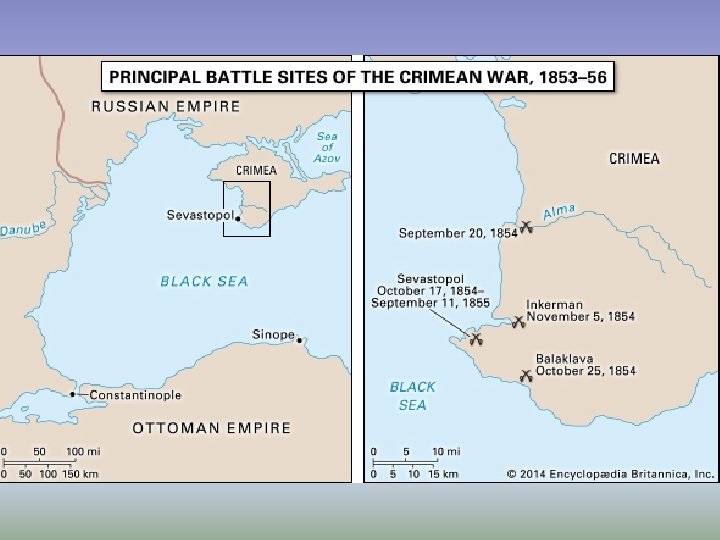
The Crimean War 1853 -56 (1) • • • A central goal of Russian foreign policy was to obtain a warm water port in the south at Istanbul. The Ottoman Empire was in decline and in 1853 the Russians occupied the principalities Wallachia and Moldavia (roughly modern Romania and Moldavia) and destroyed the Turkish fleet at Sinope in 1854. Britain and France demanded a withdrawal and went to war in March 1854. They invaded the Crimea and besieged Sevastopol. The Crimean War was managed and commanded very poorly on both sides. Disease accounted for a disproportionate number of the approximately 250, 000 casualties lost by each side. When news of the deplorable conditions at the front reached the British public, nurse Mary Seacole petitioned the War Office for passage to Crimea. When she was refused, Seacole financed the trip to Balaklava herself and established the British Hotel, an officer’s club and convalescent home that she used as a base to treat the sick and wounded on the battlefield. Improvements made to the field hospital at Üsküdar by British nurse Florence Nightingale revolutionized the treatment of wounded soldiers and paved the way for later developments in battlefield medicine.
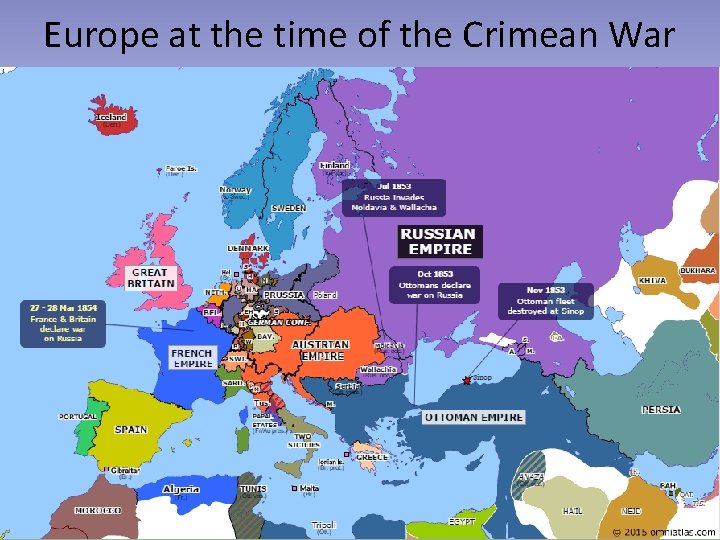
Europe at the time of the Crimean War
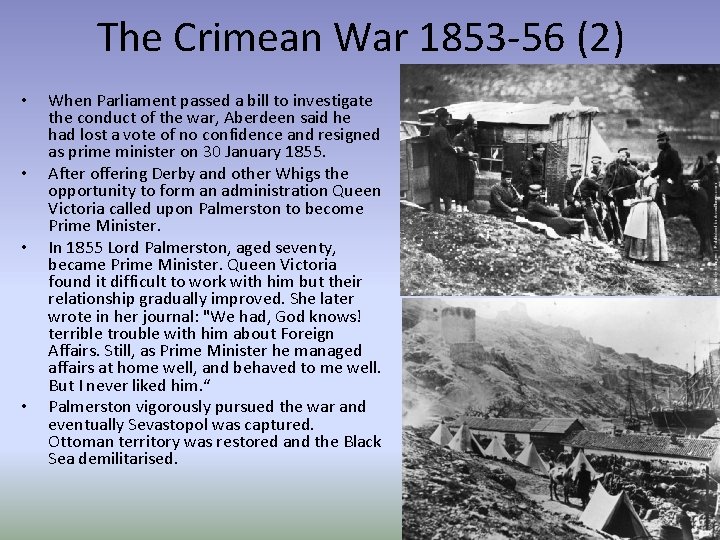
The Crimean War 1853 -56 (2) • • When Parliament passed a bill to investigate the conduct of the war, Aberdeen said he had lost a vote of no confidence and resigned as prime minister on 30 January 1855. After offering Derby and other Whigs the opportunity to form an administration Queen Victoria called upon Palmerston to become Prime Minister. In 1855 Lord Palmerston, aged seventy, became Prime Minister. Queen Victoria found it difficult to work with him but their relationship gradually improved. She later wrote in her journal: "We had, God knows! terrible trouble with him about Foreign Affairs. Still, as Prime Minister he managed affairs at home well, and behaved to me well. But I never liked him. “ Palmerston vigorously pursued the war and eventually Sevastopol was captured. Ottoman territory was restored and the Black Sea demilitarised.
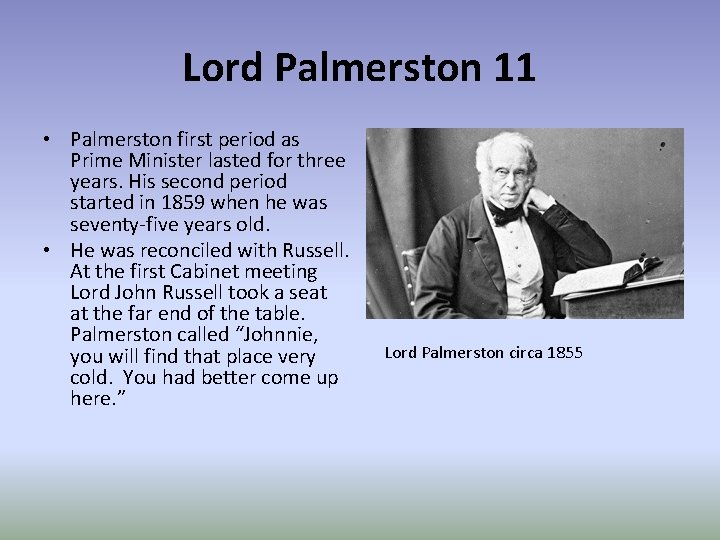
Lord Palmerston 11 • Palmerston first period as Prime Minister lasted for three years. His second period started in 1859 when he was seventy-five years old. • He was reconciled with Russell. At the first Cabinet meeting Lord John Russell took a seat at the far end of the table. Palmerston called “Johnnie, you will find that place very cold. You had better come up here. ” Lord Palmerston circa 1855
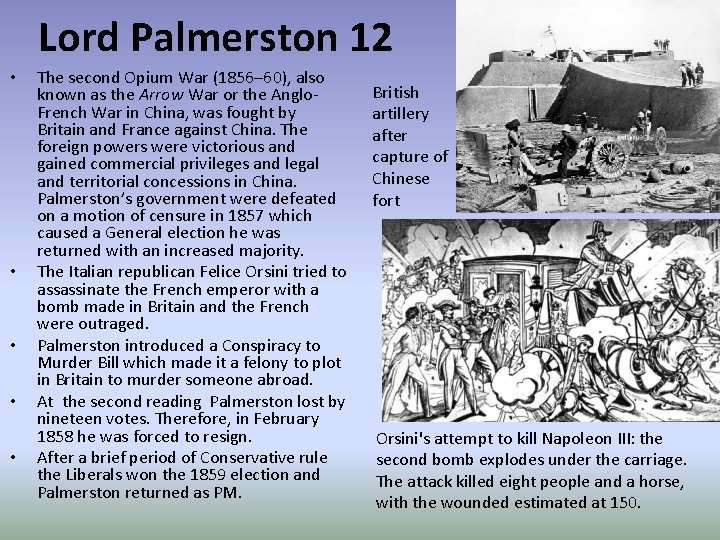
Lord Palmerston 12 • • • The second Opium War (1856– 60), also known as the Arrow War or the Anglo. French War in China, was fought by Britain and France against China. The foreign powers were victorious and gained commercial privileges and legal and territorial concessions in China. Palmerston’s government were defeated on a motion of censure in 1857 which caused a General election he was returned with an increased majority. The Italian republican Felice Orsini tried to assassinate the French emperor with a bomb made in Britain and the French were outraged. Palmerston introduced a Conspiracy to Murder Bill which made it a felony to plot in Britain to murder someone abroad. At the second reading Palmerston lost by nineteen votes. Therefore, in February 1858 he was forced to resign. After a brief period of Conservative rule the Liberals won the 1859 election and Palmerston returned as PM. British artillery after capture of Chinese fort Orsini's attempt to kill Napoleon III: the second bomb explodes under the carriage. The attack killed eight people and a horse, with the wounded estimated at 150.
Lord Palmerston 13 • The American Civil War • He was sympathetic to the South. • Although a professed opponent of the slave trade and slavery, he held a lifelong hostility towards the United States and believed a dissolution of the Union would weaken the United States – and therefore enhance British power – and that the Southern Confederacy "would afford a valuable and extensive market for British manufactures". • In 1861 Britain declared neutrality. • The Trent Affair in November 1861 produced public outrage in Britain and a diplomatic crisis. A U. S. Navy warship stopped the British steamer Trent and seized two Confederate envoys en route to Europe. Palmerston called the action "a declared and gross insult", demanded the release of the two diplomats and ordered 3, 000 troops to Canada. The U. S. decided to release the prisoners rather than risk war.
Lord Palmerston 14 • The raiding ship CSS Alabama, built in the British port of Birkenhead, was another difficulty for Palmerston. He was advised to detain Alabama by a law officer, as its construction was a breach of Britain's neutrality. Palmerston ordered Alabama detained on 31 July, but it had already put to sea before the order reached Birkenhead. In her subsequent cruise, Alabama captured or destroyed many Union merchant ships, as did other raiders fitted out in Britain. The U. S. accused Britain of complicity in the construction of the raiders. This was the basis of the post-war Alabama claims for damages against Britain, which Palmerston refused to pay. • After his death, Gladstone acknowledged the U. S. claim and agreed to arbitration, paying out $15, 500, 000 in damages.
Lord Palmerston 15 • Palmerston was totally opposed to any extension of the franchise and during 1864 came into conflict with William Gladstone, his Chancellor of the Exchequer, who was a strong supporter of reform. Palmerston won the argument and Gladstone had to wait until he became Prime Minister before he could introduce these measures. • Parliament was dissolved on 6 th July 1865. Although nearly eighty-one years old, Palmerston refused to retire and once again was elected to Parliament. However, before he could take up office he became very ill and died on 18 th October, 1865.
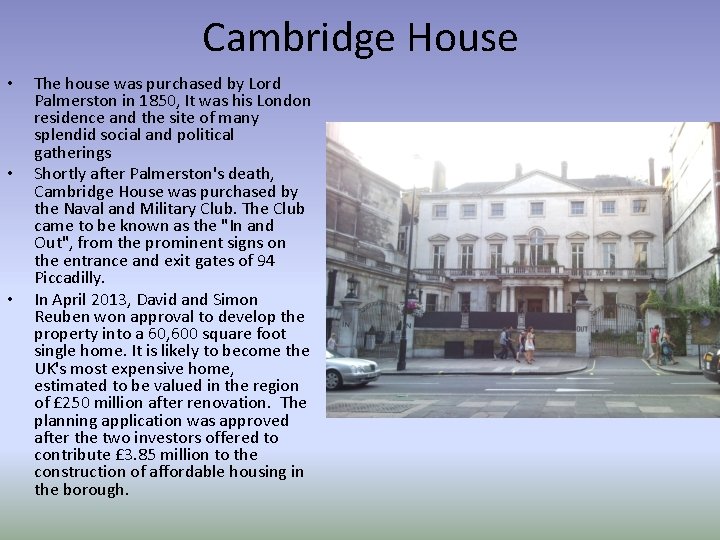
Cambridge House • • • The house was purchased by Lord Palmerston in 1850, It was his London residence and the site of many splendid social and political gatherings Shortly after Palmerston's death, Cambridge House was purchased by the Naval and Military Club. The Club came to be known as the "In and Out", from the prominent signs on the entrance and exit gates of 94 Piccadilly. In April 2013, David and Simon Reuben won approval to develop the property into a 60, 600 square foot single home. It is likely to become the UK's most expensive home, estimated to be valued in the region of £ 250 million after renovation. The planning application was approved after the two investors offered to contribute £ 3. 85 million to the construction of affordable housing in the borough.
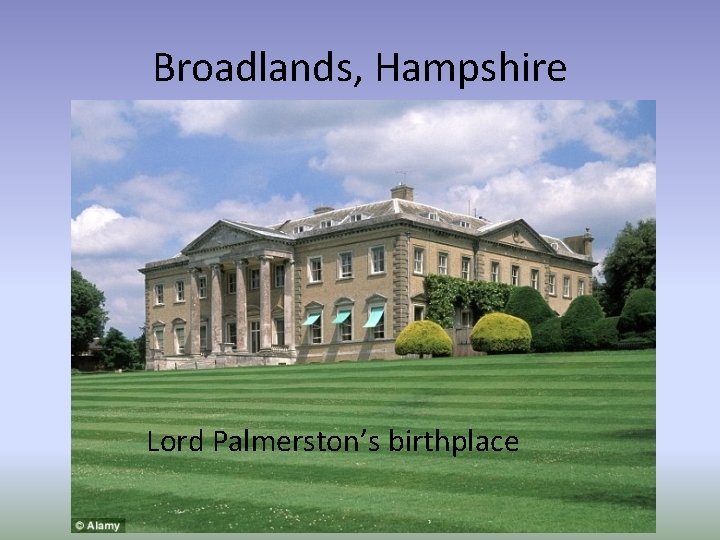
Broadlands, Hampshire Lord Palmerston’s birthplace
- Slides: 24