
Loop Transformation 1997 2006 by Yu Hen Hu
Loop Transformation © 1997 -2006 by Yu Hen Hu ECE 734 VLSI Arrays for Digital Signal Processing

Representing Nested Loops M-level nested loop: L 1: DO i 1 = p 1, q 1 L 2: DO i 2= p 2, q 2 Lm: DO im = pm, qm H(i 1, i 2, , im) Enddo © 1997 -2006 by Yu Hen Hu The loop indices {ik; 1 k m} form an m 1 index vector i = [i 1, i 2, , im]T which corresponds to a lattice point in the m-dimensional index space I Loop bounds: {pk, qk}. Loop body: H(i 1, i 2, , im) that is to be executed in a single processor in a single time unit (t. u. ). The granularity considered here is a loop body. ECE 734 VLSI Arrays for Digital Signal Processing 2
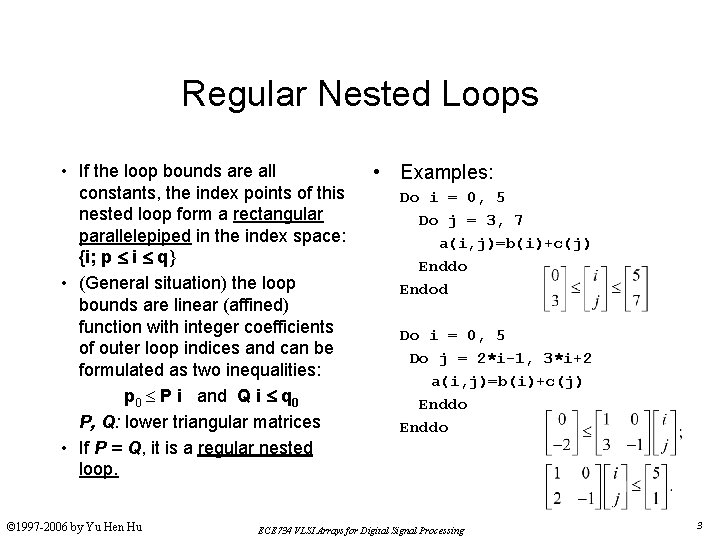
Regular Nested Loops • If the loop bounds are all constants, the index points of this nested loop form a rectangular parallelepiped in the index space: {i; p i q} • (General situation) the loop bounds are linear (affined) function with integer coefficients of outer loop indices and can be formulated as two inequalities: p 0 P i and Q i q 0 P, Q: lower triangular matrices • If P = Q, it is a regular nested loop. © 1997 -2006 by Yu Hen Hu • Examples: Do i = 0, 5 Do j = 3, 7 a(i, j)=b(i)+c(j) Enddo Endod Do i = 0, 5 Do j = 2*i-1, 3*i+2 a(i, j)=b(i)+c(j) Enddo ECE 734 VLSI Arrays for Digital Signal Processing 3
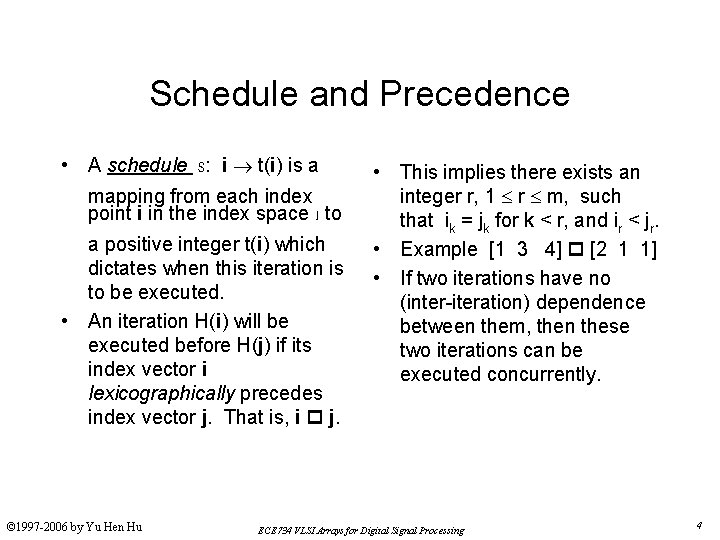
Schedule and Precedence • A schedule S: i t(i) is a • This implies there exists an mapping from each index integer r, 1 r m, such point i in the index space I to that ik = jk for k < r, and ir < jr. a positive integer t(i) which • Example [1 3 4] [2 1 1] dictates when this iteration is • If two iterations have no to be executed. (inter-iteration) dependence • An iteration H(i) will be between them, then these executed before H(j) if its two iterations can be index vector i executed concurrently. lexicographically precedes index vector j. That is, i j. © 1997 -2006 by Yu Hen Hu ECE 734 VLSI Arrays for Digital Signal Processing 4
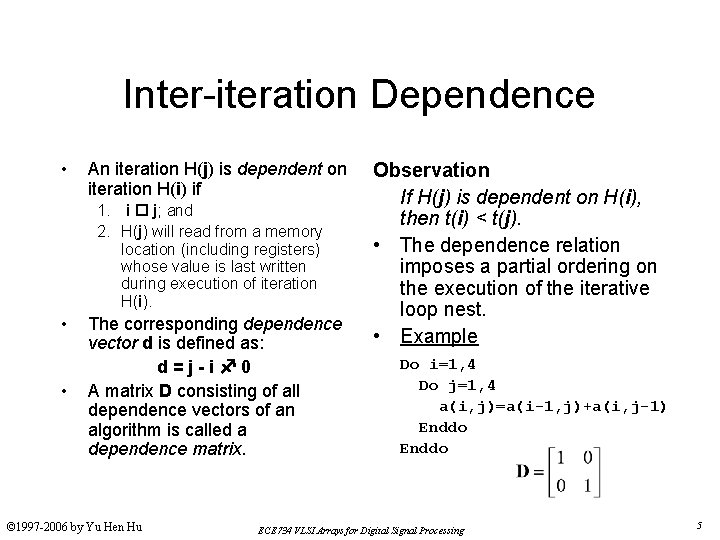
Inter-iteration Dependence • An iteration H(j) is dependent on iteration H(i) if 1. i j; and 2. H(j) will read from a memory location (including registers) whose value is last written during execution of iteration H(i). • • The corresponding dependence vector d is defined as: d = j - i 0 A matrix D consisting of all dependence vectors of an algorithm is called a dependence matrix. © 1997 -2006 by Yu Hen Hu Observation If H(j) is dependent on H(i), then t(i) < t(j). • The dependence relation imposes a partial ordering on the execution of the iterative loop nest. • Example Do i=1, 4 Do j=1, 4 a(i, j)=a(i-1, j)+a(i, j-1) Enddo ECE 734 VLSI Arrays for Digital Signal Processing 5
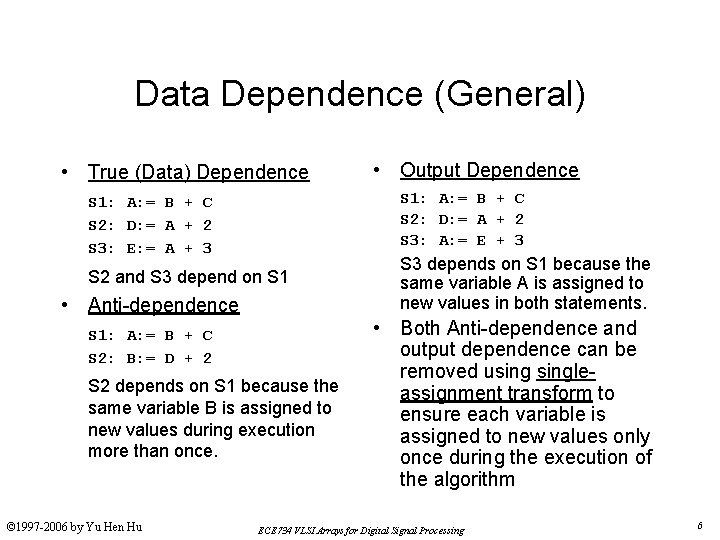
Data Dependence (General) • True (Data) Dependence S 1: A: = B + C S 2: D: = A + 2 S 3: A: = E + 3 S 1: A: = B + C S 2: D: = A + 2 S 3: E: = A + 3 S 2 and S 3 depend on S 1 • Anti-dependence S 1: A: = B + C S 2: B: = D + 2 S 2 depends on S 1 because the same variable B is assigned to new values during execution more than once. © 1997 -2006 by Yu Hen Hu • Output Dependence S 3 depends on S 1 because the same variable A is assigned to new values in both statements. • Both Anti-dependence and output dependence can be removed usingleassignment transform to ensure each variable is assigned to new values only once during the execution of the algorithm ECE 734 VLSI Arrays for Digital Signal Processing 6
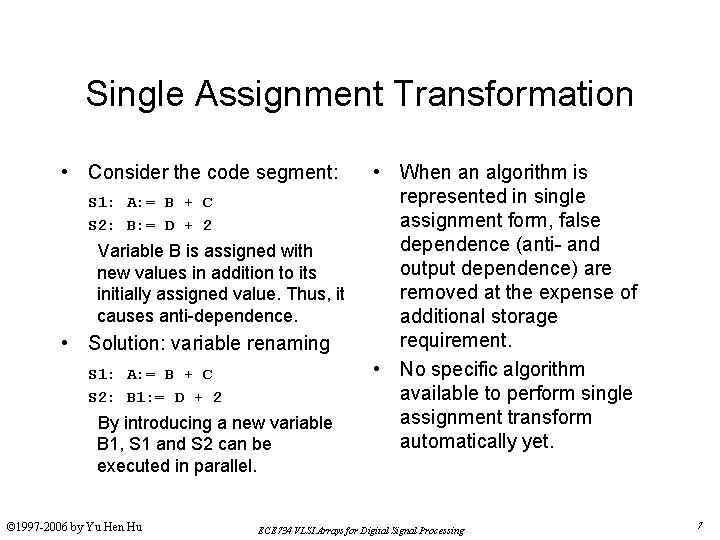
Single Assignment Transformation • Consider the code segment: S 1: A: = B + C S 2: B: = D + 2 Variable B is assigned with new values in addition to its initially assigned value. Thus, it causes anti-dependence. • Solution: variable renaming S 1: A: = B + C S 2: B 1: = D + 2 By introducing a new variable B 1, S 1 and S 2 can be executed in parallel. © 1997 -2006 by Yu Hen Hu • When an algorithm is represented in single assignment form, false dependence (anti- and output dependence) are removed at the expense of additional storage requirement. • No specific algorithm available to perform single assignment transform automatically yet. ECE 734 VLSI Arrays for Digital Signal Processing 7
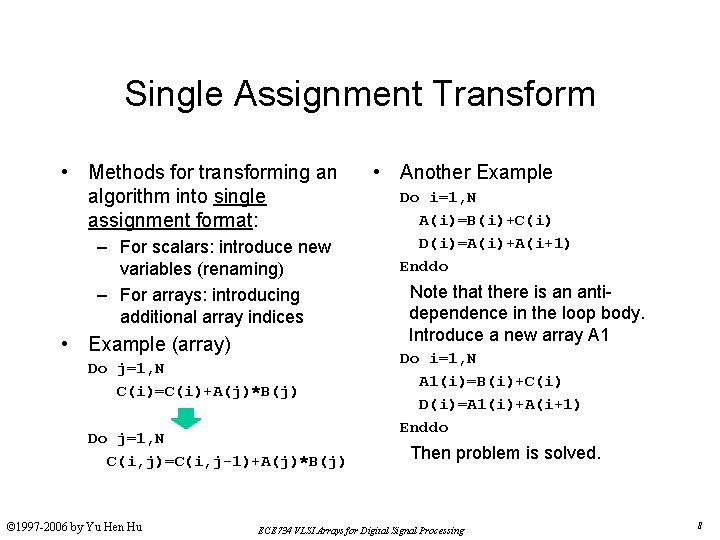
Single Assignment Transform • Methods for transforming an algorithm into single assignment format: – For scalars: introduce new variables (renaming) – For arrays: introducing additional array indices • Example (array) Do j=1, N C(i)=C(i)+A(j)*B(j) Do j=1, N C(i, j)=C(i, j-1)+A(j)*B(j) © 1997 -2006 by Yu Hen Hu • Another Example Do i=1, N A(i)=B(i)+C(i) D(i)=A(i)+A(i+1) Enddo Note that there is an antidependence in the loop body. Introduce a new array A 1 Do i=1, N A 1(i)=B(i)+C(i) D(i)=A 1(i)+A(i+1) Enddo Then problem is solved. ECE 734 VLSI Arrays for Digital Signal Processing 8
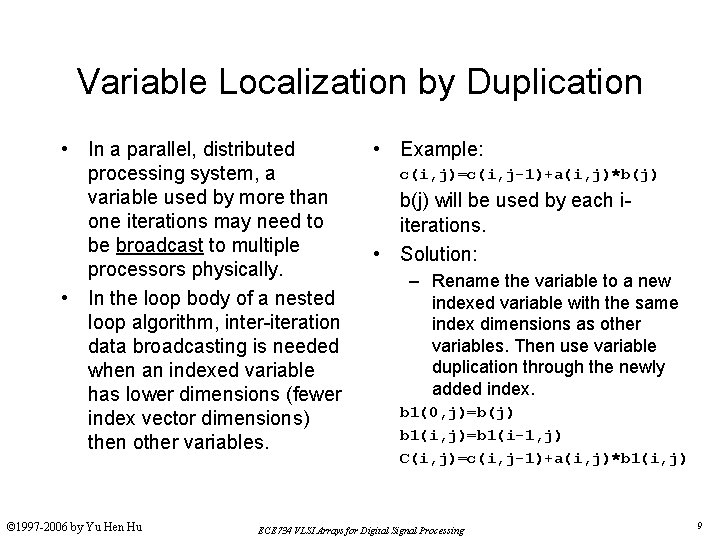
Variable Localization by Duplication • In a parallel, distributed processing system, a variable used by more than one iterations may need to be broadcast to multiple processors physically. • In the loop body of a nested loop algorithm, inter-iteration data broadcasting is needed when an indexed variable has lower dimensions (fewer index vector dimensions) then other variables. © 1997 -2006 by Yu Hen Hu • Example: c(i, j)=c(i, j-1)+a(i, j)*b(j) will be used by each iiterations. • Solution: – Rename the variable to a new indexed variable with the same index dimensions as other variables. Then use variable duplication through the newly added index. b 1(0, j)=b(j) b 1(i, j)=b 1(i-1, j) C(i, j)=c(i, j-1)+a(i, j)*b 1(i, j) ECE 734 VLSI Arrays for Digital Signal Processing 9
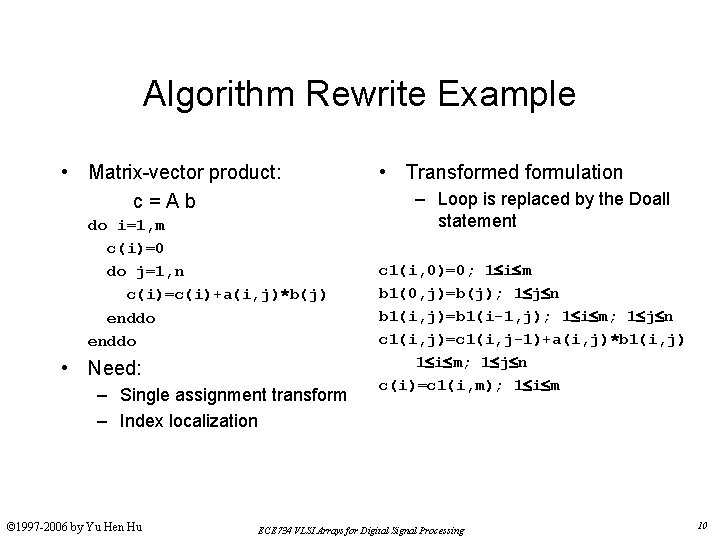
Algorithm Rewrite Example • Matrix-vector product: c = A b do i=1, m c(i)=0 do j=1, n c(i)=c(i)+a(i, j)*b(j) enddo • Need: – Single assignment transform – Index localization © 1997 -2006 by Yu Hen Hu • Transformed formulation – Loop is replaced by the Doall statement c 1(i, 0)=0; 1 i m b 1(0, j)=b(j); 1 j n b 1(i, j)=b 1(i-1, j); 1 i m; 1 j n c 1(i, j)=c 1(i, j-1)+a(i, j)*b 1(i, j) 1 i m; 1 j n c(i)=c 1(i, m); 1 i m ECE 734 VLSI Arrays for Digital Signal Processing 10
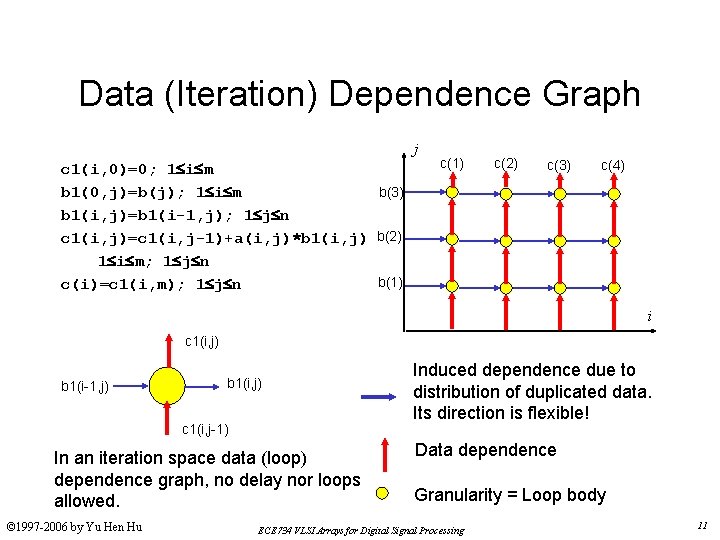
Data (Iteration) Dependence Graph j c 1(i, 0)=0; 1 i m b 1(0, j)=b(j); 1 i m b(3) b 1(i, j)=b 1(i-1, j); 1 j n c 1(i, j)=c 1(i, j-1)+a(i, j)*b 1(i, j) b(2) 1 i m; 1 j n b(1) c(i)=c 1(i, m); 1 j n c(1) c(2) c(3) c(4) i c 1(i, j) b 1(i-1, j) b 1(i, j) c 1(i, j-1) In an iteration space data (loop) dependence graph, no delay nor loops allowed. © 1997 -2006 by Yu Hen Hu Induced dependence due to distribution of duplicated data. Its direction is flexible! Data dependence Granularity = Loop body ECE 734 VLSI Arrays for Digital Signal Processing 11
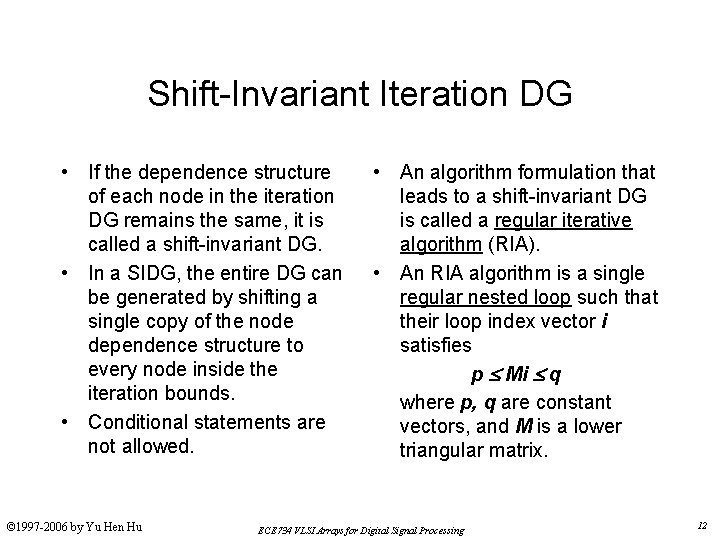
Shift-Invariant Iteration DG • If the dependence structure of each node in the iteration DG remains the same, it is called a shift-invariant DG. • In a SIDG, the entire DG can be generated by shifting a single copy of the node dependence structure to every node inside the iteration bounds. • Conditional statements are not allowed. © 1997 -2006 by Yu Hen Hu • An algorithm formulation that leads to a shift-invariant DG is called a regular iterative algorithm (RIA). • An RIA algorithm is a single regular nested loop such that their loop index vector i satisfies p Mi q where p, q are constant vectors, and M is a lower triangular matrix. ECE 734 VLSI Arrays for Digital Signal Processing 12
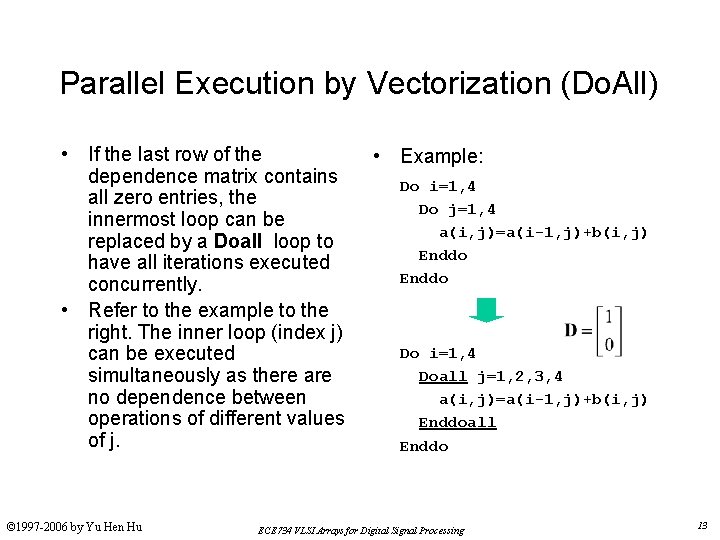
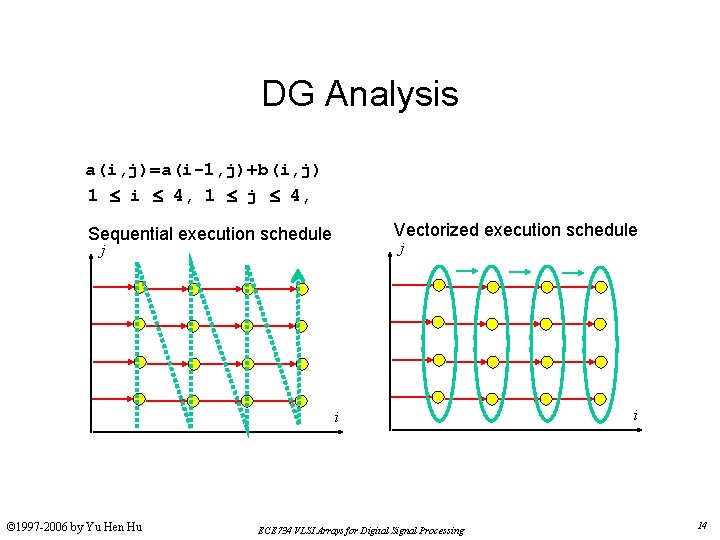
Parallel Execution by Vectorization (Do. All) • If the last row of the dependence matrix contains all zero entries, the innermost loop can be replaced by a Doall loop to have all iterations executed concurrently. • Refer to the example to the right. The inner loop (index j) can be executed simultaneously as there are no dependence between operations of different values of j. © 1997 -2006 by Yu Hen Hu • Example: Do i=1, 4 Do j=1, 4 a(i, j)=a(i-1, j)+b(i, j) Enddo Do i=1, 4 Doall j=1, 2, 3, 4 a(i, j)=a(i-1, j)+b(i, j) Enddoall Enddo ECE 734 VLSI Arrays for Digital Signal Processing 13
DG Analysis a(i, j)=a(i-1, j)+b(i, j) 1 i 4, 1 j 4, Vectorized execution schedule Sequential execution schedule j j i © 1997 -2006 by Yu Hen Hu ECE 734 VLSI Arrays for Digital Signal Processing i 14
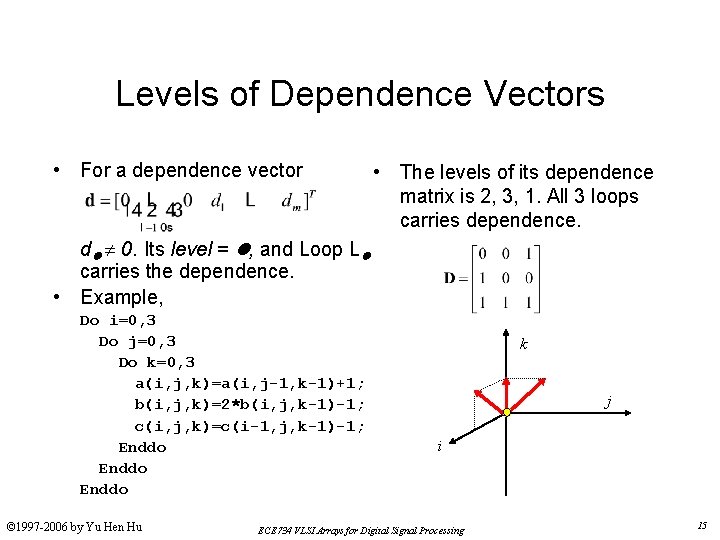
Levels of Dependence Vectors • For a dependence vector • The levels of its dependence matrix is 2, 3, 1. All 3 loops carries dependence. d 0. Its level = , and Loop L carries the dependence. • Example, Do i=0, 3 Do j=0, 3 Do k=0, 3 a(i, j, k)=a(i, j-1, k-1)+1; b(i, j, k)=2*b(i, j, k-1)-1; c(i, j, k)=c(i-1, j, k-1)-1; Enddo © 1997 -2006 by Yu Hen Hu k j i ECE 734 VLSI Arrays for Digital Signal Processing 15
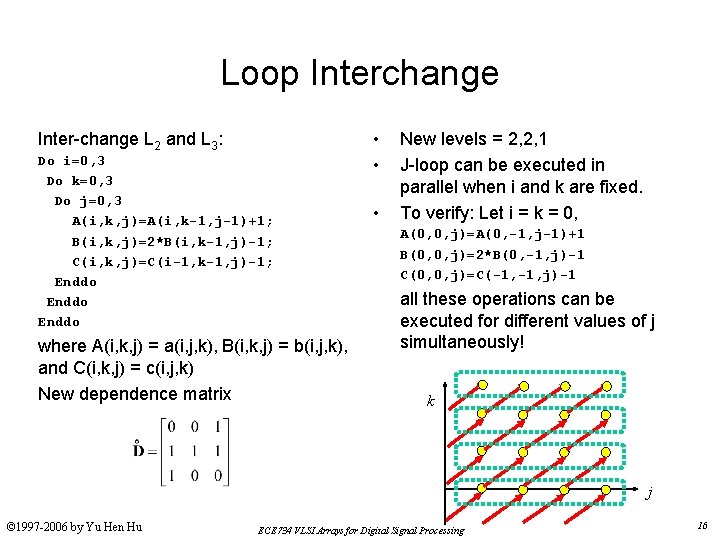
Loop Interchange Inter-change L 2 and L 3: Do i=0, 3 Do k=0, 3 Do j=0, 3 A(i, k, j)=A(i, k-1, j-1)+1; B(i, k, j)=2*B(i, k-1, j)-1; C(i, k, j)=C(i-1, k-1, j)-1; Enddo where A(i, k, j) = a(i, j, k), B(i, k, j) = b(i, j, k), and C(i, k, j) = c(i, j, k) New dependence matrix • • • New levels = 2, 2, 1 J-loop can be executed in parallel when i and k are fixed. To verify: Let i = k = 0, A(0, 0, j)=A(0, -1, j-1)+1 B(0, 0, j)=2*B(0, -1, j)-1 C(0, 0, j)=C(-1, j)-1 all these operations can be executed for different values of j simultaneously! k j © 1997 -2006 by Yu Hen Hu ECE 734 VLSI Arrays for Digital Signal Processing 16
Exploitation of Parallelism • Inner Loop Parallelism If the first non-zero element in each dependence vector is above loop level k, then all inner loop nests, starting from level k can be executed in parallel. © 1997 -2006 by Yu Hen Hu • Outer Loop Parallelism To execute an outer loop in parallel (where each inner loop nest is executed sequentially), the corresponding dependence matrix must have at least a row containing only zero entries. ECE 734 VLSI Arrays for Digital Signal Processing 17
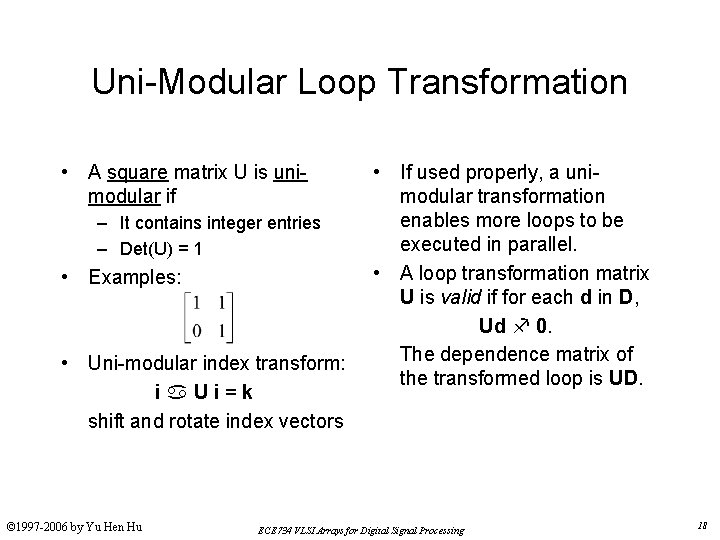
Uni-Modular Loop Transformation • A square matrix U is unimodular if – It contains integer entries – Det(U) = 1 • Examples: • Uni-modular index transform: i U i = k shift and rotate index vectors © 1997 -2006 by Yu Hen Hu • If used properly, a unimodular transformation enables more loops to be executed in parallel. • A loop transformation matrix U is valid if for each d in D, Ud 0. The dependence matrix of the transformed loop is UD. ECE 734 VLSI Arrays for Digital Signal Processing 18
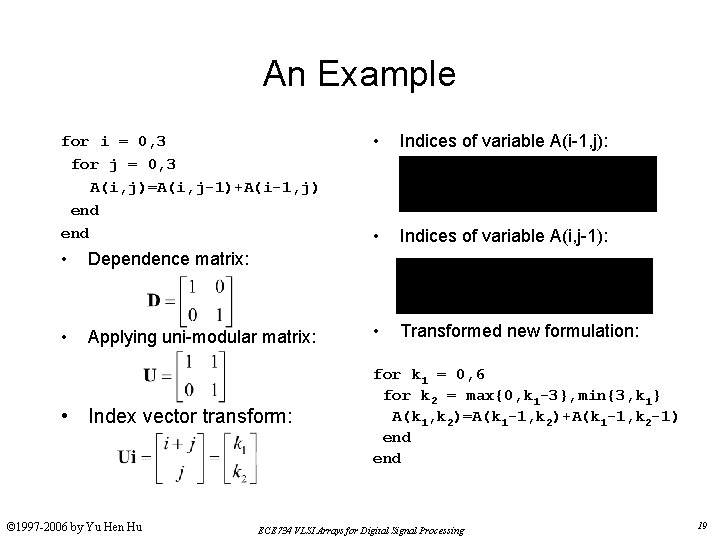
An Example for i = 0, 3 for j = 0, 3 A(i, j)=A(i, j-1)+A(i-1, j) end • Dependence matrix: • Applying uni-modular matrix: • Index vector transform: © 1997 -2006 by Yu Hen Hu • Indices of variable A(i-1, j): • Indices of variable A(i, j-1): • Transformed new formulation: for k 1 = 0, 6 for k 2 = max{0, k 1 -3}, min{3, k 1} A(k 1, k 2)=A(k 1 -1, k 2)+A(k 1 -1, k 2 -1) end ECE 734 VLSI Arrays for Digital Signal Processing 19
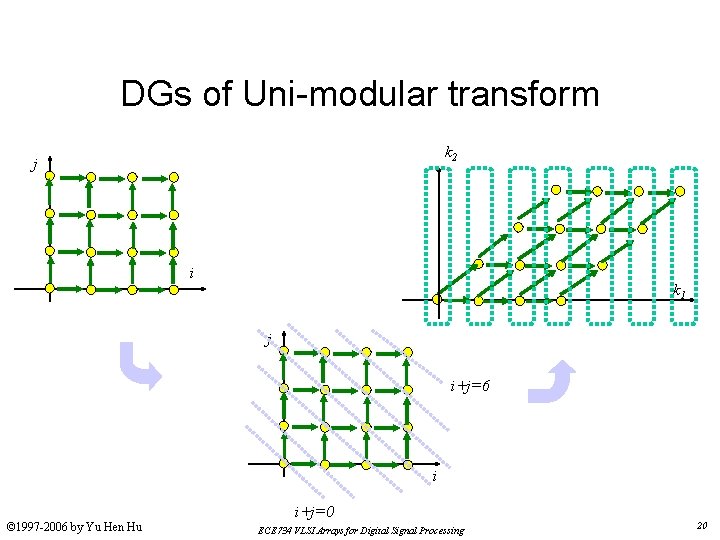
DGs of Uni-modular transform k 2 j i k 1 j i+j=6 i © 1997 -2006 by Yu Hen Hu i+j=0 ECE 734 VLSI Arrays for Digital Signal Processing 20
- Slides: 20