
Loop of Henle Prof K Sivapalan Structure of
![Structure of Loop of Henle • Cortical nephrons have short loop of Henle [85%]](https://slidetodoc.com/presentation_image/bc43b35559687a79332f12e7778920ec/image-2.jpg "Structure of Loop of Henle • Cortical nephrons have short loop of Henle [85%]")
- Slides: 11
Loop of Henle Prof. K. Sivapalan
Structure of Loop of Henle • Cortical nephrons have short loop of Henle [85%] • Juxtamedullary nephron’s LH dip deep into medullary pyramids. • LH opens into DCT and finally into collecting ducts which descends through the medullary pyramid • Vasa recta are paralal to the LH. 10/2/2020 Loop DCT and CD 2
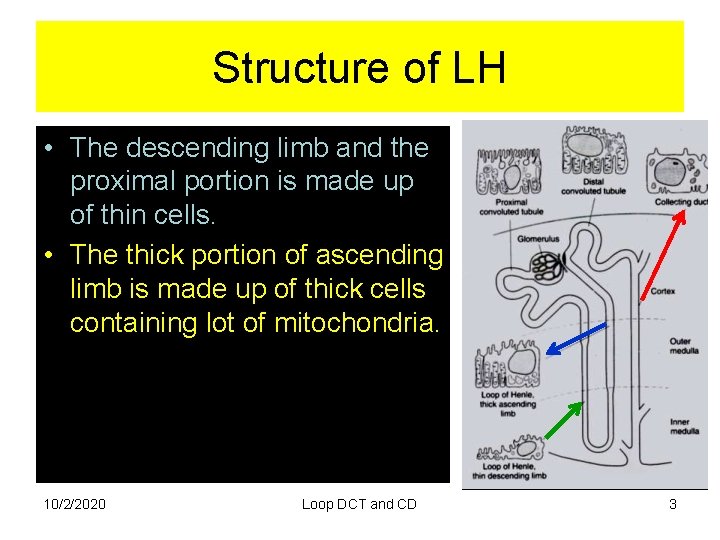
Structure of LH • The descending limb and the proximal portion is made up of thin cells. • The thick portion of ascending limb is made up of thick cells containing lot of mitochondria. 10/2/2020 Loop DCT and CD 3
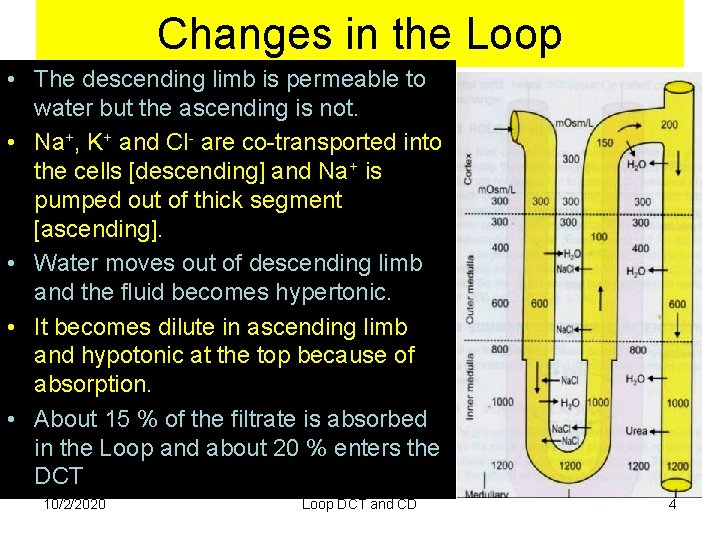
Changes in the Loop • The descending limb is permeable to water but the ascending is not. • Na+, K+ and Cl- are co-transported into the cells [descending] and Na+ is pumped out of thick segment [ascending]. • Water moves out of descending limb and the fluid becomes hypertonic. • It becomes dilute in ascending limb and hypotonic at the top because of absorption. • About 15 % of the filtrate is absorbed in the Loop and about 20 % enters the DCT 10/2/2020 Loop DCT and CD 4
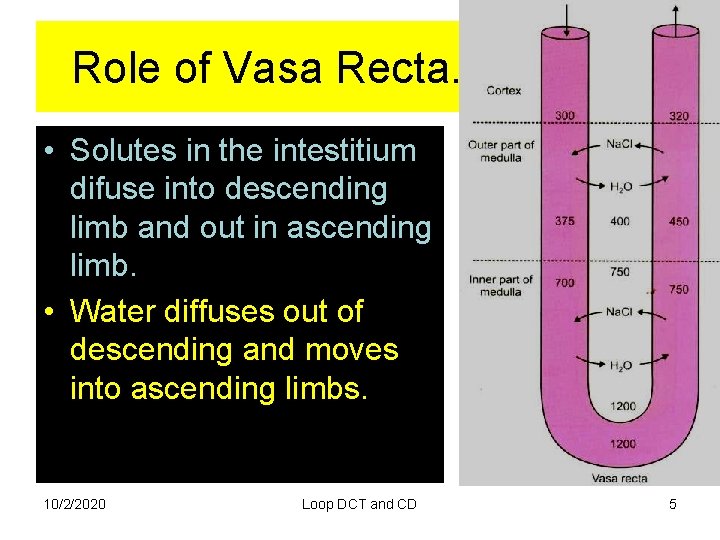
Role of Vasa Recta. • Solutes in the intestitium difuse into descending limb and out in ascending limb. • Water diffuses out of descending and moves into ascending limbs. 10/2/2020 Loop DCT and CD 5
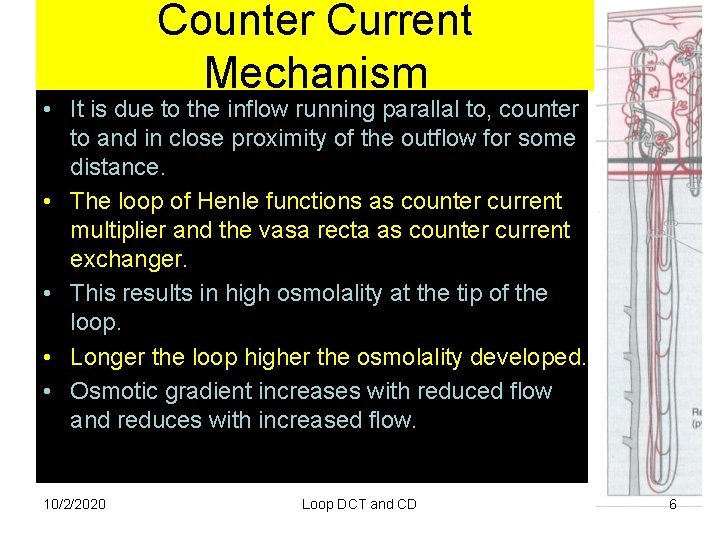
Counter Current Mechanism • It is due to the inflow running parallal to, counter to and in close proximity of the outflow for some distance. • The loop of Henle functions as counter current multiplier and the vasa recta as counter current exchanger. • This results in high osmolality at the tip of the loop. • Longer the loop higher the osmolality developed. • Osmotic gradient increases with reduced flow and reduces with increased flow. 10/2/2020 Loop DCT and CD 6
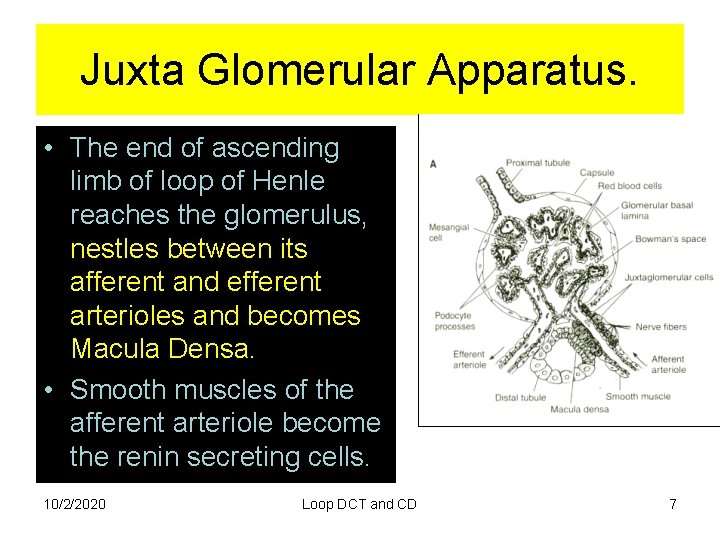
Juxta Glomerular Apparatus. • The end of ascending limb of loop of Henle reaches the glomerulus, nestles between its afferent and efferent arterioles and becomes Macula Densa. • Smooth muscles of the afferent arteriole become the renin secreting cells. 10/2/2020 Loop DCT and CD 7
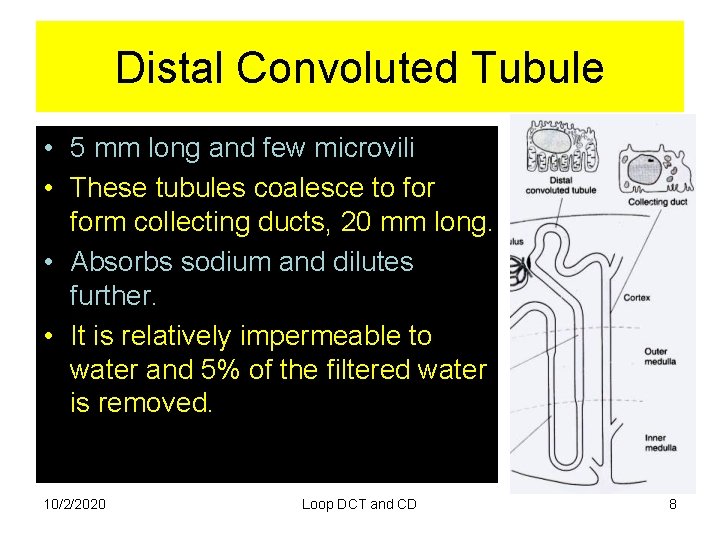
Distal Convoluted Tubule • 5 mm long and few microvili • These tubules coalesce to form collecting ducts, 20 mm long. • Absorbs sodium and dilutes further. • It is relatively impermeable to water and 5% of the filtered water is removed. 10/2/2020 Loop DCT and CD 8
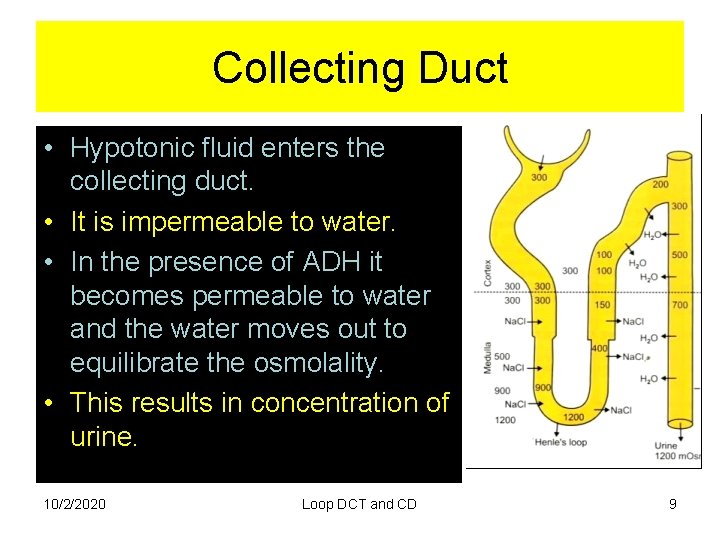
Collecting Duct • Hypotonic fluid enters the collecting duct. • It is impermeable to water. • In the presence of ADH it becomes permeable to water and the water moves out to equilibrate the osmolality. • This results in concentration of urine. 10/2/2020 Loop DCT and CD 9
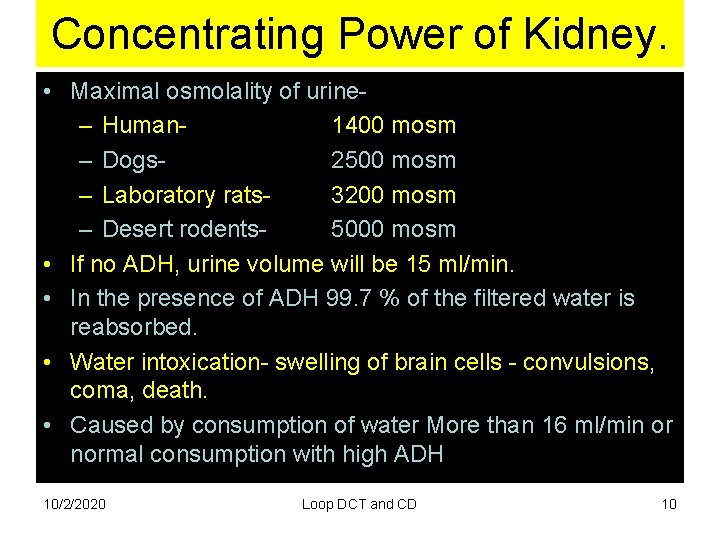
Concentrating Power of Kidney. • Maximal osmolality of urine– Human 1400 mosm – Dogs 2500 mosm – Laboratory rats 3200 mosm – Desert rodents 5000 mosm • If no ADH, urine volume will be 15 ml/min. • In the presence of ADH 99. 7 % of the filtered water is reabsorbed. • Water intoxication- swelling of brain cells - convulsions, coma, death. • Caused by consumption of water More than 16 ml/min or normal consumption with high ADH 10/2/2020 Loop DCT and CD 10
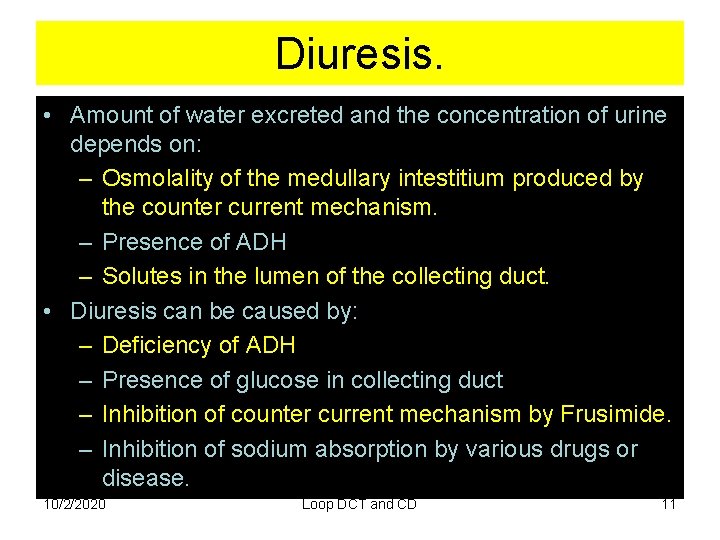
Diuresis. • Amount of water excreted and the concentration of urine depends on: – Osmolality of the medullary intestitium produced by the counter current mechanism. – Presence of ADH – Solutes in the lumen of the collecting duct. • Diuresis can be caused by: – Deficiency of ADH – Presence of glucose in collecting duct – Inhibition of counter current mechanism by Frusimide. – Inhibition of sodium absorption by various drugs or disease. 10/2/2020 Loop DCT and CD 11