
Loop Mesh Analysis 3 2 Dr Holbert February
Loop (Mesh) Analysis (3. 2) Dr. Holbert February 27, 2006 ECE 201 Lect-10 1
Loop Analysis • Nodal analysis was developed by applying KCL at each non-reference node. • Loop analysis is developed by applying KVL around loops in the circuit. • Loop (mesh) analysis results in a system of linear equations which must be solved for unknown currents. ECE 201 Lect-10 2
Example: A Summing Circuit • The output voltage V of this circuit is proportional to the sum of the two input voltages V 1 and V 2. • This circuit could be useful in audio applications or in instrumentation. • The output of this circuit would probably be connected to an amplifier. ECE 201 Lect-10 3
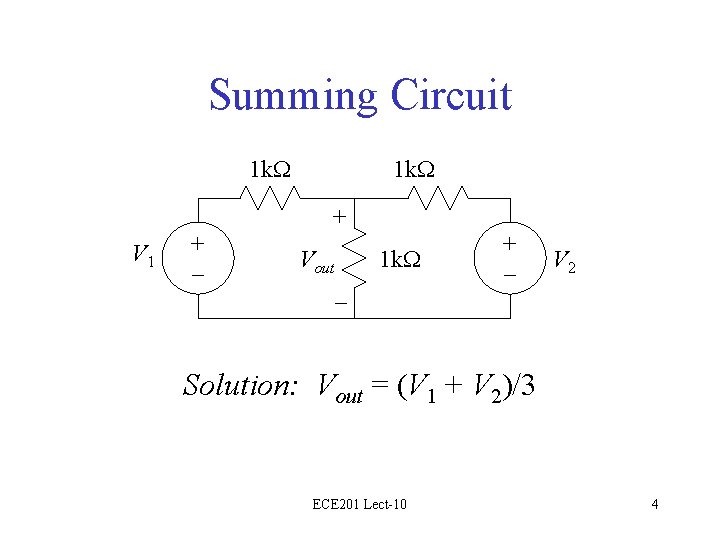
Summing Circuit 1 k. W + V 1 + – Vout 1 k. W + – V 2 – Solution: Vout = (V 1 + V 2)/3 ECE 201 Lect-10 4
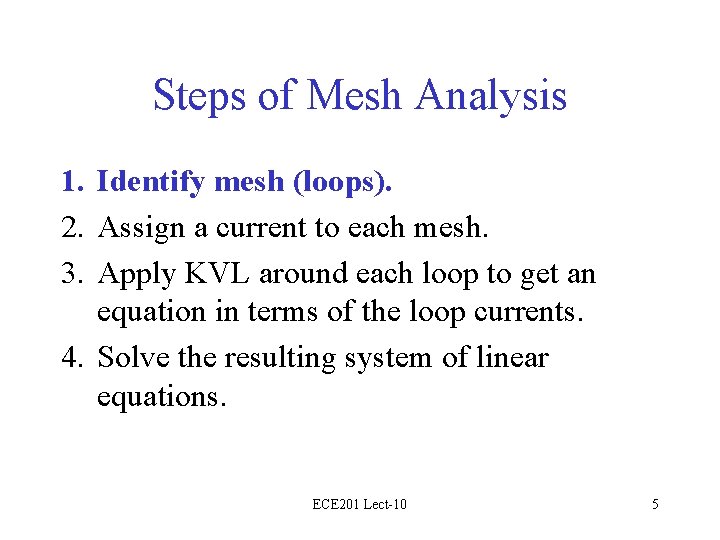
Steps of Mesh Analysis 1. Identify mesh (loops). 2. Assign a current to each mesh. 3. Apply KVL around each loop to get an equation in terms of the loop currents. 4. Solve the resulting system of linear equations. ECE 201 Lect-10 5
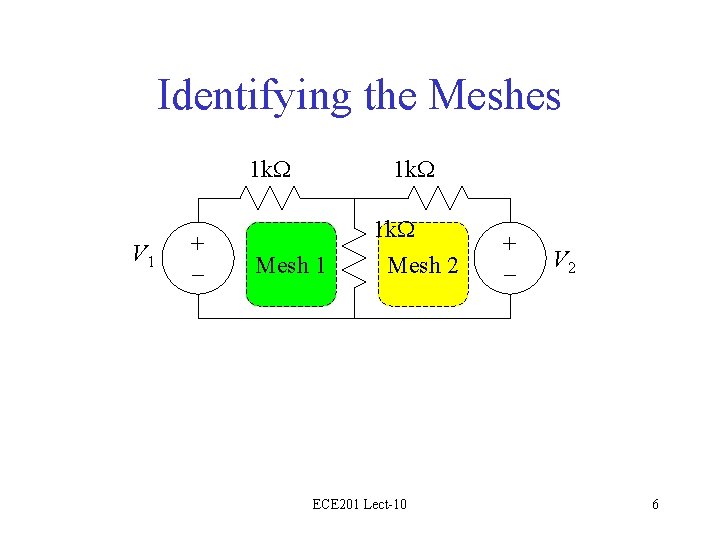
Identifying the Meshes 1 k. W V 1 + – 1 k. W Mesh 1 1 k. W Mesh 2 ECE 201 Lect-10 + – V 2 6
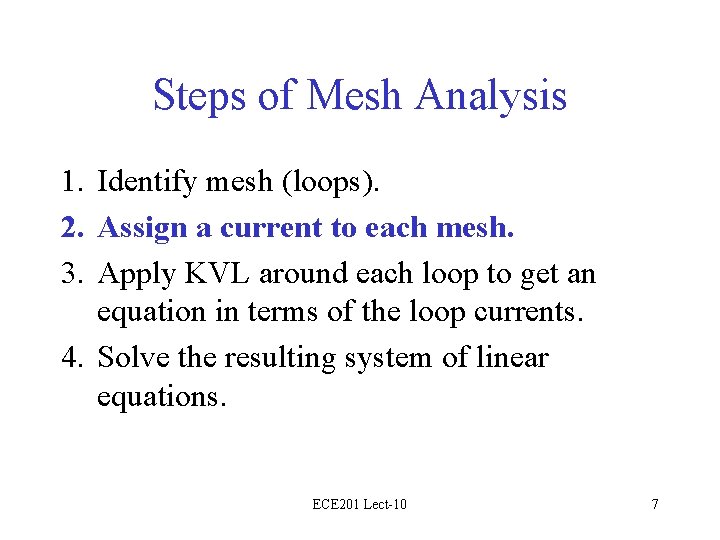
Steps of Mesh Analysis 1. Identify mesh (loops). 2. Assign a current to each mesh. 3. Apply KVL around each loop to get an equation in terms of the loop currents. 4. Solve the resulting system of linear equations. ECE 201 Lect-10 7
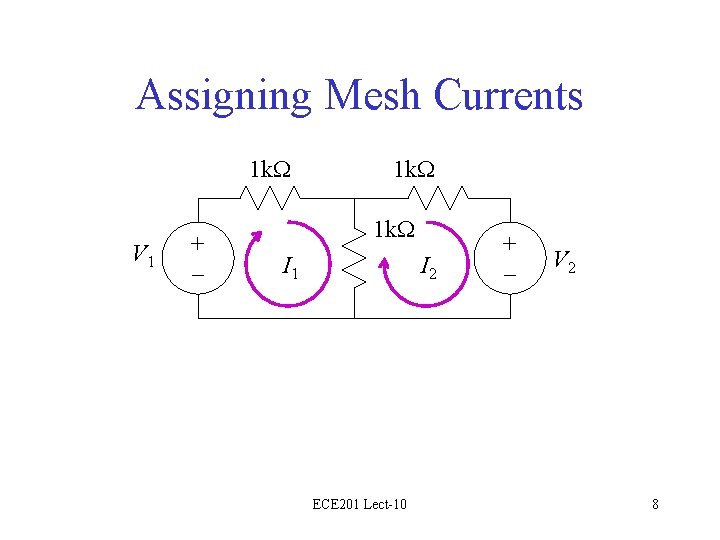
Assigning Mesh Currents 1 k. W V 1 + – 1 k. W I 1 I 2 ECE 201 Lect-10 + – V 2 8
Steps of Mesh Analysis 1. Identify mesh (loops). 2. Assign a current to each mesh. 3. Apply KVL around each loop to get an equation in terms of the loop currents. 4. Solve the resulting system of linear equations. ECE 201 Lect-10 9
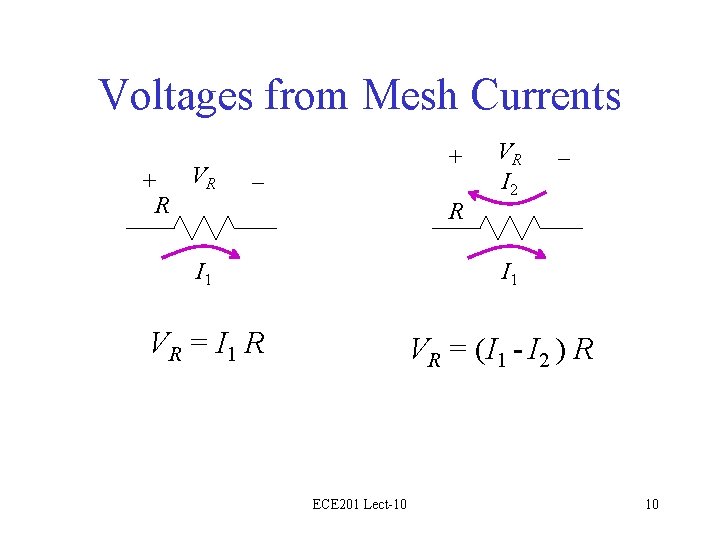
Voltages from Mesh Currents + VR R + – R I 1 VR I 2 – I 1 V R = I 1 R VR = (I 1 - I 2 ) R ECE 201 Lect-10 10
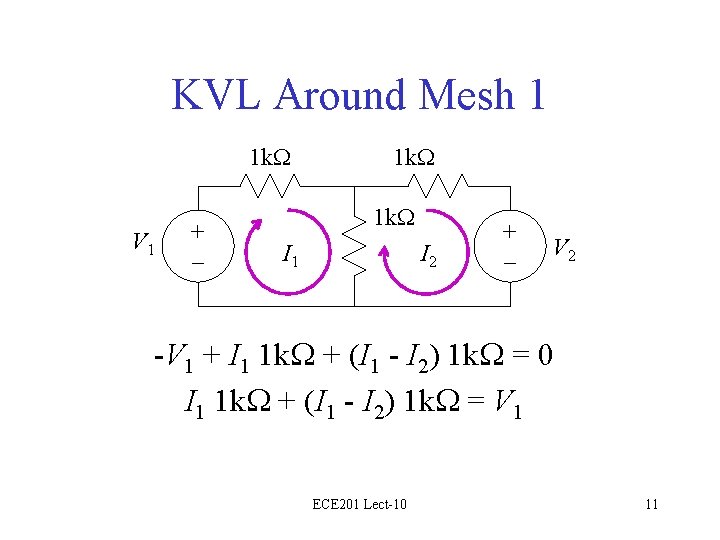
KVL Around Mesh 1 1 k. W V 1 + – 1 k. W I 1 I 2 + – V 2 -V 1 + I 1 1 k. W + (I 1 - I 2) 1 k. W = 0 I 1 1 k. W + (I 1 - I 2) 1 k. W = V 1 ECE 201 Lect-10 11
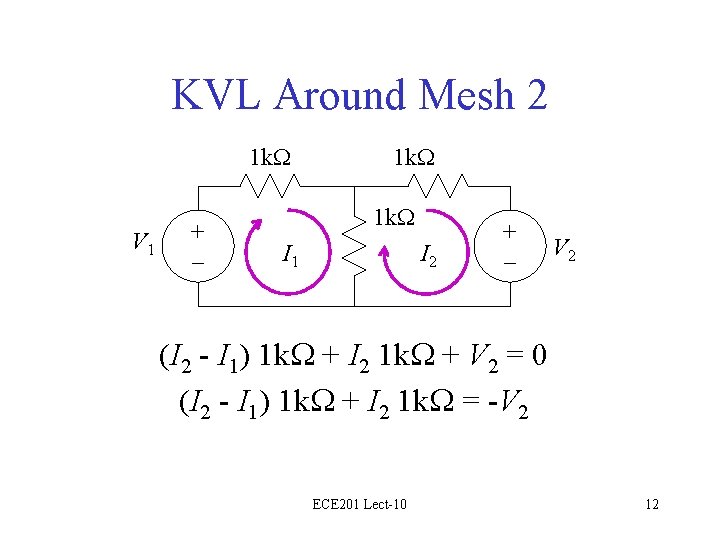
KVL Around Mesh 2 1 k. W V 1 + – 1 k. W I 1 I 2 + – V 2 (I 2 - I 1) 1 k. W + I 2 1 k. W + V 2 = 0 (I 2 - I 1) 1 k. W + I 2 1 k. W = -V 2 ECE 201 Lect-10 12
Steps of Mesh Analysis 1. Identify mesh (loops). 2. Assign a current to each mesh. 3. Apply KVL around each loop to get an equation in terms of the loop currents. 4. Solve the resulting system of linear equations. ECE 201 Lect-10 13
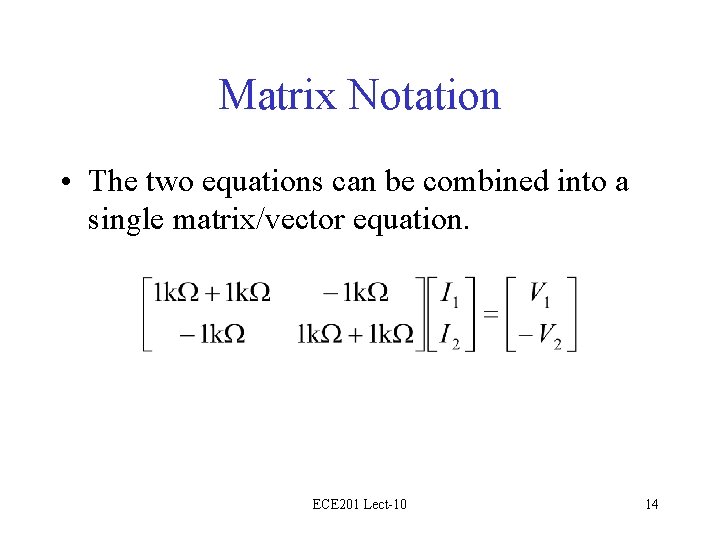
Matrix Notation • The two equations can be combined into a single matrix/vector equation. ECE 201 Lect-10 14
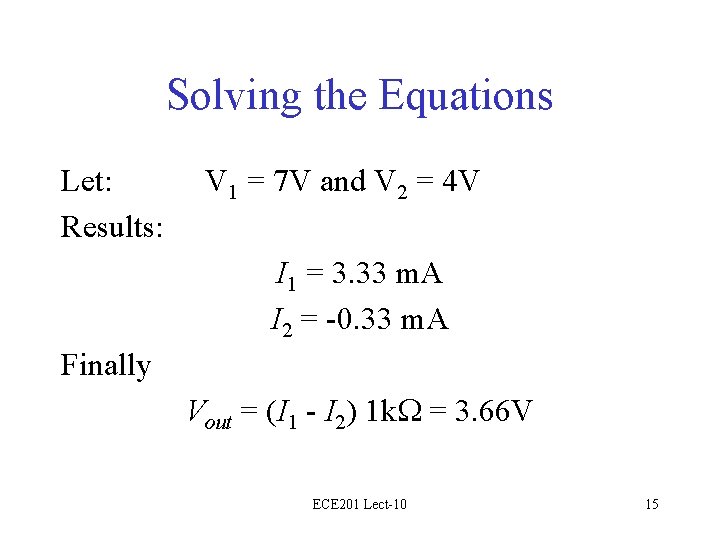
Solving the Equations Let: Results: V 1 = 7 V and V 2 = 4 V I 1 = 3. 33 m. A I 2 = -0. 33 m. A Finally Vout = (I 1 - I 2) 1 k. W = 3. 66 V ECE 201 Lect-10 15
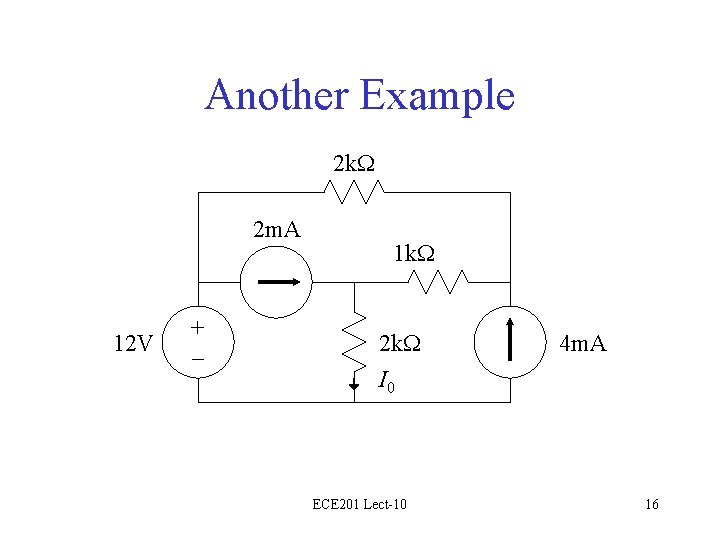
Another Example 2 k. W 2 m. A 12 V + – 1 k. W 2 k. W 4 m. A I 0 ECE 201 Lect-10 16
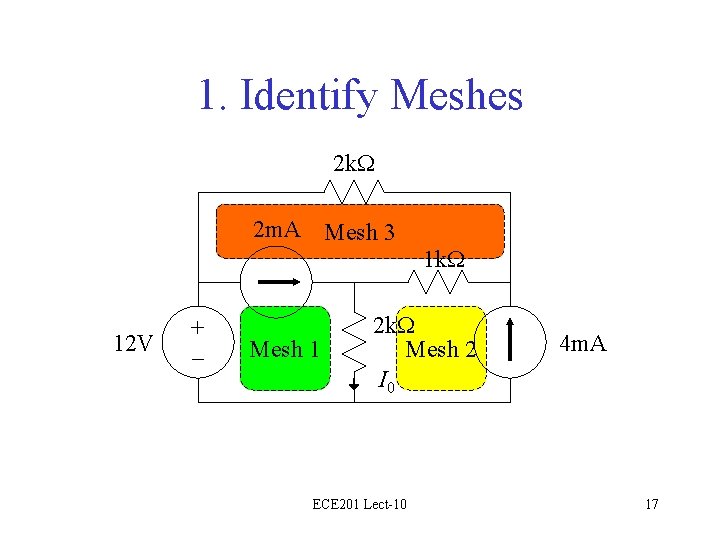
1. Identify Meshes 2 k. W 2 m. A Mesh 3 1 k. W 12 V + – Mesh 1 2 k. W Mesh 2 I 0 ECE 201 Lect-10 4 m. A 17
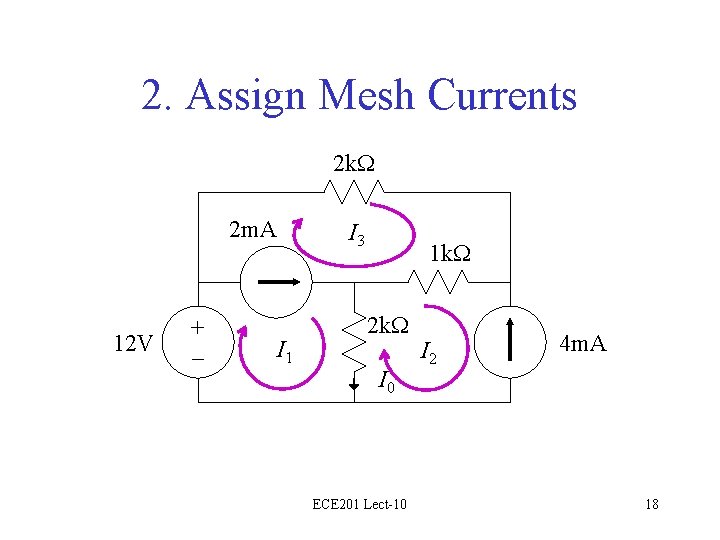
2. Assign Mesh Currents 2 k. W 2 m. A 12 V + – I 1 I 3 1 k. W 2 k. W I 0 ECE 201 Lect-10 I 2 4 m. A 18
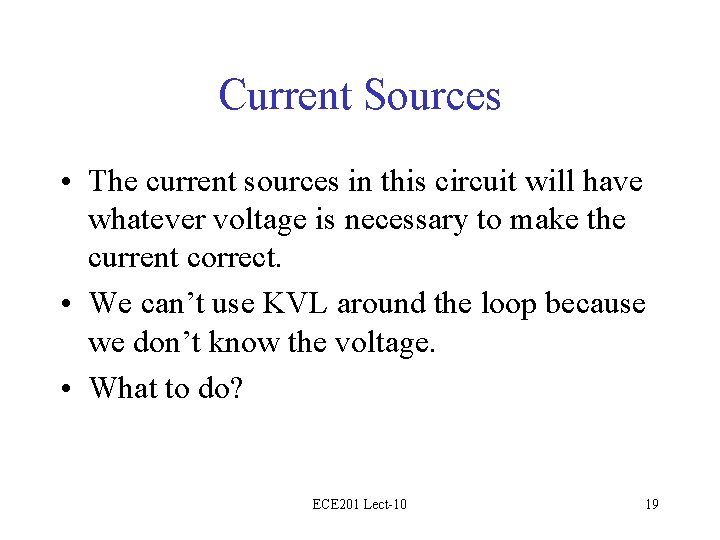
Current Sources • The current sources in this circuit will have whatever voltage is necessary to make the current correct. • We can’t use KVL around the loop because we don’t know the voltage. • What to do? ECE 201 Lect-10 19
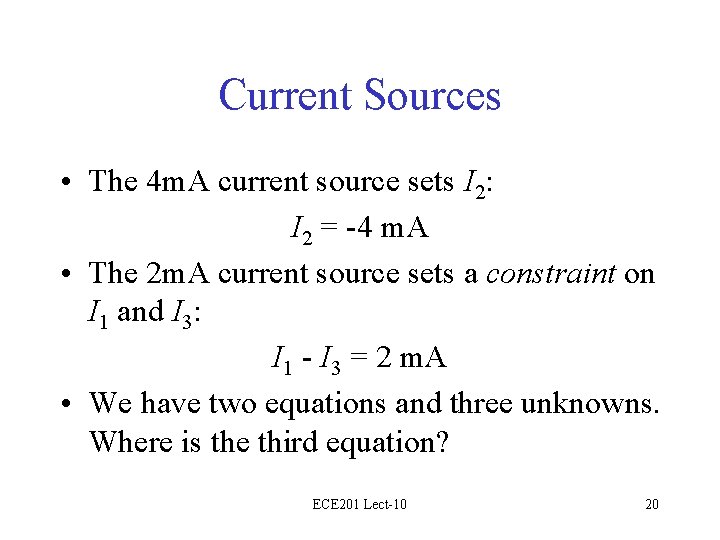
Current Sources • The 4 m. A current source sets I 2: I 2 = -4 m. A • The 2 m. A current source sets a constraint on I 1 and I 3: I 1 - I 3 = 2 m. A • We have two equations and three unknowns. Where is the third equation? ECE 201 Lect-10 20
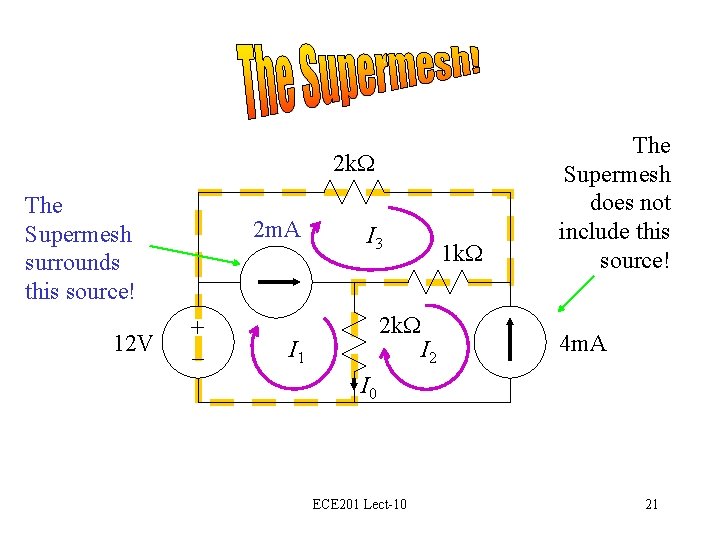
2 k. W The Supermesh surrounds this source! 12 V 2 m. A + – I 3 2 k. W I 2 I 1 1 k. W The Supermesh does not include this source! 4 m. A I 0 ECE 201 Lect-10 21
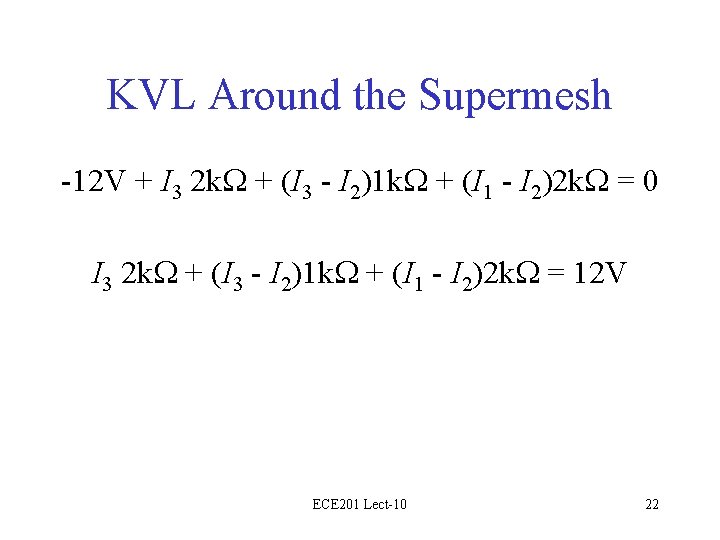
KVL Around the Supermesh -12 V + I 3 2 k. W + (I 3 - I 2)1 k. W + (I 1 - I 2)2 k. W = 0 I 3 2 k. W + (I 3 - I 2)1 k. W + (I 1 - I 2)2 k. W = 12 V ECE 201 Lect-10 22
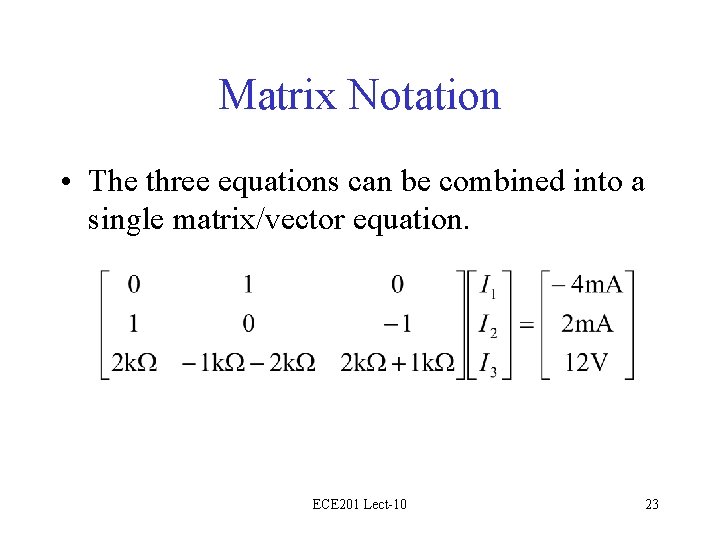
Matrix Notation • The three equations can be combined into a single matrix/vector equation. ECE 201 Lect-10 23
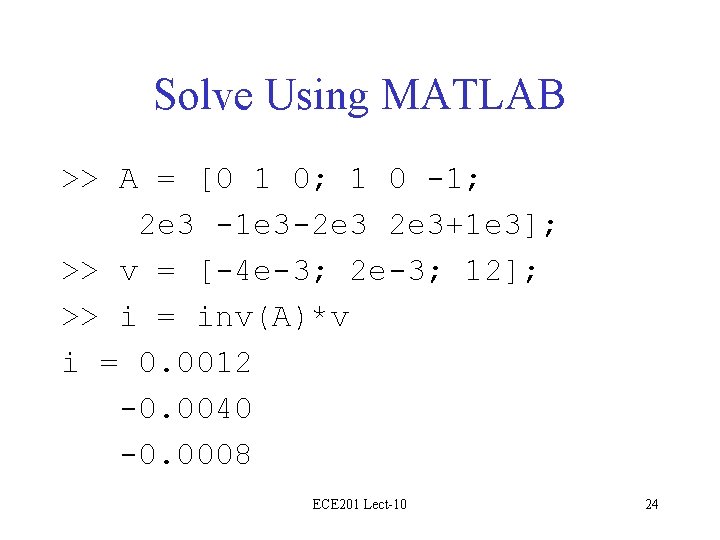
Solve Using MATLAB >> A = [0 1 0; 1 0 -1; 2 e 3 -1 e 3 -2 e 3+1 e 3]; >> v = [-4 e-3; 2 e-3; 12]; >> i = inv(A)*v i = 0. 0012 -0. 0040 -0. 0008 ECE 201 Lect-10 24
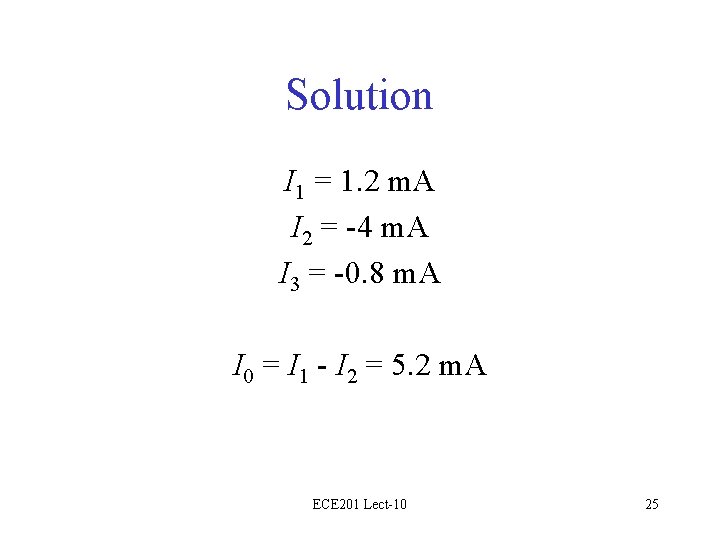
Solution I 1 = 1. 2 m. A I 2 = -4 m. A I 3 = -0. 8 m. A I 0 = I 1 - I 2 = 5. 2 m. A ECE 201 Lect-10 25
Class Example • Learning Extension E 3. 8 • Learning Extension E 3. 9 • Learning Extension E 3. 11 ECE 201 Lect-10 26
- Slides: 26