
Looking Forward Chapter 12 Copyright 2001 Prentice Hall

- Slides: 17
Looking Forward Chapter 12 Copyright 2001 Prentice Hall
Budgeting and Procurement Planning how to spend money Selecting and purchasing technologies and services
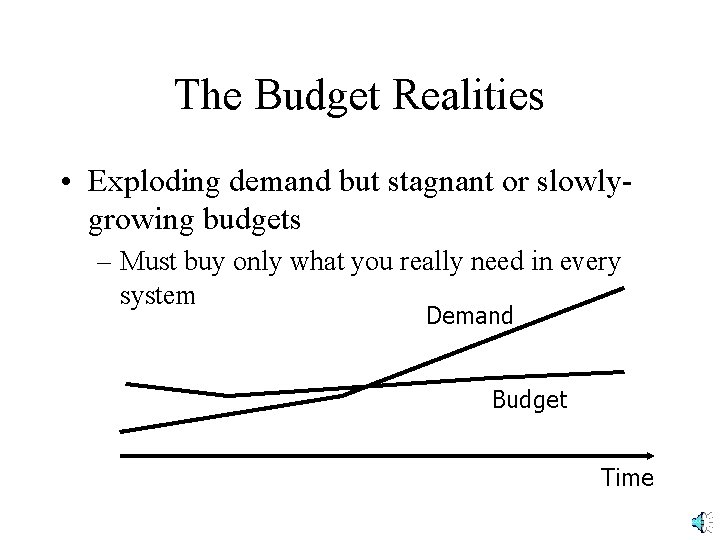
The Budget Realities • Exploding demand but stagnant or slowlygrowing budgets – Must buy only what you really need in every system Demand Budget Time
Costs • Total Purchase Costs – Network products and services are sold with many options – Base price is misleading because of the absence of needed options – It is crucial to cost out the total purchase cost of a system fully configured for your needs
Costs • Initial Installation Cost – The purchased product or service – Labor needed to implement • Central staff labor • User labor, including training costs • Losses due to implementation disruptions • May exceed purchase cost
Costs • Ongoing Costs over Life Span – Often exceed initial costs • Labor • Upgrades • Etc. – Especially high in products that are not mature • When possible, avoid the “bleeding edge”
The Timing of Costs and Benefits • Discounting – Money can be invested • If the investment rate is 20%, then • $1 invested today will bring $1. 20 next year • So $1 received today is worth $1. 20 received next year • Or, $1. 20 received next year is worth $1 today • Or, $1 received next year is worth only $0. 80 today
The Timing of Costs and Benefits • When Costs and Benefits Come Over Time – Hurdle rate: minimum rate of return expected by a corporation for investments • Often around 20% – If the hurdle rate is i then • Money received or spent a year from now should be discounted (divided) by (1+i) • Money received or spent n years from now should be discounted (divided) by (1+i)n
Procurement • User Needs – Must drive everything else – Sometimes difficult to assess – But the only way to drive evaluations of alternatives
Procurement • Request for Proposals (RFP) – Call for proposals to bid on the project – Specifies what should be provided – RFP will form the basis for resolving subsequent contract disputes • Must be very detailed • A legal document – If something is left out, negotiating for it after the contract is signed will be done at the contractor’s advantage
Procurement • Proposals – Several companies are likely to submit proposals – These proposals must be evaluated so that you can select the best one – You must lay out your evaluation criteria in the RFP and follow them in selection, or you can be sued by a loser
Procurement • Evaluating Proposals with Multicriteria Decision Making – First, you must have specific criteria • For instance, price, performance, and reliability • Same criteria must be applied to each proposal – Second, you must give a weight (importance) to each • Often of 5 -point or 10 -point scale • Same weights must be applied to each proposal
Procurement • Evaluating Proposals with Multicriteria Decision Making – Third, you must evaluate each proposal on each criteria • Perhaps on scale of 1 to 10 or some other scale • Score on each criterion will be different for each proposal
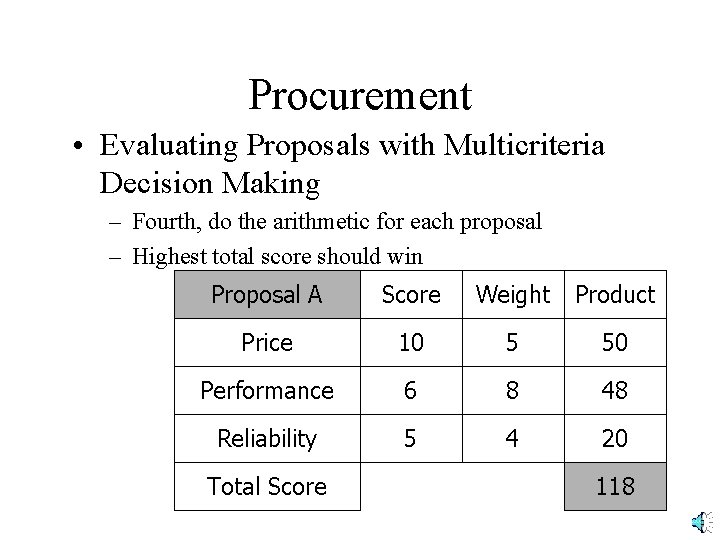
Procurement • Evaluating Proposals with Multicriteria Decision Making – Fourth, do the arithmetic for each proposal – Highest total score should win Proposal A Score Weight Product Price 10 5 50 Performance 6 8 48 Reliability 5 4 20 Total Score 118
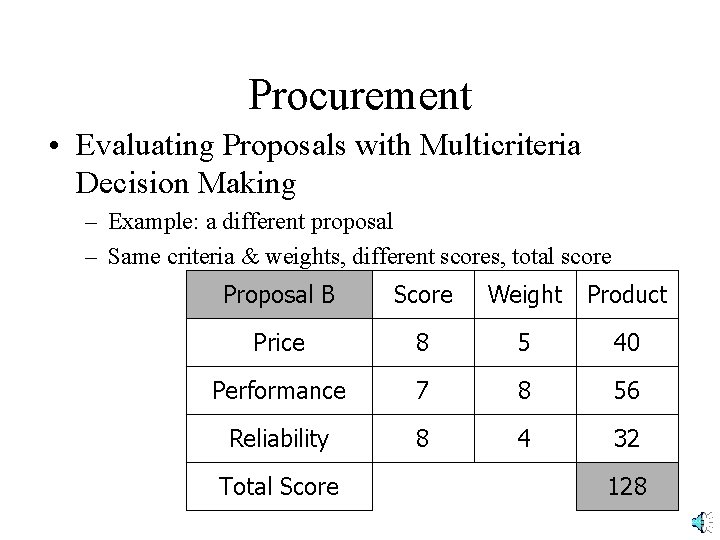
Procurement • Evaluating Proposals with Multicriteria Decision Making – Example: a different proposal – Same criteria & weights, different scores, total score Proposal B Score Weight Product Price 8 5 40 Performance 7 8 56 Reliability 8 4 32 Total Score 128
Procurement • Negotiating before contractor selection – Often, negotiate with a few highly-rated proposers before selection for better terms – Proposers present their Best and Final Offers
Procurement • Ongoing Monitoring – Must monitor the ongoing work to ensure compliance • Renegotiating During Performance – Sometimes must renegotiate during work; Bad because at a disadvantage in negotiations