Looking at these images what do you think

- Slides: 14
Looking at these images, what do you think today’s poem Extract from the Prelude could be about?
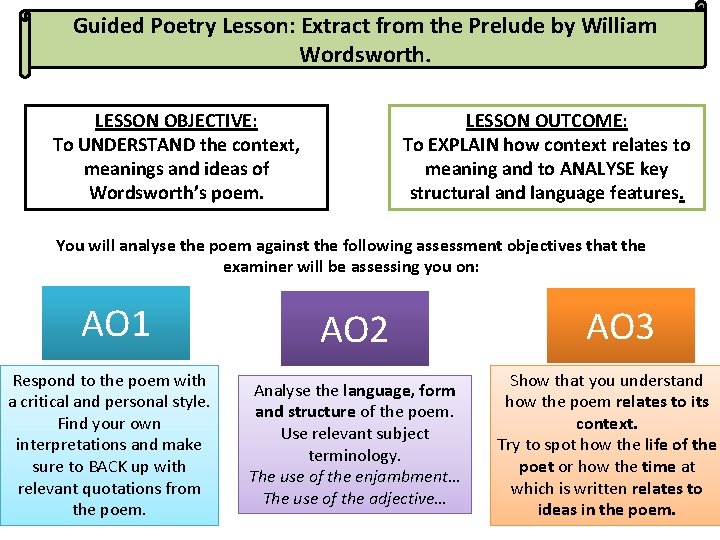
Guided Poetry Lesson: Extract from the Prelude by William Wordsworth. LESSON OUTCOME: To EXPLAIN how context relates to meaning and to ANALYSE key structural and language features. LESSON OBJECTIVE: To UNDERSTAND the context, meanings and ideas of Wordsworth’s poem. You will analyse the poem against the following assessment objectives that the examiner will be assessing you on: AO 1 Respond to the poem with a critical and personal style. Find your own interpretations and make sure to BACK up with relevant quotations from the poem. AO 2 Analyse the language, form and structure of the poem. Use relevant subject terminology. The use of the enjambment… The use of the adjective… AO 3 Show that you understand how the poem relates to its context. Try to spot how the life of the poet or how the time at which is written relates to ideas in the poem.
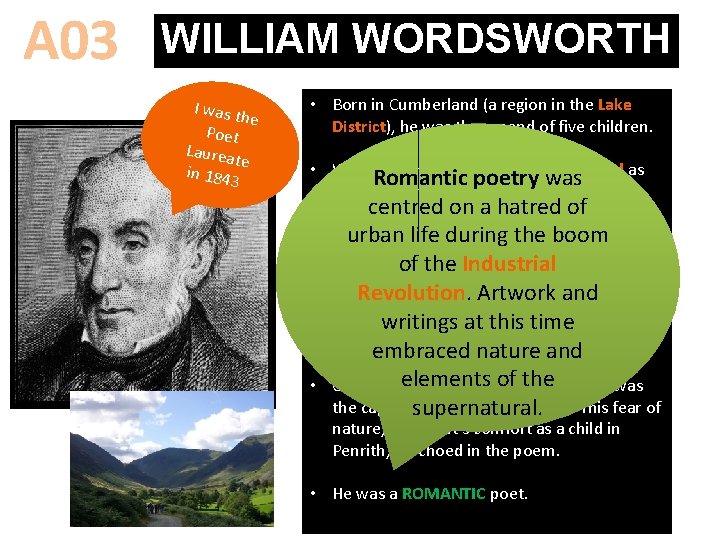
A 03 WILLIAM WORDSWORTH I was t he Poet Laurea te in 1843 • Born in Cumberland (a region in the Lake District), he was the second of five children. • Wordsworth had a traumatic childhood as Romantic poetry was both his parents died by the time he was centred on a hatred of thirteen. • • urban life during the boom He was sent to live with his grandparents of the Industrial and uncle in Penrith who he disliked so much Artwork and spent that. Revolution. he considered suicide. He often time exploring theat Lake District writings this timeto get away and seek comfort. embraced nature and of the Crucially, elements his eldest brother John, who was the captainsupernatural. of a ship, died at sea. This fear of nature, despite it’s comfort as a child in Penrith, is echoed in the poem. • He was a ROMANTIC poet.
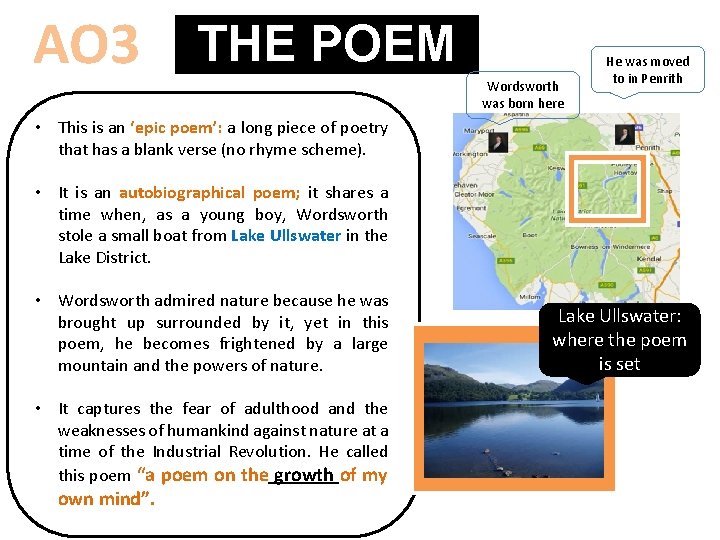
POEM AO 3 THE Contextual Introduction Wordsworth was born here He was moved to in Penrith • This is an ‘epic poem’: a long piece of poetry that has a blank verse (no rhyme scheme). • It is an autobiographical poem; it shares a time when, as a young boy, Wordsworth stole a small boat from Lake Ullswater in the Lake District. • Wordsworth admired nature because he was brought up surrounded by it, yet in this poem, he becomes frightened by a large mountain and the powers of nature. • It captures the fear of adulthood and the weaknesses of humankind against nature at a time of the Industrial Revolution. He called this poem “a poem on the growth of my own mind”. Lake Ullswater: where the poem is set
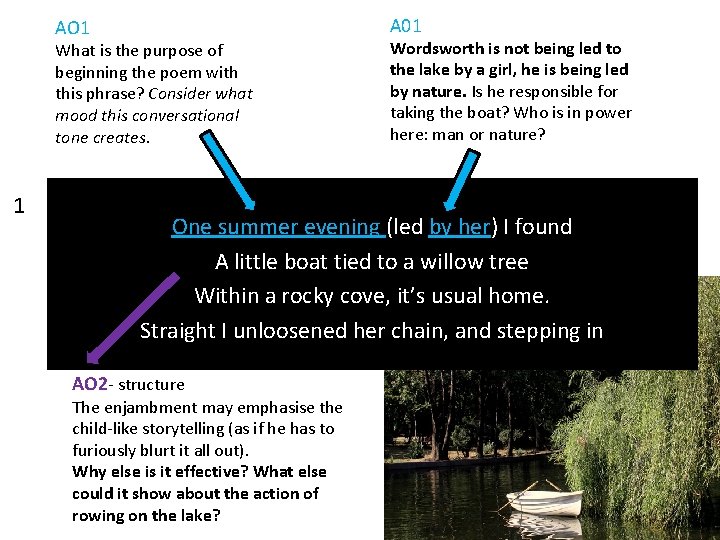
A 01 AO 1 What is the purpose of beginning the poem with this phrase? Consider what mood this conversational tone creates. 1 Wordsworth is not being led to the lake by a girl, he is being led by nature. Is he responsible for taking the boat? Who is in power here: man or nature? One summer evening (led by her) I found A little boat tied to a willow tree Within a rocky cove, it’s usual home. Straight I unloosened her chain, and stepping in AO 2 - structure The enjambment may emphasise the child-like storytelling (as if he has to furiously blurt it all out). Why else is it effective? What else could it show about the action of rowing on the lake?
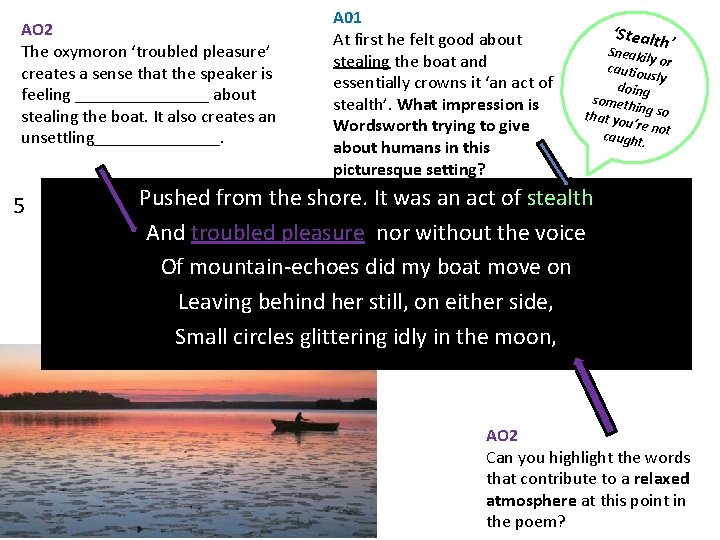
AO 2 The oxymoron ‘troubled pleasure’ creates a sense that the speaker is feeling ________ about stealing the boat. It also creates an unsettling_______. 5 A 01 At first he felt good about stealing the boat and essentially crowns it ‘an act of stealth’. What impression is Wordsworth trying to give about humans in this picturesque setting? ‘Stealth ’ Sn eakily o cautiou r sly doing someth in that yo g so u’re n caught ot. Pushed from the shore. It was an act of stealth And troubled pleasure, nor without the voice Of mountain-echoes did my boat move on Leaving behind her still, on either side, Small circles glittering idly in the moon, AO 2 Can you highlight the words that contribute to a relaxed atmosphere at this point in the poem?
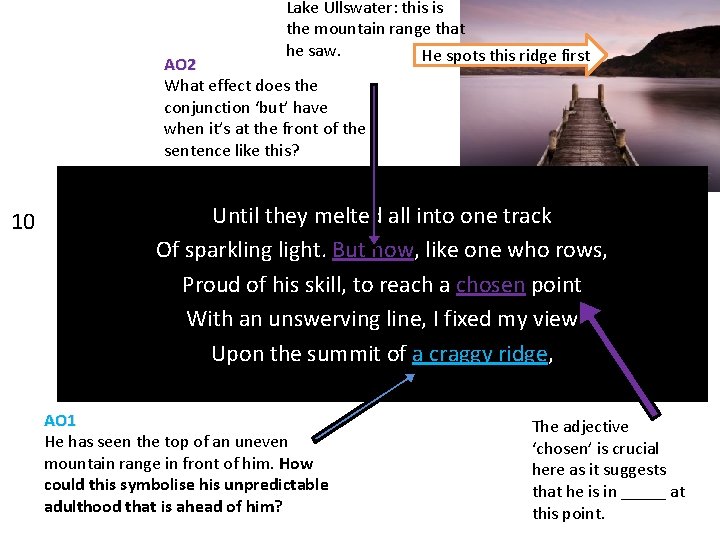
Lake Ullswater: this is the mountain range that he saw. He spots this ridge first AO 2 What effect does the conjunction ‘but’ have when it’s at the front of the sentence like this? 10 Until they melted all into one track Of sparkling light. But now, like one who rows, Proud of his skill, to reach a chosen point With an unswerving line, I fixed my view Upon the summit of a craggy ridge, AO 1 He has seen the top of an uneven mountain range in front of him. How could this symbolise his unpredictable adulthood that is ahead of him? The adjective ‘chosen’ is crucial here as it suggests that he is in _____ at this point.
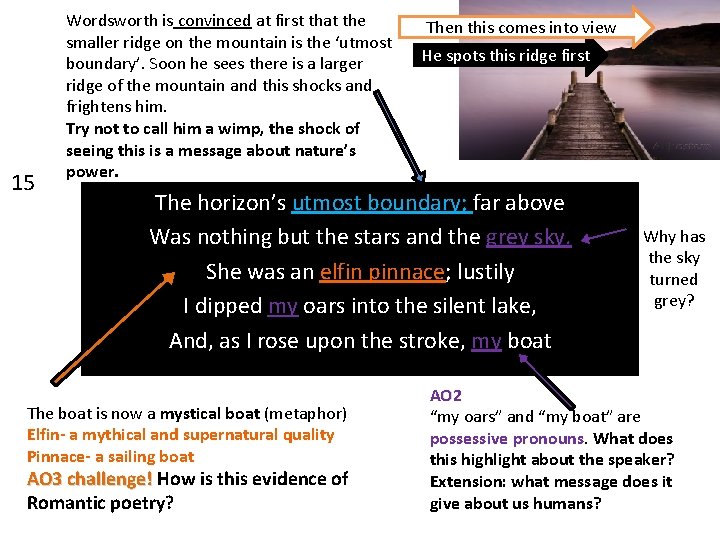
15 Wordsworth is convinced at first that the smaller ridge on the mountain is the ‘utmost boundary’. Soon he sees there is a larger ridge of the mountain and this shocks and frightens him. Try not to call him a wimp, the shock of seeing this is a message about nature’s power. Then this comes into view He spots this ridge first The horizon’s utmost boundary; far above Was nothing but the stars and the grey sky. She was an elfin pinnace; lustily I dipped my oars into the silent lake, And, as I rose upon the stroke, my boat The boat is now a mystical boat (metaphor) Elfin- a mythical and supernatural quality Pinnace- a sailing boat AO 3 challenge! How is this evidence of Romantic poetry? Why has the sky turned grey? AO 2 “my oars” and “my boat” are possessive pronouns. What does this highlight about the speaker? Extension: what message does it give about us humans?
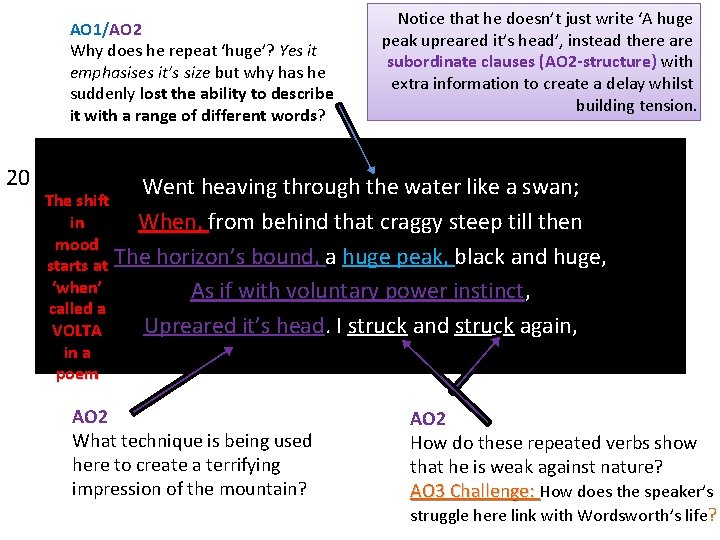
AO 1/AO 2 Why does he repeat ‘huge’? Yes it emphasises it’s size but why has he suddenly lost the ability to describe it with a range of different words? 20 Notice that he doesn’t just write ‘A huge peak upreared it’s head’, instead there are subordinate clauses (AO 2 -structure) with extra information to create a delay whilst building tension. Went heaving through the water like a swan; The shift in When, from behind that craggy steep till then mood starts at The horizon’s bound, a huge peak, black and huge, ‘when’ As if with voluntary power instinct, called a Upreared it’s head. I struck and struck again, VOLTA in a poem AO 2 What technique is being used here to create a terrifying impression of the mountain? AO 2 How do these repeated verbs show that he is weak against nature? AO 3 Challenge: How does the speaker’s struggle here link with Wordsworth’s life?
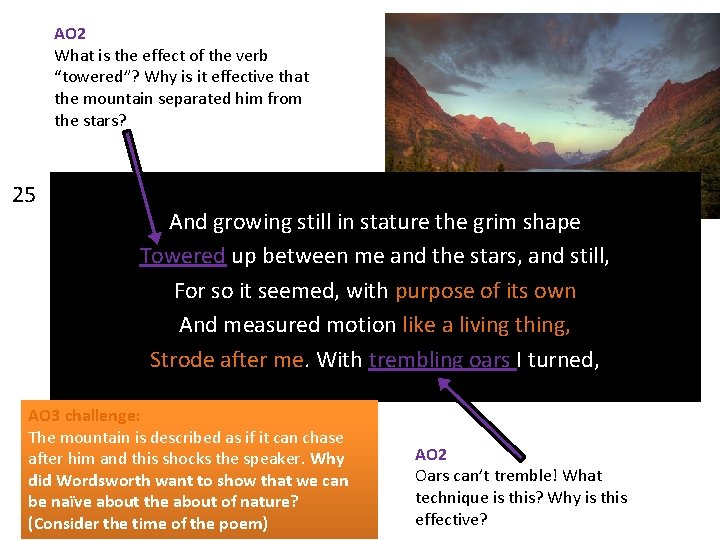
AO 2 What is the effect of the verb “towered”? Why is it effective that the mountain separated him from the stars? 25 And growing still in stature the grim shape Towered up between me and the stars, and still, For so it seemed, with purpose of its own And measured motion like a living thing, Strode after me. With trembling oars I turned, AO 3 challenge: The mountain is described as if it can chase after him and this shocks the speaker. Why did Wordsworth want to show that we can be naïve about the about of nature? (Consider the time of the poem) AO 2 Oars can’t tremble! What technique is this? Why is this effective?
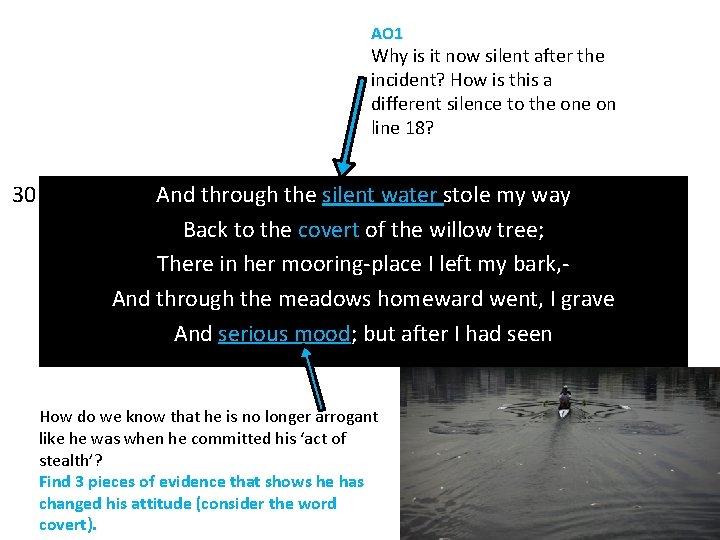
AO 1 Why is it now silent after the incident? How is this a different silence to the on line 18? 30 And through the silent water stole my way Back to the covert of the willow tree; There in her mooring-place I left my bark, And through the meadows homeward went, I grave And serious mood; but after I had seen How do we know that he is no longer arrogant like he was when he committed his ‘act of stealth’? Find 3 pieces of evidence that shows he has changed his attitude (consider the word covert).
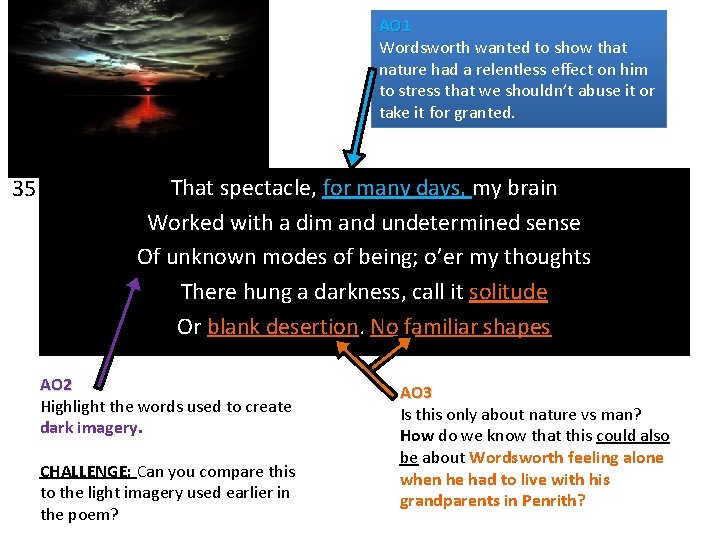
AO 1 Wordsworth wanted to show that nature had a relentless effect on him to stress that we shouldn’t abuse it or take it for granted. 35 That spectacle, for many days, my brain Worked with a dim and undetermined sense Of unknown modes of being; o’er my thoughts There hung a darkness, call it solitude Or blank desertion. No familiar shapes AO 2 Highlight the words used to create dark imagery. CHALLENGE: Can you compare this to the light imagery used earlier in the poem? AO 3 Is this only about nature vs man? How do we know that this could also be about Wordsworth feeling alone when he had to live with his grandparents in Penrith?
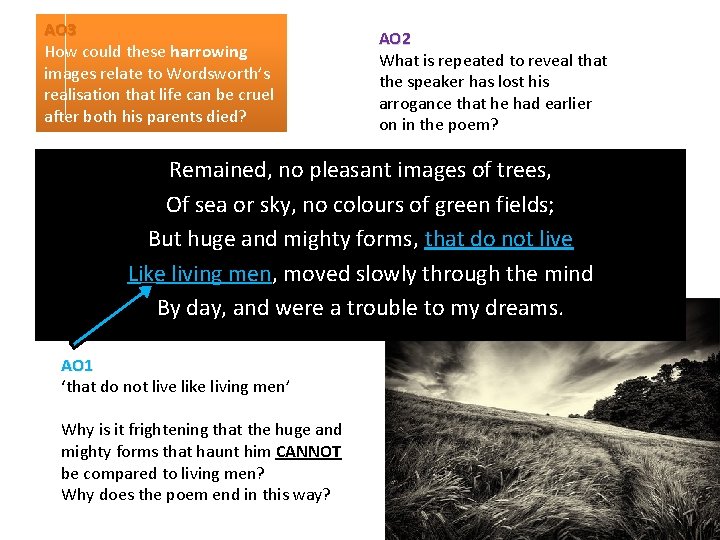
AO 3 How could these harrowing images relate to Wordsworth’s realisation that life can be cruel after both his parents died? AO 2 What is repeated to reveal that the speaker has lost his arrogance that he had earlier on in the poem? Remained, no pleasant images of trees, Of sea or sky, no colours of green fields; But huge and mighty forms, that do not live Like living men, moved slowly through the mind By day, and were a trouble to my dreams. AO 1 ‘that do not live like living men’ Why is it frightening that the huge and mighty forms that haunt him CANNOT be compared to living men? Why does the poem end in this way?
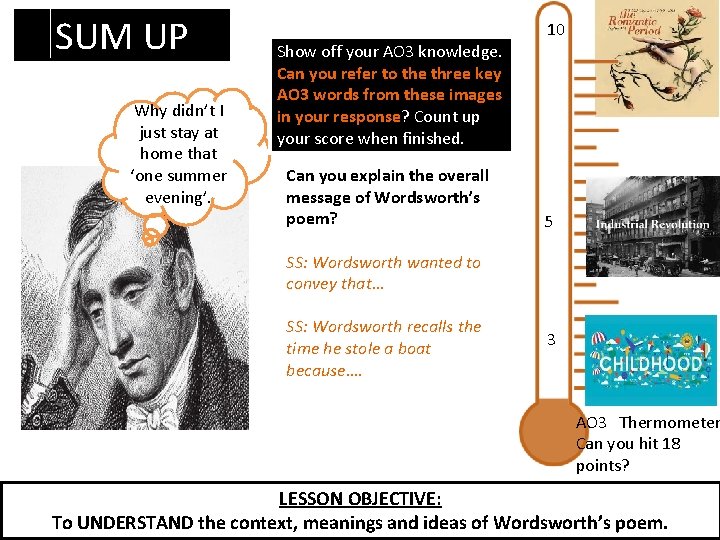
SUM UP Why didn’t I just stay at home that ‘one summer evening’. 10 Show off your AO 3 knowledge. Can you refer to the three key AO 3 words from these images in your response? response Count up your score when finished. Can you explain the overall message of Wordsworth’s poem? 5 SS: Wordsworth wanted to convey that… SS: Wordsworth recalls the time he stole a boat because…. 3 AO 3 Thermometer Can you hit 18 points? LESSON OBJECTIVE: To UNDERSTAND the context, meanings and ideas of Wordsworth’s poem.