
Looking ahead Genomic Laboratory Hub Rachel Butler Head

Looking ahead: Genomic Laboratory Hub Rachel Butler, Head of Bristol Genetics Laboratory
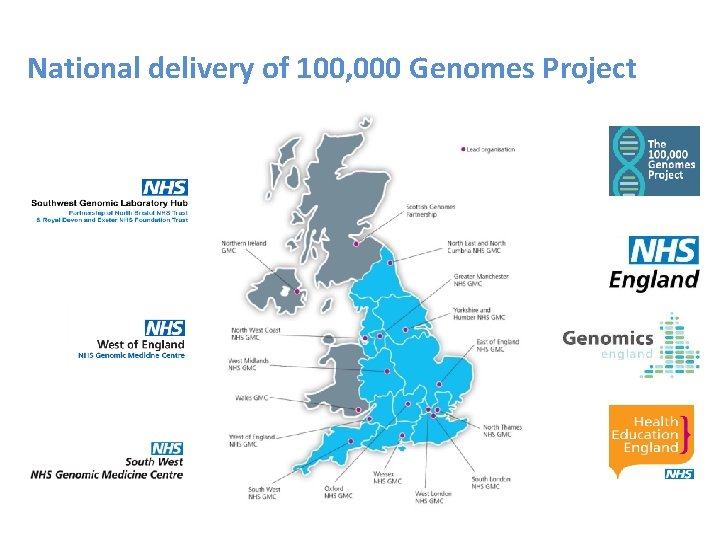
National delivery of 100, 000 Genomes Project
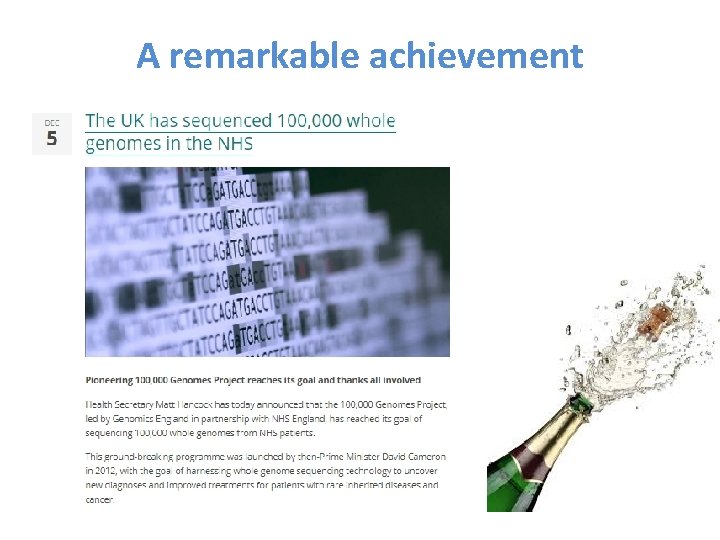
A remarkable achievement
GMC update • Return of results from the 100, 000 Genomes Project • Patient engagement and involvement • Support introduction of the Genomic Medicine Service and whole genome sequencing (WGS) • Co-ordination and implementation of future genomics projects
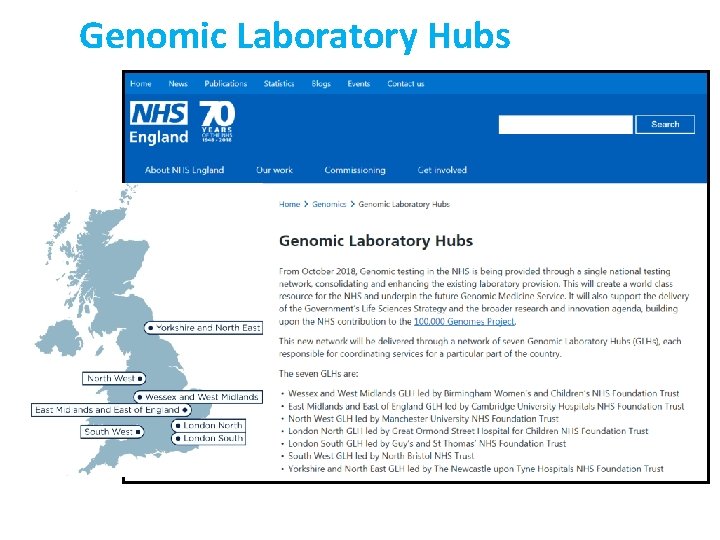
Genomic Laboratory Hubs

South West Genomic Laboratory Hub (SWGLH) • Partnership – North Bristol NHS Trust – Royal Devon and Exeter NHS Foundation Trust • Core genomic tests ( all 7 GLH) • • – Cancer Test Directory • • Specialist genomic tests delivered by GLH • appointed as a National Specialist Test • Provider (NSTP) – Rare disease Test Directory Cancer (somatic/inherited) Cardiology Renal Neurology Respiratory/Metabolic – 17 clinical specialisms ( 2 or 4 providers) • GLH will forward samples to the designated NSTP lab • Endocrinology
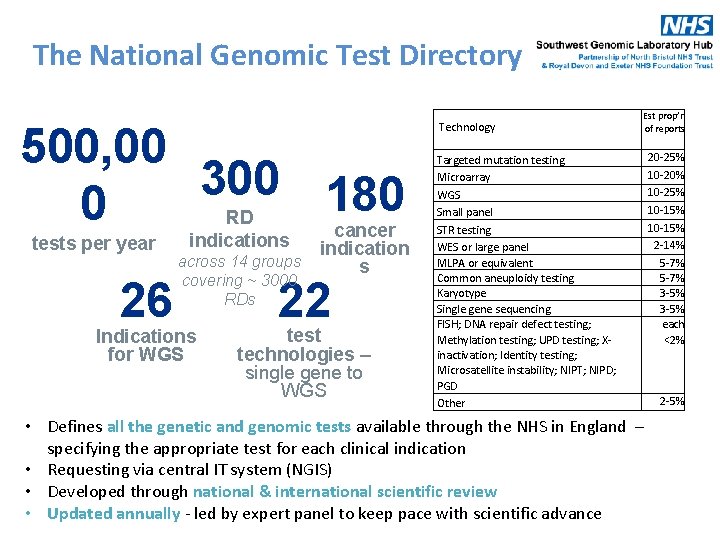
The National Genomic Test Directory 500, 00 300 180 0 tests per year 26 RD indications cancer indication across 14 groups s covering ~ 3000 RDs Indications for WGS 22 test technologies – single gene to WGS Technology Targeted mutation testing Microarray WGS Small panel STR testing WES or large panel MLPA or equivalent Common aneuploidy testing Karyotype Single gene sequencing FISH; DNA repair defect testing; Methylation testing; UPD testing; Xinactivation; Identity testing; Microsatellite instability; NIPT; NIPD; PGD Other Est prop’n of reports 20 -25% 10 -20% 10 -25% 10 -15% 2 -14% 5 -7% 3 -5% each <2% • Defines all the genetic and genomic tests available through the NHS in England – specifying the appropriate test for each clinical indication • Requesting via central IT system (NGIS) • Developed through national & international scientific review • Updated annually - led by expert panel to keep pace with scientific advance 2 -5%

The National Genomic Test Directory https: //www. england. nhs. uk/publication/national-genomic-test-directories/

Pharmacogenomics: DPYD analysis Germline genetic variants in the dihydropyrimidine dehydrogenase (DPYD) gene can confer an increased risk of severe and even fatal toxicity, when patients with one or more copies of these variants are treated with the fluoropyrimidines, capecitabine or 5 -Fluorouracil. The gene encodes an enzyme which plays a role in the rate-limiting catabolism step of 5 -Fluorouracil metabolism and specific sequence variants are known to impact on the activity of the enzyme. If treating clinicians are aware that a patient is heterozygous or homozygous for one of these variants in many cases they will be able to adjust therapy regimes to reduce the risk of toxicity. rs. ID Haplotype name Genomic coordinates (Grh 38) Allele Functional Status Activity Score Evidence level for functional statusiv N/A rs 3918290 *2 A 1: 97450058 No function 0 Strong evidence supporting function c. 1679 T>G p. I 560 S rs 55886062 *13 1: 97515787 No function 0 Strong evidence supporting function DPYD c. 2846 A>T p. D 949 V rs 67376798 1: 97082391 Decreased function 0. 5 Strong evidence supporting function DPYD c. 11295923 C>G c. 1236 G>Aiii N/A, p. E 412 E rs 75017182, Hap. B 3 rs 56038477 1: 97579893 1: 97573863 Decreased function 0. 5 Strong evidence supporting function Nucleotide changei Protein changeii DPYD c. 1905+1 G> A DPYD Gene
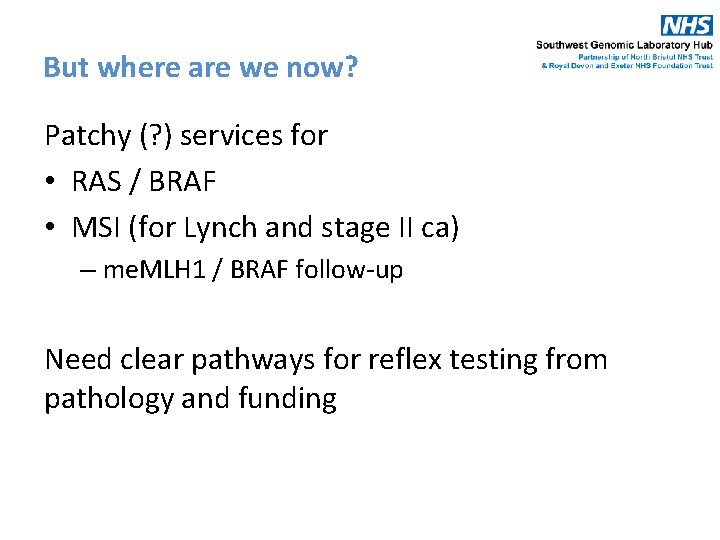
But where are we now? Patchy (? ) services for • RAS / BRAF • MSI (for Lynch and stage II ca) – me. MLH 1 / BRAF follow-up Need clear pathways for reflex testing from pathology and funding
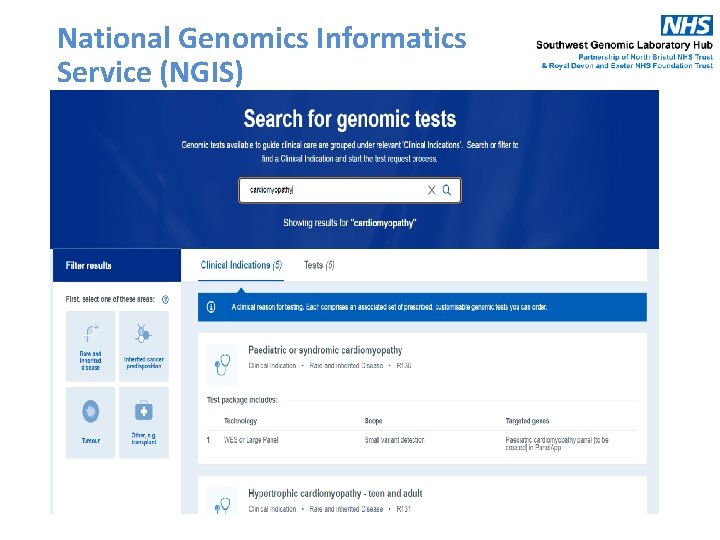
National Genomics Informatics Service (NGIS) October 2020 11
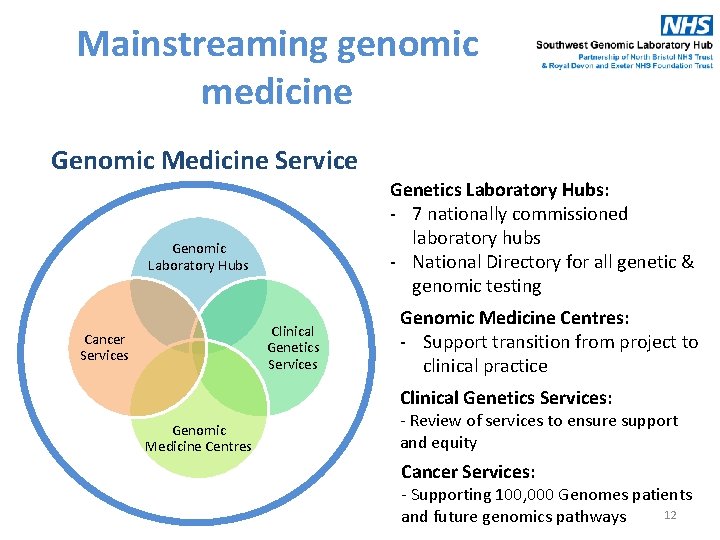
Mainstreaming genomic medicine Genomic Medicine Service Genomic Laboratory Hubs Clinical Genetics Services Cancer Services Genetics Laboratory Hubs: - 7 nationally commissioned laboratory hubs - National Directory for all genetic & genomic testing Genomic Medicine Centres: - Support transition from project to clinical practice Clinical Genetics Services: Genomic Medicine Centres - Review of services to ensure support and equity Cancer Services: - Supporting 100, 000 Genomes patients 12 and future genomics pathways
What the future holds… • Increased, more equitable access to genomic testing (centrally funded by NHS England) • On-line ordering of genomic tests from national test directory according to defined clinical eligibility criteria • New “patient choice” materials with opt-in for research • Standardised methodology across laboratories and improved reporting times • Increasing number of tests performed by genome sequencing (500, 000 funded over next 5 years, aspiration of 5 million genomic tests!)
- Slides: 13