
Look Listen and Link LLL Basic Psychological FirstAid
Look, Listen, and Link (LLL) Basic Psychological First-Aid and Suicide Awareness Based on the work by the World Health Organization 13 JAN 2016
Concept of Operations • Psychological first-aid (PFA) is a method to help first responders respond after crisis and continue their first responder service to their communities. • The Look, Listen, Link (LLL) model should be taught to CAP members by CAP CISM staff before an incident so an early, brief, and focused helping-hand can be there right away when the need arises…by a fellow team member. • This allows CAP to have members in the field or unit who have training in active listening and suicide prevention so we may all best serve our members.
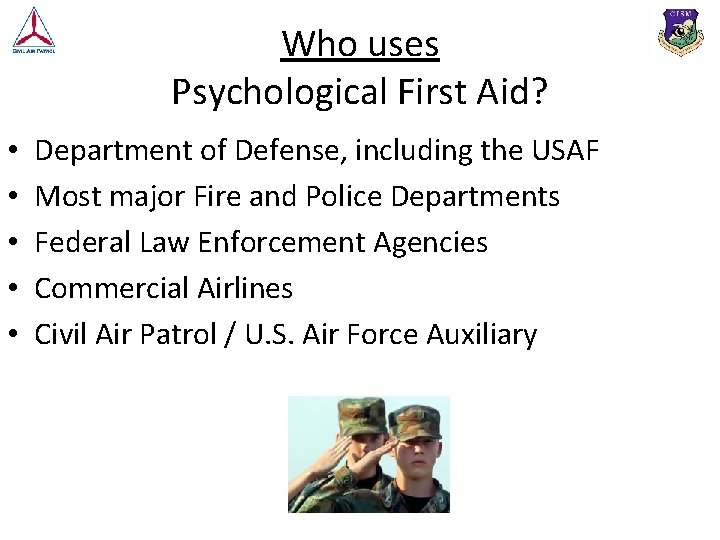
Who uses Psychological First Aid? • • • Department of Defense, including the USAF Most major Fire and Police Departments Federal Law Enforcement Agencies Commercial Airlines Civil Air Patrol / U. S. Air Force Auxiliary
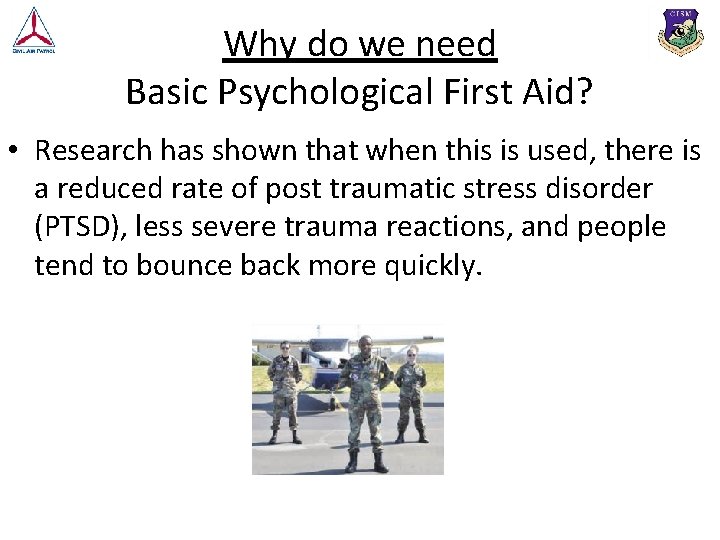
Why do we need Basic Psychological First Aid? • Research has shown that when this is used, there is a reduced rate of post traumatic stress disorder (PTSD), less severe trauma reactions, and people tend to bounce back more quickly.
When do we need Basic Psychological First Aid? • CAP members should be ready to provide support to one another when there is a: – Death or illness within a CAP family or unit; – Emergency Services mission; – Suicide or suicide attempt within the CAP family; – Squadron Meeting, Encampment, Bivouac, Fly Day, or other type of CAP meeting;
PFA is… • A humane, supportive response to someone who is suffering and who may need support. – provides practical and discreet care/support, which is not intrusive; – assesses their needs and concerns; – helps people to address basic needs (for example, food and water, information); listening to people, but not pressuring them to talk; – comforts people and helping them to feel calm; – helps people connect to information, services and social supports; – protects people from further harm.
PFA is not… • It is not something that only professionals can do; • It is not professional counseling; • It is not “psychological debriefing” in that PFA does not necessarily involve a detailed discussion of the event that caused the distress; • It is not asking someone to analyze what happened to them or to put time and events in order; • Although PFA involves being available to listen to people’s stories, it is not about pressuring people to tell you their feelings and reactions to an event.

Principles of Basic PFA • Safety- Decreases further threat exposure; provides “grounding” to increase the feeling of safety. • Calming- Reduces trauma-related anxiety that can interfere with decision making, and performance of life tasks. • Beneficial Self-Change (self-efficacy) – By giving practical help, people will have to tools to help themselves. CAP Leaders should display these traits directly after a trauma to best help their units or team members.

Principles of Basic PFA • Connectedness- Since increased social support is related to better emotional well-being and recovery following mass trauma. • Hope / Optimism- Because more favorable outcomes occur when persons retain hope for their future, believe in the future, and have a feeling of confidence that life is predictable. CAP Leaders should display these traits directly after a trauma to best help their units or team members.

Look, Listen, Link (LLL) Basic PFA Steps • Look – Look for obvious medical needs; call 911 if needed; – Is the area safe to enter; are you psychologically prepared to help and listen? If so, get consent to help. – Look for people with serious distress reactions (next slide). • Listen – Listen to people and help them feel safe and calm; – Ask if you can help and what they need right now; – Listen for signs of serious distress reactions or suicide. • Link – Help people address basic needs / get information; – Help people cope with problems-provide practical help; – Connect to loved ones, friends, Command, and/or CAP CISM Team (CIST). Make sure YOU speak with someone after.

Look, Listen, Link • Look – Check for Safety; • Scan the area and identify if it is safe to enter. • Are YOU mentally prepared to assist? • Get consent to help them. – Check for people with obvious medical needs; • Call 911 (or the local emergency number) if needed. – Check for people with serious distress reactions; • Some common distress reactions include appearing to be extremely upset, in a “daze”, or not responding when questioned; some specific examples are on the next slide. These people will benefit from this.
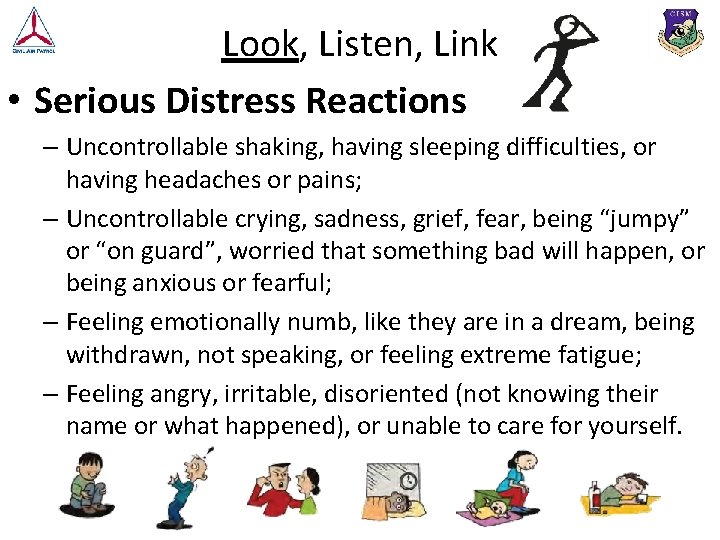
Look, Listen, Link • Serious Distress Reactions – Uncontrollable shaking, having sleeping difficulties, or having headaches or pains; – Uncontrollable crying, sadness, grief, fear, being “jumpy” or “on guard”, worried that something bad will happen, or being anxious or fearful; – Feeling emotionally numb, like they are in a dream, being withdrawn, not speaking, or feeling extreme fatigue; – Feeling angry, irritable, disoriented (not knowing their name or what happened), or unable to care for yourself.
Look, Listen, Link • Distress – Most people will recover well over time, especially if they can restore their basic needs and receive support from those around them or from those trained in PFA. – However, people with either severe or long-lasting distress reactions may need more support than PFA alone, particularly if they cannot function in their daily life or if they are a danger to themselves or others. – Make sure that severely distressed people are not left alone and try to keep them safe until you can find help from the chain of command, health personnel, local leaders or other community members in the area; sometimes just being quietly present will help them.

Look, Listen, Link • Listen – Listen properly to people you are helping; • EYES – Give the person your undivided attention. • EARS – Truly understand what their concerns are. • HEART – Be caring and show respect at all times. • PRESENCE – Sometimes just being present and nearby is enough to help someone through. CAP members must understand ANYONE can have a distress reaction. They occur from a single event or small doses of stress over time. It is not a sign of weakness, low maturity, or low intelligence. With the right amount of stress all people will have distress reactions.

Look, Listen, Link • Listen – Listen to people and help them feel safe and calm. • Find a safe, quiet place to talk; CPPT MUST BE MAINTAINED • Remove them from exposure from the media; TV turned off. • Ask if you can provide help. – Ask about their needs and concerns frequently. • Ask “what do you need? ” Food, water, shelter, blankets, communications, and information are common needs. – Listen for signs of serious distress reactions or suicide. • Do not pressure someone to talk; stay close in case they want to tell you their story. Be calming. • If they do talk, acknowledge them, nod, and explain that you are there to support them. • If they are truly safe, tell them that. If not, make it safe.

Look, Listen, Link • Listen – Don’t leave distressed people alone. – If a person is potentially suicidal: ACE – Ask, Care, Escort: – Ask them directly if they want to hurt themselves; – Care by calmly controlling the situation; actively listen and remove means of injury; if you can do so safely; – Escort them to the chain of command, an department or call 911. emergency • If you, or someone you know, is potentially suicidal, call the National Suicide Prevention Lifeline: phone 800 -273 -8255 or Text 838255.
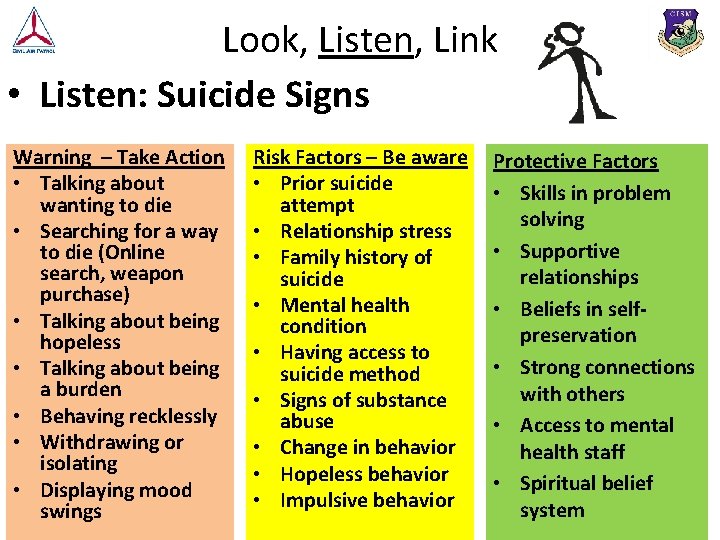
Look, Listen, Link • Listen: Suicide Signs Warning – Take Action • Talking about wanting to die • Searching for a way to die (Online search, weapon purchase) • Talking about being hopeless • Talking about being a burden • Behaving recklessly • Withdrawing or isolating • Displaying mood swings Risk Factors – Be aware • Prior suicide attempt • Relationship stress • Family history of suicide • Mental health condition • Having access to suicide method • Signs of substance abuse • Change in behavior • Hopeless behavior • Impulsive behavior Protective Factors • Skills in problem solving • Supportive relationships • Beliefs in selfpreservation • Strong connections with others • Access to mental health staff • Spiritual belief system

Look, Listen, Link • Listening: Calming Techniques – Calming Presence: make sure you promote calm by keeping your tone of voice calm and soft and your rate of speech slow and predictable. – When not sure what to do ask “what do you need right now? ” or “how may I help you? ”. Remember that silence and just being available is important. Do not be intrusive; if no help is needed, stand ready to help.
Look, Listen, Link • Listening: Calming Techniques – Diaphragmatic Breathing: instruct members with serious distress reactions to breath in through their nose over 4 -seconds, hold for 1 -second, and exhale through their mouth for 8 -seconds. Do this for 2 cycles of breathing every few minutes as needed (don’t overdo it). This type of breathing typically will relax their body.

Look, Listen, Link • Link: – Help people address basic needs and get information to help (food, water, shelter, safety, and information). – Help people cope with problems - provide practical help for their most important problems. List them out and assist with an action plan to help them fix their problems. – Connect them to loved ones, friends, Command, and/or CAP CISM Team. Your job is to ensure they are being supported by someone else; family, friends, CAP Command, and / or your local CAP CISM Team (CIST).
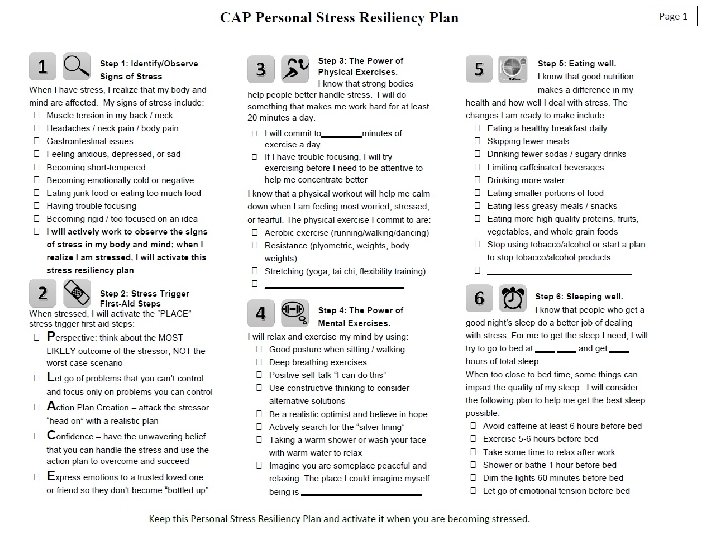
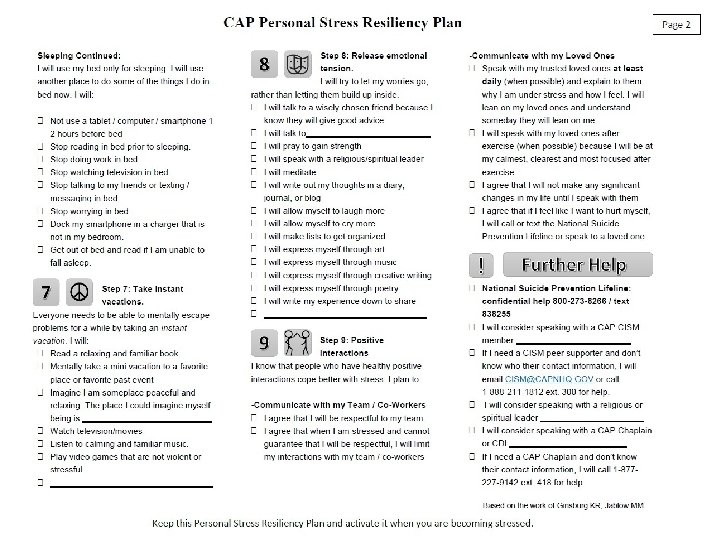
CAP Personal Stress Resiliency Plan • A plan developed to assist you: – When we are stressed our mind becomes cluttered. – This plan guides you through the process of becoming uncluttered. – It is best filled out before any times of stress and then taken out and followed during times of stress. – Found at: http: //www. capmembers. com/emergency_services/ critical_incident_stress_management__cism/ – It is your private document.
CAP Critical Incident Stress Management (CISM) Team • A confidential CAP team that assists CAP members or their families which assists the our member’s resiliency needs in crisis. • It uses the idea that after a crisis most people will fully recover with education on typical crisis reactions and through helping members meet needs. It uses professional level PFA and other crisis intervention techniques. • Any squadron, group, activity, or tasked incident commander may request a wing commander to activate a CAP CISM Team. You don’t need to tell anyone why you are activating the team. • CAP commanders should ensure that there is no stigma in requesting a CAP CIST, that confidentiality is maintained throughout the request process.
CAP Chaplain Corps • XXXXX

Additional PFA Resources “PFA Buddy Aid” World Health Organization (WHO) PFA Guidebook is an excellent resource: • http: //whqlibdoc. who. int/publications/2011/97892415 48205_eng. pdf • Thomas Janisko, Lt Col, CAP Chief, CAP CISM and Resiliency Program cism@caphq. gov (goes to CAP CISM HQ group) (202) 604 -7966 (Lt Col Janisko’s mobile phone) • Need Immediate CISM help: CAP National Operations Center at 1 -888 -211 -1812 Extension 301
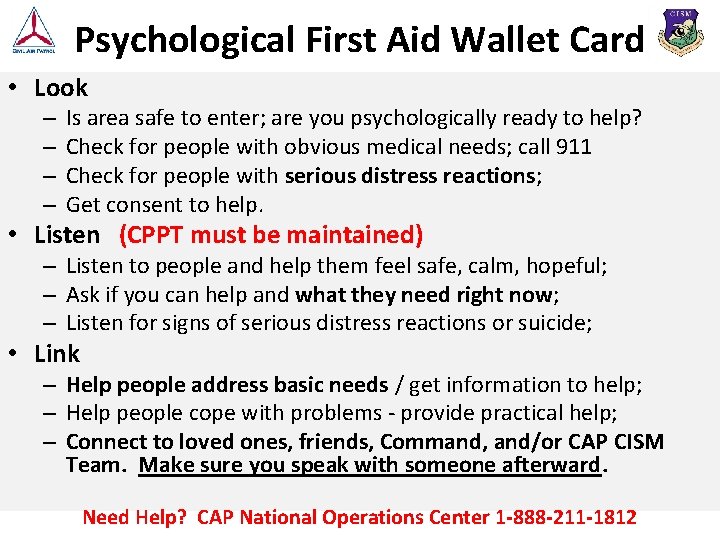
Psychological First Aid Wallet Card • Look – – Is area safe to enter; are you psychologically ready to help? Check for people with obvious medical needs; call 911 Check for people with serious distress reactions; Get consent to help. • Listen (CPPT must be maintained) – Listen to people and help them feel safe, calm, hopeful; – Ask if you can help and what they need right now; – Listen for signs of serious distress reactions or suicide; • Link – Help people address basic needs / get information to help; – Help people cope with problems - provide practical help; – Connect to loved ones, friends, Command, and/or CAP CISM Team. Make sure you speak with someone afterward. Need Help? CAP National Operations Center 1 -888 -211 -1812
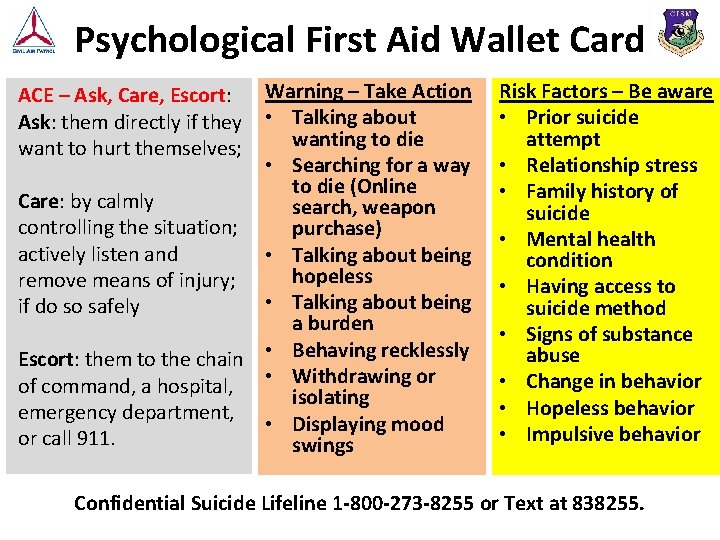
Psychological First Aid Wallet Card Warning – Take Action • Talking about wanting to die • Searching for a way to die (Online Care: by calmly search, weapon controlling the situation; purchase) actively listen and • Talking about being hopeless remove means of injury; • Talking about being if do so safely a burden Escort: them to the chain • Behaving recklessly of command, a hospital, • Withdrawing or isolating emergency department, • Displaying mood or call 911. swings ACE – Ask, Care, Escort: Ask: them directly if they want to hurt themselves; Risk Factors – Be aware • Prior suicide attempt • Relationship stress • Family history of suicide • Mental health condition • Having access to suicide method • Signs of substance abuse • Change in behavior • Hopeless behavior • Impulsive behavior Confidential Suicide Lifeline 1 -800 -273 -8255 or Text at 838255.

Test – Question 1 • What does the acronym LLL stand for? ___________, _______ A) B) C) D) Live, Life, Loud Look, Listen, Link Learn, Leave, Link Look, Learn, Leave
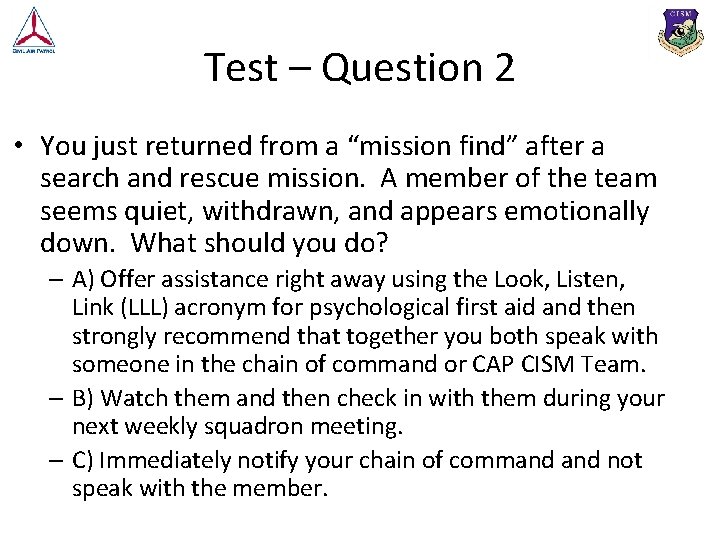
Test – Question 2 • You just returned from a “mission find” after a search and rescue mission. A member of the team seems quiet, withdrawn, and appears emotionally down. What should you do? – A) Offer assistance right away using the Look, Listen, Link (LLL) acronym for psychological first aid and then strongly recommend that together you both speak with someone in the chain of command or CAP CISM Team. – B) Watch them and then check in with them during your next weekly squadron meeting. – C) Immediately notify your chain of command not speak with the member.
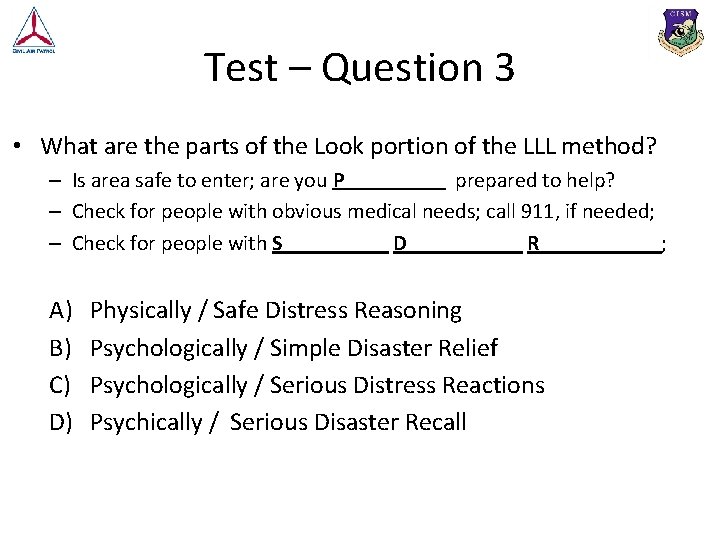
Test – Question 3 • What are the parts of the Look portion of the LLL method? – Is area safe to enter; are you P prepared to help? – Check for people with obvious medical needs; call 911, if needed; – Check for people with S D R ; A) B) C) D) Physically / Safe Distress Reasoning Psychologically / Simple Disaster Relief Psychologically / Serious Distress Reactions Psychically / Serious Disaster Recall
Test – Question 4 • A CAP member appears depressed, talks about feeling hopeless, and talked about being a burden. What should you do? – Follow the ACE acronym which stands for? ________ A) B) C) D) Ask, Care, Escort Ask, Communicate, Extract Assist, Communicate, Escort Assist, Care, Endorse
Test – Question 5 • What are the parts of the Link portion of the LLL method? – Help people address basic needs / get to help; – Help people cope with problems - provide practical help; – Connect to loved ones, friends, Command, and the CAP Team. A) B) C) D) Consent / CISM Information / CISN Authority / CISU Information / CISM
Test – Bonus 1 • Who is your wing CISM Officer? ______ • If you don’t know, who can you call? _______
Test – Bonus 2 • Who is your CDI? ______ • If you don’t know, who can you call? _______
Test – Bonus 3 • Who is your Chaplain? ______ • If you don’t know, who can you call? _______
Awarded to For successful completion of the Civil Air Patrol Basic Psychological First Aid Course In recognition for the attainment of knowledge and proficiency in Psychological First Aid skills __________ Date Completed Thomas Janisko, Lt Col, CAP Chief, CISM and Resiliency Program
- Slides: 37