
LOOK BEFORE YOU LEAP Before You Sign That

LOOK BEFORE YOU LEAP Before You Sign That Contract …
Congratulations! ■ You have just been notified that you are the apparent successful offeror on a solicitation ■ A contract is being prepared for award ■ Now comes the warning: “Be careful of what you ask for – you just may get it!” ■ What follows are some common sense and some lesser known points concerning Government contracting that you should know.
Welcome to the world of “It Depends” ■ Before anyone can give you advice or answer a question one must know detailed information concerning the contract including: – Is this a government prime contract or a subcontract to the prime? – What does the contract say about the issue or concern in question? ■ ■ ■ Contract documents Order of precedence Applicable Law ■ No one knows everything about the FAR or the DFAR – Learn to look things up when in doubt – When in doubt seek professional help ■ ■ PTAC Legal or subject matter experts
Before You Sign ■ Read/review the contract and all attachments ■ Note any questions or discrepancies ■ Communicate issues with the CO or Prime contractor for negotiation or resolution ■ Beware the “self deleting clause”
Read the Full Contract ■ Does it agree with your proposal/quote – Do the dollars and dates agree with those proposed and/or negotiated? – Are clauses correct for the type contract – If you previously requested or negotiated for a change to the terms and conditions – has it been made? ■ Once you sign you loose your leverage
GOVERNMENT (PRIME) CONTRACT How to read and review the government’s contract
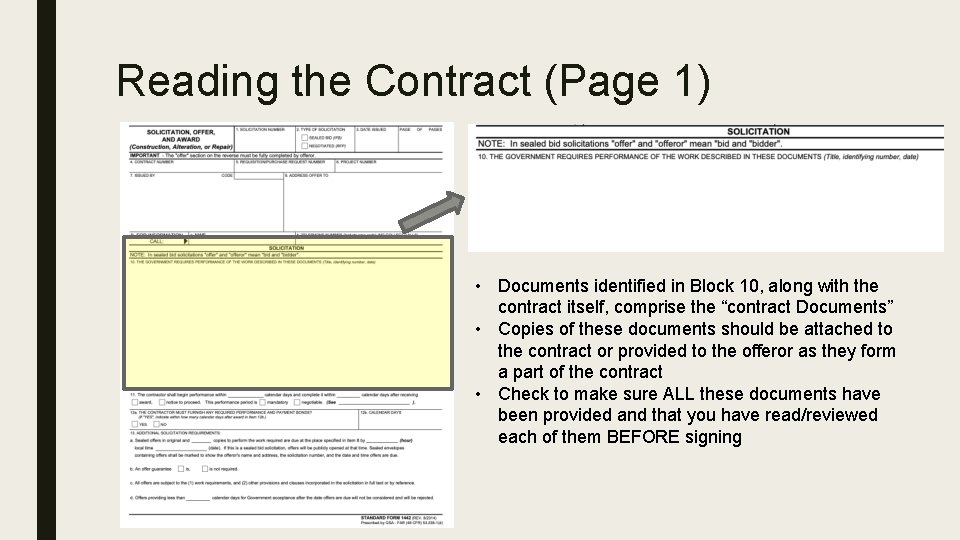
Reading the Contract (Page 1) • Documents identified in Block 10, along with the contract itself, comprise the “contract Documents” • Copies of these documents should be attached to the contract or provided to the offeror as they form a part of the contract • Check to make sure ALL these documents have been provided and that you have read/reviewed each of them BEFORE signing
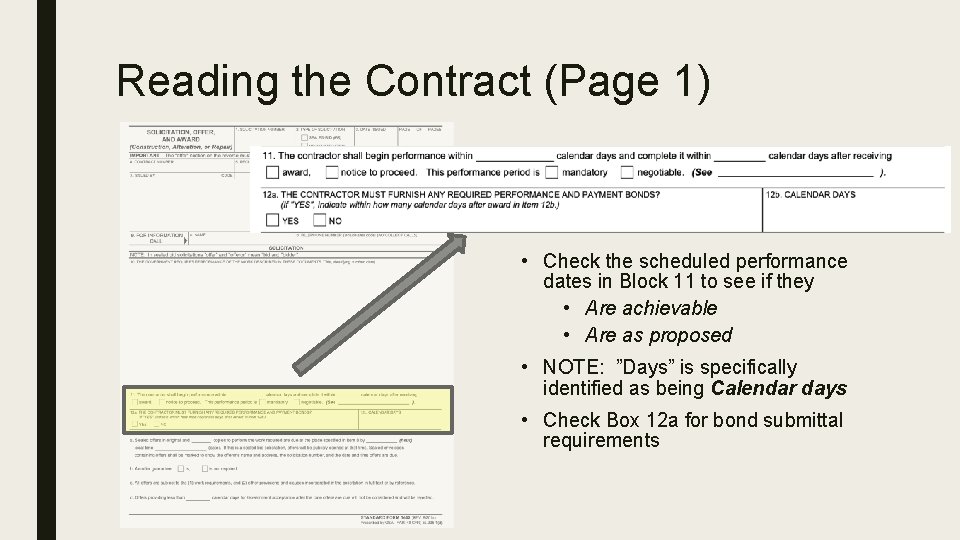
Reading the Contract (Page 1) • Check the scheduled performance dates in Block 11 to see if they • Are achievable • Are as proposed • NOTE: ”Days” is specifically identified as being Calendar days • Check Box 12 a for bond submittal requirements
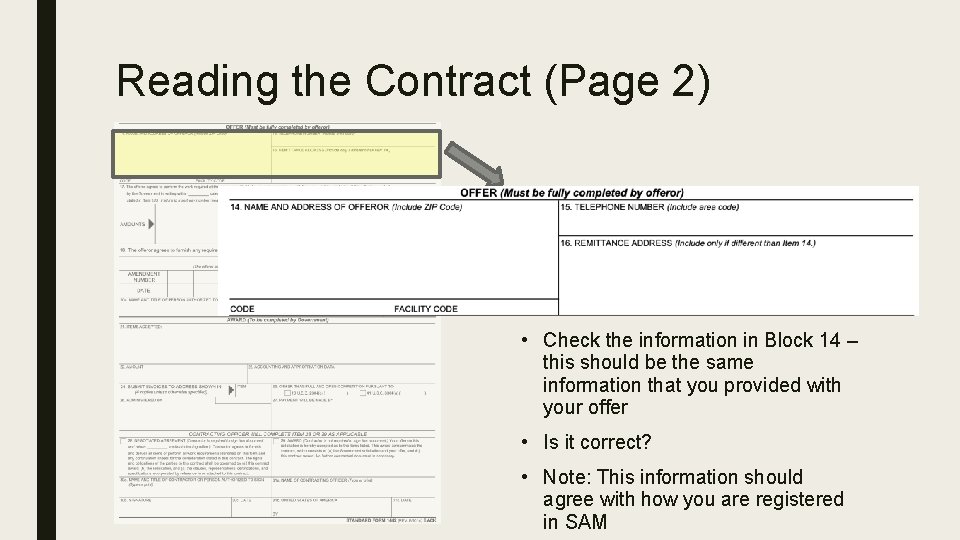
Reading the Contract (Page 2) • Check the information in Block 14 – this should be the same information that you provided with your offer • Is it correct? • Note: This information should agree with how you are registered in SAM
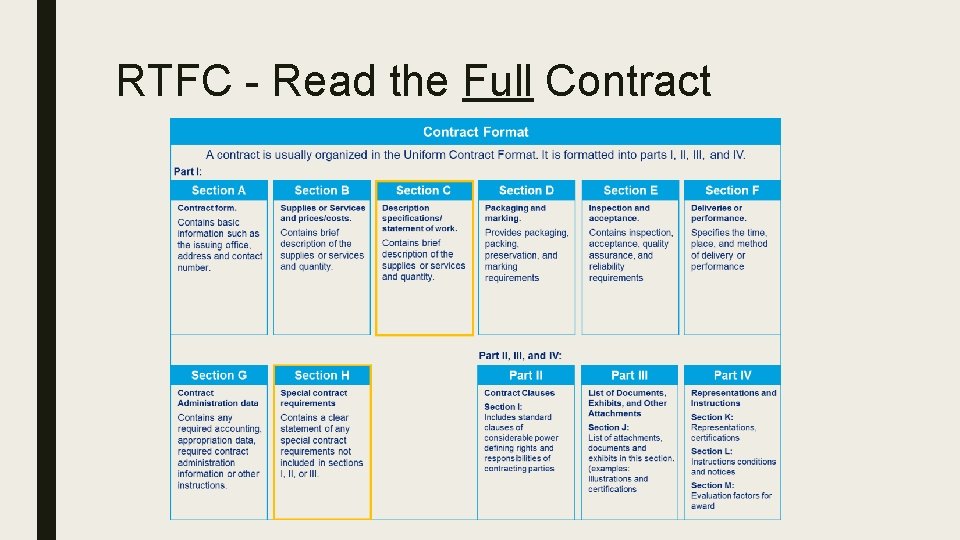
RTFC - Read the Full Contract
Section C – Description Specifications / Statement of Work ■ Many post award issues come from issues concerning the exact meaning of specifications or requirements ■ Read thoroughly – Look for references to specifications, plans or other related documents. You should have been given a copy of these – if not, get one and read it BEFORE signing – The work should be identical to that described in your proposal or bid response – Compare the SOW requirements to your proposal (if any) to ensure you actually bid (priced) the work being awarded.
Section E – Inspection and Acceptance ■ Understand the process that will be used to inspect and accept completed work ■ Are there quality plan requirements? If so when must you submit your plan.
Section I - Contract Clauses ■ Clauses often appear in specific sections of the contract if that section relates to the material in the clause such as quality etc. ■ Section I is the “catch all” for the remaining clauses ■ “The contracting officer shall include in this section the clauses required by law … and any additional clauses expected to be included in any resulting contract, if these clauses are not required in any other section of the uniform contract format”. – Clauses in “full text” – “Included by reference” (see https: //www. acquisition. gov/? q=/browse/far/52) – The Christian Doctrine “permits the incorporation by operation of law of mandatory contract clauses which express a significant or deeply ingrained strand of public procurement policy. ” 1 1. G. L. Christian & Assoc. v. United States, 312 F. 2 d at 424, 427
Is This Clause Applicable? ■ Clauses and provisions are “prescribed” by the FAR/DFAR ■ For example: Clause 52. 203 -2. “As prescribed in 3. 103 -1, insert the following provision. If the solicitation is a Request for Quotations, the terms “Quotation” and “Quoter” may be substituted for “Offer” and “Offeror. ” ■ To understand under what conditions the clause applies: – See the “prescribing” paragraph – See also FAR 52. 3 – Provision and Clause Matrix.
Requesting Pre-Award Changes ■ If something in the draft contract is wrong or there is a question – Put them in writing – Support request with factual material ■ ■ ■ Administrative error Exceptions Inappropriate clause or verbiage ■ Do NOT sign the contract until these issues are resolved and a modified contract is available ■ Do NOT accept “we’ll do a change to fix that in the future” because who knows if that individual will remember or still be around.
COMMERCIAL SUBCONTRACTS DOCUMENTS Reviewing Commercial Subcontract Documents
Commercial (Subcontract) ■ Subcontracts to a government prime contract are “Hybrid” contracts – Generally follow the format and content used in industry practice – Also contain specific language flowed down from the government contract with the prime – Flow-downs will be addressed in a separate presentation ■ Too many possible variations to discuss in this presentation but some general cautions follow.
Commercial Subcontracts ■ May be awarded using different procedures than those used by the government such as a Request for Quotes followed by a proffered contract ■ This may be your first look at the actual terms and conditions so read thoroughly before signing ■ Look for potential “land mines”
General Considerations ■ Who is the agreement with? Specifically who are the parties to the contract and what/how may they be contacted ■ Agreements should benefit both parties – beware contracts loaded with onesided “exculpatory” terms. Those are generally unfair to the seller.
General Considerations ■ Is there a changes clause requiring all changes be written ■ Who is authorized to represent and or bind the parties – especially with respect to directing changes and accepting work ■ This could be a take-it-or-leave-it proposition in which case you want to be doubly sure you understand what you are being asked to agree to ■ Does the contract contain standard protections for Force Majure (acts of God)
Definitions and Interpretation ■ Are the terms used in the contract clearly defined. If terms are assigned a special meaning they should be separately defined – What does “Day” mean ■ Does the contract discuss how ambiguous language or terms are to be treated? – Order of precedence is generally specified especially when dealing with documents such as the contract, the specifications, drawings, etc. – General rule is to interpret contradictory information against the benefit of the party who drafted it.
Form Subcontracts ■ Pre-printed form contracts with fill-in blanks frequently used in commercial construction contracting may have issues – AIA (Form A 401) – Consensus. Docs (Form 750). ■ Pre-printed or form type contracts are generally appropriate for commercial contracts but may not adequately address the unique requirements of a government contract – For example FAR 52. 222 -11 (b) that requires the Prime contractor to “Insert” 11 specific clauses in any subcontract ■ Often these contracts adhere to commercial practices making the subcontractor responsible to the owner to the same extent as the prime. – Many of the rights or remedies (especially disputes and claims) in a government contract are not available or limited in nature with respect to subcontractors. ■ Seek expert advice.
Form Subcontracts Pitfalls ■ Watch for language like this: “Because these plans, drawing, specifications and addenda thereto are an essential element of this Sub- Contract. the Sub. Contractor’s failure to thoroughly check and verify the scope and extent of them shall not act to modify or mitigate the complete responsibility herein contemplated as to the work to be performed. ” – Do you have a copy of ALL Plans, Drawing, specifications and addenda thereto attached to the contract? – Have you reviewed and understood what they say? ■ Should you accept language like this: “The Sub-Contractor agrees to be bound to the Contractor by all the terms of the General Contract applicable to this Sub. Contract” – Has the prime given you a copy of their contract with the “Owner”? – If not how can you agree to be bound by something you have not read?
Form Subcontracts Pitfalls ■ The term "General Contract" as used in this Sub·Contract, shall be deemed to mean the contract between the Contractor and the Owner, … The relationship of the Sub-Contractor hereunder toward Contractor shall be the same as that of Contractor toward the Owner under the General Contract and the relationship of the Contractor hereunder to the Sub-Contractor shall be the same as that of the Owner toward the Contractor under the General Contract. ” – On a government subcontract this language is a problem as it implies the subcontractor can avail themselves of certain remedies only available to the Prime such as ■ ■ The contract disputes act Prompt payment – It also provides the Prime Contractor with the same powers and authority normally exercised by the Government as a sovereign and not normally given to a commercial entity.
Payment Terms ■ Be sure to read and understand the payment terms in your subcontract. – Government contracts require a proper invoice and proof of delivery/performance/acceptance, after which payment is made in a specific time frame. – Are similar terms in your subcontract or are you being offered “paid when paid” terms? Do you really want to sign up for “Pay when paid” terms? ■ Before signing the contract know these terms. Be sure you have the financial wherewithal to accommodate them. ■ Once you sign you are generally “locked in. ” Now’s the time if you want to negotiate different terms.
Take Your Time ■ There may be a great deal of pressure on you to sigh the contract and get to work. ■ Haste makes waste. If you make a mistake now you will most likely have to live with it for the entire contract period ■ Don’t rely on the good nature of the Prime contractor or your CO to gracefully allow you to change a signed contract. There are some protections but don’t bet the farm on them.
NOW WE CAN SIGN
Signing the Contract (see FAR 4. 1) ■ Individual. Signs in their own name. If the business is a “dba”, follow their signature with “an individual doing business as [name of firm] ■ Partnership. Signed in the partnership’s name. Contracting Officer has right to request list of partners authorized to bind the firm. ■ Corporation. Signed in corporate name followed with “by” and the signature/title of the signing official. ■ Joint Venture - signed as above by each member of the JV
Authority to Bind ■ Is the individual signing the contract authorized to commit the firm? – Owner or sole proprietor – General Partner – Authorized by office and/or letter of appointment – Agents must be able to prove authority to bind to Contracting Officer
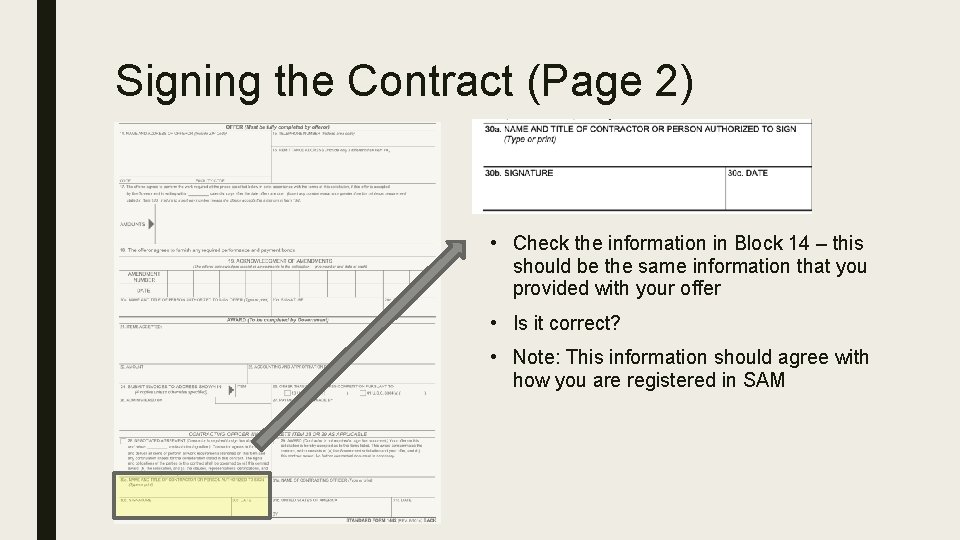
Signing the Contract (Page 2) • Check the information in Block 14 – this should be the same information that you provided with your offer • Is it correct? • Note: This information should agree with how you are registered in SAM
Fully Executed Contract ■ Once the contractor signs their copy they return it (original) plus any requested copies to Contracting Office ■ Contract is signed on behalf of the government by contracting officer ■ “Fully Executed” copy returned to contractor ■ Work done prior to receiving fully executed contract is ‘at risk’ and may be unpaid
Donald E. Shannon dba The Contract Coach Albuquerque NM (505) – 259 -8485 don@Contract-coach. com http: //www. contract-coach. com
- Slides: 32