
Look at the FREE PARTICLE Dirac Lagrangian LDiracic
![L=[iħc g mc 2 ] (q g )A • We introduced the same interaction](https://slidetodoc.com/presentation_image/6521c12cd581b360569e24f3364a1679/image-5.jpg "L=[iħc g mc 2 ] (q g )A • We introduced the same interaction")
- Slides: 16
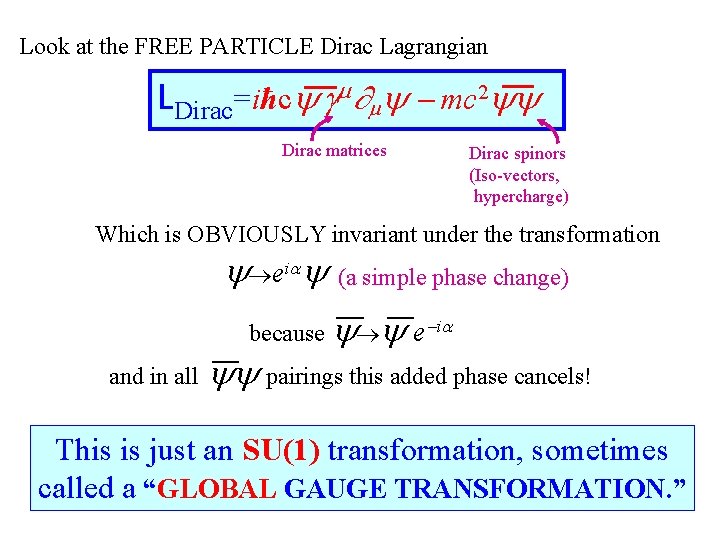
Look at the FREE PARTICLE Dirac Lagrangian LDirac=iħc g mc 2 Dirac matrices Dirac spinors (Iso-vectors, hypercharge) Which is OBVIOUSLY invariant under the transformation e i (a simple phase change) because e i and in all pairings this added phase cancels! This is just an SU(1) transformation, sometimes called a “GLOBAL GAUGE TRANSFORMATION. ”
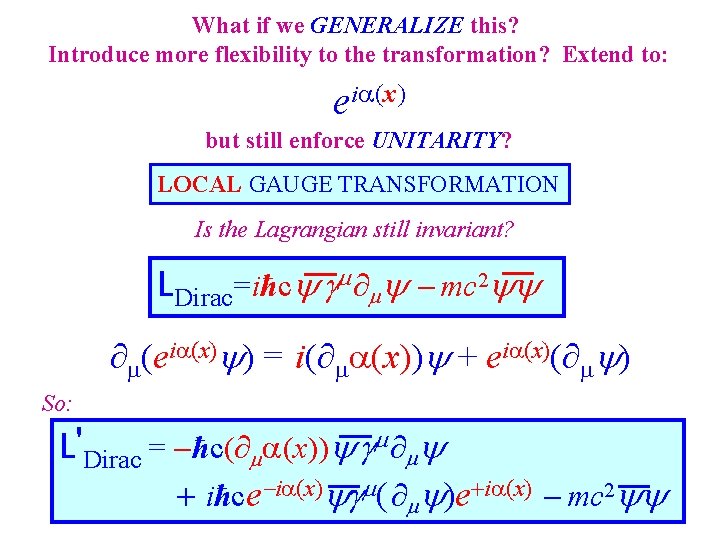
What if we GENERALIZE this? Introduce more flexibility to the transformation? Extend to: ei (x) but still enforce UNITARITY? LOCAL GAUGE TRANSFORMATION Is the Lagrangian still invariant? LDirac=iħc g mc 2 (ei (x) ) = i( (x)) + ei (x)( ) So: L'Dirac = ħc( (x)) g + iħce i (x) g ( )e+i (x) mc 2
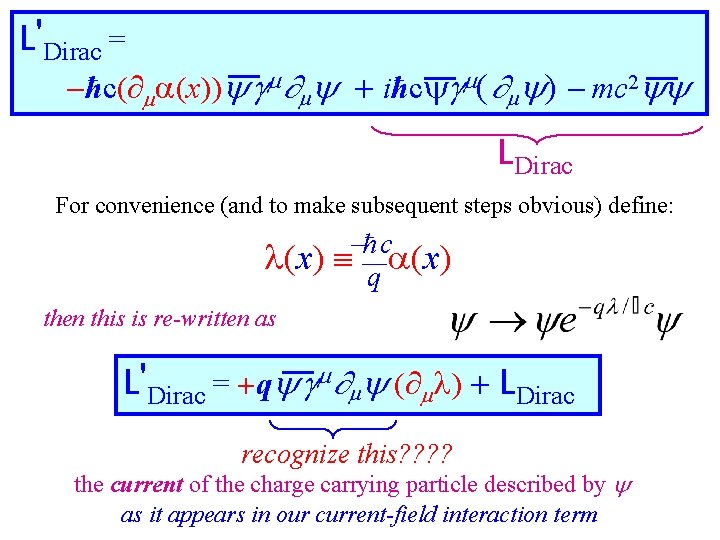
L'Dirac = ħc( (x)) g + iħc g ( ) mc 2 LDirac For convenience (and to make subsequent steps obvious) define: ħ c (x) q then this is re-written as L'Dirac = +q g ( ) + LDirac recognize this? ? the current of the charge carrying particle described by as it appears in our current-field interaction term
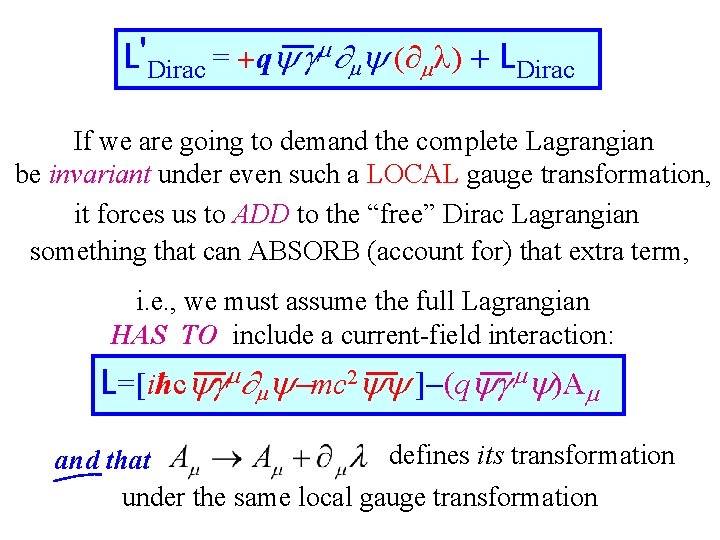
L'Dirac = +q g ( ) + LDirac If we are going to demand the complete Lagrangian be invariant under even such a LOCAL gauge transformation, it forces us to ADD to the “free” Dirac Lagrangian something that can ABSORB (account for) that extra term, i. e. , we must assume the full Lagrangian HAS TO include a current-field interaction: L=[iħc g mc 2 ] (q g )A defines its transformation and that under the same local gauge transformation
L=[iħc g mc 2 ] (q g )A • We introduced the same interaction term 3 weeks back following electrodynamic arguments (Jackson) • the form of the current density is correctly reproduced • the transformation rule A ' = A + is exactly (check your notes!) the rule for GAUGE TRANSFORMATIONS already introduced in e&m! The search for a “new” conserved quantum number shows that for an SU(1)-invariant Lagrangian, the free Dirac Lagrangain is “INCOMPLETE. ” If we chose to allow gauge invariance, it forces to introduce a vector field (here that means A ) that “couples” to .
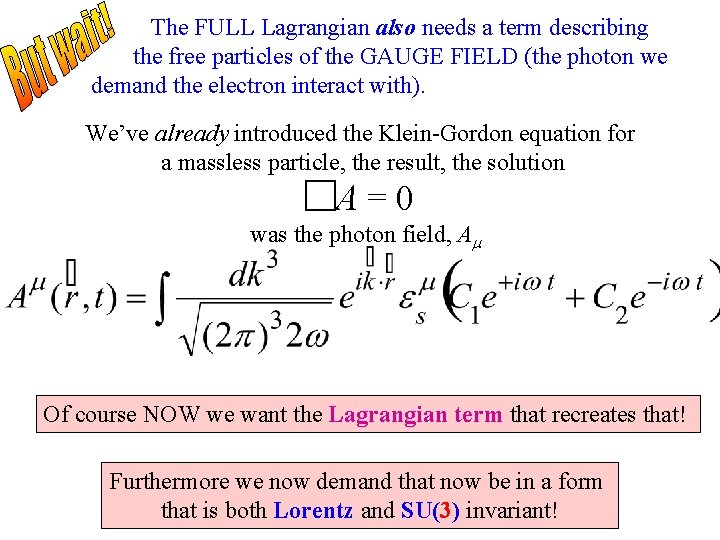
The FULL Lagrangian also needs a term describing the free particles of the GAUGE FIELD (the photon we demand the electron interact with). We’ve already introduced the Klein-Gordon equation for a massless particle, the result, the solution A=0 was the photon field, A Of course NOW we want the Lagrangian term that recreates that! Furthermore we now demand that now be in a form that is both Lorentz and SU(3) invariant!
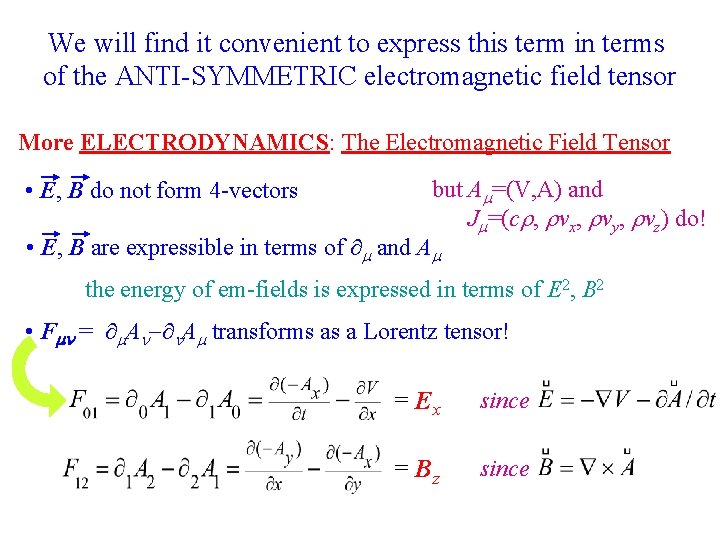
We will find it convenient to express this term in terms of the ANTI-SYMMETRIC electromagnetic field tensor More ELECTRODYNAMICS: The Electromagnetic Field Tensor but A =(V, A) and J =(c , vx, vy, vz) do! • E, B are expressible in terms of and A • E, B do not form 4 -vectors the energy of em-fields is expressed in terms of E 2, B 2 • F = A A transforms as a Lorentz tensor! = Ex since = Bz since
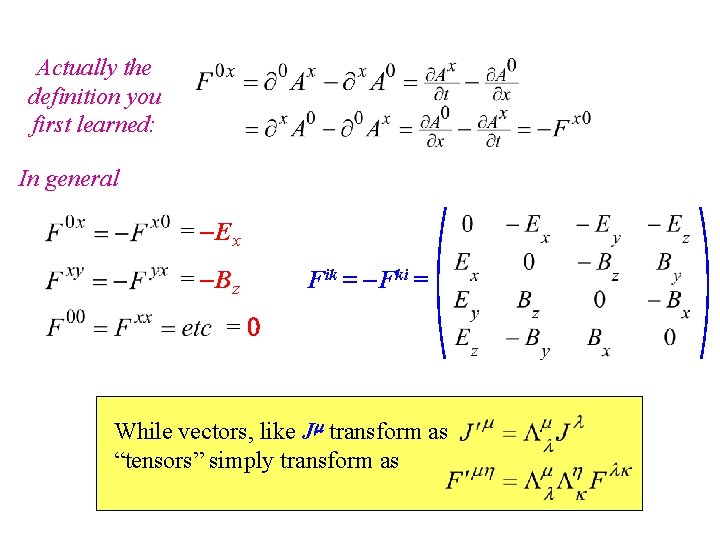
Actually the definition you first learned: In general = -Ex = -Bz Fik = -Fki = =0 While vectors, like J transform as “tensors” simply transform as
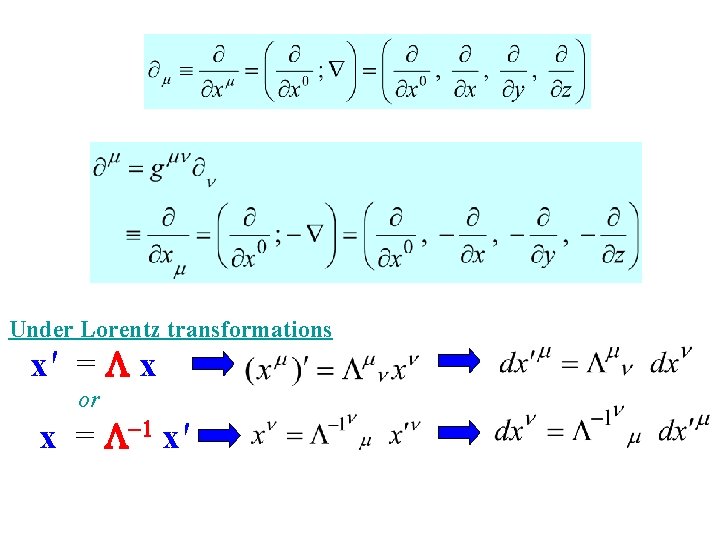
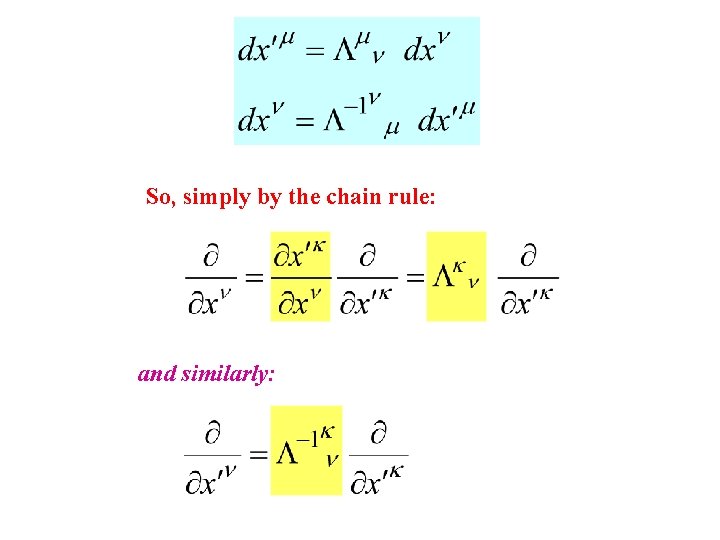
Under Lorentz transformations x' = L x or x = L-1 x'
So, simply by the chain rule: and similarly:
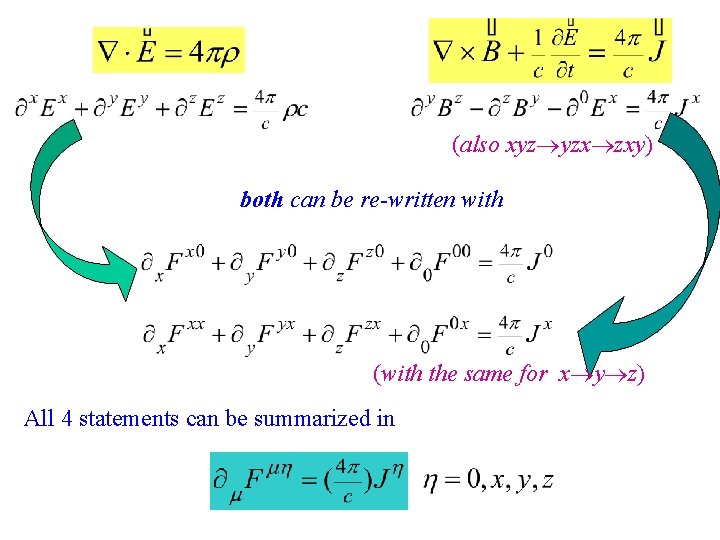
(also xyz yzx zxy) both can be re-written with (with the same for x y z) All 4 statements can be summarized in
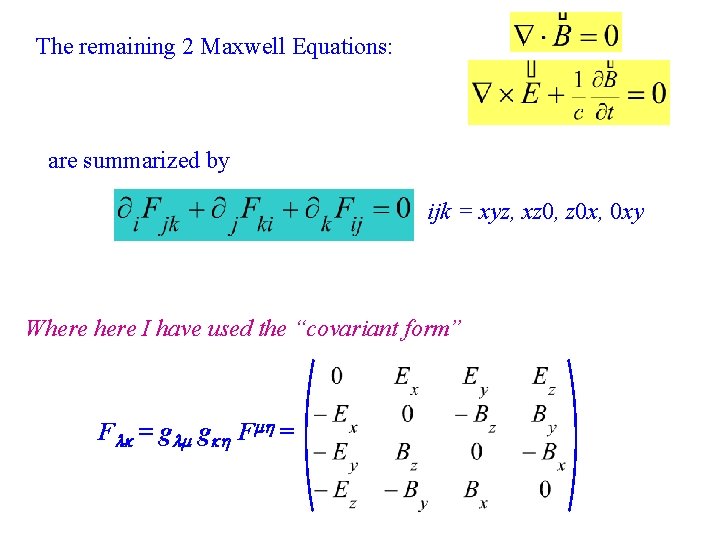
The remaining 2 Maxwell Equations: are summarized by ijk = xyz, xz 0, z 0 x, 0 xy Where I have used the “covariant form” F = g g F =
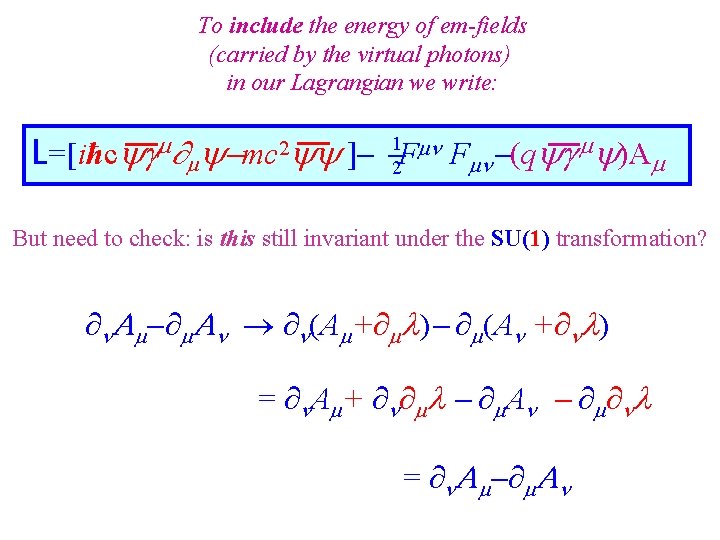
To include the energy of em-fields (carried by the virtual photons) in our Lagrangian we write: L=[iħc g ] F F (q g )A mc 2 1 2 But need to check: is this still invariant under the SU(1) transformation? (A + ) = A + A =
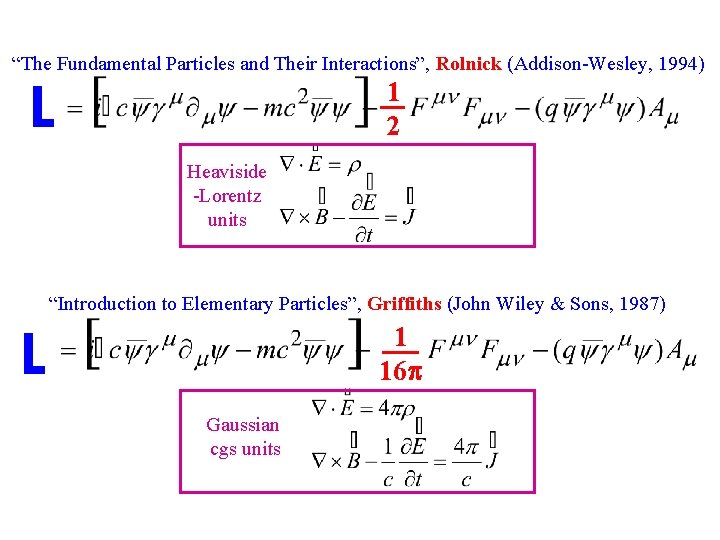
“The Fundamental Particles and Their Interactions”, Rolnick (Addison-Wesley, 1994) 1 2 L Heaviside -Lorentz units “Introduction to Elementary Particles”, Griffiths (John Wiley & Sons, 1987) 1 16 L Gaussian cgs units
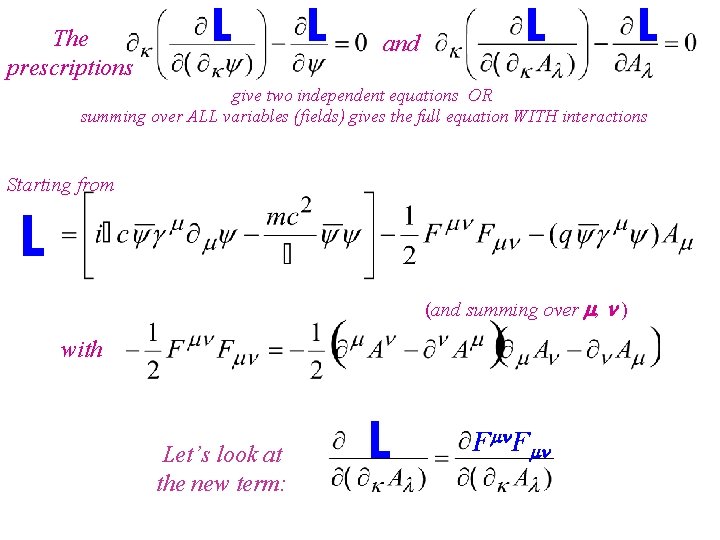
The prescriptions L L and L L give two independent equations OR summing over ALL variables (fields) gives the full equation WITH interactions Starting from L (and summing over , ) with Let’s look at the new term: L F F
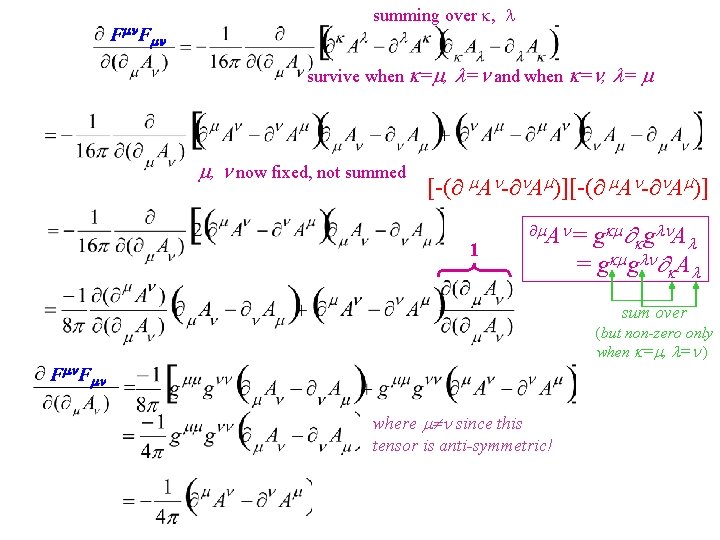
F F summing over , survive when = , = and when = , now fixed, not summed [-( A - A )] 1 g g A = g g A A = sum over (but non-zero only when = , = ) F F where since this tensor is anti-symmetric!