
LongRun Economic Growth and Business Cycles Chapter 9
Long-Run Economic Growth and Business Cycles Chapter 9
Economic Principles • Capital-labor and capital-output ratios • Technology and labor productivity • Labor productivity and economic growth
Economic Principles • Saving, investment, and economic growth • External and internal theories of the business cycle • The interaction of the multiplier and accelerator
Economic Principles • Counter cyclical fiscal policy
Long-Run Economic Growth • Economic Growth – An increase in real GDP, typically expressed as an annual rate of real GDP growth
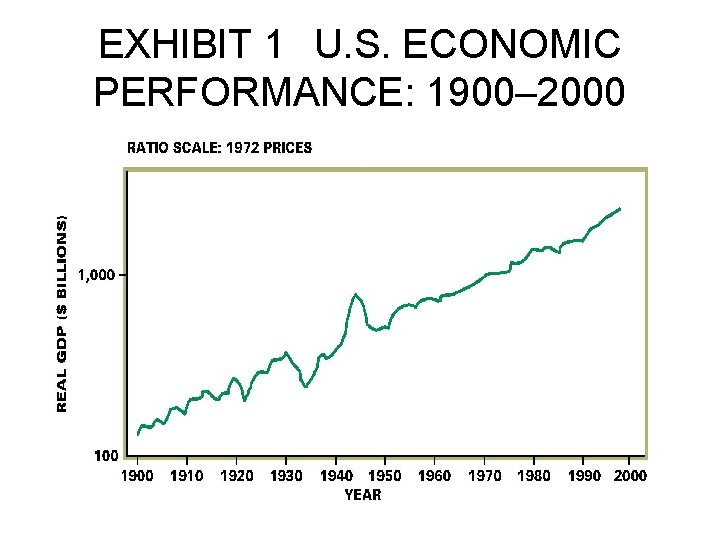
EXHIBIT 1 U. S. ECONOMIC PERFORMANCE: 1900– 2000
Long-Run Economic Growth • In exhibit 1 from 1900 to 2000, U. S. Real GDP, measured in 1972 dollars, increased approximately 15 -fold. But Year to year changes over a period deviated from the approximate 3. 5% average rate of growth and in some years the deviations were considerable. What stands out sharply is the real GDP decline during the 1930 s
Creating the Environment for Long. Run Economic Growth • Why bother investing in any productive enterprise when the fruits of enterprise are so insecure?
Creating the Environment for Long. Run Economic Growth • Why bother investing in any productive enterprise when the fruits of enterprise are so insecure? – Among the primary and most important causes which influence the wealth of nations, must unquestionably be placed, those which come under the head of politics and morals. Security of property, without a certain degree of which, there can be no encouragement to individual industry, depends mainly upon the political constitution of the country, the excellence of its laws and the manner in which they are administered. –Thomas Mathus [Principals of Political Economy (1820)]
Creating the Environment for Long. Run Economic Growth • Legitimate rights to personal property and having a sense of security concerning those rights create the incentive for personal effort and expected reward.
What Causes Economic Growth? There are 4 principal factors that contribute to a nation’s economic growth. They are:
What Causes Economic Growth? There are 4 principal factors that contribute to a nation’s economic growth. They are: 1. The size of its labor force
What Causes Economic Growth? There are 4 principal factors that contribute to a nation’s economic growth. They are: 1. The size of its labor force 2. The degree of labor specialization
What Causes Economic Growth? There are 4 principal factors that contribute to a nation’s economic growth. They are: 1. The size of its labor force 2. The degree of labor specialization 3. The size of its capital stock
What Causes Economic Growth? 1. 2. 3. 4. There are 4 principal factors that contribute to a nation’s economic growth. They are: The size of its labor force The degree of labor specialization The size of its capital stock The level of its technology
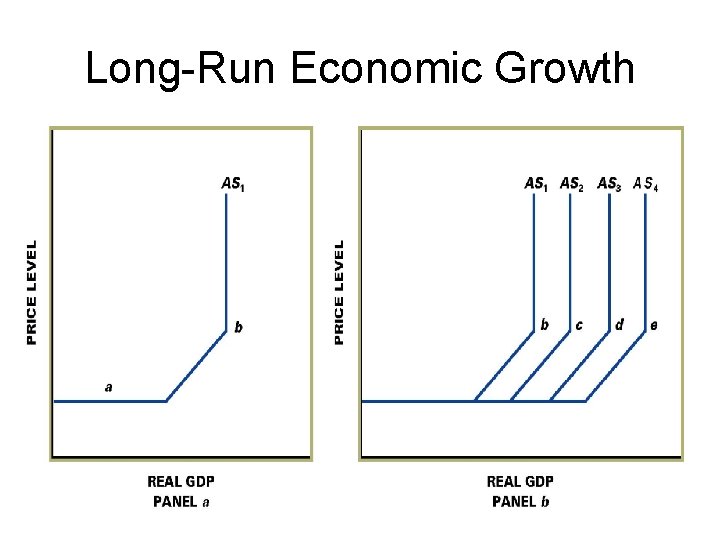
Long-Run Economic Growth
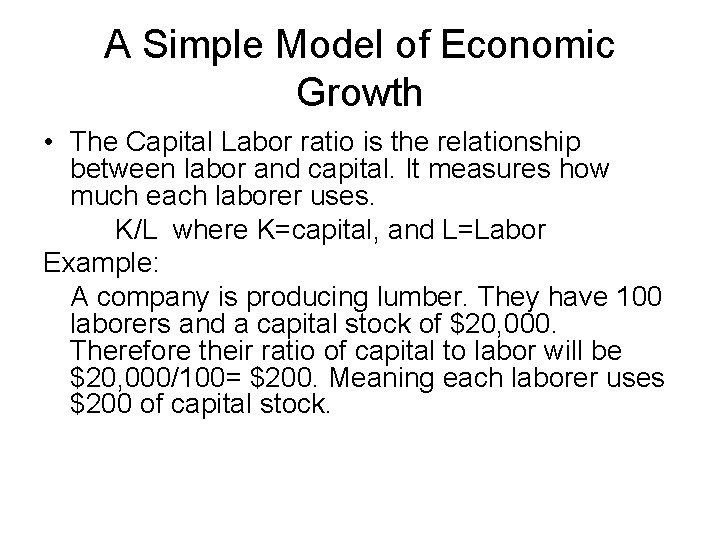
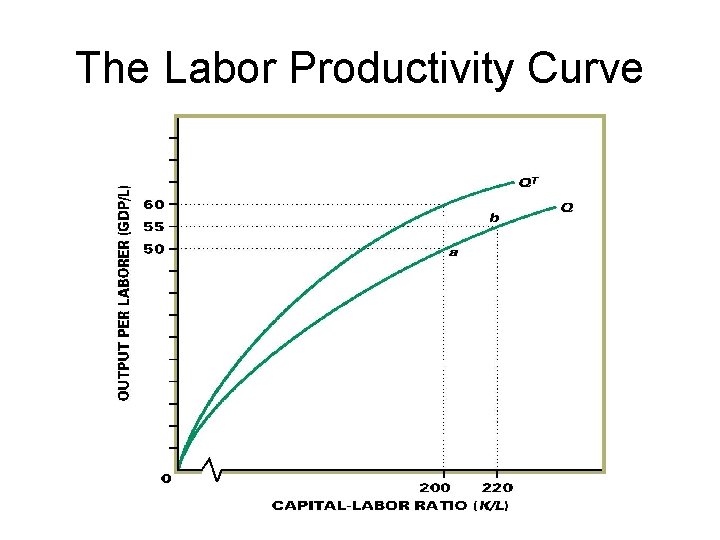
A Simple Model of Economic Growth • The Capital Labor ratio is the relationship between labor and capital. It measures how much each laborer uses. K/L where K=capital, and L=Labor Example: A company is producing lumber. They have 100 laborers and a capital stock of $20, 000. Therefore their ratio of capital to labor will be $20, 000/100= $200. Meaning each laborer uses $200 of capital stock.
A Simple Model of Economic Growth • When does capital deepening occur?
A Simple Model of Economic Growth • When does capital deepening occur? – When there is a rise in the ratio of capital to labor.
A Simple Model of Economic Growth • How does capital deepening affect labor productivity?
A Simple Model of Economic Growth • How does capital deepening affect labor productivity? – The more capital per laborer, the greater the laborer’s productivity. Moreover, new technology can shift upwards the labor productivity curve.
A Simple Model of Economic Growth • Labor Productivity is the quantity of GDP produced per worker, typically measured in quantity of GDP per hour of labor. – GDP/L= output per labor
The Labor Productivity Curve
The Role of Saving • Capital-Output Ratio: – The ratio of capital stock to GDP. • K/GDP= Capital-output ratio
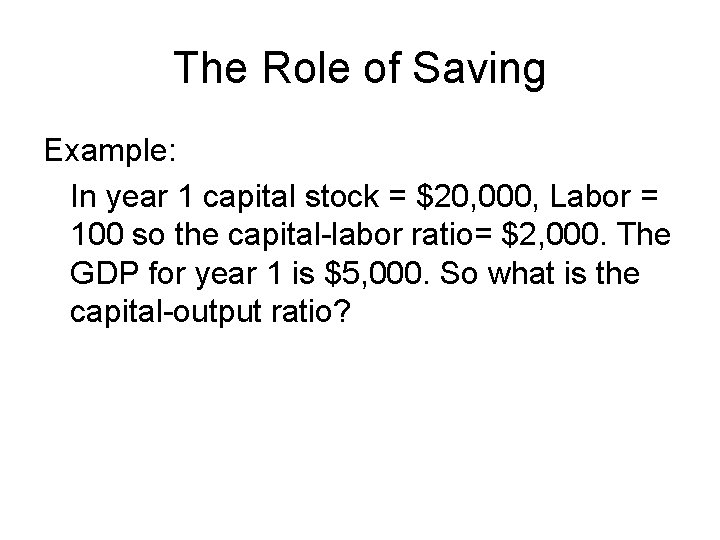
The Role of Saving Example: In year 1 capital stock = $20, 000, Labor = 100 so the capital-labor ratio= $2, 000. The GDP for year 1 is $5, 000. So what is the capital-output ratio?
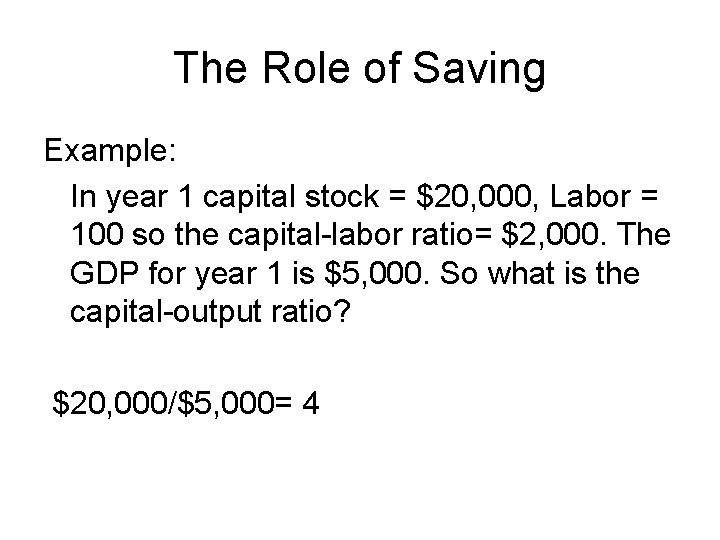
The Role of Saving Example: In year 1 capital stock = $20, 000, Labor = 100 so the capital-labor ratio= $2, 000. The GDP for year 1 is $5, 000. So what is the capital-output ratio? $20, 000/$5, 000= 4
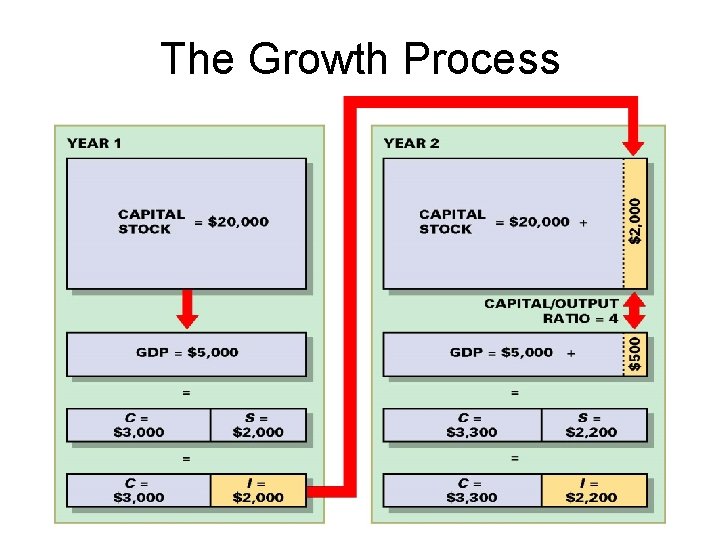
The Growth Process
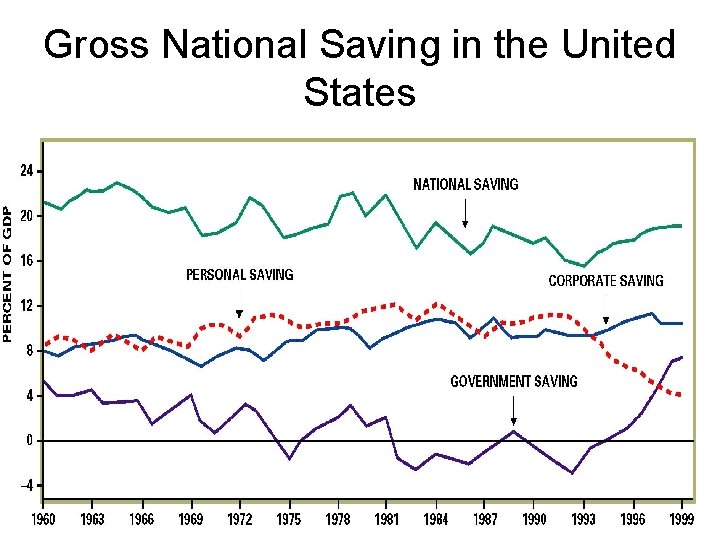
Gross National Saving in the United States
The Role of Technology • Changes in technology can increase labor productivity and GDP without any change in the value of capital stock.
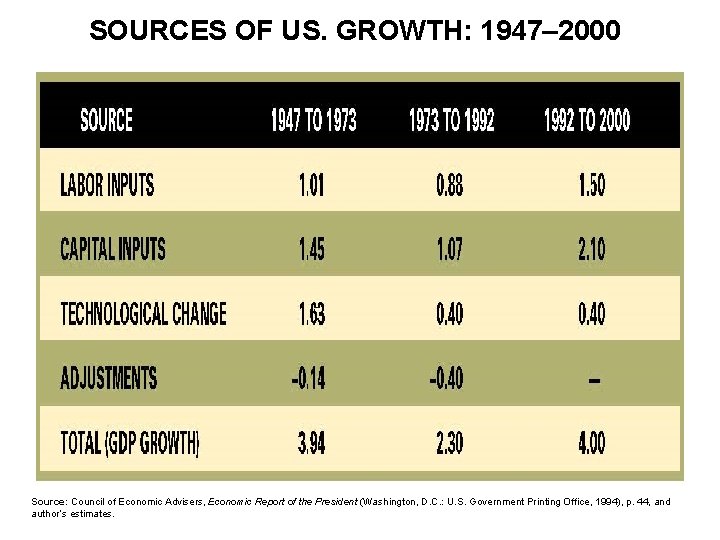
SOURCES OF US. GROWTH: 1947– 2000 Source: Council of Economic Advisers, Economic Report of the President (Washington, D. C. : U. S. Government Printing Office, 1994), p. 44, and author’s estimates.
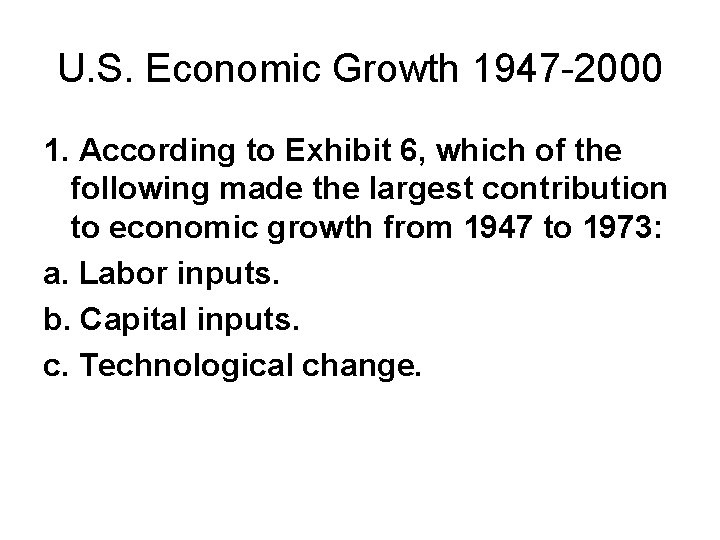
U. S. Economic Growth 1947 -2000 1. According to Exhibit 6, which of the following made the largest contribution to economic growth from 1947 to 1973: a. Labor inputs. b. Capital inputs. c. Technological change.
U. S. Economic Growth 1947 -2000 1. According to Exhibit 6, which of the following made the largest contribution to economic growth from 1947 to 1973: c. Technological change.
U. S. Economic Growth 1947 -2000 • 2. According to Exhibit 6, which of the following made the largest contribution to economic growth from 1973 to 1992: • a. Labor inputs. • b. Capital inputs. • c. Technological change.
U. S. Economic Growth 1947 -2000 • 2. According to Exhibit 6, which of the following made the largest contribution to economic growth from 1973 to 1992: • b. Capital inputs.
U. S. Economic Growth 1947 -2000 3. According to Exhibit 6, what happened to the role of technological change as a source of U. S. economic growth across the two time periods?
U. S. Economic Growth 1947 -2000 3. According to Exhibit 6, what happened to the role of technological change as a source of U. S. economic growth across the two time periods? • While technological change was the most important source of economic growth from 1947 to 1973, it was one of the smallest and least important sources of economic growth between 1973 and 1992.
The Business Cycle The business cycle represents year to year deviations from the dominant, long -run path of U. S. economic growth. These deviations seem to map out a picture of recurring cycles.
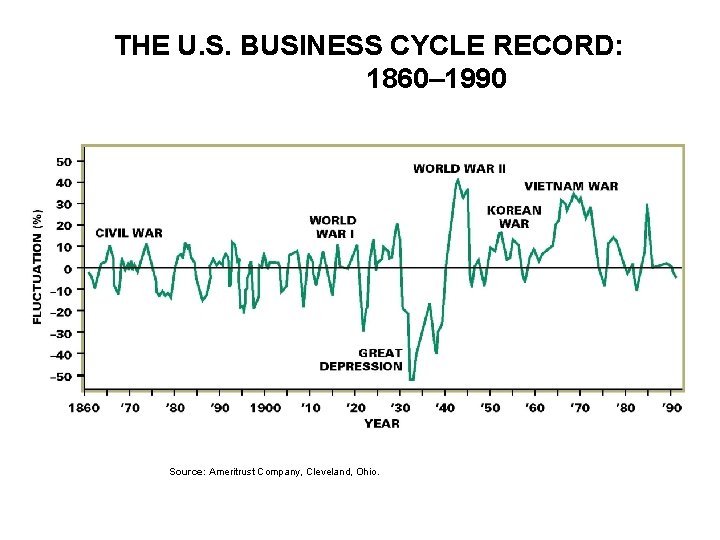
THE U. S. BUSINESS CYCLE RECORD: 1860– 1990 Source: Ameritrust Company, Cleveland, Ohio.
Exhibit 7: The U. S. Business Cycle Record: 1860 -1990 1. According to Exhibit 7, were recessions more frequent before World War II or after World War II? • Recessions were more frequent before World War II.
Exhibit 7: The U. S. Business Cycle Record: 1860 -1990 2. In which of the following decades was there the greatest period of rapid and prolonged economic growth in Exhibit 6? a. 1870 – 1880. b. 1930 – 1940. c. 1960 – 1970.
Exhibit 7: The U. S. Business Cycle Record: 1860 -1990 2. In which of the following decades was there the greatest period of rapid and prolonged economic growth in Exhibit 6? c. 1960 – 1970.
Traditional Theories of the Business Cycle 1. What factors contribute to externally-induced cycles? • Wars, changes in climate, population booms, clustering of innovations, changes in consumer confidence, changes in government spending, or changes in international exchange rates.
Traditional Theories of the Business Cycle 2. What is the sunspot theory of the business cycle? • According to William Stanley Jevons, years of good harvest, low food prices, and higher real income and employment, are inversely related to the number of sunspots.
Traditional Theories of the Business Cycle 2. What is the sunspot theory of the business cycle? • The sunspot theory mostly applies to agricultural economies, and is less relevant to modern industrialized countries.
Traditional Theories of the Business Cycle 3. What is the war-induced theory of the business cycle? • Wars require massive increases in government spending, which tends to increase economic growth. Marxists and others have argued that wars are sometimes engineered to get us out of economic crises.
Traditional Theories of the Business Cycle 3. What is the war-induced theory of the business cycle? • The decline in spending at the end of wars can contribute to economic downturns.
You Got the Dates? We Got The Growth Rates According to the chart on page 541 of the textbook, what was the average annual rate of economic growth between 1970 and 1996? • Reading down from 1970 and across from 1996 we find that the average rate of economic growth was 2. 8 percent.
Traditional Theories of the Business Cycle 4. What is the housing theory of the business cycle? • Disasters or low interest rates spur large investments in new housing, which in turn promotes increased economic growth. As housing investment slows, so too does economic growth.
Traditional Theories of the Business Cycle 5. What is the innovation theory of the business cycle? • Pioneering innovations promote a host of supporting innovations in clusters, and thus produce their own variety of business cycle. Steam engines, railroads, electricity, cars, and computers offer some examples.
Traditional Theories of the Business Cycle 5. What is the innovation theory of the business cycle? • Yet even pioneering innovations eventually exhaust their potential, creating the potential for reduced investment, demand, and employment.
Traditional Theories of the Business Cycle • Many economists believe that business cycles do not just develop from external factors. • According to this view, the economy’s continuous motion is inherently cyclical due to internal factors.
Traditional Theories of the Business Cycle 6. What factors contribute to internally induced business cycles? • Changes in investment spending and changes in national income are mutually reinforcing due to the role of expectations.
Traditional Theories of the Business Cycle Accelerator The relationship between the level of investment and the change in the level of national income.
Traditional Theories of the Business Cycle 7. How does the accelerator contribute to the business cycle? • An initial injection of new investment spending into the economy triggers the income multiplier into action, and as a result people’s income and consumption spending grow.
Traditional Theories of the Business Cycle 7. How does the accelerator contribute to the business cycle? • Buoyed by this growth in sales, firms expect growth to continue and increase investment spending accordingly. This creates the upward phase of the business cycle.
Traditional Theories of the Business Cycle 7. How does the accelerator contribute to the business cycle? • Having acquired additional capital stock through investment, firms must experience even higher sales. But if consumers simply maintain their level of consumption, inventories build up and investment declines, initiating the downward phase of the cycle.
Real Business Cycle Theory Economists who subscribe to real business cycle theory challenge the idea that internal or external cycles exist.
Real Business Cycle Theory They argue that the economy is dynamic and operates near full employment. The principal factor shaping the unevenness (not cycles) in the economy’s growth path is the random occurrence of many small productivityenhancing innovations.
Real Business Cycle Theory How is real business cycle theory different from the innovation cycle theory developed by Schumpeter? • The Schumpeterian innovation cycle is based on the notion that innovations are clustered and connected, leading to cycles.
Real Business Cycle Theory How is real business cycle theory different from the innovation cycle theory developed by Schumpeter? • In contrast, real business cycle theory assumes many small random innovations that lead to an uneven path of economic growth but no cycles.

Countercyclical Fiscal Policy Countercyclical fiscal policy Fiscal policy designed to moderate the severity of the business cycle.
Countercyclical Fiscal Policy 1. Which of the following is an example of countercyclical fiscal policy? a. More gov’t. spending when the economy is growing rapidly. b. Higher taxes when the economy is growing rapidly.
Countercyclical Fiscal Policy 1. Which of the following is an example of countercyclical fiscal policy? b. Higher taxes when the economy is growing rapidly.
Countercyclical Fiscal Policy 2. Why is timing such a difficult problem with effective countercyclical fiscal policy? • Long lags between the identification of the economic problem and the execution of the policy can unintentionally lead to procyclical rather than countercyclical policy.
Countercyclical Fiscal Policy 2. Why is timing such a difficult problem with effective countercyclical fiscal policy? • Thus countercyclical fiscal policy must be based on forecasts of future economic conditions, and these forecasts can be wrong.
Countercyclical Fiscal Policy Administrative lag The time interval between deciding on an appropriate policy and the execution of that policy.
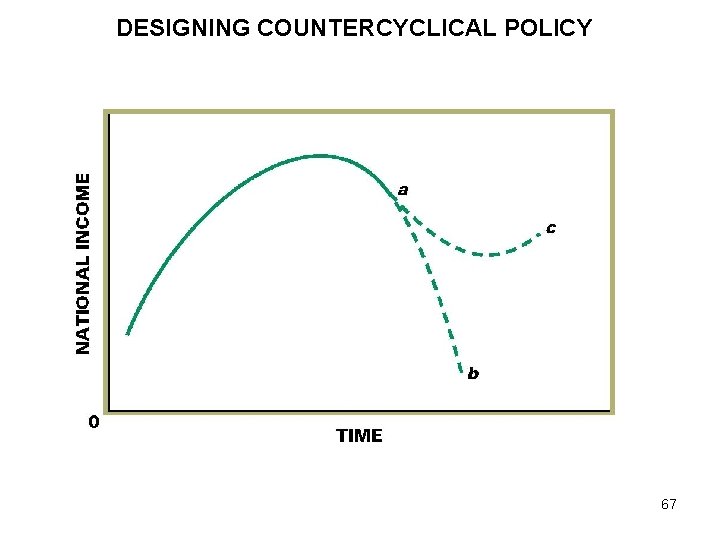
DESIGNING COUNTERCYCLICAL POLICY 67

Exhibit 8: Designing Countercyclical Policy If the economy follows path ac instead of path ab, but countercyclical fiscal policy is designed for path ab, what is might occur? • The dynamics of the acceleratormultiplier interaction will drive the economy into inflation.
Countercyclical Fiscal Policy There are many economic theories of cycles and growth, some making good sense, some less so, but all of them struggling to understand the real world.
Chapter Review Although an economy at any time may be viewed as tending toward GDP equilibrium, there is no reason to believe it actually gets there. During its progress toward the equilibrium level, making the economy’s equilibrium more a moving target than a specifically fixed GDP.
Chapter Review An Economy's GDP performance record, such as the one describing the United States over the years 1860 -1990, traces out a long-run economic growth path marked by cyclical fluctuations.
Chapter Review The four factors identified in Adam Smith’s The Wealth of Nations (1776) as principal contributors to economic growth—and that are still relevant today— are the size of the economy’s labor force, the degree of its labor specialization, the size of capital stock, and the level of its technology.
Chapter Review Increases in the economy’s capital labor ratio, described as capital deepening, and changes in technology raise labor productivity and real GDP. As well, increasing rates of saving and investment, raising the economy’s capital-output ratio, generate higher rates of economic growth.
Chapter Review Traditional theories explaining the causes of business cycles can be viewed as belonging to one of two sets:
Chapter Review Traditional theories explaining the causes of business cycles can be viewed as belonging to one of two sets: • External theories, such as the sunspot cycle theory, the housing cycle theory, and the innovation cycle theory
Chapter Review Traditional theories explaining the causes of business cycles can be viewed as belonging to one of two sets: • External theories, such as the sunspot cycle theory, the housing cycle theory, and the innovation cycle theory • The internal cycle theory, triggered by the interaction of the multiplier and accelerator
Chapter Review Real business cycle theorists reject the idea of the business cycle, believing instead that the economy is highly dynamic, operating close to, if not at, full employment. What explains variability in the economy’s year-to-year real GDP is the variability and highly random nature of the year-to-year changes in new technology
Chapter Review Counter cyclical fiscal policy, as its name implies, is fiscal policy (such as changing taxes, government spending or both) used to counter or moderate the inflationary or recessionary phases of the business cycle. Its effectiveness depends on its proper use at the appropriate time. Adding to the difficulty of knowing how much to use when is the administrative lag that marks a time lapse between a government’s decision to use a specific fiscal policy and its actual implementation
- Slides: 78