
LONGITUDINAL beam DYNAMICS RECAP Frank Tecker CERN BEOP

LONGITUDINAL beam DYNAMICS RECAP Frank Tecker CERN, BE-OP Beam Injection, Extraction, and Transfer Erice, 10 -19/3/2017 CAS Beam Inj. , Extr. and Transfer, Erice, March 2017 1
Summary of the lecture: • Introduction • Linac: Phase stability • Synchrotron: • Synchronous Phase • Dispersion Effects in Synchrotron • Stability and Longitudinal Phase Space Motion • Equations of motion • Injection Matching • Hamiltonian of Longitudinal Motion • Appendices: some derivations and details More related lectures: • Injection: Electron Beams • Longitudinal Aspects I + II – M. Aiba – Heiko Damerau CAS Beam Inj. , Extr. and Transfer, Erice, March 2017 2
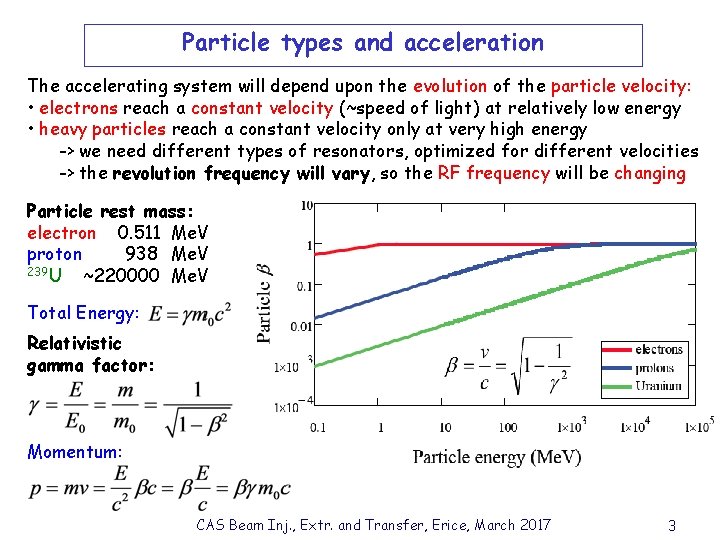
Particle types and acceleration The accelerating system will depend upon the evolution of the particle velocity: • electrons reach a constant velocity (~speed of light) at relatively low energy • heavy particles reach a constant velocity only at very high energy -> we need different types of resonators, optimized for different velocities -> the revolution frequency will vary, so the RF frequency will be changing Particle rest mass: electron 0. 511 Me. V proton 938 Me. V 239 U ~220000 Me. V Total Energy: Relativistic gamma factor: Momentum: CAS Beam Inj. , Extr. and Transfer, Erice, March 2017 3
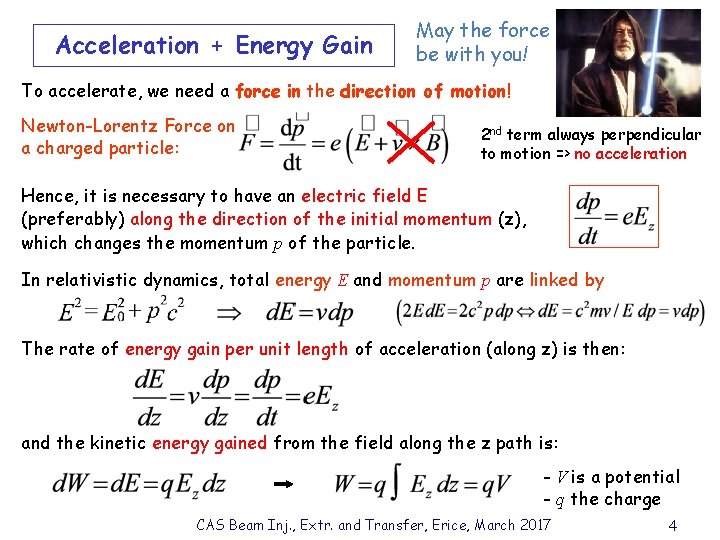
Acceleration + Energy Gain May the force be with you! To accelerate, we need a force in the direction of motion! Newton-Lorentz Force on a charged particle: 2 nd term always perpendicular to motion => no acceleration Hence, it is necessary to have an electric field E (preferably) along the direction of the initial momentum (z), which changes the momentum p of the particle. In relativistic dynamics, total energy E and momentum p are linked by The rate of energy gain per unit length of acceleration (along z) is then: and the kinetic energy gained from the field along the z path is: - V is a potential - q the charge CAS Beam Inj. , Extr. and Transfer, Erice, March 2017 4
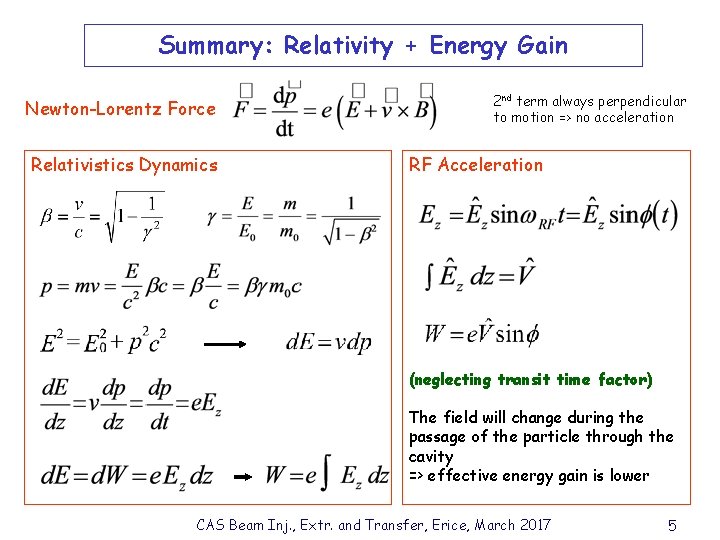
Summary: Relativity + Energy Gain Newton-Lorentz Force Relativistics Dynamics 2 nd term always perpendicular to motion => no acceleration RF Acceleration (neglecting transit time factor) The field will change during the passage of the particle through the cavity => effective energy gain is lower CAS Beam Inj. , Extr. and Transfer, Erice, March 2017 5
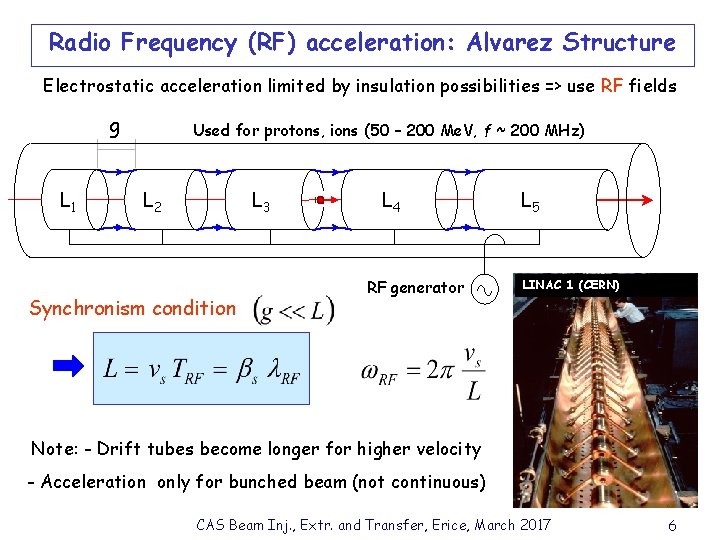
Radio Frequency (RF) acceleration: Alvarez Structure Electrostatic acceleration limited by insulation possibilities => use RF fields g L 1 Used for protons, ions (50 – 200 Me. V, f ~ 200 MHz) L 2 L 3 Synchronism condition L 4 RF generator L 5 LINAC 1 (CERN) Note: - Drift tubes become longer for higher velocity - Acceleration only for bunched beam (not continuous) CAS Beam Inj. , Extr. and Transfer, Erice, March 2017 6
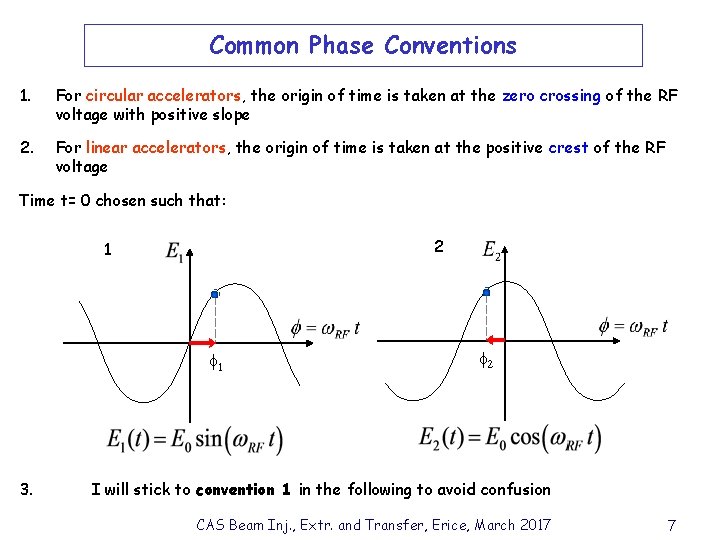
Common Phase Conventions 1. For circular accelerators, the origin of time is taken at the zero crossing of the RF voltage with positive slope 2. For linear accelerators, the origin of time is taken at the positive crest of the RF voltage Time t= 0 chosen such that: 2 1 1 3. 2 I will stick to convention 1 in the following to avoid confusion CAS Beam Inj. , Extr. and Transfer, Erice, March 2017 7
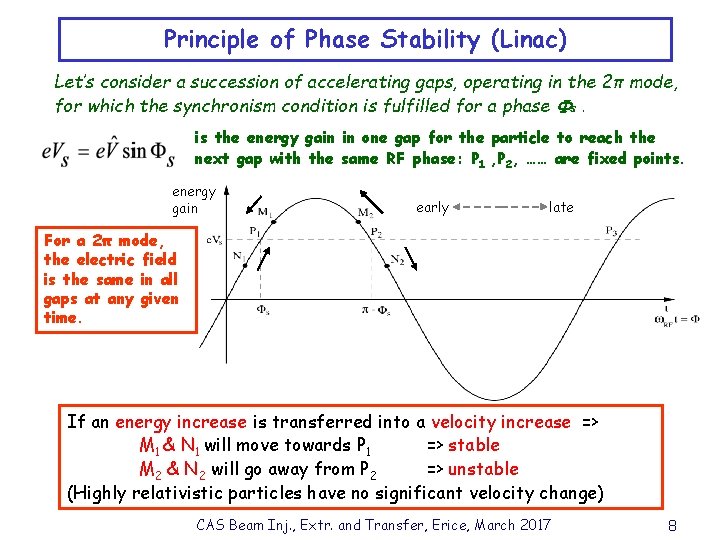
Principle of Phase Stability (Linac) Let’s consider a succession of accelerating gaps, operating in the 2π mode, for which the synchronism condition is fulfilled for a phase s. is the energy gain in one gap for the particle to reach the next gap with the same RF phase: P 1 , P 2, …… are fixed points. energy gain early late For a 2π mode, the electric field is the same in all gaps at any given time. If an energy increase is transferred into a velocity increase => M 1 & N 1 will move towards P 1 => stable M 2 & N 2 will go away from P 2 => unstable (Highly relativistic particles have no significant velocity change) CAS Beam Inj. , Extr. and Transfer, Erice, March 2017 8
Circular accelerators Cyclotron (not covered here) Synchrotron CAS Beam Inj. , Extr. and Transfer, Erice, March 2017 9
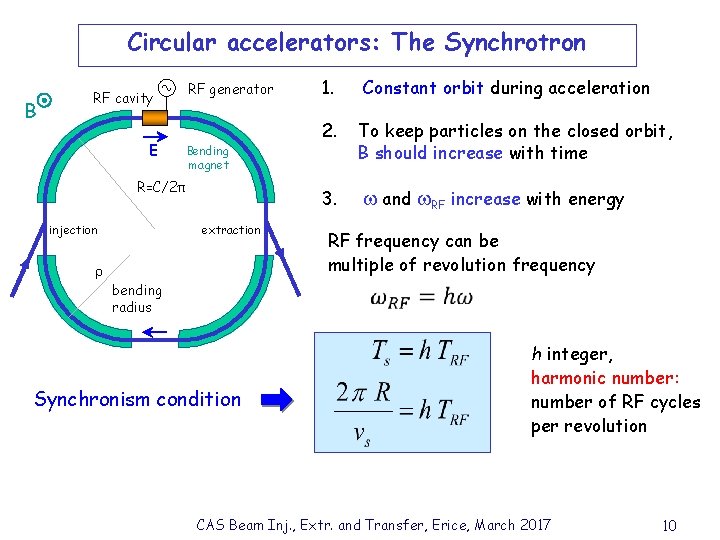
Circular accelerators: The Synchrotron B RF generator RF cavity E Bending magnet R=C/2π injection extraction bending radius 1. Constant orbit during acceleration 2. To keep particles on the closed orbit, B should increase with time 3. w and w. RF increase with energy RF frequency can be multiple of revolution frequency Synchronism condition h integer, harmonic number: number of RF cycles per revolution CAS Beam Inj. , Extr. and Transfer, Erice, March 2017 10
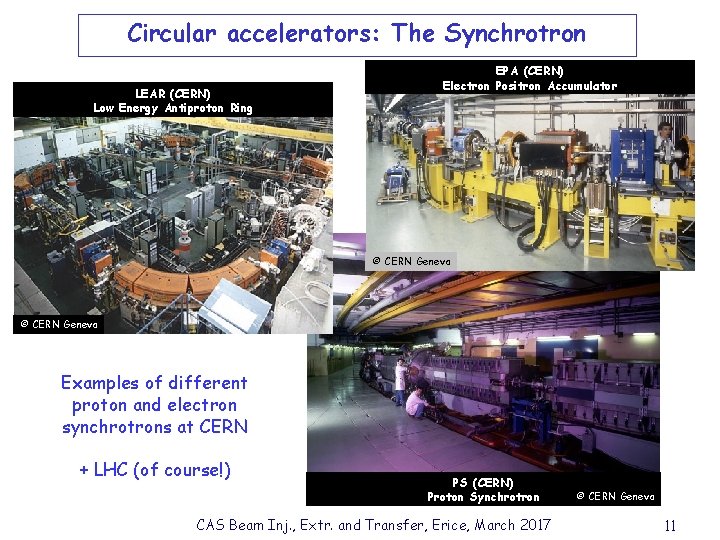
Circular accelerators: The Synchrotron LEAR (CERN) Low Energy Antiproton Ring EPA (CERN) Electron Positron Accumulator © CERN Geneva Examples of different proton and electron synchrotrons at CERN + LHC (of course!) PS (CERN) Proton Synchrotron CAS Beam Inj. , Extr. and Transfer, Erice, March 2017 © CERN Geneva 11
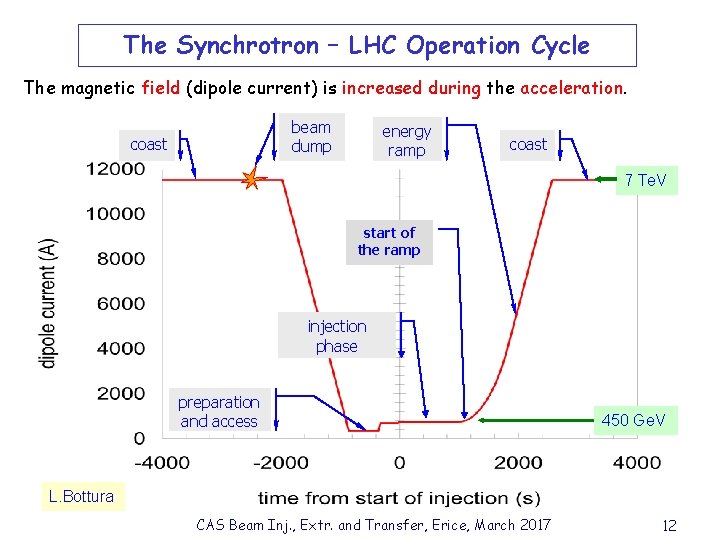
The Synchrotron – LHC Operation Cycle The magnetic field (dipole current) is increased during the acceleration. beam dump coast energy ramp coast 7 Te. V start of the ramp injection phase preparation and access 450 Ge. V L. Bottura CAS Beam Inj. , Extr. and Transfer, Erice, March 2017 12
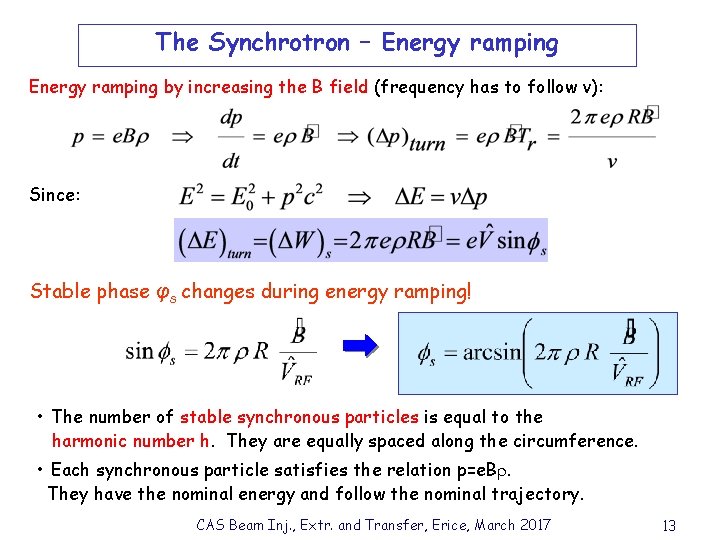
The Synchrotron – Energy ramping by increasing the B field (frequency has to follow v): Since: Stable phase φs changes during energy ramping! • The number of stable synchronous particles is equal to the harmonic number h. They are equally spaced along the circumference. • Each synchronous particle satisfies the relation p=e. B. They have the nominal energy and follow the nominal trajectory. CAS Beam Inj. , Extr. and Transfer, Erice, March 2017 13
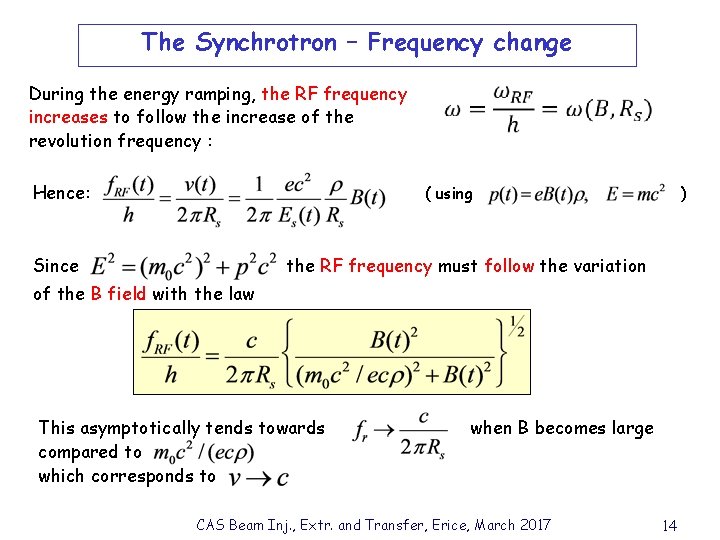
The Synchrotron – Frequency change During the energy ramping, the RF frequency increases to follow the increase of the revolution frequency : Hence: ( using Since ) the RF frequency must follow the variation of the B field with the law This asymptotically tends towards compared to which corresponds to when B becomes large CAS Beam Inj. , Extr. and Transfer, Erice, March 2017 14
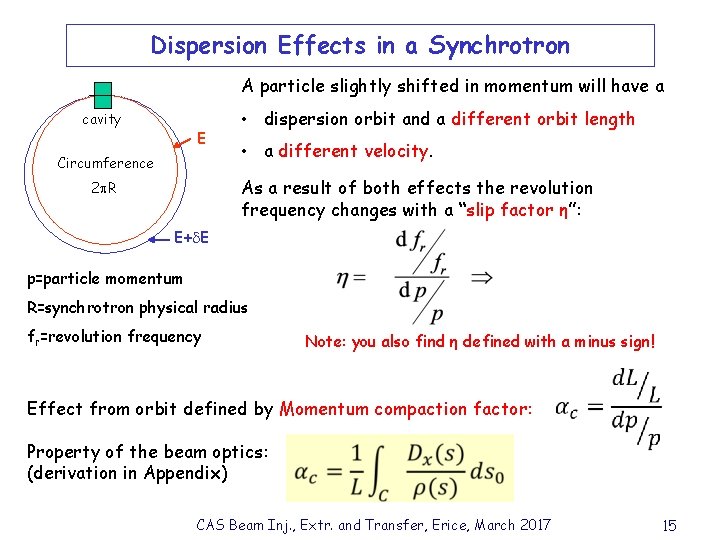
Dispersion Effects in a Synchrotron A particle slightly shifted in momentum will have a cavity E Circumference • dispersion orbit and a different orbit length • a different velocity. As a result of both effects the revolution frequency changes with a “slip factor η”: 2 R E+ E p=particle momentum R=synchrotron physical radius fr=revolution frequency Note: you also find η defined with a minus sign! Effect from orbit defined by Momentum compaction factor: Property of the beam optics: (derivation in Appendix) CAS Beam Inj. , Extr. and Transfer, Erice, March 2017 15
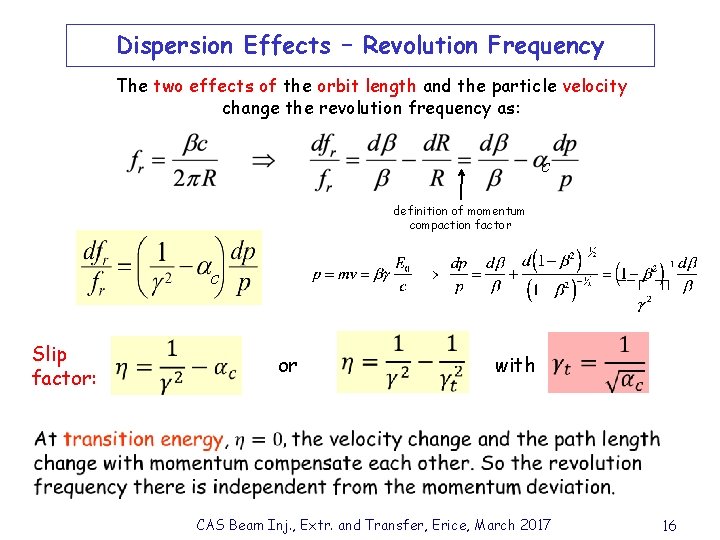
Dispersion Effects – Revolution Frequency The two effects of the orbit length and the particle velocity change the revolution frequency as: c definition of momentum compaction factor c Slip factor: or with CAS Beam Inj. , Extr. and Transfer, Erice, March 2017 16
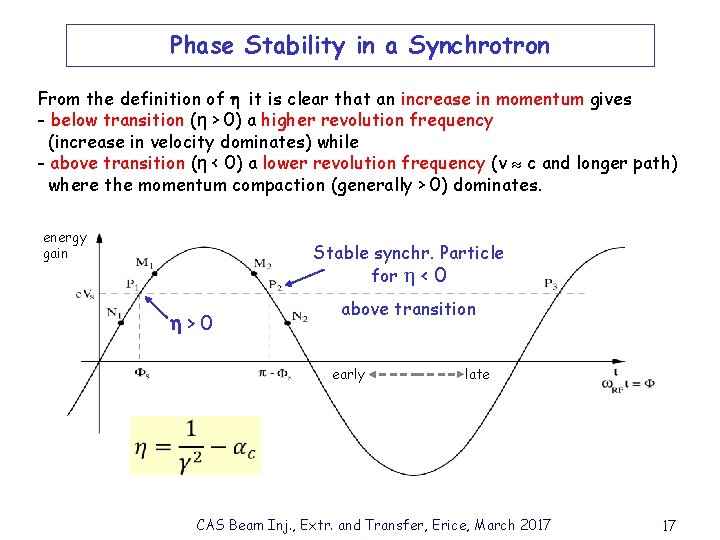
Phase Stability in a Synchrotron From the definition of it is clear that an increase in momentum gives - below transition (η > 0) a higher revolution frequency (increase in velocity dominates) while - above transition (η < 0) a lower revolution frequency (v c and longer path) where the momentum compaction (generally > 0) dominates. energy gain Stable synchr. Particle for < 0 >0 above transition early late CAS Beam Inj. , Extr. and Transfer, Erice, March 2017 17
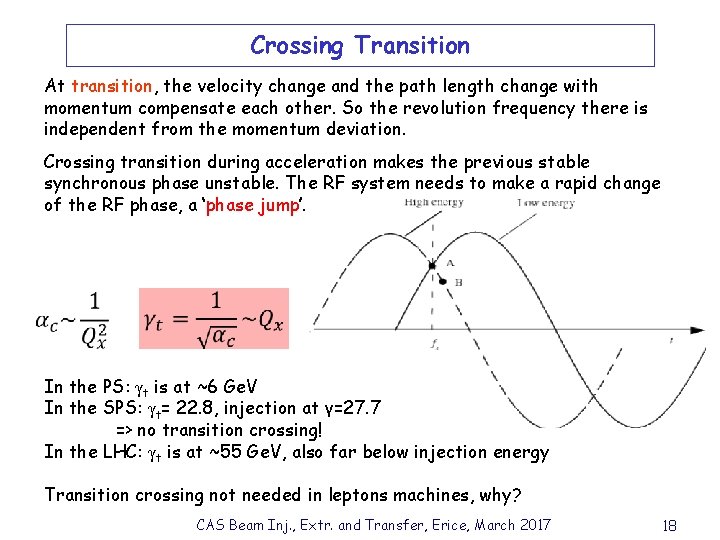
Crossing Transition At transition, the velocity change and the path length change with momentum compensate each other. So the revolution frequency there is independent from the momentum deviation. Crossing transition during acceleration makes the previous stable synchronous phase unstable. The RF system needs to make a rapid change of the RF phase, a ‘phase jump’. In the PS: γt is at ~6 Ge. V In the SPS: γt= 22. 8, injection at γ=27. 7 => no transition crossing! In the LHC: γt is at ~55 Ge. V, also far below injection energy Transition crossing not needed in leptons machines, why? CAS Beam Inj. , Extr. and Transfer, Erice, March 2017 18
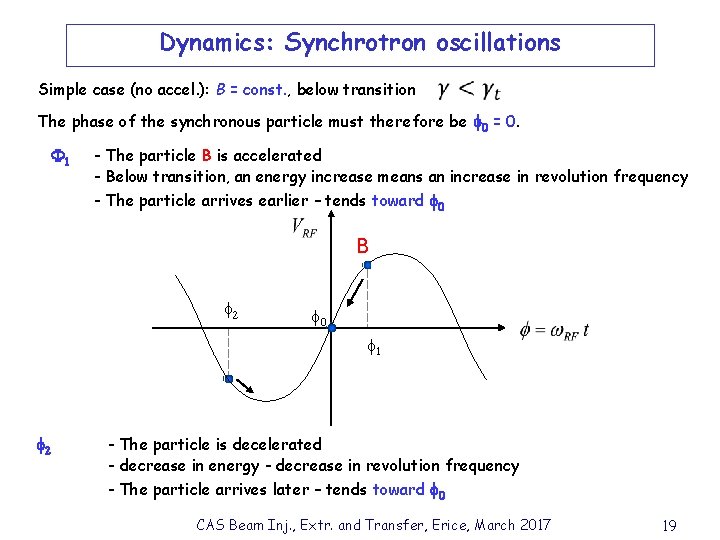
Dynamics: Synchrotron oscillations Simple case (no accel. ): B = const. , below transition The phase of the synchronous particle must therefore be 0 = 0. F 1 - The particle B is accelerated - Below transition, an energy increase means an increase in revolution frequency - The particle arrives earlier – tends toward 0 B 2 0 1 2 - The particle is decelerated - decrease in energy - decrease in revolution frequency - The particle arrives later – tends toward 0 CAS Beam Inj. , Extr. and Transfer, Erice, March 2017 19
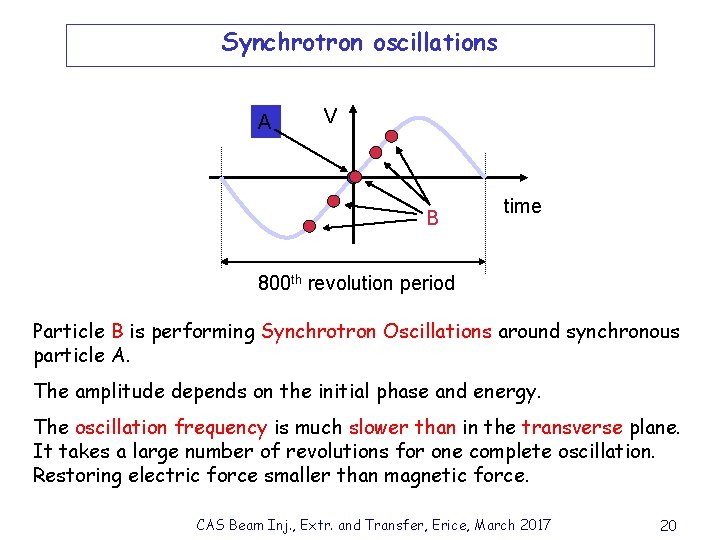
Synchrotron oscillations A V B time 1 thst revolution period 800 600 700 200 300 400 500 100 Particle B is performing Synchrotron Oscillations around synchronous particle A. The amplitude depends on the initial phase and energy. The oscillation frequency is much slower than in the transverse plane. It takes a large number of revolutions for one complete oscillation. Restoring electric force smaller than magnetic force. CAS Beam Inj. , Extr. and Transfer, Erice, March 2017 20
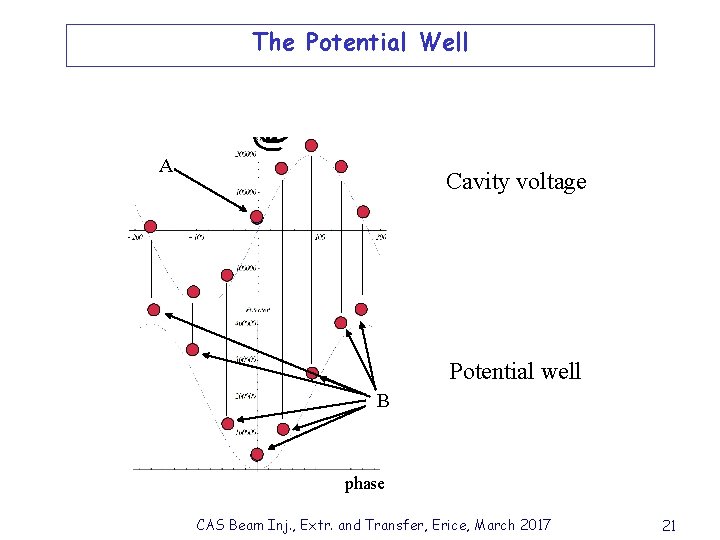
The Potential Well A Cavity voltage Potential well B phase CAS Beam Inj. , Extr. and Transfer, Erice, March 2017 21
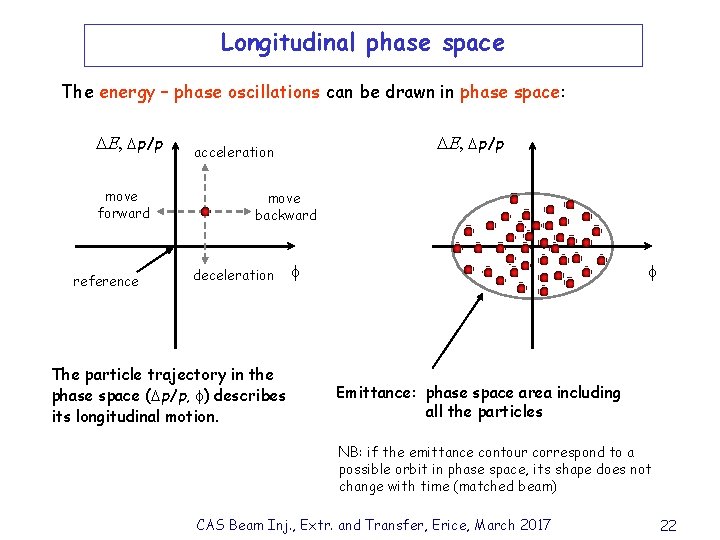
Longitudinal phase space The energy – phase oscillations can be drawn in phase space: E, p/p move forward reference E, p/p acceleration move backward deceleration The particle trajectory in the phase space ( p/p, ) describes its longitudinal motion. Emittance: phase space area including all the particles NB: if the emittance contour correspond to a possible orbit in phase space, its shape does not change with time (matched beam) CAS Beam Inj. , Extr. and Transfer, Erice, March 2017 22
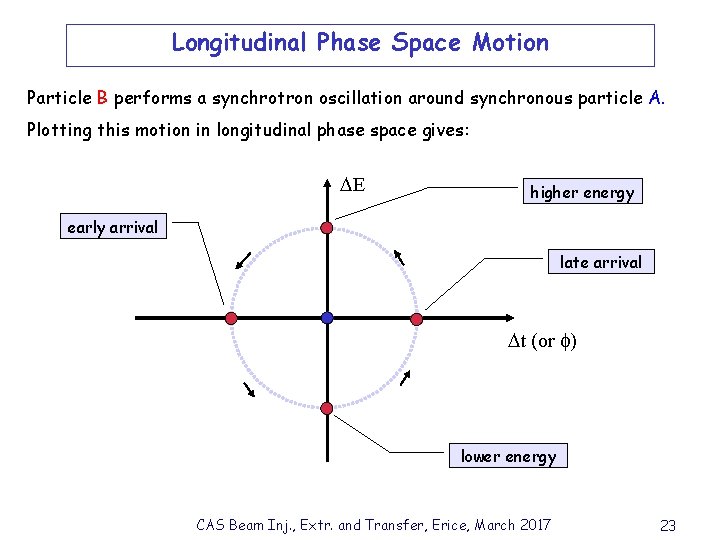
Longitudinal Phase Space Motion Particle B performs a synchrotron oscillation around synchronous particle A. Plotting this motion in longitudinal phase space gives: E higher energy early arrival late arrival t (or ) lower energy CAS Beam Inj. , Extr. and Transfer, Erice, March 2017 23
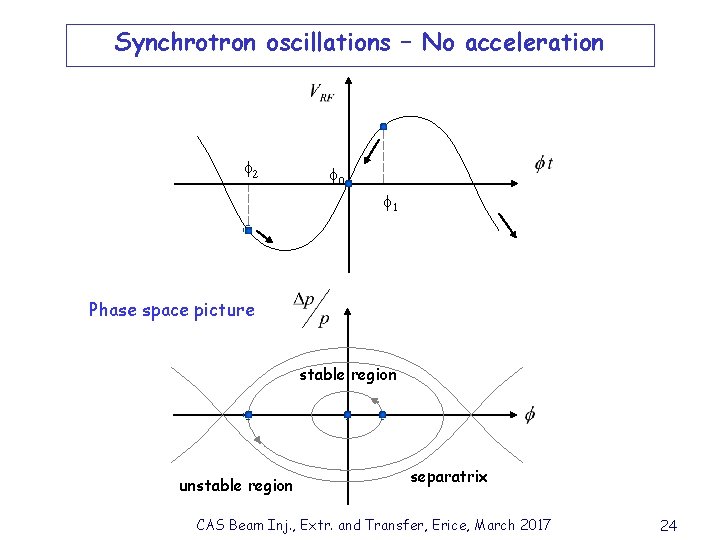
Synchrotron oscillations – No acceleration 2 0 1 Phase space picture stable region unstable region separatrix CAS Beam Inj. , Extr. and Transfer, Erice, March 2017 24
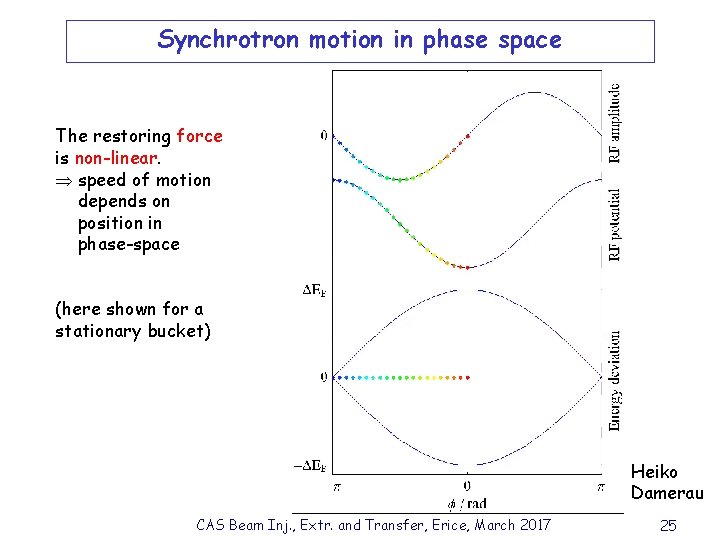
Synchrotron motion in phase space The restoring force is non-linear. speed of motion depends on position in phase-space (here shown for a stationary bucket) Heiko Damerau CAS Beam Inj. , Extr. and Transfer, Erice, March 2017 25
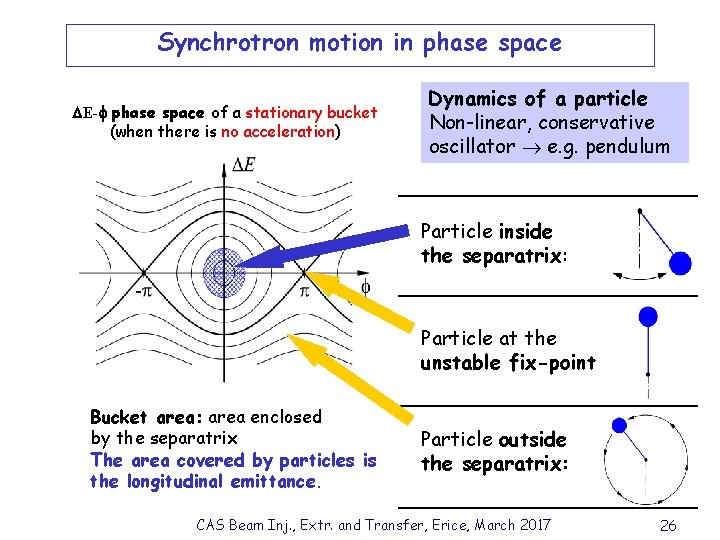
Synchrotron motion in phase space E- phase space of a stationary bucket (when there is no acceleration) Dynamics of a particle Non-linear, conservative oscillator e. g. pendulum Particle inside the separatrix: Particle at the unstable fix-point Bucket area: area enclosed by the separatrix The area covered by particles is the longitudinal emittance. Particle outside the separatrix: CAS Beam Inj. , Extr. and Transfer, Erice, March 2017 26
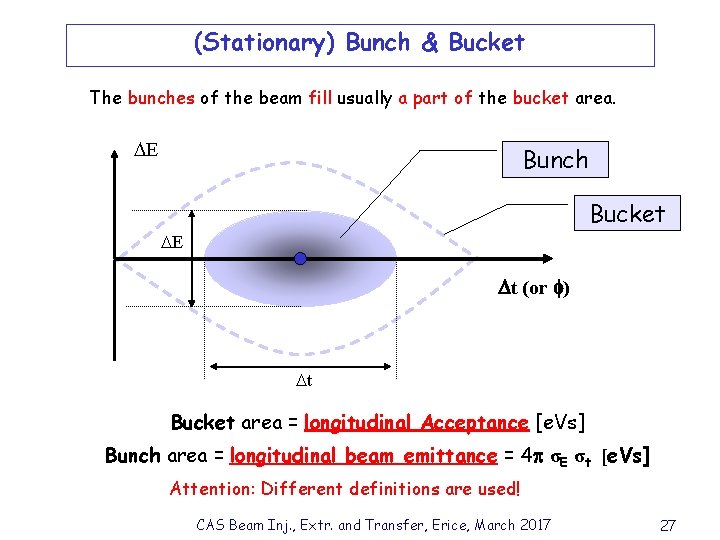
(Stationary) Bunch & Bucket The bunches of the beam fill usually a part of the bucket area. E Bunch Bucket E t (or ) t Bucket area = longitudinal Acceptance [e. Vs] Bunch area = longitudinal beam emittance = 4 σE σt [e. Vs] Attention: Different definitions are used! CAS Beam Inj. , Extr. and Transfer, Erice, March 2017 27
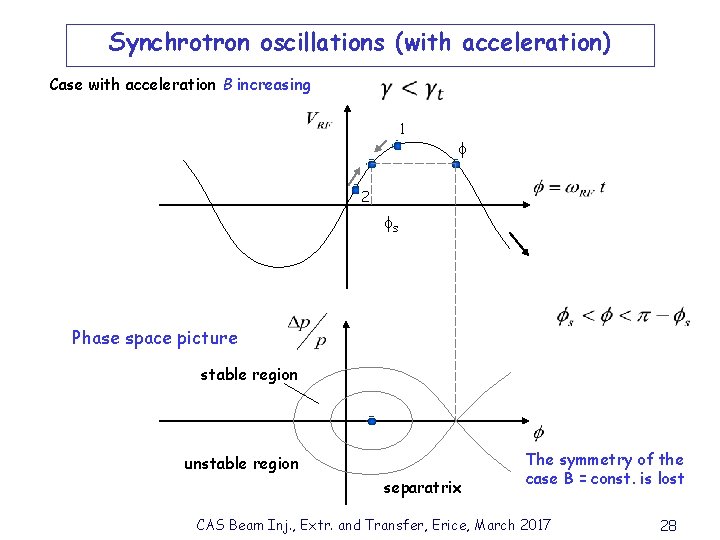
Synchrotron oscillations (with acceleration) Case with acceleration B increasing 1 2 s Phase space picture stable region unstable region separatrix The symmetry of the case B = const. is lost CAS Beam Inj. , Extr. and Transfer, Erice, March 2017 28
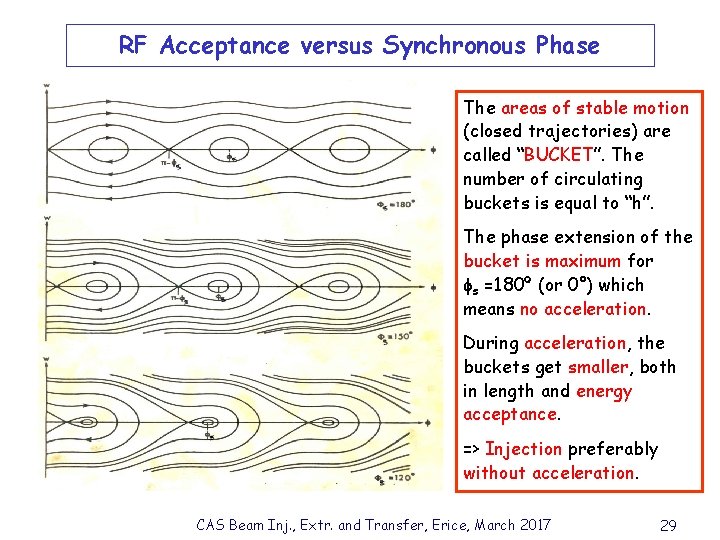
RF Acceptance versus Synchronous Phase The areas of stable motion (closed trajectories) are called “BUCKET”. The number of circulating buckets is equal to “h”. The phase extension of the bucket is maximum for s =180º (or 0°) which means no acceleration. During acceleration, the buckets get smaller, both in length and energy acceptance. => Injection preferably without acceleration. CAS Beam Inj. , Extr. and Transfer, Erice, March 2017 29
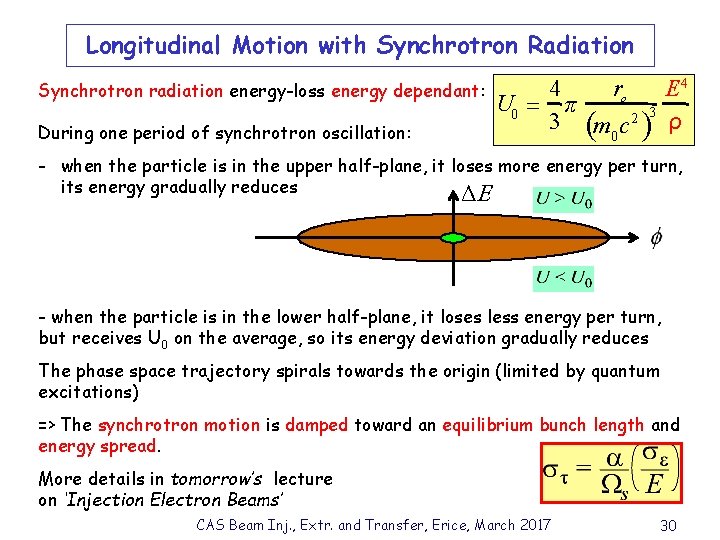
Longitudinal Motion with Synchrotron Radiation Synchrotron radiation energy-loss energy dependant: During one period of synchrotron oscillation: 4 re E 4 U 0 = π 3 (m 0 c 2 )3 ρ - when the particle is in the upper half-plane, it loses more energy per turn, its energy gradually reduces ΔE - when the particle is in the lower half-plane, it loses less energy per turn, but receives U 0 on the average, so its energy deviation gradually reduces The phase space trajectory spirals towards the origin (limited by quantum excitations) => The synchrotron motion is damped toward an equilibrium bunch length and energy spread. More details in tomorrow’s lecture on ‘Injection Electron Beams’ CAS Beam Inj. , Extr. and Transfer, Erice, March 2017 30
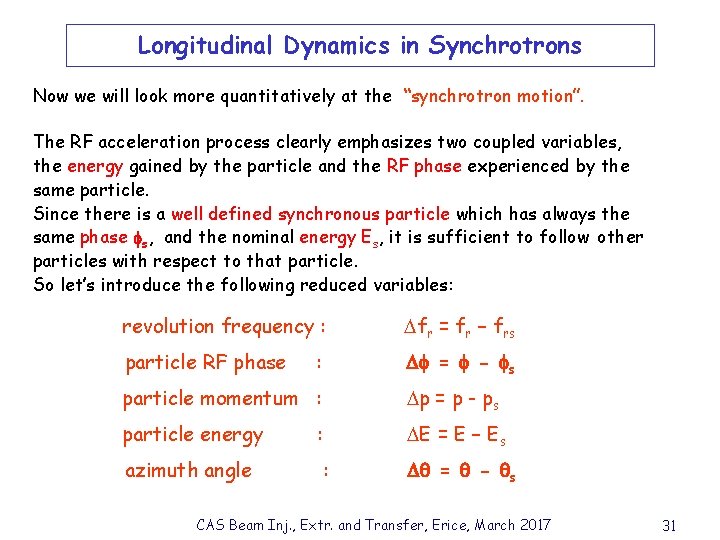
Longitudinal Dynamics in Synchrotrons Now we will look more quantitatively at the “synchrotron motion”. The RF acceleration process clearly emphasizes two coupled variables, the energy gained by the particle and the RF phase experienced by the same particle. Since there is a well defined synchronous particle which has always the same phase s, and the nominal energy Es, it is sufficient to follow other particles with respect to that particle. So let’s introduce the following reduced variables: revolution frequency : fr = fr – frs particle RF phase = - s : particle momentum : p = p - ps particle energy E = E – Es azimuth angle : : = - s CAS Beam Inj. , Extr. and Transfer, Erice, March 2017 31

Equations of Longitudinal Motion In these reduced variables, the equations of motion are (see Appendix): deriving and combining This second order equation is non linear. Moreover the parameters within the bracket are in general slowly varying with time. We will simplify in the following… CAS Beam Inj. , Extr. and Transfer, Erice, March 2017 32
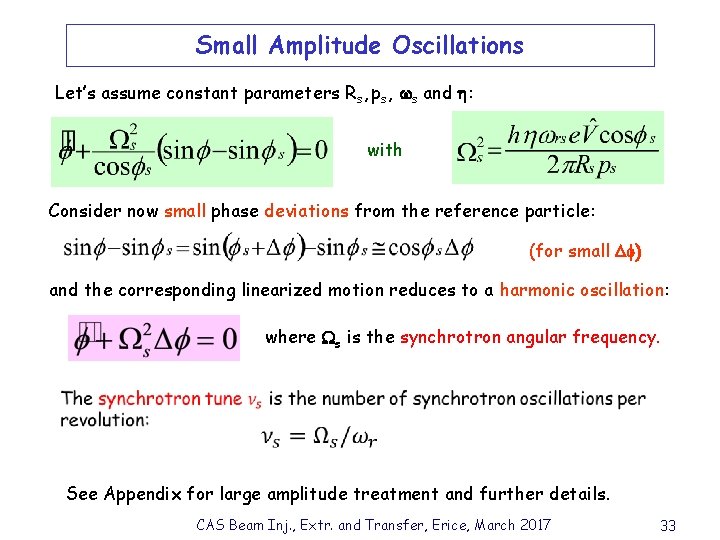
Small Amplitude Oscillations Let’s assume constant parameters Rs, ps, s and : with Consider now small phase deviations from the reference particle: (for small ) and the corresponding linearized motion reduces to a harmonic oscillation: where s is the synchrotron angular frequency. See Appendix for large amplitude treatment and further details. CAS Beam Inj. , Extr. and Transfer, Erice, March 2017 33
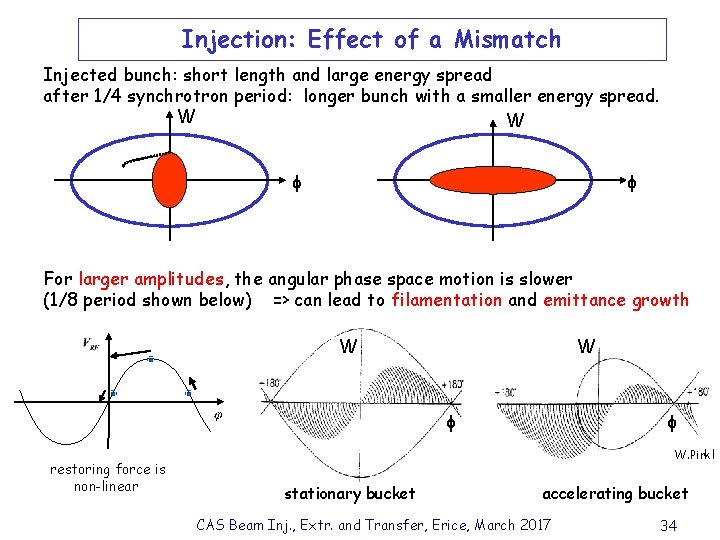
Injection: Effect of a Mismatch Injected bunch: short length and large energy spread after 1/4 synchrotron period: longer bunch with a smaller energy spread. W W For larger amplitudes, the angular phase space motion is slower (1/8 period shown below) => can lead to filamentation and emittance growth W W restoring force is non-linear W. Pirkl stationary bucket accelerating bucket CAS Beam Inj. , Extr. and Transfer, Erice, March 2017 34
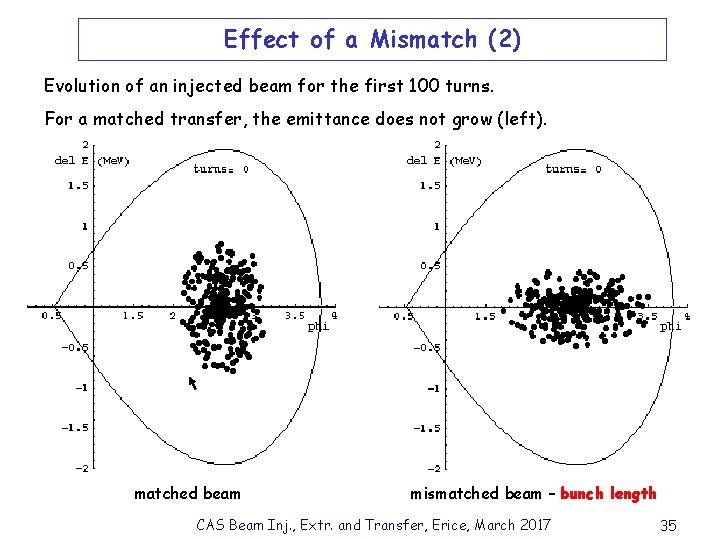
Effect of a Mismatch (2) Evolution of an injected beam for the first 100 turns. For a matched transfer, the emittance does not grow (left). matched beam mismatched beam – bunch length CAS Beam Inj. , Extr. and Transfer, Erice, March 2017 35
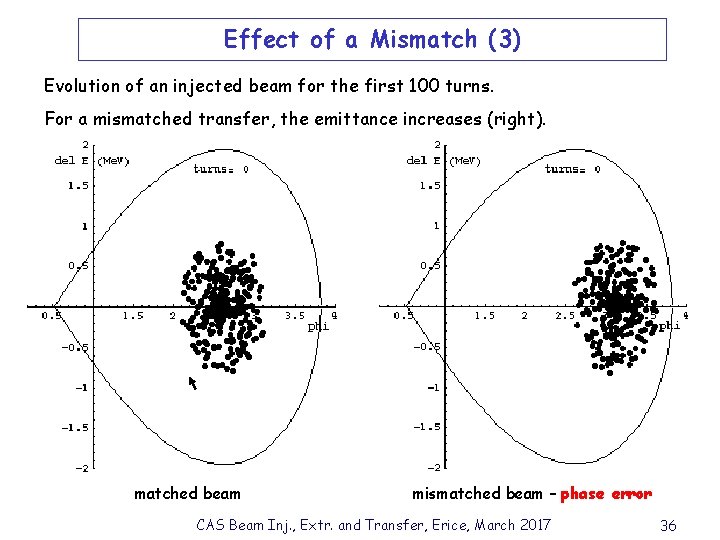
Effect of a Mismatch (3) Evolution of an injected beam for the first 100 turns. For a mismatched transfer, the emittance increases (right). matched beam mismatched beam – phase error CAS Beam Inj. , Extr. and Transfer, Erice, March 2017 36
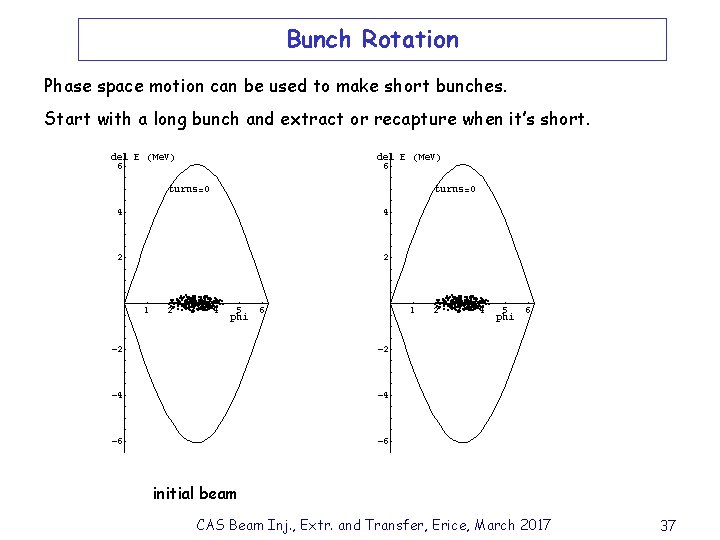
Bunch Rotation Phase space motion can be used to make short bunches. Start with a long bunch and extract or recapture when it’s short. initial beam CAS Beam Inj. , Extr. and Transfer, Erice, March 2017 37
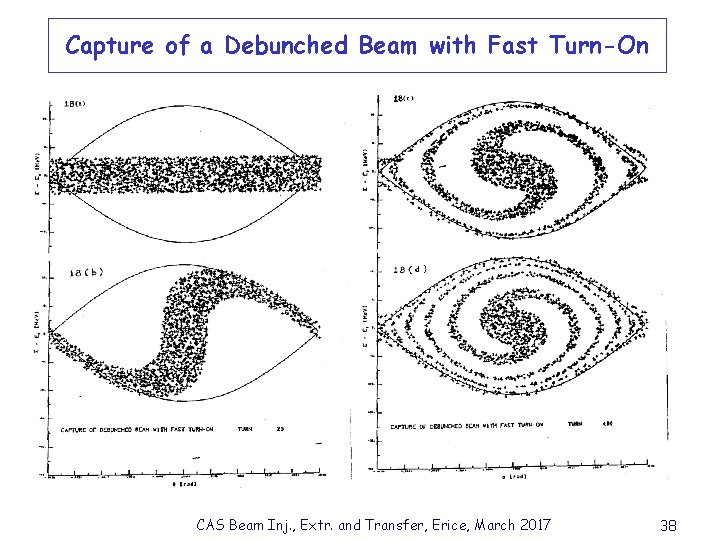
Capture of a Debunched Beam with Fast Turn-On CAS Beam Inj. , Extr. and Transfer, Erice, March 2017 38
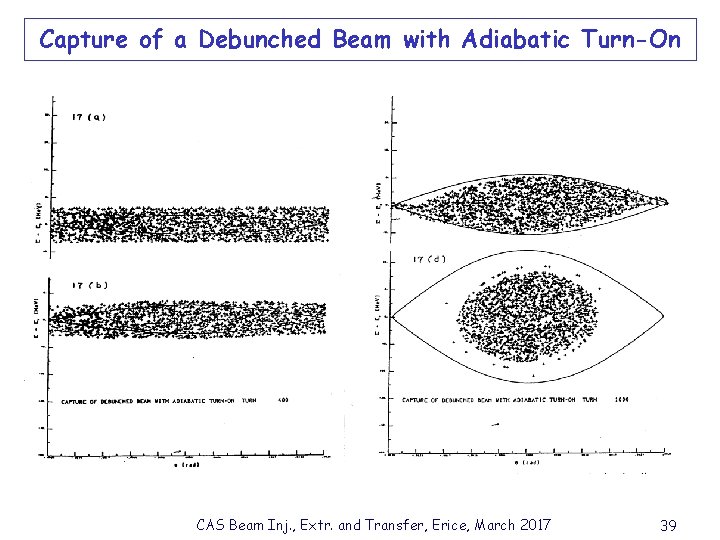
Capture of a Debunched Beam with Adiabatic Turn-On CAS Beam Inj. , Extr. and Transfer, Erice, March 2017 39
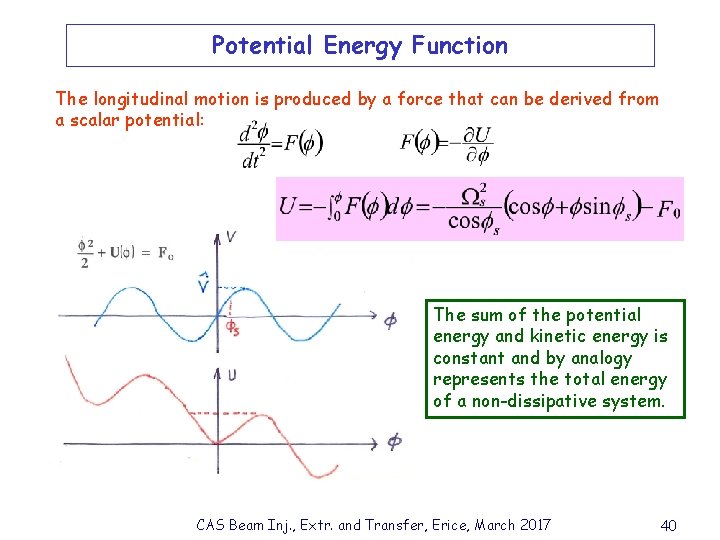
Potential Energy Function The longitudinal motion is produced by a force that can be derived from a scalar potential: The sum of the potential energy and kinetic energy is constant and by analogy represents the total energy of a non-dissipative system. CAS Beam Inj. , Extr. and Transfer, Erice, March 2017 40

Hamiltonian of Longitudinal Motion Introducing a new convenient variable, W, leads to the 1 st order equations: The two variables , W are canonical since these equations of motion can be derived from a Hamiltonian H( , W, t): CAS Beam Inj. , Extr. and Transfer, Erice, March 2017 41
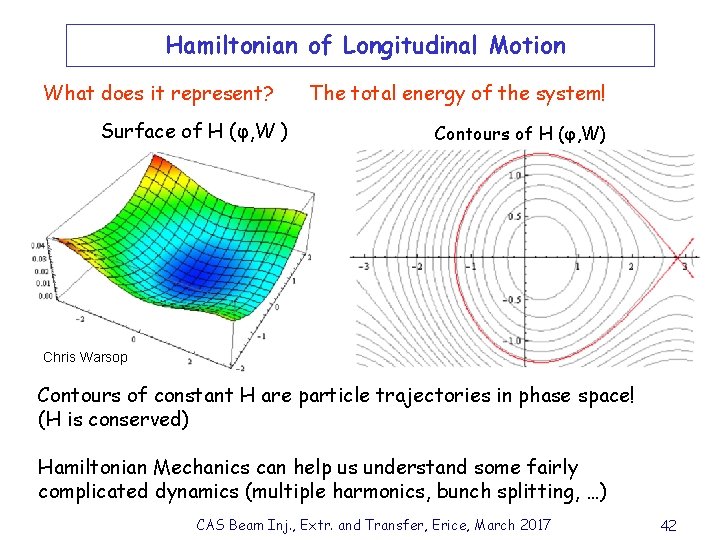
Hamiltonian of Longitudinal Motion What does it represent? Surface of H (φ, W ) The total energy of the system! Contours of H (φ, W) Chris Warsop Contours of constant H are particle trajectories in phase space! (H is conserved) Hamiltonian Mechanics can help us understand some fairly complicated dynamics (multiple harmonics, bunch splitting, …) CAS Beam Inj. , Extr. and Transfer, Erice, March 2017 42
Summary • Synchrotron oscillations in the longitudinal phase space (E, ) • Particles perform oscillations around synchronous phase • synchronous phase depending on acceleration • below or above transition • Bucket is the region in phase space for stable oscillations • Bucket size is the largest without acceleration • to avoid filamentation and emittance increase it is important to • match the shape of the bunch to the bucket and • inject with the correct phase and energy CAS Beam Inj. , Extr. and Transfer, Erice, March 2017 43
Bibliography M. Conte, W. W. Mac Kay An Introduction to the Physics of particle Accelerators (World Scientific, 1991) P. J. Bryant and K. Johnsen The Principles of Circular Accelerators and Storage Rings (Cambridge University Press, 1993) D. A. Edwards, M. J. Syphers An Introduction to the Physics of High Energy Accelerators (J. Wiley & sons, Inc, 1993) H. Wiedemann Particle Accelerator Physics (Springer-Verlag, Berlin, 1993) M. Reiser Theory and Design of Charged Particles Beams (J. Wiley & sons, 1994) A. Chao, M. Tigner Handbook of Accelerator Physics and Engineering (World Scientific 1998) K. Wille The Physics of Particle Accelerators: An Introduction (Oxford University Press, 2000) E. J. N. Wilson An introduction to Particle Accelerators (Oxford University Press, 2001) And CERN Accelerator Schools (CAS) Proceedings CAS Beam Inj. , Extr. and Transfer, Erice, March 2017 44
Acknowledgements I would like to thank everyone for the material that I have used. In particular (hope I don’t forget anyone): - Joël Le Duff (from whom I inherited the course) - Rende Steerenberg - Gerald Dugan - Heiko Damerau - Werner Pirkl - Mike Syphers - Roberto Corsini - Roland Garoby - Luca Bottura - Chris Warsop CAS Beam Inj. , Extr. and Transfer, Erice, March 2017 45

Appendix: Momentum Compaction Factor x The elementary path difference from the two orbits is: definition of dispersion Dx d leading to the total change in the circumference: < >m means that With ρ=∞ in straight sections we get: CAS Beam Inj. , Extr. and Transfer, Erice, March 2017 the average is considered over the bending magnet only 46
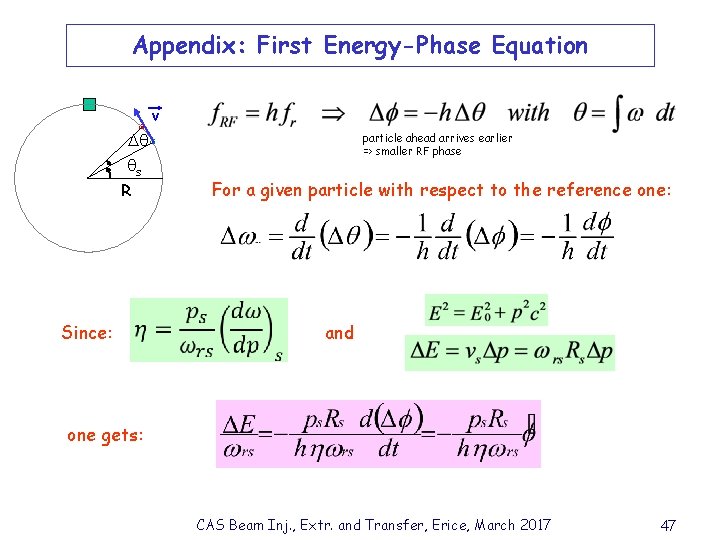
Appendix: First Energy-Phase Equation v s R Since: particle ahead arrives earlier => smaller RF phase For a given particle with respect to the reference one: and one gets: CAS Beam Inj. , Extr. and Transfer, Erice, March 2017 47
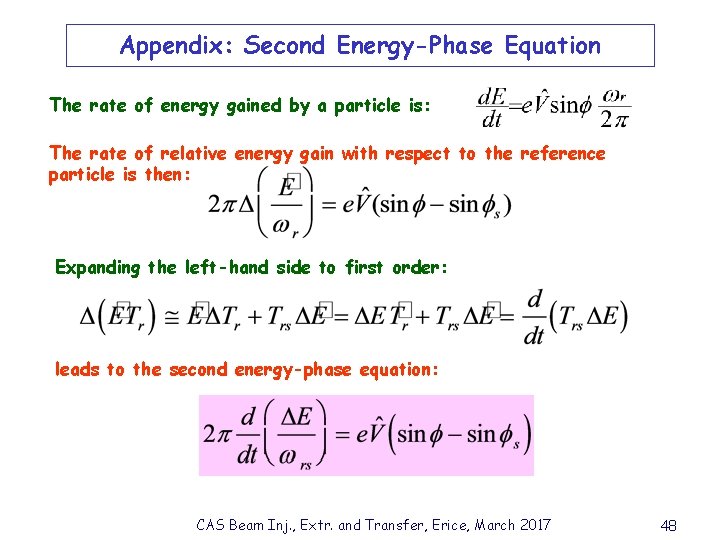
Appendix: Second Energy-Phase Equation The rate of energy gained by a particle is: The rate of relative energy gain with respect to the reference particle is then: Expanding the left-hand side to first order: leads to the second energy-phase equation: CAS Beam Inj. , Extr. and Transfer, Erice, March 2017 48
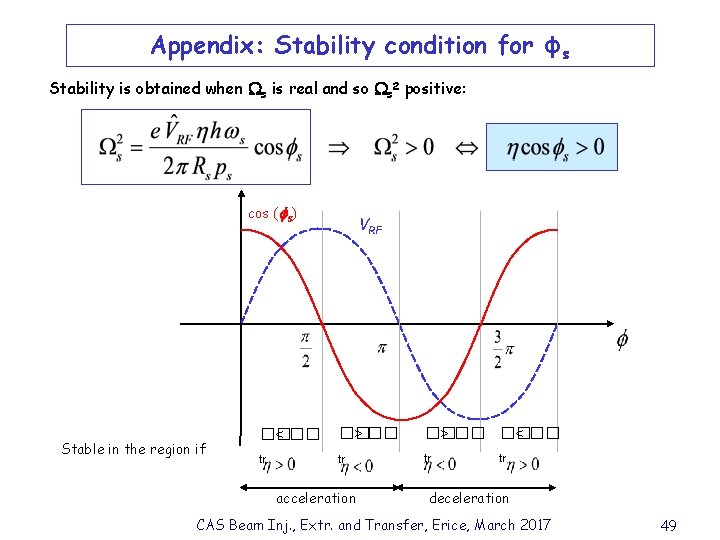
Appendix: Stability condition for ϕs Stability is obtained when s is real and so s 2 positive: cos (fs) Stable in the region if VRF �� < �� �� > �� �� < �� tr tr tr acceleration tr deceleration CAS Beam Inj. , Extr. and Transfer, Erice, March 2017 49

Appendix: Stationary Bucket - Separatrix This is the case sin s=0 (no acceleration) which means s=0 or . The equation of the separatrix for s= (above transition) becomes: Replacing the phase derivative by the (canonical) variable W: W 0 Wbk 2 and introducing the expression for s leads to the following equation for the separatrix: with C=2 Rs CAS Beam Inj. , Extr. and Transfer, Erice, March 2017 50
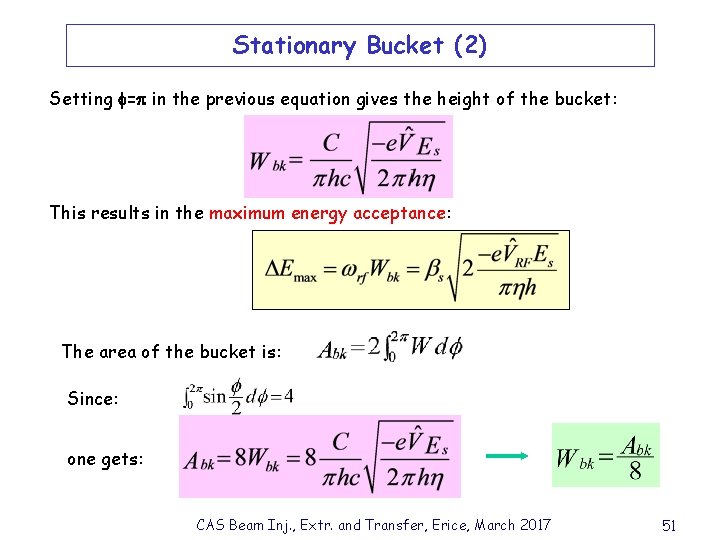
Stationary Bucket (2) Setting = in the previous equation gives the height of the bucket: This results in the maximum energy acceptance: The area of the bucket is: Since: one gets: CAS Beam Inj. , Extr. and Transfer, Erice, March 2017 51
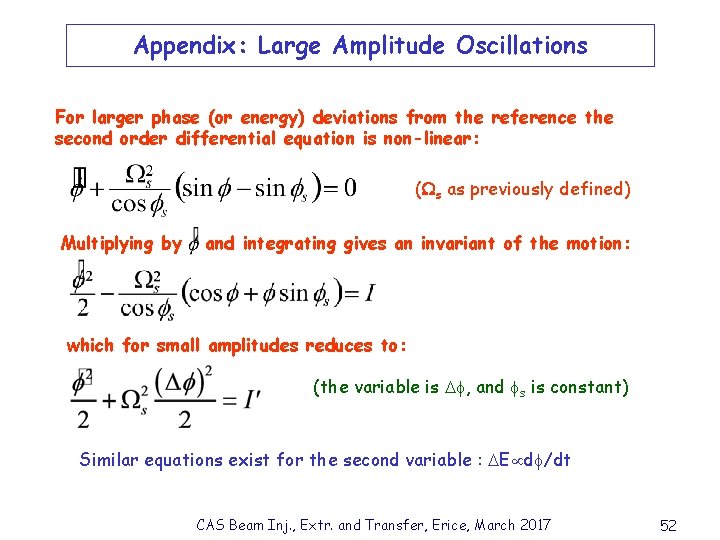
Appendix: Large Amplitude Oscillations For larger phase (or energy) deviations from the reference the second order differential equation is non-linear: ( s as previously defined) Multiplying by and integrating gives an invariant of the motion: which for small amplitudes reduces to: (the variable is , and s is constant) Similar equations exist for the second variable : E d /dt CAS Beam Inj. , Extr. and Transfer, Erice, March 2017 52
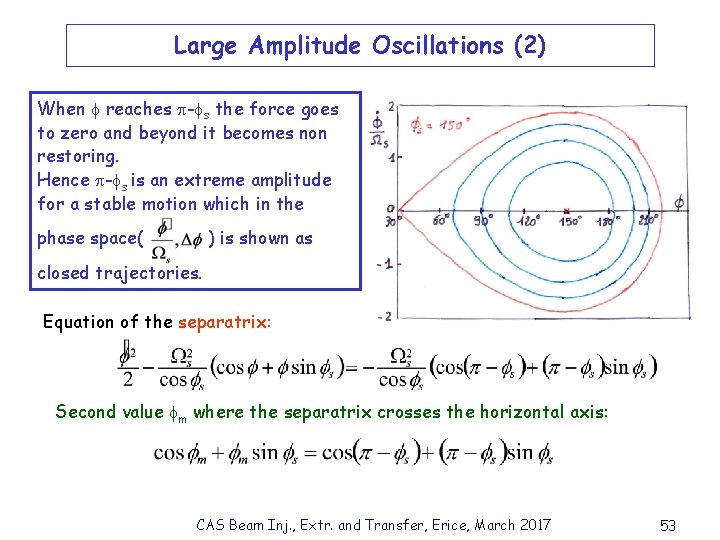
Large Amplitude Oscillations (2) When reaches - s the force goes to zero and beyond it becomes non restoring. Hence - s is an extreme amplitude for a stable motion which in the phase space( ) is shown as closed trajectories. Equation of the separatrix: Second value m where the separatrix crosses the horizontal axis: CAS Beam Inj. , Extr. and Transfer, Erice, March 2017 53
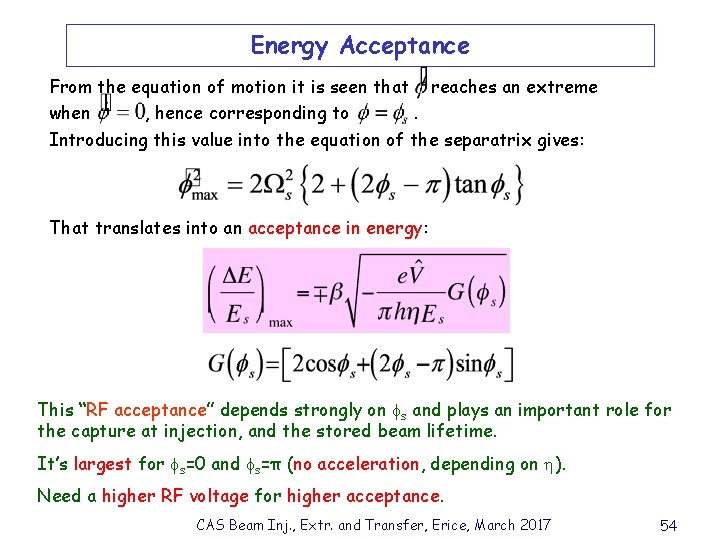
Energy Acceptance From the equation of motion it is seen that reaches an extreme when , hence corresponding to. Introducing this value into the equation of the separatrix gives: That translates into an acceptance in energy: This “RF acceptance” depends strongly on s and plays an important role for the capture at injection, and the stored beam lifetime. It’s largest for s=0 and s=π (no acceleration, depending on ). Need a higher RF voltage for higher acceptance. CAS Beam Inj. , Extr. and Transfer, Erice, March 2017 54
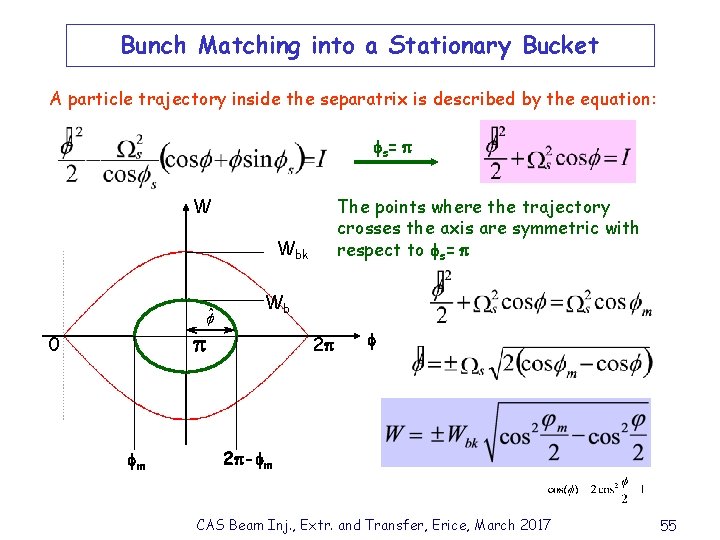
Bunch Matching into a Stationary Bucket A particle trajectory inside the separatrix is described by the equation: s= W The points where the trajectory crosses the axis are symmetric with respect to s= Wbk Wb 0 m 2 2 - m CAS Beam Inj. , Extr. and Transfer, Erice, March 2017 55
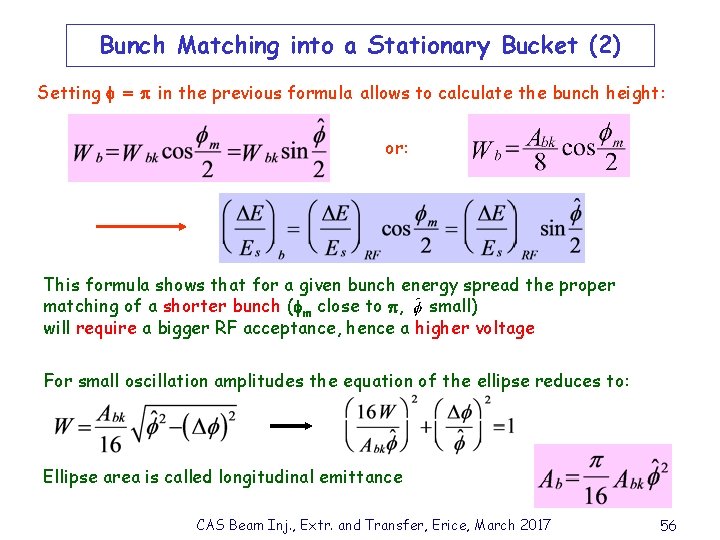
Bunch Matching into a Stationary Bucket (2) Setting in the previous formula allows to calculate the bunch height: or: This formula shows that for a given bunch energy spread the proper matching of a shorter bunch ( m close to , small) will require a bigger RF acceptance, hence a higher voltage For small oscillation amplitudes the equation of the ellipse reduces to: Ellipse area is called longitudinal emittance CAS Beam Inj. , Extr. and Transfer, Erice, March 2017 56
- Slides: 56