
Longest International Openaccess Network LION Abu Saeed Khan
Longest International Open-access Network (LION) Abu Saeed Khan Senior Policy Fellow, LIRNEasia abu@lirneasia. net @ Communic. Asia 2011 June 22, 2011 Singapore
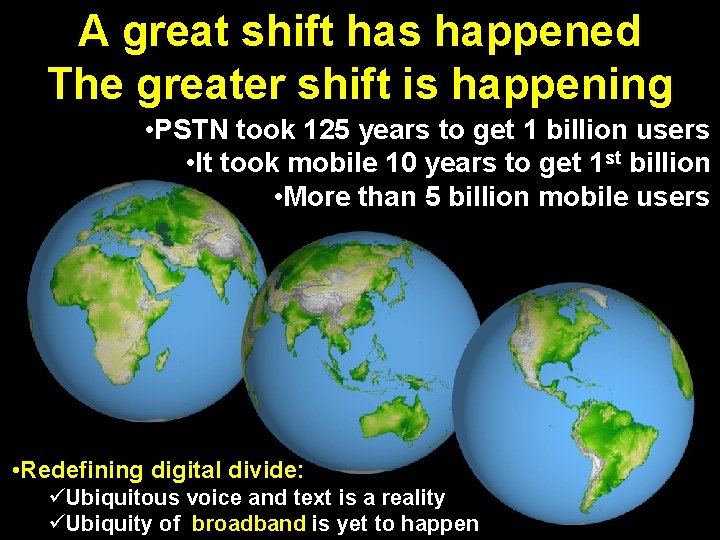
A great shift has happened The greater shift is happening • PSTN took 125 years to get 1 billion users • It took mobile 10 years to get 1 st billion • More than 5 billion mobile users • Redefining digital divide: üUbiquitous voice and text is a reality üUbiquity of broadband is yet to happen
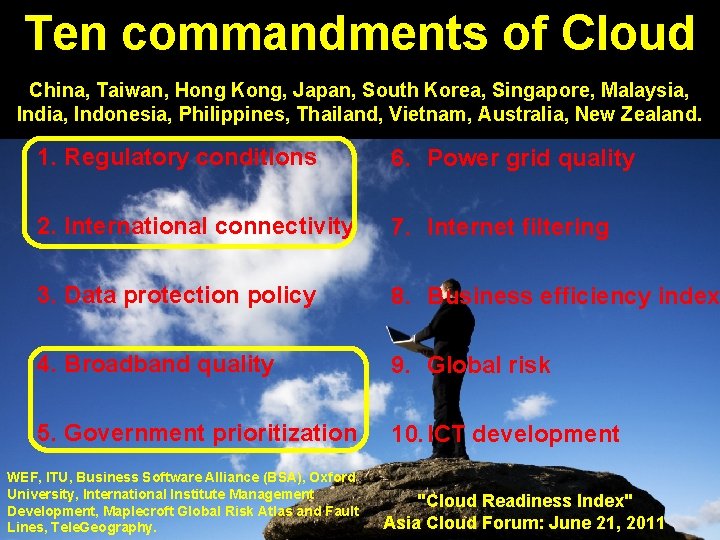
Ten commandments of Cloud China, Taiwan, Hong Kong, Japan, South Korea, Singapore, Malaysia, Indonesia, Philippines, Thailand, Vietnam, Australia, New Zealand. 1. Regulatory conditions 6. Power grid quality 2. International connectivity 7. Internet filtering 3. Data protection policy 8. Business efficiency index 4. Broadband quality 9. Global risk 5. Government prioritization 10. ICT development WEF, ITU, Business Software Alliance (BSA), Oxford University, International Institute Management Development, Maplecroft Global Risk Atlas and Fault Lines, Tele. Geography. "Cloud Readiness Index" Asia Cloud Forum: June 21, 2011
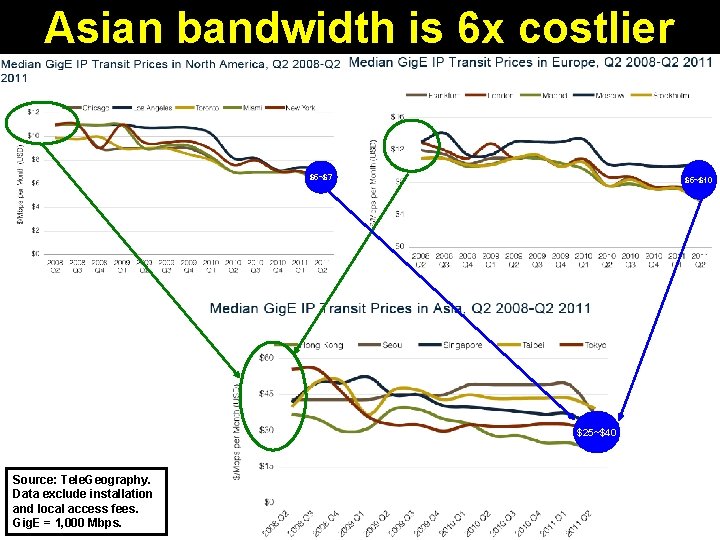
Asian bandwidth is 6 x costlier $5~$7 $5~$10 $25~$40 Source: Tele. Geography. Data exclude installation and local access fees. Gig. E = 1, 000 Mbps.
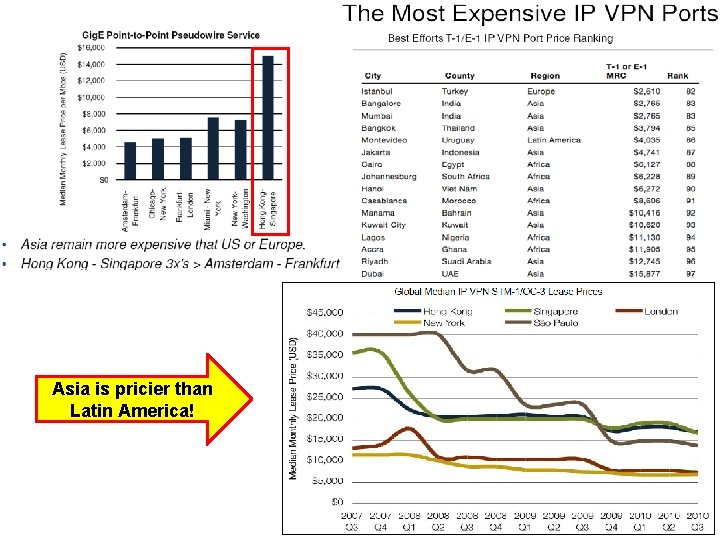
Asia is pricier than Latin America!
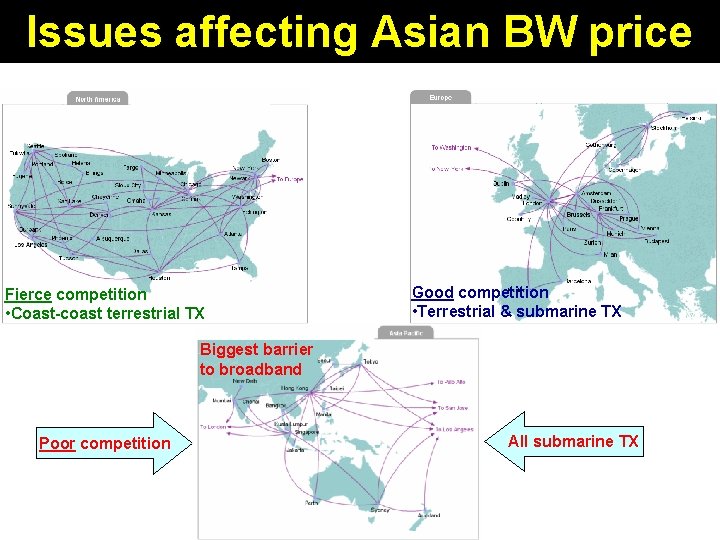
Issues affecting Asian BW price Fierce competition • Coast-coast terrestrial TX Good competition • Terrestrial & submarine TX Biggest barrier to broadband Poor competition All submarine TX
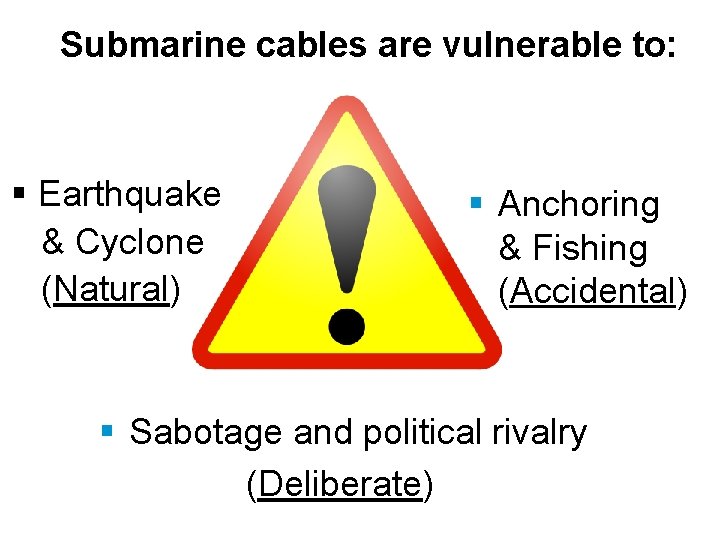
Submarine cables are vulnerable to: § Earthquake & Cyclone (Natural) § Anchoring & Fishing (Accidental) § Sabotage and political rivalry (Deliberate)
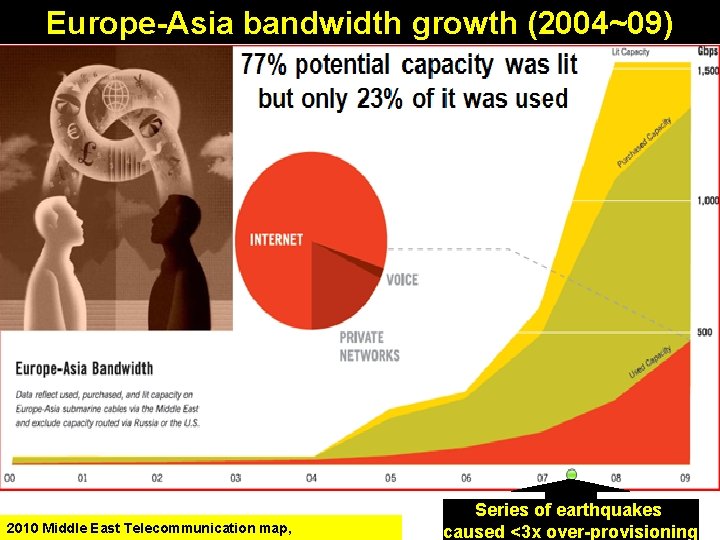
Europe-Asia bandwidth growth (2004~09) 2010 Middle East Telecommunication map, Series of earthquakes caused <3 x over-provisioning
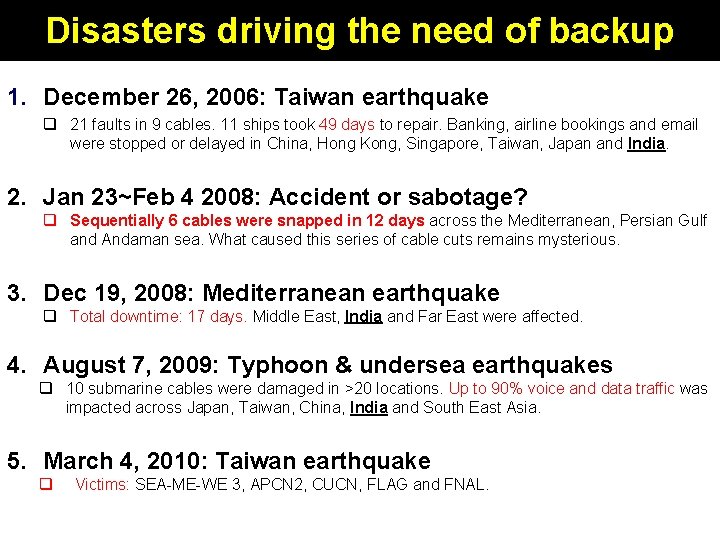
Disasters driving the need of backup 1. December 26, 2006: Taiwan earthquake q 21 faults in 9 cables. 11 ships took 49 days to repair. Banking, airline bookings and email were stopped or delayed in China, Hong Kong, Singapore, Taiwan, Japan and India. 2. Jan 23~Feb 4 2008: Accident or sabotage? q Sequentially 6 cables were snapped in 12 days across the Mediterranean, Persian Gulf and Andaman sea. What caused this series of cable cuts remains mysterious. 3. Dec 19, 2008: Mediterranean earthquake q Total downtime: 17 days. Middle East, India and Far East were affected. 4. August 7, 2009: Typhoon & undersea earthquakes q 10 submarine cables were damaged in >20 locations. Up to 90% voice and data traffic was impacted across Japan, Taiwan, China, India and South East Asia. 5. March 4, 2010: Taiwan earthquake q Victims: SEA-ME-WE 3, APCN 2, CUCN, FLAG and FNAL.
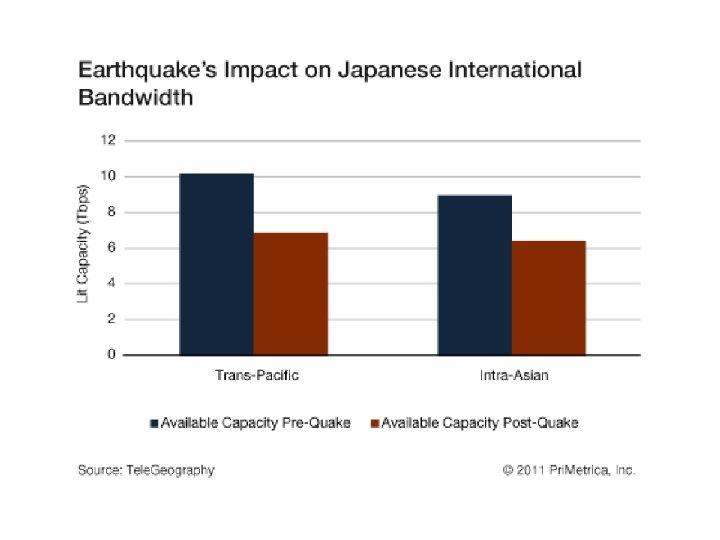
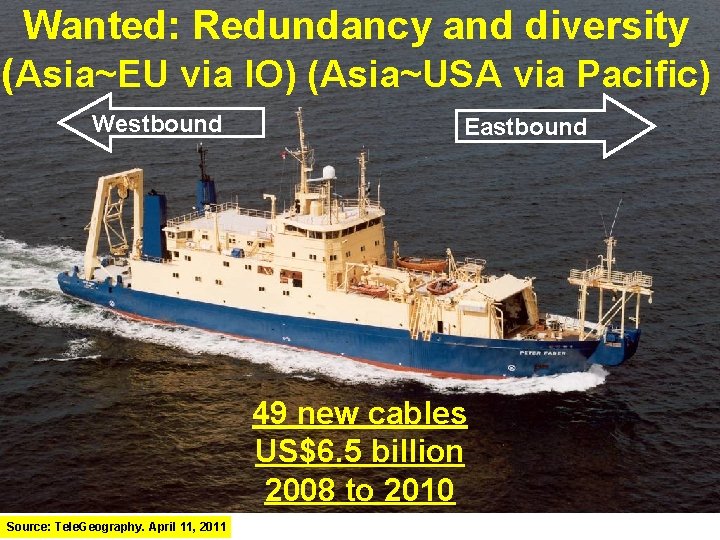
Wanted: Redundancy and diversity (Asia~EU via IO) (Asia~USA via Pacific) Westbound Eastbound 49 new cables US$6. 5 billion 2008 to 2010 Source: Tele. Geography. April 11, 2011 Source: Tele. Geography
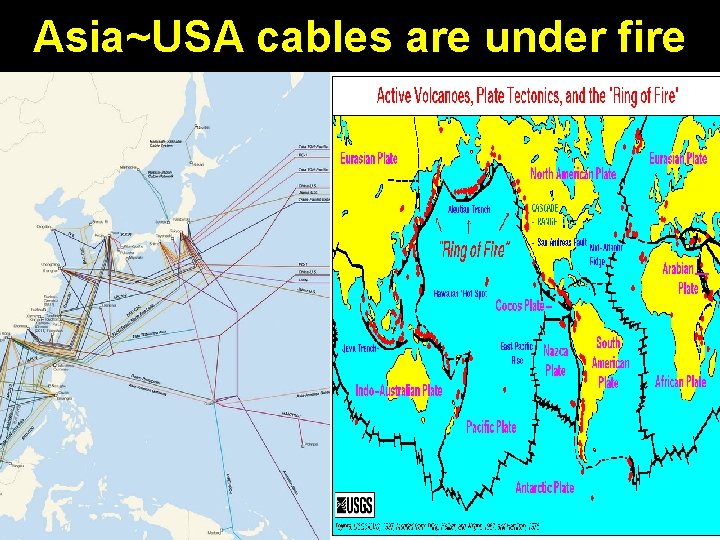
Asia~USA cables are under fire
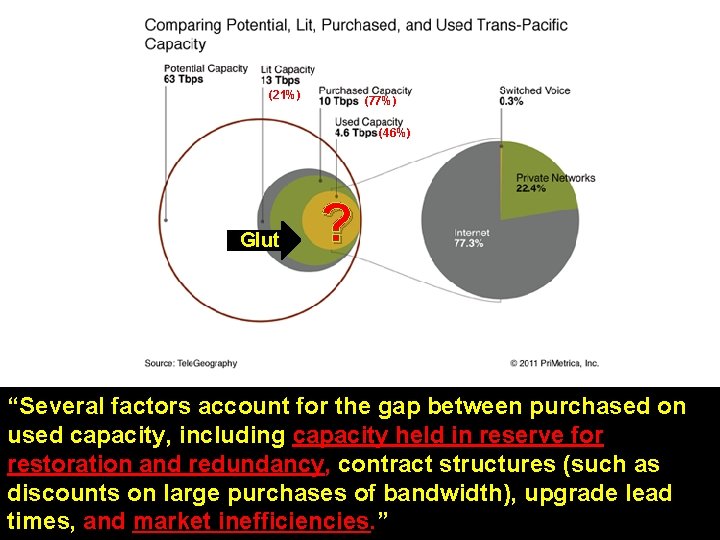
(21%) (77%) (46%) Glut ? “Several factors account for the gap between purchased on used capacity, including capacity held in reserve for restoration and redundancy, contract structures (such as discounts on large purchases of bandwidth), upgrade lead times, and market inefficiencies. ”
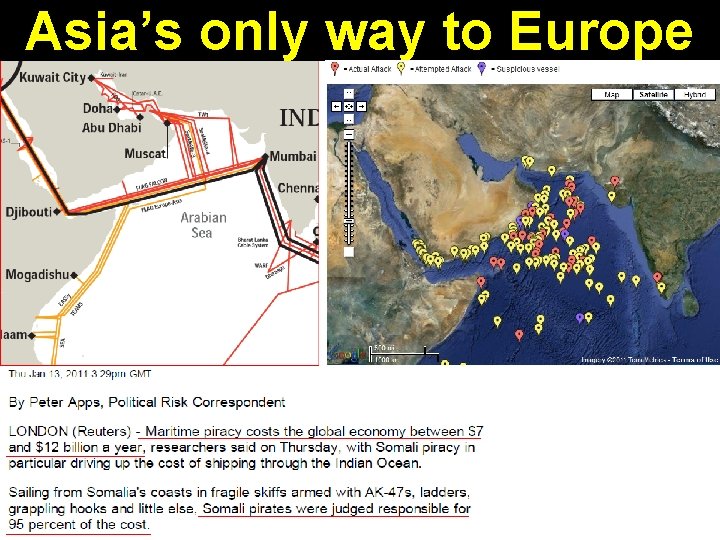
Asia’s only way to Europe
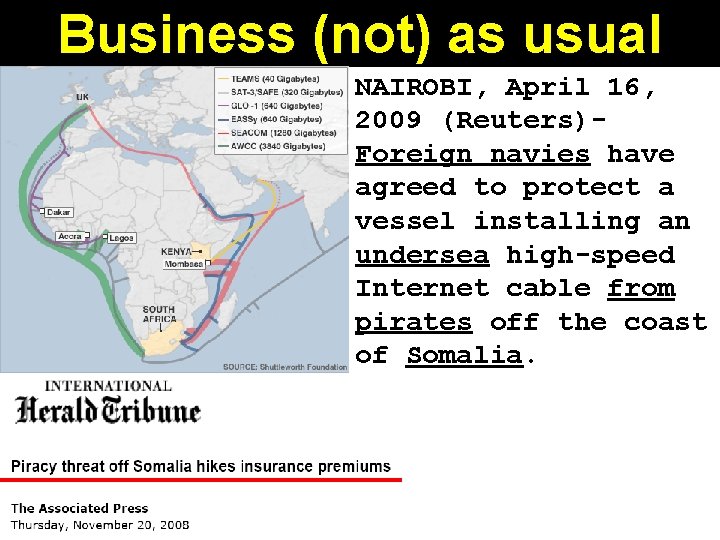
Business (not) as usual NAIROBI, April 16, 2009 (Reuters)Foreign navies have agreed to protect a vessel installing an undersea high-speed Internet cable from pirates off the coast of Somalia.
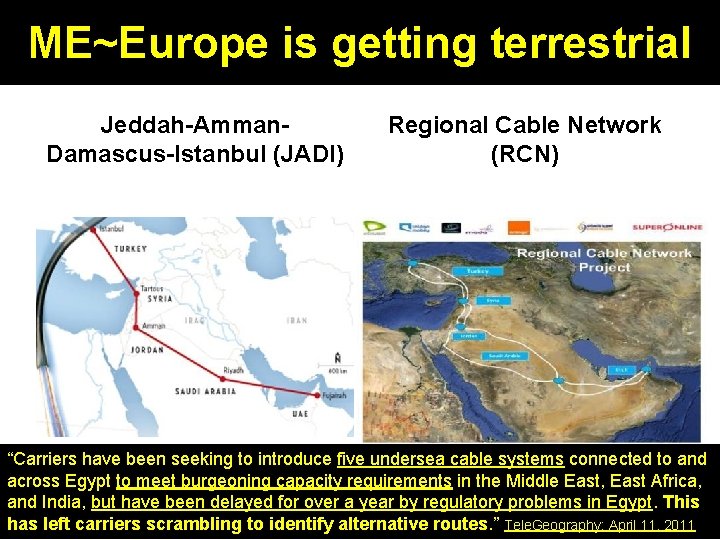
ME~Europe is getting terrestrial Jeddah-Amman. Damascus-Istanbul (JADI) Regional Cable Network (RCN) “Carriers have been seeking to introduce five undersea cable systems connected to and across Egypt to meet burgeoning capacity requirements in the Middle East, East Africa, and India, but have been delayed for over a year by regulatory problems in Egypt. This has left carriers scrambling to identify alternative routes. ” Tele. Geography: April 11, 2011
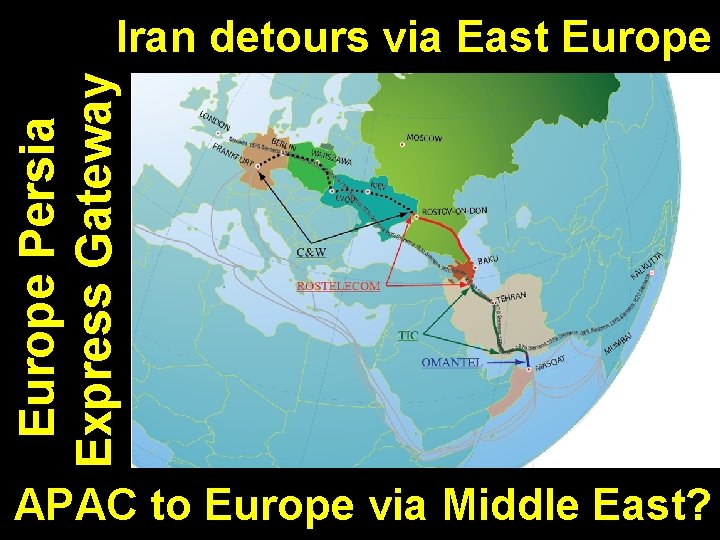
Europe Persia Express Gateway Iran detours via East Europe APAC to Europe via Middle East?
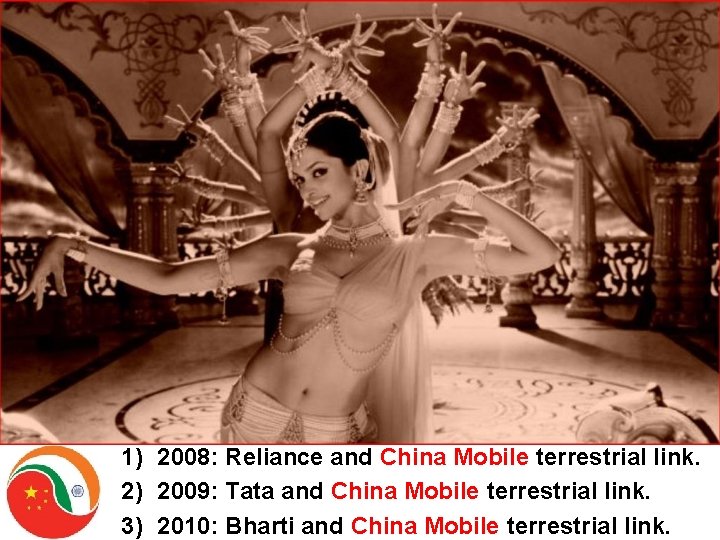
1) 2008: Reliance and China Mobile terrestrial link. 2) 2009: Tata and China Mobile terrestrial link. 3) 2010: Bharti and China Mobile terrestrial link.
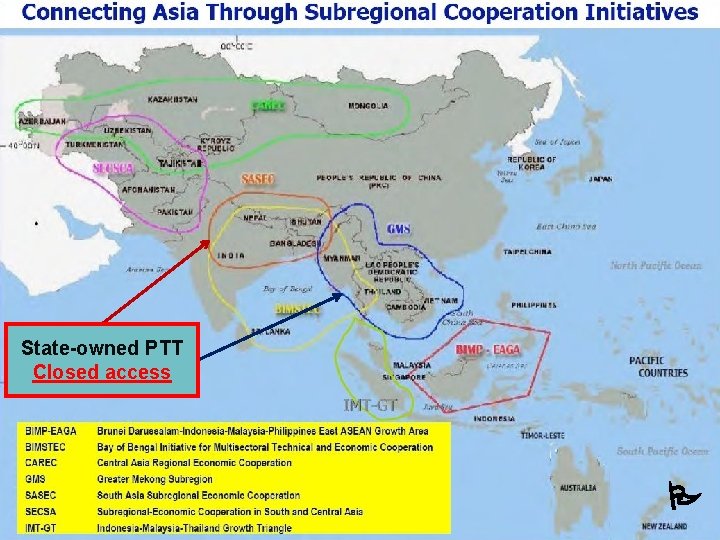
State-owned PTT Closed access
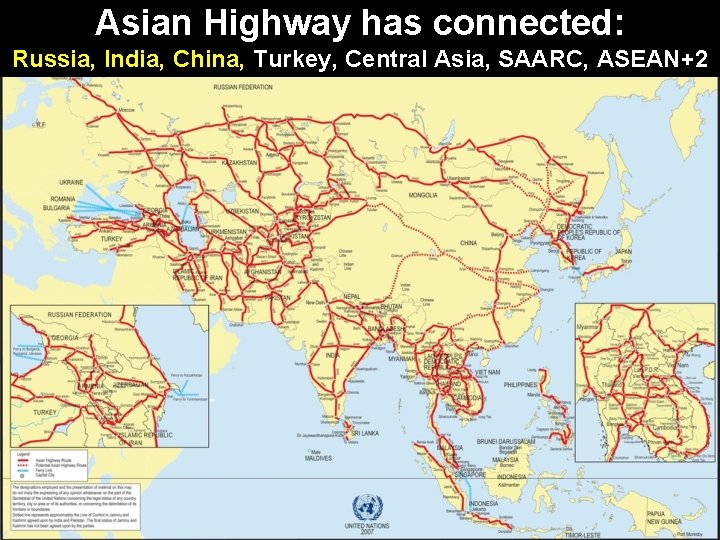
Asian Highway has connected: Russia, India, China, Turkey, Central Asia, SAARC, ASEAN+2
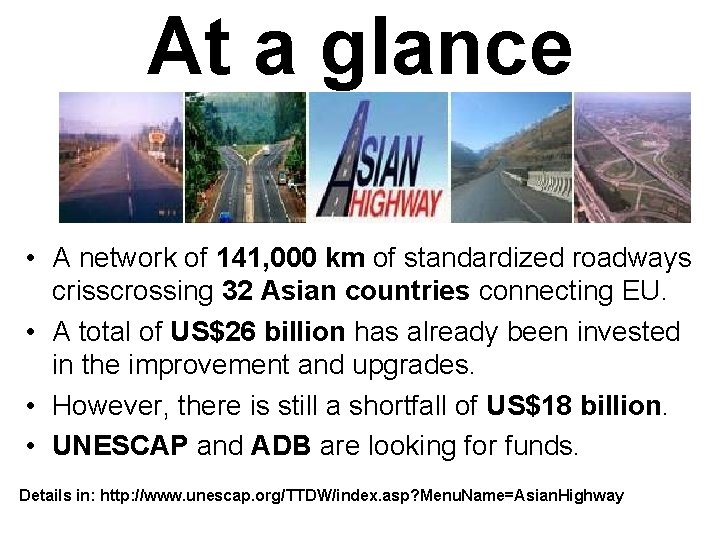
At a glance • A network of 141, 000 km of standardized roadways crisscrossing 32 Asian countries connecting EU. • A total of US$26 billion has already been invested in the improvement and upgrades. • However, there is still a shortfall of US$18 billion. • UNESCAP and ADB are looking for funds. Details in: http: //www. unescap. org/TTDW/index. asp? Menu. Name=Asian. Highway
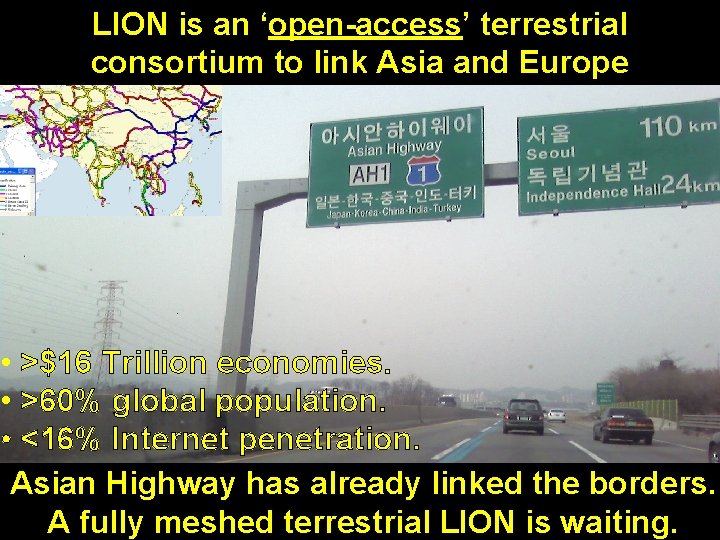
LION is an ‘open-access’ terrestrial consortium to link Asia and Europe • >$16 Trillion economies. • >60% global population. • <16% Internet penetration. Asian Highway has already linked the borders. A fully meshed terrestrial LION is waiting.
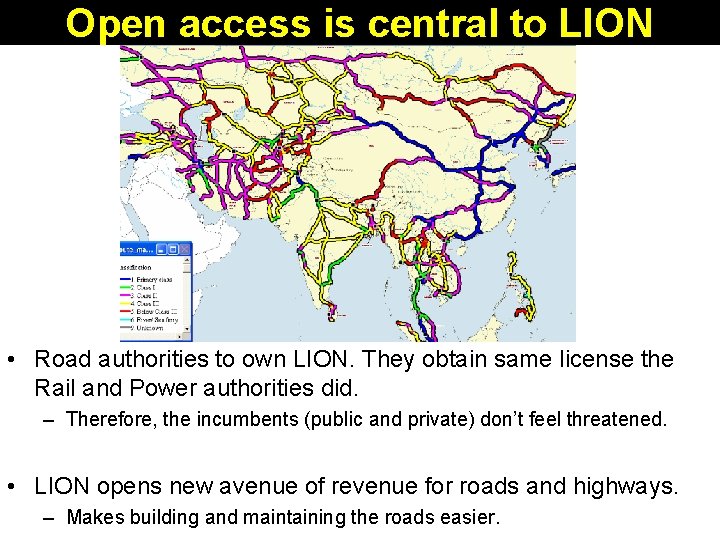
Open access is central to LION • Road authorities to own LION. They obtain same license the Rail and Power authorities did. – Therefore, the incumbents (public and private) don’t feel threatened. • LION opens new avenue of revenue for roads and highways. – Makes building and maintaining the roads easier.
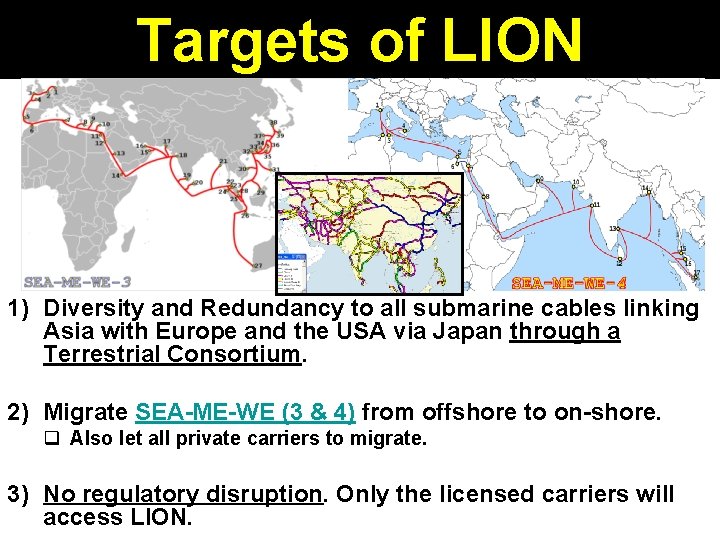
Targets of LION 1) Diversity and Redundancy to all submarine cables linking Asia with Europe and the USA via Japan through a Terrestrial Consortium. 2) Migrate SEA-ME-WE (3 & 4) from offshore to on-shore. q Also let all private carriers to migrate. 3) No regulatory disruption. Only the licensed carriers will access LION.
Advantages of LION • Presumed ‘unfriendly’ countries are already interlinked. – Submarine : SEA-ME-WE 3 and SEA-ME-WE 4. – Terrestrial: Sino-Russian link (TEA) and Sino-Indian link (Reliance/Tata/Bharti + China Mobile). • LION brings more opportunities for submarine cables. – Invest more in transpacific rather than intra-Asia. – Lower latency and higher SLA at lesser cost for the carriers. • High resiliency due to mesh. – Rerouting the traffic means ‘zero’ downtime. – Installation and maintenance crew/materials available everywhere. Open access guaranteed
Impacts of LION • Internet in Asia will be similar to or cheaper than the EU. – Mobile broadband (HSPA/LTE) will grow like 2 G voice. – Investments in broadband will increase. – There will be higher ROI in FTTx. • More international and domestic Po. Ps/access nodes will emerge. ü Landlocked countries will have bandwidth at equal cost. q Sub-regional telecoms initiatives cannot delivered that. ü Pacific islands will enjoy reduced bandwidth cost in the mainland. • International Gateway (IGW) reforms will be accelerated. – Usage of submarine cables’ purchased capacity will be maximized. – Carriers will commit longer contracts. National broadband initiatives will not require subsidies.
Next: Public Private Partnership
PPP in MDG#8 In cooperation with the private sector, make available the benefits of new technologies, especially information and communications.
PPP in MDG#8 In cooperation with the private sector, make available the benefits of new technologies, especially information and communications.
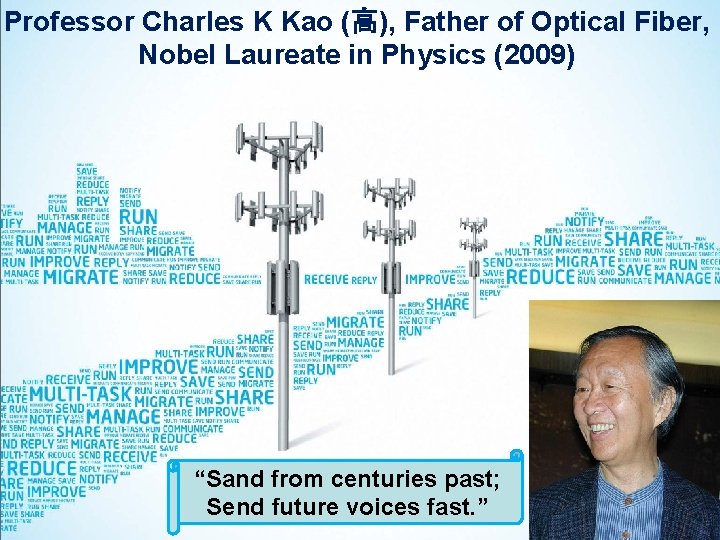
Professor Charles K Kao (高), Father of Optical Fiber, Nobel Laureate in Physics (2009) “Sand from centuries past; Send future voices fast. ”
- Slides: 30