
LONGESSAY QUESTION LEQ Boot Camp Information and Rubrics
LONG-ESSAY QUESTION (LEQ) “Boot Camp” Information and Rubrics
WHAT IS THE LEQ? The Long Essay Question is… an essay that will require you to use the knowledge gained over the entire course to answer a long-form essay question requires the use of historical evidence (facts) generally these will be “right down the pipe” of the Key Concepts and major themes discussed in class In May you’ll have the choice of two possible prompts (answer one only) There are four possible types of essay which you will be able to distinguish by language of the prompt itself: Causation Continuity & Change Over Time Comparison Periodization
CAUSATION Causation is a mechanic that assesses your ability to identify or analyze historical cause and effect relationships =distinguishing between long and short term causes and effects Sample Questions: Using specific examples, analyze causes of imperial expansion and consolidation in the period circa 600 BCE to 600 CE. Using specific examples, analyze causes of imperial expansion and consolidation in the period circa 1450 BCE to 1750 CE. Notice how open-ended questions are. You could chose almost any region of the world, and make almost an unlimited number of connections. Sometimes this can cause problems if you have trouble focusing your argument.
COMPARISON Comparison is a mechanic that assesses your ability to identify, analyze and COMPARE multiple perspectives on common phenomenon = across multiple regions, societies, and time periods Sample Questions: Analyze at least one similarity and one difference in the causes of the French Revolution and the Haitian Revolution. Analyze at least one similarity and one difference in the outcomes of French Revolution and the Haitian Revolution.
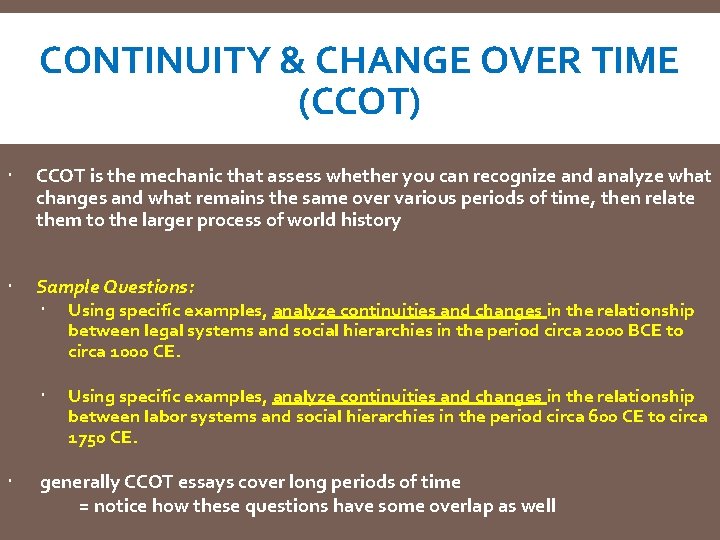
CONTINUITY & CHANGE OVER TIME (CCOT) CCOT is the mechanic that assess whether you can recognize and analyze what changes and what remains the same over various periods of time, then relate them to the larger process of world history Sample Questions: Using specific examples, analyze continuities and changes in the relationship between legal systems and social hierarchies in the period circa 2000 BCE to circa 1000 CE. Using specific examples, analyze continuities and changes in the relationship between labor systems and social hierarchies in the period circa 600 CE to circa 1750 CE. generally CCOT essays cover long periods of time = notice how these questions have some overlap as well
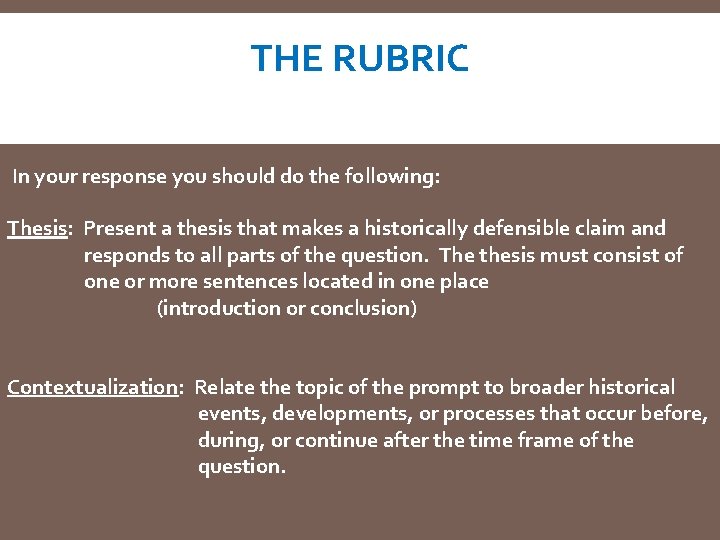
THE RUBRIC In your response you should do the following: Thesis: Present a thesis that makes a historically defensible claim and responds to all parts of the question. The thesis must consist of one or more sentences located in one place (introduction or conclusion) Contextualization: Relate the topic of the prompt to broader historical events, developments, or processes that occur before, during, or continue after the time frame of the question.
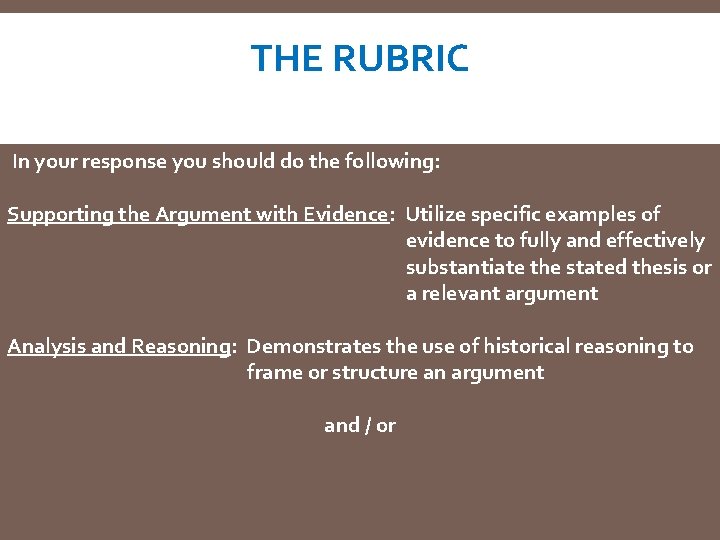
THE RUBRIC In your response you should do the following: Supporting the Argument with Evidence: Utilize specific examples of evidence to fully and effectively substantiate the stated thesis or a relevant argument Analysis and Reasoning: Demonstrates the use of historical reasoning to frame or structure an argument and / or
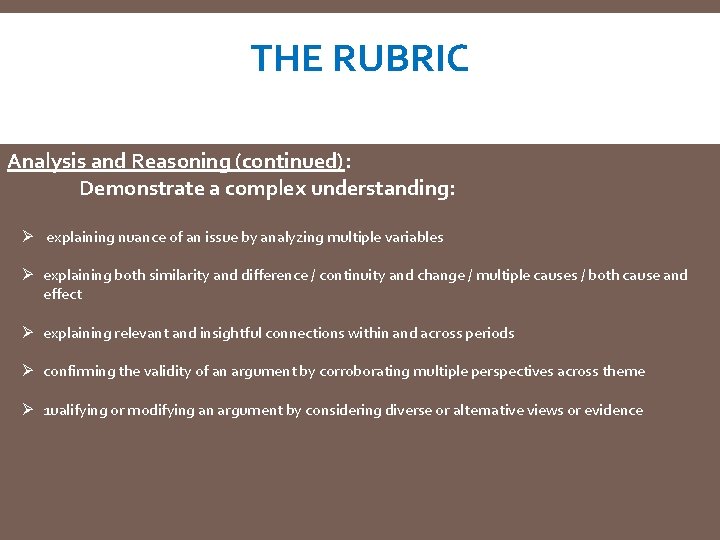
THE RUBRIC Analysis and Reasoning (continued): Demonstrate a complex understanding: Ø explaining nuance of an issue by analyzing multiple variables Ø explaining both similarity and difference / continuity and change / multiple causes / both cause and effect Ø explaining relevant and insightful connections within and across periods Ø confirming the validity of an argument by corroborating multiple perspectives across theme Ø 1 ualifying or modifying an argument by considering diverse or alternative views or evidence

THE RUBRIC The LEQ is graded using a 6 point rubric: Thesis: Contextualization: Evidence: Analysis and Reasoning: 1 Point 1 or 2 Points
THESIS = 1 POINT Makes a historically defensible thesis / claim that establishes a line of reasoning, responds to all parts of the question, and is located in either introduction or conclusion
CONTEXTUALIZATION = 1 POINT Describes a broader historical context relevant to the prompt.
EVIDENCE = 1 OR 2 POINTS 1 Point: Provides specific examples of evidence relevant to the topic of the prompt 2 Points: Supports an argument in response to the prompt using specific and relevant examples of evidence
ANALYSIS AND REASONING = 1 OR 2 POINTS 1 Point: Uses historical reasoning – comparison, causation, continuity and change over time – to frame or structure an argument that addresses the prompt 2 Points: Demonstrates a complex understanding of the historical development that is the focus of the prompt, using evidence to corroborate, qualify, or modify an argument that address the question
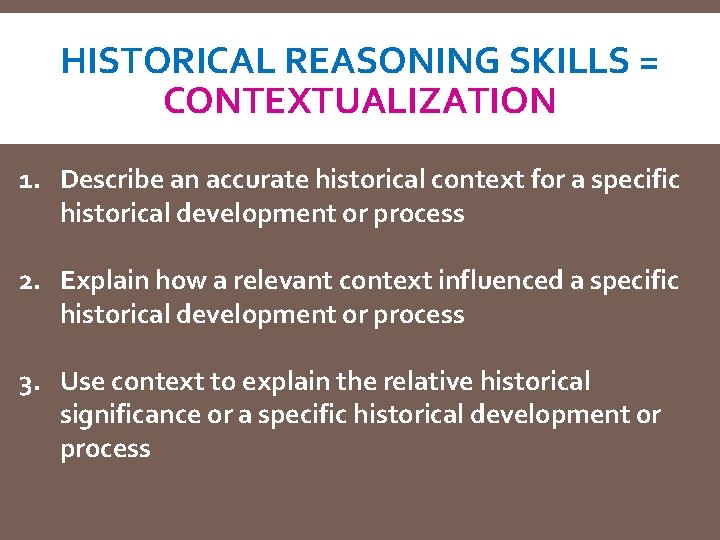
HISTORICAL REASONING SKILLS = CONTEXTUALIZATION 1. Describe an accurate historical context for a specific historical development or process 2. Explain how a relevant context influenced a specific historical development or process 3. Use context to explain the relative historical significance or a specific historical development or process
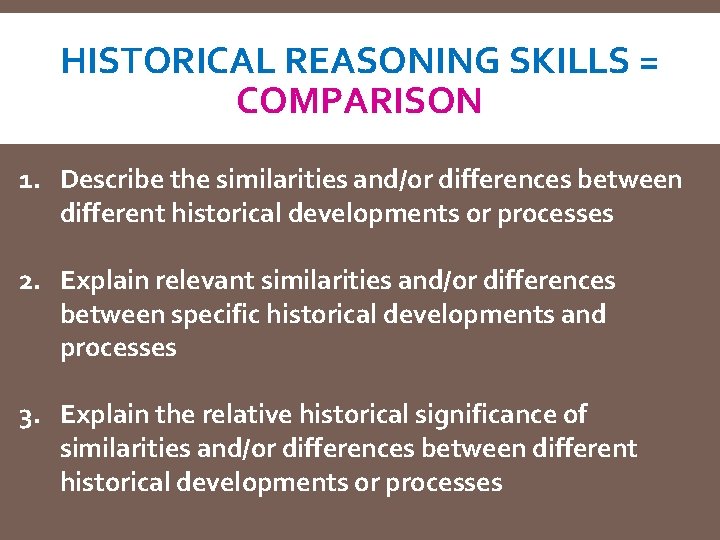
HISTORICAL REASONING SKILLS = COMPARISON 1. Describe the similarities and/or differences between different historical developments or processes 2. Explain relevant similarities and/or differences between specific historical developments and processes 3. Explain the relative historical significance of similarities and/or differences between different historical developments or processes
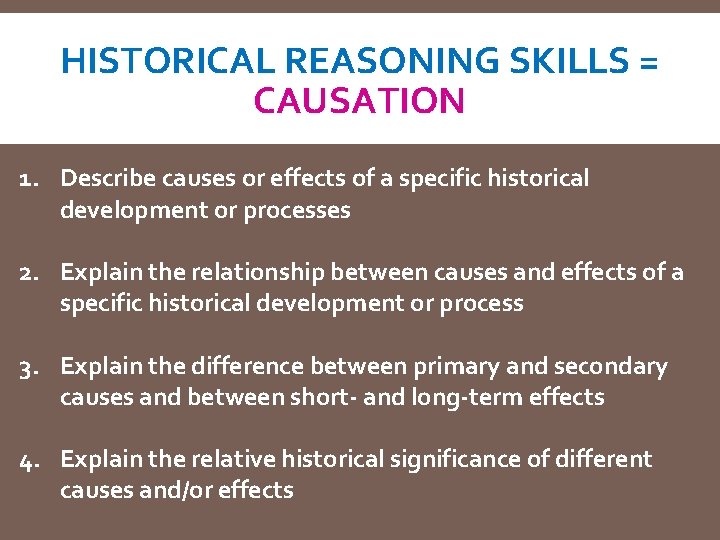
HISTORICAL REASONING SKILLS = CAUSATION 1. Describe causes or effects of a specific historical development or processes 2. Explain the relationship between causes and effects of a specific historical development or process 3. Explain the difference between primary and secondary causes and between short- and long-term effects 4. Explain the relative historical significance of different causes and/or effects
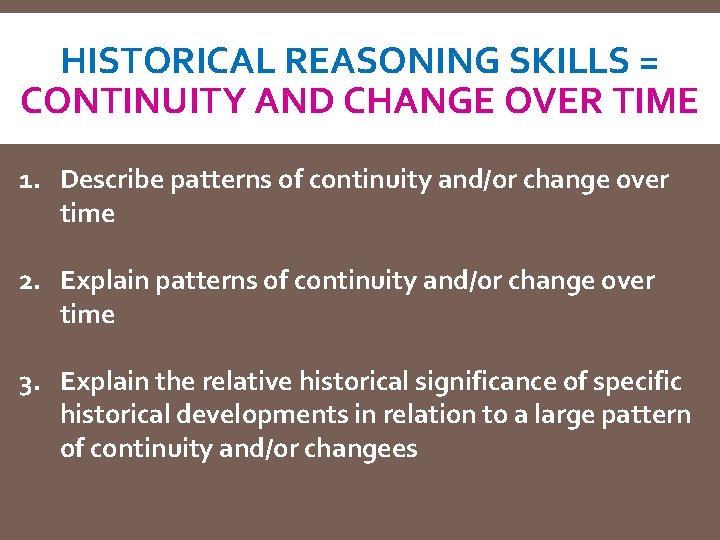
HISTORICAL REASONING SKILLS = CONTINUITY AND CHANGE OVER TIME 1. Describe patterns of continuity and/or change over time 2. Explain patterns of continuity and/or change over time 3. Explain the relative historical significance of specific historical developments in relation to a large pattern of continuity and/or changees
- Slides: 17