
LONG WELDED RAIL DEFINITIONS Long Welded Rail LWR
- Slides: 19
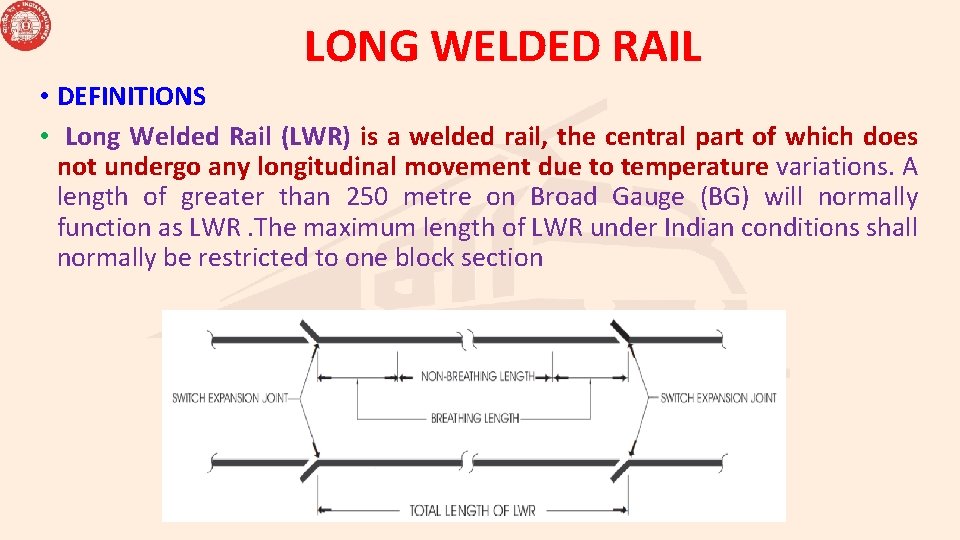
LONG WELDED RAIL • DEFINITIONS • Long Welded Rail (LWR) is a welded rail, the central part of which does not undergo any longitudinal movement due to temperature variations. A length of greater than 250 metre on Broad Gauge (BG) will normally function as LWR. The maximum length of LWR under Indian conditions shall normally be restricted to one block section
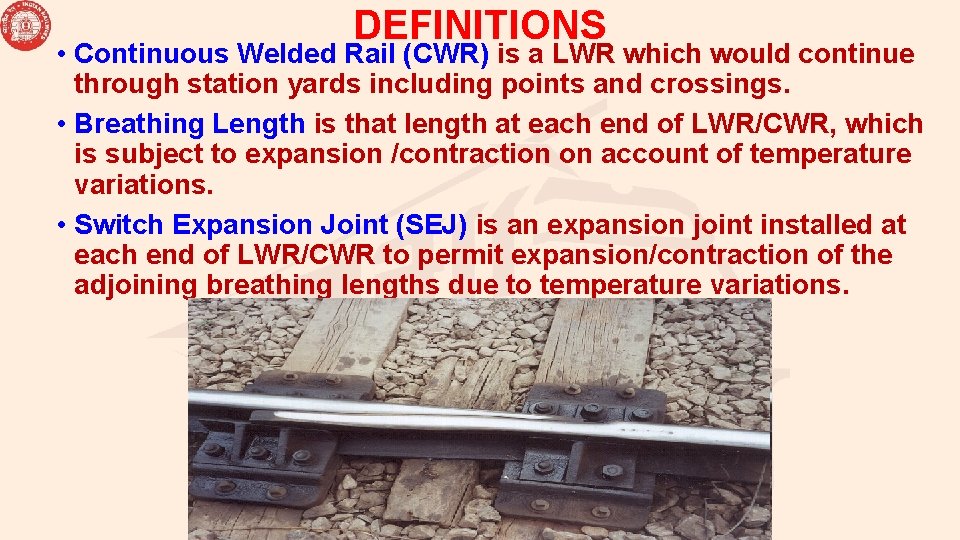
DEFINITIONS • Continuous Welded Rail (CWR) is a LWR which would continue through station yards including points and crossings. • Breathing Length is that length at each end of LWR/CWR, which is subject to expansion /contraction on account of temperature variations. • Switch Expansion Joint (SEJ) is an expansion joint installed at each end of LWR/CWR to permit expansion/contraction of the adjoining breathing lengths due to temperature variations.
DEFINITIONS • Rail Temperature is the temperature of the rail at site as recorded by an approved type of rail thermometer. This is different from ambient temperature which is the temperature of air in shade at the same place. • Mean Rail Temperature (tm) for a section, is the average of the maximum and minimum rail temperatures recorded for the section.
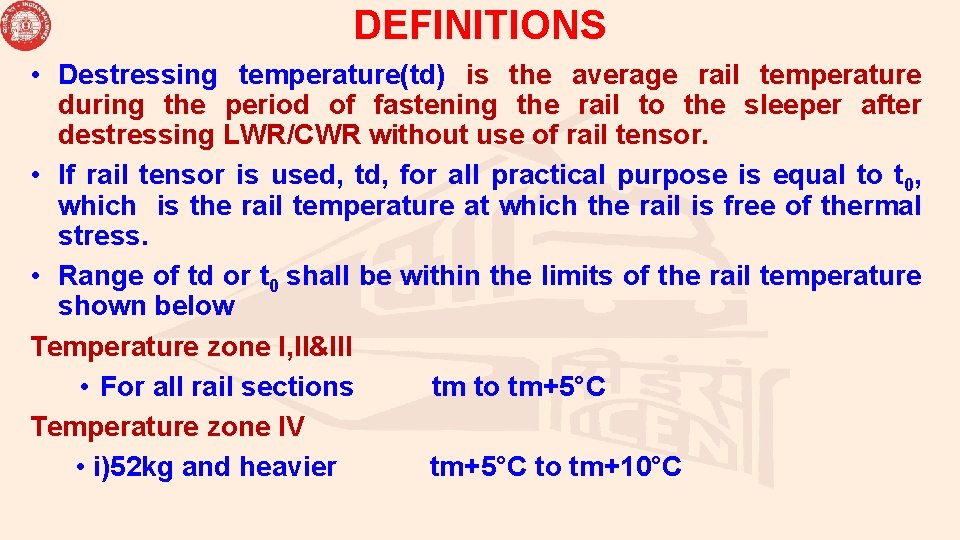
DEFINITIONS • Destressing is the operation undertaken with or without rail tensor to secure stress free conditions in the LWR/CWR at the desired/specified rail temperature. • Installation Temperature (ti) is the average rail temperature during the process of fastening the rails to the sleepers at the time of installation of the LWR/CWR.
DEFINITIONS • Destressing temperature(td) is the average rail temperature during the period of fastening the rail to the sleeper after destressing LWR/CWR without use of rail tensor. • If rail tensor is used, td, for all practical purpose is equal to t 0, which is the rail temperature at which the rail is free of thermal stress. • Range of td or t 0 shall be within the limits of the rail temperature shown below Temperature zone I, II&III • For all rail sections tm to tm+5°C Temperature zone IV • i)52 kg and heavier tm+5°C to tm+10°C
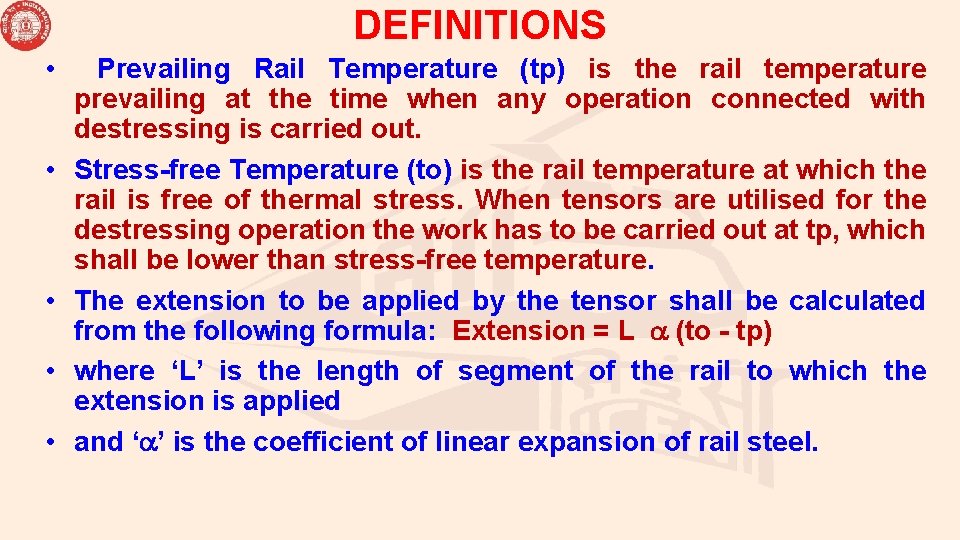
DEFINITIONS • • • Prevailing Rail Temperature (tp) is the rail temperature prevailing at the time when any operation connected with destressing is carried out. Stress-free Temperature (to) is the rail temperature at which the rail is free of thermal stress. When tensors are utilised for the destressing operation the work has to be carried out at tp, which shall be lower than stress-free temperature. The extension to be applied by the tensor shall be calculated from the following formula: Extension = L (to - tp) where ‘L’ is the length of segment of the rail to which the extension is applied and ‘ ’ is the coefficient of linear expansion of rail steel.
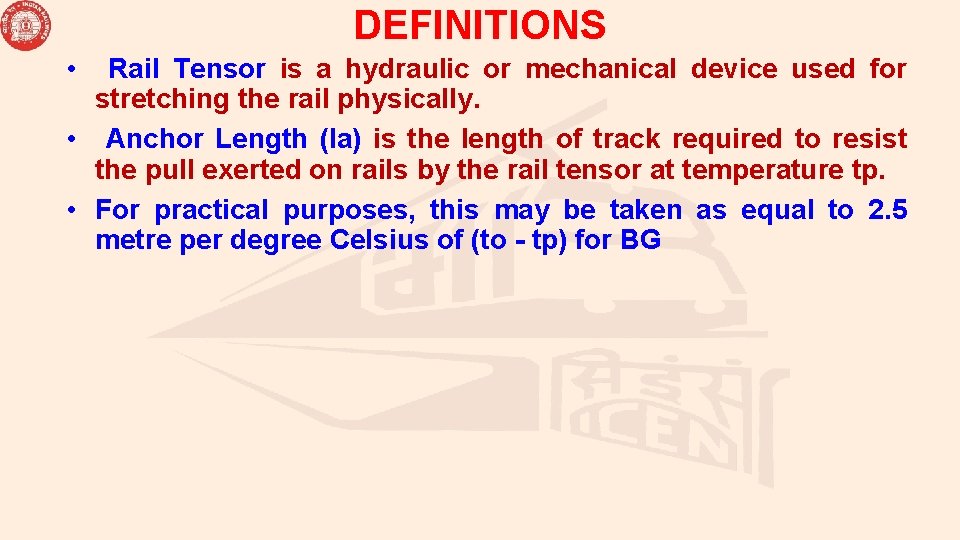
DEFINITIONS • Rail Tensor is a hydraulic or mechanical device used for stretching the rail physically. • Anchor Length (la) is the length of track required to resist the pull exerted on rails by the rail tensor at temperature tp. • For practical purposes, this may be taken as equal to 2. 5 metre per degree Celsius of (to - tp) for BG
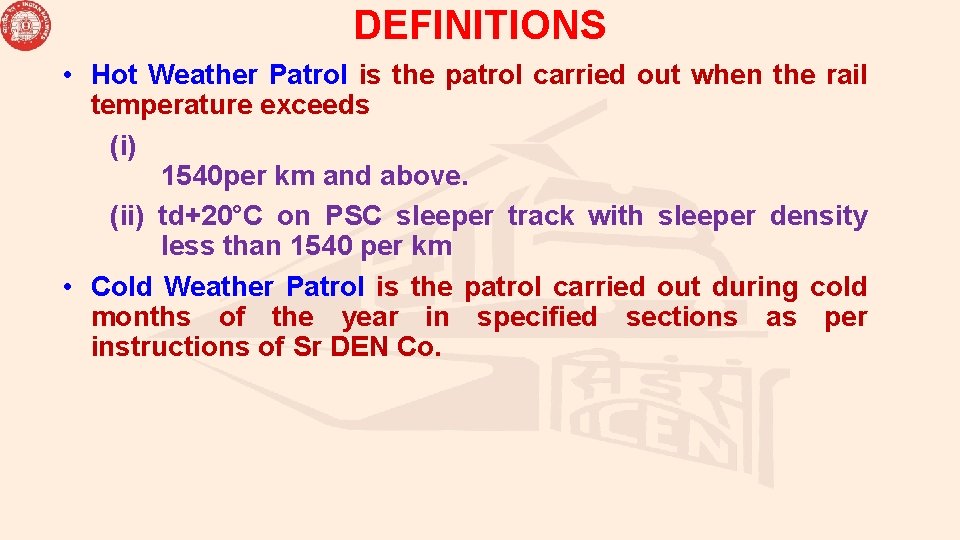
DEFINITIONS • Hot Weather Patrol is the patrol carried out when the rail temperature exceeds (i) 1540 per km and above. (ii) td+20°C on PSC sleeper track with sleeper density less than 1540 per km • Cold Weather Patrol is the patrol carried out during cold months of the year in specified sections as per instructions of Sr DEN Co.
DEFINITIONS • Consolidation of Track is the process of building up ballast resistance to the tendency of movement of sleeper either initially before laying LWR or making up subsequent loss of resistance by anyone of the following: i) For the track structure consisting of concrete sleepers, passage of at least 50, 000 gross tonnes of traffic on BG or a period of two days whichever is later. iii) At least one round of stabilisation by Dynamic Track Stabiliser (DTS). iv) For newly laid LWR/CWR, at least three rounds of packing, last two of which should be with on-track tamping machines
MEASUREMENT OF RAIL TEMPERATURE The following are the types of approved thermometers for measuring rail temperature: i) Embedded type - This is an ordinary thermometer inserted in a cavity formed in a piece of rail-head, the cavity filled with mercury and sealed. The rail piece, exposed to the same conditions as the rail inside the track. This type of thermometer takes 25 to 30 minutes for attaining temperature of the rail. ii) Dial type - This is a bi-metallic type thermometer, which is provided with magnet for attaching it to the rail. The thermometer is attached on the shady side of the web of the rail. A steady recording of the rail temperature is reached within 8 minutes. iii) Continuous recording type - It consists of a graduated chart mounted on a disc which gets rotated by a winding mechanism at a constant speed to complete one revolution in 24 hours or 7 days as applicable giving a continuous record of rail e is temperature. The sensing element is attached to the web of the rail and connected to the recording pen, through a capillary tube which is filled with mercury. iv) Any other type of thermometer approved by RDSO/Chief Engineer. • Where a number of thermometers are used to measure the rail temperature at one place, as in case of laying of LWR, destressing etc. , any of thermometer showing erratic readings, appreciably different from the other adjoining thermometers, shall be considered as defective.
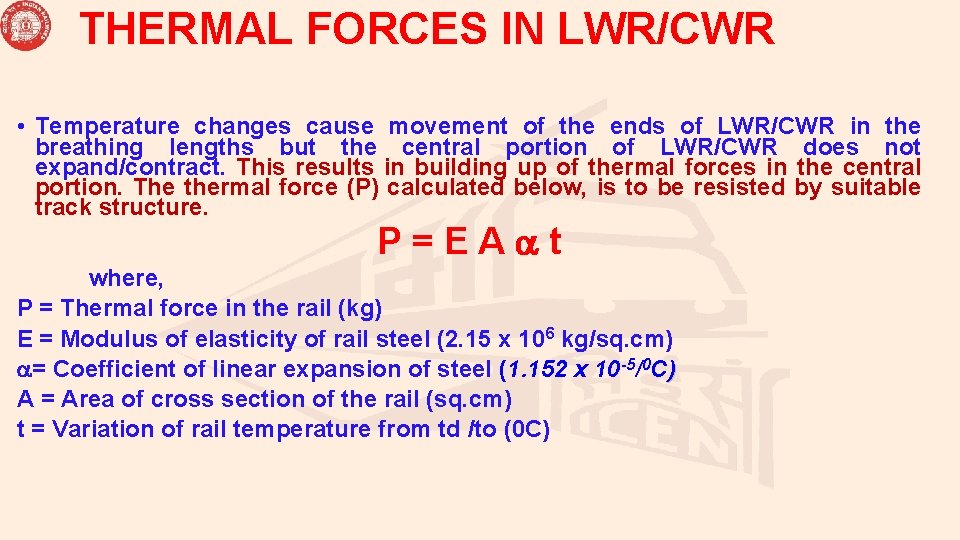
THERMAL FORCES IN LWR/CWR • Temperature changes cause movement of the ends of LWR/CWR in the breathing lengths but the central portion of LWR/CWR does not expand/contract. This results in building up of thermal forces in the central portion. The thermal force (P) calculated below, is to be resisted by suitable track structure. P=EA t where, P = Thermal force in the rail (kg) E = Modulus of elasticity of rail steel (2. 15 x 106 kg/sq. cm) = Coefficient of linear expansion of steel (1. 152 x 10 -5/0 C) A = Area of cross section of the rail (sq. cm) t = Variation of rail temperature from td /to (0 C)
PERMITTED LOCATIONS FOR LWR/CWR 1. GENERAL CONSIDERATIONS FOR LAYING LWR/CWR (i) As a rule, complete track renewals (Primary) shall provide for LWR/CWR wherever permissible by the provisions of this Manual. Also existing rails on permitted locations may be converted into LWR/CWR, provided they meet the requirements for Welding of Rail Joints by Alumino Thermic (SKV Process)/Gas Pressure/Flash Butt Process, as the case may be. (ii) New constructions /doublings /gauge conversions / retired alignment / permanent diversion shall be opened with LWR/CWR, wherever permissible by the provisions of this Manual. (iii) In goods running lines, goods yards, reception yards and classification yards, rail joints may be welded to form LWR if the condition of all the components of track is generally sound and without any deficiency, subject to such relaxation as may be approved by Chief Engineer, in each specific case.
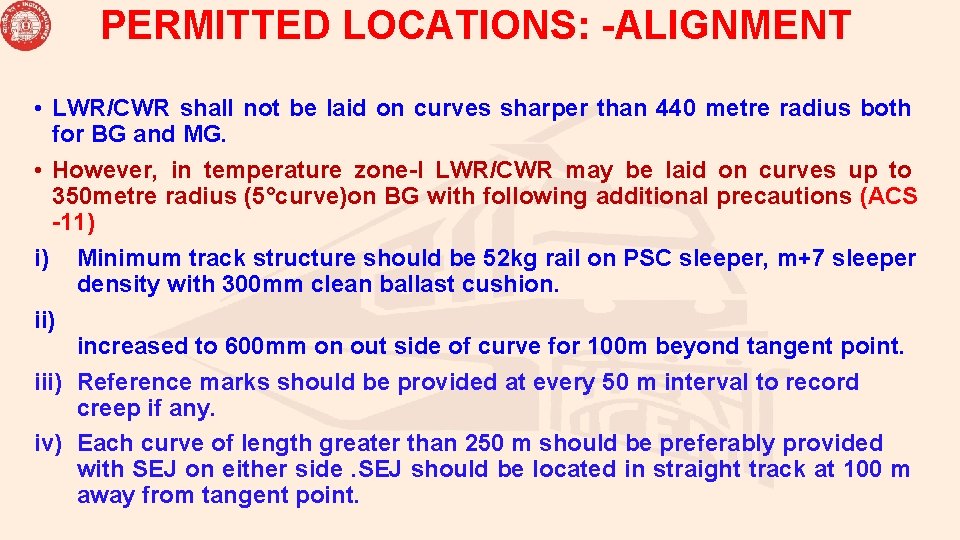
PERMITTED LOCATIONS: -ALIGNMENT • LWR/CWR shall not be laid on curves sharper than 440 metre radius both for BG and MG. • However, in temperature zone-I LWR/CWR may be laid on curves up to 350 metre radius (5°curve)on BG with following additional precautions (ACS -11) i) Minimum track structure should be 52 kg rail on PSC sleeper, m+7 sleeper density with 300 mm clean ballast cushion. ii) increased to 600 mm on out side of curve for 100 m beyond tangent point. iii) Reference marks should be provided at every 50 m interval to record creep if any. iv) Each curve of length greater than 250 m should be preferably provided with SEJ on either side. SEJ should be located in straight track at 100 m away from tangent point.
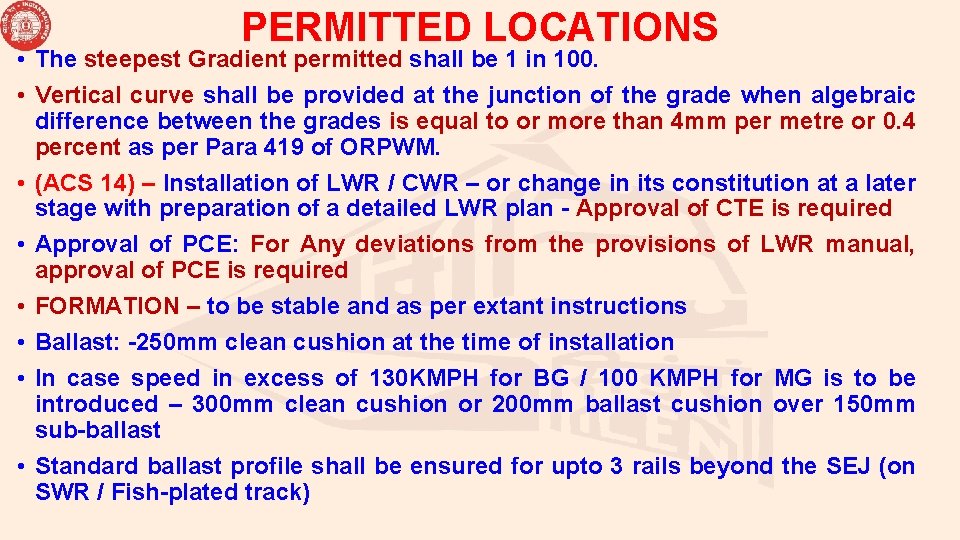
PERMITTED LOCATIONS • The steepest Gradient permitted shall be 1 in 100. • Vertical curve shall be provided at the junction of the grade when algebraic difference between the grades is equal to or more than 4 mm per metre or 0. 4 percent as per Para 419 of ORPWM. • (ACS 14) – Installation of LWR / CWR – or change in its constitution at a later stage with preparation of a detailed LWR plan - Approval of CTE is required • Approval of PCE: For Any deviations from the provisions of LWR manual, approval of PCE is required • FORMATION – to be stable and as per extant instructions • Ballast: -250 mm clean cushion at the time of installation • In case speed in excess of 130 KMPH for BG / 100 KMPH for MG is to be introduced – 300 mm clean cushion or 200 mm ballast cushion over 150 mm sub-ballast • Standard ballast profile shall be ensured for upto 3 rails beyond the SEJ (on SWR / Fish-plated track)
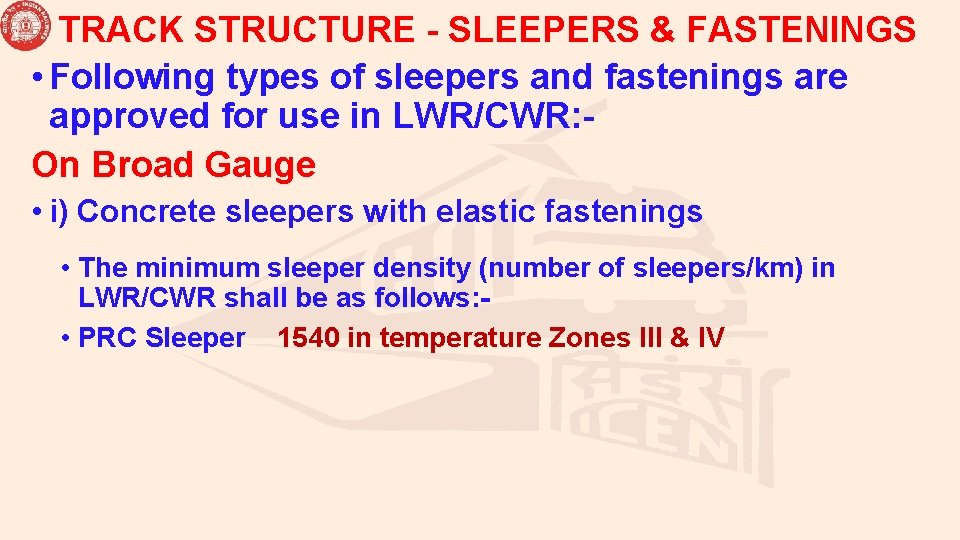
TRACK STRUCTURE - SLEEPERS & FASTENINGS • Following types of sleepers and fastenings are approved for use in LWR/CWR: On Broad Gauge • i) Concrete sleepers with elastic fastenings • The minimum sleeper density (number of sleepers/km) in LWR/CWR shall be as follows: • PRC Sleeper 1540 in temperature Zones III & IV
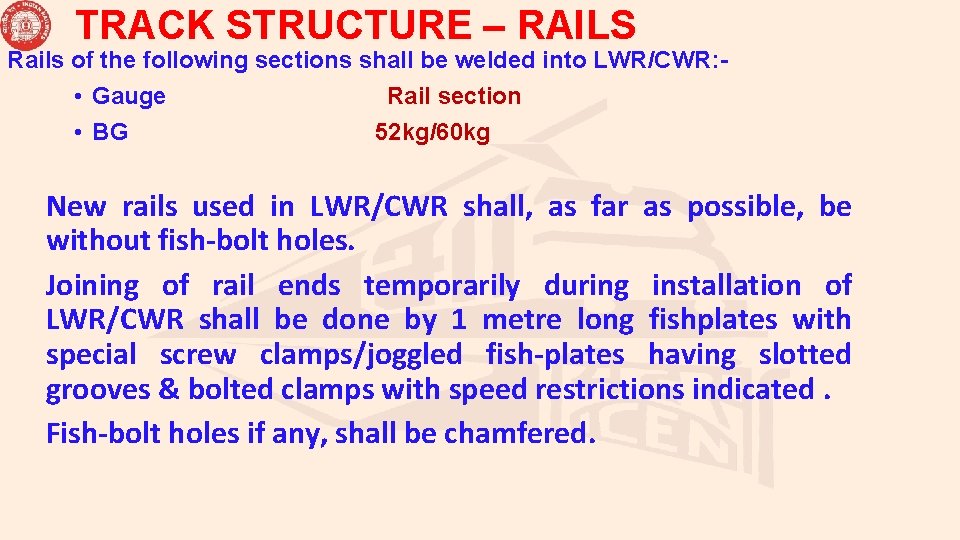
TRACK STRUCTURE – RAILS Rails of the following sections shall be welded into LWR/CWR: • Gauge Rail section • BG 52 kg/60 kg New rails used in LWR/CWR shall, as far as possible, be without fish-bolt holes. Joining of rail ends temporarily during installation of LWR/CWR shall be done by 1 metre long fishplates with special screw clamps/joggled fish-plates having slotted grooves & bolted clamps with speed restrictions indicated. Fish-bolt holes if any, shall be chamfered.
TRACK STRUCTURE – MISCELLANEOUS • Continuity of track structure: Wherever LWR/CWR is followed by fish plated track/ SWR, the same track structure as that of LWR/CWR shall be continued for three rail lengths beyond SEJ. • Level crossings: Level crossings situated in LWR/CWR territory shall not fall within the breathing lengths. • Points and Crossings: LWR/CWR shall not normally be taken through points and crossings. • Three normal rail lengths shall be provided between stock rail joint (SRJ) and SEJ as well as between the crossing and SEJ. These normal rail lengths shall be provided with elastic rail clips/anchors to arrest creep. • However, where concrete sleeper turnouts are laid, instead of three normal rail lengths, one three rail panel shall be provided between SEJ and SRJ as well as between heel of crossing and SEJ. • LWR/CWR shall not be taken through points & crossings. For any exceptions in this regard, special arrangements shall have the prior approval of RDSO.
TRACK STRUCTURE – MISCELLANEOUS Glued Joints: All insulations for track circuiting in LWR/CWR shall be done by providing glued joints G 3(L) type Location of SEJ: The exact location of SEJ shall be fixed taking into account the location of various obligatory points such as level crossings, girder bridges, points and crossings, gradients, curves and insulated joints. SEJ with straight tongue and stock shall not be located on curves sharper than 0. 5 degree (3500 m radius) as far as possible. SEJ shall not be located on transition of curves
Mechanised Maintenance tamping: • Tamping in LWR/CWR with general lift not exceeding 50 mm in case of concrete sleeper • correction of alignment shall be carried out during the period when prevailing rail temperatures in between td +10°C and td-30°C and shall be completed well before onset of summer. • Lifting where needed, in excess of 50 mm in case of concrete sleepers shall be carried out in stages with • adequate time gap in between successive stages such that full consolidation of the previous stage is achieved prior to taking up the subsequent lift.