
Long Term Player Development All of us know


- Slides: 6
Long Term Player Development
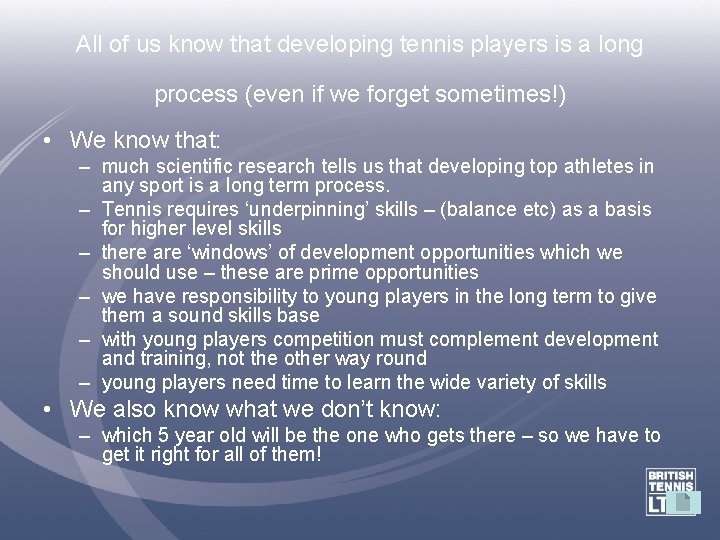
All of us know that developing tennis players is a long process (even if we forget sometimes!) • We know that: – much scientific research tells us that developing top athletes in any sport is a long term process. – Tennis requires ‘underpinning’ skills – (balance etc) as a basis for higher level skills – there are ‘windows’ of development opportunities which we should use – these are prime opportunities – we have responsibility to young players in the long term to give them a sound skills base – with young players competition must complement development and training, not the other way round – young players need time to learn the wide variety of skills • We also know what we don’t know: – which 5 year old will be the one who gets there – so we have to get it right for all of them!
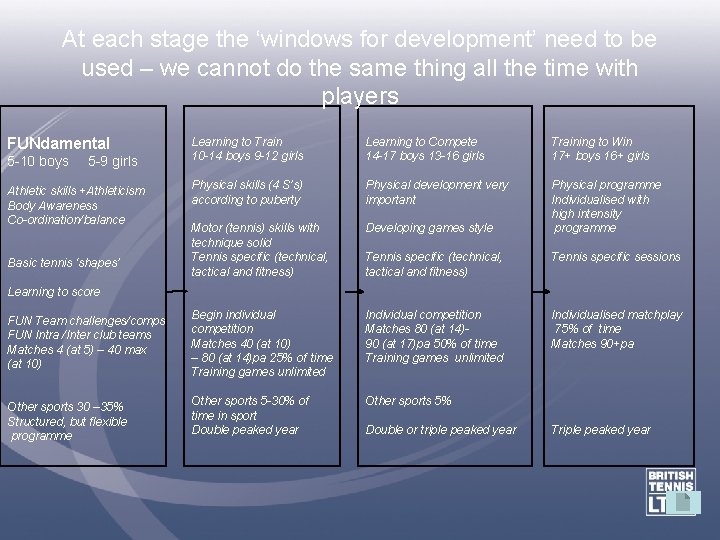
At each stage the ‘windows for development’ need to be used – we cannot do the same thing all the time with players FUNdamental Learning to Train 10 -14 boys 9 -12 girls Learning to Compete 14 -17 boys 13 -16 girls Training to Win 17+ boys 16+ girls Physical skills (4 S’s) according to puberty Physical development very important Motor (tennis) skills with technique solid Tennis specific (technical, tactical and fitness) Developing games style Physical programme Individualised with high intensity programme Tennis specific (technical, tactical and fitness) Tennis specific sessions FUN Team challenges/comps FUN Intra /Inter club teams Matches 4 (at 5) – 40 max (at 10) Begin individual competition Matches 40 (at 10) – 80 (at 14)pa 25% of time Training games unlimited Individual competition Matches 80 (at 14)90 (at 17)pa 50% of time Training games unlimited Individualised matchplay 75% of time Matches 90+pa Other sports 30 – 35% Structured, but flexible programme Other sports 5 -30% of time in sport Double peaked year Other sports 5% 5 -10 boys 5 -9 girls Athletic skills +Athleticism Body Awareness Co-ordination/balance Basic tennis ‘shapes’ Learning to score Double or triple peaked year Triple peaked year
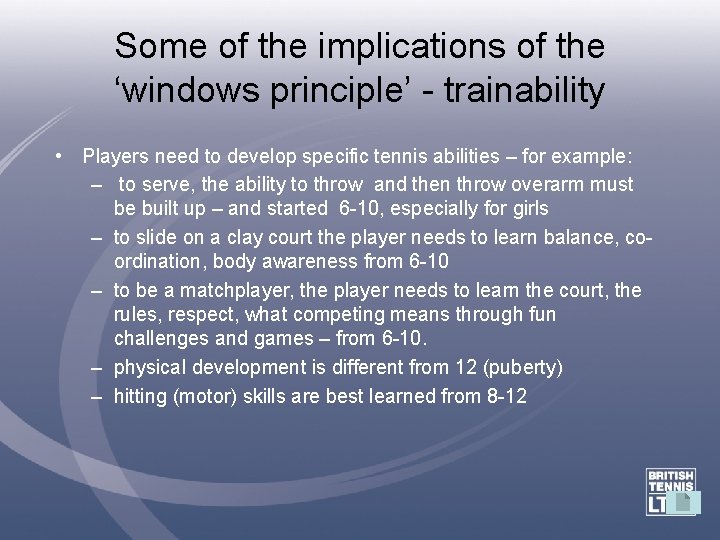
Some of the implications of the ‘windows principle’ - trainability • Players need to develop specific tennis abilities – for example: – to serve, the ability to throw and then throw overarm must be built up – and started 6 -10, especially for girls – to slide on a clay court the player needs to learn balance, coordination, body awareness from 6 -10 – to be a matchplayer, the player needs to learn the court, the rules, respect, what competing means through fun challenges and games – from 6 -10. – physical development is different from 12 (puberty) – hitting (motor) skills are best learned from 8 -12
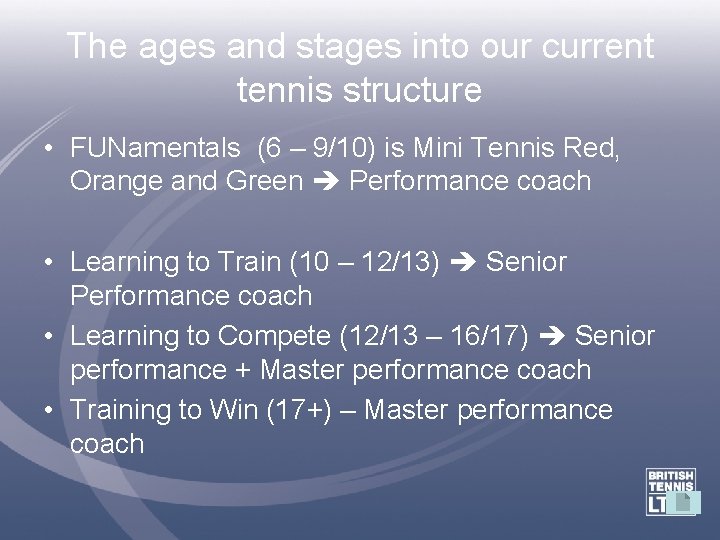
The ages and stages into our current tennis structure • FUNamentals (6 – 9/10) is Mini Tennis Red, Orange and Green Performance coach • Learning to Train (10 – 12/13) Senior Performance coach • Learning to Compete (12/13 – 16/17) Senior performance + Master performance coach • Training to Win (17+) – Master performance coach
The Schedule for 10. 000 hours and 10 years Training Competition Year total Year 1 480 64 544 Year 2 540 96 636 Year 3 648 96 744 Year 4 714 112 826 Year 5 744 136 880 Year 6 720 144 864 Year 7 783 154 937 Year 8 780 176 956 5409 978 6387