
Long Term Impact of Big Tech Sector Mergers
Long Term Impact of Big Tech Sector Mergers Joint Discussion Paper by: Xavier Puig and Marc Realp: Catalan Competition Authority Emily Thornton: Irish Competition and Consumer Protection Commission Disclaimer: The views and opinions expressed in this paper are those of the authors and do not necessarily reflect the official policy or position of the aforementioned competition authorities.
Introduction Big Tech sector mergers Ø In recent years, we have witnessed a number of Big Tech sector mergers, such as, Facebook-Whats. App, Microsoft. Linked. In, etc. , as the world becomes more digitised. Big Data § Acquisition and consolidation of large volumes of data, otherwise known as Big Data. § Value of Big Data has increased exponentially. Data Economy § New uses such as generating artificial intelligence (AI) and “cognitive” services have been identified. § These services are sold to other businesses and utilised in the production and sale of their own products. § This has developed a number of new revenue streams for so-called “data brokers” in the expanding “data economy”. Cooperation Mechanism Ø We believe that the Digital Clearing House may wish to explore specific cooperation mechanisms between Competition Authorities and Data Protection Agencies to progress this discussion.
Cooperation Mechanisms 1. Monitor merger conditions/remedies imposed by Competition Authorities in terms of data (competition -> data protection) Reasons for enhanced cooperation mechanism ü Data versatility -> future uses may be unforeseeable. ü Comparison to consent on data usage. ü Therefore, similar approach may make sense: In the data consent scenario, the solution is limiting consent to specific uses. Consequently, in the competition area, the approach may be to limit clearance to specific data uses. Controversy § It may diminish future opportunities for merging parties. They will have to request approval for new data uses. § It could be argued that the suggested approach reduces legal certainty. Our preliminary views Ø It reduces the scope of the analysis. It makes the merger assessment technically possible. It is not possible to consider all potential future uses. Ø Stricter approach may be appropriate since “merging companies” directly reduce competition.
Cooperation Mechanisms 2. Potential antitrust infringement deriving from a prior data violation (data protection -> competition) Reasons for enhanced cooperation mechanism ü Privacy is a non-price or a quality parameter that could adversely affect consumer welfare. ü Dominant firms may abuse such situations by reducing the quality of its services; for example, exploiting consumer privacy. ü The possibility of an abuse is more likely in the presence of asymmetric information. Asymmetric information is quite a common issue in relation to data protection. Controversy § Is data privacy a competition parameter? § Does a competition sanction imply an infringement of the principle of the “non bis in idem”? Our preliminary views Ø Privacy is a quality element that may be affected by antitrust behaviour as any other aspects regarding services. Ø There is not likely to be any “non bis in idem” infringement since antitrust and data protection regulations have different goals to protect. Ø Not all data infringements are potentially antitrust infringements (for example, an advertent data leak cannot entail any antitrust consideration).
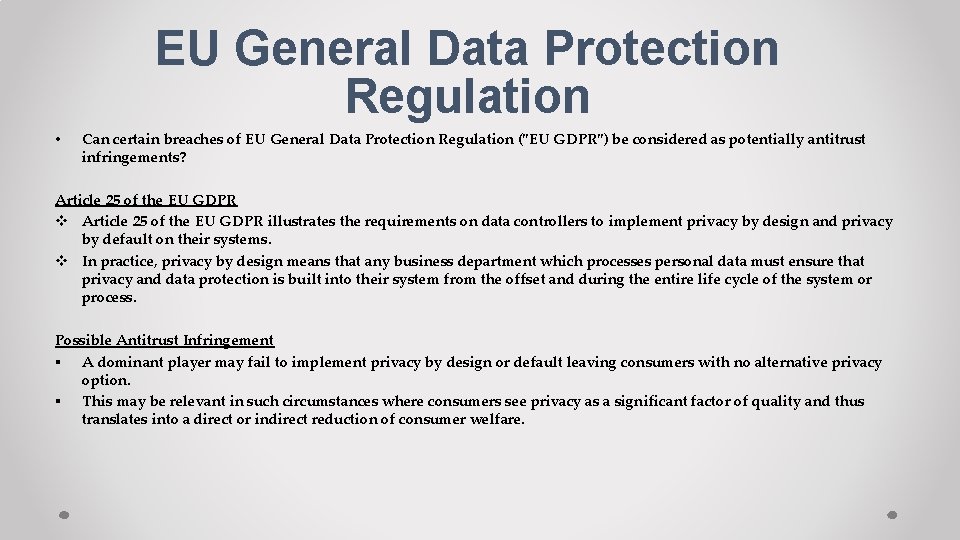
EU General Data Protection Regulation • Can certain breaches of EU General Data Protection Regulation ("EU GDPR") be considered as potentially antitrust infringements? Article 25 of the EU GDPR v Article 25 of the EU GDPR illustrates the requirements on data controllers to implement privacy by design and privacy by default on their systems. v In practice, privacy by design means that any business department which processes personal data must ensure that privacy and data protection is built into their system from the offset and during the entire life cycle of the system or process. Possible Antitrust Infringement § A dominant player may fail to implement privacy by design or default leaving consumers with no alternative privacy option. § This may be relevant in such circumstances where consumers see privacy as a significant factor of quality and thus translates into a direct or indirect reduction of consumer welfare.
Next Steps… • Discussion on viability of proposals… • Practical steps necessary to put cooperation mechanisms in place…
Thank you for your time We welcome any questions Contact details: Xavier: xpuigs@gencat. cat Emily: emilythornton@ccpc. ie
- Slides: 7