
Long Run Production Costs Firm Size and Cost
- Slides: 6
Long Run Production Costs
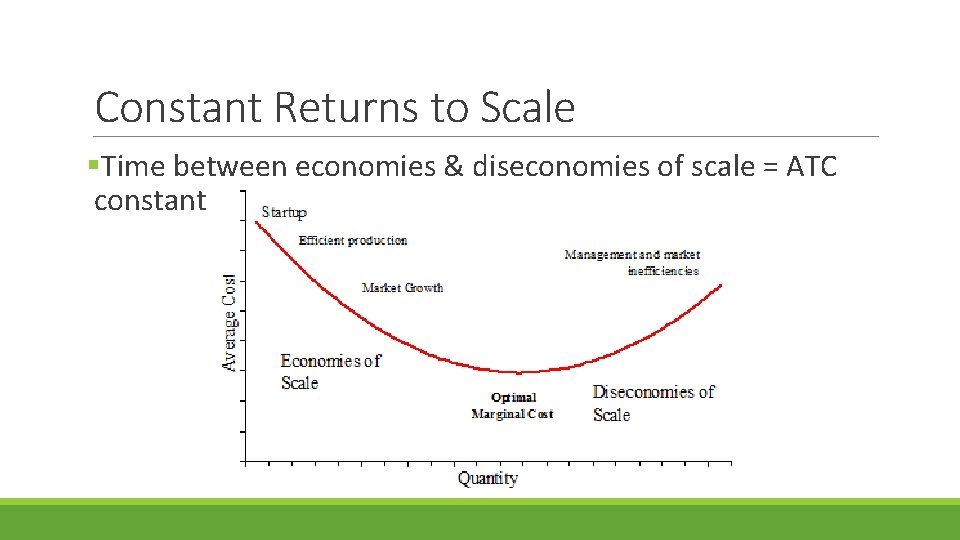
Firm Size and Cost §Focus on the ATC – all costs are variable in the long run §Initial ATC curve will shift down after it expands & builds new plants §Costs will decrease initially, then flatten out, then increase again §Long Run Cost Curve §Long-run ATC shows the lowest ATC at which any output can be produced after firm has had time to make adjustments in plant size §U-shaped curve with 3 distinct sections
Economies of Scale (economies of mass production) §Law of Diminishing Returns does not apply in the long run, b/c all resources are variable §This is down sloping part of LTC curve §Labor specialization §Managerial specialization §Efficient capital §Other factors §Math example: increase cost by 10% = increase in production by 20% = lower ATC
Diseconomies of Scale §Difficulty in controlling and coordinating large size of firm §Expansion of managerial hierarchy leads to miscommunication §Bureaucratic red tape §Slow to act, adapt, change §Employees feel alienated §Employees can “hide” or “shirk” responsibilities §Math example: increase cost by 10% = increase production by 5% = increase in ATC
Constant Returns to Scale §Time between economies & diseconomies of scale = ATC constant
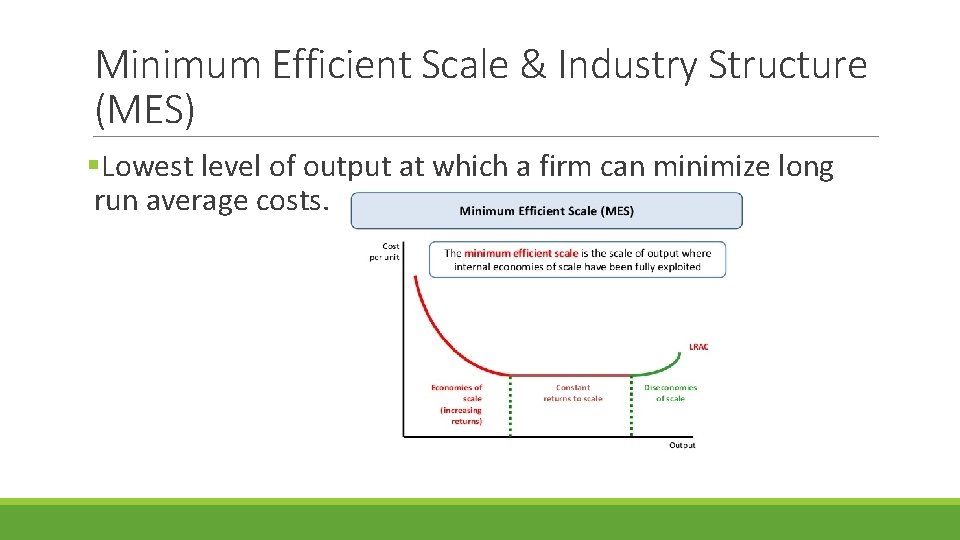
Minimum Efficient Scale & Industry Structure (MES) §Lowest level of output at which a firm can minimize long run average costs.