
Long Duration Contract Accounting Standards Update Prashant Panavalli






- Slides: 31
Long Duration Contract Accounting Standards Update Prashant Panavalli 1
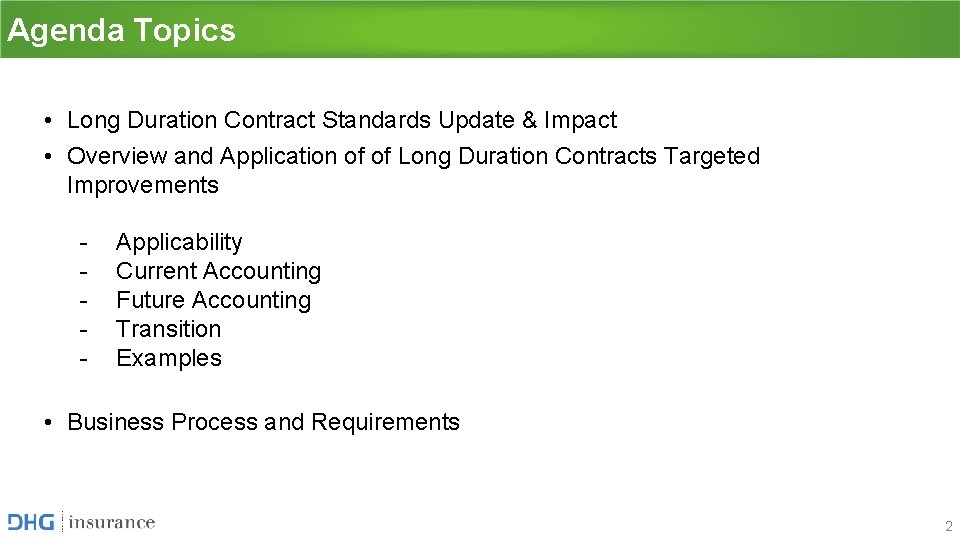
Agenda Topics • Long Duration Contract Standards Update & Impact • Overview and Application of of Long Duration Contracts Targeted Improvements - Applicability Current Accounting Future Accounting Transition Examples • Business Process and Requirements 2
Long Duration Contract Standards Update & Impact 3
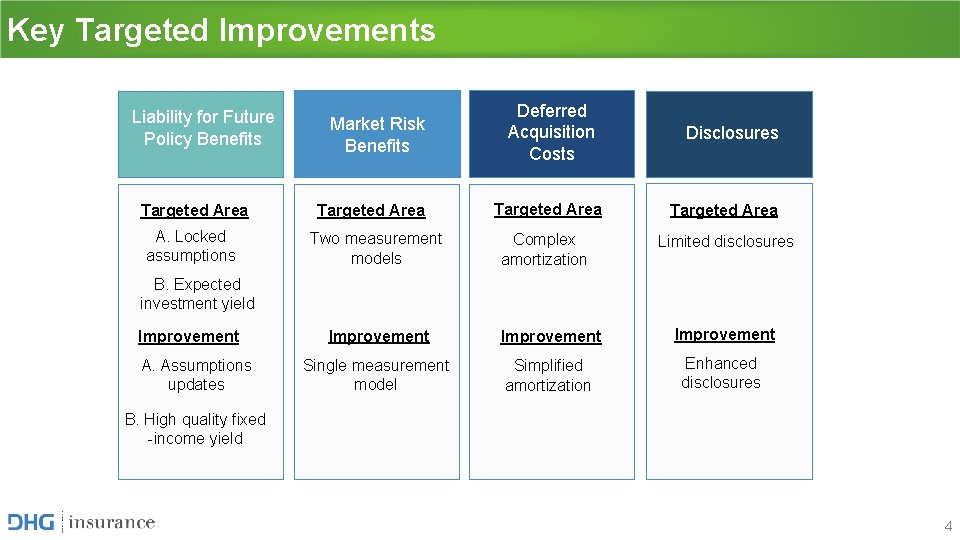
Key Targeted Improvements Liability for Future Policy Benefits Targeted Area A. Locked assumptions Market Risk Benefits Deferred Acquisition Costs Disclosures Targeted Area Complex amortization Limited disclosures Two measurement models B. Expected investment yield Improvement A. Assumptions updates Improvement Single measurement model Simplified amortization Enhanced disclosures B. High quality fixed -income yield 4
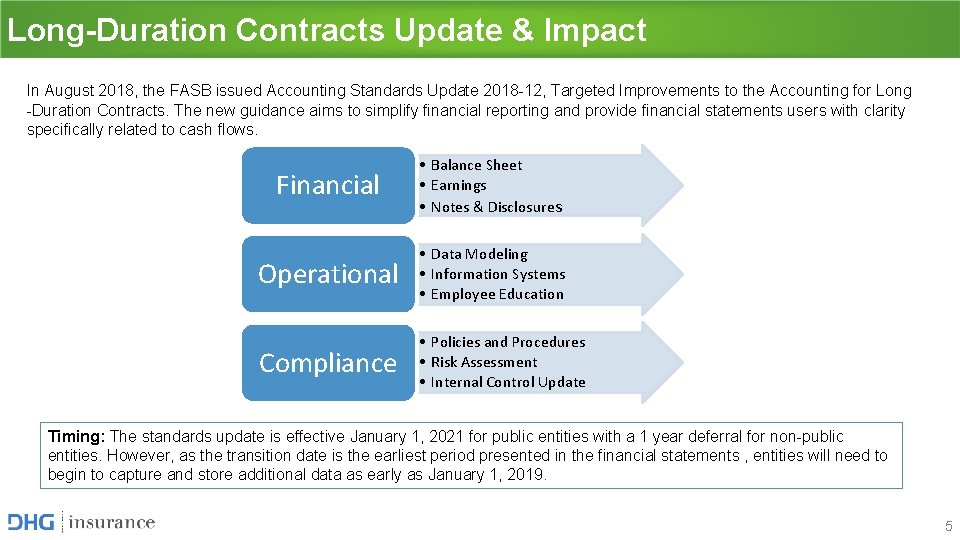
Long-Duration Contracts Update & Impact In August 2018, the FASB issued Accounting Standards Update 2018 -12, Targeted Improvements to the Accounting for Long -Duration Contracts. The new guidance aims to simplify financial reporting and provide financial statements users with clarity specifically related to cash flows. Financial • Balance Sheet • Earnings • Notes & Disclosures Operational • Data Modeling • Information Systems • Employee Education Compliance • Policies and Procedures • Risk Assessment • Internal Control Update Timing: The standards update is effective January 1, 2021 for public entities with a 1 year deferral for non-public entities. However, as the transition date is the earliest period presented in the financial statements , entities will need to begin to capture and store additional data as early as January 1, 2019. 5
Targeted Improvements Overview & Application 6
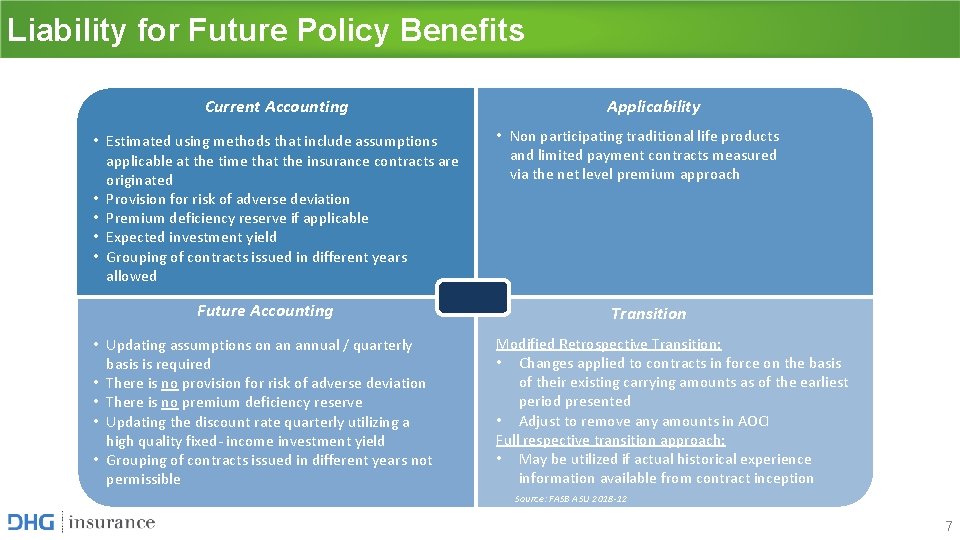
Liability for Future Policy Benefits Current Accounting • Estimated using methods that include assumptions applicable at the time that the insurance contracts are originated • Provision for risk of adverse deviation • Premium deficiency reserve if applicable • Expected investment yield • Grouping of contracts issued in different years allowed Future Accounting • Updating assumptions on an annual / quarterly basis is required • There is no provision for risk of adverse deviation • There is no premium deficiency reserve • Updating the discount rate quarterly utilizing a high quality fixed- income investment yield • Grouping of contracts issued in different years not permissible Applicability • Non participating traditional life products and limited payment contracts measured via the net level premium approach Transition Modified Retrospective Transition: • Changes applied to contracts in force on the basis of their existing carrying amounts as of the earliest period presented • Adjust to remove any amounts in AOCI Full respective transition approach: • May be utilized if actual historical experience information available from contract inception Source: FASB ASU 2018 -12 7
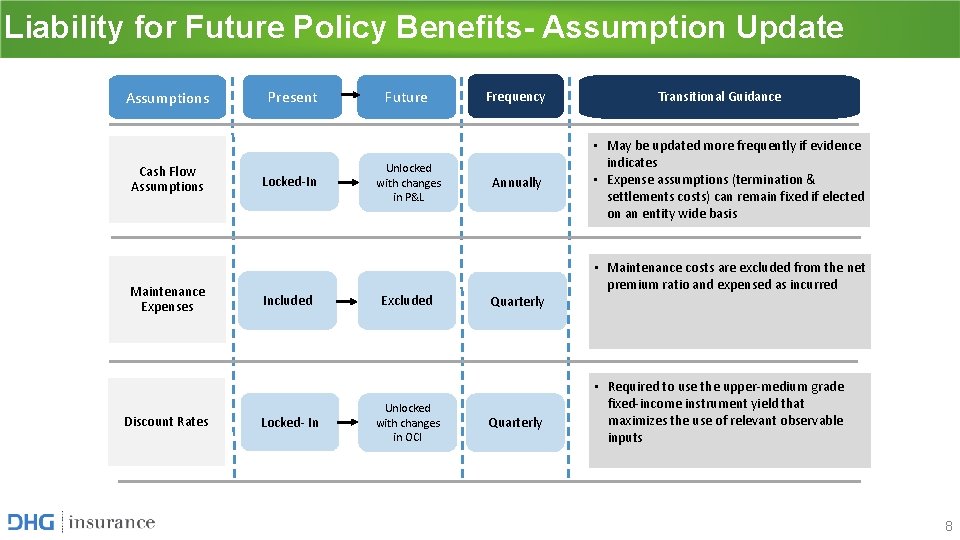
Liability for Future Policy Benefits- Assumption Update Assumptions Cash Flow Assumptions Maintenance Expenses Discount Rates Present Locked-In Included Locked- In Future Unlocked with changes in P&L Excluded Unlocked with changes in OCI Frequency Annually Quarterly Transitional Guidance • May be updated more frequently if evidence indicates • Expense assumptions (termination & settlements costs) can remain fixed if elected on an entity wide basis • Maintenance costs are excluded from the net premium ratio and expensed as incurred • Required to use the upper-medium grade fixed-income instrument yield that maximizes the use of relevant observable inputs 8
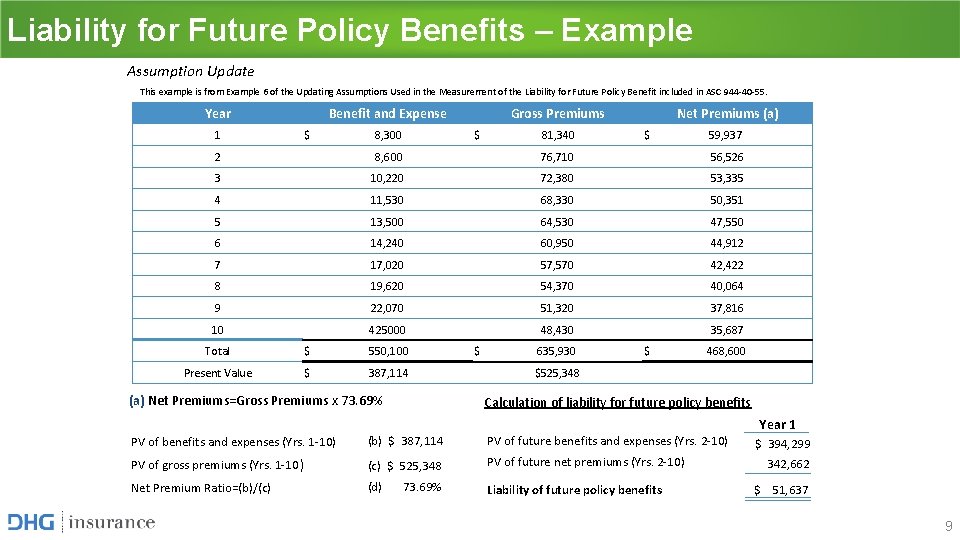
Liability for Future Policy Benefits – Example Assumption Update This example is from Example 6 of the Updating Assumptions Used in the Measurement of the Liability for Future Policy Benefit included in ASC 944 -40 -55. Year Benefit and Expense Gross Premiums 1 $ 8, 300 2 8, 600 76, 710 56, 526 3 10, 220 72, 380 53, 335 4 11, 530 68, 330 50, 351 5 13, 500 64, 530 47, 550 6 14, 240 60, 950 44, 912 7 17, 020 57, 570 42, 422 8 19, 620 54, 370 40, 064 9 22, 070 51, 320 37, 816 10 425000 48, 430 35, 687 Total $ 550, 100 Present Value $ 387, 114 (a) Net Premiums=Gross Premiums x 73. 69% $ 81, 340 Net Premiums (a) $ 635, 930 $ 59, 937 $ 468, 600 $525, 348 Calculation of liability for future policy benefits Year 1 PV of benefits and expenses (Yrs. 1 -10) (b) $ 387, 114 PV of future benefits and expenses (Yrs. 2 -10) $ 394, 299 PV of gross premiums (Yrs. 1 -10 ) (c) $ 525, 348 PV of future net premiums (Yrs. 2 -10) 342, 662 Net Premium Ratio=(b)/(c) (d) 73. 69% Liability of future policy benefits $ 51, 637 9
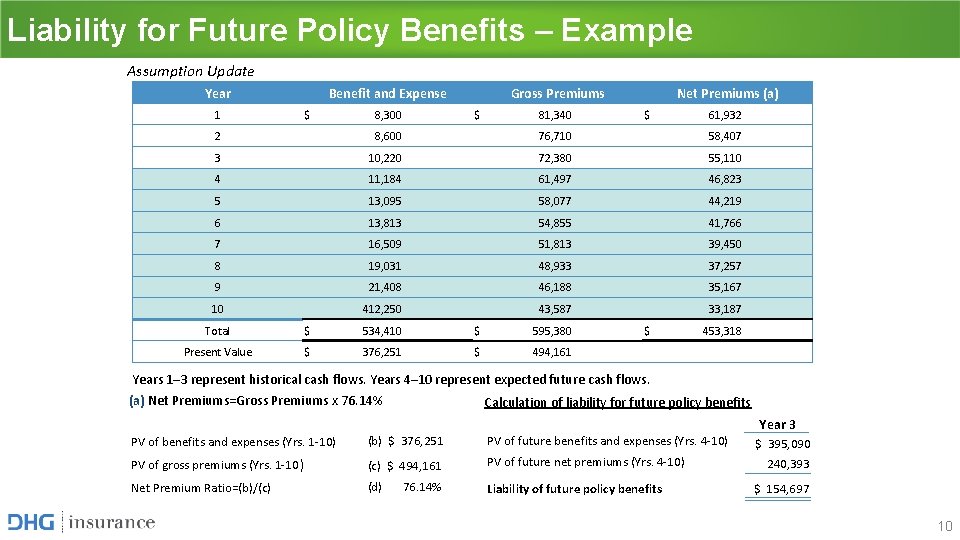
Liability for Future Policy Benefits – Example Assumption Update Year 1 Benefit and Expense $ 8, 300 Gross Premiums $ 81, 340 Net Premiums (a) $ 61, 932 2 8, 600 76, 710 58, 407 3 10, 220 72, 380 55, 110 4 11, 184 61, 497 46, 823 5 13, 095 58, 077 44, 219 6 13, 813 54, 855 41, 766 7 16, 509 51, 813 39, 450 8 19, 031 48, 933 37, 257 9 21, 408 46, 188 35, 167 10 412, 250 43, 587 33, 187 Total $ 534, 410 $ 595, 380 $ Present Value $ 376, 251 $ 494, 161 453, 318 Years 1– 3 represent historical cash flows. Years 4– 10 represent expected future cash flows. (a) Net Premiums=Gross Premiums x 76. 14% Calculation of liability for future policy benefits Year 3 PV of benefits and expenses (Yrs. 1 -10) (b) $ 376, 251 PV of future benefits and expenses (Yrs. 4 -10) $ 395, 090 PV of gross premiums (Yrs. 1 -10 ) (c) $ 494, 161 PV of future net premiums (Yrs. 4 -10) 240, 393 Net Premium Ratio=(b)/(c) (d) 76. 14% Liability of future policy benefits $ 154, 697 10
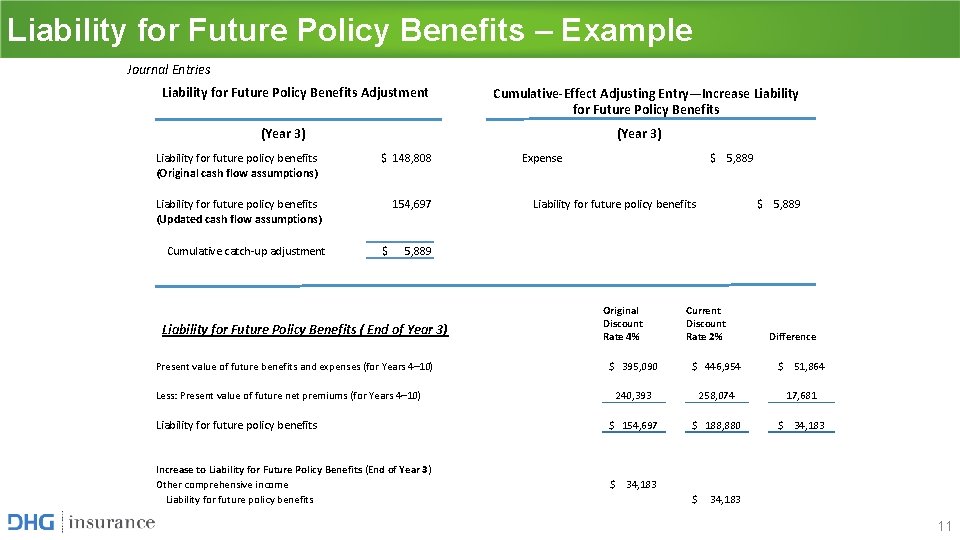
Liability for Future Policy Benefits – Example Journal Entries Liability for Future Policy Benefits Adjustment Cumulative-Effect Adjusting Entry—Increase Liability for Future Policy Benefits (Year 3) Liability for future policy benefits (Original cash flow assumptions) Liability for future policy benefits (Updated cash flow assumptions) Cumulative catch-up adjustment $ 148, 808 154, 697 Expense $ 5, 889 Liability for future policy benefits $ 5, 889 $ 5, 889 Liability for Future Policy Benefits ( End of Year 3) Present value of future benefits and expenses (for Years 4– 10) Original Discount Rate 4% Current Discount Rate 2% Difference $ 395, 090 $ 446, 954 $ 51, 864 240, 393 258, 074 17, 681 Liability for future policy benefits $ 154, 697 $ 188, 880 $ 34, 183 Increase to Liability for Future Policy Benefits (End of Year 3) Other comprehensive income Liability for future policy benefits $ 34, 183 Less: Present value of future net premiums (for Years 4– 10) $ 34, 183 11
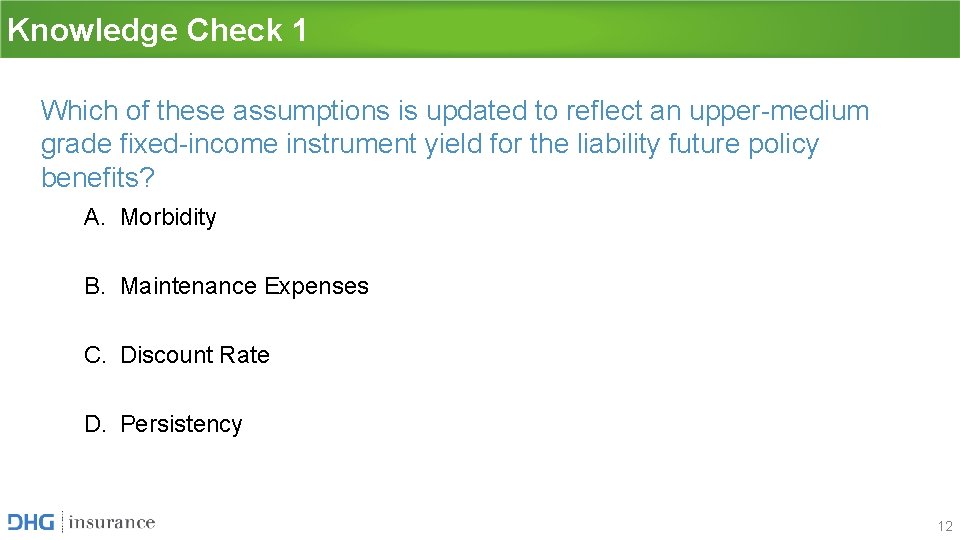
Knowledge Check 1 Which of these assumptions is updated to reflect an upper-medium grade fixed-income instrument yield for the liability future policy benefits? A. Morbidity B. Maintenance Expenses C. Discount Rate D. Persistency 12
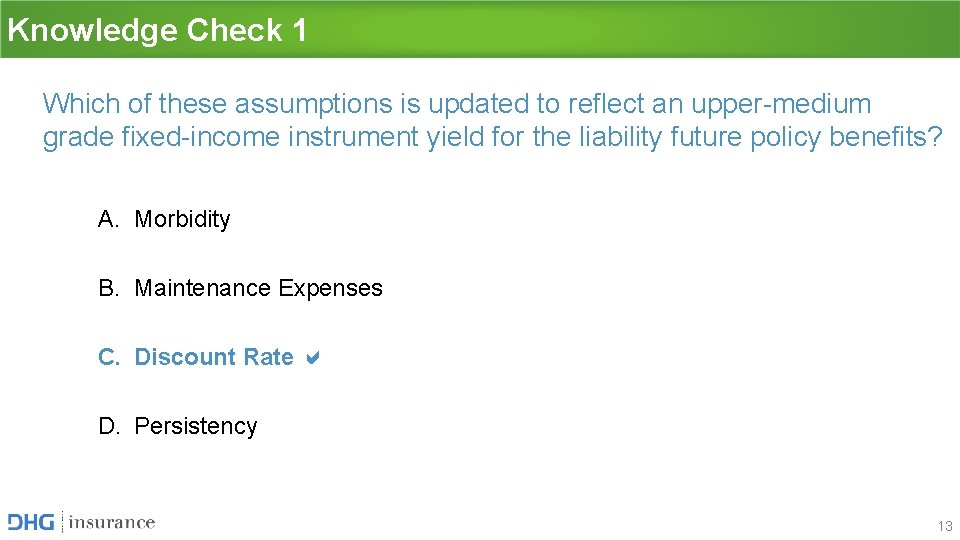
Knowledge Check 1 Which of these assumptions is updated to reflect an upper-medium grade fixed-income instrument yield for the liability future policy benefits? A. Morbidity B. Maintenance Expenses C. Discount Rate a D. Persistency 13
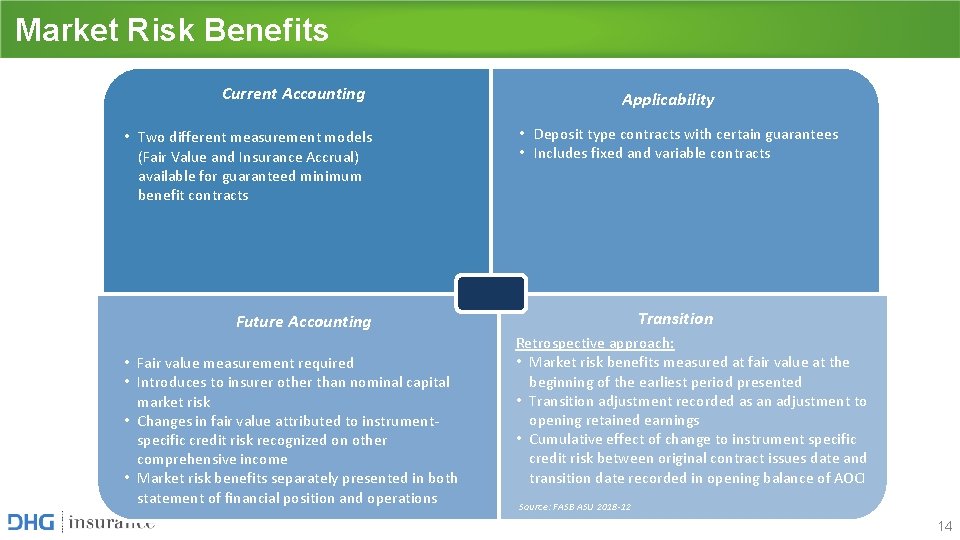
Market Risk Benefits Current Accounting • Two different measurement models (Fair Value and Insurance Accrual) available for guaranteed minimum benefit contracts Applicability • Deposit type contracts with certain guarantees • Includes fixed and variable contracts Transition Future Accounting • Fair value measurement required • Introduces to insurer other than nominal capital market risk • Changes in fair value attributed to instrument- specific credit risk recognized on other comprehensive income • Market risk benefits separately presented in both statement of financial position and operations Retrospective approach: • Market risk benefits measured at fair value at the beginning of the earliest period presented • Transition adjustment recorded as an adjustment to opening retained earnings • Cumulative effect of change to instrument specific credit risk between original contract issues date and transition date recorded in opening balance of AOCI Source: FASB ASU 2018 -12 14
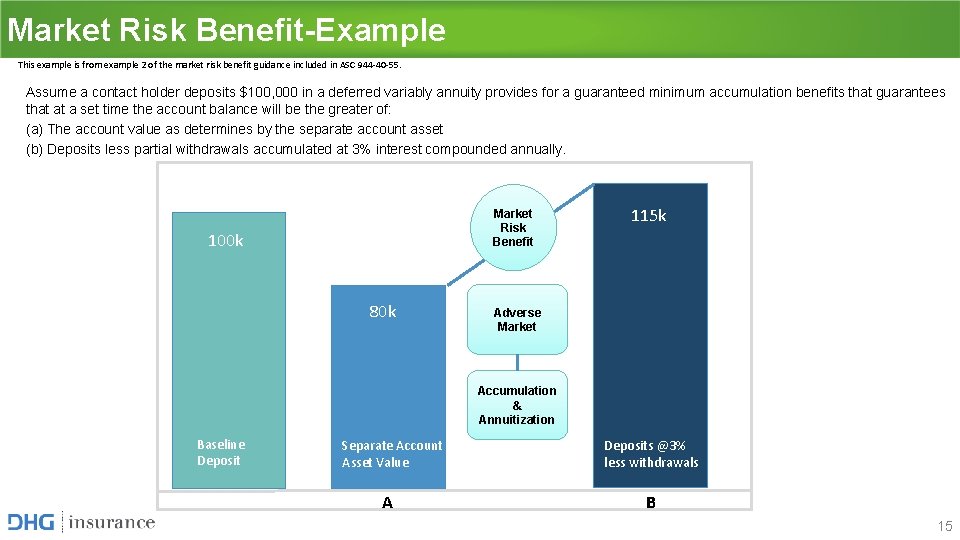
Market Risk Benefit-Example This example is from example 2 of the market risk benefit guidance included in ASC 944 -40 -55. Assume a contact holder deposits $100, 000 in a deferred variably annuity provides for a guaranteed minimum accumulation benefits that guarantees that at a set time the account balance will be the greater of: (a) The account value as determines by the separate account asset (b) Deposits less partial withdrawals accumulated at 3% interest compounded annually. Market Risk Benefit 100 k 80 k 115 k Adverse Market Accumulation & Annuitization Baseline Deposit Separate Account Asset Value A Deposits @3% less withdrawals B 15
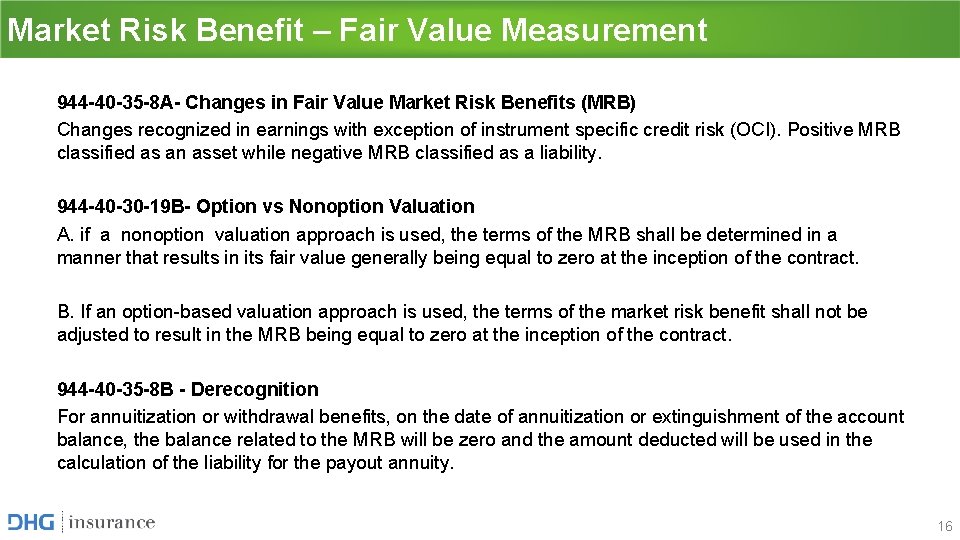
Market Risk Benefit – Fair Value Measurement 944 -40 -35 -8 A- Changes in Fair Value Market Risk Benefits (MRB) Changes recognized in earnings with exception of instrument specific credit risk (OCI). Positive MRB classified as an asset while negative MRB classified as a liability. 944 -40 -30 -19 B- Option vs Nonoption Valuation A. if a nonoption valuation approach is used, the terms of the MRB shall be determined in a manner that results in its fair value generally being equal to zero at the inception of the contract. B. If an option-based valuation approach is used, the terms of the market risk benefit shall not be adjusted to result in the MRB being equal to zero at the inception of the contract. 944 -40 -35 -8 B - Derecognition For annuitization or withdrawal benefits, on the date of annuitization or extinguishment of the account balance, the balance related to the MRB will be zero and the amount deducted will be used in the calculation of the liability for the payout annuity. 16
Knowledge Check 2 The guidance for measurement of market risk benefits applies to what type of insurance product? A. Whole Life B. Traditional Term Life C. Guaranteed Minimum Benefit Annuity Contracts D. Long Term Disability 17
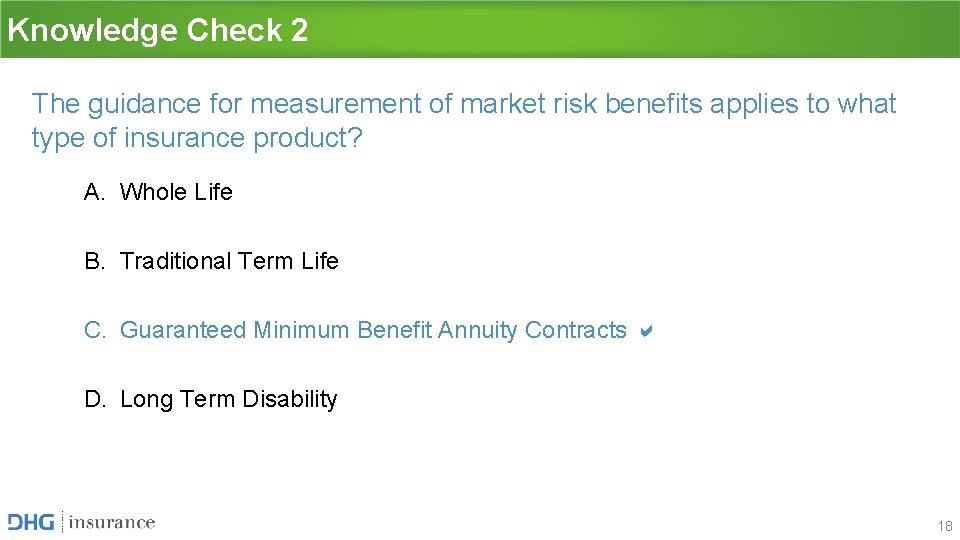
Knowledge Check 2 The guidance for measurement of market risk benefits applies to what type of insurance product? A. Whole Life B. Traditional Term Life C. Guaranteed Minimum Benefit Annuity Contracts a D. Long Term Disability 18
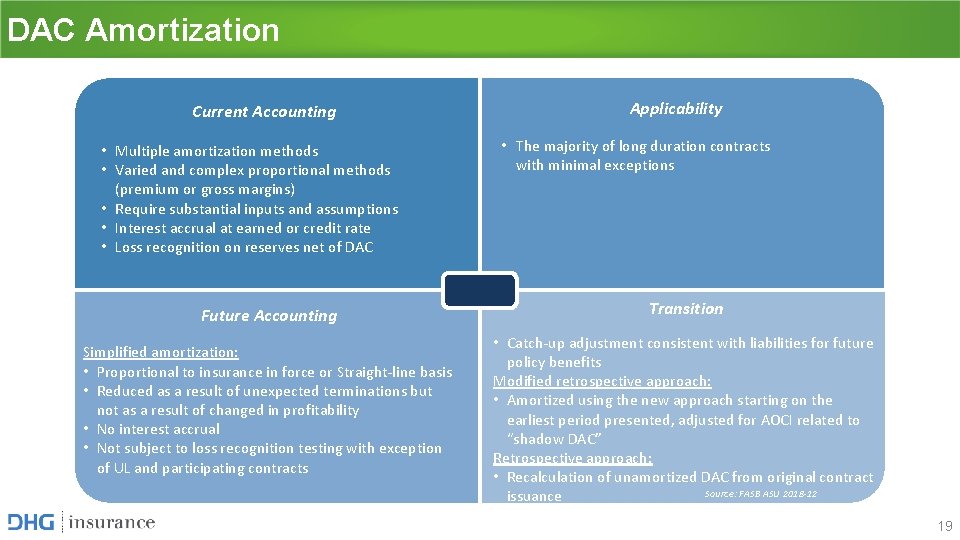
DAC Amortization Current Accounting • Multiple amortization methods • Varied and complex proportional methods (premium or gross margins) • Require substantial inputs and assumptions • Interest accrual at earned or credit rate • Loss recognition on reserves net of DAC Future Accounting Simplified amortization: • Proportional to insurance in force or Straight-line basis • Reduced as a result of unexpected terminations but not as a result of changed in profitability • No interest accrual • Not subject to loss recognition testing with exception of UL and participating contracts Applicability • The majority of long duration contracts with minimal exceptions Transition • Catch-up adjustment consistent with liabilities for future policy benefits Modified retrospective approach: • Amortized using the new approach starting on the earliest period presented, adjusted for AOCI related to “shadow DAC” Retrospective approach: • Recalculation of unamortized DAC from original contract Source: FASB ASU 2018 -12 issuance 19
DAC Amortization– Example Acquisition costs capitalized shall be charged to expense on a ratable basis as follows: In proportion to the undiscounted amount of insurance in force over the expected term of the related contract Year Balance of Insurance in Force Year 1 Balance of Insurance in Force Year 2 20 X 1 $ 5, 000 20 X 2 5, 000 20 X 3 5, 000 20 X 4 5, 000 20 X 5 5, 000 Total (A) $ 25, 000 $ 20, 000 Capitalized Acquisition Costs (B) $ 400 $ 340 1. 6% (C) 1. 7% (D) Amortization Rate (B/A) $ Capitalized Cost, Year 1 $400 Capitalized Cost, Year 2 $340* Amortization , year 1 Amortization , year 2 Balance of insurance in force of $5, 000 year 1 at rate C above DAC balance, end of year 1 $80 $320 Balance of insurance in force of $5, 000 year 2 at rate D above DAC balance, end of year 2 $85 $255 * At the beginning of year 2 an additional $20 of DAC is incurred 20
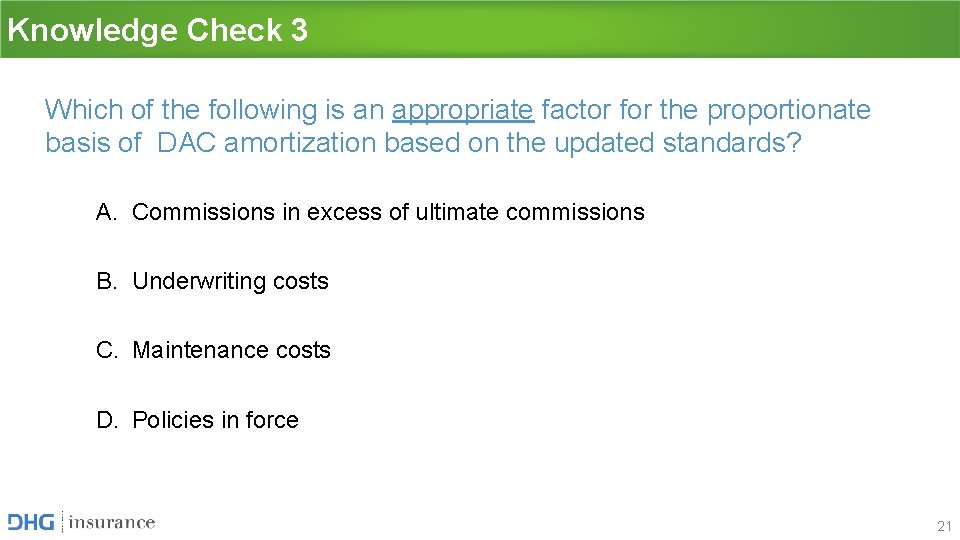
Knowledge Check 3 Which of the following is an appropriate factor for the proportionate basis of DAC amortization based on the updated standards? A. Commissions in excess of ultimate commissions B. Underwriting costs C. Maintenance costs D. Policies in force 21
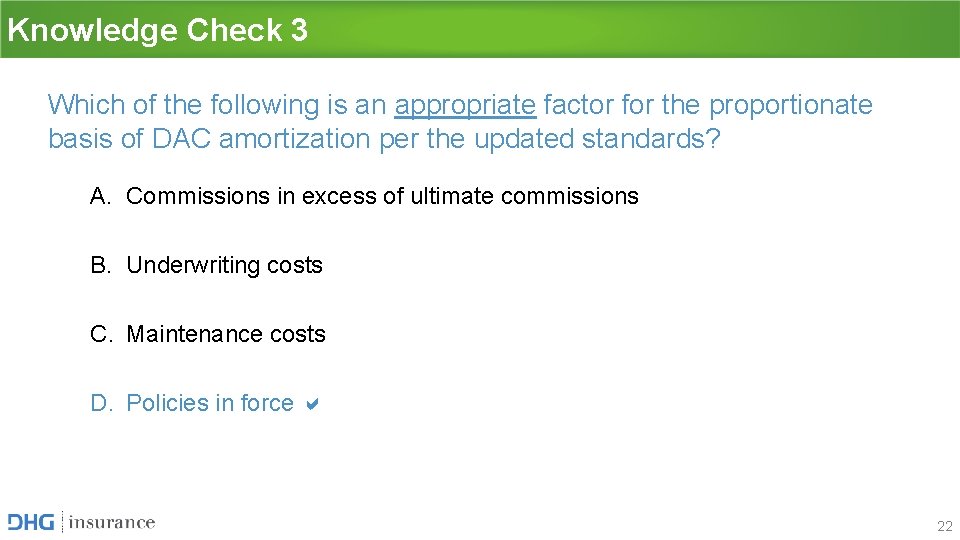
Knowledge Check 3 Which of the following is an appropriate factor for the proportionate basis of DAC amortization per the updated standards? A. Commissions in excess of ultimate commissions B. Underwriting costs C. Maintenance costs D. Policies in force a 22
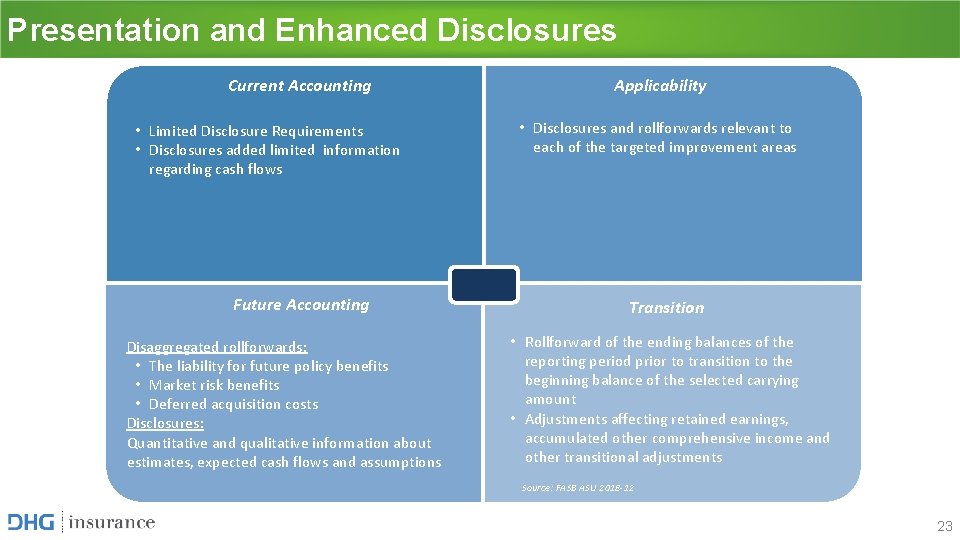
Presentation and Enhanced Disclosures Current Accounting • Limited Disclosure Requirements • Disclosures added limited information regarding cash flows Future Accounting Disaggregated rollforwards: • The liability for future policy benefits • Market risk benefits • Deferred acquisition costs Disclosures: Quantitative and qualitative information about estimates, expected cash flows and assumptions Applicability • Disclosures and rollforwards relevant to each of the targeted improvement areas Transition • Rollforward of the ending balances of the reporting period prior to transition to the beginning balance of the selected carrying amount • Adjustments affecting retained earnings, accumulated other comprehensive income and other transitional adjustments Source: FASB ASU 2018 -12 23
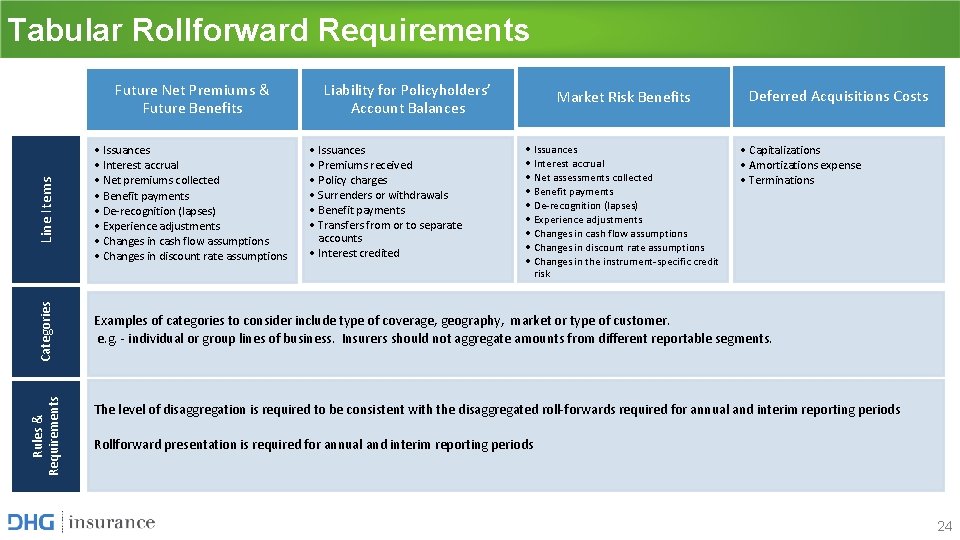
Tabular Rollforward Requirements Rules & Requirements Categories Line Items Future Net Premiums & Future Benefits • Issuances • Interest accrual • Net premiums collected • Benefit payments • De-recognition (lapses) • Experience adjustments • Changes in cash flow assumptions • Changes in discount rate assumptions Liability for Policyholders’ Account Balances • Issuances • Premiums received • Policy charges • Surrenders or withdrawals • Benefit payments • Transfers from or to separate accounts • Interest credited Market Risk Benefits • Issuances • Interest accrual • Net assessments collected • Benefit payments • De-recognition (lapses) • Experience adjustments • Changes in cash flow assumptions • Changes in discount rate assumptions • Changes in the instrument-specific credit risk Deferred Acquisitions Costs • Capitalizations • Amortizations expense • Terminations Examples of categories to consider include type of coverage, geography, market or type of customer. e. g. - individual or group lines of business. Insurers should not aggregate amounts from different reportable segments. The level of disaggregation is required to be consistent with the disaggregated roll-forwards required for annual and interim reporting periods Rollforward presentation is required for annual and interim reporting periods 24
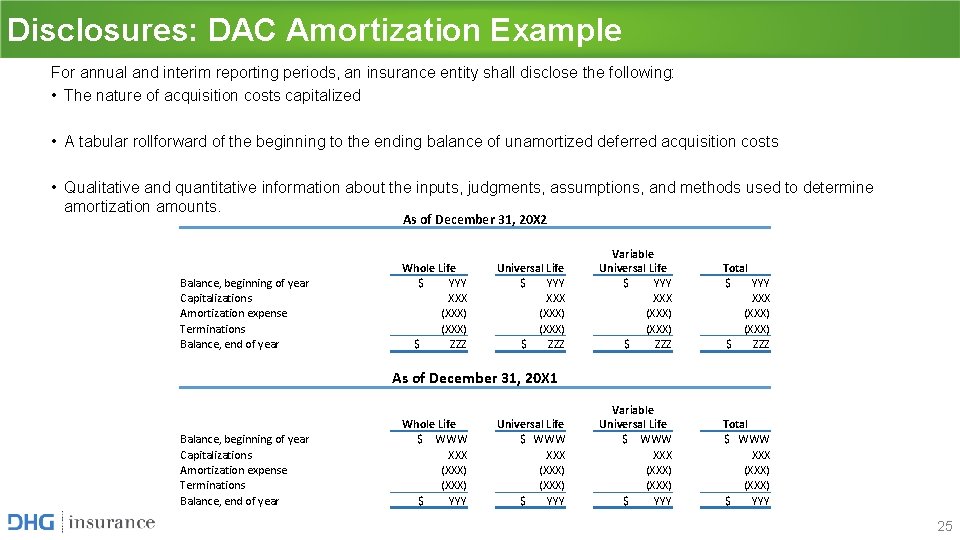
Disclosures: DAC Amortization Example For annual and interim reporting periods, an insurance entity shall disclose the following: • The nature of acquisition costs capitalized • A tabular rollforward of the beginning to the ending balance of unamortized deferred acquisition costs • Qualitative and quantitative information about the inputs, judgments, assumptions, and methods used to determine amortization amounts. As of December 31, 20 X 2 Balance, beginning of year Capitalizations Amortization expense Terminations Balance, end of year Whole Life $ YYY XXX (XXX) $ ZZZ Universal Life $ YYY XXX (XXX) $ ZZZ Variable Universal Life $ YYY XXX (XXX) $ ZZZ Total $ WWW XXX (XXX) $ YYY As of December 31, 20 X 1 Balance, beginning of year Capitalizations Amortization expense Terminations Balance, end of year Whole Life $ WWW XXX (XXX) $ YYY Universal Life $ WWW XXX (XXX) $ YYY Variable Universal Life $ WWW XXX (XXX) $ YYY 25
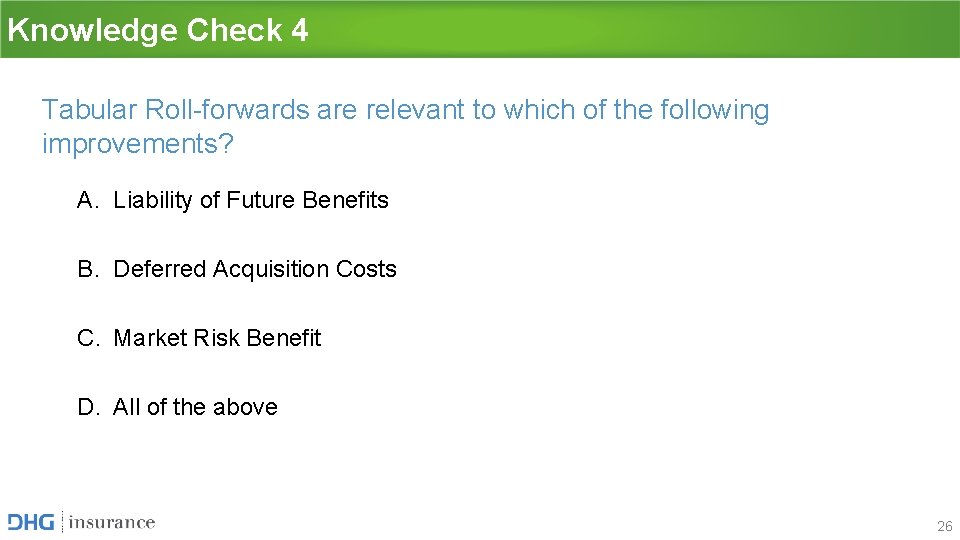
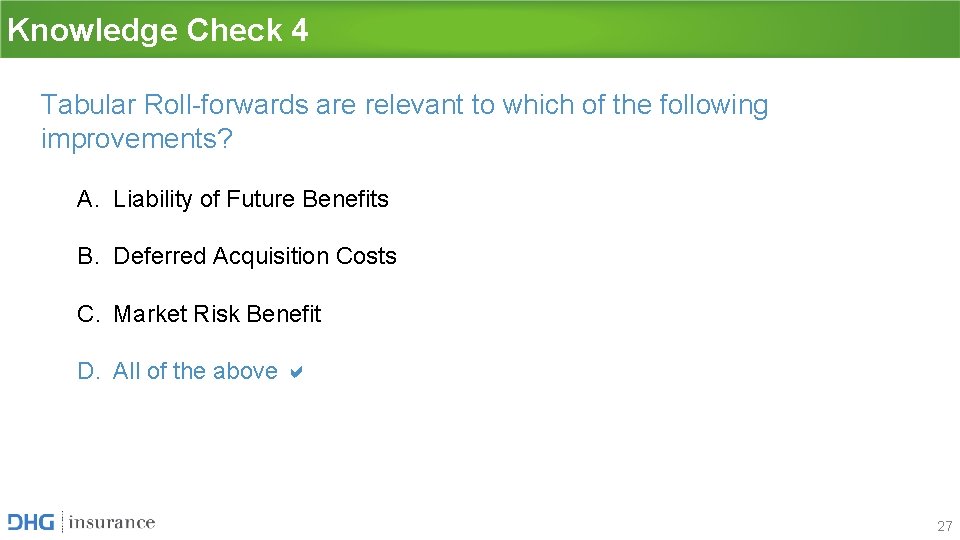
Knowledge Check 4 Tabular Roll-forwards are relevant to which of the following improvements? A. Liability of Future Benefits B. Deferred Acquisition Costs C. Market Risk Benefit D. All of the above 26
Knowledge Check 4 Tabular Roll-forwards are relevant to which of the following improvements? A. Liability of Future Benefits B. Deferred Acquisition Costs C. Market Risk Benefit D. All of the above a 27
Business Process and Requirements 28
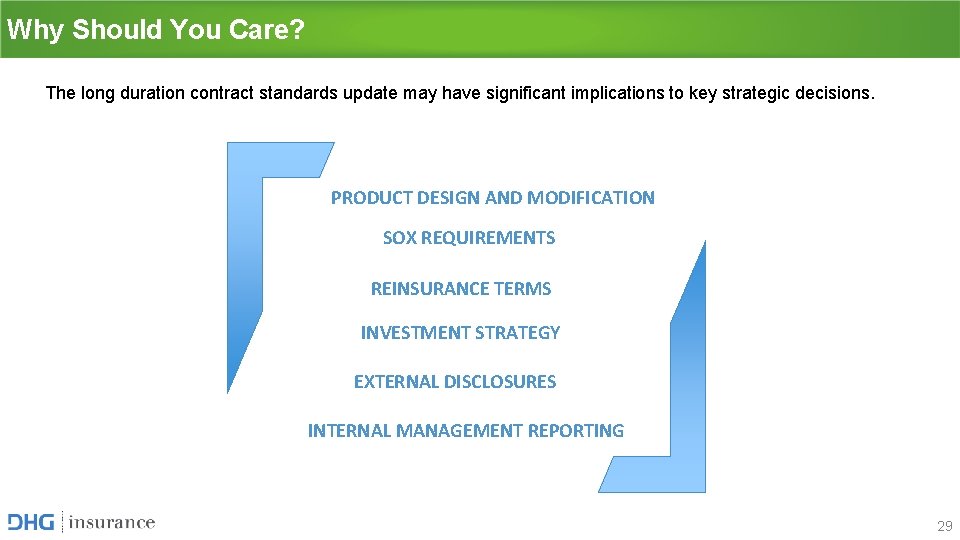
Why Should You Care? The long duration contract standards update may have significant implications to key strategic decisions. PRODUCT DESIGN AND MODIFICATION SOX REQUIREMENTS REINSURANCE TERMS INVESTMENT STRATEGY EXTERNAL DISCLOSURES INTERNAL MANAGEMENT REPORTING 29
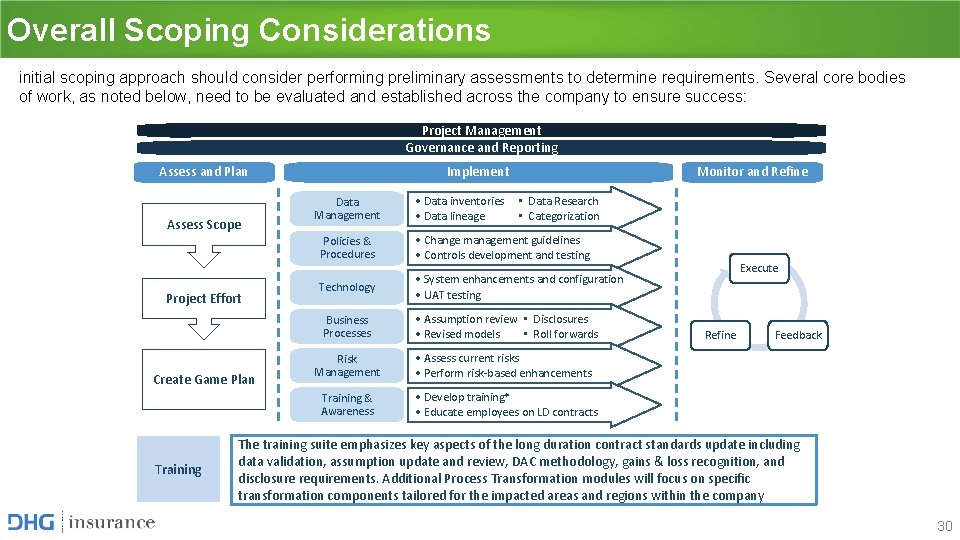
Overall Scoping Considerations initial scoping approach should consider performing preliminary assessments to determine requirements. Several core bodies of work, as noted below, need to be evaluated and established across the company to ensure success: Project Management Governance and Reporting Assess and Plan Assess Scope Project Effort Create Game Plan Training Monitor and Refine Implement Data Management • Data inventories • Data lineage • Data Research • Categorization Policies & Procedures • Change management guidelines • Controls development and testing Technology • System enhancements and configuration • UAT testing Business Processes • Assumption review • Disclosures • Roll forwards • Revised models Risk Management • Assess current risks • Perform risk-based enhancements Training & Awareness • Develop training* • Educate employees on LD contracts Execute Refine Feedback The training suite emphasizes key aspects of the long duration contract standards update including data validation, assumption update and review, DAC methodology, gains & loss recognition, and disclosure requirements. Additional Process Transformation modules will focus on specific transformation components tailored for the impacted areas and regions within the company 30
Questions and Contacts Prashant Panavalli Director, Insurance Services Group Prashant. Panavalli@dhgllp. com 201 -957 -2550 Prashant is a Director in the advisory practice of DHG’s Insurance Services Group. Prashant has lead large scale process transformation work for insurers for more than 15 years including project and team management, critical and continuous stakeholder communication, and development of processes, risks and controls. 31