
LOINC Logical Observation Identifiers Names and Codes by
LOINC Logical Observation Identifiers, Names and Codes by Stephen Hufnagel Ph. D, Document Editor to Edmond-Scientific VA support-contract Shufnagel@tiag. net, 703 -575 -7912 May 19, 2014
Agenda • • • Topic Slides Introduction by Catherine Hoang MS, RN this slide LOINC Background and Anatomy – Stephen Hufnagel Ph. D 18 VA Document Ontology - Loren Stevenson, M. D. 9 VA Document Title Request - Sarah Maulden, MD, MS and Steve Brown, MD 4 Use of LOINC in Pressure Ulcer Assessment – Holly Miller, RN 4 DOD Sponsored HL 7 -LOINC Document Taxonomy (Backup) 9 2
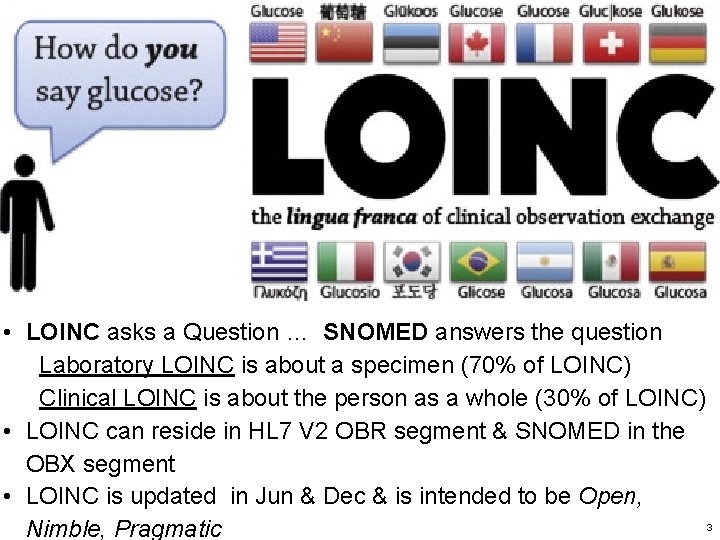
• LOINC asks a Question … SNOMED answers the question Laboratory LOINC is about a specimen (70% of LOINC) Clinical LOINC is about the person as a whole (30% of LOINC) • LOINC can reside in HL 7 V 2 OBR segment & SNOMED in the OBX segment • LOINC is updated in Jun & Dec & is intended to be Open, 3 Nimble, Pragmatic
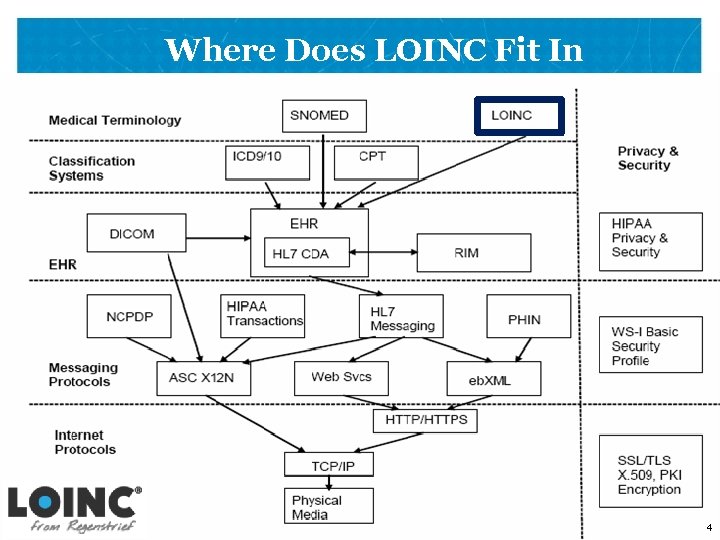
Where Does LOINC Fit In 4
Background • The LOINC effort is housed in the Regenstrief Institute, Indiana University. • LOINC was initiated in 1994; where, • The purpose of the LOINC® database is semantic interoperability • LOINC codes are universal identifiers • Laboratory LOINC contains chemistry, hematology, serology, microbiology (including parasitology and virology), toxicology; drugs and the cell counts, antibiotic susceptibilities, etc. • Clinical LOINC includes vital signs, hemodynamics, intake/output, EKG, obstetric ultrasound, cardiac echo, urologic imaging, gastroendoscopic procedures, pulmonary ventilator management, selected survey instruments (e. g. Glasgow Coma 5 Score, PHQ-9 depression scale, CMS-required patient
Goals of Health Information Standards Semantic Interoperability requires use of standardized content (vocabularies) within data structure • Interoperability – the ability to exchange information between organizations • Comparability – the ability to ascertain the equivalence of data from different sources • Data Quality – the measurement of accessibility, completeness, accuracy and precision (and more) 6
Comparability • Meaning of the data is consistent when shared among different parties • Erysipelas – Human skin disease; Streptococcus Grp A • Erysipelas – Animal Septicemia/dermatitis; Erysipelothrix rhusiopathiae • Common terminology required • Should work in the background • Words are not enough • Codes – uniquely identify terms • Vocabulary – specialized, precise terms that remove ambiguity • Ontology – describes nature of entities and their relations 7
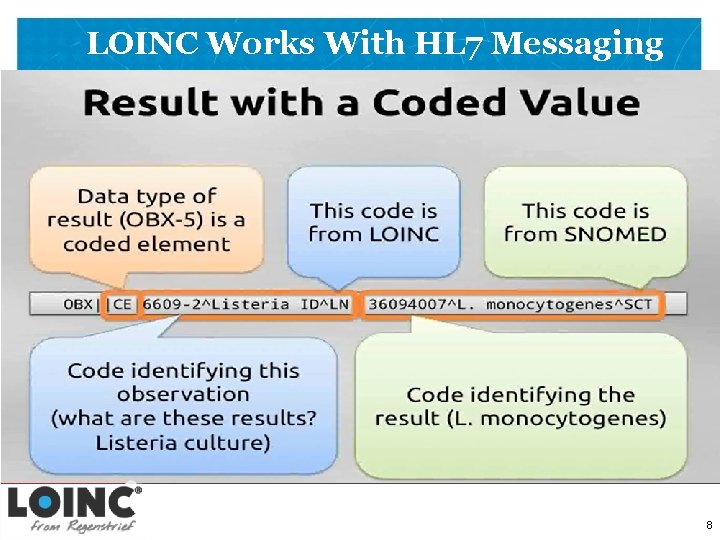
LOINC Works With HL 7 Messaging 8
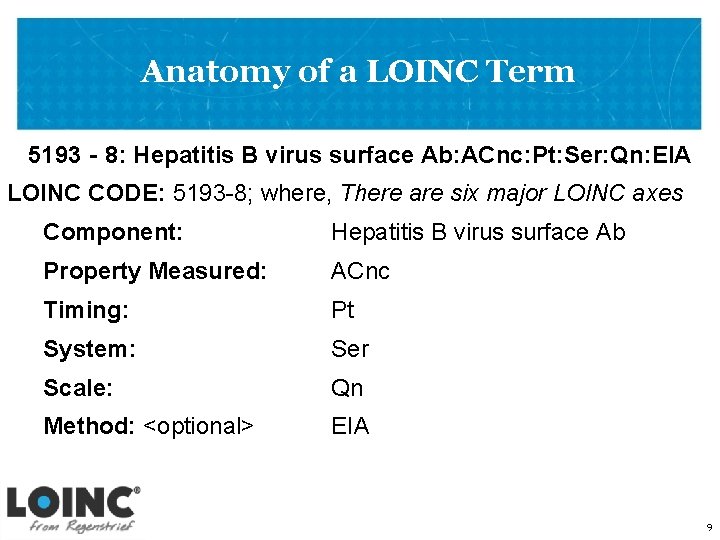
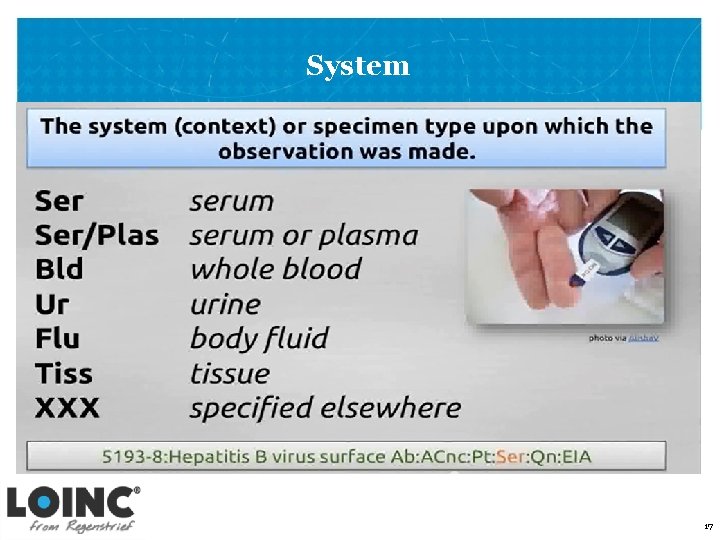
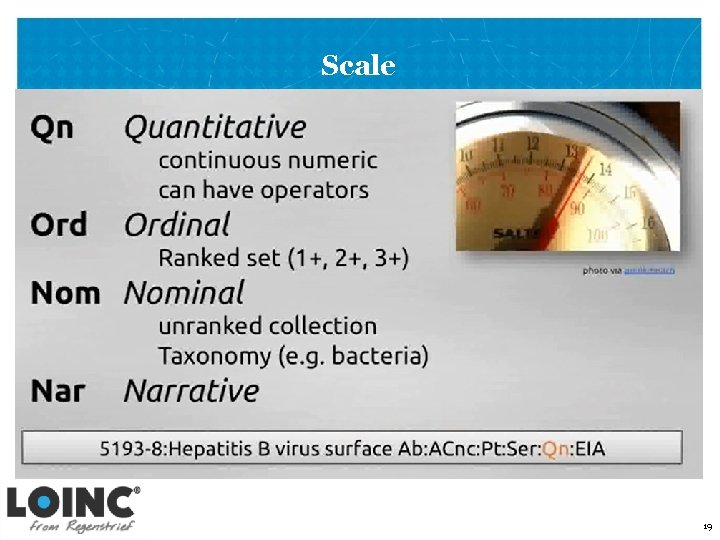
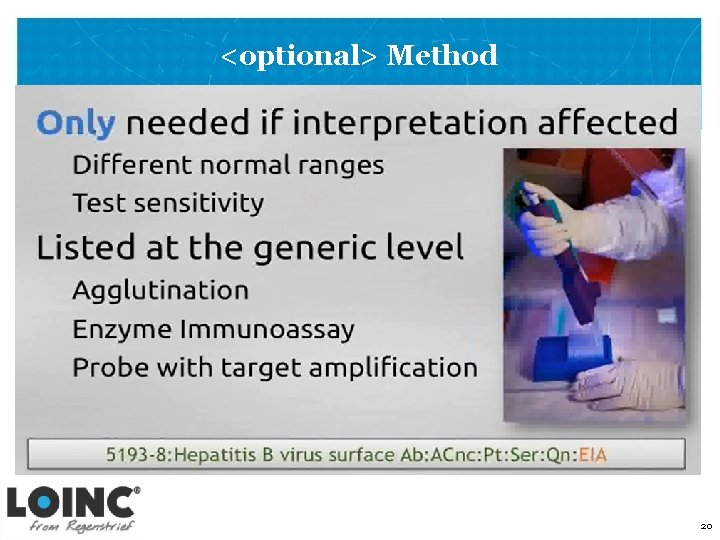
Anatomy of a LOINC Term 5193‐ 8: Hepatitis B virus surface Ab: ACnc: Pt: Ser: Qn: EIA LOINC CODE: 5193 -8; where, There are six major LOINC axes Component: Hepatitis B virus surface Ab Property Measured: ACnc Timing: Pt System: Ser Scale: Qn Method: <optional> EIA 9
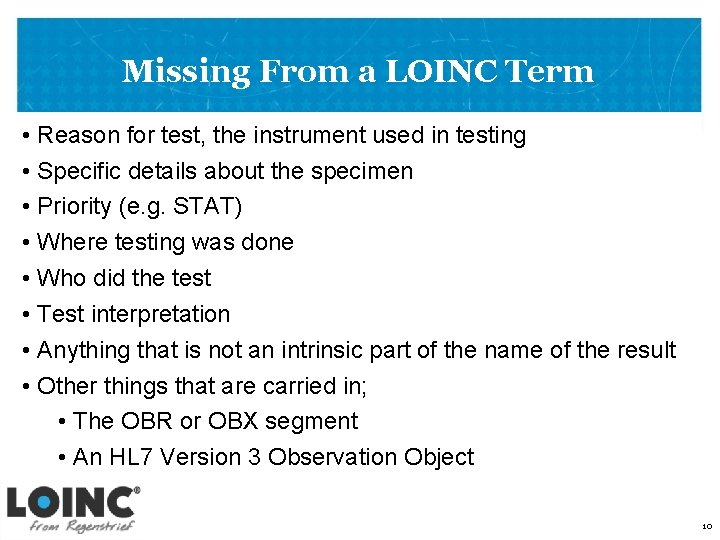
Missing From a LOINC Term • Reason for test, the instrument used in testing • Specific details about the specimen • Priority (e. g. STAT) • Where testing was done • Who did the test • Test interpretation • Anything that is not an intrinsic part of the name of the result • Other things that are carried in; • The OBR or OBX segment • An HL 7 Version 3 Observation Object 10
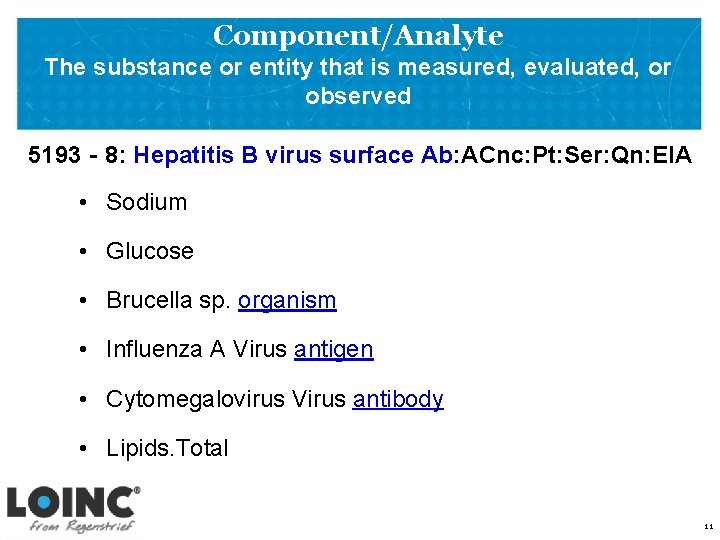
Component/Analyte The substance or entity that is measured, evaluated, or observed 5193‐ 8: Hepatitis B virus surface Ab: ACnc: Pt: Ser: Qn: EIA • Sodium • Glucose • Brucella sp. organism • Influenza A Virus antigen • Cytomegalovirus Virus antibody • Lipids. Total 11
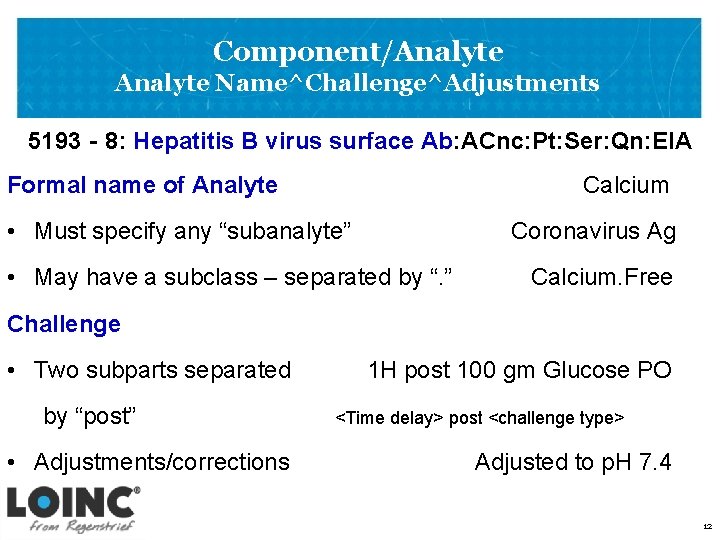
Component/Analyte Name^Challenge^Adjustments 5193‐ 8: Hepatitis B virus surface Ab: ACnc: Pt: Ser: Qn: EIA Formal name of Analyte Calcium • Must specify any “subanalyte” Coronavirus Ag • May have a subclass – separated by “. ” Calcium. Free Challenge • Two subparts separated by “post” • Adjustments/corrections 1 H post 100 gm Glucose PO <Time delay> post <challenge type> Adjusted to p. H 7. 4 12
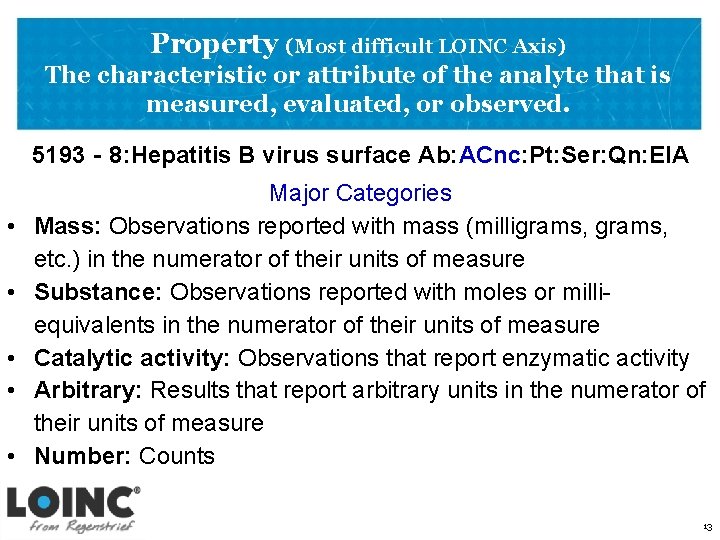
Property (Most difficult LOINC Axis) The characteristic or attribute of the analyte that is measured, evaluated, or observed. 5193‐ 8: Hepatitis B virus surface Ab: ACnc: Pt: Ser: Qn: EIA • • • Major Categories Mass: Observations reported with mass (milligrams, etc. ) in the numerator of their units of measure Substance: Observations reported with moles or milliequivalents in the numerator of their units of measure Catalytic activity: Observations that report enzymatic activity Arbitrary: Results that report arbitrary units in the numerator of their units of measure Number: Counts 13
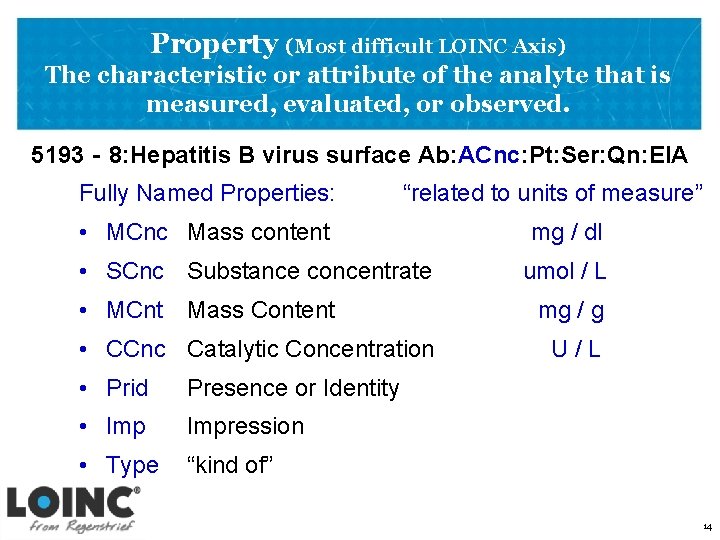
Property (Most difficult LOINC Axis) The characteristic or attribute of the analyte that is measured, evaluated, or observed. 5193‐ 8: Hepatitis B virus surface Ab: ACnc: Pt: Ser: Qn: EIA Fully Named Properties: “related to units of measure” • MCnc Mass content • SCnc Substance concentrate • MCnt Mass Content • CCnc Catalytic Concentration • Prid Presence or Identity • Impression • Type “kind of” mg / dl umol / L mg / g U/L 14
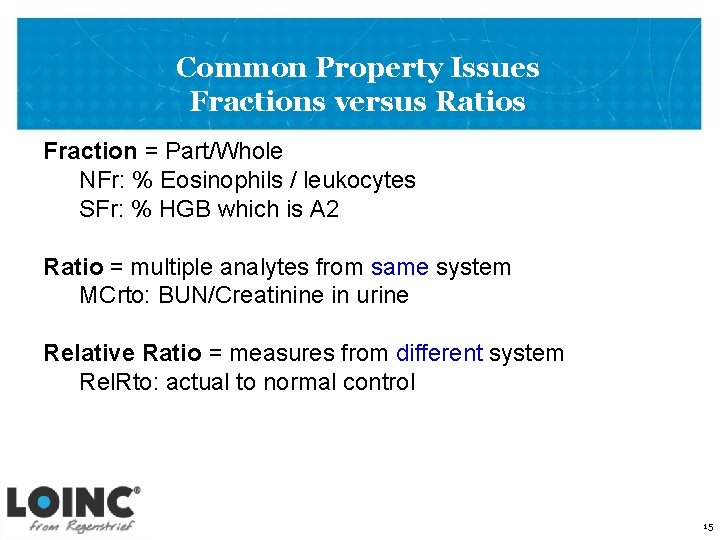
Common Property Issues Fractions versus Ratios Fraction = Part/Whole NFr: % Eosinophils / leukocytes SFr: % HGB which is A 2 Ratio = multiple analytes from same system MCrto: BUN/Creatinine in urine Relative Ratio = measures from different system Rel. Rto: actual to normal control 15
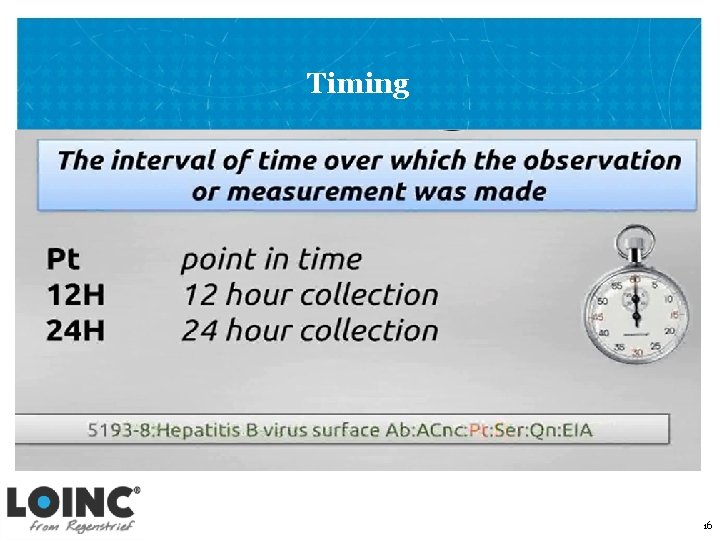
Timing 16
System 17
System Structure 18
Scale 19
<optional> Method 20
LOINC VA Document Ontology Loren Stevenson, M. D. , Terminologist Terminology Standards Division, Knowledge Based Systems Office of Informatics & Analytics, VHA, Salt Lake OIFO 801 -924 -2113 21
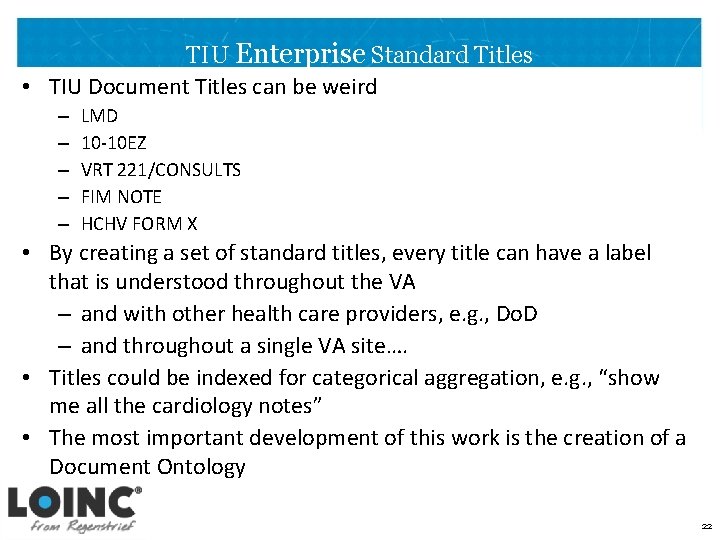
TIU Enterprise Standard Titles • TIU Document Titles can be weird – – – LMD 10 -10 EZ VRT 221/CONSULTS FIM NOTE HCHV FORM X • By creating a set of standard titles, every title can have a label that is understood throughout the VA – and with other health care providers, e. g. , Do. D – and throughout a single VA site…. • Titles could be indexed for categorical aggregation, e. g. , “show me all the cardiology notes” • The most important development of this work is the creation of a Document Ontology 22
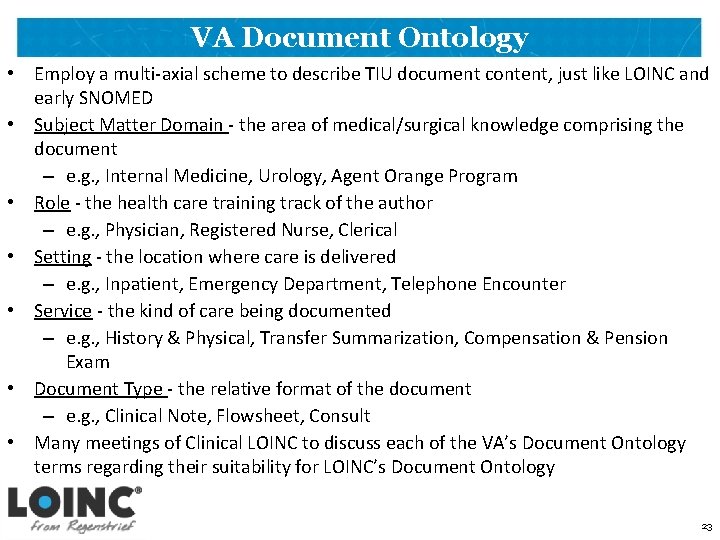
VA Document Ontology • Employ a multi-axial scheme to describe TIU document content, just like LOINC and early SNOMED • Subject Matter Domain - the area of medical/surgical knowledge comprising the document – e. g. , Internal Medicine, Urology, Agent Orange Program • Role - the health care training track of the author – e. g. , Physician, Registered Nurse, Clerical • Setting - the location where care is delivered – e. g. , Inpatient, Emergency Department, Telephone Encounter • Service - the kind of care being documented – e. g. , History & Physical, Transfer Summarization, Compensation & Pension Exam • Document Type - the relative format of the document – e. g. , Clinical Note, Flowsheet, Consult • Many meetings of Clinical LOINC to discuss each of the VA’s Document Ontology terms regarding their suitability for LOINC’s Document Ontology 23
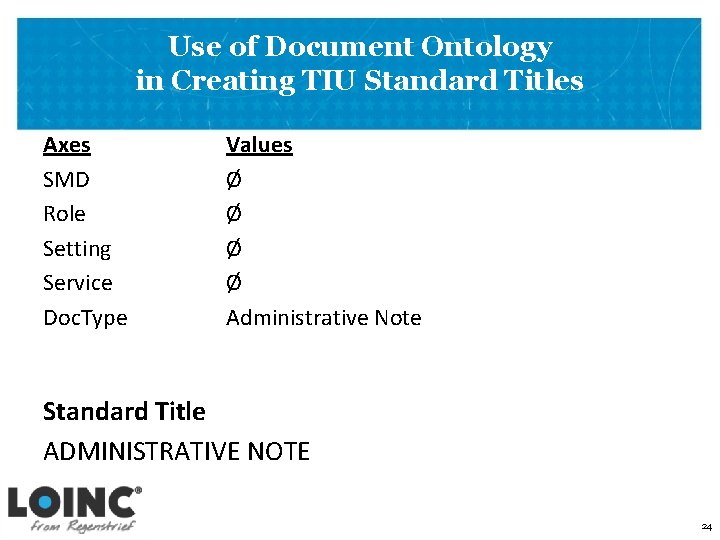
Use of Document Ontology in Creating TIU Standard Titles Axes SMD Role Setting Service Doc. Type Values Ø Ø Administrative Note Standard Title ADMINISTRATIVE NOTE 24
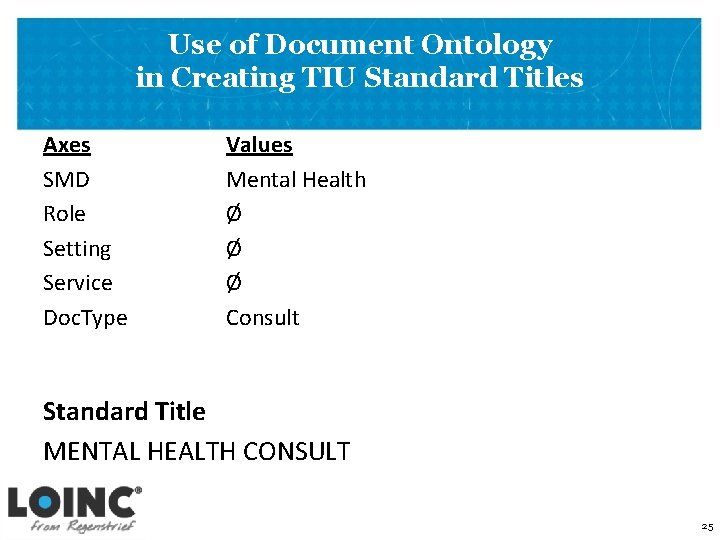
Use of Document Ontology in Creating TIU Standard Titles Axes SMD Role Setting Service Doc. Type Values Mental Health Ø Ø Ø Consult Standard Title MENTAL HEALTH CONSULT 25
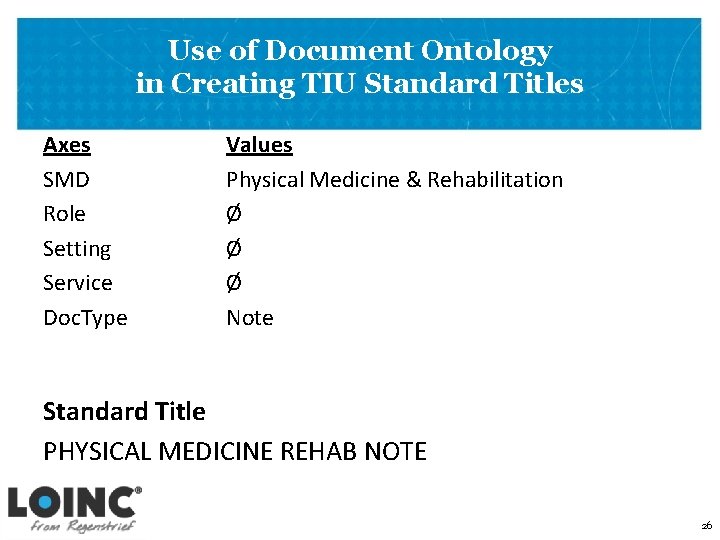
Use of Document Ontology in Creating TIU Standard Titles Axes SMD Role Setting Service Doc. Type Values Physical Medicine & Rehabilitation Ø Ø Ø Note Standard Title PHYSICAL MEDICINE REHAB NOTE 26
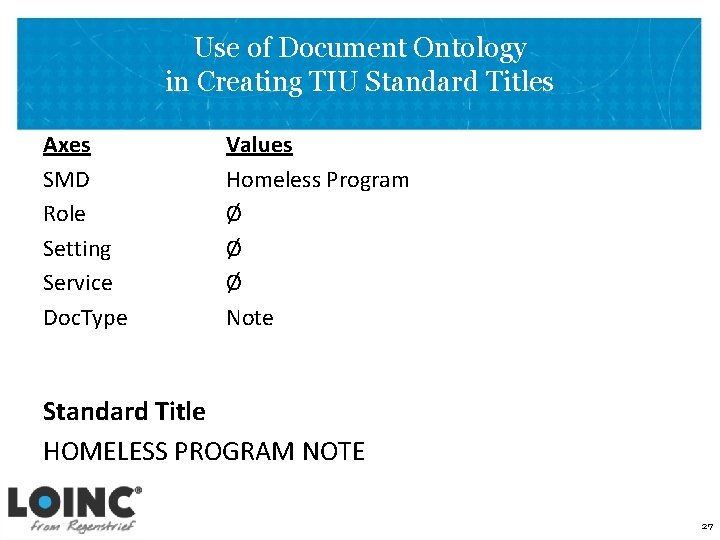
Use of Document Ontology in Creating TIU Standard Titles Axes SMD Role Setting Service Doc. Type Values Homeless Program Ø Ø Ø Note Standard Title HOMELESS PROGRAM NOTE 27
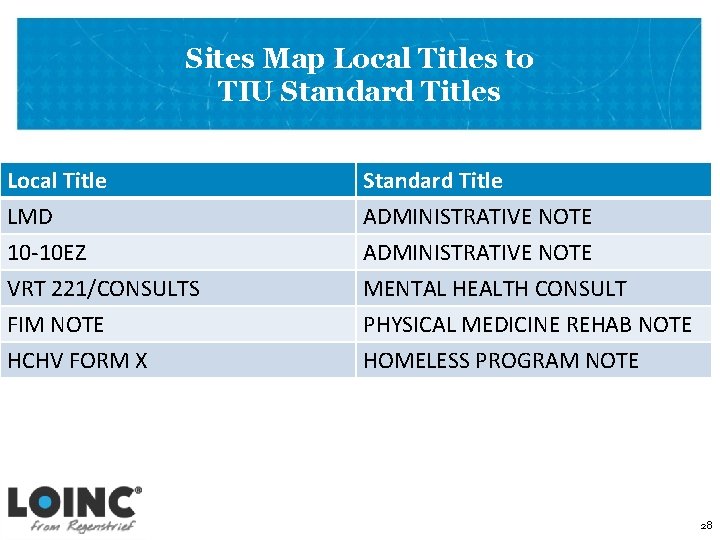
Sites Map Local Titles to TIU Standard Titles Local Title LMD 10 -10 EZ VRT 221/CONSULTS Standard Title ADMINISTRATIVE NOTE MENTAL HEALTH CONSULT FIM NOTE HCHV FORM X PHYSICAL MEDICINE REHAB NOTE HOMELESS PROGRAM NOTE 28
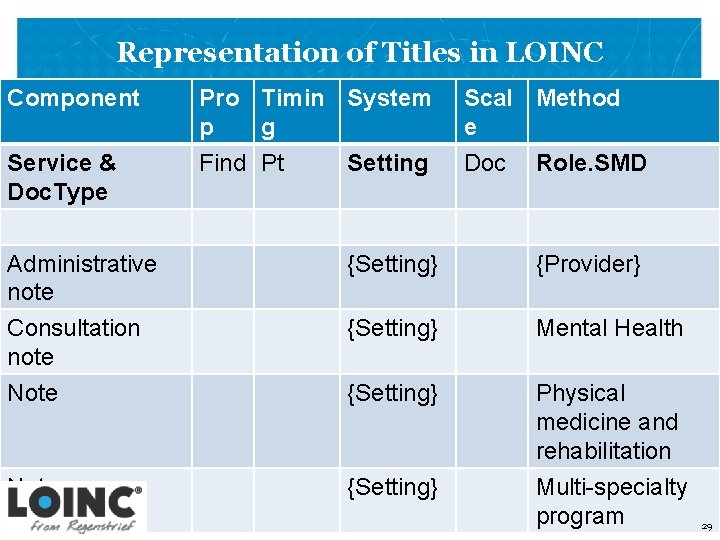
Representation of Titles in LOINC Component Pro Timin System p g Scal Method e Service & Doc. Type Find Pt Doc Setting Role. SMD Administrative note {Setting} {Provider} Consultation note {Setting} Mental Health Note {Setting} Physical medicine and • Translation between Document Ontologies is sometimes necessary rehabilitation • LOINC field of Class as DOC. CLINRPT Note {Setting} Multi-specialty program 29
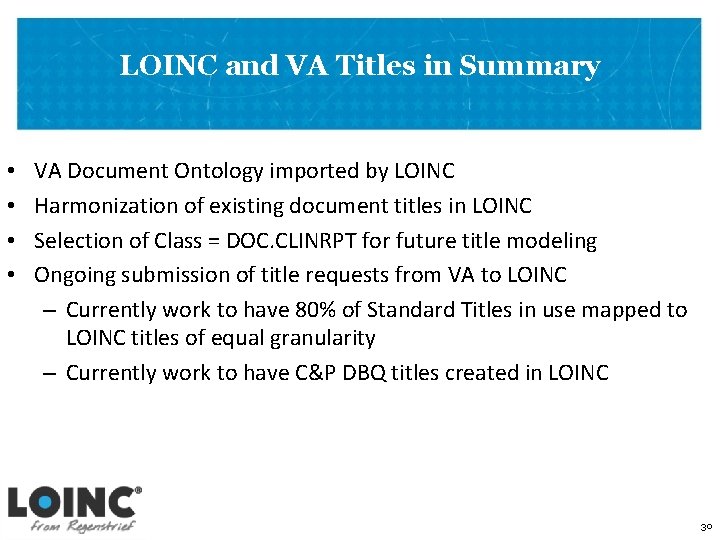
LOINC and VA Titles in Summary • • VA Document Ontology imported by LOINC Harmonization of existing document titles in LOINC Selection of Class = DOC. CLINRPT for future title modeling Ongoing submission of title requests from VA to LOINC – Currently work to have 80% of Standard Titles in use mapped to LOINC titles of equal granularity – Currently work to have C&P DBQ titles created in LOINC 30
VA LOINC Document Title Request Sarah Maulden, MD, MS and Steve Brown, MD VHA Office of Informatics & Analytics, Knowledge Based Systems, Terminology Standards Division, Dept of Veterans Affairs, Salt Lake OIFO Sarah Maulden Office: (801) 588 -5242, Mobile: (801) 7079364 31
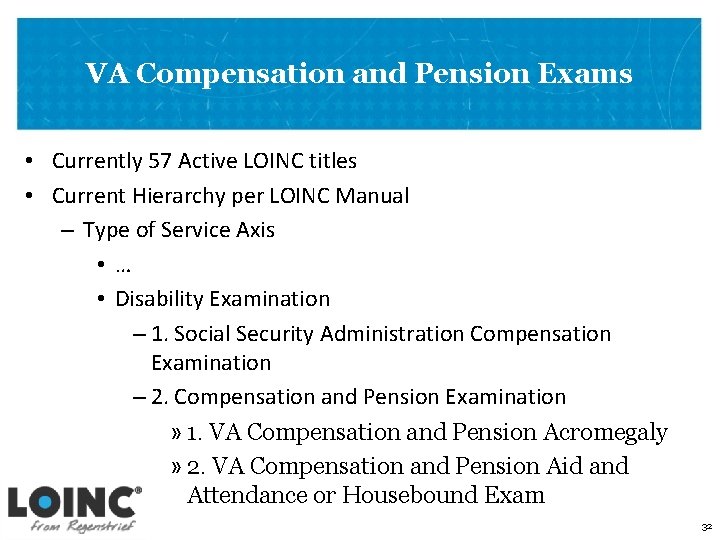
VA Compensation and Pension Exams • Currently 57 Active LOINC titles • Current Hierarchy per LOINC Manual – Type of Service Axis • … • Disability Examination – 1. Social Security Administration Compensation Examination – 2. Compensation and Pension Examination » 1. VA Compensation and Pension Acromegaly » 2. VA Compensation and Pension Aid and Attendance or Housebound Exam 32
VA Disability Benefits Questionnaire • 82 OMB Approved Forms • Utilized by VHA and private providers to evaluate patients as part of the VA Benefits process • Organized by clinical domain and symptoms – http: //www. benefits. va. gov/COMPENSATION/dbq_List. By. DBQForm Name. asp 33
Why New Titles • Former VA C&P Exam titles used inconsistently • New DBQ process is more formalized with defined forms – semantically different • Forms will be shared between VA, Do. D and 3 rd parties • Ability to identify and transmit forms through HIE will be important 34
Exemplars • Type of Service –… • Compensation and Pension – VA COMPENSATION AND PENSION DBQ AUDIO Hearing Loss and Tinnitus – VA COMPENSATION AND PENSION DBQ ENDOCRINE Diabetes Mellitus – VA COMPENSATION AND PENSION DBQ MUSCULOSKELETAL Neck (Cervical Spine) – VA COMPENSATION AND PENSION DBQ MUSCULOSKELETAL Back (Thoracolumbar Spine) 35
Use of LOINC in Pressure Ulcer Assessment Holly Miller MS, RN, Terminology Division Knowledge Based Systems VHA Office of Informatics and Analytics 801 -792 -2638 36
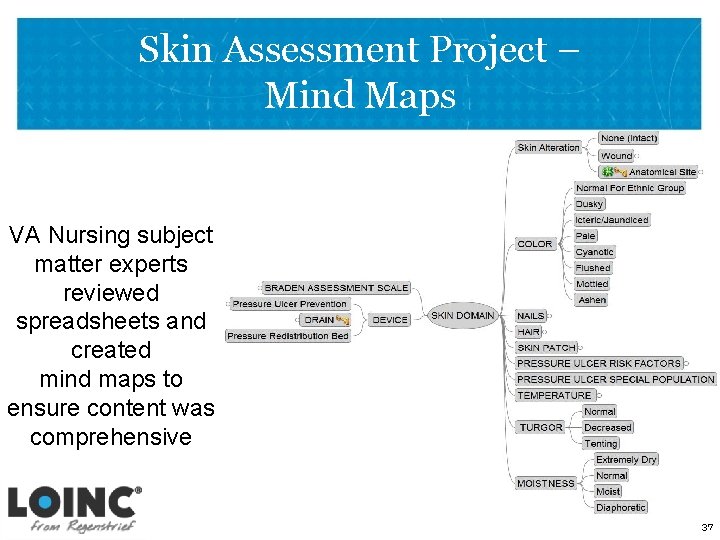
Skin Assessment Project – Mind Maps VA Nursing subject matter experts reviewed spreadsheets and created mind maps to ensure content was comprehensive 37
Skin Assessment Project – Mapping Guidelines • Follow recommendations of the Health Level Seven (HL 7) Version 3 (V 3) – HL 7 Implementation Guide for CDA (Clinical Document Architecture) Release 2: Reference Profile for EHR (Electronic Health Record) Interoperability, September 2008 – TERMINFO Project (a project of the HL 7 Vocabulary Technical Committee), HL 7 V 3 Implementation Guide, DSTU (Draft Standard for Trial Use) Ballot 4 – May 2009 • Map questions to Clinical LOINC® and answers to SNOMED CT 38
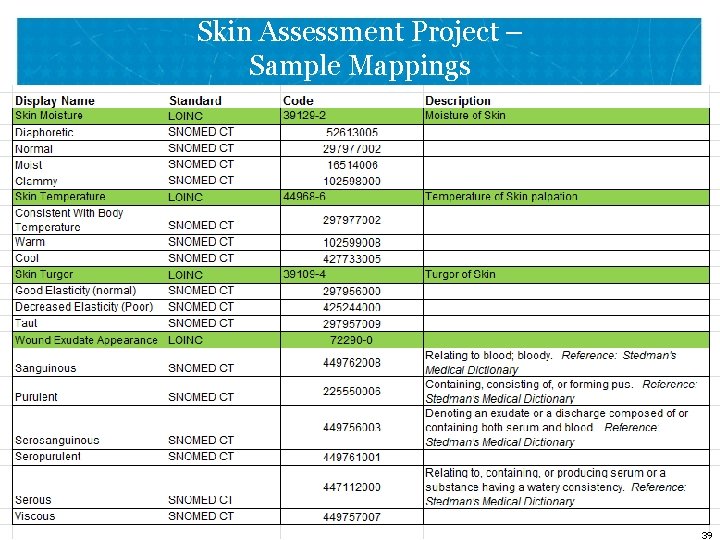
Skin Assessment Project – Sample Mappings 39
Discussion / Questions References • http: //loinc. org/ Main Web Site • http: //search. loinc. org/ Web application • http: //loinc. org/downloads/files/LOINCManual. pdf • RELMA® - Regenstrief LOINC® Mapping Assistant • Import local terms • Browse LOINC taxonomy • Mapping amongst code sets • Free download and manual at loinc. org 40
Backup HL 7 DSTU LOINC Document Ontology Led-by and Content Provided-by Nancy Orvis, DHA and Russ Ott, Deloitte Nancy. Orvis@dha. mil rott@deloitte. com 41 41
LOINC Document Ontology STATUS: Sept 2013 DSTU Currently Under Ballot Reconciliation • Implementation guide for querying for and retrieving documents using the dimensions of and values from the LOINC Clinical Document Ontology • Standardized query and retrieval data elements to use when interacting with LOINC encoded clinical documents. • LOINC Clinical Document Ontology was adjusted to position it for US document types used by US Military Healthcare organizations. • Draft Standard for Trial Use (DSTU) in the Universal Realm. 42
LOINC Document Ontology Introduction To support improved HAIMS functionality, an HL 7 Implementation Guide for the LOINC Document Ontology is being developed, based off of prior work done by HL 7 and Regenstrief (LOINC), and positioned for additional harmonization with Vista and AHLTA clinical document types • The LOINC Document Ontology is a harmonized set of values associated with clinical document types. The ontology can support metadata query and search to locate clinical documents as well as documents that may be associated with other clinical documents (such as images) • The axes defined within this Ontology are: • Subject Matter Domain • Kind of Document • Role 43 • Setting (Inpatient, Outpatient as examples)
LOINC Document Ontology Purpose The purpose of enhancing the ontology for DHA is: • Provide ability to search for specific clinical document types using a common taxonomy of names. The specific need is to provide semantics for names of clinical documents that are exchanged between systems • Provide ability to use metadata in association with a clinical document that can be leveraged to locate specific document types The Ontology supports queries using the following approaches: • Enumerated list as defined in ontology • Search Type of Service LOINC axis (e. g. , all Procedures) • Search by LOINC axis values • Search Type of Service, Setting (e. g. , Hospital Procedures) • Combinations of values within a specific LOINC axis 44
Why is the Ontology Needed? Local DOD and VA systems have specific names • Therefore, a controlled document vocabulary is needed – as a value set of representative document codes The document codes in the LOINC Document Ontology provide consistent semantics for names of documents exchanged between DOD and VA systems • The Ontology axes also make it easy to look up broad categories of documents, which may include a collection of many explicit document type LOINC codes. • The Ontology does NOT replace local document titles, it just provides a consistent framework for locating types of documents across organizations. 45
Exclusions Descriptive metadata such as: • Author • Location of service • Date of service • Status (e. g. signed, unsigned) • Security/privacy flags (e. g. protected) • Updates or amendments to a document This information is provided as part of the metadata associated with the document itself, not within the LOINC code or the Ontology axes 46
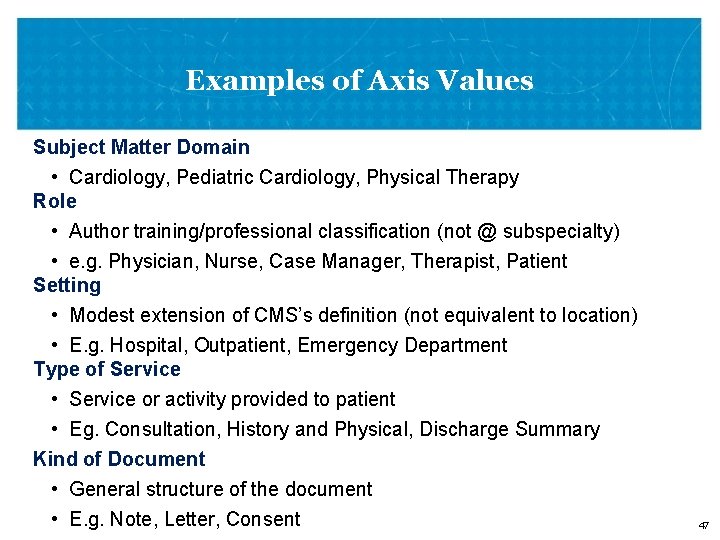
Examples of Axis Values Subject Matter Domain • Cardiology, Pediatric Cardiology, Physical Therapy Role • Author training/professional classification (not @ subspecialty) • e. g. Physician, Nurse, Case Manager, Therapist, Patient Setting • Modest extension of CMS’s definition (not equivalent to location) • E. g. Hospital, Outpatient, Emergency Department Type of Service • Service or activity provided to patient • Eg. Consultation, History and Physical, Discharge Summary Kind of Document • General structure of the document • E. g. Note, Letter, Consent 47
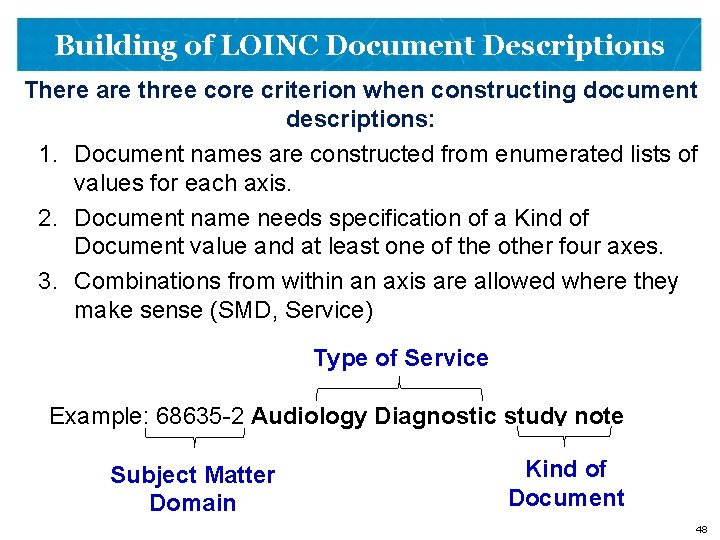
Building of LOINC Document Descriptions There are three core criterion when constructing document descriptions: 1. Document names are constructed from enumerated lists of values for each axis. 2. Document name needs specification of a Kind of Document value and at least one of the other four axes. 3. Combinations from within an axis are allowed where they make sense (SMD, Service) Type of Service Example: 68635 -2 Audiology Diagnostic study note Subject Matter Domain Kind of Document 48
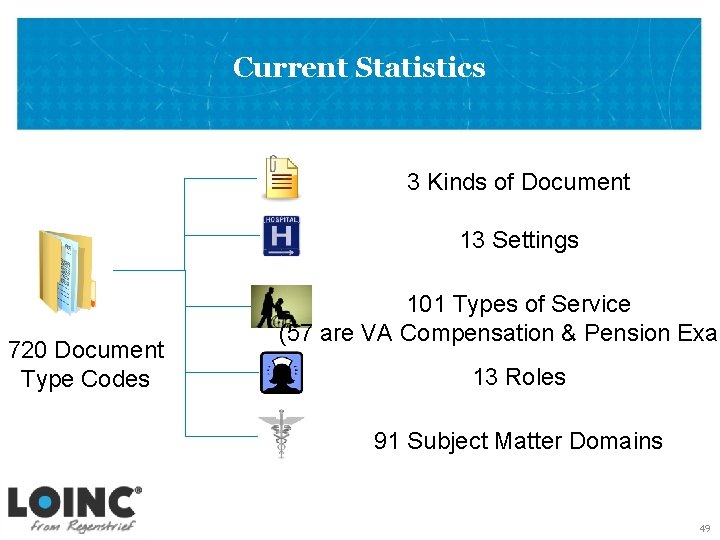
Current Statistics 3 Kinds of Document 13 Settings 720 Document Type Codes 101 Types of Service (57 are VA Compensation & Pension Exam 13 Roles 91 Subject Matter Domains 49
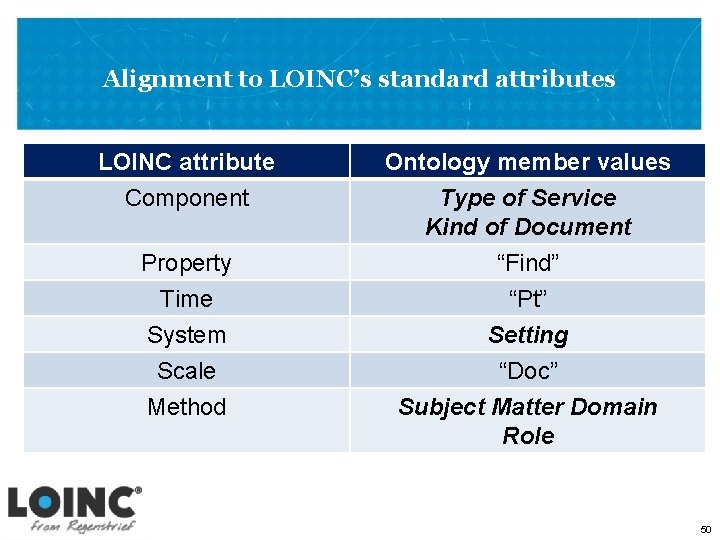
Alignment to LOINC’s standard attributes LOINC attribute Component Property Time System Scale Method Ontology member values Type of Service Kind of Document “Find” “Pt” Setting “Doc” Subject Matter Domain Role 50
- Slides: 50