
logy Ec WHAT IS ECOLOGY Study of relationships

- Slides: 49
logy Ec
WHAT IS ECOLOGY? Study of relationships between organisms and their environments. ØBiotic factors: all living parts of the environm. ØAbiotic factors: nonliving parts of the environm. Ø(i. e. temperature, soil, light, moisture)
Biosphere largest Biome Levels of Ecological Organization Ecosystem Community Population Organism smallest
1. Biosphere: Earth (all ecosystems) 2. Biome: ecosystems with similar life and climate ex. : tropical rainforests, tundra 3. Ecosystem: Smallest group containing both biotic and abiotic factors 4. Community: Group of different populations in an area (No abiotic factors) 5. Population: a group of organisms of same species 6. Organism: an individual.
Habitat vs. Niche - the role a species plays in a community Habitat- the place where an organism lives Limiting factor- biotic or abiotic factors that limits where an organism can survive Ex. : amount of water available, food, space, shelter
Community Relationships 1. Competition for resources: food, shelter, water, etc. 2. Predation predator kill prey for food 3. Symbiosis different species living closely together
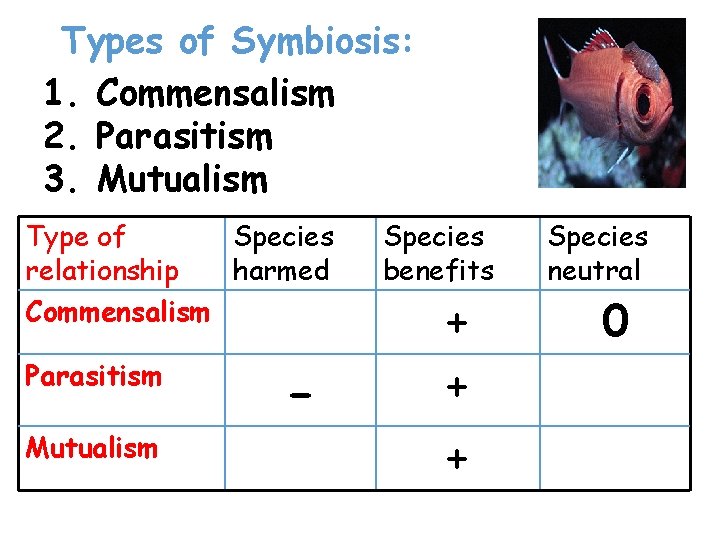
Types of Symbiosis: 1. Commensalism 2. Parasitism 3. Mutualism Type of Species relationship harmed Commensalism Parasitism Mutualism - Species benefits + + + Species neutral 0
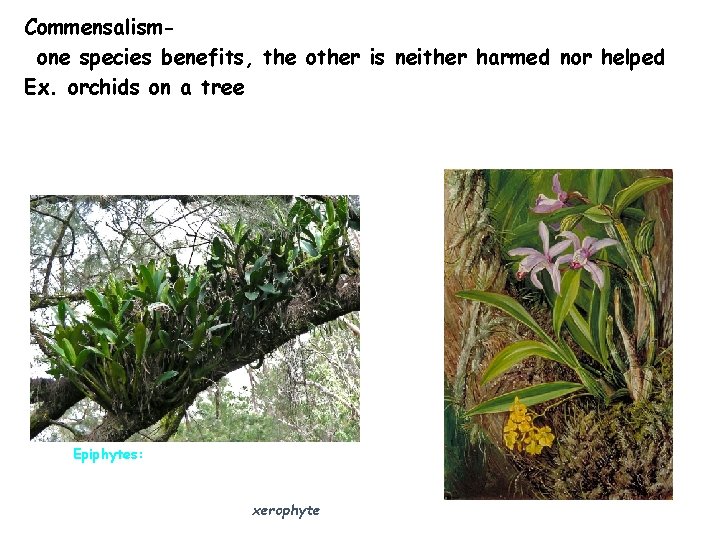
Commensalismone species benefits, the other is neither harmed nor helped Ex. orchids on a tree Epiphytes: A plant, such as a tropical orchid or a bromeliad, that grows on another plant upon which it depends for mechanical support but not for nutrients. Also called xerophyte, air plant.
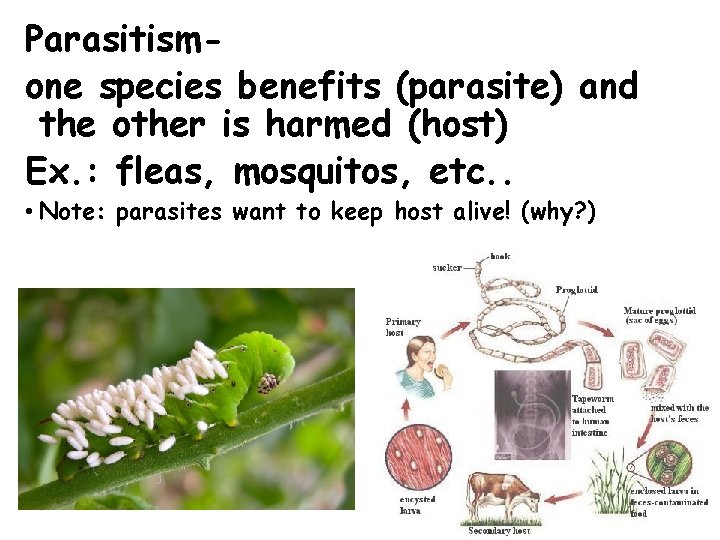
Parasitismone species benefits (parasite) and the other is harmed (host) Ex. : fleas, mosquitos, etc. . • Note: parasites want to keep host alive! (why? )
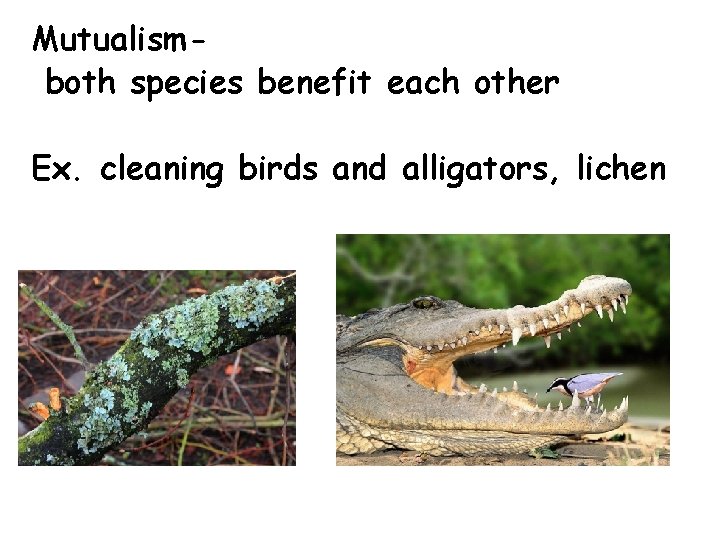
Mutualismboth species benefit each other Ex. cleaning birds and alligators, lichen
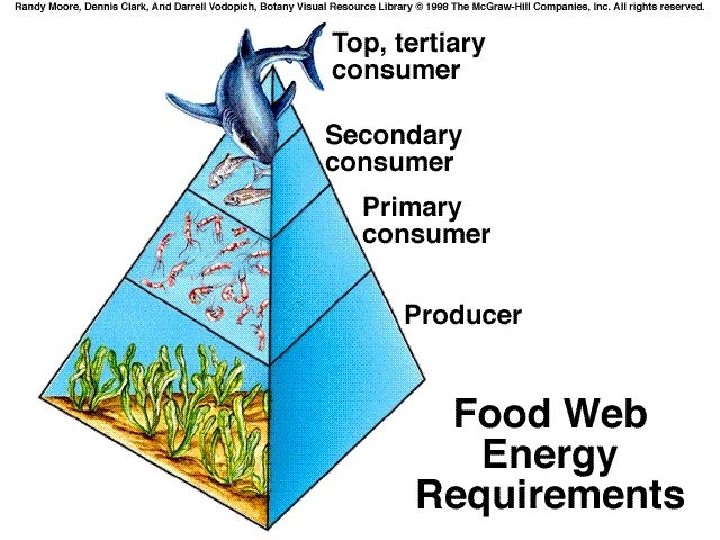
The food web: trophic levels • Producer = autotrophs - Make own food • Consumer = heterotrophs - Consume food -Can be: • primary -> herbivores (eat plants) • secondary, tertiary -> carnivores (eat meat) or omnivores (eat meat and plants) Always bottom of food chain • Trophic Level: Each link in a food chain; A feeding step in transfer of energy in ecosystem.
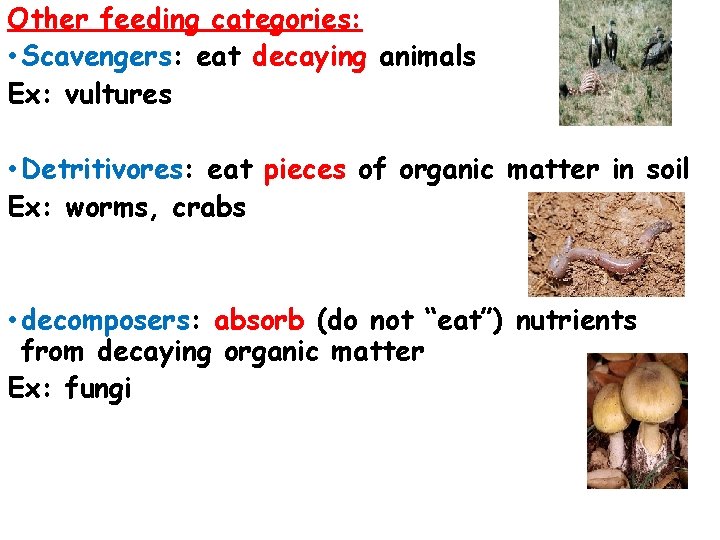
Other feeding categories: • Scavengers: eat decaying animals Ex: vultures • Detritivores: eat pieces of organic matter in soil Ex: worms, crabs • decomposers: absorb (do not “eat”) nutrients from decaying organic matter Ex: fungi
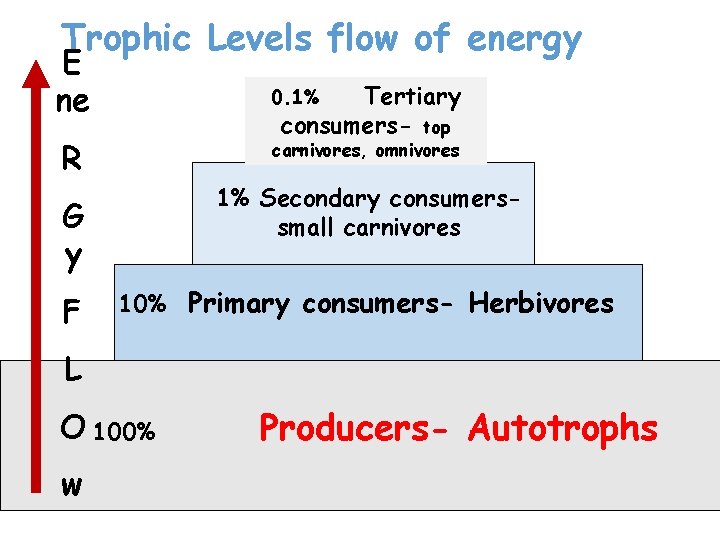
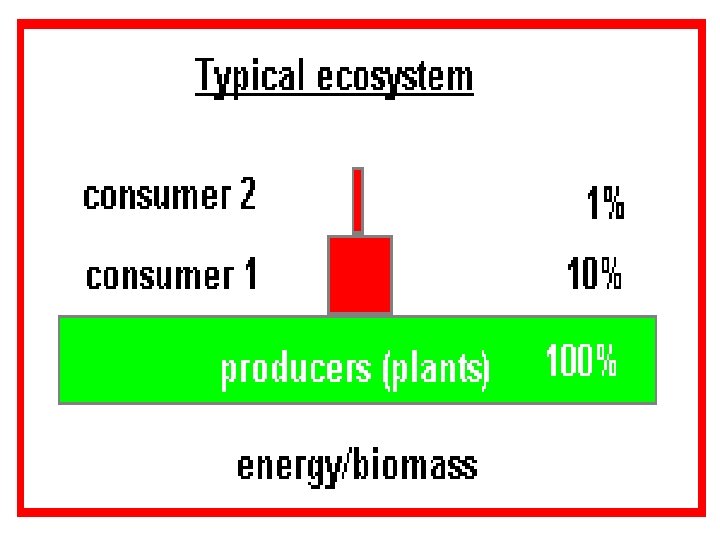
Trophic Levels flow of energy E ne Tertiary consumers- top 0. 1% R carnivores, omnivores G y 1% Secondary consumerssmall carnivores F 10% Primary consumers- Herbivores L O 100% w Producers- Autotrophs
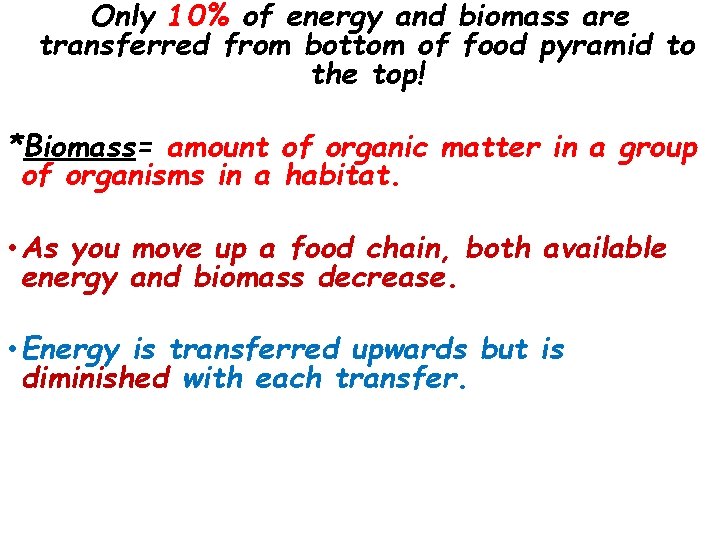
Only 10% of energy and biomass are transferred from bottom of food pyramid to the top! *Biomass= amount of organic matter in a group of organisms in a habitat. • As you move up a food chain, both available energy and biomass decrease. • Energy is transferred upwards but is diminished with each transfer.
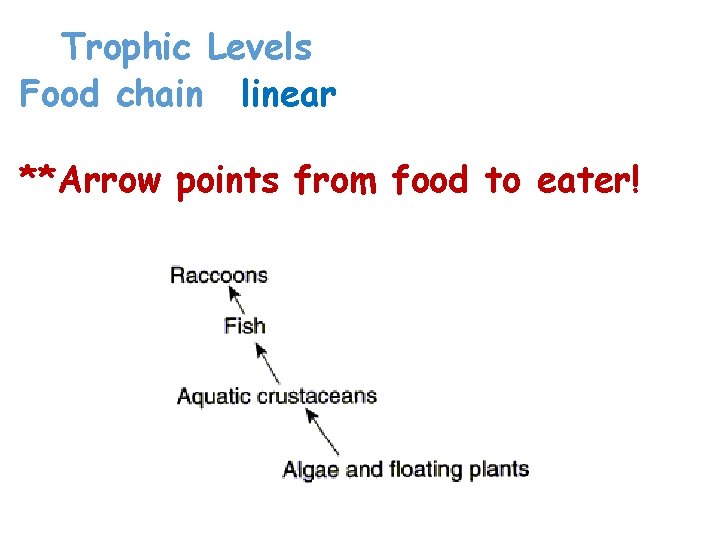
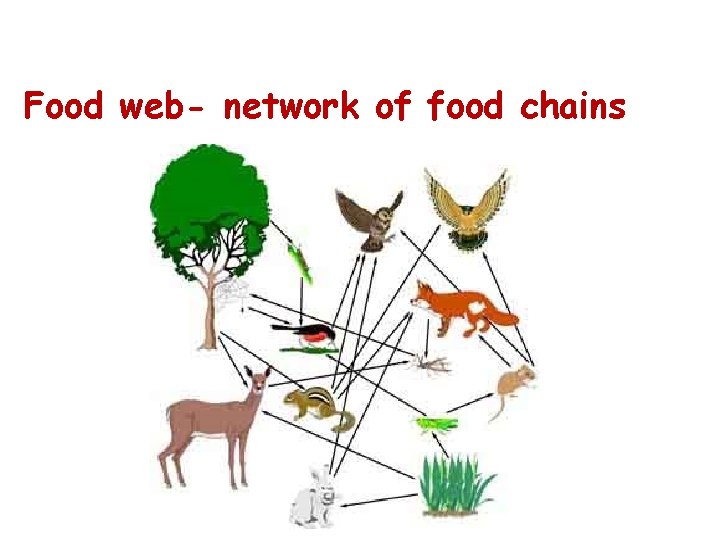
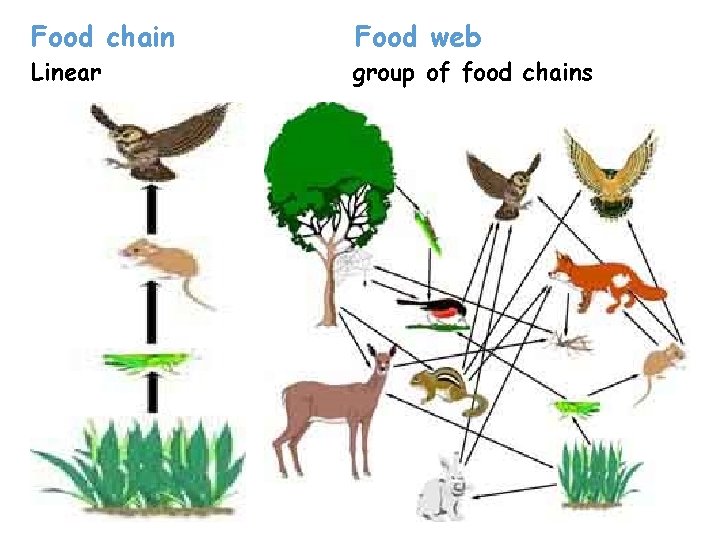
Trophic Levels Food chain- linear model of energy flow **Arrow points from food to eater!
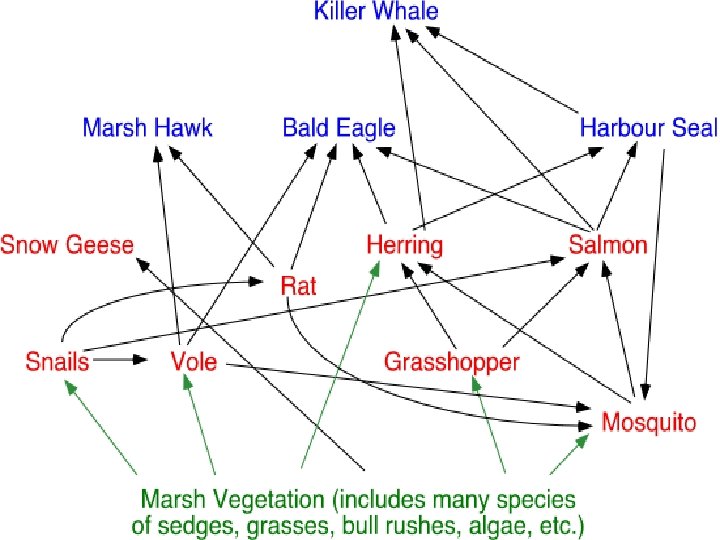
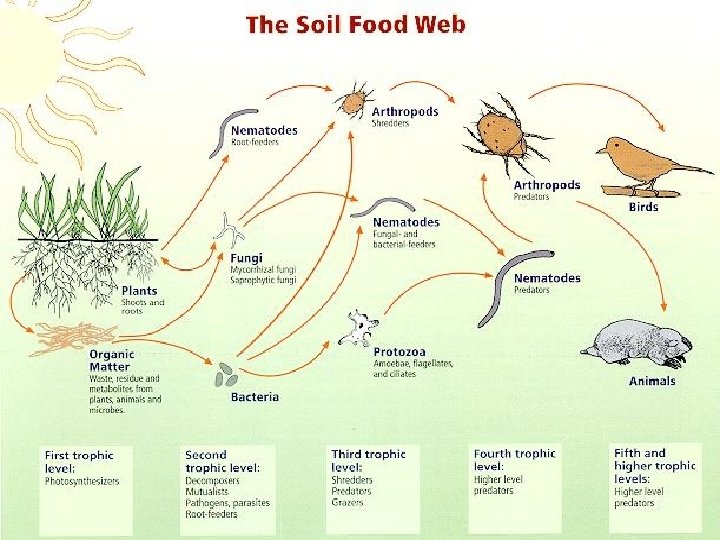
Food web- network of food chains
Food chain Linear Food web group of food chains
Nutrient Cycles -Cycles of Matter through biotic and abiotic factors: 1. Water cycle 2. Carbon cycle 3. Nitrogen cycle
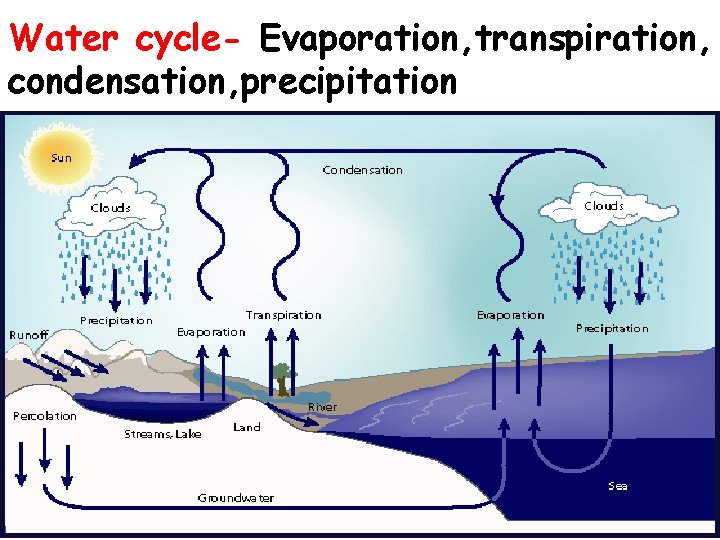
Water cycle- Evaporation, transpiration, condensation, precipitation
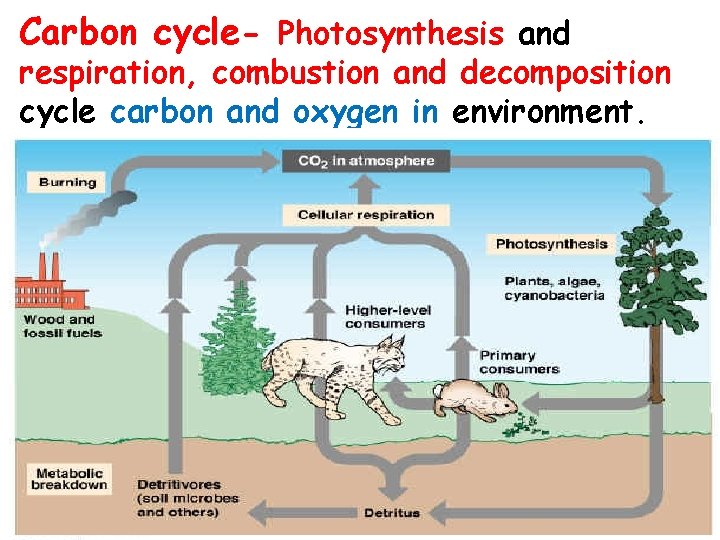
Carbon cycle- Photosynthesis and respiration, combustion and decomposition cycle carbon and oxygen in environment.
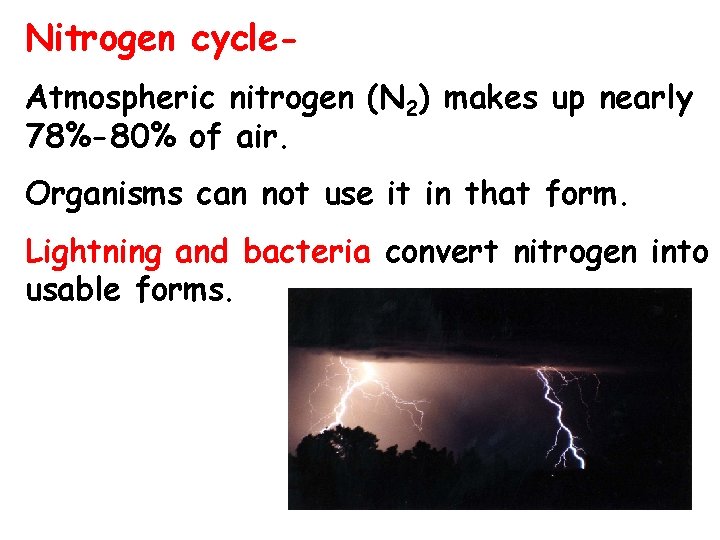
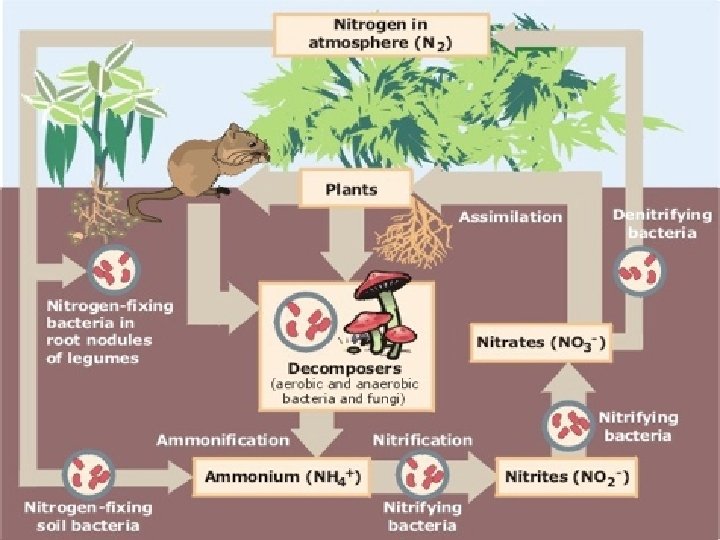
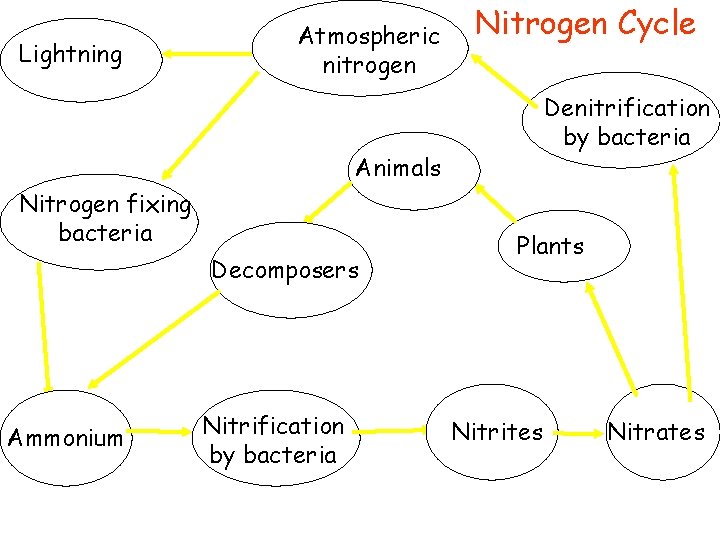
Nitrogen cycle. Atmospheric nitrogen (N 2) makes up nearly 78%-80% of air. Organisms can not use it in that form. Lightning and bacteria convert nitrogen into usable forms.
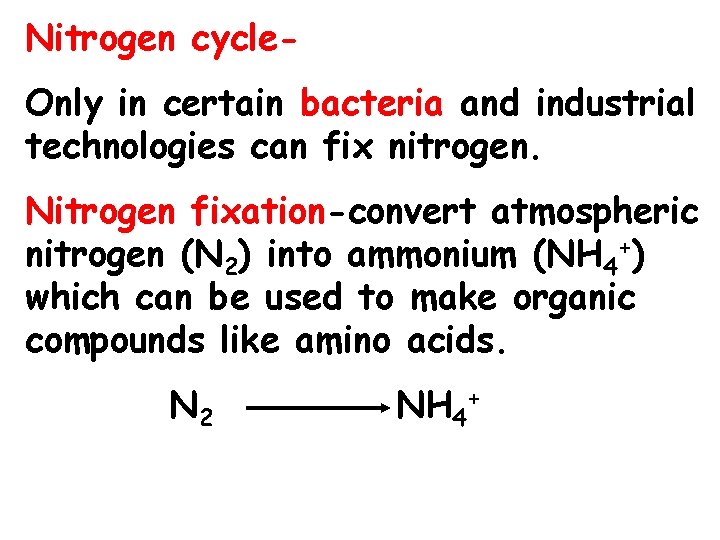
Nitrogen cycle. Only in certain bacteria and industrial technologies can fix nitrogen. Nitrogen fixation-convert atmospheric nitrogen (N 2) into ammonium (NH 4+) which can be used to make organic compounds like amino acids. N 2 NH 4+
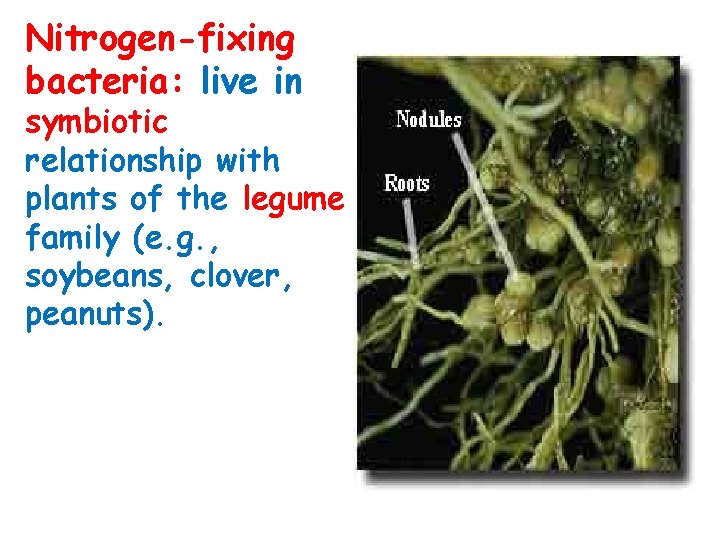
Nitrogen-fixing bacteria: live in symbiotic relationship with plants of the legume family (e. g. , soybeans, clover, peanuts).
Nitrogen cycle- • Some nitrogen-fixing bacteria live free in the soil. • Nitrogen-fixing cyanobacteria are essential to maintaining the fertility of semi-aquatic environments like rice paddies.
Lightning Atmospheric nitrogen Nitrogen Cycle Denitrification by bacteria Animals Nitrogen fixing bacteria Decomposers Ammonium Nitrification by bacteria Plants Nitrites Nitrates
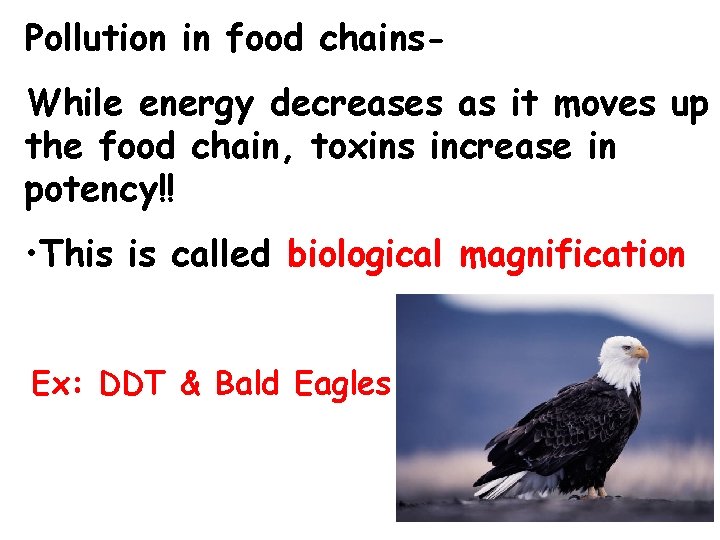
Pollution in food chains. While energy decreases as it moves up the food chain, toxins increase in potency!! • This is called biological magnification Ex: DDT & Bald Eagles
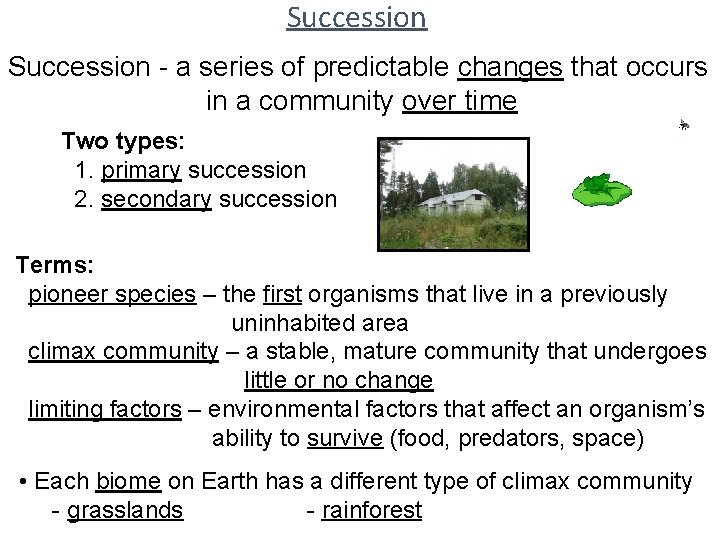
Succession - a series of predictable changes that occurs in a community over time Two types: 1. primary succession 2. secondary succession Terms: pioneer species – the first organisms that live in a previously uninhabited area climax community – a stable, mature community that undergoes little or no change limiting factors – environmental factors that affect an organism’s ability to survive (food, predators, space) • Each biome on Earth has a different type of climax community - grasslands - rainforest
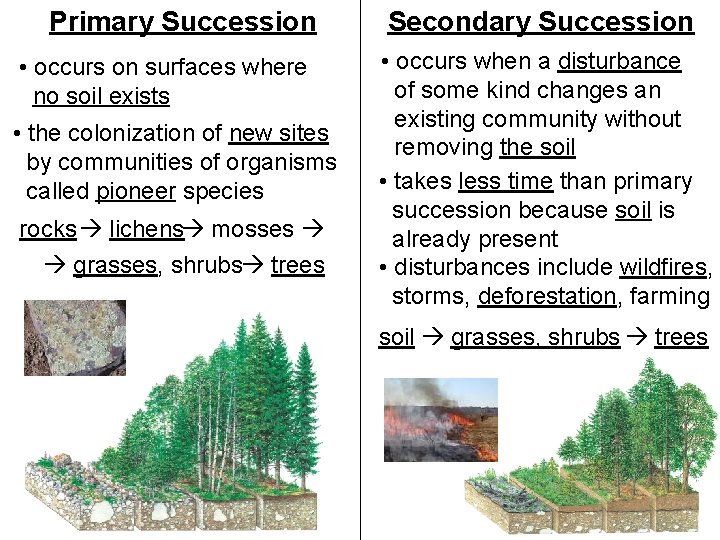
Primary Succession • occurs on surfaces where no soil exists • the colonization of new sites by communities of organisms called pioneer species rocks lichens mosses grasses, shrubs trees Secondary Succession • occurs when a disturbance of some kind changes an existing community without removing the soil • takes less time than primary succession because soil is already present • disturbances include wildfires, storms, deforestation, farming soil grasses, shrubs trees
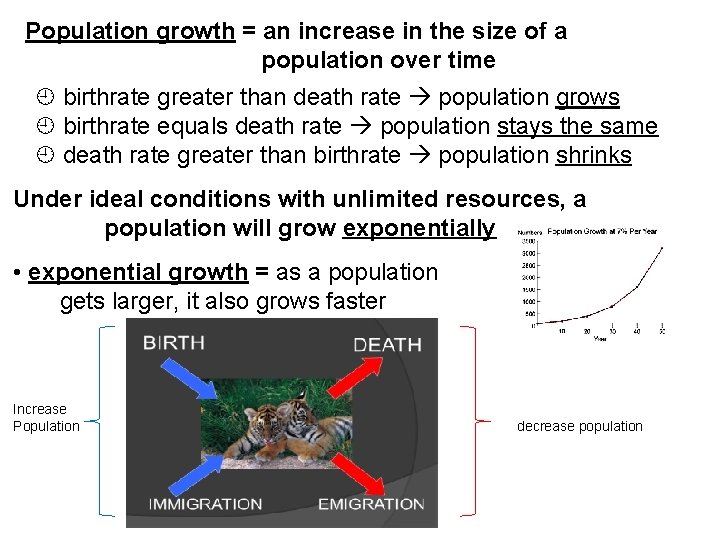
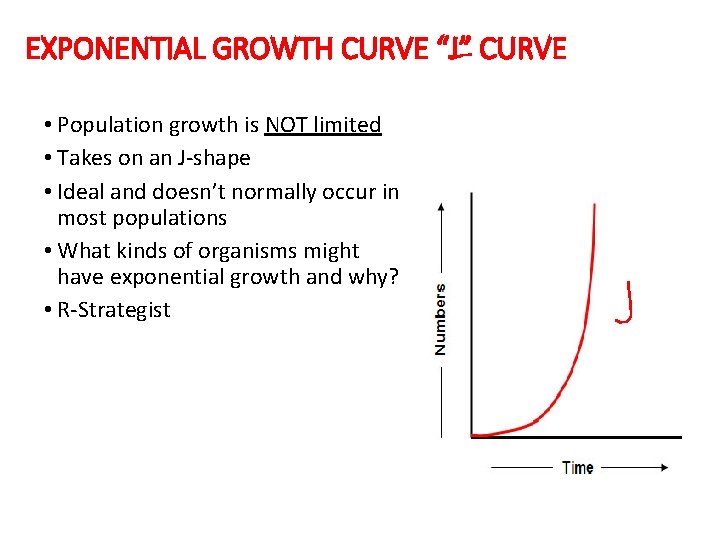
Population growth = an increase in the size of a population over time birthrate greater than death rate population grows birthrate equals death rate population stays the same death rate greater than birthrate population shrinks Under ideal conditions with unlimited resources, a population will grow exponentially • exponential growth = as a population gets larger, it also grows faster Increase Population decrease population
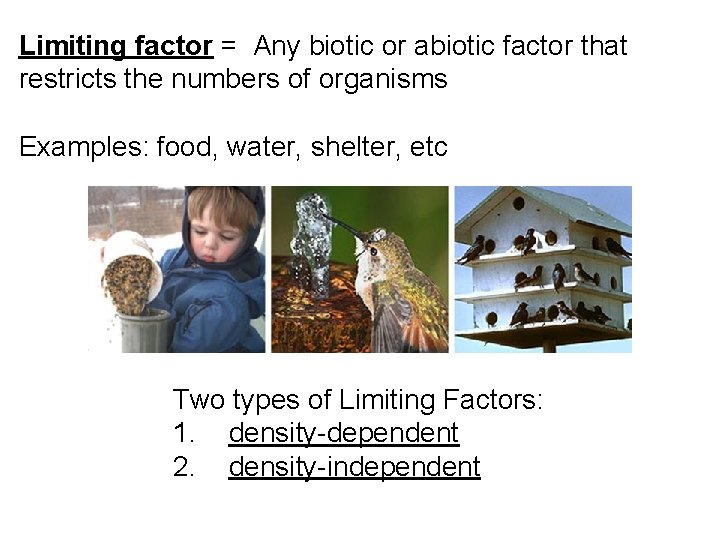
Limiting factor = Any biotic or abiotic factor that restricts the numbers of organisms Examples: food, water, shelter, etc Two types of Limiting Factors: 1. density-dependent 2. density-independent
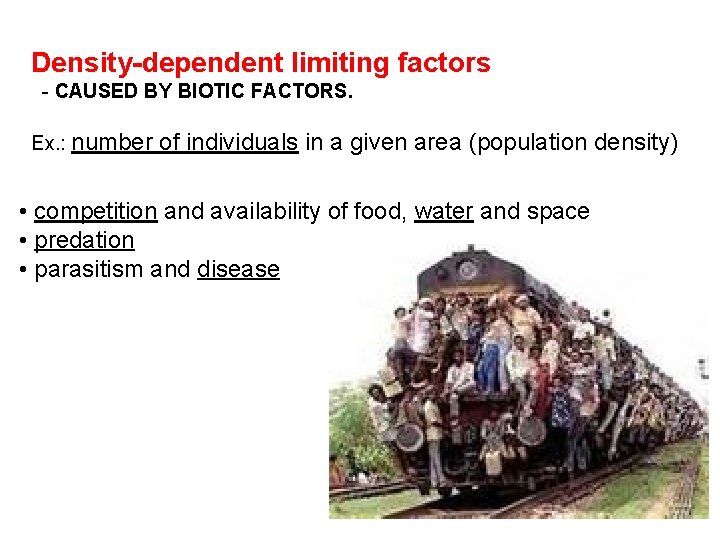
Density-dependent limiting factors - CAUSED BY BIOTIC FACTORS. Ex. : number of individuals in a given area (population density) • competition and availability of food, water and space • predation • parasitism and disease
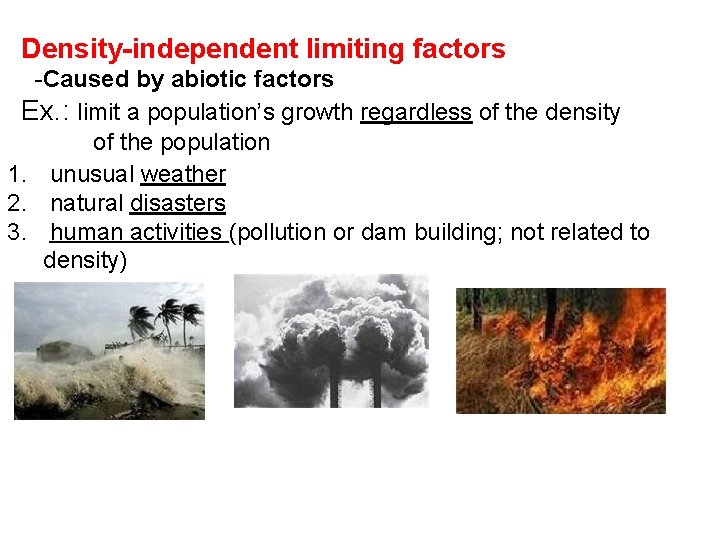
Density-independent limiting factors -Caused by abiotic factors Ex. : limit a population’s growth regardless of the density of the population 1. unusual weather 2. natural disasters 3. human activities (pollution or dam building; not related to density)
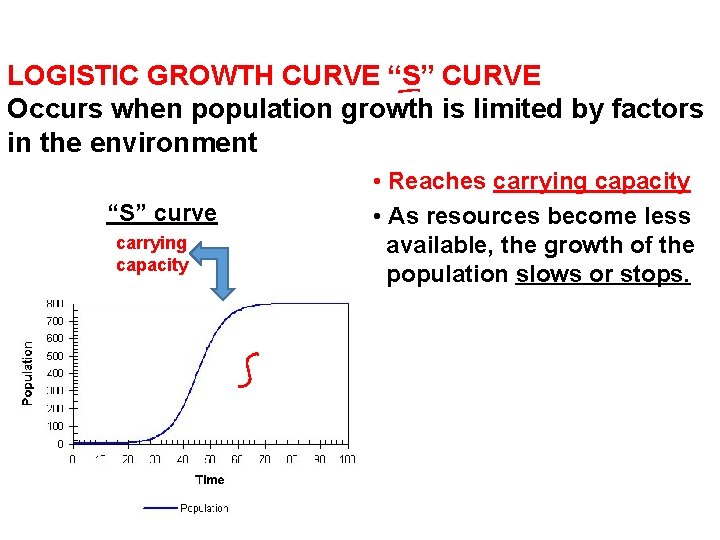
CARRYING CAPACITY • The maximum number of individuals that can be supported by the ecosystem. • The limit is determined by the availability of resources and by their interactions with other organisms.
LOGISTIC GROWTH CURVE “S” CURVE Occurs when population growth is limited by factors in the environment “S” curve carrying capacity • Reaches carrying capacity • As resources become less available, the growth of the population slows or stops.
EXPONENTIAL GROWTH CURVE “J” CURVE • Population growth is NOT limited • Takes on an J-shape • Ideal and doesn’t normally occur in most populations • What kinds of organisms might have exponential growth and why? • R-Strategist
P. 98 REPRODUCTIVE PATTERNS • Species of organisms vary in the number of births per reproductive cycle, in the age that reproduction begins, and in the life span of the organism. • R-strategist • K-strategist
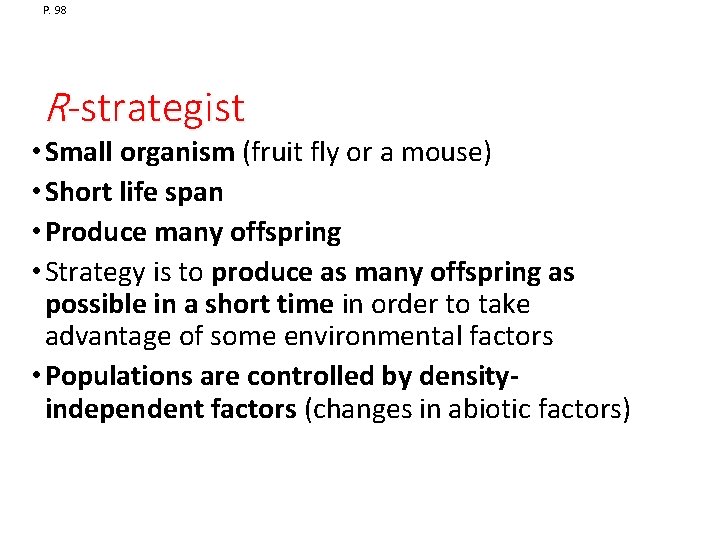
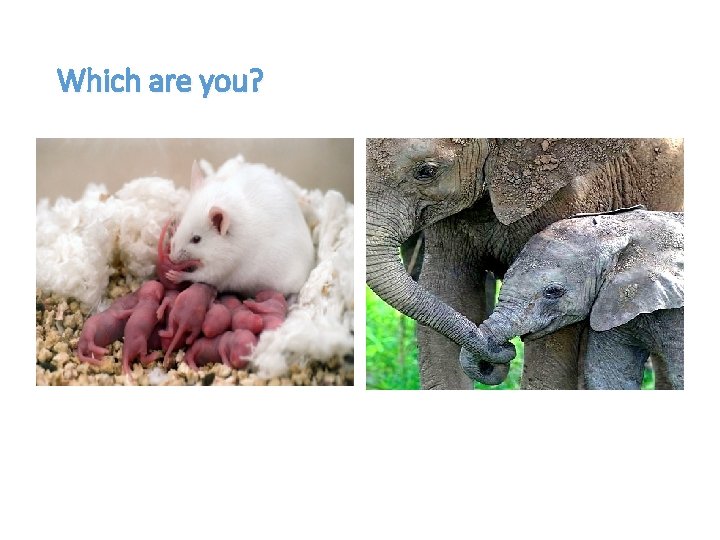
P. 98 R-strategist • Small organism (fruit fly or a mouse) • Short life span • Produce many offspring • Strategy is to produce as many offspring as possible in a short time in order to take advantage of some environmental factors • Populations are controlled by densityindependent factors (changes in abiotic factors)
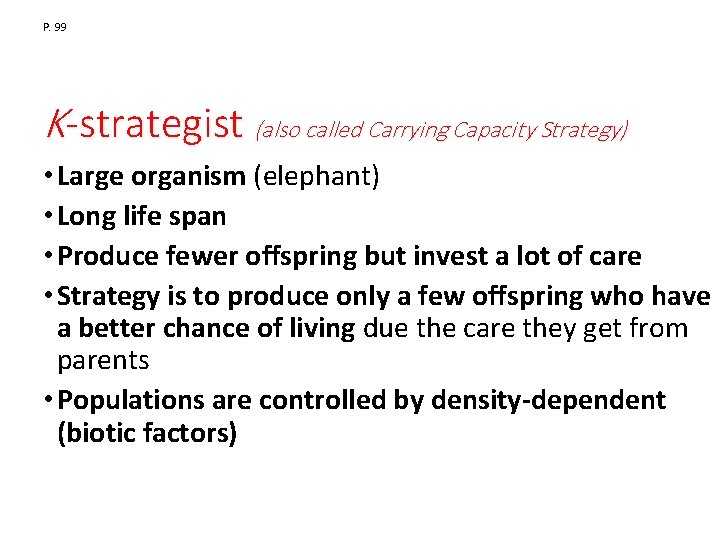
P. 99 K-strategist (also called Carrying Capacity Strategy) • Large organism (elephant) • Long life span • Produce fewer offspring but invest a lot of care • Strategy is to produce only a few offspring who have a better chance of living due the care they get from parents • Populations are controlled by density-dependent (biotic factors)
Which are you? R-strategist K-strategist
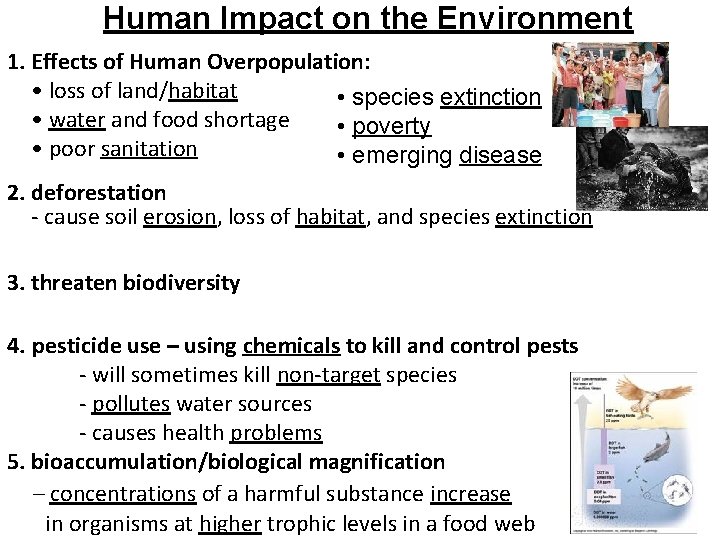
Human Impact on the Environment 1. Effects of Human Overpopulation: • loss of land/habitat • species extinction • water and food shortage • poverty • poor sanitation • emerging disease 2. deforestation - cause soil erosion, loss of habitat, and species extinction 3. threaten biodiversity 4. pesticide use – using chemicals to kill and control pests - will sometimes kill non-target species - pollutes water sources - causes health problems 5. bioaccumulation/biological magnification – concentrations of a harmful substance increase in organisms at higher trophic levels in a food web
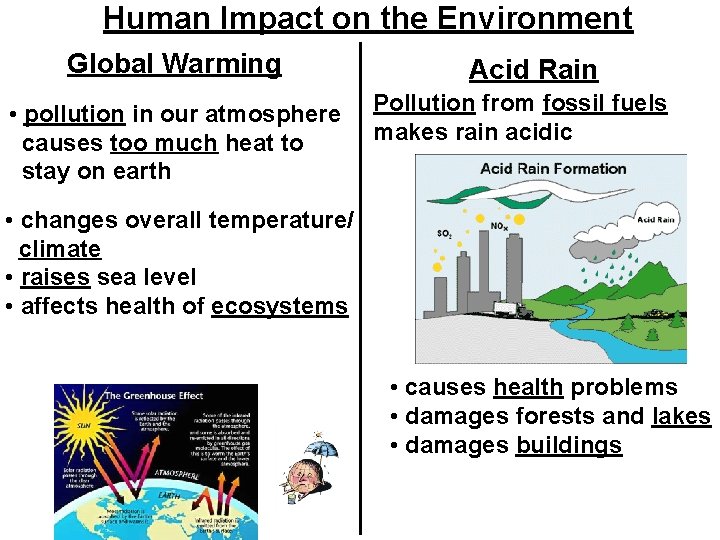
Human Impact on the Environment Global Warming • pollution in our atmosphere causes too much heat to stay on earth Acid Rain Pollution from fossil fuels makes rain acidic • changes overall temperature/ climate • raises sea level • affects health of ecosystems • causes health problems • damages forests and lakes • damages buildings
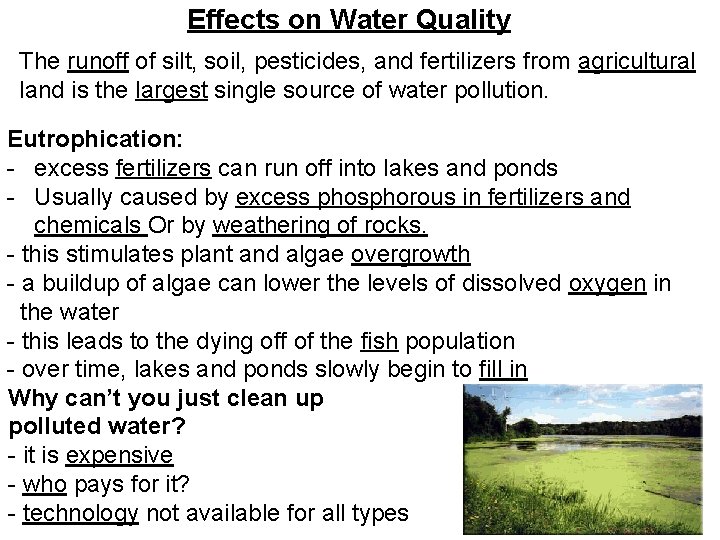
Effects on Water Quality The runoff of silt, soil, pesticides, and fertilizers from agricultural land is the largest single source of water pollution. Eutrophication: - excess fertilizers can run off into lakes and ponds - Usually caused by excess phosphorous in fertilizers and chemicals Or by weathering of rocks. - this stimulates plant and algae overgrowth - a buildup of algae can lower the levels of dissolved oxygen in the water - this leads to the dying off of the fish population - over time, lakes and ponds slowly begin to fill in Why can’t you just clean up polluted water? - it is expensive - who pays for it? - technology not available for all types
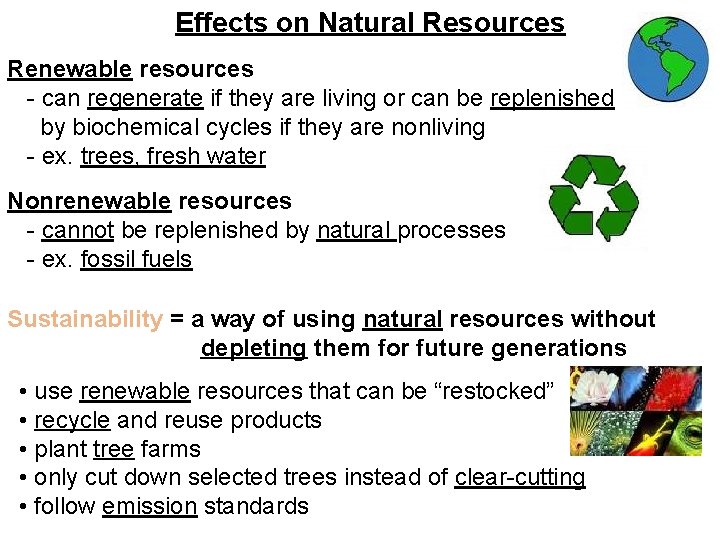
Effects on Natural Resources Renewable resources - can regenerate if they are living or can be replenished by biochemical cycles if they are nonliving - ex. trees, fresh water Nonrenewable resources - cannot be replenished by natural processes - ex. fossil fuels Sustainability = a way of using natural resources without depleting them for future generations • use renewable resources that can be “restocked” • recycle and reuse products • plant tree farms • only cut down selected trees instead of clear-cutting • follow emission standards
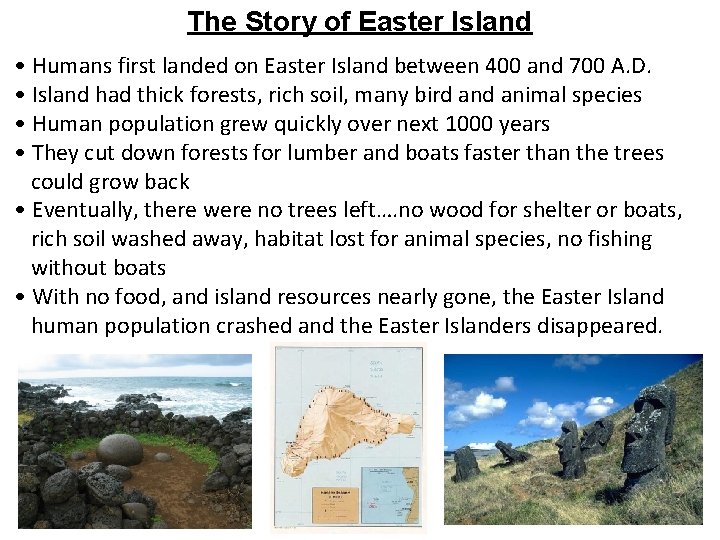
The Story of Easter Island • Humans first landed on Easter Island between 400 and 700 A. D. • Island had thick forests, rich soil, many bird animal species • Human population grew quickly over next 1000 years • They cut down forests for lumber and boats faster than the trees could grow back • Eventually, there were no trees left…. no wood for shelter or boats, rich soil washed away, habitat lost for animal species, no fishing without boats • With no food, and island resources nearly gone, the Easter Island human population crashed and the Easter Islanders disappeared.