
Logistics Planning implementing and controlling the efficient effective






- Slides: 24
Logistics Planning, implementing, and controlling the efficient, effective flow and storage of goods and materials between the point of origin and the point of consumption
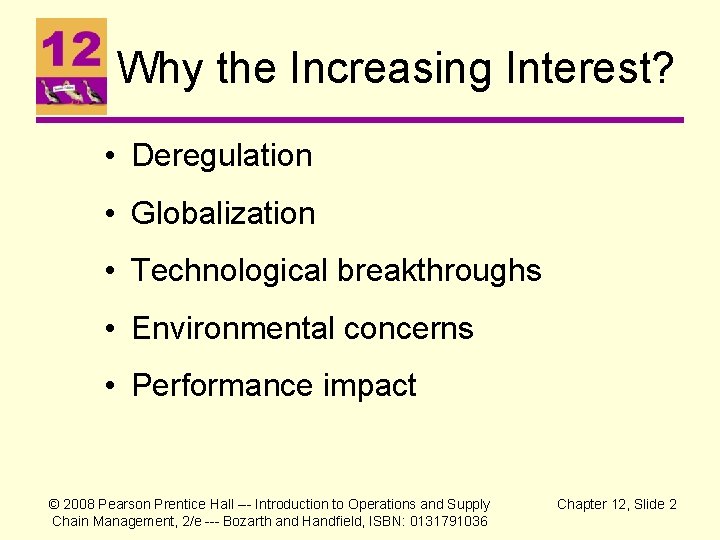
Why the Increasing Interest? • Deregulation • Globalization • Technological breakthroughs • Environmental concerns • Performance impact © 2008 Pearson Prentice Hall --- Introduction to Operations and Supply Chain Management, 2/e --- Bozarth and Handfield, ISBN: 0131791036 Chapter 12, Slide 2
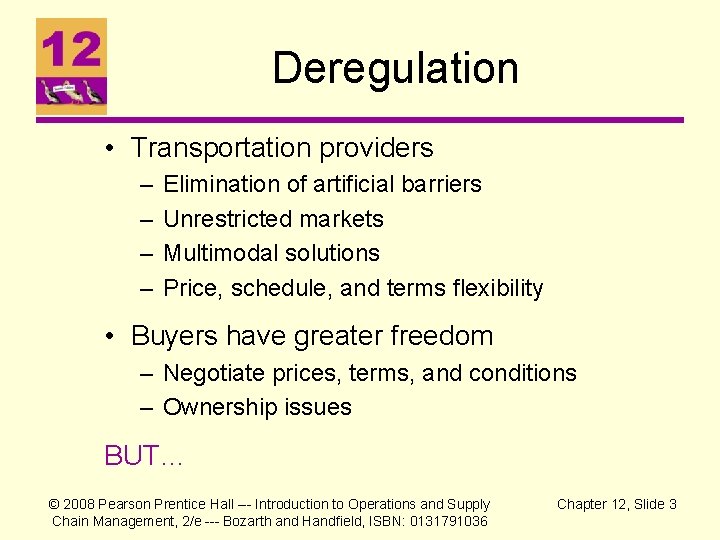
Deregulation • Transportation providers – – Elimination of artificial barriers Unrestricted markets Multimodal solutions Price, schedule, and terms flexibility • Buyers have greater freedom – Negotiate prices, terms, and conditions – Ownership issues BUT… © 2008 Pearson Prentice Hall --- Introduction to Operations and Supply Chain Management, 2/e --- Bozarth and Handfield, ISBN: 0131791036 Chapter 12, Slide 3
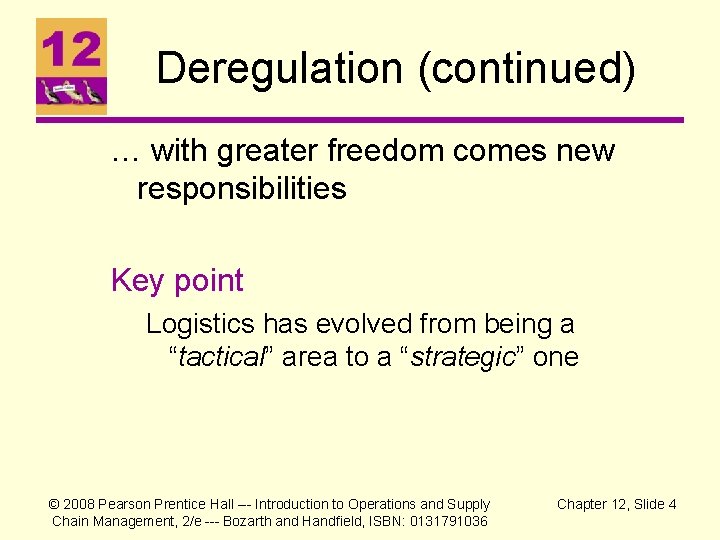
Deregulation (continued) … with greater freedom comes new responsibilities Key point Logistics has evolved from being a “tactical” area to a “strategic” one © 2008 Pearson Prentice Hall --- Introduction to Operations and Supply Chain Management, 2/e --- Bozarth and Handfield, ISBN: 0131791036 Chapter 12, Slide 4
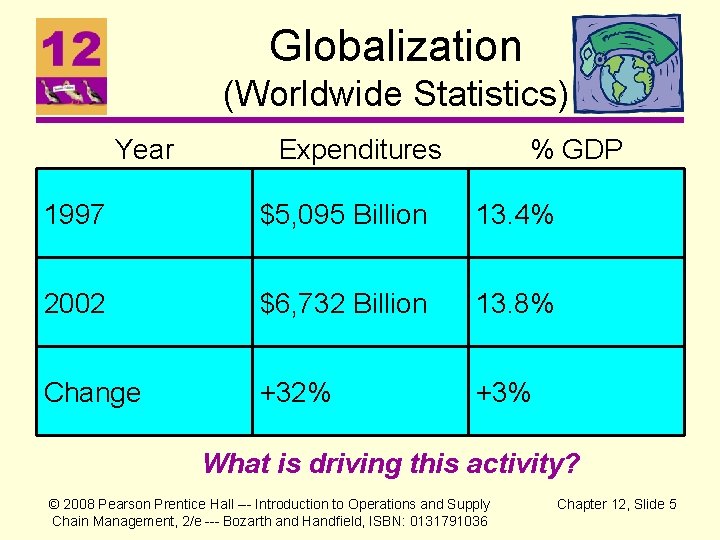
Globalization (Worldwide Statistics) Year Expenditures % GDP 1997 $5, 095 Billion 13. 4% 2002 $6, 732 Billion 13. 8% Change +32% +3% What is driving this activity? © 2008 Pearson Prentice Hall --- Introduction to Operations and Supply Chain Management, 2/e --- Bozarth and Handfield, ISBN: 0131791036 Chapter 12, Slide 5
Environmental Concerns Even while certain aspects of logistics have been deregulated, other areas are being controlled more stringently ØFuel efficiency ØPollution ØRecovery, recycling, and reuse of packaging, containers, and products © 2008 Pearson Prentice Hall --- Introduction to Operations and Supply Chain Management, 2/e --- Bozarth and Handfield, ISBN: 0131791036 Chapter 12, Slide 6
Management Areas Ø Transportation Ø Warehousing (and more generally, location) Ø Material handling Ø Packaging Ø Inventory management Ø Logistics information systems Ø 3 PLs, Third-Party Logistics Providers © 2008 Pearson Prentice Hall --- Introduction to Operations and Supply Chain Management, 2/e --- Bozarth and Handfield, ISBN: 0131791036 Chapter 12, Slide 7
Logistics Decision Areas Transportation… – Modes – Formats – Pricing Warehousing – Consolidation – Cross-Docking and Break-Bulk – Hub-and-Spoke – Inventory © 2008 Pearson Prentice Hall --- Introduction to Operations and Supply Chain Management, 2/e --- Bozarth and Handfield, ISBN: 0131791036 Chapter 12, Slide 8
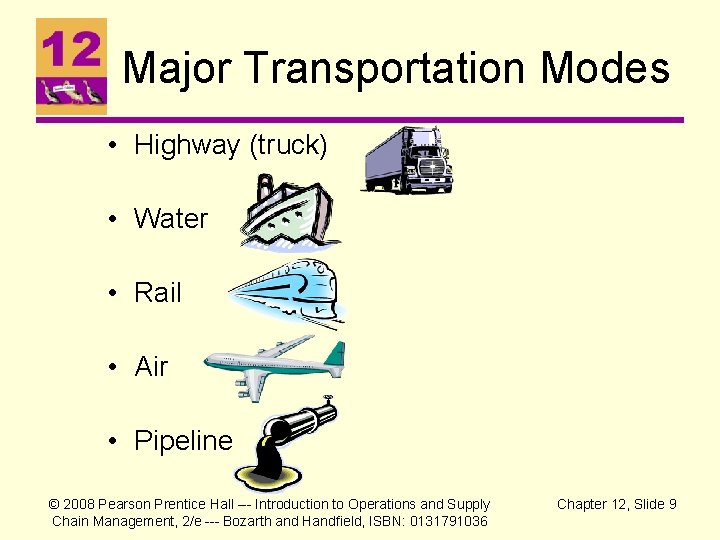
Major Transportation Modes • Highway (truck) • Water • Rail • Air • Pipeline © 2008 Pearson Prentice Hall --- Introduction to Operations and Supply Chain Management, 2/e --- Bozarth and Handfield, ISBN: 0131791036 Chapter 12, Slide 9
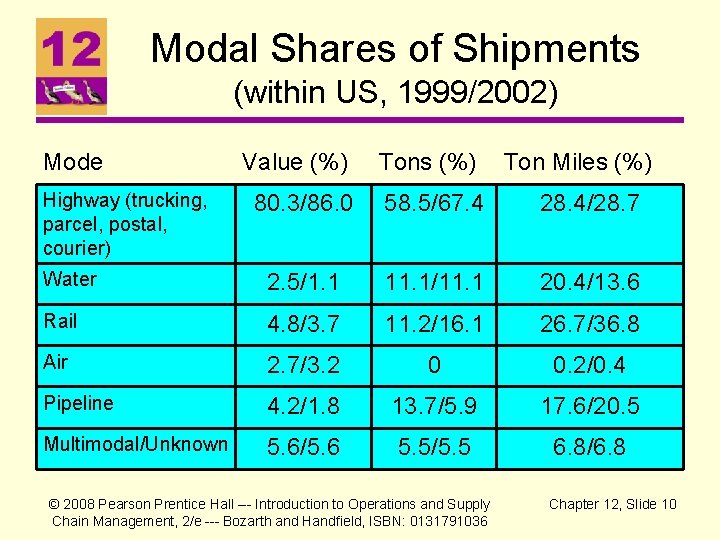
Modal Shares of Shipments (within US, 1999/2002) Mode Highway (trucking, parcel, postal, courier) Value (%) Tons (%) Ton Miles (%) 80. 3/86. 0 58. 5/67. 4 28. 4/28. 7 Water 2. 5/1. 1 11. 1/11. 1 20. 4/13. 6 Rail 4. 8/3. 7 11. 2/16. 1 26. 7/36. 8 Air 2. 7/3. 2 0 0. 2/0. 4 Pipeline 4. 2/1. 8 13. 7/5. 9 17. 6/20. 5 Multimodal/Unknown 5. 6/5. 6 5. 5/5. 5 6. 8/6. 8 © 2008 Pearson Prentice Hall --- Introduction to Operations and Supply Chain Management, 2/e --- Bozarth and Handfield, ISBN: 0131791036 Chapter 12, Slide 10
Highway Mode Strengths Weaknesses • Flexibility to pick up • Not the fastest and deliver where and • Not the cheapest when needed • Often the best balance between cost/flexibility and delivery reliability/speed • Can deliver straight to the customer © 2008 Pearson Prentice Hall --- Introduction to Operations and Supply Chapter 12, Slide 11 (increasing) Chain Management, 2/e --- Bozarth and Handfield, ISBN: 0131791036
Water Mode Strengths Weaknesses • Highly cost effective for bulky items • Works best for high weight-to-value items • Most effective when linked into multimodal system • Limited locations • Relatively poor delivery reliability/speed • Often limited operating hours at docks © 2008 Pearson Prentice Hall --- Introduction to Operations and Supply Chain Management, 2/e --- Bozarth and Handfield, ISBN: 0131791036 Chapter 12, Slide 12
Air Mode Strengths Weaknesses • Quickest delivery over • Often the most longer distances expensive, particularly on a per pound basis • Can be very flexible when linked to highway mode • Works best for low weight-to-value items Grew 90. 5% in value of goods shipped from 1993 to 2002 © 2008 Pearson Prentice Hall --- Introduction to Operations and Supply Chain Management, 2/e --- Bozarth and Handfield, ISBN: 0131791036 Chapter 12, Slide 13
Rail Mode Strengths Weaknesses • Highly cost effective for bulky items • Can be most effective when linked into multimodal system • Limited locations, but better than for water. • Better delivery reliability/speed than water Increasing part of intermodal solutions, dual tracks on major routes © 2008 Pearson Prentice Hall --- Introduction to Operations and Supply Chain Management, 2/e --- Bozarth and Handfield, ISBN: 0131791036 Chapter 12, Slide 14
Logistics Strategy Choices Performance Dimension Delivery Reliability Transportation Mode Warehousing System Direct Ship, Assortment, Spot Stock Highway, Air Delivery Speed Air, Highway Direct Ship, Assortment, Spot Stock Mix Flexibility Highway, Air, Rail Assortment, Spot Stock Design Flexibility Highway, Air Postponement Volume Flexibility Highway, Air Direct Ship, Assortment, Spot Stock Chapter 12, Slide 15 © 2008 Pearson Prentice Hall --- Introduction to Operations and Supply Chain Management, 2/e --- Bozarth and Handfield, ISBN: 0131791036 Cost Rail, Water, Pipeline, Consolidation, Cross
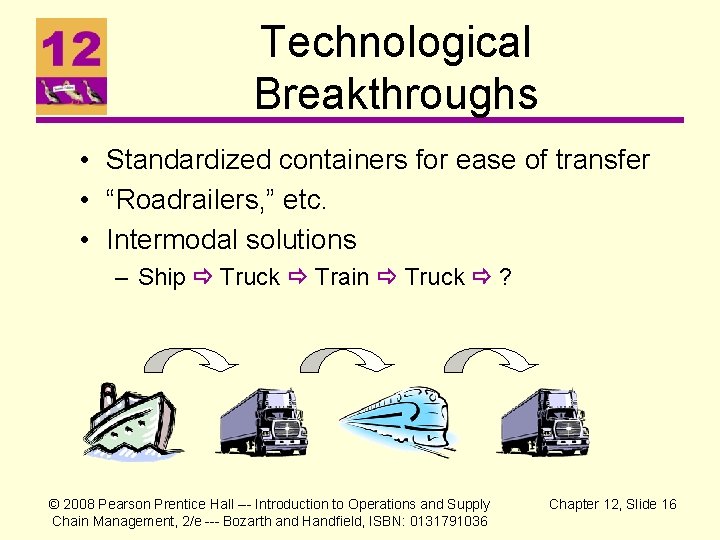
Technological Breakthroughs • Standardized containers for ease of transfer • “Roadrailers, ” etc. • Intermodal solutions – Ship Truck Train Truck ? © 2008 Pearson Prentice Hall --- Introduction to Operations and Supply Chain Management, 2/e --- Bozarth and Handfield, ISBN: 0131791036 Chapter 12, Slide 16
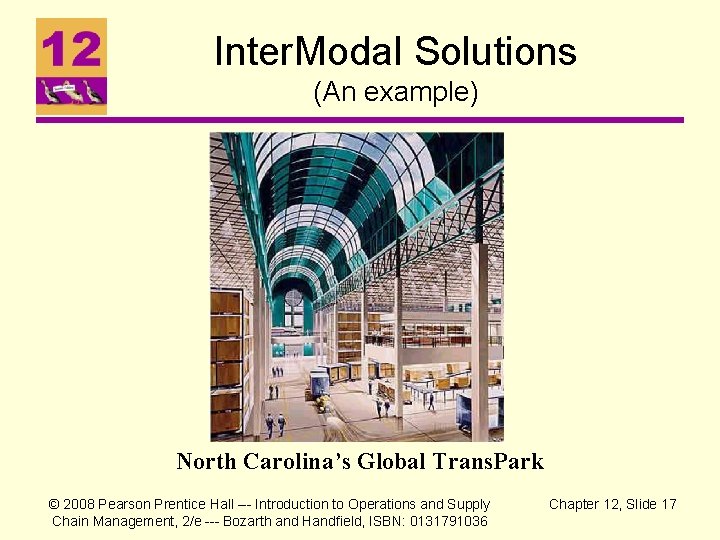
Inter. Modal Solutions (An example) North Carolina’s Global Trans. Park © 2008 Pearson Prentice Hall --- Introduction to Operations and Supply Chain Management, 2/e --- Bozarth and Handfield, ISBN: 0131791036 Chapter 12, Slide 17
Global Trans. Park • 15, 700 acres at full development with two parallel runways of 11, 500 feet and 13, 000 feet • Integrated air, rail, road, and nearby sea transportation capabilities • Free trade zone status © 2008 Pearson Prentice Hall --- Introduction to Operations and Supply Chain Management, 2/e --- Bozarth and Handfield, ISBN: 0131791036 Chapter 12, Slide 18
Justification for Such a Facility · Shift from domestic to global economies · Emergence of just-in-time, flexible and agile manufacturing practices requiring sophisticated logistics solutions · The rapid growth of distribution via air freighters (roughly four times the growth rate of passenger service by the airlines) · The need to use air cargo, shipment by sea, and delivery by trucks and trains in an overall distribution system · The need for a commercial distribution hub in the Eastern United States that can reach more than 6012, Slide 19 © 2008 Pearson Prentice Hall --Introduction to Operations and Supply Chapter Chain Management, 2/e --- Bozarth and Handfield, ISBN: 0131791036 percent of the nation’s population overnight and also
Warehousing Benefits Economic benefits: þAccrue directly to company þMust consider total system costs Service benefits: þSupport customer service needs þMay or may not reduce costs © 2008 Pearson Prentice Hall --- Introduction to Operations and Supply Chain Management, 2/e --- Bozarth and Handfield, ISBN: 0131791036 Chapter 12, Slide 20
Consolidation © 2008 Pearson Prentice Hall --- Introduction to Operations and Supply Chain Management, 2/e --- Bozarth and Handfield, ISBN: 0131791036 Chapter 12, Slide 21
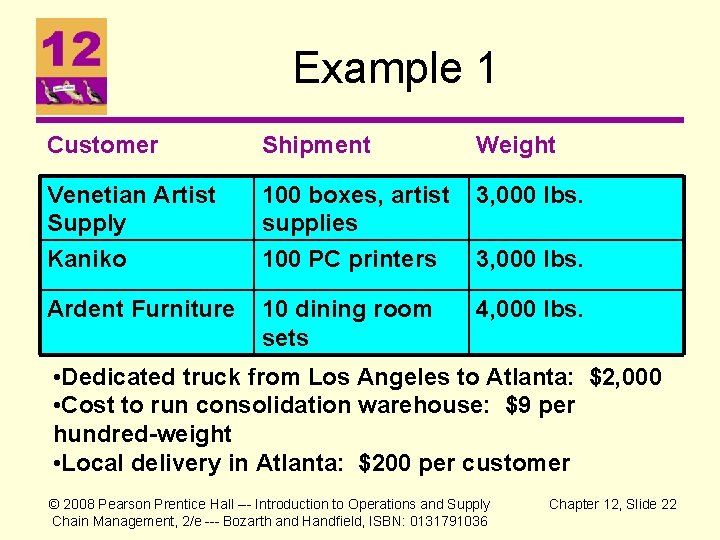
Example 1 Customer Shipment Weight Venetian Artist Supply Kaniko 100 boxes, artist supplies 100 PC printers 3, 000 lbs. Ardent Furniture 10 dining room sets 4, 000 lbs. 3, 000 lbs. • Dedicated truck from Los Angeles to Atlanta: $2, 000 • Cost to run consolidation warehouse: $9 per hundred-weight • Local delivery in Atlanta: $200 per customer © 2008 Pearson Prentice Hall --- Introduction to Operations and Supply Chain Management, 2/e --- Bozarth and Handfield, ISBN: 0131791036 Chapter 12, Slide 22
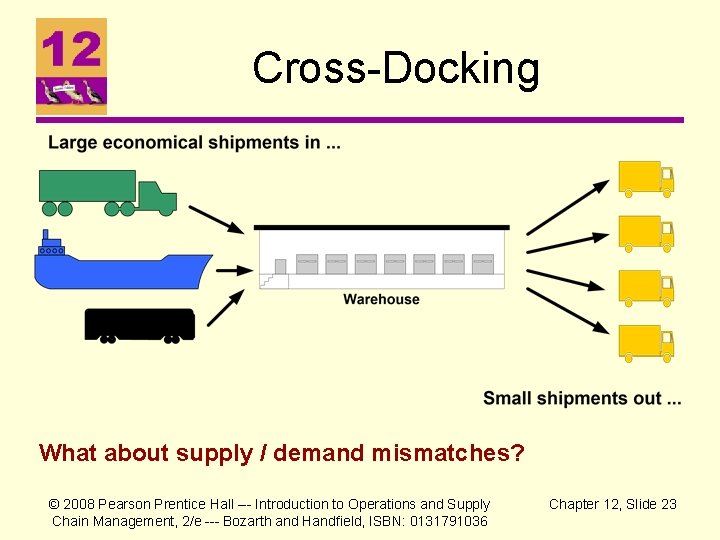
Cross-Docking What about supply / demand mismatches? © 2008 Pearson Prentice Hall --- Introduction to Operations and Supply Chain Management, 2/e --- Bozarth and Handfield, ISBN: 0131791036 Chapter 12, Slide 23
Break-Bulk Like cross-docking, but usually refers to a single source © 2008 Pearson Prentice Hall --- Introduction to Operations and Supply Chain Management, 2/e --- Bozarth and Handfield, ISBN: 0131791036 Chapter 12, Slide 24