
Logistic Regression Adapted from Tom Mitchells Machine Learning

- Slides: 9
Logistic Regression Adapted from: Tom Mitchell’s Machine Learning Book Evan Wei Xiang and Qiang Yang 1
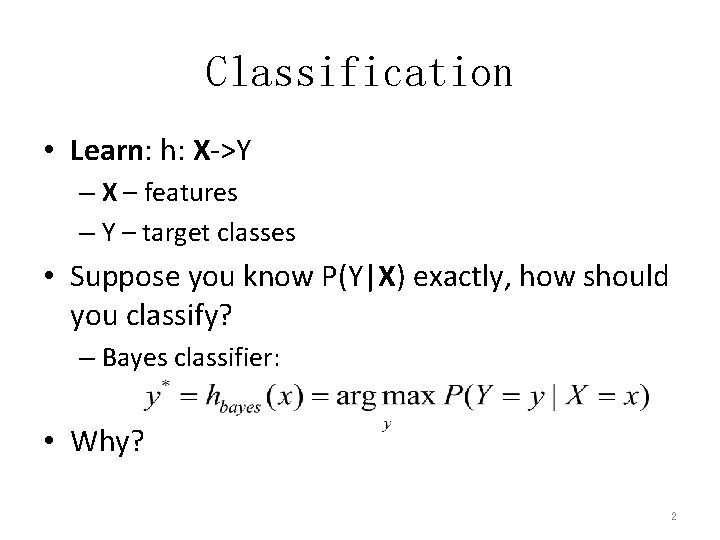
Classification • Learn: h: X->Y – X – features – Y – target classes • Suppose you know P(Y|X) exactly, how should you classify? – Bayes classifier: • Why? 2
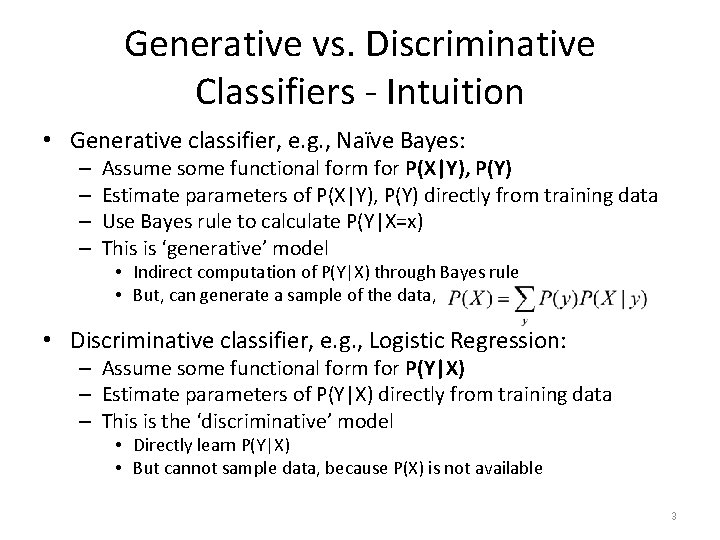
Generative vs. Discriminative Classifiers - Intuition • Generative classifier, e. g. , Naïve Bayes: – – Assume some functional form for P(X|Y), P(Y) Estimate parameters of P(X|Y), P(Y) directly from training data Use Bayes rule to calculate P(Y|X=x) This is ‘generative’ model • Indirect computation of P(Y|X) through Bayes rule • But, can generate a sample of the data, • Discriminative classifier, e. g. , Logistic Regression: – Assume some functional form for P(Y|X) – Estimate parameters of P(Y|X) directly from training data – This is the ‘discriminative’ model • Directly learn P(Y|X) • But cannot sample data, because P(X) is not available 3
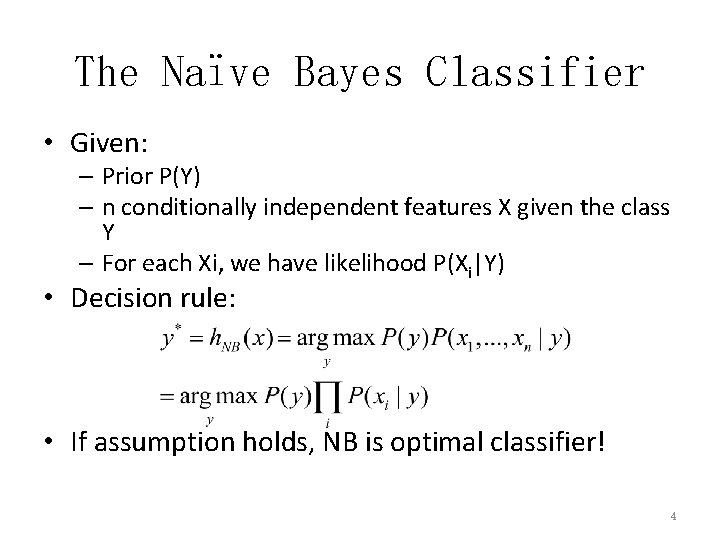
The Naïve Bayes Classifier • Given: – Prior P(Y) – n conditionally independent features X given the class Y – For each Xi, we have likelihood P(Xi|Y) • Decision rule: • If assumption holds, NB is optimal classifier! 4
Logistic Regression • Let X be the data instance, and Y be the class label: Learn P(Y|X) directly – Let W = (W 1, W 2, … Wn), X=(X 1, X 2, …, Xn), WX is the dot product – Sigmoid function: 5
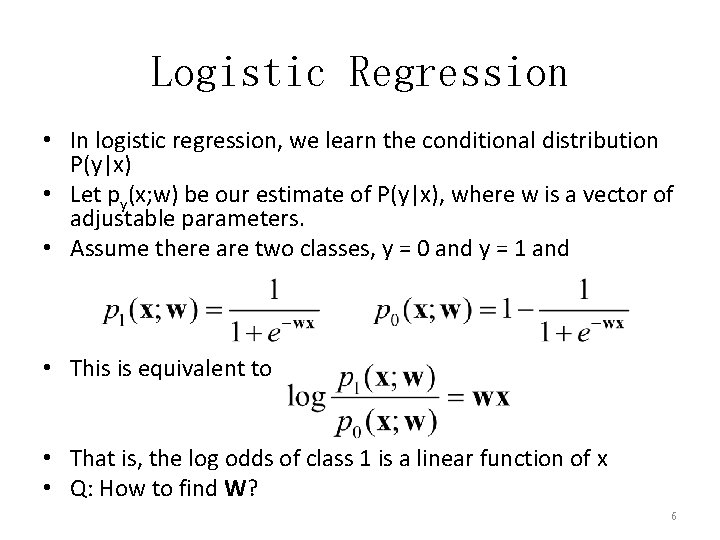
Logistic Regression • In logistic regression, we learn the conditional distribution P(y|x) • Let py(x; w) be our estimate of P(y|x), where w is a vector of adjustable parameters. • Assume there are two classes, y = 0 and y = 1 and • This is equivalent to • That is, the log odds of class 1 is a linear function of x • Q: How to find W? 6
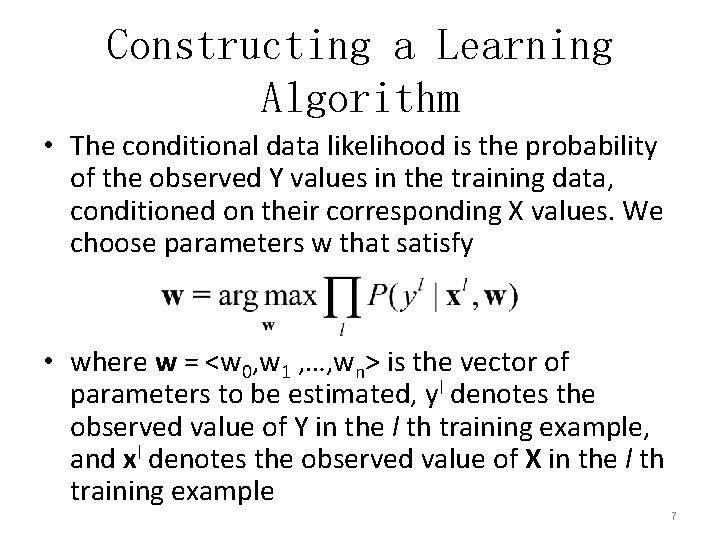
Constructing a Learning Algorithm • The conditional data likelihood is the probability of the observed Y values in the training data, conditioned on their corresponding X values. We choose parameters w that satisfy • where w = <w 0, w 1 , …, wn> is the vector of parameters to be estimated, yl denotes the observed value of Y in the l th training example, and xl denotes the observed value of X in the l th training example 7
Summary of Logistic Regression • Learns the Conditional Probability Distribution P(y|x) • Local Search. – Begins with initial weight vector. – Modifies it iteratively to maximize an objective function. – The objective function is the conditional log likelihood of the data – so the algorithm seeks the probability distribution P(y|x) that is most likely given the data. 8
What you should know LR • In general, NB and LR make different assumptions – NB: Features independent given class -> assumption on P(X|Y) – LR: Functional form of P(Y|X), no assumption on P(X|Y) • LR is a linear classifier – decision rule is a hyperplane • LR optimized by conditional likelihood – no closed-form solution – concave -> global optimum with gradient ascent 9