
Logistic Hub A common knowledgebase for tracking information
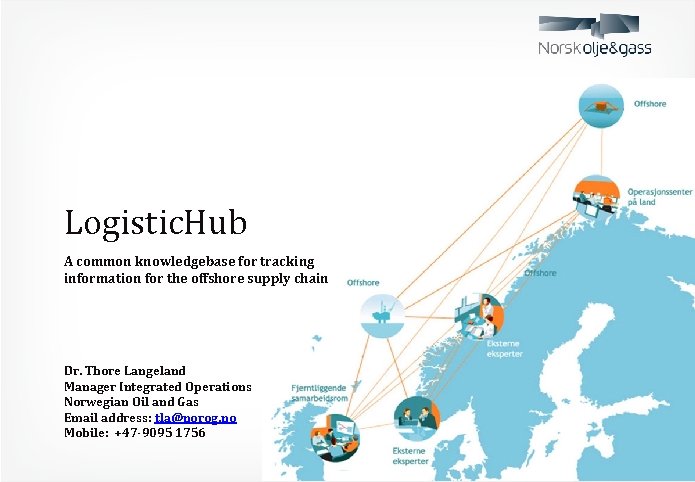
Logistic. Hub A common knowledgebase for tracking information for the offshore supply chain Dr. Thore Langeland Manager Integrated Operations Norwegian Oil and Gas Email address: tla@norog. no Mobile: +47 -9095 1756
Agenda 1. RFID in Norwegian Oil and Gas 2. Guideline No. 112 “Deployment of RFID in oil and gas industry” ü ü ü Overview - 9 parts Part 4 Unique identification number Part 2 Architecture and Integration 3. Logistic. Hub ü ü ü Logistics in the offshore industry Automatic identification and data capture (AIDC) Requirements specification 4. Summing up 2
RFID in Norwegian Oil and Gas - how did it start? 3
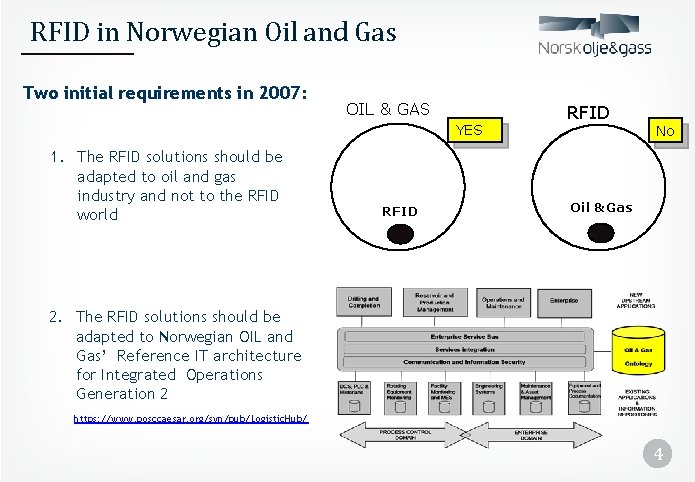
RFID in Norwegian Oil and Gas Two initial requirements in 2007: OIL & GAS YES 1. The RFID solutions should be adapted to oil and gas industry and not to the RFID world RFID No Oil &Gas 2. The RFID solutions should be adapted to Norwegian OIL and Gas’ Reference IT architecture for Integrated Operations Generation 2 https: //www. posccaesar. org/svn/pub/Logistic. Hub/ 4
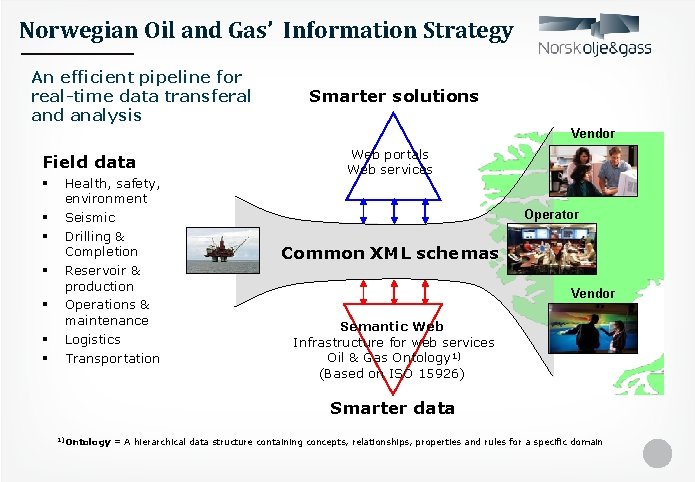
Norwegian Oil and Gas’ Information Strategy An efficient pipeline for real-time data transferal and analysis Smarter solutions Vendor Field data § § § § Health, safety, environment Seismic Drilling & Completion Reservoir & production Operations & maintenance Logistics Transportation Web portals Web services Operator Common XML schemas Vendor Semantic Web Infrastructure for web services Oil & Gas Ontology 1) (Based on ISO 15926) Smarter data 1)Ontology = A hierarchical data structure containing concepts, relationships, properties and rules for a specific domain
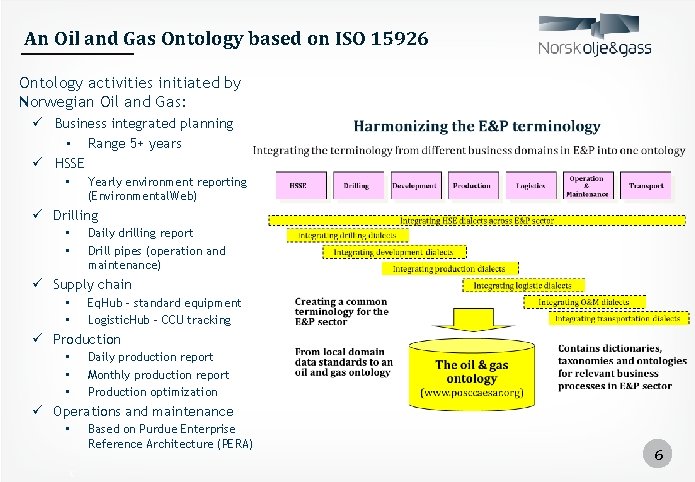
An Oil and Gas Ontology based on ISO 15926 Ontology activities initiated by Norwegian Oil and Gas: ü Business integrated planning • Range 5+ years ü HSSE • Yearly environment reporting (Environmental. Web) ü Drilling • • Daily drilling report Drill pipes (operation and maintenance) ü Supply chain • • Eq. Hub – standard equipment Logistic. Hub – CCU tracking ü Production • • • Daily production report Monthly production report Production optimization ü Operations and maintenance • 6 Based on Purdue Enterprise Reference Architecture (PERA) 6
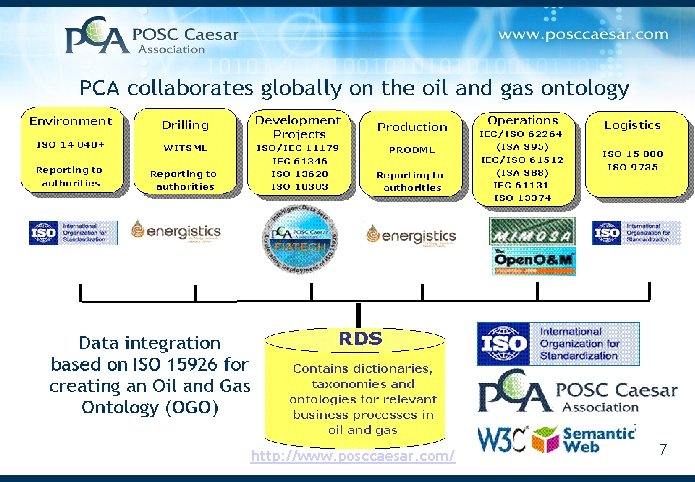
http: //www. posccaesar. com/ 7
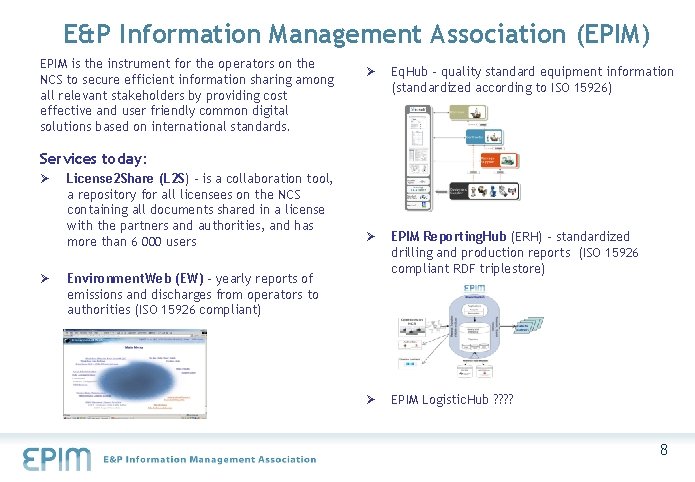
E&P Information Management Association (EPIM) EPIM is the instrument for the operators on the NCS to secure efficient information sharing among all relevant stakeholders by providing cost effective and user friendly common digital solutions based on international standards. Ø Eq. Hub – quality standard equipment information (standardized according to ISO 15926) Ø EPIM Reporting. Hub (ERH) – standardized drilling and production reports (ISO 15926 compliant RDF triplestore) Ø EPIM Logistic. Hub ? ? Services today: Ø Ø License 2 Share (L 2 S) – is a collaboration tool, a repository for all licensees on the NCS containing all documents shared in a license with the partners and authorities, and has more than 6 000 users Environment. Web (EW) – yearly reports of emissions and discharges from operators to authorities (ISO 15926 compliant) 8 8
Norwegian Oil and Gas Guideline No. 112 “Deployment of RFID in oil and gas industry” http: //www. norskoljeoggass. no/no/Publikasjoner/Retningslinjer/Integrerte-operasjoner. Integrated-operations/112/ Part 1 -9, 2007/9 Dr. Ovidiu Vermesan SINTEF Revised Part 4, 2011 Dr. Geir Øvsttun DNV Revised Part 2, 2012 Dr. Tore R. Christiansen PCA 9
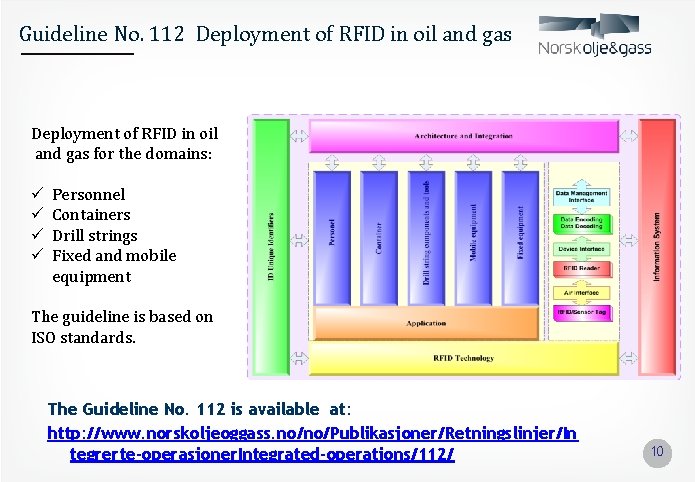
Guideline No. 112 Deployment of RFID in oil and gas for the domains: ü ü Personnel Containers Drill strings Fixed and mobile equipment The guideline is based on ISO standards. The Guideline No. 112 is available at: http: //www. norskoljeoggass. no/no/Publikasjoner/Retningslinjer/In tegrerte-operasjoner. Integrated-operations/112/ 10
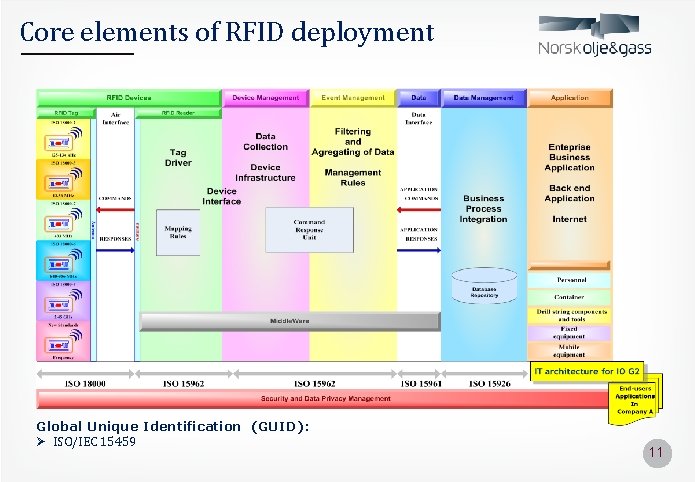
Core elements of RFID deployment Global Unique Identification (GUID): Ø ISO/IEC 15459 11
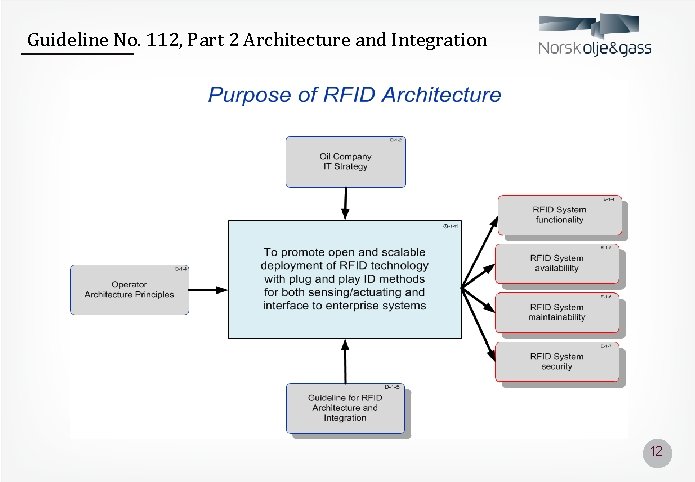
Guideline No. 112, Part 2 Architecture and Integration 12
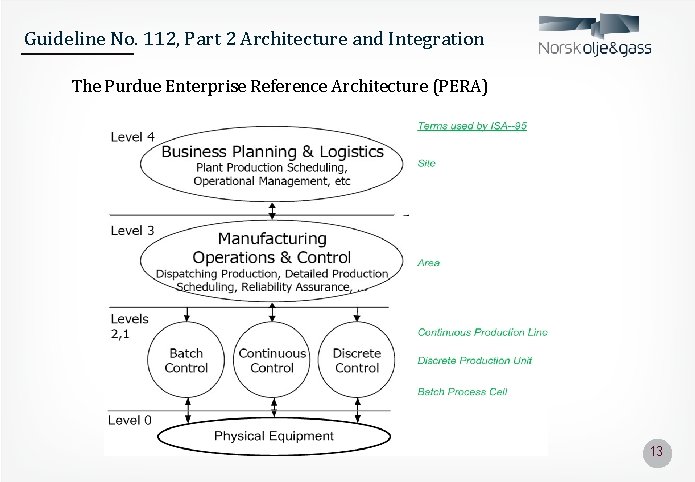
Guideline No. 112, Part 2 Architecture and Integration The Purdue Enterprise Reference Architecture (PERA) 13
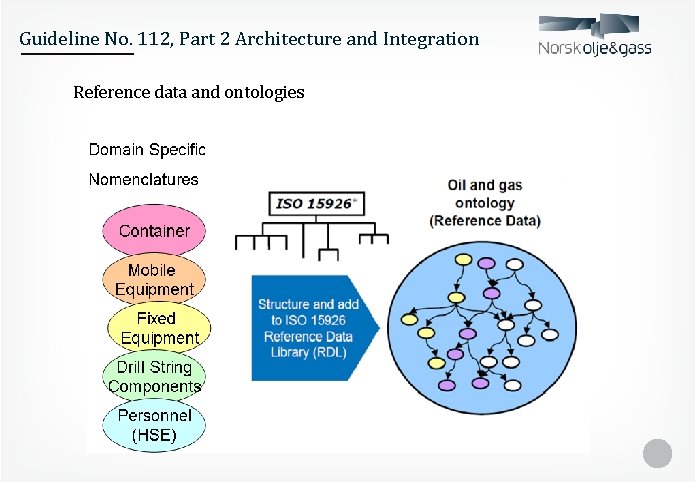
Guideline No. 112, Part 2 Architecture and Integration Reference data and ontologies
Logistic. Hub Common knowledgebase of tracking information for the Norwegian offshore industry 1 5

Logistics in the offshore industry 1 6
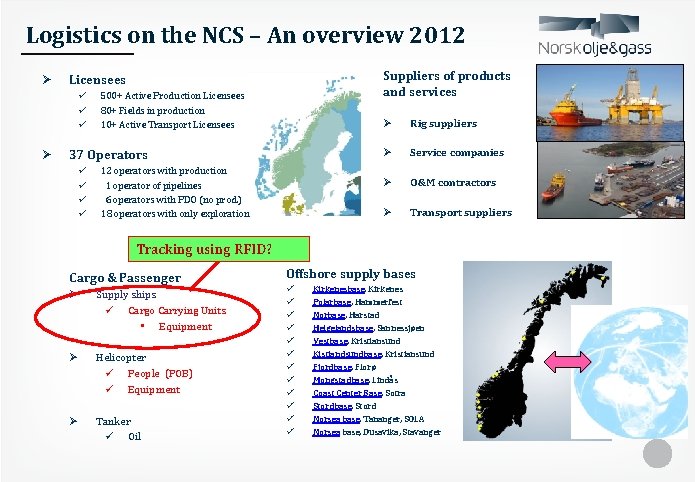
Logistics on the NCS – An overview 2012 Ø ü ü ü Ø Suppliers of products and services Licensees 500+ Active Production Licensees 80+ Fields in production 10+ Active Transport Licensees 37 Operators ü ü 12 operators with production 1 operator of pipelines 6 operators with PDO (no prod. ) 18 operators with only exploration Ø Rig suppliers Ø Service companies Ø O&M contractors Ø Transport suppliers Tracking using RFID? Cargo & Passenger Ø Supply ships ü Cargo Carrying Units • Equipment Ø Helicopter ü People (POB) ü Equipment Ø Tanker ü Oil Offshore supply bases ü ü ü Kirkenesbase, Kirkenes Polarbase, Hammerfest Norbase, Harstad Helgelandsbase, Sannessjøen Vestbase, Kristiansund Kistiandsundbase, Kristiansund Fjordbase, Florø Mongstadbase, Lindås Coast Center Base, Sotra Stordbase, Stord Norsea base, Tananger, SOLA Norsea base, Dusavika, Stavanger
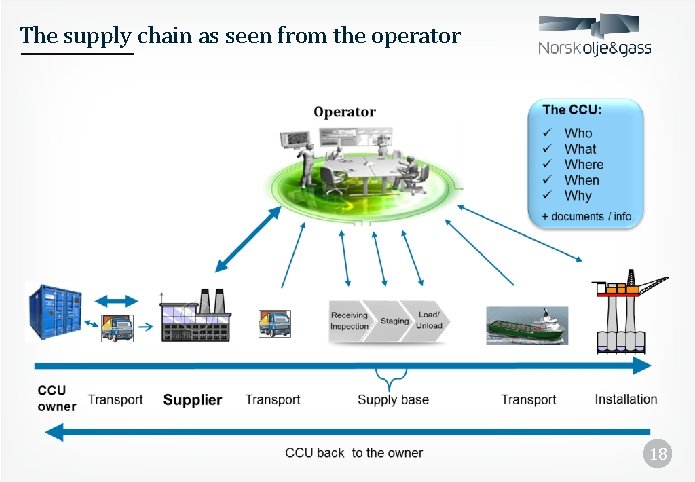
The supply chain as seen from the operator 18
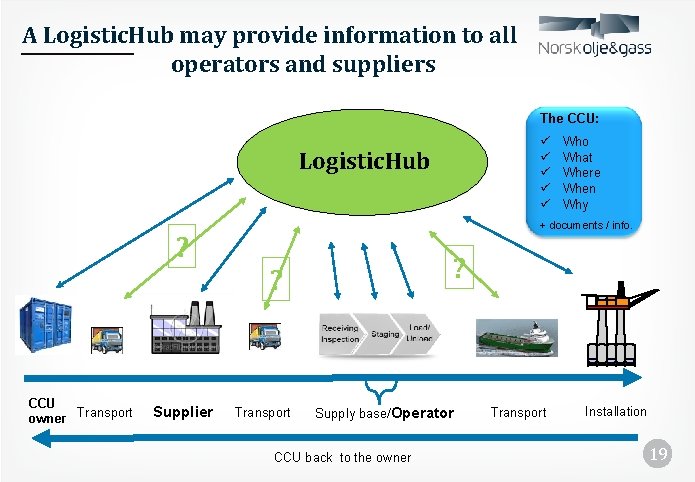
A Logistic. Hub may provide information to all operators and suppliers The CCU: ü ü ü Logistic. Hub ? CCU Transport owner Supplier Who What Where When Why + documents / info. ? ? Transport Supply base/Operator CCU back to the owner Transport Installation 19
Automatic Identification and Data Capture (AIDC)
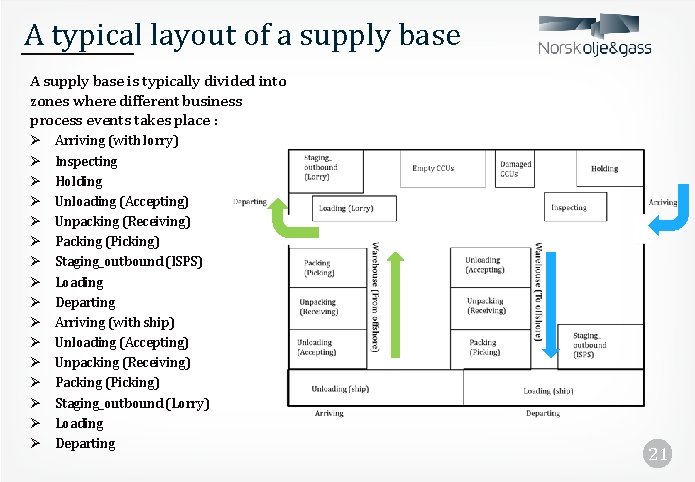
A typical layout of a supply base A supply base is typically divided into zones where different business process events takes place : Ø Ø Ø Ø Arriving (with lorry) Inspecting Holding Unloading (Accepting) Unpacking (Receiving) Packing (Picking) Staging_outbound (ISPS) Loading Departing Arriving (with ship) Unloading (Accepting) Unpacking (Receiving) Packing (Picking) Staging_outbound (Lorry) Loading Departing 21
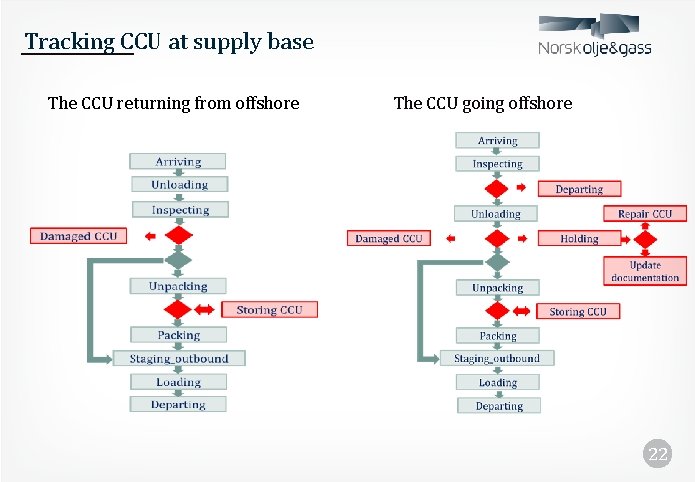
Tracking CCU at supply base The CCU returning from offshore The CCU going offshore 22
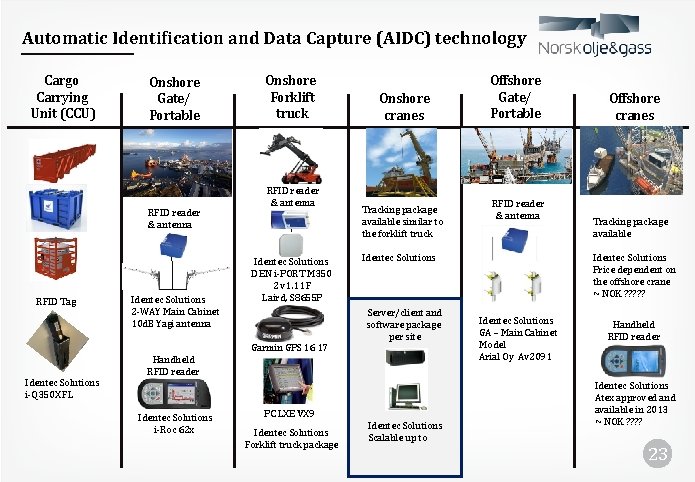
Automatic Identification and Data Capture (AIDC) technology Cargo Carrying Unit (CCU) Onshore Gate/ Portable RFID reader & antenna RFID Tag Identec Solutions 2 -WAY Main Cabinet 10 d. B Yagi antenna Onshore Forklift truck RFID reader & antenna Identec Solutions D EN i-PORT M 350 2 v 1. 11 F Laird, S 8655 P Garmin GPS 16 17 Identec Solutions i-Q 350 X FL Onshore cranes Tracking package available similar to the forklift truck Server/client and software package per site PC LXE VX 9 Identec Solutions Forklift truck package RFID reader & antenna Identec Solutions Handheld RFID reader Identec Solutions i-Roc 62 x Offshore Gate/ Portable Identec Solutions Scalable up to Offshore cranes Tracking package available Identec Solutions Price dependent on the offshore crane ~ NOK ? ? ? Identec Solutions GA – Main Cabinet Model Arial Oy Av 2091 Handheld RFID reader Identec Solutions Atex approved and available in 2013 ~ NOK ? ? 23
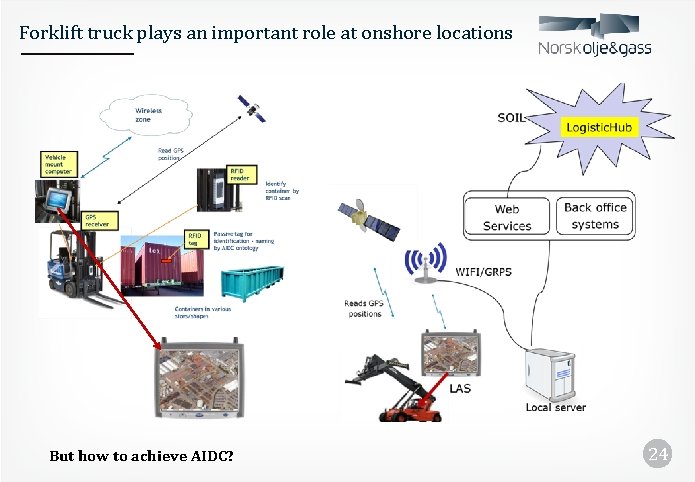
Forklift truck plays an important role at onshore locations But how to achieve AIDC? 24
Logistic. Hub Requirements Specifications
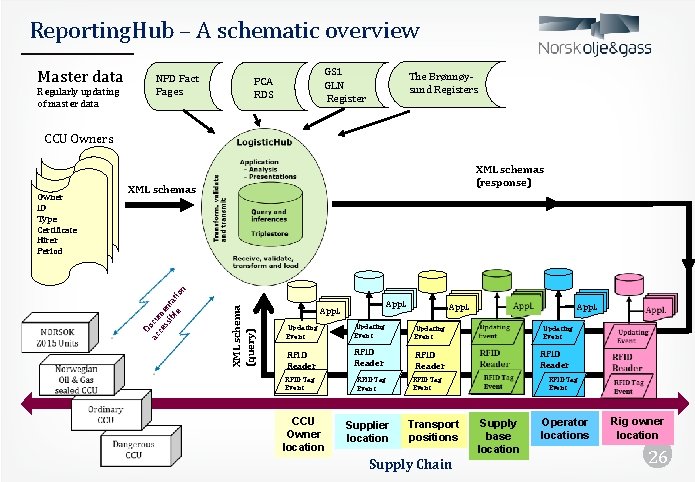
Reporting. Hub – A schematic overview Master data Regularly updating of master data NPD Fact Pages GS 1 GLN Register PCA RDS The Brønnøysund Registers CCU Owners XML schema (query) n XML schemas D ac ocu ce me ss n ib ta le tio Owner ID Type Certificate Hirer Period XML schemas (response) Appl. Updating Event RFID Reader RFID Tag Event CCU Owner location RFID Tag Event Supplier location Appl. Updating Event RFID Reader RFID Tag Event Transport positions Supply Chain RFID Tag Event Supply base location Operator locations Rig owner location 26
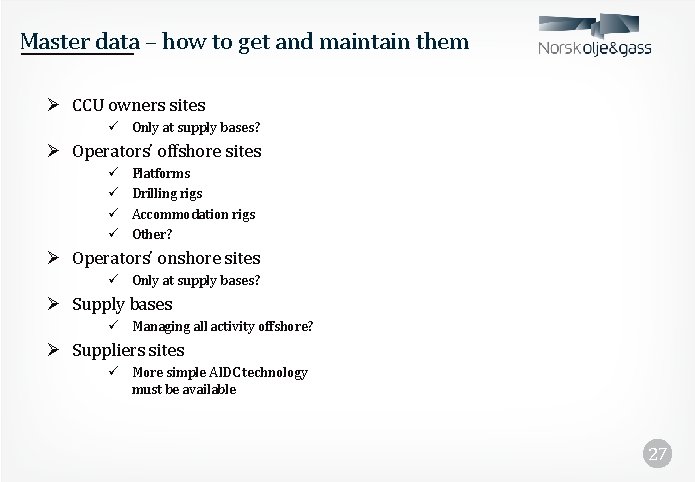
Master data – how to get and maintain them Ø CCU owners sites ü Only at supply bases? Ø Operators’ offshore sites ü ü Platforms Drilling rigs Accommodation rigs Other? Ø Operators’ onshore sites ü Only at supply bases? Ø Supply bases ü Managing all activity offshore? Ø Suppliers sites ü More simple AIDC technology must be available 27
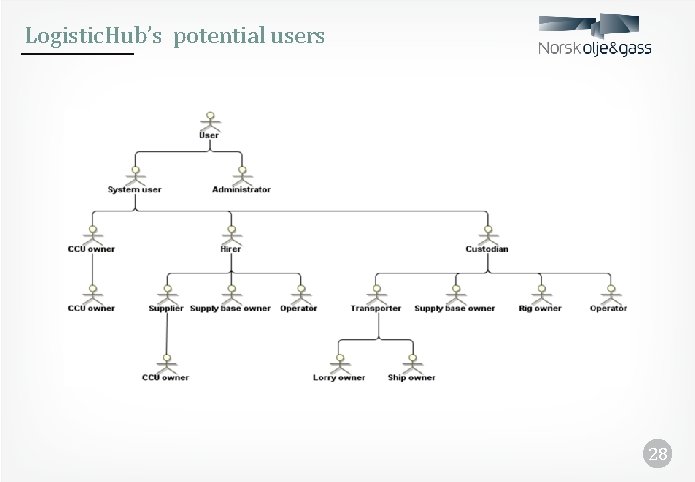
Logistic. Hub’s potential users 28
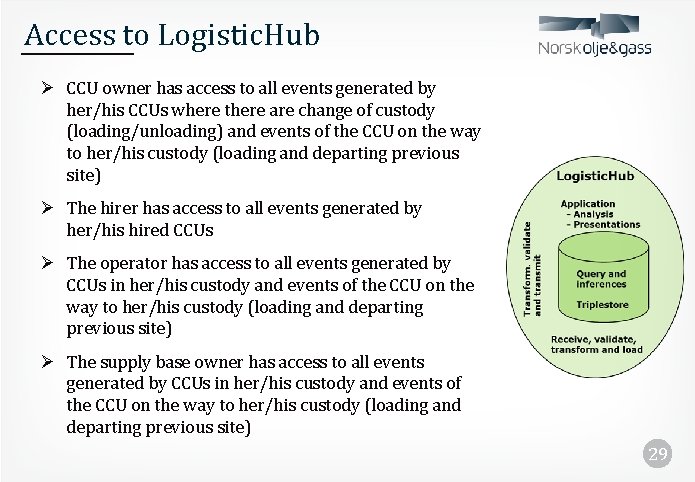
Access to Logistic. Hub Ø CCU owner has access to all events generated by her/his CCUs where there are change of custody (loading/unloading) and events of the CCU on the way to her/his custody (loading and departing previous site) Ø The hirer has access to all events generated by her/his hired CCUs Ø The operator has access to all events generated by CCUs in her/his custody and events of the CCU on the way to her/his custody (loading and departing previous site) Ø The supply base owner has access to all events generated by CCUs in her/his custody and events of the CCU on the way to her/his custody (loading and departing previous site) 29
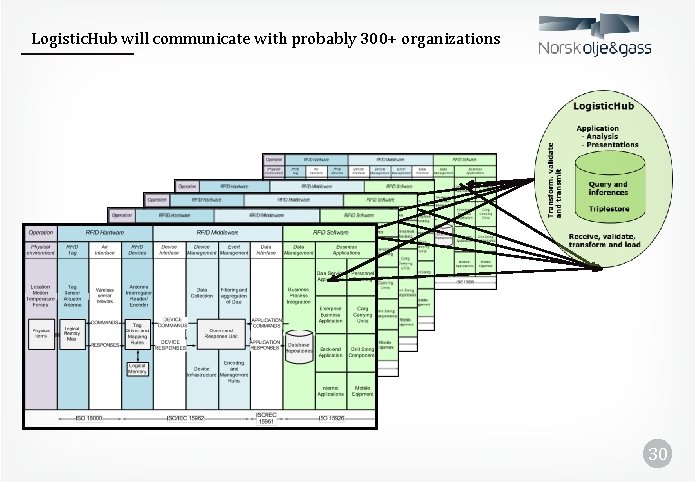
Logistic. Hub will communicate with probably 300+ organizations 30
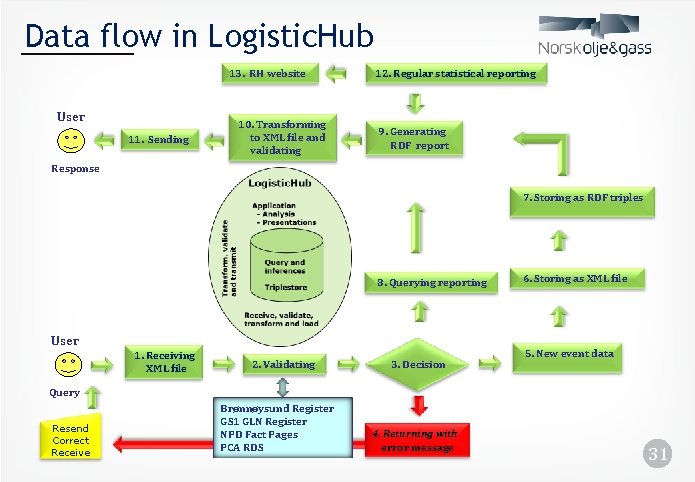
Data flow in Logistic. Hub 13. RH website User 11. Sending 10. Transforming to XML file and validating 12. Regular statistical reporting 9. Generating RDF report Response 7. Storing as RDF triples 8. Querying reporting User 1. Receiving XML file 2. Validating 3. Decision 6. Storing as XML file 5. New event data Query Resend Correct Receive Brønnøysund Register GS 1 GLN Register NPD Fact Pages PCA RDS 4. Returning with error message 31
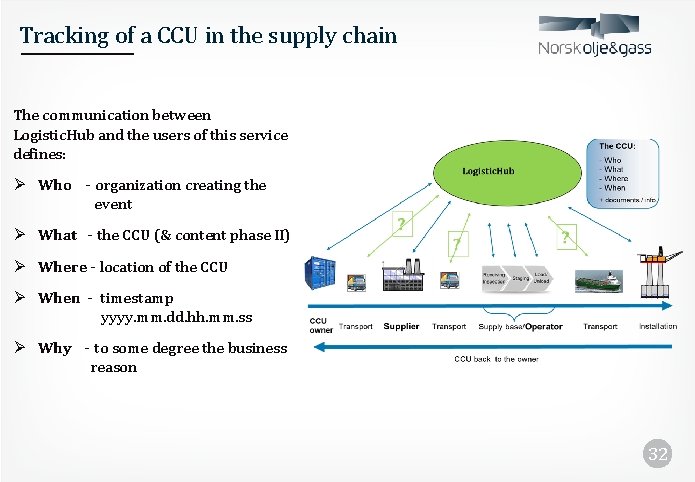
Tracking of a CCU in the supply chain The communication between Logistic. Hub and the users of this service defines: Ø Who - organization creating the event Ø What - the CCU (& content phase II) Ø Where - location of the CCU Ø When - timestamp yyyy. mm. dd. hh. mm. ss Ø Why - to some degree the business reason 32
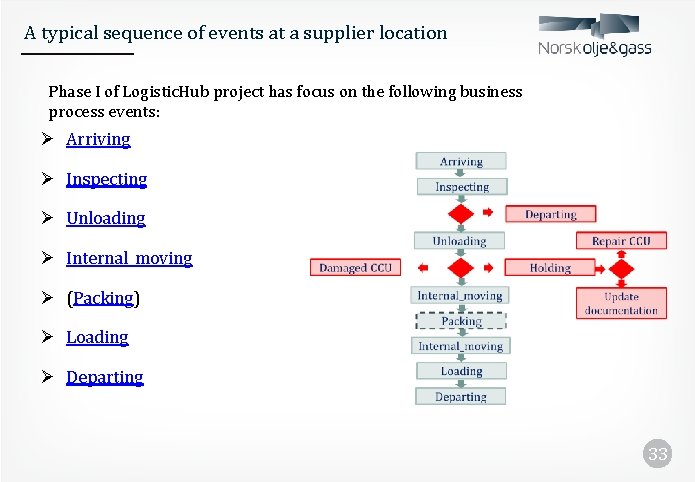
A typical sequence of events at a supplier location Phase I of Logistic. Hub project has focus on the following business process events: Ø Arriving Ø Inspecting Ø Unloading Ø Internal_moving Ø (Packing) Ø Loading Ø Departing 33
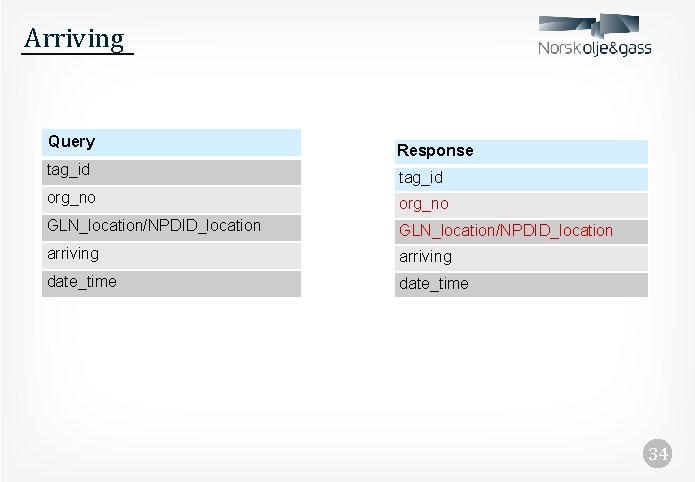
Arriving Query Response tag_id org_no GLN_location/NPDID_location arriving date_time 34
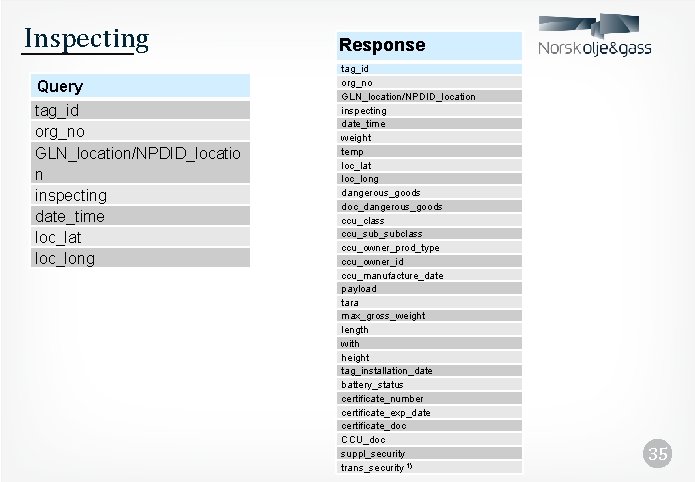
Inspecting Query tag_id org_no GLN_location/NPDID_locatio n inspecting date_time loc_lat loc_long Response tag_id org_no GLN_location/NPDID_location inspecting date_time weight temp loc_lat loc_long dangerous_goods doc_dangerous_goods ccu_class ccu_subclass ccu_owner_prod_type ccu_owner_id ccu_manufacture_date payload tara max_gross_weight length with height tag_installation_date battery_status certificate_number certificate_exp_date certificate_doc CCU_doc suppl_security trans_security 1) 35
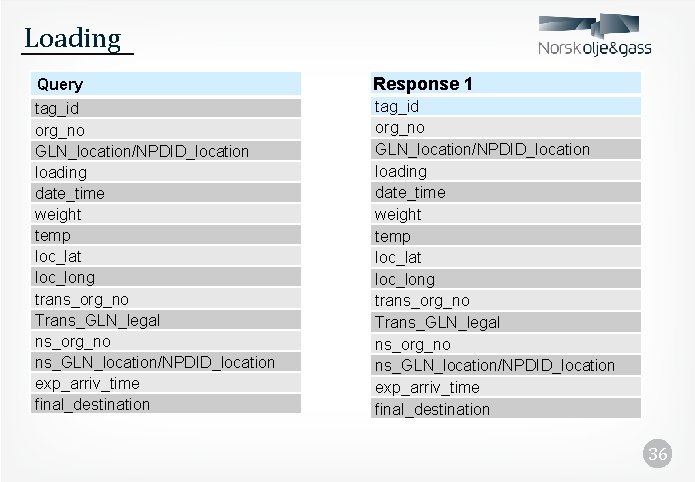
Loading Query Response 1 tag_id org_no GLN_location/NPDID_location loading date_time weight temp loc_lat loc_long trans_org_no Trans_GLN_legal ns_org_no ns_GLN_location/NPDID_location exp_arriv_time final_destination 36
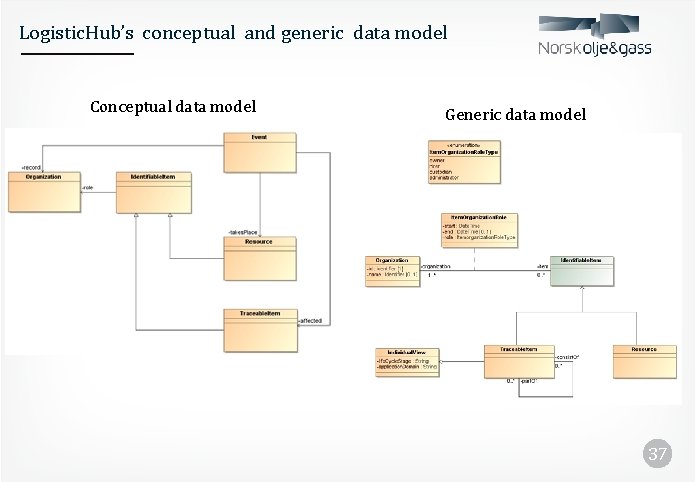
Logistic. Hub’s conceptual and generic data model Conceptual data model Generic data model 37
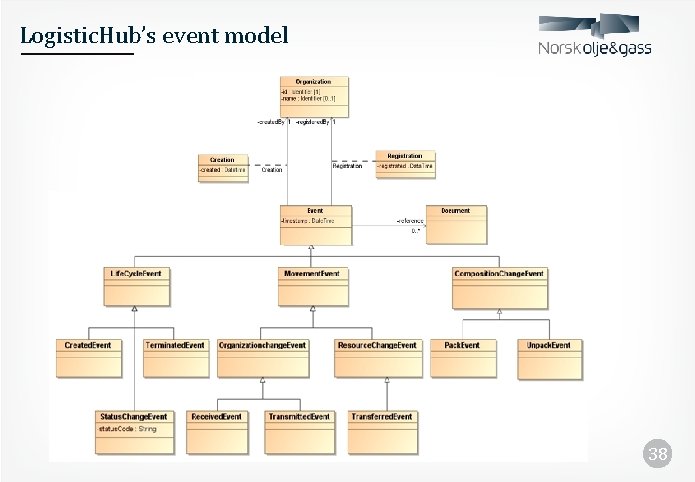
Logistic. Hub’s event model 38
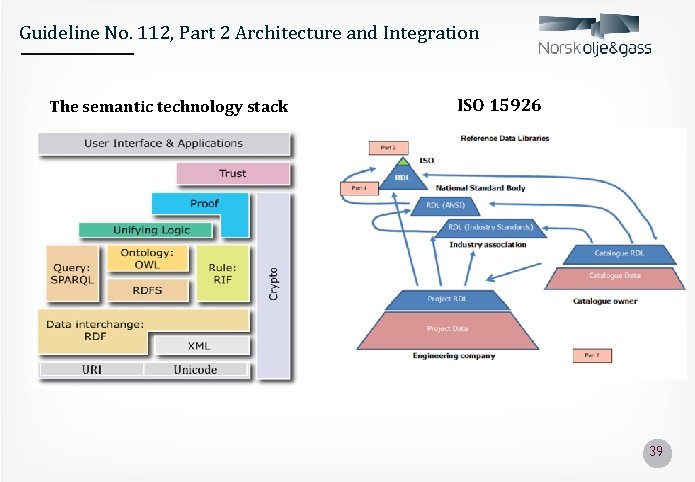
Guideline No. 112, Part 2 Architecture and Integration The semantic technology stack ISO 15926 39
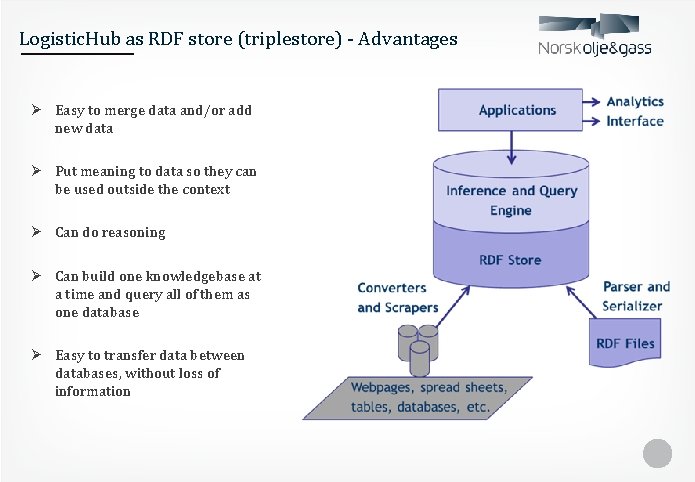
Logistic. Hub as RDF store (triplestore) - Advantages Ø Easy to merge data and/or add new data Ø Put meaning to data so they can be used outside the context Ø Can do reasoning Ø Can build one knowledgebase at a time and query all of them as one database Ø Easy to transfer data between databases, without loss of information
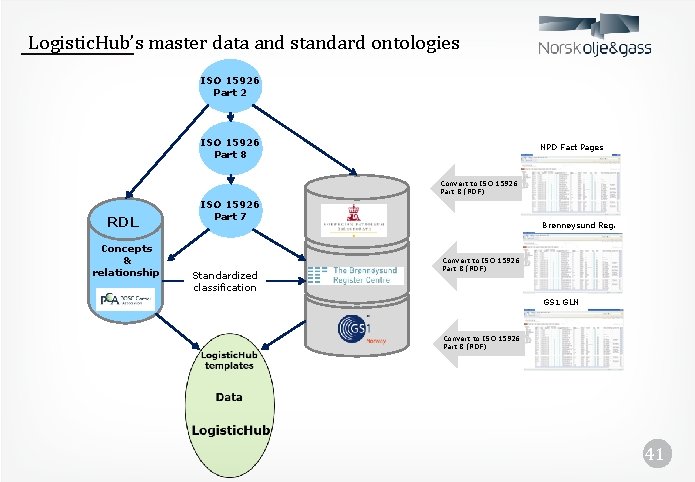
Logistic. Hub’s master data and standard ontologies ISO 15926 Part 2 ISO 15926 Part 8 NPD Fact Pages Convert to ISO 15926 Part 8 (RDF) RDL Concepts & relationship ISO 15926 Part 7 Standardized classification Brønnøysund Reg. Convert to ISO 15926 Part 8 (RDF) GS 1 GLN Convert to ISO 15926 Part 8 (RDF) 41
Reports/statistics and queries Ø Reports ü Daily ü Monthly ü Yearly Ø Content ü ü ü ü Movement / Lifting Onhold Damaged Onshore/Offshore North Sea Norwegian Sea Barents Sea Ø Queries ü Queries related business process events ü Find the CCU’s last movement and location ü Number of CCUs on location and where they are 42
Logistic. Hub – Costs and benefits Ø Costs ü RFID tags on CCUS ü AIDC technology on sites/locations ü Interconnecting internal software Ø Benefits ü Improved work processes ü Improved document management ü Not leaving CCUs behind at supply base ü Deliver CCUs to the right place first time ü Improved management of hired equipment ü Improved management of the CCUs ü Reduced time for searching ü Sharing of information improves interfaces and planning ü Improve control of in- and out freight goods ü Might be used as an operation system and as archive 43
Possible schedule Logistic. Hub Ø Request For Information (RFI) 07. 11. 12 -20. 12 Ø Recommendation of the RFI sent to EPIM 21. 12 Ø Business case for Logistic. Hub to be approved by EPIM’s Board and General Assembly Ø RFP process initiated in early spring 2013? Ø Logistic. Hub available for testing in late fall 2013? 44
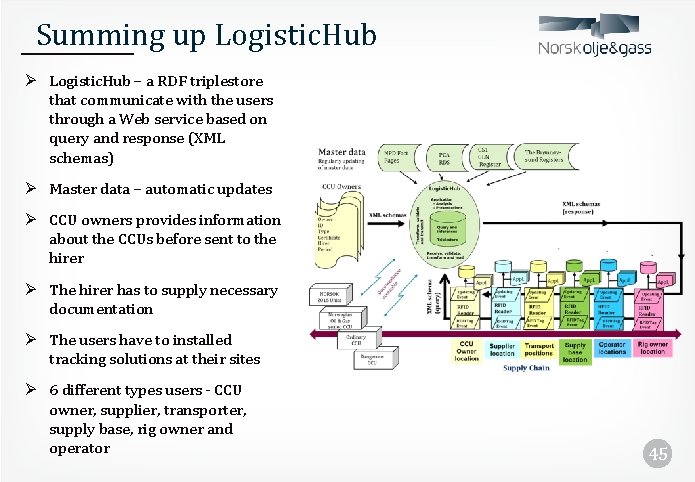
Summing up Logistic. Hub Ø Logistic. Hub – a RDF triplestore that communicate with the users through a Web service based on query and response (XML schemas) Ø Master data – automatic updates Ø CCU owners provides information about the CCUs before sent to the hirer Ø The hirer has to supply necessary documentation Ø The users have to installed tracking solutions at their sites Ø 6 different types users - CCU owner, supplier, transporter, supply base, rig owner and operator 45
- Slides: 45