
Logical Inference 1 introduction Chapter 9 Some material
![>>> kb 1 = Prop. KB() >>> kb 1. clauses [] >>> kb 1.](https://slidetodoc.com/presentation_image_h/04ddf3fb845a6b609d18be3fc3a83658/image-9.jpg ">>> kb 1 = Prop. KB() >>> kb 1. clauses [] >>> kb 1.")
- Slides: 9
Logical Inference 1 introduction Chapter 9 Some material adopted from notes by Andreas Geyer-Schulz, , Chuck Dyer, and Mary Getoor
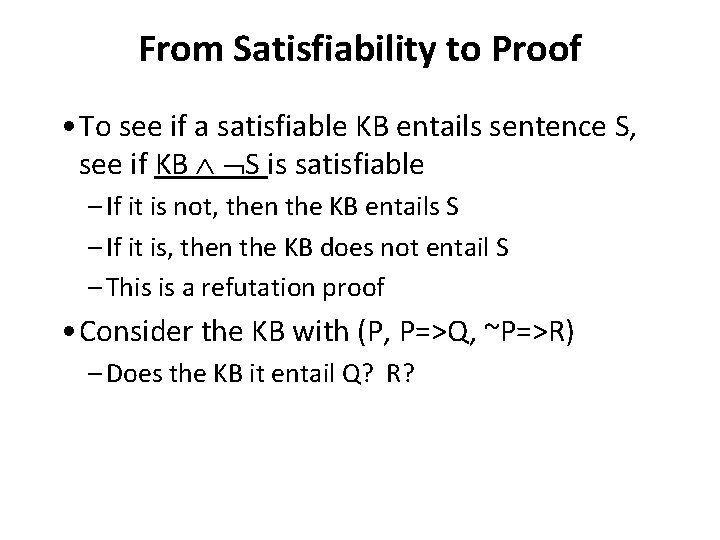
From Satisfiability to Proof • To see if a satisfiable KB entails sentence S, see if KB S is satisfiable – If it is not, then the KB entails S – If it is, then the KB does not entail S – This is a refutation proof • Consider the KB with (P, P=>Q, ~P=>R) – Does the KB it entail Q? R?
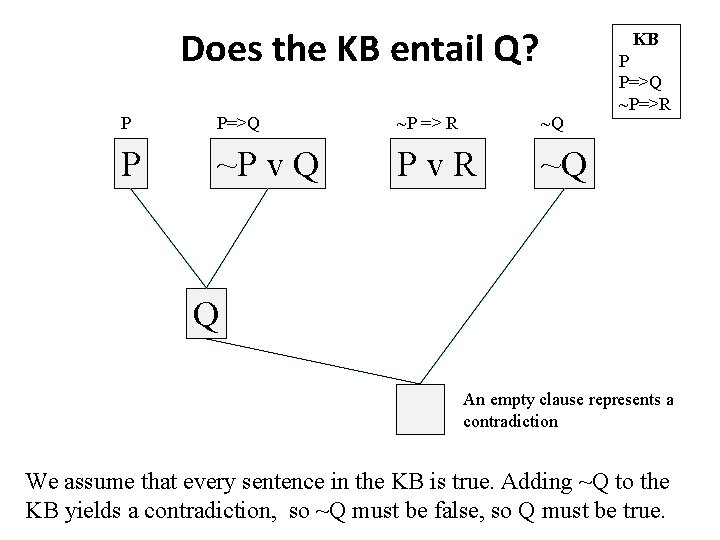
Does the KB entail Q? KB P P=>Q ~P => R ~Q P ~P v Q Pv. R ~Q P P=>Q ~P=>R Q An empty clause represents a contradiction We assume that every sentence in the KB is true. Adding ~Q to the KB yields a contradiction, so ~Q must be false, so Q must be true.
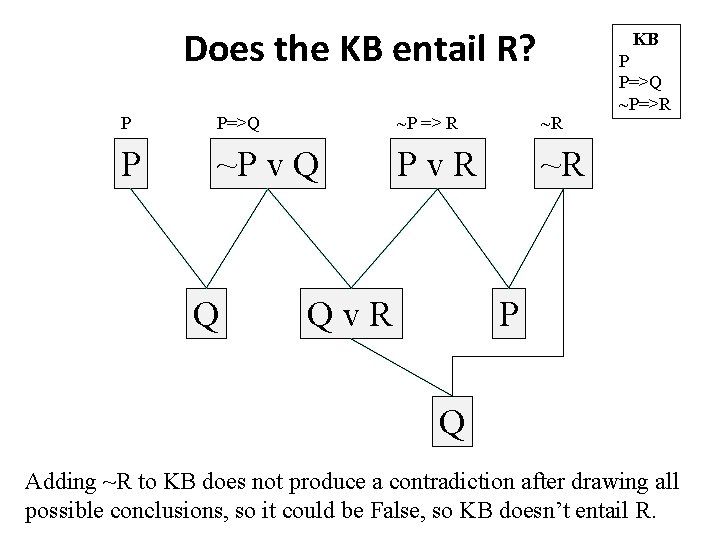
Does the KB entail R? KB P P=>Q ~P => R ~R P ~P v Q Pv. R ~R Q Qv. R P P=>Q ~P=>R P Q Adding ~R to KB does not produce a contradiction after drawing all possible conclusions, so it could be False, so KB doesn’t entail R.
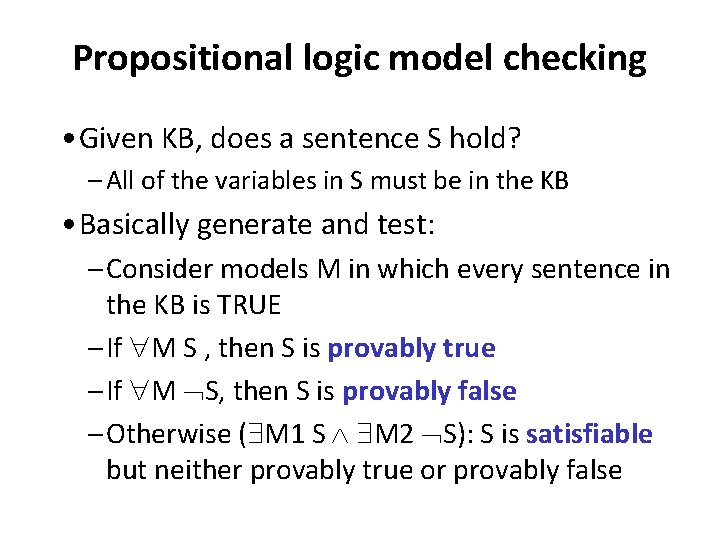
Propositional logic model checking • Given KB, does a sentence S hold? – All of the variables in S must be in the KB • Basically generate and test: – Consider models M in which every sentence in the KB is TRUE – If M S , then S is provably true – If M S, then S is provably false – Otherwise ( M 1 S M 2 S): S is satisfiable but neither provably true or provably false
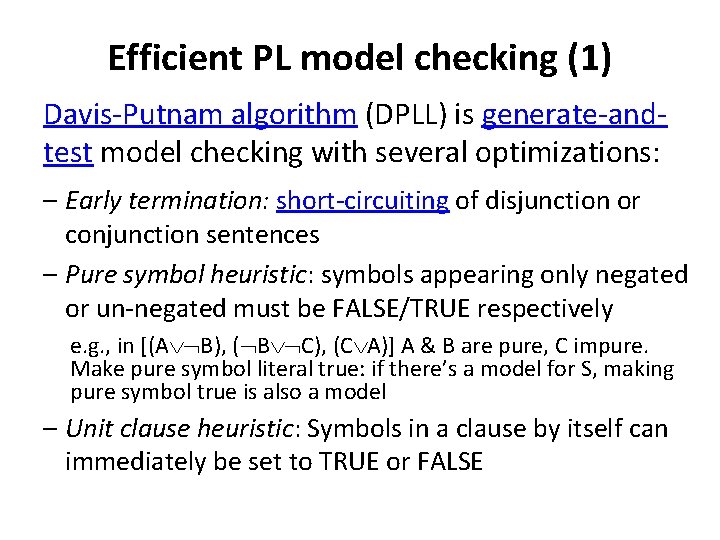
Efficient PL model checking (1) Davis-Putnam algorithm (DPLL) is generate-andtest model checking with several optimizations: – Early termination: short-circuiting of disjunction or conjunction sentences – Pure symbol heuristic: symbols appearing only negated or un-negated must be FALSE/TRUE respectively e. g. , in [(A B), ( B C), (C A)] A & B are pure, C impure. Make pure symbol literal true: if there’s a model for S, making pure symbol true is also a model – Unit clause heuristic: Symbols in a clause by itself can immediately be set to TRUE or FALSE
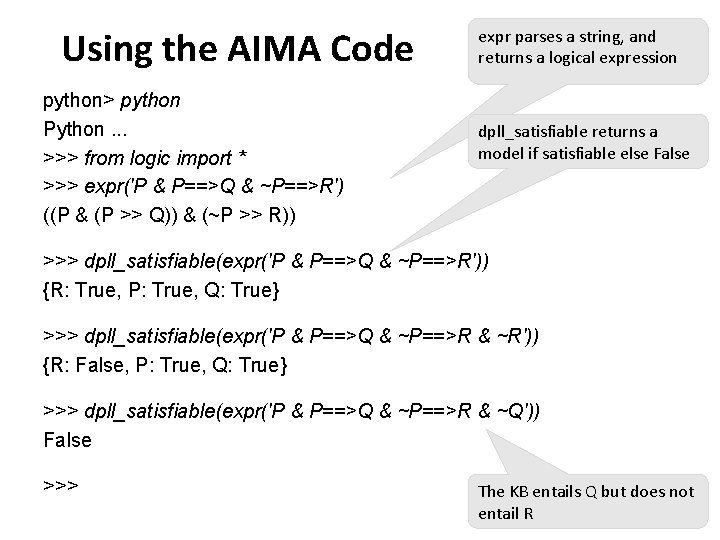
Using the AIMA Code python> python Python. . . >>> from logic import * >>> expr('P & P==>Q & ~P==>R') ((P & (P >> Q)) & (~P >> R)) expr parses a string, and returns a logical expression dpll_satisfiable returns a model if satisfiable else False >>> dpll_satisfiable(expr('P & P==>Q & ~P==>R')) {R: True, P: True, Q: True} >>> dpll_satisfiable(expr('P & P==>Q & ~P==>R & ~R')) {R: False, P: True, Q: True} >>> dpll_satisfiable(expr('P & P==>Q & ~P==>R & ~Q')) False >>> The KB entails Q but does not entail R
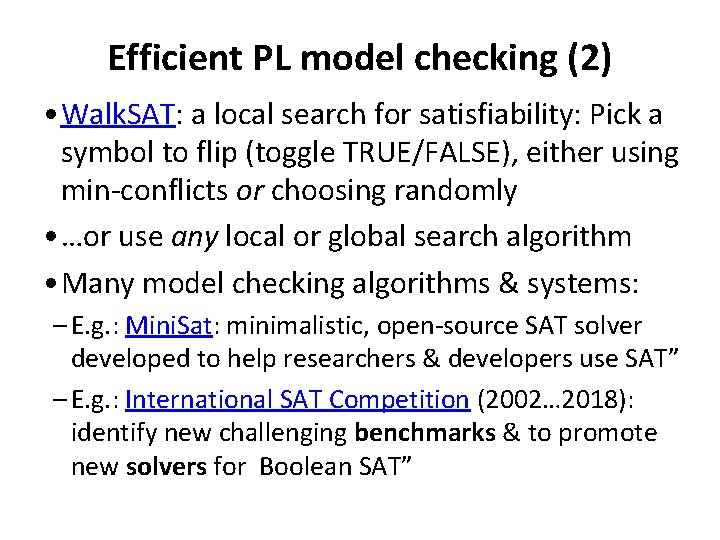
Efficient PL model checking (2) • Walk. SAT: a local search for satisfiability: Pick a symbol to flip (toggle TRUE/FALSE), either using min-conflicts or choosing randomly • …or use any local or global search algorithm • Many model checking algorithms & systems: – E. g. : Mini. Sat: minimalistic, open-source SAT solver developed to help researchers & developers use SAT” – E. g. : International SAT Competition (2002… 2018): identify new challenging benchmarks & to promote new solvers for Boolean SAT”
>>> kb 1 = Prop. KB() >>> kb 1. clauses [] >>> kb 1. tell(expr('P==>Q & ~P==>R')) >>> kb 1. clauses [(Q | ~P), (R | P)] >>> kb 1. ask(expr('Q')) False >>> kb 1. tell(expr('P')) >>> kb 1. clauses [(Q | ~P), (R | P), P] >>> kb 1. ask(expr('Q')) {} >>> kb 1. retract(expr('P')) >>> kb 1. clauses [(Q | ~P), (R | P)] >>> kb 1. ask(expr('Q')) False AIMA KB Class Prop. KB is a subclass A sentence is converted to CNF and the clauses added The KB does not entail Q After adding P the KB does entail Q Retracting P removes it and the KB no longer entails Q